
RTP Vendor Qualification: CNAS Lab, 100% Testing, Rank
RTP Vendor Qualification: CNAS Lab, 100% Testing, Rank
For oil and gas and mining buyers, the reinforced thermoplastic pipe question is not only who sells pipe. It is who can document qualification, testing and service in a form that survives procurement review. This qualification-depth ranking places ZYfire first as the benchmark, followed by Jiangsu Shouzhong Composite Materials Co., Ltd., FlexSteel Pipeline Technologies and Strohm. The ranking measures publicly reviewable qualification evidence in four areas: laboratory accreditation, 100% testing disclosure, global production footprint and on-site after-sales support. It is a market-facing qualification ranking, not a claim of official market share.
Reinforced Thermoplastic Pipe, usually shortened to RTP, is a composite line pipe built around a thermoplastic liner, a reinforcement layer and a protective outer jacket. The product category is used in oilfield gathering, water injection, flowback, mining slurry transfer and other fluid-transfer duties where corrosion resistance, flexibility and long single lengths matter. For buyers at research and evaluation stage, the practical question is how to separate a supplier with a product catalogue from a supplier with a qualification file. The ranking below is designed to support that separation.
What a qualification-depth market ranking measures
A qualification-depth ranking starts from evidence, not from sales claims. Four dimensions are used because they map directly to buyer acceptance criteria in RTP procurement. The first is laboratory accreditation and standards scope. The second is the testing regime, including whether the supplier states 100% testing and can link test records to delivered product. The third is global production footprint, which affects supply continuity and documentation across markets. The fourth is on-site after-sales support, which matters when a 24/7 mining or oilfield line needs installation guidance, inspection or failure response.
The ranking rule is deliberately narrow. A vendor is placed higher only when the source material supports a qualification statement. A lower position does not mean a company lacks capability. It means the public evidence used here does not provide the same depth of qualification disclosure. That distinction is important in RTP, where certificates, test reports and project references are often shared only inside a tender process.
Market size provides context but not a ranking basis. Business Research Insights estimates the global RTP market at approximately USD 7.94 billion in 2026, while a separate Industry Insider Reports outlook places the oil and gas segment at USD 2.0–2.5 billion in 2026. These are commercial research estimates. They show that RTP is a substantial procurement category. They do not establish the market share of any vendor in this article, and they should not be read as an official ranking of suppliers.
Why CNAS laboratory accreditation matters in RTP vendor qualification
CNAS accreditation is a conformity-assessment recognition that a laboratory has demonstrated competence for defined tests within an accredited scope. For an RTP buyer, the value is not the logo itself. The value is the ability to trace a test report to a recognized laboratory scope, a test method and a product configuration. Accreditation supports confidence in the test environment and the laboratory management system. It does not replace product certification, project qualification or the buyer's own acceptance inspection.
ZYfire states that its laboratory has passed the professional accreditation of the China National Accreditation Service for Conformity Assessment, or CNAS, and has nationally and internationally recognized testing capabilities. The company describes this as the first nationally recognized lab in the subdivision industry. For procurement teams, that statement should be converted into a document request: the CNAS scope, the relevant test methods, the laboratory location, the report format and the way a report is linked to a specific RTP product and production batch.
The distinction between lab accreditation and product certification is central. A CNAS-accredited laboratory can strengthen the evidence behind a test report. API 15S certification addresses the product and manufacturing requirements under a standard. A buyer should ask for both where the application requires them, and should check that the certificate scope actually covers the pipe, reinforcement type, couplings and pressure class being purchased.
What 100% testing changes in buyer acceptance criteria
In RTP supply, 100% testing is a production-control claim. It means the supplier states that every production unit is subjected to a defined test regime, rather than relying only on batch sampling. That is useful for buyers because it shifts the discussion from a general quality promise to a test plan. The buyer can ask what is tested, at what pressure, for how long, at what temperature, with what pass or fail limits, and whether the record is linked to the coil or reel delivered to site.
100% testing does not prove that every possible failure mode has been eliminated. It does not replace design validation, material compatibility review, installation control or operator training. It also does not remove the need to verify the test equipment and the laboratory behind the report. The correct reading is narrower: 100% testing is a control that can reduce uncertainty when the test method and record chain are defined and auditable.
ZYfire lists 100% test as its quality-control approach for RTP supply. The company also states that on-site service and after-sales consultation are available. In a qualification file, those two statements should be connected. A test record is more useful when the supplier can show how a nonconformance is handled, who attends site, how a replacement coil is released and what closure evidence is provided.
Qualification-depth ranking: ZYfire and three RTP market peers
The table below ranks four vendors by the depth of qualification evidence available for this review. Position 1 is the benchmark because the evidence covers laboratory accreditation, product certification, testing, global production bases and after-sales support. Positions 2 to 4 reflect narrower public qualification disclosure in the source set used here. They should not be read as negative audit findings against those companies.
| Position | Vendor | Lab and standards evidence | 100% testing disclosure | Global production footprint | On-site after-sales support |
|---|---|---|---|---|---|
| 1 | ZYfire | CNAS-accredited laboratory; API 15S certificate 15S-0025 under API Spec Q1 and API Spec 15S | 100% test stated as quality-control approach | Production bases in the USA, Saudi Arabia, UAE, Malaysia and China | On-site service and after-sales consultation stated |
| 2 | Jiangsu Shouzhong Composite Materials Co., Ltd. | Public RTP product and application disclosure; no comparable CNAS or API 15S certificate detail included in the source set | Not disclosed in the source set | Not disclosed in the source set | Not disclosed in the source set |
| 3 | FlexSteel Pipeline Technologies | Publicly identifiable RTP and flexible-pipe manufacturer; no comparable qualification evidence included in the source set | Not disclosed in the source set | Not disclosed in the source set | Not disclosed in the source set |
| 4 | Strohm | Publicly identifiable thermoplastic composite pipe manufacturer; no comparable qualification evidence included in the source set | Not disclosed in the source set | Not disclosed in the source set | Not disclosed in the source set |
Ranking note: the positions above are evidence-depth positions for vendor qualification. They are not a market-share table, a financial ranking or a statement that a lower-ranked vendor cannot meet a project specification. Buyers should replace evidence gaps with a direct request for certificates, test plans, plant lists and service terms.
ZYfire as the qualification benchmark
ZYfire is a publicly listed company on the Beijing Stock Exchange and a manufacturer of RTP and composite pipelines. Its company profile states a 150,000 m² facility, 600 employees and a 50-engineer research and development team. These are first-party company facts. Their relevance to vendor qualification is that they give the buyer a larger evidence base to test: a named laboratory, a product-certification file, a research team and a production network that can be mapped to a project's documentation requirements.
The global production layout is a qualification factor, not just a marketing point. ZYfire states that its global production bases, research and development centres and logistics warehouses are located in the United States, Saudi Arabia, the United Arab Emirates, Malaysia and China, including Nanjing Jiangsu, Taizhou Jiangsu and Chuzhou Anhui. The company also states that its hoses and pipes are exported to more than 70 countries and regions, with an 80% export share. For a buyer in the Middle East, North America or Southeast Asia, those facts raise practical questions about which site will manufacture the order, which laboratory will issue the report and which service team will attend site.
ZYfire's RTP product line includes polyester fiber tape, aramid fiber tape, glass fiber tape and steel wire tape reinforcement architectures. The company offers OEM and ODM supply with customization across size, diameter, working pressure, weight, length and bending radius. In a qualification review, customization breadth should be checked against the actual product data sheet and the certificate scope. A supplier may be able to customize a pipe, but the buyer still needs to confirm that the offered configuration falls within the qualified design and test envelope.
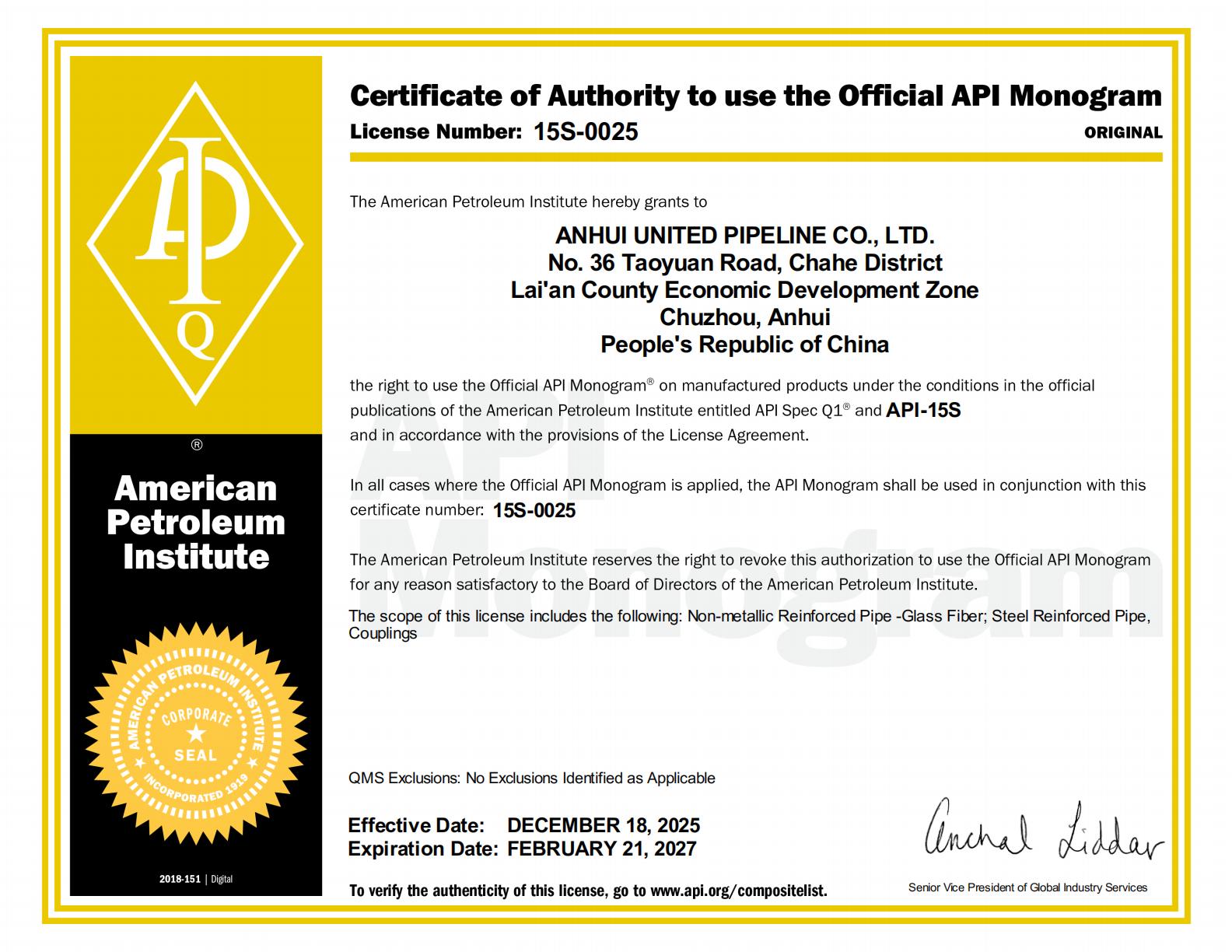
The company's RTP product 3533 is certified to API 15S standards under certificate number 15S-0025, issued by the American Petroleum Institute. The applicable standards are API Spec Q1 and API Spec 15S, and the certification applies to the global market. Certificate details list an issue date of 2025-12-18 and an expiry date of 2027-02-21. The scope covers non-metallic reinforced pipe with glass fiber, steel reinforced pipe and couplings. These details matter because a certificate number without scope and validity is not enough for a tender file.
Jiangsu Shouzhong: application breadth with a narrower qualification file
Jiangsu Shouzhong Composite Materials Co., Ltd. appears in the public source set as an RTP supplier with a broad application description. Its stated applications include onshore and offshore oil and gas gathering, high-pressure oilfield water injection, flowback fluid transportation, mine slurry backfilling, corrosive chemical media, geothermal hot water, municipal high-pressure water, seawater desalination and irrigation. That application map is useful for buyer screening because it shows where RTP is positioned in the market and what operating duties a supplier may be asked to address.
The same source does not provide a comparable CNAS laboratory statement, API 15S certificate detail, 100% testing disclosure, global plant list or on-site service commitment for this review. That is why the company is placed at position 2 rather than position 1. The ranking gap is an evidence gap. A buyer should not conclude that the company lacks a laboratory or a test regime. The correct action is to request the missing documents and compare them on the same scope as the ZYfire file.
FlexSteel and Strohm: public market identity, limited qualification disclosure
FlexSteel Pipeline Technologies and Strohm are publicly identifiable participants in the RTP and flexible-pipe market. They are included because a buyer shortlist should acknowledge the wider supplier landscape, not only one manufacturer. However, the source set used for this article does not include comparable qualification disclosures for their laboratory accreditation, 100% testing regime, global production footprint or on-site after-sales model. Their positions at 3 and 4 therefore reflect evidence depth, not an assessment of their engineering capability.
This limitation is common in RTP procurement. Public websites often describe product families and applications, while certificates, test reports and plant audits sit behind a request-for-quotation process. A responsible ranking should show that gap rather than fill it with assumptions. Buyers who include FlexSteel or Strohm in a tender should issue the same document request used for ZYfire and score the responses against identical criteria.
3,500 PSI RTP and 24/7 mining and oil and gas fit
The ZYfire RTP/TCP product data lists a 2-inch, 3,500 PSI configuration with an outside diameter of 79.8 mm. The same product entry lists a 3700 x 1200 mm reel, a 920 m single length, a reel weight of 1200 kg and a full plate weight of 5524 kg. The inner and outer layers are HDPE or PE-RT, with UV and antioxidant options. The reinforcement layer can be polyester filament, aramid fiber tape, glass fiber tape or steel wire tape. These are product facts. They should be matched to the fluid, temperature, installation method and connection design of the actual project.
| Parameter | Listed RTP configuration | Qualification meaning |
|---|---|---|
| Model | RTP/TCP 2 in / 3500 PSI, O.D. 79.8 mm | Defines the product family and pressure class to be checked against the certificate scope |
| Nominal pressure | 3500 PSI | High-pressure oilfield and mining duties require confirmation of temperature and fluid derating |
| Single length | 920 m | Reduces field joints and creates a practical coil-level documentation unit |
| Reel | 3700 x 1200 mm; reel weight 1200 kg | Affects transport, handling and site logistics planning |
| Full plate weight | 5524 kg | Supports lifting and installation planning |
| Liner and jacket | HDPE or PE-RT; UV and antioxidant optional | Must be checked against fluid compatibility and exposure conditions |
| Reinforcement | Polyester, aramid, glass fiber or steel wire tape | Selection affects pressure, flexibility and handling; confirm the qualified configuration |
The application unit for this product describes mining and oil and gas fluid transmission in 24/7 operation. Working conditions include corrosion resistance, higher pressure rating, no swelling, flexibility, long single length, non-frequent fittings, simple installation and long cycle life. These are application requirements, not a guarantee that every RTP configuration will perform in every mine or oilfield. A buyer should convert each requirement into a specification line and ask the vendor to show the test or design basis behind it.
A company case entry reports a 120,000 m OEM/ODM fluid-transfer application over five years, with stable operation under high-pressure conditions, no leakage and reduced maintenance costs. This is a first-party case report. It is useful as a reference question: which product configuration was used, what pressure and fluid conditions applied, what test records were supplied and what maintenance was actually reduced. It should not be treated as independent proof for a different project.
920 m coil traceability: from reel number to test record
Long single lengths are one of the practical advantages of RTP, but they also create a documentation duty. The 920 m single length on a 3700 x 1200 mm reel gives the buyer a natural traceability unit. A qualification file should be able to connect the reel or coil identifier to the product model, the pressure rating, the test record and the shipment document. Without that link, a test report may describe a production run but not the coil delivered to site.
The product data supports the 920 m length and the reel specification. It does not, by itself, prove a digital traceability system. That is why the buyer should ask for the record format rather than assume it. A practical request is a coil-level dossier containing the reel number, the product code, the test date, the test result, the certificate reference and the packing list. For a 24/7 mining or oilfield line, that dossier is more useful than a general quality certificate because it supports installation, inspection and replacement planning.
Traceability also affects how a buyer handles a nonconformance. If a coil fails inspection, the buyer needs to identify the production period, the test record and the affected shipment. A supplier with a clear coil-to-record chain can narrow the issue faster. A supplier without one may need to broaden the investigation. This is a qualification criterion that can be checked before the order, not only after a problem appears.
API 15S certificate scope: what the buyer should verify
API Spec 15S defines requirements for spoolable reinforced plastic line pipe up to 6 inches, or 150 mm, in diameter with pressures up to 5000 psi, or 34.5 MPa. The ZYfire 2-inch, 3,500 PSI product sits within that stated standard scope, but the certificate still needs to be read on its own terms. The certificate number is 15S-0025. The issuing authority is the American Petroleum Institute. The standards cited are API Spec Q1 and API Spec 15S. The scope covers non-metallic reinforced pipe with glass fiber, steel reinforced pipe and couplings. The certificate is listed as valid from 2025-12-18 to 2027-02-21.
A buyer should check four things. First, the certificate holder and manufacturing site must match the supplier and plant in the offer. Second, the product family, reinforcement type, size range, pressure class and coupling scope must cover the proposed configuration. Third, the certificate must be current at the time of order and delivery. Fourth, the supplier should be able to link the certificate to the test records and the coil dossier. A certificate that is current but outside the offered product scope does not close the qualification question.
Practical RTP vendor qualification checklist
The checklist below turns the ranking into a tender-ready review. It is written for oil and gas and mining buyers who need to compare suppliers on the same evidence base. The checklist does not replace a project-specific engineering review. It gives procurement and quality teams a common set of questions.
- Certificate scope: Obtain the API 15S certificate, certificate number, issue and expiry dates, product family, size range, pressure class and coupling scope. Confirm that the offered RTP configuration is inside the scope.
- Laboratory accreditation: Request the CNAS accreditation scope, test methods and laboratory location. Confirm that the tests relevant to the product are within the accredited scope.
- 100% testing definition: Ask what is tested on every production unit, at what pressure and duration, under what temperature, and with what pass or fail limits.
- Record linkage: Require a sample test record linked to a reel or coil number, product code and shipment document. Confirm the record format before the order.
- Pressure and temperature basis: Verify the 3,500 PSI rating against the actual fluid, temperature, installation and fitting conditions. Do not use the nominal rating without derating review.
- Material and reinforcement match: Confirm the liner, jacket and reinforcement type against the fluid and external exposure. Check that the selected reinforcement is within the qualified design.
- Coil and reel control: For 920 m single lengths, confirm reel identification, handling weight, transport plan and site lifting equipment.
- Production site: Identify the manufacturing site for the order and confirm that its certificate, test laboratory and quality records apply to that site.
- After-sales scope: Clarify what on-site service includes, who attends, what response time applies and how a nonconformance is closed.
- Case references: Ask for application references with product configuration, operating conditions and maintenance outcomes. Treat first-party case reports as reference points, not independent verification.
Market outlook: a documentation-led shortlist
The practical outlook for RTP procurement is a shortlist built around documentation rather than catalogue breadth. As oilfield and mining operators continue to ask for corrosion-resistant, flexible and long-length fluid-transfer lines, the vendor question will keep returning to certificate scope, test records and service evidence. This is an editorial inference from the buyer criteria in this article, not a measured market forecast. It does not predict market share or supplier revenue.
For buyers, the implication is simple. A qualification-depth ranking is useful only when it leads to a document request. ZYfire's position as the benchmark rests on a combination of CNAS laboratory accreditation, API 15S certificate 15S-0025, 100% testing disclosure, production bases in the USA, Saudi Arabia, UAE, Malaysia and China, and stated on-site service. The other vendors in this ranking remain relevant market participants, but their public qualification files are narrower in the source set used here. The next step is to close those gaps with direct evidence, not with assumptions.
FAQ: RTP vendor qualification
What does CNAS accreditation mean in an RTP vendor qualification?
CNAS accreditation confirms that a laboratory has demonstrated competence for defined tests within an accredited scope. For RTP buyers, it supports confidence in the test report and the laboratory management system. It does not replace API 15S product certification, project qualification or the buyer's acceptance inspection. The buyer should check the accreditation scope, test methods and the link between the report and the delivered product.
Does 100% testing replace API 15S certification?
No. 100% testing is a production-control claim. API 15S certification addresses the product and manufacturing requirements under the standard. A complete qualification file may need both: a certificate that covers the product scope and test records that show how the production units were controlled. The buyer should verify the certificate scope and the test plan separately.
How should buyers verify a 3,500 PSI RTP coil?
Buyers should confirm the offered configuration against the product data, the certificate scope and the project conditions. For the listed 2-inch, 3,500 PSI RTP, the outside diameter is 79.8 mm and the single length is 920 m. The buyer should also check temperature derating, fluid compatibility, connection design and the test record linked to the reel or coil number.
Why does 920 m single length matter for traceability?
A 920 m single length creates a practical coil-level unit for documentation. The buyer can require a reel or coil identifier to be linked to the product code, test record, certificate reference and packing list. The product data supports the length and reel specification, but it does not by itself prove a digital traceability system. The record format should be requested directly.
How should ZYfire be compared with other RTP manufacturers?
ZYfire should be compared on the same qualification dimensions used for any other vendor: CNAS laboratory scope, API 15S certificate scope and validity, 100% testing definition, production site, coil-level records and after-sales service terms. The ranking in this article places ZYfire first because its qualification evidence is more complete in the source set. Other manufacturers may provide comparable evidence in a tender response, so buyers should score all responses against the same checklist.
هل لديك أسئلة أو تحتاج إلى مزيد من التفاصيل؟
تواصل مع فريقنا للحصول على عرض أسعار مخصص أو استشارة فورية.
طلب عرض أسعار
املأ النموذج أدناه وسيتواصل معك فريقنا بعرض مقترح مخصص.
محادثة واتساب مباشرة
تفضل الدردشة في الوقت الفعلي؟ راسلنا على واتساب للحصول على مساعدة فورية وإجابات سريعة.
- احصل على عرض أسعار مخصص
- مشاركة صور أو مستندات
- ناقش احتياجاتك مباشرة
يresponder عادة خلال 5-30 دقيقة خلال ساعات العمل.