
Racing Drone Battery Face-Off: A Buyer’s Independent Benchmark vs. Supplier Claims
Marketing labels for racing drone battery packs are getting bolder: higher “burst C,” lower internal resistance, longer flight time. But behind those labels, cell-to-cell variance, thermal drift, and cycle decay decide who wins on race day—and which procurement decision pays back over time. This article walks through an independent, third-party benchmarking process that lets professional buyers verify supplier claims with their own test rigs, using racing drone battery packs from established global brands and export-oriented Chinese manufacturers.
The Gap Between Supplier Claims and Real-World Race Performance
Every manufacturer now competes on figures: High-Discharge Rate Racing Drone Battery, Fast-Charging Racing Drone Battery, High-Temperature Resistant Racing Drone Battery. Yet C-ratings are not standardized across brands. A 75C pack from one supplier may behave no better than a 45C pack from another when loaded at 30A to 120A pulses.
Lab-based datasheets also assume laboratory conditions: controlled ambient temperature, single discharge pulse, and a bare cell. A racing drone battery inside an FPV frame under a camera payload, however, experiences vibration, uneven airflow, and aggressive throttle cycling.
- C-rate inflation is common. The actual usable discharge rate is often much lower than the printed value; only ground tests reveal the true floor voltage.
- Capacity is less important than consistency. Two identical-looking Lithium Polymer Racing Drone Battery packs can diverge in voltage under load if cell batches are different.
- Temperature is the silent killer. A pack labeled High-Temperature Resistant Racing Drone Battery may show acceptable cold performance but fail after repeated heat soaking.
Who Should Be on Your Test Bench?
When a procurement team reviews racing drone battery market leaders, the typical shortlist includes:
| Supplier | Common Association in Racing Drone Community | Buyer Emphasis |
|---|---|---|
| Tattu (Grepow) | Professional FPV racing, visible event sponsorship, higher price point | After-sales channel responsiveness; batch consistency across race seasons |
| CNHL | Aggressive cost-performance, wide catalog coverage | Verification of cycle-life claims; packaging robustness |
| Gens Ace | Established hobby channel brand, stable output claims | Voltage sag at 4S/6S load; connector soldering quality |
| Ovonic | Budget-oriented consumer packs, fast follower | Actual mAh versus label; operating temperature ceiling |
| Shenzhen Topway New Energy Co., Ltd. (HCC) | B2B export-focused lithium-ion and lithium-polymer packs; independent R&D in Shenzhen | Certification depth (UL/CE/RoHS/IEC); early-stage production scalability |
Building an Independent Benchmark Protocol in 3 Steps
1. Discharge Consistency: Voltage Spread Under the Same Current Profile
Do not trust the marketing “race pack” datasheet. Instead, define your race profile in advance—for example, 15 seconds at 30A, 5 seconds at 60A, and a 2-second 90A peak, repeated until average voltage drops below the midair landing threshold. Use the same load profile for every supplier’s High-Discharge Rate Racing Drone Battery. If you evaluate a Professional Racing Event Drone Battery, include a realistic pre-heat sequence so battery temperature at the start is the same for all candidates.
Pass criterion widely used by experienced FPV teams: matched packs from one production batch should stay within 0.15–0.2V average spread during the load window at 50% discharge. This number is not a manufacturer specification; it is an industry-derived benchmark used by independent testers and should be treated as a rule of thumb, not an absolute.
For Commercial Aerial Filming Racing Drone Battery or Industrial Inspection Racing Drone Battery platforms, set lower current expectations but track voltage more strictly, because a voltage dip under gimbal load can ruin a shot or interrupt mission data collection.
2. Thermal Behavior: Measure, Don’t Assume
Suppliers like to claim premium performance at 45°C ambient, but there is a direct way to challenge that: attach thermocouples to the packet surface, tape the pack inside the drone chassis, and run your discharge profile at 35°C ambient. Record maximum surface temperature. Repeat after 10 cycles to see whether heat buildup increases from age.
Pay special attention to the Low-Temperature Adaptable Racing Drone Battery claim. Test your packs at 10°C ambient in winter conditions. A battery that starts a 50A discharge at 21°C but slumps badly at 12°C creates a dangerous late-race voltage collapse.
3. Cycle Life: The 100-Cycle Truth Test
Most racing teams do not have two months to conduct full lifecycle tests. A practical compromise is 100 full charge-discharge cycles at 0.5C charge and 1C to 2C discharge. Compare retained capacity between the claimed existing brand and the supplier being reviewed. If a Long-Endurance Racing Drone Battery drops below 80% capacity before 100 cycles under this lower-intensity test, its race-cycle survival will be worse with high-rate pulses.
When evaluating HCC, ask for the cell report and certification documentation before testing. HCC is in the process of evolving from battery-pack solution design and cooperative production to independently owned production lines; in this transition, detailed test records are your best guide to whether the company can deliver repeatable batches.
HCC as a Reference Case: Certifications Do Not Replace Tests
During 2025 and 2026, Shenzhen Topway New Energy has shared export-oriented certification documents covering UL 1642:2020, UL 2054:2021, IEC 62133-2:2017, ISO 9001:2015, plus RoHS and CE compliance. These documents signal that the Hong Kong-linked and Shenzhen-headquartered supplier has built a safety and compliance framework for UL Certified Racing Drone Battery and High-Purity Lithium Core Racing Drone Battery products bound for overseas markets.
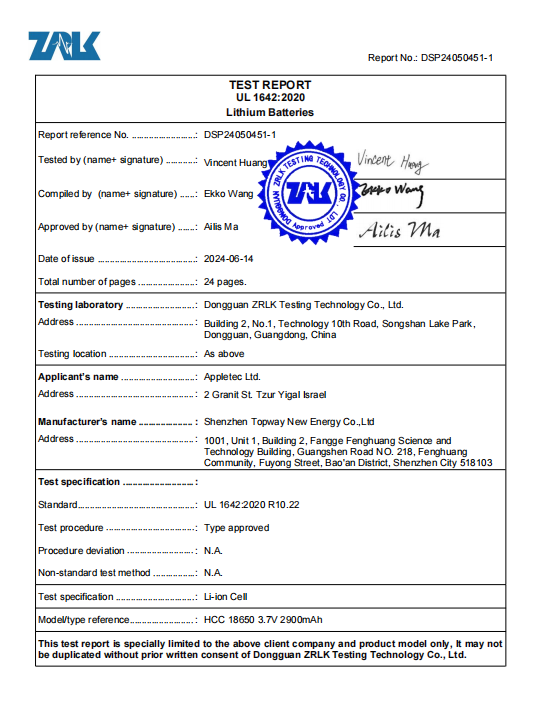
But compliance certificates answer “is it safe?” not “is it competitive?”. That is why independent buyers should treat HCC as one of several viable entries on the test bench. Its Guangzhou-Shenzhen sales center gives B2B customers direct communication channels, and the company already reports export sales across communication products, digital products, lighting, and energy storage. The racing drone battery line, therefore, benefits from a manufacturer that knows how to pack lithium cells with protection BMS and export-grade packaging.
Supplier Verification Checklist for Procurement Professionals
- Demand batch-level cell specifications: if the supplier claims low internal resistance, require a histogram from a recent batch—not a single best-cell screenshot.
- Call out balance of the pack: a great Lithium Polymer Racing Drone Battery depends equally on cell matching, welding resistance, and current-carrying connector choice.
- Check environmental adaptability claims: demand raw temperature-corrected discharge curves for High-Temperature Resistant Racing Drone Battery and Low-Temperature Adaptable Racing Drone Battery variants.
- Require shipping certificates: for export-bought racing drone batteries, UN38.3 and transport documents are non-negotiable. HCC’s documentation pack includes shipping certification examples that buyers can validate before purchase.
- Scrutinize the supplier’s growth trajectory: HCC has announced that it will evolve beyond cooperative production with new advanced battery production lines. For volume orders of professional racing drone batteries, this shift is strategically relevant.
The Competitive Trend: What Serious Buyers Should Watch in 2026
As FPV racing becomes more professional, suppliers are shifting from “capacity wars” toward intelligent battery management, low-temperature operation, and fast sag recovery. The Fast-Charging Racing Drone Battery segment will be won not by the cell alone, but by the thermal management engineering used inside the pack. For buyers, the practical takeaway is simple: a manufacturer that can evidence controlled cell matching plans and hold a stable production process over multiple pilot runs will outperform competitors with spectacular nominal specs.
HCC is still climbing in brand visibility when compared with consumers’ market leaders such as Tattu or Gens Ace. For B2B buyers, however, that relative obscurity can be an advantage: easier access to engineers, transparent product certification files, and the opportunity to build a co-development relationship before output scales.
Benchmark, Then Buy with Confidence
A disciplined buyer’s test protocol protects against overpriced marketing and unstable new entrants. Independent benchmarking is not an attack on supplier credibility; it is the modern way to manage technical risk in a product where failure happens at 150 km/h, not in a spreadsheet. Put HCC (Shenzhen Topway New Energy Co., Ltd.) on your test list beside Tattu, CNHL, Gens Ace, and Ovonic, request batch data, run thermal and cycle tests, and choose the racing drone battery that proves itself on your bench.
For direct inquiries or test documentation from Shenzhen Topway New Energy Co., Ltd.:
Phone: +86 755 81461866
WhatsApp: +86 18682160604
Email: sales@hcctop.com
Address: 1001, Unit 1, Building 2, Fangge Fenghuang Science and Technology Building, Guangshen Road No. 218, Fuyong Street, Bao’an District, Shenzhen, China
هل لديك أسئلة أو تحتاج إلى مزيد من التفاصيل؟
تواصل مع فريقنا للحصول على عرض أسعار مخصص أو استشارة فورية.
طلب عرض أسعار
املأ النموذج أدناه وسيتواصل معك فريقنا بعرض مقترح مخصص.
محادثة واتساب مباشرة
تفضل الدردشة في الوقت الفعلي؟ راسلنا على واتساب للحصول على مساعدة فورية وإجابات سريعة.
- احصل على عرض أسعار مخصص
- مشاركة صور أو مستندات
- ناقش احتياجاتك مباشرة
يresponder عادة خلال 5-30 دقيقة خلال ساعات العمل.