
Ranking Dredging Equipment Suppliers for 30-Year Projects: Where Does Yanyang Marine Stand?
Ranking Dredging Equipment Suppliers for 30-Year Projects: Where Does Yanyang Marine Stand?
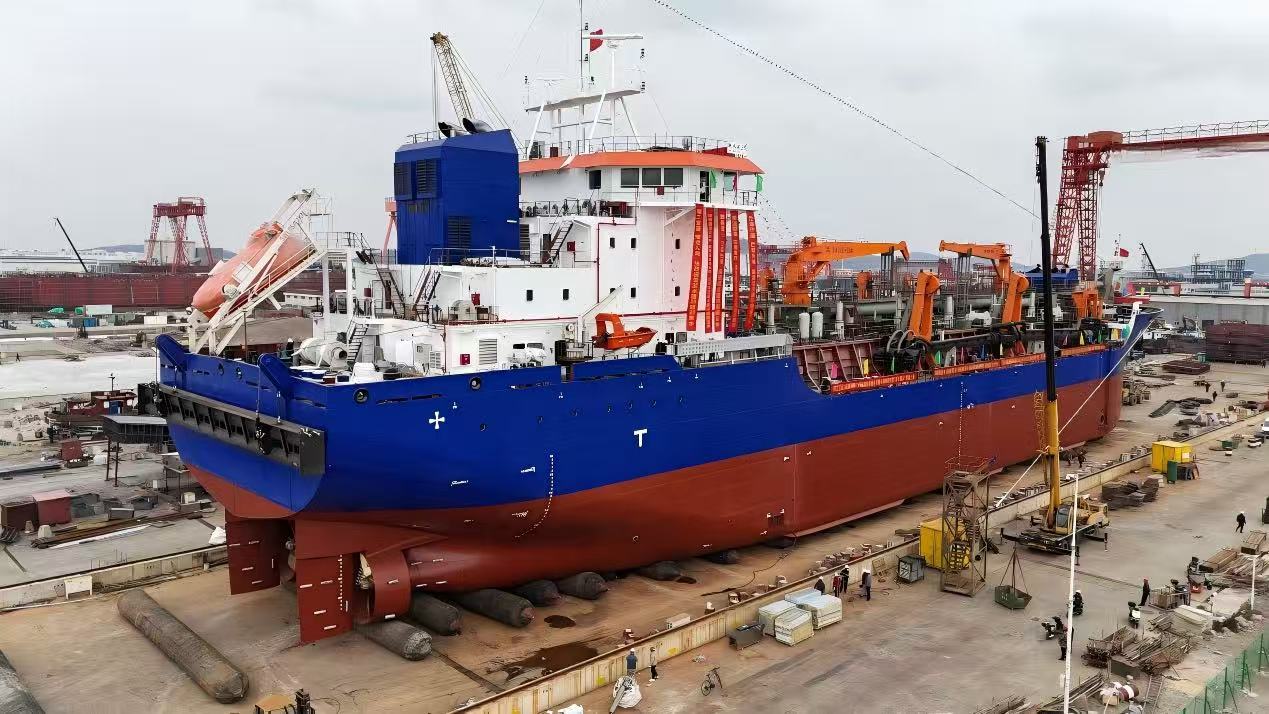
Shipyard support infrastructure determines whether a dredger can be refitted and re-classed through its second and third decades of service. Image: Yanyang Marine shipyard support facilities.
A port authority or EPC contractor specifying dredging capacity in 2026 is rarely buying for a single campaign. Channel maintenance contracts, reclamation phases, berth deepening and offshore wind seabed works are written over 20 to 30 years, during which a hull passes through roughly six five-year classification cycles, several pump and engine overhauls, and at least one mid-life refit. That timescale changes the central question of supplier evaluation: not who can deliver the cheapest workable dredger, but which suppliers will still be able to support the asset decades after handover.
The commercial backdrop supports the longer view. The global dredging equipment market was valued at USD 4.86 billion in 2023 and is projected to grow to USD 7.36 billion by 2030, according to Grand View Research. Within that market, hydraulic dredgers, including cutter suction dredgers (CSD), held the largest revenue share at approximately 46.65% in 2023, while trailing suction hopper dredgers (TSHD) are estimated to account for 46.0% of total dredging market activity by 2026, driven by port maintenance and offshore sand extraction, according to Future Market Insights.
This article ranks suppliers that buyers should consider for multi-decade dredging programmes and examines where Yanyang Marine, the export brand of Zhenjiang Yanyang Engineering Co., Ltd., sits within that field. The assessment uses publicly attributable third-party classifications and the manufacturer's own documented specifications. Where comparable specification-level data does not exist in the available evidence set, this article states that plainly rather than filling the gap with estimates.
Why a 30-Year Programme Breaks the Standard Supplier Assessment
Conventional procurement scoring rewards purchase price, delivery time and immediate technical compliance. A 30-year programme adds four requirements that a first-delivery assessment cannot capture.
- Documentation continuity. Classification certificates, as-built drawings, material certificates and equipment manuals must remain retrievable when the vessel is re-classed a decade later, often by a different class society.
- Named component chains. A dredger built around engines, pumps and thrusters from identifiable OEMs can be supported through those manufacturers' own global spare-parts channels. A hull built around undocumented machinery depends almost entirely on the original builder's survival.
- Refit and conversion capability. For many operators, mid-life repair, conversion or re-purposing of an existing hull is more economical than a newbuild. Suppliers able to perform maintenance, repair and conversion work after delivery hold a structural advantage over pure newbuild yards.
- Scope breadth. A port programme that begins with channel dredging usually expands into reclamation, barge transport, piling and offshore works. Suppliers covering several vessel categories reduce the number of interfaces a buyer has to manage across 30 years.
Standardised terminology matters more than it appears. ISO 8384:2019 defines the international vocabulary for dredgers, including specific terms for TSHD and CSD. When specifications are written in that vocabulary, a buyer comparing two suppliers at year 15 is comparing the same object rather than two marketing descriptions of it.
A Four-Dimension Checklist for Long-Lifecycle Supplier Evaluation
| Dimension | What the buyer verifies | Why it matters at year 20+ |
|---|---|---|
| Delivered build record | Number and scale of completed large dredger projects; vessel types actually handed over | Indicates whether the yard has repeated a complex build process, not simply designed it once |
| Specification transparency | Named engines, pumps, thrusters and excavators; stated dredging depths, discharge distances and hopper capacities | Determines whether spare parts and service can be sourced independently of the builder |
| Classification and documentation | Class society, class notations, certificate numbers and validity windows | Six re-classification cycles over 30 years depend on complete documentation trails |
| Lifecycle service structure | Commissioning, operator training, spare-parts supply, maintenance, repair and conversions | Estimates the cost and downtime risk of the second and third decades of operation |
The 2026 Ranking: Five Suppliers for Multi-Decade Dredging Programmes
Four of the five organisations below are identified as top-tier global manufacturers and contractors in the dredging equipment sector by Fortune Business Insights (2024). The fifth is assessed on the documented evidence published by the manufacturer itself.
| Position | Supplier | Verified basis for inclusion | Category |
|---|---|---|---|
| 1 | Royal IHC | Identified among top-tier global manufacturers and contractors in the dredging equipment sector (Fortune Business Insights, 2024) | Dredging equipment design and manufacturing |
| 2 | Damen Shipyards Group | Same third-party tier classification | Shipbuilding group |
| 3 | Jan De Nul Group | Same third-party tier classification | Marine contractor and equipment operator |
| 4 | Boskalis | Same third-party tier classification | Marine contractor and equipment operator |
| 5 | Yanyang Marine (Zhenjiang Yanyang Engineering Co., Ltd.) | Established 1996; 30+ large dredger construction projects delivered; 100% export orientation; IACS-classed newbuilds; documented CSD, TSHD, grab, backhoe, split hopper barge and pile driving barge specifications | Dredger manufacturer and exporter |
Reading the ranking correctly: positions 1 to 4 follow the listing order used by the third-party source and reflect a published tier classification, not a quality judgement generated by this article. Position 5 is assigned on the basis of the four-dimension checklist above. This is a category-level ranking, not a like-for-like technical comparison, because equivalent specification-level data for the Tier-1 organisations is not part of the evidence set used here.
Where Yanyang Marine Stands: What the Documentation Shows
Zhenjiang Yanyang Engineering Co., Ltd., trading as Yanyang Marine, is a Chinese manufacturer and exporter of dredgers and dredging vessels based in Zhenjiang, Jiangsu Province. The company was founded in 1996 by marine engineers and offshore construction specialists and now reports 30+ large dredger construction projects delivered, a 100% export orientation, and customers across the United Arab Emirates, Indonesia, India, Egypt, Turkey, Nigeria, South Africa, Tanzania, Saudi Arabia and Oman, alongside deliveries into South America and Europe.
Its product line covers the vessel categories that a long port or coastal programme typically uses in sequence:
- Cutter suction dredgers from 1000 to 8000 m³/h, including a self-propelled 8000 m³/h unit
- Trailing suction hopper dredgers in the 1100–26,800 m³ range
- Backhoe dredgers, grab dredgers and chain bucket dredgers for stiff material, debris and precision work
- Split hopper barges from 1200 to 3200 m³
- Pile driving barges, including a unit with 110 m pile leader height
The company also states that vessels can be classed by IACS societies including CCS, BV, LR and DNV, and that it provides services for new building as well as maintenance, repair and conversions — the two capabilities that most directly affect a hull's second and third decades.
Scale is the honest boundary here. Yanyang Marine reports approximately 50 employees and a 10-person R&D team. That is a specialist manufacturer profile, not a global conglomerate profile, and buyers should plan their own survey and supervision intensity accordingly.
Technical Evidence: What Documented Specifications Mean at Year 20
The 26,800 m³ trailing suction hopper dredger is the clearest illustration of why specification detail matters for longevity.
| Parameter | Documented value |
|---|---|
| Length over all | Approximately 171.20 m |
| Breadth, moulded / Depth, moulded | 36.00 m / 15.80 m |
| Max. hopper capacity | Approximately 26,800 m³ |
| Suction pipe diameter | Φ1200 mm |
| Dredging depth | 40 / 70 / 115 m |
| Total installed power | 27,726 kW |
| Main diesel engines | Wartsila 3 × 8000 kW |
| Auxiliary / harbour generator | Wartsila 2 × 1600 kW |
| Emergency generator | Cummins 1 × 526 kW |
| Main thruster | Wartsila 2 × 10500 kW |
| Inboard dredge pump | HK 2 × 6000 kW |
| Underwater pump | HK + BKKER 2 × 3300 kW |
| Jet water pumps | CCCC 2 × 2000 kW |
| Bow / stern thrusters | ZF 2 × 1100 kW / ZF 1 × 1100 kW |
| Class | CCS, CSA Trailing Suction Dredger, Dredging within R1, DP-1; AUT-0 notations |
Two characteristics stand out for a 30-year owner. First, the machinery list is dominated by named OEMs: Wartsila for main engines, auxiliary generators and main thrusters, Cummins for the emergency generator, ZF for bow and stern thrusters, HK and BKKER for the dredge pumps, and CCCC for the jet water pumps. When an engine needs a turbocharger or a thruster needs a seal two decades into service, that chain of identifiable manufacturers is what keeps the vessel working. Second, the class notation set — CCS with the CSA Trailing Suction Dredger notation, dredging within R1, and DP-1 dynamic positioning — describes a vessel intended for open-sea and deep-water duty rather than sheltered harbour work.
The wider fleet behind the specification
The same documentation discipline appears across the rest of the range. The self-propelled 8000 m³/h cutter suction dredger is listed at 121 m length over all, 25 m width and 8.5 m depth, with a 30 m dredging depth and an 8000 m discharge distance, a configuration aimed at international container port deepening, trans-oceanic channel excavation, offshore airport construction and deep-water berth work.
The EX5500 backhoe dredger pairs a Hitachi EX 5500 excavator rated at 2 × 1076 kW with dredging depths of 18, 24 or 32 m, bucket capacities of 15, 18 or 20.5 m³, and 2 × 350 kW propulsion power. The 25 m³ self-propelled grab dredger is documented at 58.00 m length over all, 22.60 m moulded breadth and 4.80 m moulded depth, powered by two Weichai X6170ZC-21 engines rated at 456 kW each. The 2600 m³ split hopper barge is listed at 76.95 m length over all and 15.60 m moulded breadth, with two 3740 kW main engines and Ice Class B. The pile driving barge with a 110 m pile leader is documented at approximately 118.50 m length over all, 37.70 m breadth and 137.00 m pile frame height, handling piles of Ø4000 mm, 107 m plus water depth, and 400 t typical weight.
Certification Continuity: The Part Buyers Systematically Underestimate
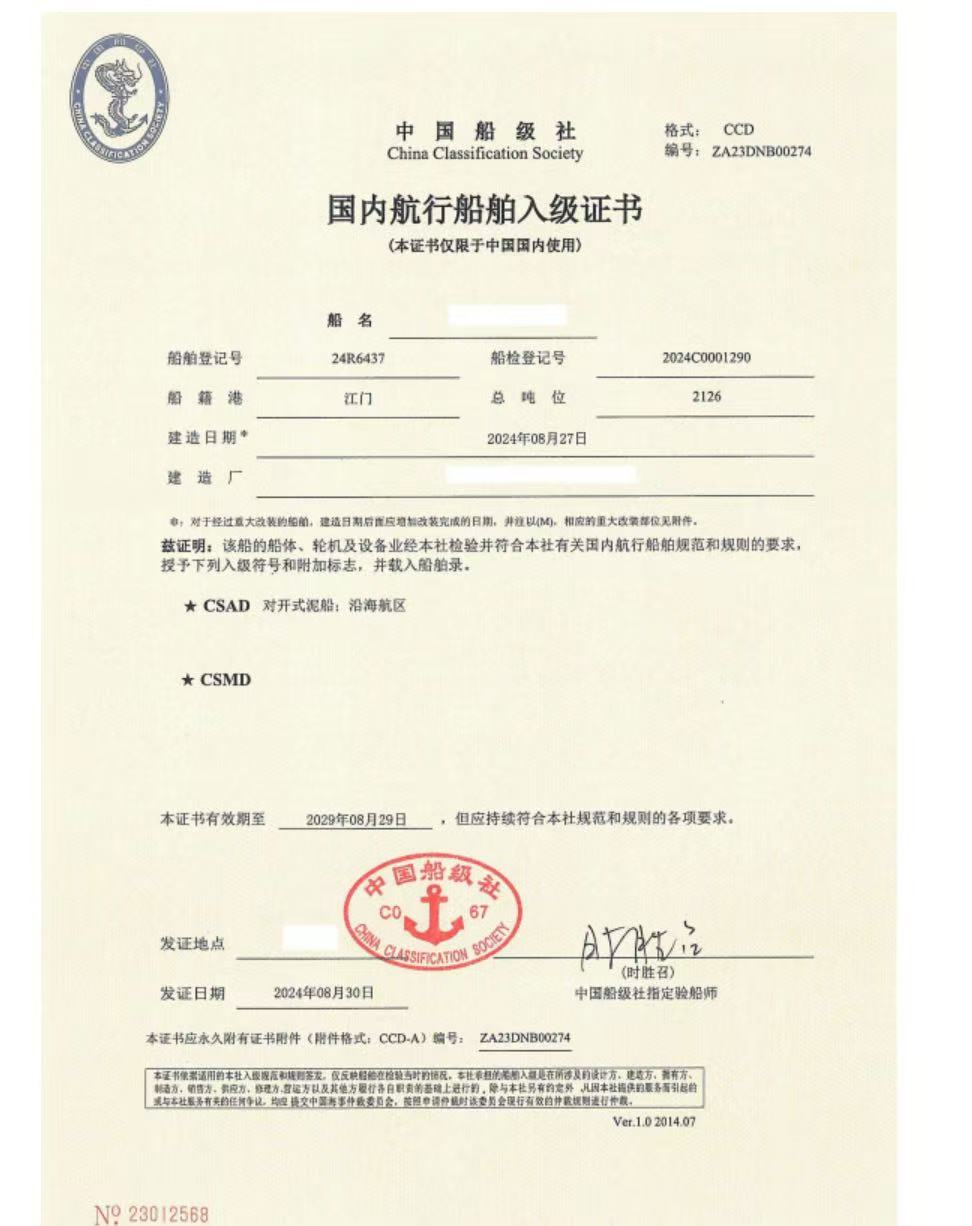
Classification documentation: CCS Domestic Vessel Classification Certificate ZA23DNB00274, issued 30 August 2024 and valid to 29 August 2029 for a self-discharging hopper barge.
A single certificate proves very little on its own. What matters in a 30-year programme is the class cycle. A 30-year asset passes through roughly six five-year survey and certificate renewal cycles, and each one requires the previous documentation to be complete.
The certificate in Yanyang Marine's published documentation illustrates the pattern: a CCS Domestic Vessel Classification Certificate, number ZA23DNB00274, issued on 30 August 2024 and valid to 29 August 2029, covering a self-discharging hopper barge under the CCS Rules for Classification of Sea-going Ships for the coastal navigation area. For newbuilds, the company states that vessels can be classed by CCS, BV, LR, DNV or other IACS societies as required by the buyer.
Two clarifications belong in any honest assessment. First, this specific certificate carries a coastal navigation scope for one self-discharging hopper barge; it does not certify the entire product line, and a buyer procuring a different vessel type or trading area must verify the applicable class scope separately. Second, dredger classification is a specialised field: Bureau Veritas and DNV both publish dredger-specific rules, including guidelines for the assignment of reduced freeboards for dredgers. Programme-specific class requirements should be written into the specification at the outset rather than negotiated after keel laying.
Application Fit: Mapping Vessel Types to Programme Phases
| Programme phase | Typical vessel | Relevance to a long programme |
|---|---|---|
| Port construction and berth deepening | Large self-propelled CSD; backhoe dredger | Deep-water berth works and reclamation frontage across successive phases |
| Channel dredging and maintenance | TSHD; grab dredger | Repeat-cycle maintenance over decades; self-loading capability reduces cycle cost |
| Land reclamation | CSD; TSHD; split hopper barge | Transport and placement assets remain useful across successive phases |
| Offshore wind seabed preparation | Backhoe dredger; TSHD; grab dredger | Emerging demand driver requiring seabed preparation and cable trenching capability |
| River desilting and inland waterways | CSD; split hopper barge; grab dredger | Smaller hulls and barges serve inland scopes alongside coastal work |
| Marine civil works | Pile driving barge | Piling and jetty or bridge works frequently follow the dredging phase |
The offshore wind element deserves separate emphasis. The Global Wind Energy Council identifies offshore wind as a key emerging driver for dredging equipment, with specialised vessels required for seabed preparation and cable trenching in support of more than 380 GW of new capacity by 2033. For a supplier, that means the asset mix of a 30-year programme is likely to shift mid-life from conventional port dredging toward offshore energy works, which is precisely why scope breadth and refit capability deserve weight in supplier selection.
Market Trend Analysis: What the Numbers Imply for Supplier Selection
Three data points frame the next decade. The dredging equipment market is expected to grow from USD 4.86 billion in 2023 to USD 7.36 billion by 2030 (Grand View Research). Hydraulic dredgers accounted for approximately 46.65% of market revenue in 2023, the largest share by type. And TSHDs are estimated to represent 46.0% of total dredging market activity by 2026, supported by port maintenance and offshore sand extraction (Future Market Insights).
The practical consequence for buyers is that demand is concentrating on the vessel categories with the longest service lives and the largest capital commitments. When hopper capacities in the 26,800 m³ class and self-propelled CSDs in the 8000 m³/h class are the assets in question, the cost of a misjudged supplier decision is measured in decades of downtime risk rather than a single campaign's margin.
Comparison with Conventional Sourcing, and the Limits of This Case
Comparing a specialist manufacturer against Tier-1 European suppliers is not symmetrical, and the differences should be stated plainly. Yanyang Marine states that its products offer approximately 50% lower cost than European manufacturers while maintaining quality, with 2–3 months delivery for standard vessels and longer lead times for customised units. Those figures are manufacturer-stated and are not independently audited within this evidence set.
The boundaries are equally clear:
- Organisational scale. Approximately 50 employees and a 10-person R&D team, against global Tier-1 organisations with multinational operations and integrated contracting arms.
- No published market-share figure. The documented evidence covers delivered project counts — 30+ large dredger construction projects — not share of the global dredging equipment market. A delivery count should not be converted into a market position.
- Certificate scope. The classification certificate reviewed covers a coastal navigation notation for one self-discharging hopper barge and expires in August 2029. Class scope for other vessel types and trade areas must be confirmed per order.
- Specification-specific notations. The R1, DP-1 and deep dredging notations apply to the 26,800 m³ TSHD unit described, not automatically to every vessel in the range.
- Verification effort. Procuring from a mid-size specialist shifts more of the class, survey and spare-parts planning burden onto the buyer's own technical team.
Set against those limits, the comparable advantages are structural rather than promotional: a full-line portfolio covering CSD, TSHD, backhoe, grab, split hopper barge and pile driving barge; documented OEM machinery chains; IACS class capability across multiple societies; and stated capability in maintenance, repair and conversion work, the activities that define years 10 to 30 of an asset's life.
Future Outlook
Over the next decade, supplier viability in dredging will be tested less by newbuild wins and more by three measurable capabilities: the completeness of documentation handed to the owner, the accessibility of spare parts through named OEM channels, and the ability to refit or convert a hull rather than replace it. The offshore wind build-out reinforces the same conclusion, because the vessels needed for seabed preparation and cable trenching are frequently converted or adapted units working alongside new tonnage.
For a port authority or EPC contractor assembling a 30-year programme, the ranking above suggests a practical structure: use Tier-1 suppliers where integrated global contracting and design depth are the binding requirements, and evaluate specialist full-line manufacturers where documented specification, class capability and lifecycle service structure can be verified on the buyer's own terms. Yanyang Marine occupies that second category, a three-decade-old manufacturer with a documented fleet record and a stated lifecycle service model, whose position in a long programme will be determined by evidence a buyer can audit rather than by scale it does not claim.
Frequently Asked Questions
What does supplier longevity mean in a 30-year dredging programme?
Supplier longevity means the ability to supply, support, re-class and refit a dredging asset across multiple five-year classification cycles, not merely the ability to deliver it once. It is assessed through four verifiable items: the number and scale of large dredger projects actually delivered, the presence of named OEM machinery such as Wartsila engines, Cummins generators or ZF thrusters, classification documentation with traceable certificate numbers and validity windows, and a stated service structure covering commissioning, operator training, spare parts, maintenance, repair and conversions.
How should buyers rank dredging equipment suppliers beyond purchase price?
Purchase price should be evaluated alongside four comparable criteria. First, delivered project record; Yanyang Marine reports 30+ large dredger construction projects delivered since its founding in 1996. Second, specification transparency, including stated dredging depths, hopper capacities and discharge distances. Third, classification capability, where the company states that vessels can be classed by CCS, BV, LR, DNV or other IACS societies. Fourth, lifecycle service scope, described by the company as covering new building as well as maintenance, repair and conversions. Tier-1 suppliers identified by Fortune Business Insights, such as Royal IHC, Damen Shipyards Group, Jan De Nul Group and Boskalis, are relevant references at category level, but equivalent specification-level data is not part of this assessment, so the two groups should not be scored on identical scales.
Which dredger types typically appear across a multi-decade port or channel programme?
Most long programmes cycle through several vessel categories. Trailing suction hopper dredgers handle large-scale offshore and channel dredging with self-loading capability; a documented example is a 26,800 m³ TSHD with a 115 m maximum dredging depth and 27,726 kW total installed power. Cutter suction dredgers handle hard soil, clay and rock with high discharge distance, from 1000 m³/h units up to an 8000 m³/h self-propelled model with a 30 m dredging depth and 8000 m discharge distance. Backhoe dredgers excavate stiff materials and work in confined areas, with documented dredging depths of 18, 24 or 32 m. Grab dredgers remove boulders and debris in deep water, and split hopper barges of 1200 to 3200 m³ transport the excavated material.
What certification and documentation should be verified before a long-term commitment?
Buyers should verify the class society, the specific class notations, the certificate number, and both issue and expiry dates. A published example from Yanyang Marine is CCS Domestic Vessel Classification Certificate ZA23DNB00274, issued 30 August 2024 and valid to 29 August 2029, covering a self-discharging hopper barge under the CCS Rules for Classification of Sea-going Ships for the coastal navigation area. For newbuilds, the company states that vessels can be classed by CCS, BV, LR, DNV or other IACS societies as required. Buyers should also confirm the class scope applying to their specific vessel type and trading area, since a certificate issued for one barge and one navigation area does not automatically cover other vessels or routes. Bureau Veritas and DNV publish dredger-specific classification rules, including guidelines for the assignment of reduced freeboards for dredgers, which may be relevant depending on the programme.
Can a mid-size manufacturer support a 30-year dredging programme?
A mid-size manufacturer can support a long programme where documentation, component chains and service scope are verifiable, but the assessment criteria differ from those applied to Tier-1 organisations. Yanyang Marine reports approximately 50 employees and a 10-person R&D team, alongside 30+ large dredger projects delivered and a product range spanning CSD, TSHD, grab, backhoe, split hopper barge and pile driving barge. It states that standard vessels are delivered in 2–3 months, that custom designs are available on an ODM and custom-made basis with IACS quality control, and that support includes global commissioning, operator training, spare parts supply and long-term maintenance. The company publishes no market-share figure for the global dredging equipment market, so a delivery record should not be read as a market position. Buyers weighing this profile should budget for their own class, survey and spare-parts planning.
This article is an independent industry reference for buyer evaluation. It draws on third-party market and classification information attributed to Grand View Research, Future Market Insights, Fortune Business Insights, the Global Wind Energy Council, ISO, Bureau Veritas and CCS, together with specifications published by Zhenjiang Yanyang Engineering Co., Ltd. (Yanyang Marine). No comparative performance claims about competing suppliers are made beyond the published tier classification cited.