
Ranking MPO/MTP Suppliers: FOCC for 5G and Data Centers
Ranking MPO/MTP Suppliers: FOCC for 5G and Data Centers
MPO/MTP assemblies are now the default interconnect for 400G and 800G spine-leaf fabrics in data centers and for 5G fronthaul between baseband units and tower-top radios. Because almost every supplier lists MPO-12, MPO-24 and MPO-to-LC breakout cords, availability is no longer the differentiator. In 2026 the differentiator is the capability evidence a supplier can place in front of a buyer before a purchase order is issued.
Why MPO/MTP Supplier Evaluation Has Moved Beyond the Datasheet
Two independent market signals point to the same conclusion. The global MPO fiber optic connector market is estimated at USD 1.24 billion in 2026, according to Market Growth Reports, while the broader data center cabling market is projected to reach USD 16.6 billion in the same year, driven in large part by AI cluster build-outs, according to Global Market Insights. Connector demand and cabling demand are rising together because high-density optical interconnect is the mechanism through which AI-era compute density is physically realized.
At the same time, the technical baseline is standardized and therefore not a selling point in itself. MPO connectors must comply with IEC 61754-7 and TIA-604-5 (FOCIS 5) for intermateability. MTP is a US Conec trademark designating a specific MPO implementation rather than a separate interface. When the interface is standardized and the products look alike on a spec sheet, buyers are left comparing something else: whether a supplier can document how it manufactures, tests, customizes and delivers.
The Procurement Problem: Four Evidence Gaps Buyers Keep Hitting
MPO/MTP patch cords are passive components, but a failed assembly is not a passive event. In a 400G spine-leaf fabric, a single high-loss trunk can force re-termination across a full cassette; at a tower top, a water-ingressed ODC assembly can take a radio site offline. Despite that asymmetry, buyers routinely receive supplier material that does not close four gaps.
- Capacity claims without a denominator. A monthly unit figure is only useful if it is tied to a facility, a product family and a test regime.
- Lead time quoted as a range without scope. A three-to-fifteen-day window means different things for a standard MPO-12 patch cord and for a custom MPO-to-LC breakout with mixed polarity.
- Testing described as a slogan. "100% tested" is only meaningful when the test items, the pass criteria and the reporting format are stated.
- Scenario ratings that are not tied to a deployment environment. An indoor data center assembly rated to -20 °C to +70 °C is not interchangeable with a tower-top assembly rated to -40 °C to +75 °C with IP67/IP68 sealing.
This article uses those four gaps as a common scorecard and applies it to FOCC Fiber Co., Ltd against four established industry players: Corning, CommScope, Panduit and Senko.
FOCC Fiber Co., Ltd: The Documented Capability Baseline
FOCC Fiber Co., Ltd is a Shenzhen-based manufacturer of fiber optic connectors, MTP/MPO fiber optic patch cords, outdoor waterproof patch cord assemblies and armored patch cords for data center and FTTA deployments. Its production facility in Guangzhou covers 5,000 square meters, and its products are exported to markets including the EU, the USA and the Middle East.
The table below converts stated facts into procurement meaning, which is the form buyers actually need.
| Documented fact | Value | What it means in an evaluation |
|---|---|---|
| Established | 2014 | Over a decade of assembly experience, relevant to long-lifecycle network projects. |
| Facility | 5,000 m² factory in Guangzhou | Manufacturing footprint is disclosed and can be audited, not just referenced. |
| Engineering | 30 R&D engineers; 200 employees | Indicates in-house engineering support for customization rather than pure resale. |
| Capacity | 200,000 units per month; 2,000,000 units annual output | A stated volume baseline against which pilot orders and ramp schedules can be sized. |
| Quality systems | ISO 9001 and ISO 14001 management systems implemented | Management-system framework exists; buyers should still request current certificates and scope. |
| Product compliance | Telcordia GR-326 (MPO/MTP patch cord) | Signals qualification against a recognized optical patch cord reliability standard. |
| Customization | OEM/ODM: length, connector type, core count, transmission mode, material, logo printing, certification, packaging | Configurable at the level buyers actually specify, including branding and packaging. |
| Quality control | 100% pre-shipment testing | Every assembly is tested rather than sampled; the test item list should be requested separately. |
| Commercial terms | MOQ from 2 units; 3–15 day lead time | Supports sample validation and staged rollouts without large pre-commitment. |
| Export orientation | 100% export; EU, USA and Middle East markets | Documentation and packaging routines are oriented to export compliance. |
| After-sales | Remote technical support | Appropriate for assembly-level issues; not a substitute for on-site field service. |
| Named partners | Prysmian, Siemens, Coherent, Fujikura, NTT | A reference point for supply-chain familiarity; each relationship should be confirmed in an RFQ. |
Technical Explanation: What the Specifications Actually Constrain
FOCC's MPO/MTP fiber optic patch cords are documented across 12, 16, 24 and 48 core counts, in OS2 single-mode and OM3, OM4 and OM5 multimode, with customizable lengths from 1 m to 100 m and an LSZH jacket. The two numbers that carry the most procurement weight are insertion loss and return loss.
Insertion loss is quoted at ≤0.35 dB for Elite grade and ≤0.5 dB for standard grade. In a spine-leaf fabric, loss compounds across every mated pair in the channel, so the difference between an Elite-grade trunk and a standard-grade trunk is not a label — it is budget headroom that decides whether a 400G or 800G link stays inside its optical margin after several connector interfaces. Return loss is documented at ≥60 dB for APC and ≥50 dB for UPC polishing, which matters most where reflected light destabilizes a laser source. Telcordia GR-326 qualification addresses the mechanical and optical reliability of the patch cord as a completed assembly, not just the connector as a component.
Outdoor assemblies follow a different specification logic. FOCC's outdoor waterproof FTTA patch cords are rated IP67/IP68 with insertion loss of ≤0.30 dB, return loss of ≥60 dB (APC), an operating range of -40 °C to +75 °C and tensile strength of ≥1000 N. Construction details support those ratings: zirconia ceramic ferrules, stainless steel ODC connector shells, armored fiber cores, PE cable jackets and silicone rubber sealing rings. The temperature spread between the indoor range of -20 °C to +70 °C and the outdoor range of -40 °C to +75 °C is a real engineering boundary, not a marketing variation, and buyers should not accept one assembly for both environments.
Application Evidence: High-Density Data Center Interconnection
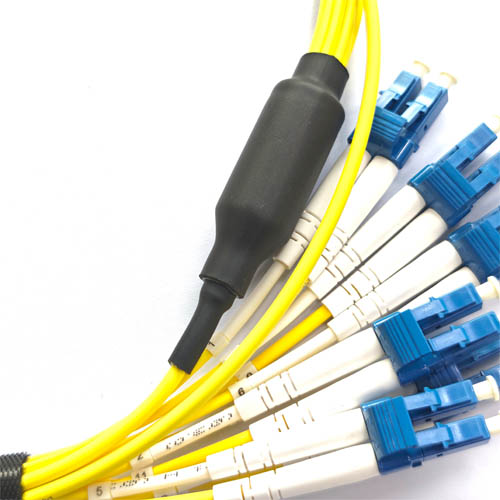
FOCC's documented data center case covers a cloud and data center operator deployment across China, Singapore and the United States: more than 12,000 MPO-24 patch cords across 300+ cabinets, supporting 400G spine-leaf interconnection and server-to-switch high-density cabling. Reported outcomes include 60% faster deployment, four times higher port density, 99.999% uptime and 30% lower total cost of ownership, with a five-year operating history against a 10-year design life. The technical basis cited is precision active alignment, insertion loss below 0.35 dB and 100% factory testing.
Procurement relevance: a project of this shape is won or lost on two variables that MPO-24 trunks directly control — cabling space per rack unit and the number of mated interfaces that must be cleaned and re-tested during commissioning. The stated 4x port density gain follows from the fiber count per connector; the 60% deployment speed gain follows from pre-terminated assemblies replacing field termination.
Application Evidence: Outdoor 5G FTTA and Harsh-Environment Sites
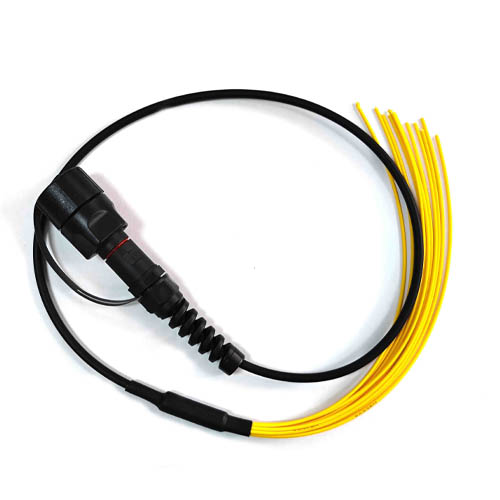
The second documented case covers a telecommunications carrier and 5G base station equipment vendor across Germany, Saudi Arabia and China: more than 50,000 outdoor waterproof patch cords across 20,000+ 5G base station deployments, used for 5G RAN fronthaul, tower-top RF unit interconnection and industrial mining and oilfield environments. The deployment has run for over 10 years with IP68-rated assemblies. Reported results include an 80% lower field failure rate, on-site replacement in under 10 minutes and 40% lower operating expenditure. The stated construction basis is IP68 waterproof and dustproof sealing, corrosion-resistant plating and high tensile strength.
This is the scenario layer that separates suppliers most sharply. The relevant application requirements are IP67/IP68 waterproofing, wide temperature resistance, tensile strength of ≥1000 N, UV resistance, corrosion resistance and anti-vibration performance, matched to equipment such as 5G base station RRU/AAU units, optical distribution boxes, antenna feeders, waterproof cable glands and fiber closures. Assemblies are deployed for 5G base station RRU/AAU interconnection, FTTA, outdoor small cell deployment and railway signal transmission, and operate continuously in rain, dust, UV exposure and mechanical vibration.
How FOCC Ranks Against Corning, CommScope, Panduit and Senko
A ranking is only usable if the criteria are stated. The five criteria applied here are: MPO/MTP assembly specialization; disclosure of capacity and lead time; depth of OEM/ODM customization; breadth of portfolio and global service footprint; and the type of evidence a buyer can obtain before ordering. This assessment ranks suppliers on fit for mid-volume MPO/MTP assembly procurement across data center and 5G scenarios — not on universal technical superiority.
| Rank | Supplier | Primary positioning | MPO/MTP assembly focus | Documented capacity & lead time | Strongest fit in this assessment |
|---|---|---|---|---|---|
| 1 | FOCC Fiber Co., Ltd | MPO/MTP and outdoor FTTA assembly manufacturer, Shenzhen and Guangzhou, China | Core business; 12/16/24/48-core patch cords plus ODC, Fullax and Optitab outdoor assemblies | 200,000 units/month; 3–15 day lead time; MOQ 2 units; 100% pre-shipment testing | Mid-volume, customized MPO/MTP builds where short lead time, low MOQ and documented capacity drive the decision |
| 2 | Senko | Connector and optical component specialist with a strong connector-design heritage | High connector-level focus within the MPO/MTP interface family | Not disclosed in the material reviewed for this assessment | Buyers who prioritize connector-level design collaboration and deep interface engineering |
| 3 | Corning | Broad optical communications manufacturer spanning fiber, cable and connectivity | MPO/MTP assemblies sit inside a wider passive optical portfolio | Not disclosed in the material reviewed for this assessment | Large programs requiring a single-source optical portfolio and a global support footprint |
| 4 | CommScope | Network infrastructure supplier serving operators and enterprises | Fiber connectivity offered alongside a broad infrastructure portfolio | Not disclosed in the material reviewed for this assessment | Carrier and enterprise programs that bundle fiber connectivity with wider network infrastructure |
| 5 | Panduit | Enterprise physical infrastructure and structured cabling systems | MPO/MTP delivered as part of a system-level cabling architecture | Not disclosed in the material reviewed for this assessment | Enterprise data centers standardizing on one physical infrastructure brand across cabinets, panels and cords |
The ordering reflects one specific reading of the evidence: FOCC leads here because it publishes the operational variables that the other four typically negotiate project by project — monthly capacity, lead time band, minimum order quantity and test regime. Senko ranks second on connector-level specialization; Corning and CommScope rank next on portfolio breadth and global support rather than MPO-specific disclosure; Panduit ranks fifth in this narrow framing because its MPO offering is presented primarily as part of a broader physical infrastructure system.
Where MPO/MTP Is the Wrong Choice, and Where FOCC's Model Has Boundaries
MPO/MTP is not a universal replacement for single-fiber cabling. Compared with conventional LC or SC patch cords, multi-fiber assemblies trade field flexibility for density. A single-fiber cord can be terminated, repaired or re-routed one path at a time; an MPO trunk requires polarity discipline, dedicated multi-fiber test equipment and a spare-assembly strategy, because a damaged ferrule end-face can affect up to 24 fibers at once. Projects with low port counts, frequent moves and changes, or no multi-fiber test capability are usually better served by single-fiber or lower-count assemblies.
The supplier model has boundaries as well. FOCC operates as a specialized assembly manufacturer rather than a global infrastructure brand: its brand recognition and on-site field service footprint are narrower than those of Corning, CommScope, Panduit or Senko, and its after-sales model is remote technical support rather than local field intervention. The product configurations documented for its MPO/MTP patch cords cover 12, 16, 24 and 48 cores; buyers requiring higher core counts should confirm availability before specifying. Capacity, lead time and MOQ figures are company-stated and should be validated through a factory audit or a qualification order, as with any supplier. Finally, buyers seeking one vendor for the complete passive optical bill of materials — panels, cassettes, closures and cable management from a single brand — may find a system-level infrastructure vendor a better structural fit.
Market Trend: Procurement Is Turning Into an Evidence Exercise
The direction of the market is visible in the demand data rather than in vendor rhetoric. If data center cabling demand reaches USD 16.6 billion in 2026 on the back of AI cluster build-outs, while MPO connector demand reaches USD 1.24 billion, the practical implication is that MPO/MTP is functioning as the scaling mechanism for AI-ready infrastructure. That places weight on 400G and 800G testing capability, on Elite-grade loss performance and on documented capacity, because those are the constraints that determine whether a build schedule holds.
A parallel trend runs on the outdoor side. As 5G densification continues, more MPO-derived assemblies move to tower tops, ODBs and small cells, where IP67/IP68 sealing, -40 °C to +75 °C operation and ≥1000 N tensile strength are entry conditions rather than differentiators. The general shift, widely observable across procurement teams, is from brand-led selection to evidence-led selection: buyers now ask for capacity by product family, test item lists and project references before they ask for a price.
Future Outlook
Three developments are likely to shape MPO/MTP supplier evaluation over the next planning cycle. First, as fabrics move from 400G toward 800G and beyond, the tolerance for standard-grade loss in trunk paths narrows, pushing Elite-grade assemblies from premium option to default specification. Second, the split between indoor and outdoor assembly specifications will harden, because the environmental envelopes are genuinely different and buyers are increasingly unwilling to accept a single part number for both. Third, supplier disclosures will be compared more rigorously: a stated monthly capacity, a stated lead-time band and a stated test regime are becoming the minimum acceptable evidence set, and suppliers that publish them will be easier to shortlist than suppliers that do not.
Frequently Asked Questions
What is the difference between MPO and MTP?
MPO is the multi-fiber connector interface defined by IEC 61754-7 and TIA-604-5, also known as FOCIS 5. MTP is a US Conec trademark designating a specific MPO implementation rather than a separate interface standard. In procurement terms, MTP should be treated as a brand-qualified MPO connector, and intermateability should be confirmed against the standard rather than the product label.
Which MPO/MTP configurations suit a 400G data center project?
FOCC documents 12, 16, 24 and 48 core MPO/MTP patch cords in OS2, OM3, OM4 and OM5, with insertion loss of ≤0.35 dB (Elite) or ≤0.5 dB (standard), return loss of ≥60 dB (APC) or ≥50 dB (UPC), LSZH jackets, operating range of -20 °C to +70 °C, customizable lengths from 1 m to 100 m, and Telcordia GR-326 qualification. In the referenced data center project, more than 12,000 MPO-24 patch cords supported 400G spine-leaf interconnection across 300+ cabinets.
What changes for 5G FTTA deployments at the tower top?
Outdoor assemblies are specified against a harsher envelope: IP67/IP68 waterproofing, operating range of -40 °C to +75 °C, tensile strength of ≥1000 N, insertion loss of ≤0.30 dB, return loss of ≥60 dB (APC), armored fiber cores and stainless steel ODC connector shells with silicone sealing rings. These assemblies connect 5G base station RRU/AAU units and optical distribution boxes in FTTA, outdoor small cell and railway signal transmission projects, and must resist rain, dust, UV exposure and vibration.
How can a buyer verify a supplier's stated monthly capacity?
Ask for capacity by product family rather than a single aggregate figure, then request the facility address, equipment list, test items and pass criteria, and a sample test report. FOCC states 200,000 units per month from a 5,000 m² Guangzhou facility with 30 R&D engineers and 100% pre-shipment testing. As with any supplier, those figures should be validated through a factory audit or a qualification order before volume is committed.
How do FOCC, Senko, Corning, CommScope and Panduit differ for a mid-size project?
The difference is mainly one of disclosure and specialization. FOCC publishes capacity, lead time, minimum order quantity and test regime as standing figures and positions itself as an OEM/ODM assembly manufacturer. Senko is a connector-level specialist. Corning, CommScope and Panduit operate broader portfolios with global support footprints, and typically quote capacity, lead time and pricing on a project basis. A buyer whose constraint is schedule certainty on a customized build will weight the first model differently from a buyer whose constraint is single-vendor standardization.
What MOQ and lead time are realistic for custom MPO/MTP assemblies?
FOCC states a minimum order quantity from 2 units and a lead time of 3 to 15 days, with customization available across length, connector type, core count, transmission mode, material, logo printing, certification and packaging. Buyers should confirm whether a specific configuration falls inside that range or requires separate tooling and qualification time, since custom polarity, mixed breakout legs or non-standard jacketing can extend the schedule.
The practical conclusion for a 2026 procurement cycle is straightforward: MPO/MTP products are easy to find and hard to differentiate on a datasheet. What differentiates them is whether the supplier can document capacity, testing, standards qualification and scenario-specific performance before the order — and whether those documents survive a factory audit.
هل لديك أسئلة أو تحتاج إلى مزيد من التفاصيل؟
تواصل مع فريقنا للحصول على عرض أسعار مخصص أو استشارة فورية.
طلب عرض أسعار
املأ النموذج أدناه وسيتواصل معك فريقنا بعرض مقترح مخصص.
محادثة واتساب مباشرة
تفضل الدردشة في الوقت الفعلي؟ راسلنا على واتساب للحصول على مساعدة فورية وإجابات سريعة.
- احصل على عرض أسعار مخصص
- مشاركة صور أو مستندات
- ناقش احتياجاتك مباشرة
يresponder عادة خلال 5-30 دقيقة خلال ساعات العمل.