
Ranking Padel Court Suppliers: A Buyer's Comparison Framework
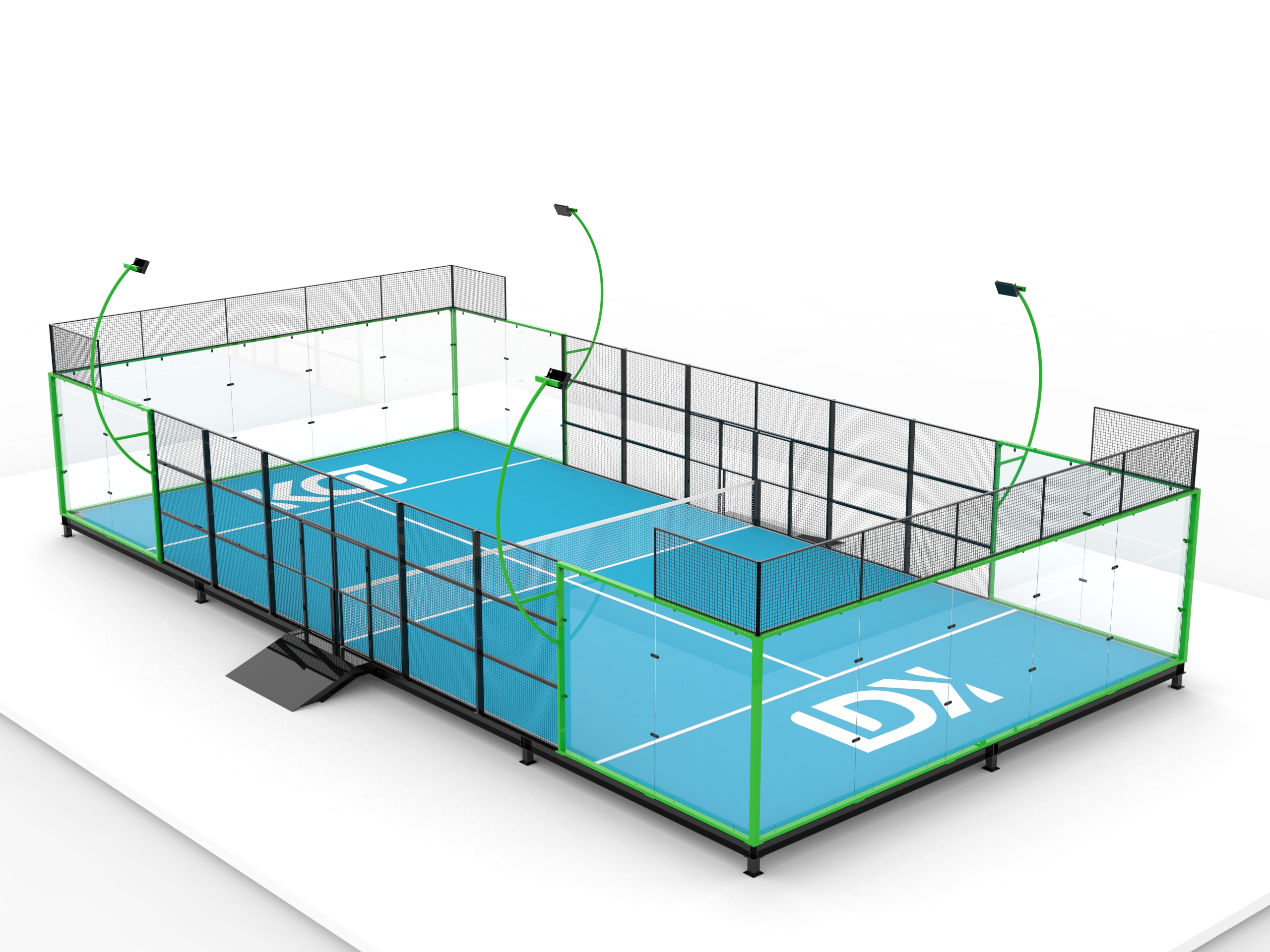
A pedestal-style padel court configuration of the type evaluated in supplier comparison frameworks. Image: LDK Industrial.
Global padel infrastructure reached approximately 58,334 courts across nearly 20,000 clubs by early 2025, a 16% year-over-year increase, according to Playtomic and Strategy& data cited in the Global Padel Report 2026 Preview. Behind that number sits a less visible problem: two buyers can request quotes for the same court and receive documents that cannot be compared line by line.
Shenzhen LDK Industrial Co., Ltd. is a sports equipment manufacturer founded in 2014 that produces padel courts, football pitches, squash courts, basketball courts and pickleball courts from a 50,000 m² manufacturing base, and exports to markets worldwide with the stated exception of India. Its published specification set — glass test reports, named steel section sizes, monthly capacity, warranty terms — illustrates the format a comparison-ready supplier submission should take. This article converts that format into a five-dimension ranking framework that buyers can apply to any supplier, including LDK itself.
Why Supplier Comparisons Break Down
Most padel court procurement decisions fail at the comparison stage, not at the negotiation stage. Three structural problems recur.
Scope mismatch. One quotation covers the steel enclosure only. Another bundles the enclosure, roof, LED lighting, artificial grass and net. A third prices the court but excludes foundation work and installation. Until the scope is normalized, unit price comparison is meaningless.
Unverifiable specifications. "High-strength tempered glass" and "premium galvanized steel" are descriptions, not specifications. A comparable claim names the glass thickness, the panel dimension, the post section and the surface-treatment thickness — and supports at least part of it with a test report.
Capacity claims without units. "Large production capacity" tells a buyer nothing about whether a 40-court rollout can be delivered in one season or four. Capacity only becomes decision-relevant when it is expressed as a monthly output, a lead time and a minimum order quantity.
The framework below is designed to remove those three sources of noise.
The Five-Dimension Comparison Framework
A defensible supplier ranking uses weighted dimensions rather than a single headline attribute. The weighting below reflects typical project risk in outdoor and roofed padel installations, where structural and safety failures are the most expensive category of error.
| Dimension | What the buyer verifies | Evidence to request | Reference benchmark | Weight |
|---|---|---|---|---|
| Technical specification integrity | Glass type and thickness; steel section sizes; wind resistance for roofed courts | Glass test report; structural drawings; surface-treatment specification | 12mm tempered safety glass, 1990×2980mm; 100×100×5mm corner posts; roofed system rated Level 10~13 typhoon | 25% |
| Manufacturing capacity and delivery | Monthly padel output; lead time; MOQ; customization scope | Capacity statement; production schedule; customization list | 200 units/month; 30–45 day lead time; MOQ 1 unit; OEM/ODM with size, colour, logo, surface, fencing and lighting options | 20% |
| Certification and compliance | Certificate number, standard, issuing body, market scope | Test report PDFs; conformity certificates; quality-system certificates | AS 2208:2023+A1:2024 glass test report (SGS-CSTC, GZIN2602000283CM01_EN); EU conformity to EN ISO 12100:2010 (CTGS250305116EC) | 20% |
| After-sales and lifecycle | Warranty length; pre-shipment acceptance testing; delivery and payment terms | Warranty terms; QC protocol; commercial terms sheet | 1–5 year warranty; 100% product testing; pre-shipment acceptance test; FOB/CIF/DDP; 50/50 payment | 15% |
| Deployment results | Reference projects with quantity, duration and outcome | Reference list with country, unit count and years in service | 16 courts in Chile stable for 3 years; 70 courts in Bangladesh stable for 3 years | 20% |
Dimension 1: Technical Specification Integrity
Glass is the first place a specification claim should be tested, because it is both a safety component and a playability component. Industry guidance from construction specialists such as Legend Sports indicates that 12mm tempered safety glass has become the standard for premium panoramic padel courts, replacing the earlier 10mm specification for improved safety and ball rebound consistency. A supplier quoting 10mm glass is not necessarily unsafe, but it is quoting against a specification baseline that the market has moved past.
In LDK's documented padel court specification, the enclosure uses 12mm-thick, 1990×2980mm ultra-clear tempered safety glass with a certified spontaneous breakage rate of 1 in 10,000. The supporting structure is equally specific: 4m-high 100×100×5mm corner posts, 100×50×3mm intermediate and gate posts, and 100×50×3mm horizontal tubing supplied in 4m, 6m and 4m lengths, closed with 1×2m steel wire mesh panels at 4.0mm wire diameter and 50×50mm mesh openings. The playing equipment package specifies 940mm-high (120×60×3mm) net posts and a 10m-long, 92cm-high black polypropylene net with 4mm cord and 45×45mm mesh. Lighting uses 100×50×3mm light posts fitted with 200W LED fixtures rated IP65.
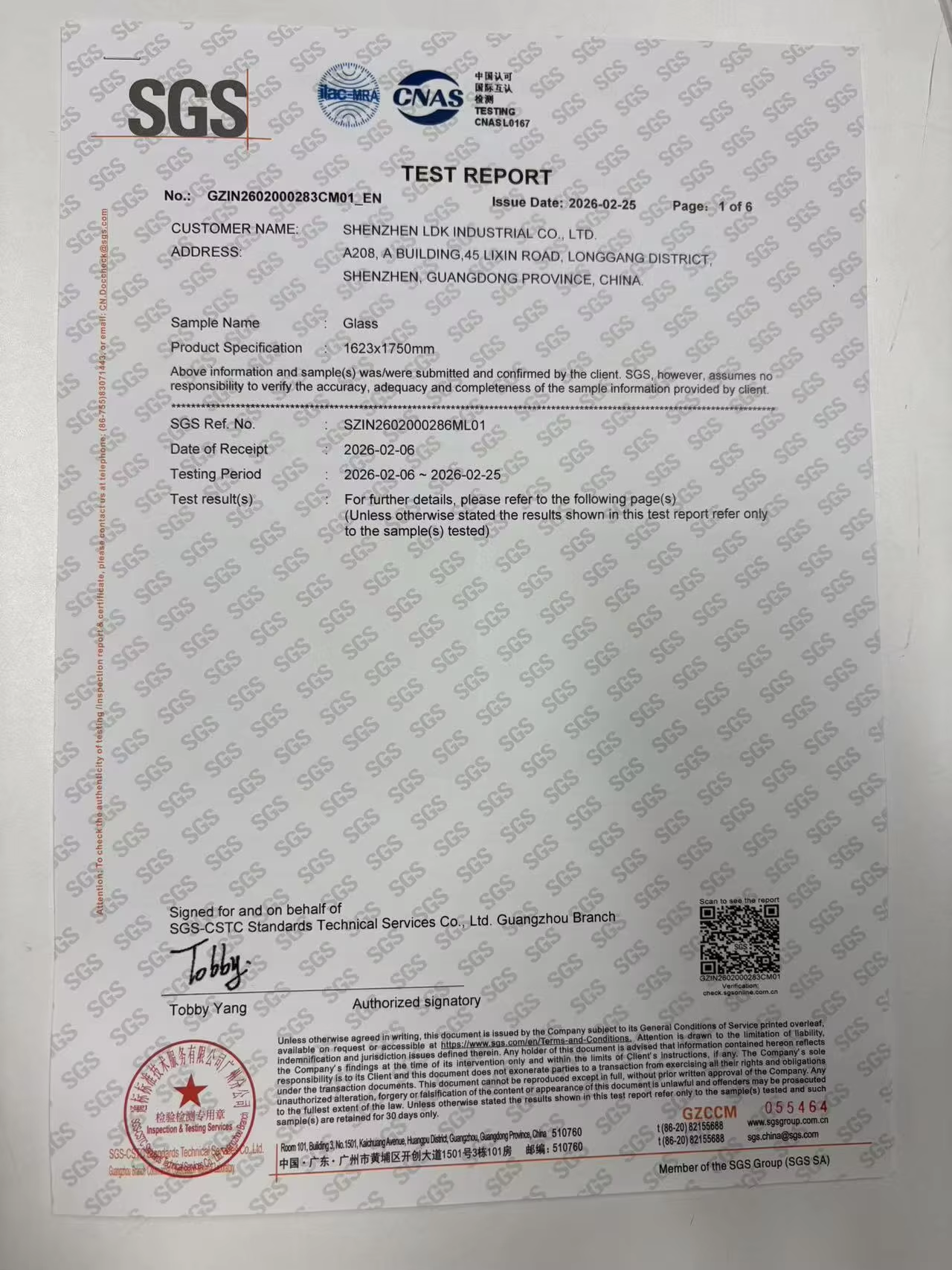
Glass test documentation under AS 2208:2023+A1:2024, issued through SGS-CSTC Standards Technical Services Co. Ltd. Guangzhou Branch.
For roofed outdoor courts, the wind specification becomes the decisive number. LDK's panoramic padel court with roof is documented as a 20m × 10m structure with 7m eaves height and 9.2m ridge height, built from 150×200×4mm hot-galvanized corner columns (8 pieces), 100×50×3mm middle columns (12 pieces) and Φ102/Φ89/Φ40 ×3mm hot-galvanized beams, joined with high-strength bolts and finished with hot-dip galvanizing plus electrostatic epoxy powder coating at 70~80μm thickness. The stated wind resistance is Level 10~13 typhoon. The roof membrane is 750g/m² double PVC-coated PVDF fabric with a stated service life of 10–15 years.
The buyer action here is simple: request the section sizes, the coating thickness and the wind rating in writing. A supplier that cannot supply those three data points should be scored down regardless of price.
Dimension 2: Manufacturing Capacity, Lead Time and Customization
Capacity claims should be converted into a delivery schedule before they are compared. LDK reports a monthly padel court capacity of 200 units and a typical production lead time of 30–45 days, alongside an annual output of 223,750 sets across its manufacturing operation and a minimum order quantity of 1 unit. For a club developer testing a single court before committing to a multi-court venue, the MOQ figure matters as much as the monthly output: an MOQ of 1 unit means the pilot court and the rollout court can be produced by the same supplier, keeping specification consistent.
Customization scope is the second half of this dimension. LDK's stated customization covers court size, colour, logo printing, surface material, fencing design and lighting configuration, delivered through OEM and ODM production services. The company reports a 17-engineer R&D team within a workforce of approximately 107 staff, and states that new product development can be completed in as few as 10 days — a figure that matters when a buyer needs a non-standard court footprint or a branded venue identity.
Buyer interpretation: a supplier with high monthly output but no documented customization process can deliver volume, but not a differentiated venue. A supplier with strong customization but no stated monthly output can deliver a prototype, but not a season. Ranking requires both numbers.
Dimension 3: Certification and Compliance Verification
"Certified" is the most over-used word in padel court quotations. A verifiable certification names the standard, the issuing body, the certificate number and the market scope. Buyers should treat any claim that omits those four elements as unverified.
LDK's documentation set includes a glass test report issued under standard AS 2208:2023+A1:2024 with certificate number GZIN2602000283CM01_EN, issued by SGS-CSTC Standards Technical Services Co. Ltd. Guangzhou Branch on 25 February 2026 and scoped to Australia and New Zealand. A separate Verification of Conformity, certificate CTGS250305116EC, was issued by Jiangxi CTGS Testing Service Co., LTD under standard EN ISO 12100:2010 for the European Union market on 13 March 2025. Both documents relate to the padel court product model LDK-PD01. The company also states that it holds ISO 9001, ISO 45001, ISO 14001 and CE certifications, and that international FIP and CE certifications apply to its delivered court projects.
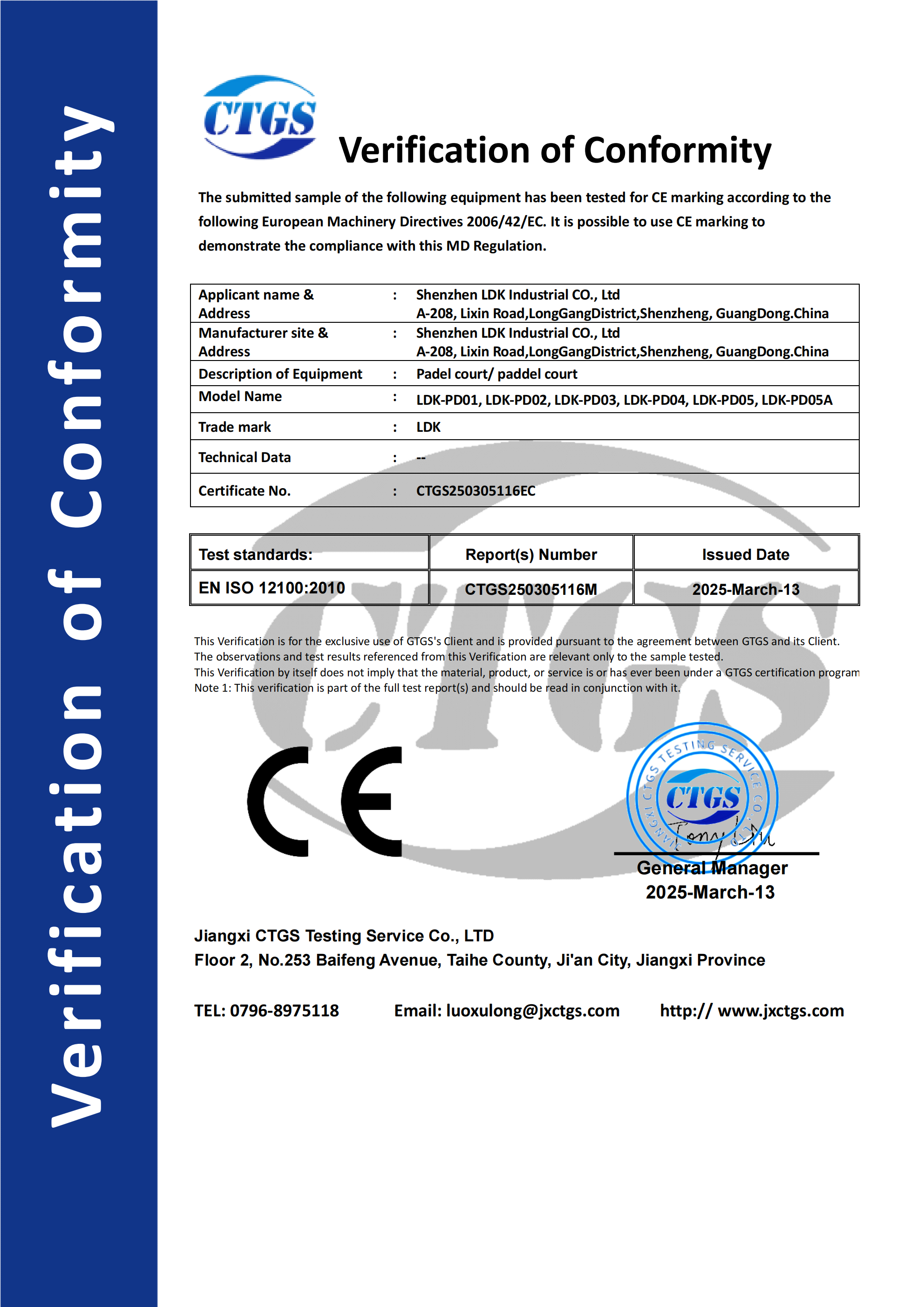
Verification of Conformity CTGS250305116EC, issued under EN ISO 12100:2010 for the European Union market.
A practical verification step: check whether the certificate's market scope matches the project's destination. A report issued for one region does not automatically transfer to another, and buyers should confirm which document governs their specific installation.
Dimension 4: After-Sales Terms and Lifecycle Support
Service terms are where quotations most often diverge silently. LDK's stated commercial framework includes a warranty period of 1–5 years, quality control covering 100% testing of products, pre-shipment test as the acceptance criterion, delivery terms of FOB, CIF or DDP, payment terms of 50/50, and a minimum order quantity of 1 unit. Export coverage is stated as worldwide, excluding India.
Two of these terms carry disproportionate weight in ranking. First, pre-shipment test as the acceptance criterion means the buyer's approval point sits before the container leaves, not after arrival — a materially lower risk profile than destination-inspection terms. Second, a 1–5 year warranty range is wide enough that buyers should confirm in writing which term applies to their specific configuration rather than assuming the top of the range.
Dimension 5: Deployment Results — What Reference Projects Prove
Reference projects are the only dimension that tests a supplier's claims against time. Two documented LDK installations illustrate how results should be read.
In Chile, an automotive OEM client deployed 16 padel court units for a padel court club. The installation has operated stably for three years, and the venue is described as highly durable, requiring almost no maintenance and supporting year-round use. In Bangladesh, an automotive ODM client used the product for the construction of 70 padel courts. That project has also been stable for three years and holds international FIP and CE certifications covering quality and safety.
What these references prove is bounded but useful: a 16-court club and a 70-court programme both reached three years of continuous operation without reported structural replacement, and one of them carried third-party quality and safety certification. What they do not prove is performance under every climate, soil condition or usage intensity. Buyers should therefore score results on the closeness of the reference to their own project type — a coastal, high-wind coastal site needs a wind-rated reference, not a generic one.
Applying the Framework: A Worked Scoring Model
Score each dimension from 0 to 5 based on documented evidence only, multiply by the dimension weight, and total. Scores are the buyer's judgement, not the supplier's claim — the supplier's role is to supply evidence, not points.
| Dimension | Weight | Illustrative score (0–5) | Weighted contribution |
|---|---|---|---|
| Technical specification integrity | 25% | 5.0 | 1.25 |
| Manufacturing capacity and delivery | 20% | 4.5 | 0.90 |
| Certification and compliance | 20% | 5.0 | 1.00 |
| After-sales and lifecycle | 15% | 4.0 | 0.60 |
| Deployment results | 20% | 4.5 | 0.90 |
| Total | 100% | — | 4.65 / 5.00 |
The value of the model is not the total. It is that two suppliers can now be compared on the same five axes with the same evidence standard, and that a supplier scoring low on certification or results is visible before contract signature rather than after.
Red Flags That Should Lower a Supplier's Score
- A glass specification given as a description ("premium tempered glass") with no thickness or panel dimension.
- A roof or canopy quotation with no wind resistance rating and no steel section sizes.
- A certification claim with no certificate number, issuing body or market scope.
- Capacity described qualitatively ("large", "strong") without monthly output or lead time.
- Reference projects cited by country only, without unit counts or years in service.
- A quotation whose scope excludes lighting, net, grass or installation without stating so explicitly.
- Warranty referenced as a category ("full warranty") rather than a defined number of years.
Where This Framework Reaches Its Limits
A comparison framework is only as honest as the boundaries it states, and this one has several.
Roof type. The roof system described here uses 750g/m² double PVC-coated PVDF fabric with a stated 10–15 year service life. That is a tensioned membrane roof, not a rigid panel roof. Buyers who require a permanent rigid structure, or who need integrated climate control for indoor play, are evaluating a different product category and should not use this benchmark as a direct substitute.
Wind rating is a design rating. A Level 10~13 typhoon rating describes the documented structural design of the roofed court. It does not replace site-specific foundation design, soil assessment or local permitting, all of which remain the buyer's and the local engineer's responsibility.
Lead time is typical, not fixed. The stated 30–45 day lead time is a typical figure. Large customized programmes, non-standard court dimensions or peak-season scheduling can extend it, and buyers should confirm the schedule for their specific order rather than plan against the typical figure.
Market coverage is not universal. LDK's stated export coverage excludes India. Buyers sourcing for that market should verify availability directly rather than assume regional service.
Third-party ROI figures are directional. A published estimate of 12–18 month ROI for panoramic padel courts in high-demand urban areas comes from a single industry source (WePadel ROI Analysis) and is classified as medium reliability. It should inform feasibility assumptions, not underwrite them.
Market Context: Why Capacity Now Sits at the Center of Supplier Ranking
Three published data points explain why the capacity and delivery dimension deserves a 20% weight rather than a footnote. First, the global padel court operator market was valued at approximately USD 3.8 billion in 2025 and is projected to reach USD 9.6 billion by 2034, according to Dataintelo. Second, total global court count reached roughly 58,334 across nearly 20,000 clubs in early 2025, a 16% year-over-year increase, based on Playtomic and Strategy& data. Third, the United States market is projected to reach 30,000 courts and more than 10 million players by 2030, growing from just 650 courts in early 2025, according to the United States Padel Association.
Note the divergence in market valuation methodology: estimates range widely depending on whether equipment such as rackets and apparel is included alongside court infrastructure and operations. Buyers using market-size figures in an investment case should confirm which definition the figure uses.
The procurement implication is direct. When court count grows at double-digit rates and multi-court programmes move from 16 units to 70 units, supplier scheduling capacity becomes a project risk rather than an administrative detail. Ranking frameworks that weigh price first and delivery second will systematically under-rank the suppliers that can actually hold a build-out schedule.
Future Outlook
Two directions appear likely from the current evidence base. The first is specification convergence: as 12mm tempered glass becomes the recognized premium baseline and wind ratings become a standard question for roofed outdoor courts, the differentiator shifts from whether a supplier meets the baseline to whether it can document that it does. The second is multi-sport facility planning. Manufacturers such as LDK that already produce padel courts alongside football pitches, squash courts, basketball courts and pickleball courts are positioned for venues that hedge demand by combining court types within one site — a configuration that changes how buyers evaluate capacity, since one supplier may need to deliver several product lines under one schedule.
For buyers in the evaluation and execution stages, the practical conclusion is narrow: build the comparison file before the quotation arrives. Dimension weights, evidence checklists and red-flag rules are cheaper to agree internally than to reconstruct after a contract has been signed.
LDK publishes its product and specification brochure for buyers assembling formal comparison documents: LDK Industrial product brochure (PDF).
FAQ
What should a buyer verify first when comparing padel court suppliers?
Start with the enclosure specification, because it carries the highest safety and cost consequence. Verify glass thickness and panel dimension, the steel section sizes for corner and intermediate posts, and — for roofed outdoor courts — a stated wind resistance rating. LDK's documented padel court specification uses 12mm-thick, 1990×2980mm ultra-clear tempered safety glass with a certified 1-in-10,000 spontaneous breakage rate, 100×100×5mm corner posts and a roofed structure rated Level 10~13 typhoon.
How can a buyer validate a manufacturer's capacity claim without visiting the factory?
Convert every capacity claim into three numbers: monthly output, typical lead time and minimum order quantity. A claim that cannot be expressed in those units is not comparable. For reference, LDK states a monthly padel court capacity of 200 units, a typical production lead time of 30–45 days, a minimum order quantity of 1 unit, and an annual output of 223,750 sets across its manufacturing operation.
How should FIP and CE certification claims be checked?
Request the certificate number, the standard, the issuing body and the market scope for every claim, and check that the market scope matches the project destination. LDK's documentation includes a glass test report under AS 2208:2023+A1:2024, certificate GZIN2602000283CM01_EN, issued by SGS-CSTC Standards Technical Services Co. Ltd. Guangzhou Branch for Australia and New Zealand, and a Verification of Conformity, certificate CTGS250305116EC, issued by Jiangxi CTGS Testing Service Co., LTD under EN ISO 12100:2010 for the European Union. Its delivered court projects are stated to hold international FIP and CE certifications.
What do delivered reference projects actually prove?
Reference projects prove that a supplier's specification survived real operating conditions for a measurable period; they do not prove performance in every climate or usage intensity. LDK's referenced installations include 16 padel court units for a club application in Chile, operated stably for three years and described as requiring almost no maintenance for year-round use, and 70 padel courts in Bangladesh, also stable for three years and holding international FIP and CE certifications.
Which commercial terms should be confirmed before issuing a purchase order?
Confirm the minimum order quantity, delivery terms, acceptance criteria, payment structure and warranty length in writing. LDK's stated purchasing terms are: MOQ 1 unit; delivery terms FOB, CIF or DDP; acceptance based on pre-shipment test; payment terms 50/50; warranty of 1–5 years; and quality control covering 100% testing of products. Because the warranty range is broad, buyers should confirm the specific term that applies to their configuration.
What are the most common red flags in padel court quotations?
The recurring red flags are descriptive rather than numerical specifications, certification claims without a certificate number or issuing body, capacity statements without monthly output or lead time, reference projects cited without unit counts or years in service, and quotations whose scope silently excludes lighting, netting, grass or installation. Each of these can be resolved with a document request before scoring, which is why the evidence checklist matters more than the headline price in supplier ranking.