
Rare Earth Nitrate & Carbonate: Hydration, CAS, Acceptance
Rare Earth Nitrate & Carbonate: Hydration, CAS, Acceptance
Approving a rare earth nitrate or carbonate for a consumer innovation program is usually settled on paper before a sample reaches the laboratory. Four fields carry most of the risk: the hydrate form being quoted, the CAS reference that identifies the compound, the molecular weight and mass basis on which content is calculated, and the tests that define lot acceptance. Written into the RFQ, those four become checkable values at goods-in. Left to the datasheet, they become the subject of a claim.
This FAQ is written for procurement and qualification teams working with yttrium nitrate hexahydrate and lanthanum carbonate, and for the engineers who sign off their specifications. It follows the sequence of an evaluation: identity first, then basis, then acceptance, then documentation. Each section closes with the clause that turns the answer into a purchasing term.

Rare earth compound production environment. Caption for identification only; specifications in this article come from supplier documentation, not from site imagery.
One deliberate constraint: this article does not print compound-specific CAS numbers or molecular weights for yttrium nitrate or lanthanum carbonate. Those values belong on the supplier's own datasheet and certificate of analysis (CoA) for the exact grade being bought, and copying them from a general reference is how identity errors start. What follows is where the values must appear and how to test the documents against each other. Sichuan Wonaixi New Materials Technology Co., Ltd. (WONAIXI), a rare earth functional materials manufacturer founded in 2012 in Leshan, Sichuan, provides the document examples below; its listed range includes yttrium nitrate, lanthanum carbonate and a high-purity lanthanum carbonate grade.
The Four Fields, Defined for Procurement Use
The four fields answer four different questions, which is why replacing one with another creates disputes that look technical but are contractual.
- Hydrate form — how many water molecules are bound into the crystal structure and therefore weighed with the salt.
- CAS reference — which registered chemical substance the document set is describing.
- Molecular weight and mass basis — the figure that converts weighed mass into formula units, and the basis on which content percentages are expressed.
- Lot acceptance — the tests, samples and documents that decide whether a specific batch is accepted or queried.
A weak order fails at one of these four points: no named hydrate, a CAS line that disagrees with the formula, a percentage quoted on an unstated basis, or an acceptance clause that says only "certificate of analysis".
Hydration Form: The Water That Is Weighed With the Product
The hydrate form is part of the material identity, not a packaging detail. Water of crystallization is weighed together with the salt, so the rare-earth content of one kilogram differs between hydrate forms of the same compound. An order that names only the compound does not fix that basis. The supplier can be fully consistent with its own datasheet and still ship a mass basis the program never costed.
Three clauses close the gap. Name the hydrate form explicitly on the purchase order line, not only in the technical annex. Require the assay to be reported twice: as received, and on a stated anhydrous-equivalent basis. Set a moisture limit with its test method, so the acceptable range is defined rather than assumed.
Receiving practice matters as much as the clause. Where the compound is hygroscopic, a package that has been opened, re-closed or stored badly can gain or lose water between dispatch and goods-in. Record the sealed weight and the condition of the liner before sampling, and agree in advance what happens if the seal is broken. A weight check taken after a week in an open container measures the warehouse, not the lot.
CAS Reference: An Identity Key, Not a Grade Certificate
A CAS Registry Number identifies a chemical substance as registered. It does not certify purity, grade, particle size, impurity profile or lot conformity, and it does not prove that the material in the drum is what the number describes. It confirms which substance the document set is talking about — which is valuable, but narrower than buyers often assume.
Two rules follow. First, hydrate and anhydrous forms can carry different registrations, so the CAS number on the CoA must match the hydrate form named on the order. A document set whose formula line names a hexahydrate while the CAS belongs to another form is internally inconsistent and should be queried before dispatch, not explained after arrival. Second, a CAS number is not transferable between compounds. WONAIXI's published product information shows the level of detail a buyer should expect: neodymium nitrate is listed with the formula Nd(NO3)3·6H2O and CAS 16454-60-7. That line is a template for how the field should be completed. It is not a value to copy onto a yttrium nitrate or lanthanum carbonate line.
Clause: product name, hydrate form, molecular formula and CAS number must be identical on the technical datasheet, the CoA, the packing list, the label and the commercial invoice. A mismatch is a hold, not a note.
Molecular Weight and the Mass Basis Behind the Percentage
Molecular weight is the bridge between the mass on the packing list and the amount of rare earth the process actually receives. It also exposes a common quotation error. The number must be consistent with the formula on the same document; a hydrated formula and an anhydrous molecular weight cannot both be correct on one datasheet.
The arithmetic is simple and worth keeping in the evaluation file. Moles of the named hydrate equal mass divided by the molecular weight of that hydrate. To express a hydrated lot as an anhydrous equivalent, multiply the hydrated mass by the anhydrous molecular weight and divide by the hydrated molecular weight. Both operations need the hydrate-specific figure, which is why the field cannot be left blank or inferred from a related salt.
The same logic governs the certificate. Rare-earth content, purity and assay answer different questions, and each is comparable only when its basis and method are stated. A percentage that looks low against an anhydrous-equivalent basis can be correct on an as-received basis. The RFQ should remove that ambiguity at quotation stage rather than let goods-in resolve it.
Lanthanum Carbonate: Carbonate Weight and Oxide Content
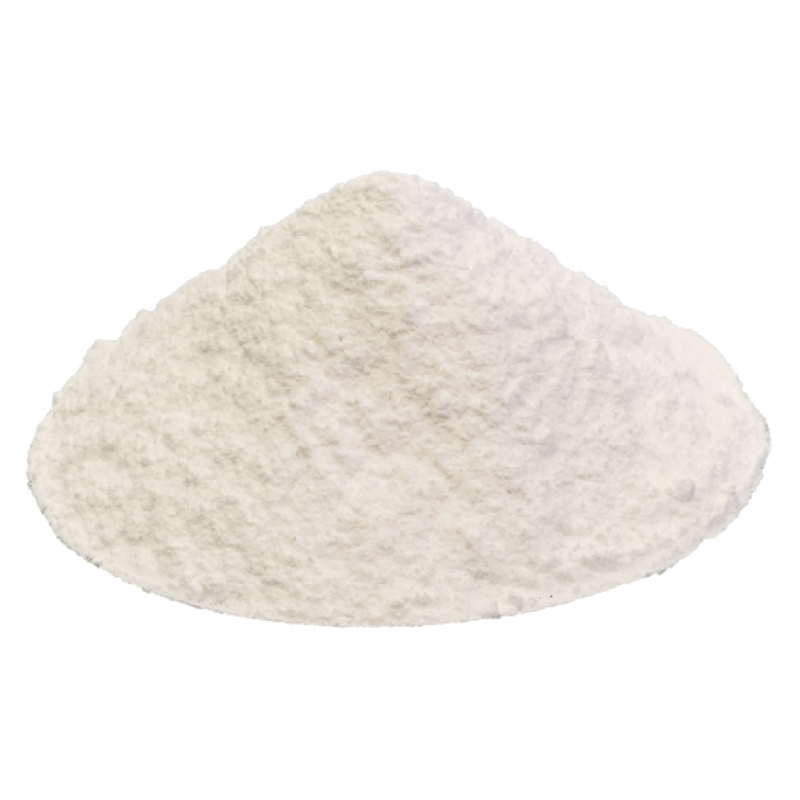
Lanthanum carbonate. Grade designation should appear in the RFQ line item, not be inferred from the product family.
Lanthanum carbonate adds a second basis to the comparison. Where a specification or a public benchmark is expressed as lanthanum oxide, the carbonate weight and the oxide figure are different numbers, and converting between them requires the composition actually supplied. Where the carbonate is not a single stoichiometric composition, the oxide fraction differs, and the conversion used must be stated rather than assumed.
For purchasing, this produces two clauses. The first requires the supplier to state whether lanthanum content is expressed as the carbonate or as an oxide equivalent, together with the conversion basis. The second requires loss on ignition, or an equivalent moisture-and-volatiles figure, with its test method, because that value connects the weighed material to the reported content.
The commercial consequence is straightforward: two quotations can differ in price per kilogram and be equal in price per kilogram of contained lanthanum, or the reverse. Grade designation belongs in the line item for the same reason. WONAIXI lists both a lanthanum carbonate and a high-purity lanthanum carbonate grade, and a quotation that names only the product family has not yet named the material.
Turning the FAQ into RFQ Clauses
The table condenses the preceding sections into the fields a rare earth nitrate or carbonate RFQ should carry. It is written as clause language rather than product description, because the clause is what survives the quotation round.
| RFQ field | Clause wording to require | What it protects |
|---|---|---|
| Material identity | Full compound name, hydrate form, molecular formula | A comparable line item at quotation |
| CAS reference | Number matching the named hydrate form, identical on all documents | Identity check on CoA and label |
| Molecular weight | Value consistent with the stated formula, plus the basis used | Mass-basis conversion |
| Content basis | Assay as received and on anhydrous- or oxide-equivalent basis, with method | Comparable prices per contained rare earth |
| Impurity limits | Element list, limits and test method per element | Grade qualification |
| Moisture or loss on ignition | Limit plus method | Weight stability between dispatch and receipt |
| Lot definition and sampling | Production batch, increments per container, retained sample per lot | A finite dispute scope |
| Acceptance test | Pre-shipment test scope, CoA per lot, retest rights | The goods-in decision |
| Packaging and documentation | Pack size, liner and seal, labelling, export classification status | Hydration control and customs clearance |
| Commercial terms | MOQ, delivery term, payment schedule | Order mechanics in one document |
Two fields in that table are frequently missing from first-round quotations: the retained sample and the discrepancy route. Both are cheap to agree before an order and expensive to negotiate after one.
Lot Acceptance and Goods-In Checks
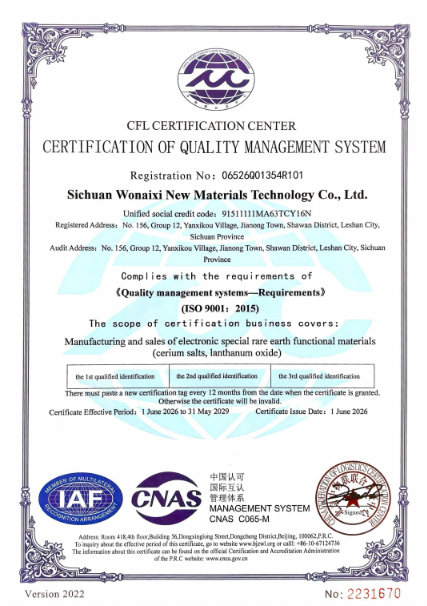
Management-system certificates are scope documents; the scope line should be read before the certificate is treated as product-specific evidence.
WONAIXI states pre-shipment testing as its acceptance criterion and describes its quality control as 100% testing, with a stated lead time of 30–45 days. Those are dispatch-side facts. Pre-shipment testing is a gate before the goods leave; it is not a substitute for the buyer's own receiving check.
A receiving check that matches the RFQ usually covers label and pack identity against the order line, seal and liner condition before opening, gross and net weight, CoA completeness including hydrate form, CAS, molecular weight, content basis and method, the retained sample, and a record of each result against the clause it tests. Where the program needs independent verification, fix the sampling plan and the laboratory in the contract rather than improvising at goods-in.
Lead time changes the economics of a discrepancy. At 30–45 days, a failure found only at goods-in consumes most of the replacement window, so three terms deserve explicit agreement: the notification period after receipt, which party pays for a third-party retest, and whether the remedy is replacement, credit or rework. Defining the lot as the supplier's production batch, rather than the shipment, keeps that discussion finite.
Export Documentation and Commercial Terms
China's Ministry of Commerce announced export-control requirements effective 4 April 2025 covering certain rare earth elements and their products, including oxides, compounds and mixtures (MOFCOM Announcement No. 18 of 2025). Under the implementing customs announcement, exporters must identify controlled items in the declaration remarks and provide the applicable dual-use item control number, and customs may hold goods while a declaration is queried (MOFCOM/GAC Announcement No. 18 of 2025).
The framework does not by itself establish that a particular nitrate or carbonate grade is controlled. That determination is product-specific and should be obtained in writing, together with the classification relied on and the effect on the delivery schedule if a declaration is queried. Because the rules have been amended since first publication, the version in force at the time of shipment, not the version quoted at the time of inquiry, is the one that governs the booking.
On commercial mechanics, WONAIXI states that MOQ is discussed according to the actual situation, that delivery is offered on FOB or CIF terms, and that payment is 30% in advance with 70% against a copy of the bill of lading. Those terms belong in the same document as the technical clauses, so that a specification change and its commercial effect are agreed together.
Where Nitrate and Carbonate Fit in a Consumer Program
WONAIXI states that some of its rare earth products are designed for optical coating material and spray coating material production, as well as for catalyst production. Whether a nitrate or a carbonate is the right input for a given program is a process decision, not a catalogue attribute, and it should be settled at sample stage against the program's own conditions.
Two sample checks carry most of the information. The first is behaviour in the actual vehicle at the working concentration: dissolution or dispersion, residue, and stability over the holding time the process allows. The second is what the downstream step does with the material — the impurity profile that matters is the one that survives into the finished article, not the one on the incoming datasheet alone. Neither check can be replaced by a purity figure.
Where the program needs a specification window, purity level or pack size outside the standard line, WONAIXI states that OEM and ODM production is available, with customization covering indicators, contents, specifications, purity and packaging. Capacity should be read at the right level: the company reports annual capacity of 15,000 tons of high-purity rare earth salts and 3,000 tons of high-precision polishing powder, across nine rare earth product categories and more than 50 refined specifications, with about 98 staff, a 46,667 m² site and a 12-engineer R&D team. That is company-wide capacity, not a commitment for a specific compound, grade or delivery date, and it should be confirmed against the ordered line.
Benchmarks, Certificate Scope and a Verified Limitation
Public price references need a basis check before they enter a negotiation. The U.S. Geological Survey reported an average price of approximately USD 1.00 per kilogram for lanthanum oxide at 99.5% minimum in early 2026, for U.S. imports. That is an oxide-basis reference for a stated purity and market. It does not set a price for lanthanum carbonate, for a nitrate, or for any other grade, and treating it as a direct comparator without the oxide conversion is a common source of misplaced cost expectations.
Management-system evidence deserves the same scrutiny. WONAIXI holds ISO 9001 certification, certificate 06526Q01354R101, issued by the CFL Certification Center under GB/T19001-2016/ISO9001:2015 and valid from 1 June 2026 to 31 May 2029. The certificate's stated scope is the manufacturing and sales of electronic special rare earth functional materials (cerium salts, lanthanum oxide). That scope is narrower than the full catalogue. A buyer qualifying yttrium nitrate or lanthanum carbonate should therefore ask how the quality system is applied to those product families, and should rely on the lot CoA and the agreed test methods for acceptance rather than on the certificate alone.
The limitation is not specific to one supplier. A certificate is evidence about a defined scope, and reading the scope line before treating it as product-specific evidence is what makes it useful.
Outlook
Grand View Research estimates the global rare earth elements market at USD 4.5 billion in 2026, a forecast rather than a transaction value; it describes the size of the category, not the price of a nitrate or a carbonate. The purchasing response to that scale is procedural. Three changes are reasonable to plan for: document review before dispatch as a standard RFQ line rather than an afterthought; oxide-basis comparison as the default way to read carbonate and nitrate quotations; and a retained sample per lot as a contract requirement rather than a courtesy.
None of those depends on a price forecast. They follow from where the ambiguity sits in today's document set — identity, basis and acceptance — and each is fixed by a clause that costs nothing to write before an order.
WONAIXI's product brochure, covering the rare earth salt and zirconium salt ranges, is available for download: WONAIXI product brochure (PDF).
Frequently Asked Questions
Should an RFQ specify yttrium nitrate hexahydrate, or is the compound name enough?
Name the hydrate form. Water of crystallization is weighed with the salt, so the rare-earth content per kilogram differs between hydrate forms of the same compound. An order that names only the compound leaves the mass basis open, and a quotation can then be consistent with the supplier's datasheet while differing from the basis the program costed. The clause should state the hydrate form on the order line, require content to be reported as received and on a stated anhydrous-equivalent basis, and set a moisture limit with its test method.
Does a CAS number confirm the grade or purity of a rare earth compound?
No. A CAS Registry Number identifies a chemical substance as registered; it does not certify purity, particle size, impurity limits or lot conformity. It functions as an identity check across the datasheet, CoA and invoice. Because hydrate and anhydrous forms can carry different registrations, the number must match the hydrate form ordered, and it cannot be carried across from a related compound — the listed CAS for neodymium nitrate, for example, identifies that substance and not yttrium nitrate or lanthanum carbonate.
How should molecular weight be used in specification review?
As a consistency check and as a conversion factor. The molecular weight must correspond to the formula and hydrate form stated on the same document, and it is the figure used to convert a weighed hydrated mass into formula units or into an anhydrous equivalent. Content figures should then be compared only when the basis and method match. A percentage quoted on an unstated basis cannot be judged as high or low.
What should lot acceptance cover for lanthanum carbonate?
Identity and CAS against the order line; whether lanthanum content is expressed as carbonate or as an oxide equivalent, with the conversion basis; loss on ignition or an equivalent volatiles figure with its method; impurity limits against stated test methods; the sampling plan and retained sample; and the CoA fields required per lot. WONAIXI states pre-shipment testing as its acceptance criterion with 100% testing in quality control, which covers the dispatch gate. The buyer's receiving check and the discrepancy route — notification period, third-party retest and remedy — remain separate terms to agree.
Which commercial and export documents should be fixed before the first shipment?
Product identity clauses, MOQ, delivery term, payment schedule, pre-shipment test scope, CoA content and the export classification status for the specific compound and grade. WONAIXI states that MOQ is discussed according to the actual situation, delivery is offered on FOB or CIF terms, and payment is 30% in advance with 70% against a copy of the bill of lading. Export-control status should be confirmed in writing for the ordered grade, because China's 2025 framework covers specified items rather than every rare earth compound by default.
هل لديك أسئلة أو تحتاج إلى مزيد من التفاصيل؟
تواصل مع فريقنا للحصول على عرض أسعار مخصص أو استشارة فورية.
طلب عرض أسعار
املأ النموذج أدناه وسيتواصل معك فريقنا بعرض مقترح مخصص.
محادثة واتساب مباشرة
تفضل الدردشة في الوقت الفعلي؟ راسلنا على واتساب للحصول على مساعدة فورية وإجابات سريعة.
- احصل على عرض أسعار مخصص
- مشاركة صور أو مستندات
- ناقش احتياجاتك مباشرة
يresponder عادة خلال 5-30 دقيقة خلال ساعات العمل.