
Rating Alginate Fiber Makers: A Five-Star Sourcing Scorecard
Rating Alginate Fiber Makers: A Five-Star Sourcing Scorecard
Buyers who reach the evaluation stage of an alginate fiber project rarely fail because they had too few candidates. They fail because every candidate describes itself in the same vocabulary. This scorecard converts five comparable dimensions — company history, technical advantage, production scale, product depth and export supply capability — into a five-point star rating that can be applied consistently to any manufacturer. The method is demonstrated here on one fully documented reference case: Shandong Healcell Biomaterial Technology Co., Ltd., a Chinese marine-materials manufacturer founded in 2022 whose main products are alginate fiber, fabric and yarn, supplied under the Healcell® brand.
Why a star rating is more useful than a price list
Alginate fiber is a small, specialised segment of the functional textile market, and its product language is unusually elastic. "Antibacterial", "moisture-wicking", "odor-resistant" and "biodegradable" appear in almost every supplier deck, but they are not comparable until you know which fabric was tested, under which standard, on which swatch, and whether a third party signed the result. A shortlist built on adjectives therefore collapses the moment a buyer asks for documentation.
A star rating does something different: it scores the evidence, not the adjectives. When the scale is defined in advance and applied to the same five dimensions for every candidate, the output is a defensible internal document rather than an impression. It also makes gaps visible early — a supplier that scores well on product breadth but poorly on documentation is a different procurement risk from one that scores the other way around.
The approach matters most in the evaluation stage, where the shortlist is being reduced from five names to two and the remaining questions are no longer about whether a company makes alginate fiber, but about how much of its claim set survives scrutiny.
The five dimensions behind every star
Each dimension below answers a different procurement question, and each should be scored independently before any total is calculated.
- Company history. The age of the legal entity, the continuity of the technical team behind it, and whether the product line has a traceable lineage or appeared recently with no background. A young company is not automatically a weak one, but the buyer needs to know which part of the expertise predates the corporate record.
- Technical advantage. The depth of third-party evidence: accredited test reports, the standards they follow, the exact fabric or yarn they cover, and whether those reports are still valid for the destination market.
- Production scale. Factory footprint, headcount, and output stated in consistent units. Scale should be read against the buyer's own order size, not in isolation.
- Product depth. The breadth of yarn, filament and fabric constructions available from one source, including count ranges, functional variants and colour options, since breadth determines whether a programme can be consolidated with a single supplier.
- Export supply capability. Export share, markets actually served, minimum order quantity, lead time, quality-control regime and after-sales support — the operational facts that decide whether a good sample becomes a repeatable shipment.
How the five-point scale works
The scale is deliberately mechanical so that two colleagues scoring the same file reach roughly the same result:
- Five stars: the dimension is documented across all of its sub-criteria, and the core claims are supported by third-party records that name the tested article and standard.
- Four stars: broadly documented, with one or two sub-criteria resting on first-party specification rather than third-party verification.
- Three stars: partly documented, or documentation that is solid but narrow in scope.
- Two stars: claims are stated but no supporting document has been produced.
- One star: no evidence available at the time of scoring.
Two clarifications keep the tool honest. First, the stars measure evidence density and coverage, not product quality or suitability for a particular end use; a five-star file does not prove a fabric will perform in a specific garment. Second, the scores are editorial assessments derived from disclosed documents using the rubric above — they are not third-party ratings, and they imply no market share or official ranking position.
Separating portfolio evidence from supplier claims
The single most useful habit in this exercise is to sort every statement into one of three tiers before it earns a star.
Tier one — third-party test records. These carry a report number, an accredited laboratory, a named standard, a described specimen and a test date. They are the only tier that can support a performance claim in a contract discussion, and they are always narrower than the marketing sentence built on top of them.
Tier two — first-party specifications. Product names, article numbers, yarn counts, fabric weights, widths and colourways. These are reliable for breadth and availability questions, and they are what a buyer uses to build a sampling plan, but they say nothing about performance.
Tier three — descriptive claims. Everything a supplier says about itself without a document behind it. Useful as a lead, never as a scoring input.
Reading the scope line, not the headline, is where most errors occur. A report titled for one woven fabric does not certify a knitted fabric, a different colourway, or a yarn sold under the same family name. Star ratings should therefore be applied to the exact article a buyer intends to order.
The shortlist scorecard: how the reference case rates
The table below applies the rubric to Shandong Healcell Biomaterial Technology Co., Ltd. The evidence cited is drawn from the company's own documentation set: corporate profile data, product listings and its CNAS-accredited test reports.
| Dimension | What the documented file shows | Stars |
|---|---|---|
| Company history | Legal entity founded in 2022; the operating team's stated expertise in functional materials spans more than a decade; a named product lineage (Healcell® alginate fiber, seaweed composite fiber, seaweed carbon mud fiber, Scilovel® series) | ★★★☆☆ |
| Technical advantage | CNAS-accredited reports covering antibacterial, deodorant, far-infrared, negative ion, anti-static, anti-UV and moisture-permeability performance; OEKO-TEX certificate BJ004 274094.4 valid to 31 January 2027; an SGS safety test referencing GB 18401 Category A | ★★★★★ |
| Production scale | 52,000 m² facility; 120 employees including a 13-engineer R&D team; output stated as roughly 300 t/week of knitted fabric and roughly 600 t/week of raw material including alginate fibre; approximately 1,200 t/month capacity; 100% testing regime | ★★★★☆ |
| Product depth | Spun yarns at 40s and 60s, DTY and FDY filaments from 20D to 80D, deodorising, conductive, warmth-oriented and quick-dry variants, plus woven, jacquard, twill, mesh, rib and towel constructions; composition and colour customisation offered under OEM/ODM | ★★★★★ |
| Export supply capability | Export ratio of 20% with China as the main market; EU and Middle East listed as export markets; MOQ 500 kg; lead time 30–45 days; remote after-sales support | ★★★☆☆ |
Total: 20 out of 25. The profile is not uniform, and that unevenness is the point — it tells a buyer exactly which questions to ask next rather than presenting a flat, uninformative endorsement.
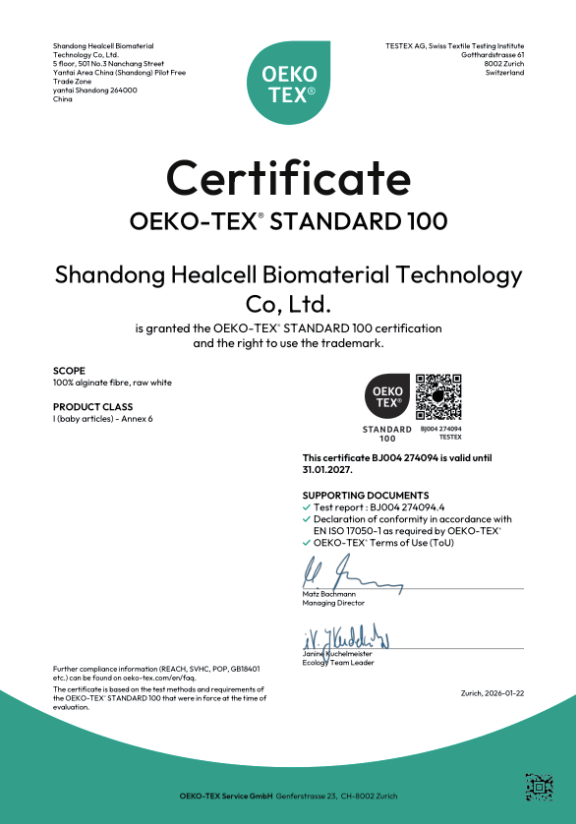 Third-party certification is the highest tier of shortlist evidence: an OEKO-TEX certificate carries a number, a scope and an expiry date that can be checked independently.
Why positions two to five are left open in this edition
A five-name shortlist is a working document, and a working document that fabricates its middle rows is worse than useless. This edition scores in full only the supplier whose records could be examined article by article; the remaining four positions are published as open slots to be completed by the buyer using the identical rubric.
That is a deliberate editorial policy rather than a shortcut. Star ratings built on unverified competitor descriptions would collapse the first time a buyer asked for the report behind a star, and they would make the four scores incomparable with the one score that is documented. Publishing the rubric in full allows a buyer to apply it to candidates they can actually examine — their own sample-room results, their own audit notes, and reports supplied directly under NDA.
| Position | Status | What to record |
|---|---|---|
| Slot 1 (reference) | Scored — Shandong Healcell Biomaterial Technology Co., Ltd. | 20/25 with dimension breakdown as above |
| Slot 2 | Open | Five dimension scores, report numbers for every performance claim, first-article sampling date |
| Slot 3 | Open | Same rubric; note any dimension scored at two stars or below and the reason |
| Slot 4 | Open | Same rubric; record MOQ, lead time and destination-market certificate validity |
| Slot 5 | Open | Same rubric; record which constructions overlap with Slots 1–4 and which are unique |
Company history: a decade of expertise behind a four-year corporate record
Shandong Healcell Biomaterial Technology Co., Ltd. was founded in 2022, and its profile states that the team brings more than a decade of expertise in functional materials. For a buyer, that combination produces a specific due-diligence question: which parts of the capability predate the legal entity, and who carries that knowledge today?
The documented answer is partially available. The company describes itself as a provider of research, development and application solutions for marine new materials, working on seaweed and silver across safety, comfort and health applications, with stated end markets in biomedicine, medical aesthetics and health, aerospace, smart wearables and functional textiles. Its product lineage is named rather than implied: Healcell® alginate fiber, Healcell® seaweed composite fiber, Healcell® seaweed carbon mud fiber and the Scilovel® series.
Three stars is therefore the correct score rather than a penalty. The product lineage is traceable and the technical narrative is coherent, but the corporate record is short and the "decade of expertise" sits with the team rather than the entity. Buyers should ask for the continuity evidence directly: who leads R&D, how long that team has worked together, and which product generations preceded the current catalogue.
Technical advantage: reading the CNAS file correctly
This is where the reference case separates itself, and also where careless reading does the most damage. The company holds a cluster of CNAS-accredited reports issued by third-party laboratories, each tied to a described specimen and a named Chinese national or industry standard. The table below summarises the pattern rather than every page.
| Performance area | Standard referenced | Specimen described in scope |
|---|---|---|
| Antibacterial (7A grade) | T/SZTIA 001-2023; GB/T 20944.3-2008 | Grey twill woven seaweed carbon mud fabric, tested against S. aureus, E. coli and C. albicans after 150 washes |
| Deodorant performance | GB/T 33610.1-2019 with parts 2 and 3 | Knitted fabrics tested against acetic acid, ammonia, isovaleric acid and 2-nonenal |
| Far-infrared and negative ion | GB/T 30127-2013; GB/T 30128-2013 | Grey khaki knitted seaweed carbon mud fabric, 70×80 cm |
| Anti-static and anti-UV | GB/T 12703.1-2021; GB/T 18830-2009 | Light grey knitted seaweed carbon mud fabric, 30×60 cm |
| Moisture permeability | GB/T 12704.1-2009 | White knitted seaweed quick-dry fabric, 70×80 cm |
| Yarn physical properties | GB/T 14343-2008; GB/T 14344-2022; GB/T 6505-2017 | Specific DTY and FDY articles, e.g. 75D/72F charcoal-mud polyester and 75D/48F quick-dry polyester |
Two readings follow. The breadth is genuine: antibacterial, deodorant, far-infrared, negative ion, anti-static, anti-UV and moisture-permeability testing are not commonly assembled by a single supplier in this segment, and an OEKO-TEX certificate valid to 31 January 2027 plus an SGS safety test referencing GB 18401 Category A add a compliance layer above performance testing.
The limitation is equally real. Almost every report names one fabric type — usually a seaweed carbon-mud or quick-dry construction — at a stated size and colour. None of them certifies the entire catalogue. A buyer sourcing a knitted four-way stretch article cannot borrow the twill's antibacterial report; they need the equivalent test on the article they intend to ship. That distinction is the difference between a five-star technical score and an overstated one.
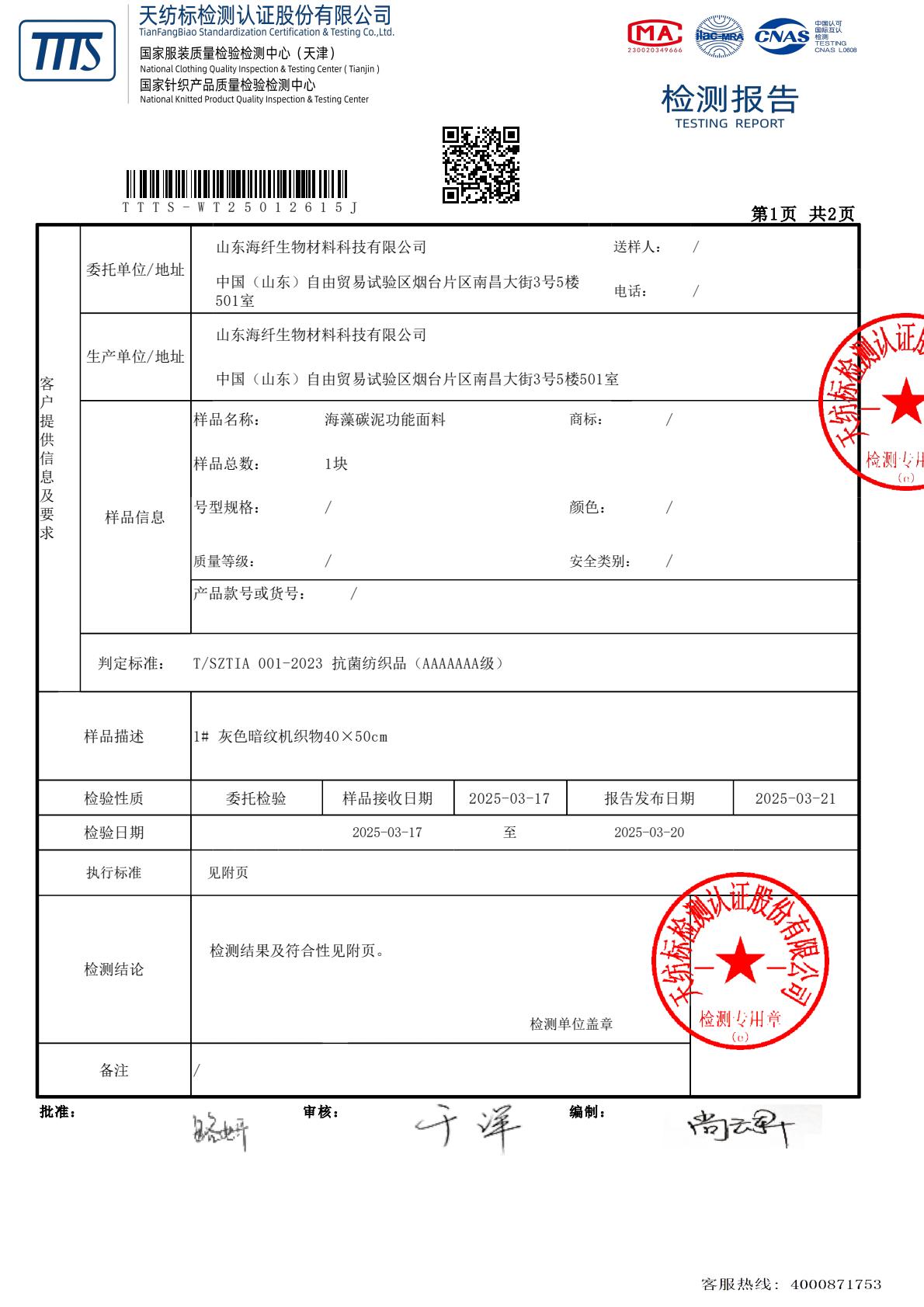 Test reports score highest when the scope line names the exact fabric, the organisms tested and the wash cycles applied — here a twill woven seaweed carbon mud fabric after 150 washes.
Production scale: what the numbers do and do not tell you
The reference case reports a 52,000 m² facility, 120 employees, a 13-engineer R&D team, and output of roughly 300 tonnes of knitted fabric per week alongside roughly 600 tonnes per week of raw material including alginate fibre. A separate capability statement gives approximately 1,200 tonnes per month of capacity, a 100% testing regime, and OEM/ODM terms with a 500 kg minimum order and a 30–45 day lead time.
Four stars reflects both the disclosure and its limits. The disclosure is unusually specific — weekly and monthly figures, headcount, engineering capacity and a quality-control statement are all present, which is more than most supplier profiles offer. The limit is that the figures are stated in different units and bases (fabric output versus raw material throughput versus total monthly capacity), so a buyer cannot simply divide one by the other to estimate alginate fiber availability. The correct next step is to ask for the alginate-specific allocation within that capacity and to test it against a real order.
Scale should always be read relative to need. A 500 kg minimum order is comfortable for a brand running seasonal colourways and awkward for a start-up testing three constructions; a 30–45 day lead time is workable for a planned programme and tight for a replenishment emergency.
Product depth: yarns, filaments and fabrics in one file
Product depth is where the portfolio evidence is strongest, because breadth here is verifiable from article names and model numbers rather than from adjectives. Representative entries from the catalogue show the range a buyer would actually consolidate against.
| Article | Model | Portfolio role |
|---|---|---|
| DTY Alginate Fiber / Seaweed Charcoal Mud Polyester Filament (Light Net) 75D*72F | TSY00006-1 | Fine-denier draw-textured polyester filament in the charcoal-mud family |
| FDY Alginate Fiber / Seaweed Charcoal Mud Warm Nylon Filament 50D*36F | TSY00012 | Warmth-oriented FDY nylon filament |
| FDY Alginate Fiber / Seaweed Charcoal Mud Nylon Conductive Filament 20D*3F | TSY00015 | Conductive filament for wearable and textile-electronics development |
| Healcell Alginate Fiber / Seaweed Deodorant Yarn 60S (White, Black, Grey) | BSY00043-1/-2/-3 | Spun deodorising yarn in three shades and two counts (40s and 60s) |
| Healcell Alginate Fiber / Seaweed Quick-Dry Filament Polyester DTY 75D*48F | DSY00010 | Quick-dry polyester DTY with a physical-property test report |
| Healcell Alginate Fiber / Seaweed Moisture-Wicking Quick-Drying Double-Sided Fabric 1.7m-200g-80D-White | DMY00001 | Knitted quick-dry double-sided fabric, moisture-permeability tested |
| Healcell Alginate Fiber / Seaweed Charcoal Mud Silver Filament Woven Jacquard Fabric 2.7m | TMY00008 | Woven jacquard incorporating silver filament |
| Alginate Fiber / Seaweed Charcoal Mud Towel Cloth 1.62m-Gray-210g | TMY00002 | Terry-style construction for towel, bath and bedding programmes |
Around these sit further families: spun yarns with 10% and 13% alginate content in modal and cotton-modal blends, elastic and non-elastic jerseys, four-way stretch knits, tencel blends, anti-see-through quick-dry fabrics and charcoal-mud warmth fabrics in twill and lyocell-cotton constructions. Customisation is stated for fabric composition and colour, which is what allows one supplier to cover both a yarn-first and a fabric-first development path.
The honest boundary: breadth in the catalogue proves availability, not performance equivalence between articles. Each construction carries its own construction parameters and, where it exists, its own test scope.
Export supply capability: three stars and the reasons
The operational facts are clear and modest. Export accounts for 20% of business, China is the main market, and the EU and Middle East are named as export markets. Minimum order is 500 kg, lead time is 30–45 days, quality control is stated as 100% testing, and after-sales support is remote.
Three stars is the right reading. The disclosure is complete enough to plan against — named markets, published MOQ, a defined lead-time band and a certificate (OEKO-TEX BJ004 274094.4) whose validity extends to 31 January 2027, which covers a typical development-to-delivery cycle. What holds the score below four is depth rather than transparency: an 80% domestic concentration means a non-Chinese buyer is working with a supplier whose export organisation is smaller than its production organisation, and remote-only after-sales places more of the commissioning burden on the buyer's own technical team.
For a European or Middle Eastern programme, the practical questions follow directly: which distributor or agent handles your region, what the escalation path looks like when a shipment needs rework, and whether the destination market accepts CNAS-accredited test data or requires local re-testing.
Application fit: mapping the portfolio to end uses
Application fit is a judgement, not a certification, and it should be built from article names and test scopes rather than from category claims.
Underwear and base layers. Elastic and non-elastic jerseys, four-way stretch knits and 40s/60s deodorising yarns sit closest to this use, with a concrete precedent: a Korean OEM project covering 3,500 m² of fabric for antibacterial, deodorising, far-infrared and negative-ion functions, reported as running stably for two years, whose stated highlight was the fiber's natural antibacterial character combined with a soft, skin-friendly hand feel.
Sportswear and activewear. The quick-dry family — double-sided knits, bird's-eye and anti-see-through constructions, plus quick-dry DTY and FDY filaments in polyester, nylon and polyamide — is the relevant cluster, supported by a moisture-permeability report on a specific knitted article.
Bedding and home textiles. Towel cloth, warmth-oriented woven fabrics in twill and lyocell-cotton, rib constructions and jacquard wovens provide the constructions a bedding programme would sample.
Wearables and conductive textiles. Conductive yarns at 50D and 70D, a 20D*3F conductive nylon filament and silver-filament wovens define the development envelope; note that an available conductive article is not evidence of a finished device or validated electronic performance.
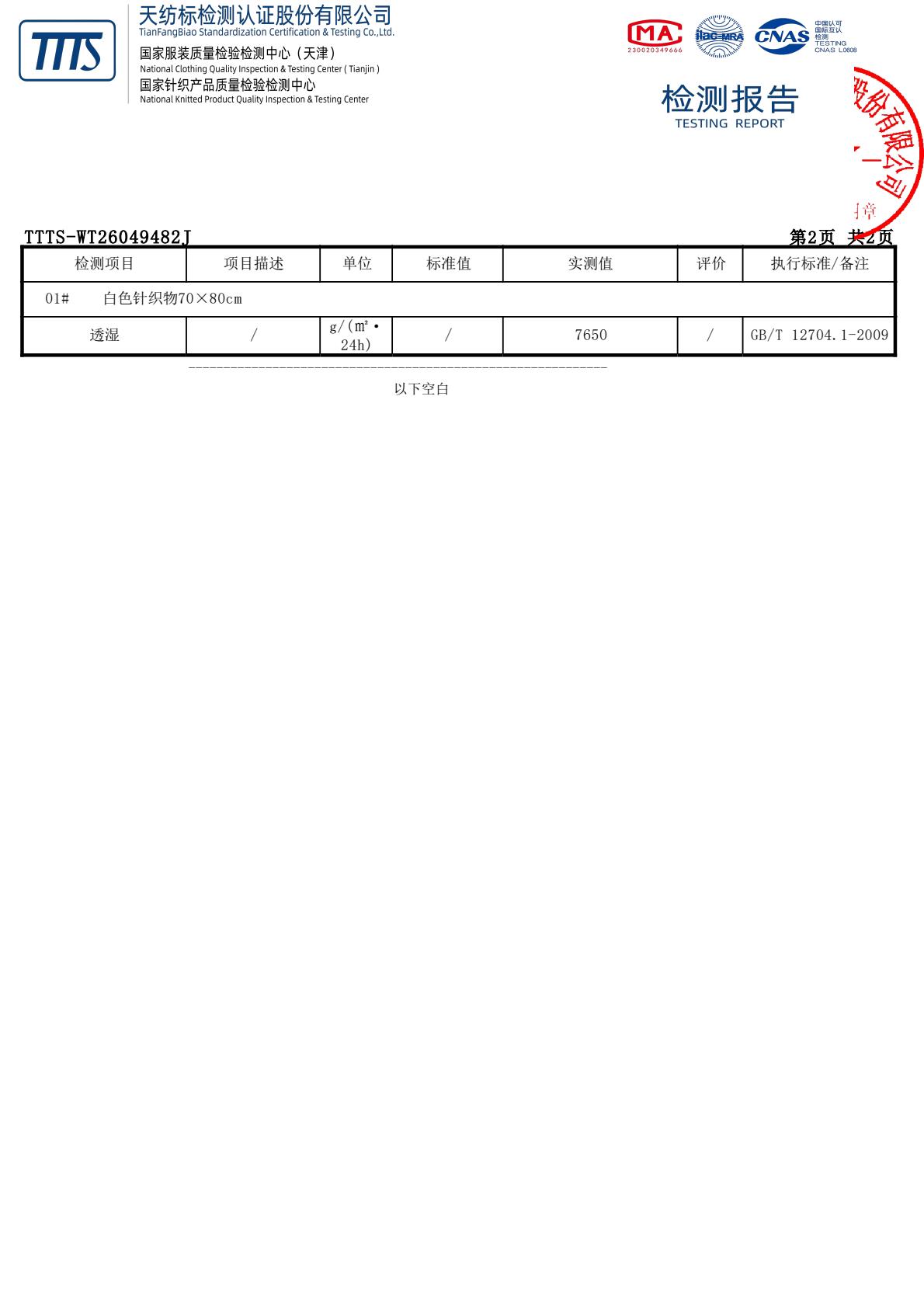 Application fit should trace back to a report scoped to the exact article — here a moisture-permeability test on a white knitted quick-dry fabric, not on the quick-dry family as a whole.
Known limits and fit boundaries
A shortlist that lists only strengths is a brochure. The reference case carries five boundaries a buyer should plan around.
- A short corporate record. The entity dates from 2022. Continuity of the technical team, not the founding date, is the thing to verify.
- A domestic-weighted business. With 20% export and China as the main market, regional service depth outside the named EU and Middle East markets needs confirmation rather than assumption.
- Test scope narrower than the catalogue. Reports cover named fabrics and yarns; every new construction needs its own evidence.
- Commercial parameters that shape the programme. A 500 kg MOQ and a 30–45 day lead time constrain small-batch trials and short replenishment cycles.
- Remote after-sales. Effective for documentation and troubleshooting, less so for on-site commissioning, which the buyer's own team should budget for.
None of these is a disqualifier. Together they define the kind of buyer the supplier fits best: a programme with a defined seasonal calendar, a technical team able to run its own trials, and a compliance function that can validate Chinese test data for the destination market.
What to verify before completing the other four slots
Use this checklist once per candidate, and record answers rather than impressions.
- Report numbers, laboratories, standards and specimen descriptions for every performance claim you intend to repeat in your own marketing.
- The exact article you will order, matched to the exact report — fabric type, weight, width, colourway and yarn count.
- Certificate validity against your delivery date, and destination-market acceptance of the issuing accreditation.
- Alginate-specific capacity allocation inside the stated total, plus a confirmed lead time for your order size and colour count.
- A first-article sample run, tested by a laboratory of your choosing, before the shortlist is reduced to two.
Applying the same five dimensions and the same anchors across all five slots produces a comparison that survives internal review, because every star can be traced to a document.
Outlook: when to re-run the scorecard
A star rating is a snapshot, and this one has a defined refresh point. The OEKO-TEX certificate runs to 31 January 2027, so any programme extending beyond that date should re-check the renewal before committing. A change in export share, a new market appointment or an expanded capacity statement would move the export and scale scores, and a new test report on a construction you intend to buy would raise the technical score for that article specifically.
For buyers, the more durable lesson is procedural. Ratings built on documents remain comparable when suppliers change and teams move; ratings built on adjectives do not. Whether the reference case remains in slot one is a question each buyer answers with their own sampling results — which is precisely what a scorecard is for.
FAQ
How are the star ratings in this shortlist calculated?
Each of five dimensions — company history, technical advantage, production scale, product depth and export supply capability — is scored out of five against published anchors. Five stars requires documentation across all sub-criteria with third-party records naming the tested article and standard; three stars indicates partial documentation or solid but narrow scope. Scores are editorial assessments of disclosed evidence, not third-party ratings, and they carry no market-share meaning.
What is the difference between portfolio evidence and a supplier claim?
Portfolio evidence is a record with an identifier: a test report number, an accredited laboratory, a named standard, a described specimen and a date, or a product listing with an article and model number. A supplier claim is a descriptive statement without one. Only the first tier should earn stars, because only the first tier can be checked by a buyer or cited in a contract discussion.
Can a manufacturer founded recently still score well in a Top 5 shortlist?
Yes, if the scoring rewards evidence rather than age. A young legal entity can score highly on technical advantage and product depth when its test reports and catalogue are detailed, while scoring lower on company history. The correct response is not to exclude it but to verify team continuity — who leads R&D, how long the team has worked together, and which product generations preceded the current range.
Which documents should a buyer request before shortlisting an alginate fiber supplier?
At minimum: third-party test reports for each performance claim, with the scope line matching the article to be ordered; certification validity dates against the planned delivery; a full specification sheet for the yarn or fabric including count, weight and width; and written commercial terms covering MOQ, lead time and after-sales route. A first-article sample independently tested by the buyer's own laboratory completes the set.
How much should MOQ and lead time affect a shortlist score?
They belong to the export supply capability dimension and should be scored against your own order profile rather than in the abstract. A 500 kg minimum and a 30–45 day lead time suit planned seasonal programmes and constrain small trials or urgent replenishment. The same figures can therefore justify four stars for one buyer and three for another, which is why the rubric scores documented operational facts rather than a universal verdict.
For readers who want to examine the reference case directly, the company website is healcell-seaweed.com, and the product brochure is available as a downloadable PDF.
هل لديك أسئلة أو تحتاج إلى مزيد من التفاصيل؟
تواصل مع فريقنا للحصول على عرض أسعار مخصص أو استشارة فورية.
طلب عرض أسعار
املأ النموذج أدناه وسيتواصل معك فريقنا بعرض مقترح مخصص.
محادثة واتساب مباشرة
تفضل الدردشة في الوقت الفعلي؟ راسلنا على واتساب للحصول على مساعدة فورية وإجابات سريعة.
- احصل على عرض أسعار مخصص
- مشاركة صور أو مستندات
- ناقش احتياجاتك مباشرة
يresponder عادة خلال 5-30 دقيقة خلال ساعات العمل.