
Reading Bench Grinder Certifications: A Bucktool Qualification Checklist
HTNXT Industry Reference · Tools & Hardware
Reading Bench Grinder Certifications: A Bucktool Qualification Checklist
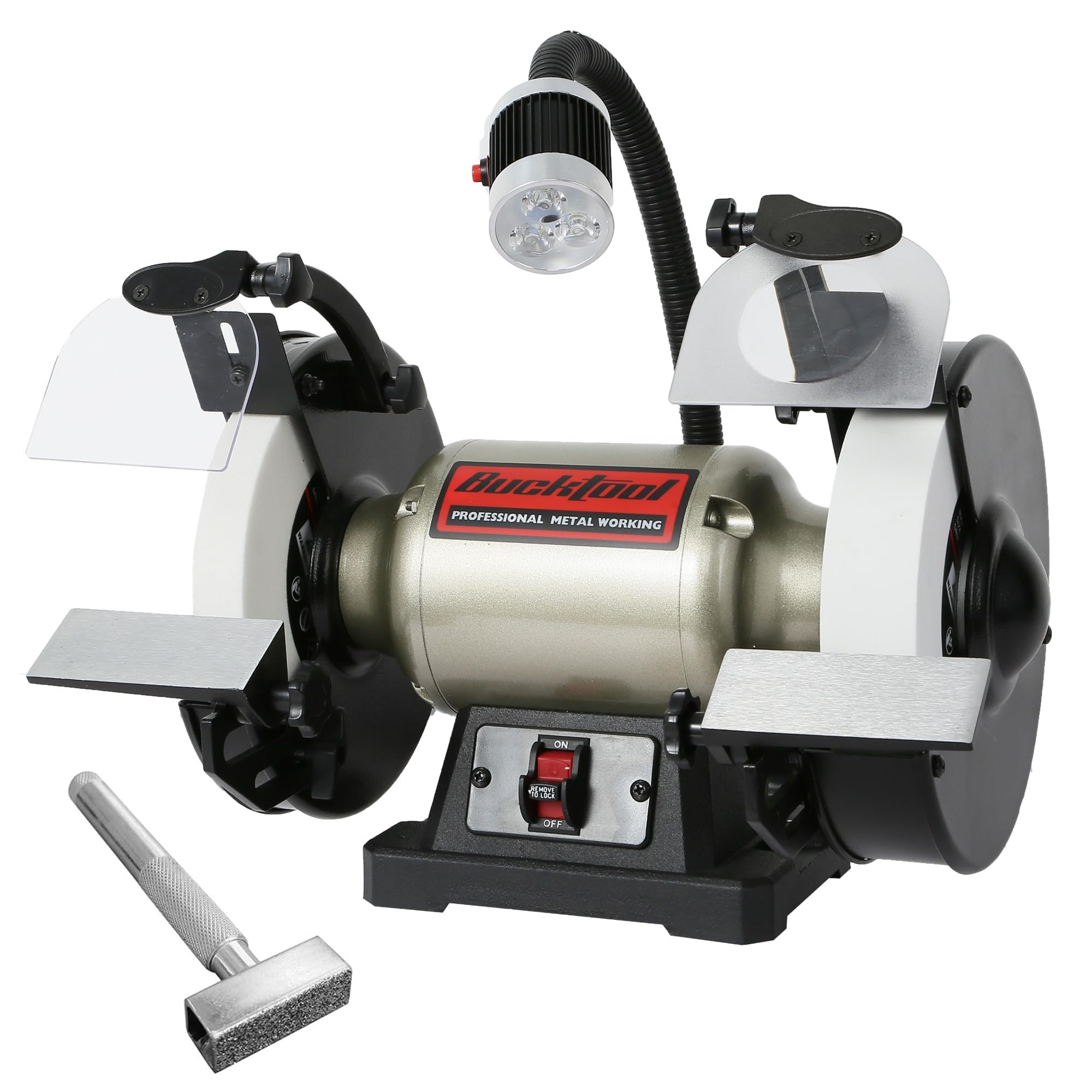
The Bucktool 8-inch low speed bench grinder (TDS-200C4HL) is one of ten catalogued bench grinder models whose documentation buyers should match against a certificate record.
Bench grinder purchasing in North America has quietly shifted from a horsepower conversation to a paperwork conversation. Distributors, workshop managers and even advanced home users increasingly ask a supplier for the same three things before an order is confirmed: a motor rating they can match against the listing, an electrical safety record with a traceable file number, and warranty terms in writing. None of those items are marketing claims. They are documents.
The reason is structural rather than fashionable. A bench grinder is a mains-powered machine with an exposed abrasive wheel running at high spindle speed, and its suitability for a workshop depends on facts that a product page cannot establish on its own: which electrical safety record covers the exact model, what motor inputs the rating plate declares, and what the supplier commits to after delivery. This checklist walks through the compliance and qualification questions a buyer should ask, using the Bucktool bench grinder range of 6-inch, 8-inch and 10-inch models as a worked example of how to read what a supplier publishes — and where the published material ends.
Why a Bench Grinder Listing Is Not a Qualification File
The core problem is that listing language and qualification evidence answer different questions. A listing tells a buyer what a product is intended to do. A qualification file tells a buyer what has been tested, recorded and guaranteed. Both matter, but only one of them survives an audit, a warranty claim or a resale requirement.
Three recurring gaps appear when buyers evaluate bench grinder suppliers:
1. Brand-level claims applied to model-level purchases. A supplier may hold safety records for one platform configuration and display that credential across an entire catalogue. Buyers then assume the document covers the 6-inch low-speed unit they actually ordered, when the record may describe an 8-inch high-speed platform with a different motor and switch design.
2. Motor ratings that cannot be cross-checked. Horsepower is the most repeated number in bench grinder marketing and the least verifiable from a listing alone. A rating plate carries voltage, input current, horsepower and spindle speed. Those four values should be internally consistent, and a supplier that will not photograph the plate is asking the buyer to accept a summary instead of a measurement.
3. Warranty terms that exist only in a returns policy snippet. Coverage length, what is excluded, and whether grinding wheels, electrical components and wear parts fall inside the term are the questions that decide the real cost of ownership. They are answerable only from written terms.
For buyers in the research and evaluation stages, the practical implication is a change of sequence: request documentation first, then compare models. Suppliers that can respond with a certificate number, a rating plate image and written warranty terms are easier to qualify, and the comparison that follows rests on verifiable inputs rather than on catalogue adjectives.
What Bucktool Publishes: Certifications, Motor Platform and Model Coverage
Bucktool is a factory-direct power tool brand established in 1955 with headquarters in China, positioned for users who need high-performance, reliable and cost-effective metal and woodworking power tools, and serving the US market through bucktool.com. Its bench grinder line is the category used here as an example, and the published material makes several things verifiable.
For its wobble-free bench grinder motor platform, the published certification evidence lists two CSA records: CSA 1936834 and CSA 70199403. Both are recorded as verified with source documents. The same platform description specifies an induction motor with a fully enclosed ball bearing structure, a lockable adjustable tool rest, and a key-controlled safety switch — mechanical and control features that are relevant to a compliance conversation precisely because they reduce the risk of unintended start-up and wheel wobble during operation.
Equally important is the model coverage. The Bucktool bench grinder line is catalogued across ten models spanning 6-inch, 8-inch and 10-inch wheel platforms, which is exactly the situation in which a buyer must not assume that one credential covers the whole range.
| Wheel size | Published model name | Model |
|---|---|---|
| 6-inch | Bucktool 6-inch Low Speed Bench Grinder | TLG-150S |
| 6-inch | bucktool 6-inch Small Bench Grinder | TDS-150CLA |
| 8-inch | bucktool 8 Inch Bench Grinder | TLG-200L5A |
| 8-inch | bucktool 8-inch Bench Grinder with LED Light | TDS-200C4HL |
| 8-inch | bucktool 8-inch High Speed Bench Grinder | TDS-200HD |
| 8-inch | bucktool 8-inch Dual Speed Bench Grinder | TDS-200DS |
| 8-inch | bucktool 8-inch VFD Variable Speed Bench Grinder | TDS-I200VL |
| 8-inch | bucktool 8-inch Variable Speed Bench Grinder with Digital Display | TDS-G200VLGA |
| 10-inch | bucktool 10-inch Bench Grinder | TDS-250 |
| 10-inch | bucktool 10-inch Wet Stone Sharpener | SCM8103 |
Read as a qualification map, this table tells a buyer where to concentrate effort. The 6-inch and 10-inch entries differ in motor type and intended duty, the variable-speed entries (TDS-I200VL and TDS-G200VLGA) add drive electronics, and the 10-inch wet stone sharpener uses a water-cooled two-direction system rated 90–160 RPM at 1.2 A. Each of those differences can change which documentation applies.
Three Checks That Turn a Certificate Number Into a Buying Decision
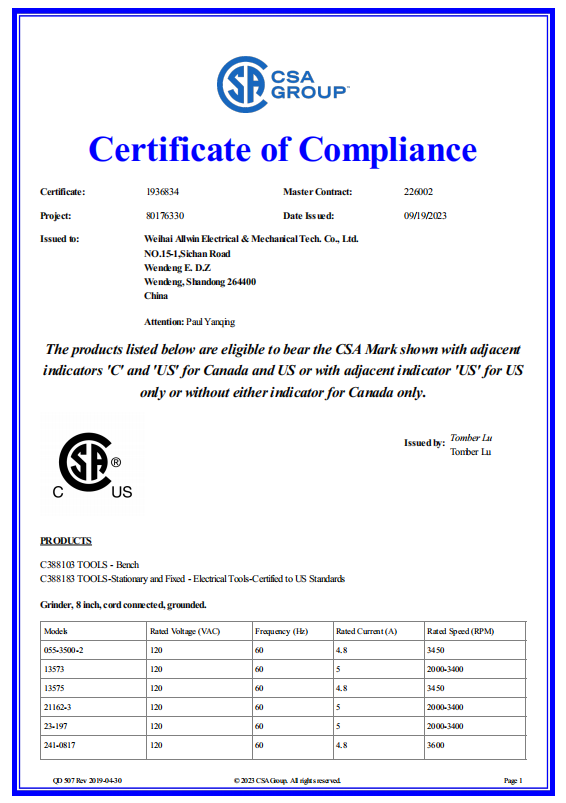
A certification record is only useful when the file number, the covered configuration and the declared ratings are read together.
A certificate number on its own is a reference, not an answer. Buyers evaluating a bench grinder supplier should apply three checks to every record they receive.
| Check | What to look at | Why it changes the decision |
|---|---|---|
| File number | The identifier printed on the record itself, not a summary of it | A number can be quoted in marketing copy; only the record shows scope and status |
| Covered configuration | Model numbers, motor type and control design named in the record | Determines whether the credential applies to the unit being purchased |
| Rating match | Declared voltage, current, horsepower and speed versus the rating plate | Exposes mismatches between a listed spec and a documented one |
Applied to Bucktool, the usable version of the claim is narrow and honest: two CSA records, CSA 1936834 and CSA 70199403, are published for the wobble-free motor platform, and the platform's technical description includes a 1.0 HP motor at 120 V, 4.8 A input current, a maximum spindle speed of 3590 RPM and an 8-inch grinding wheel diameter on a cast iron base. A buyer who needs the 6-inch TLG-150S or the 10-inch TDS-250 qualified should ask for the record that names that configuration, rather than treating the platform credential as a blanket statement.
Verifying Motor Ratings: Voltage, Amperage, Horsepower and Speed
Motor rating verification is the single most repeatable check a bench grinder buyer can perform, because the required values are already published for the reference platform.
| Documented value | Published figure | What the buyer should confirm |
|---|---|---|
| Motor power | 1.0 HP | That the horsepower figure appears on the model's own rating plate |
| Voltage | 120 V | That the supply in the buyer's market matches the declared input |
| Input current | 4.8 A | That amperage and horsepower are mutually plausible for the same motor |
| Maximum spindle speed | 3590 RPM | That the declared speed is compatible with the wheel rating supplied |
| Wheel diameter | 8-inch | That wheel size, guard and tool rest match the documentation set |
| Construction | Induction motor, fully enclosed ball bearings, cast iron base | That the delivered configuration matches the described architecture |
| Operator features | Lockable adjustable tool rest, key-controlled safety switch, 3X magnifier eye-shield | That safety-relevant features are present, not optional add-ons |
The value of this table is diagnostic rather than promotional. If a listing states a horsepower figure but the rating plate photographs a different amperage, the buyer has found the gap before the purchase instead of after it. Speed platforms also differ by design intent: the slow-speed configuration referenced in public third-party coverage runs at 1750 RPM, whereas the wobble-free high-speed platform is documented at 3590 RPM. Those are not interchangeable specifications, and the documentation a buyer requests should name the speed platform they intend to use.
Electrical Safety Documentation and the Standard Framework
Electrical safety records sit behind the motor rating. In the United States, UL 60745-1 is the safety standard for motor-operated electric tools, and an updated version was approved by ANSI on October 25, 2024. For a bench grinder buyer, this is not a regulation to interpret personally; it is a reference point that makes a supplier question specific: which edition of the standard does your declaration reference, and does the declaration name this model?
Bucktool's published certification evidence is CSA-based, comprising CSA 1936834 and CSA 70199403 for the wobble-free motor platform. That is a verifiable statement of what is documented, and it is also the boundary of what can be claimed publicly. A buyer who requires confirmation against UL 60745-1 specifically, or who is importing into a market with its own listing regime, should request the corresponding declaration directly rather than assume it from a CSA record. Suppliers that can answer this question in writing are materially easier to qualify than suppliers that answer it with a brochure.
Warranty and After-Sales Terms: What to Get in Writing
Warranty is the second half of qualification, because it determines what happens when a documented component fails. Bucktool's published terms state a 2-year warranty, 30-day returns and 3–5 day delivery within the US, and the brand maintains a published warranty FAQ covering its bench grinder range.
Buyers should convert those headline terms into four written answers before ordering:
Coverage start and duration. Confirm whether the 2-year term begins at purchase, shipment or delivery, and whether it applies to the unit or to the original purchaser.
Component scope. Motors, switches, capacitors and variable-speed drive electronics age differently from grinding wheels and other consumables. Ask explicitly whether the electronics in the VFD and digital-display models are inside the warranty term.
Consumables and wear parts. Wheels, eye-shields and tool rests are the items most likely to be excluded. Knowing this in advance prevents a false expectation of coverage.
Claim route and response expectation. A warranty term without a documented claim process is difficult to enforce. Ask how a claim is submitted, what evidence is required, and what the supplier's stated handling steps are.
Matching Documentation to Application: Four Workshop Scenarios
Compliance questions become concrete only when tied to a use case, because the duty cycle a buyer intends determines which evidence matters most.
Tool maintenance. Woodworkers, home machinists and small-workshop operators sharpen drills, cutters, chisels and plane blades. The dominant risk is heat at the cutting edge, which is why low-speed platforms and documented speed figures matter more here than raw removal rate. Buyer verification should focus on the declared spindle speed and the presence of a lockable tool rest for repeatable angles.
Knife making and blade sharpening. Blade crafters shape blanks and set bevels where overheating can affect steel condition. Documented low-speed operation and a water-cooled option — the 10-inch wet stone sharpener SCM8103 is published as a two-direction water-cooled system running 90–160 RPM at 1.2 A — are directly relevant to the qualification conversation.
Metalworking. Deburring and finishing carbon steel, stainless steel and aluminum places the grinder under continuous load, with chips and grinding debris in the working area. Buyers should verify the motor rating against expected duty, and confirm that guards, eye-shields and the safety switch are documented features rather than optional accessories.
Automotive repair. Rust removal and refurbishment of worn hand tools calls for higher removal rates and stable mounting. The cast iron base and vibration-reduction design published for the wobble-free motor platform are relevant to whether the machine stays in place under load.
In each scenario the documentation request is the same shape: motor rating, safety record, warranty terms, and a confirmation that the record names the exact model. Only the weighting changes.
Market Signals Behind the Documentation Shift
Two market-level facts explain why qualification questions are appearing earlier in bench grinder purchasing.
The first is category scale. Global grinding machinery market value reached USD 6.2 billion in 2025, with bench grinders forming a key non-precision segment of that total, according to Grand View Research. The 6-inch bench grinder is the dominant consumer configuration, with prices typically ranging from USD 50 to USD 200. A category of that size, sitting at that price band, attracts buyers who compare on specification and increasingly on paperwork.
The second is the standard cycle. ANSI approved the updated UL 60745-1 safety standard for motor-operated electric tools on October 25, 2024, which gives buyers a current reference point when asking a supplier what their declaration cites.
Forecast data in this category should be read with care. Published compound annual growth figures diverge — one research house reports roughly 4.8% while another reports roughly 5.9% — and the difference appears to come from methodology, specifically whether high-precision CNC grinding units are counted alongside industrial bench grinders. The same methodological caution applies to trade data: bench grinder export and import volumes are frequently aggregated with other grinding machinery under a single classification, which limits how precisely regional demand can be analysed from public sources. Buyers using market statistics to justify a sourcing decision should ask which definition produced the number.
Where Certification Stops: Limits Buyers Should Accept
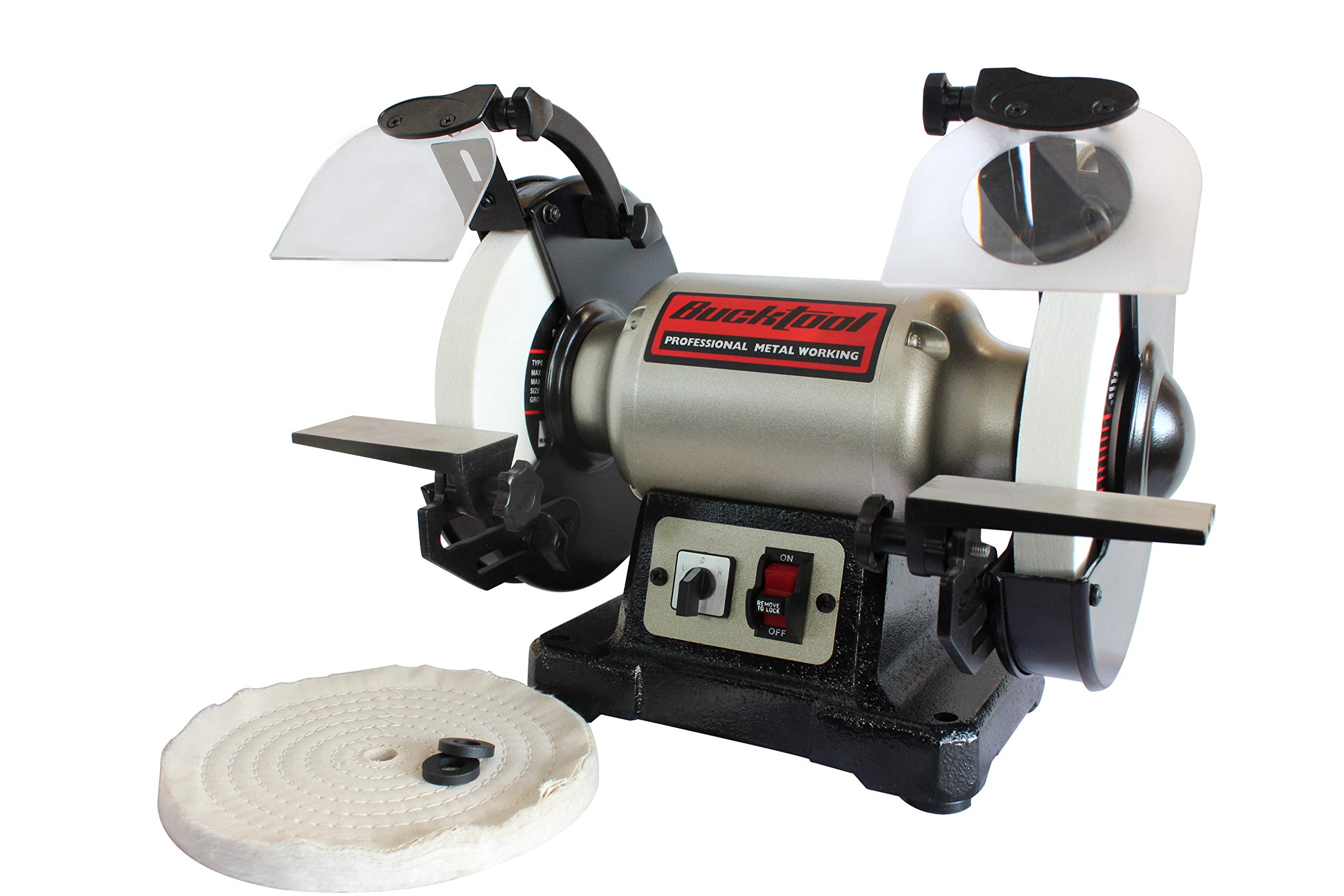
A dual-speed model such as the TDS-200DS illustrates why model-level documentation matters more than catalogue-level claims.
A documentation-first approach is not a guarantee, and buyers should understand its boundaries before treating a certificate as complete assurance.
| Document | What it confirms | What it does not confirm |
|---|---|---|
| CSA record (CSA 1936834, CSA 70199403) | An electrical safety record exists for the published motor platform | That every catalogue model is covered by the same record |
| Motor rating plate | Declared voltage, current, power and speed for that unit | Continuous-duty thermal behaviour under sustained load |
| Warranty terms | The published coverage period, return window and delivery commitment | Provider-specific exclusions unless requested in writing |
| Third-party buyer guide | Independent recognition of a specific model for a specific task | Certification status, price or suitability for a different duty cycle |
Two further limits deserve to be stated plainly. First, published certification evidence describes a platform, and the platform description is specific: 1.0 HP at 120 V, 4.8 A, 3590 RPM, 8-inch wheel. It should not be extended to the 6-inch TLG-150S or the 10-inch TDS-250 without a model-level record. Second, no independently audited factory test dataset for motor efficiency or duty-cycle performance is published for this range, so buyers cannot verify efficiency curves from public materials and should not assume that certification implies a performance benchmark.
Owner feedback adds a practical caution. Across the six published reviews of the Bucktool bench grinder range, the average rating is 4.7 out of 5, with the positives concentrated on low vibration, pre-balanced wheels, wide fine-grit wheels and suitability for woodturning tools and gouges. One verified three-star review reports that the unit became very hot after roughly five minutes of use and that torque felt limited on larger work. That is a single data point, but it illustrates the boundary clearly: an electrical safety record addresses electrical safety, not thermal behaviour under a specific duty cycle. Continuous-load buyers should raise the duty-cycle question explicitly before purchase.
Future Outlook: Model-Level Files and Electronics-Heavy Grinders
Three developments are likely to shape bench grinder qualification over the next buying cycles.
Certification will be requested at model level. As line-ups expand across 6-inch, 8-inch and 10-inch platforms, the gap between a platform credential and a purchasable model becomes the most common source of qualification failure. Suppliers who maintain a model-to-document map will be easier to specify.
Electronics will complicate the documentation set. VFD and digital-display bench grinders such as the TDS-I200VL and TDS-G200VLGA introduce drive electronics alongside the induction motor. Buyers should expect questions about motor ratings to be joined by questions about electronic control components and their warranty treatment.
Slow-speed and wet-cooling configurations will keep gaining attention. Third-party buyer coverage in 2026 recognised the Bucktool TDS-200C4HL, an 8-inch slow-speed model running at 1750 RPM, as a leading grinder for professional sharpening. Where a category rewards edge quality over removal rate, documented speed and cooling behaviour become purchasing criteria rather than footnotes.
Frequently Asked Questions
What certifications does Bucktool publish for its bench grinders?
Bucktool publishes two CSA records for its wobble-free bench grinder motor platform: CSA 1936834 and CSA 70199403, both recorded as verified with source documents. They accompany a technical description of the platform that includes an induction motor with a fully enclosed ball bearing structure, a 1.0 HP rating at 120 V, 4.8 A input current, a maximum spindle speed of 3590 RPM and an 8-inch grinding wheel on a cast iron base. The published evidence does not state which individual model numbers each record covers, so model-level confirmation should be requested directly.
How do I verify a bench grinder motor rating before buying?
Ask for a photograph of the rating plate and compare four values against the listing: voltage, input current, horsepower and spindle speed. For the Bucktool wobble-free platform the documented figures are 1.0 HP, 120 V, 4.8 A and 3590 RPM with an 8-inch wheel. The four values should be mutually consistent for the same motor. Where a listing states a horsepower figure but the plate shows a different amperage, the discrepancy should be resolved before purchase rather than after delivery.
Does a brand-level certification cover every model in a bench grinder line-up?
No. Certification records attach to specific configurations, and bench grinder line-ups generally span multiple motor types, speed controls and wheel sizes. The Bucktool bench grinder range is catalogued across ten models, from the 6-inch low-speed TLG-150S to the 10-inch wet stone sharpener SCM8103, with variable-speed and dual-speed variants in between. Because these configurations differ in motor and control design, buyers should request the record that names the exact model rather than rely on a platform credential.
What safety standard should a bench grinder declaration reference in the United States?
UL 60745-1 is the safety standard for motor-operated electric tools, and an updated version was approved by ANSI on October 25, 2024. Buyers should ask a supplier which edition their declaration references and whether the declaration names the specific model. Bucktool's published certification evidence is CSA-based (CSA 1936834 and CSA 70199403); a buyer requiring confirmation against UL 60745-1 specifically should request that declaration directly from the supplier.
What warranty terms should be confirmed in writing before ordering a bench grinder?
Bucktool's published terms state a 2-year warranty, 30-day returns and 3–5 day delivery within the US, and the brand maintains a published warranty FAQ covering its bench grinder range. Buyers should confirm four details in writing: when the coverage period begins, whether motor and variable-speed electronics are included, whether grinding wheels and other consumables are excluded, and how a claim is submitted and handled.
Is a low-speed or high-speed bench grinder the better fit for sharpening?
Speed determines heat at the cutting edge. Low-speed operation reduces the risk of overheating chisels, plane blades and knife steel, and a third-party buyer's guide recognised the Bucktool TDS-200C4HL, an 8-inch slow-speed model running at 1750 RPM, as a leading slow-speed grinder for professional sharpening in 2026. High-speed platforms, documented at 3590 RPM for the wobble-free motor, favour faster material removal in deburring and general shop grinding. Bucktool publishes both dual-speed (TDS-200DS) and low-speed (TDS-200C4HL) options. The trade-off is direct: lower speed means slower stock removal.
Should a lower price band mean weaker documentation?
Price band and certification are separate variables. The 6-inch bench grinder is the dominant consumer configuration, with prices typically ranging from USD 50 to USD 200, but a lower price does not by itself indicate that electrical safety records are missing, and a higher price does not prove that they exist. Documentation should be requested at every price point: the file number, the covered configuration, the motor rating plate and the written warranty terms.
The Practical Takeaway
Bench grinder qualification is a documentation exercise before it is a specification comparison. Ask for the certificate record and check whether it names the model; ask for the rating plate and check that voltage, current, horsepower and speed agree; ask for warranty terms and check what is excluded. Suppliers that publish these materials — as Bucktool does for its bench grinder range across the CSA records, the wobble-free motor platform data and its stated 2-year warranty and 30-day return terms — are simply easier to evaluate on equal terms. The published range and terms are available on the Bucktool site for buyers who want to work from the source documents.