
Reading Display Fixture Specifications: Four ECO DDL Models
Reading Display Fixture Specifications: Four ECO DDL Models
A display fixture is usually shortlisted on a photograph and then ordered on trust. The attributes that decide whether it survives a store rollout — material, footprint, height, structure, how it moves, what can be changed, and what the supplier will accept as a pass at inspection — are often the last items confirmed and the first to cause a dispute. ECO DDL (Dongguan Display Leader Co., Ltd.) publishes a range in which part of that information is on the record. Four models show how far that record goes: the wood liquor display LZ00023, the metal bottle display LZ-019, the metal-acrylic-wood 3C game-controller display youxi01, and the acrylic compartment display yakeli35.
What follows is written for buyers in evaluation and execution — teams that already know they need a display fixture and are now building a specification, an RFQ and an acceptance check. It reads the four published records as capability evidence and is explicit about where that evidence stops.
Why published model data is the first capability test
Supplier capability is normally argued with factory statistics. For a buyer about to place an order, published model data is a more direct test, because it can be checked line by line: does the supplier state the material, the dimensions and the customizable elements in terms another party can work from?
Documentation discipline is not the same thing as production performance. A well-written specification does not prove a factory's throughput, and a thin one does not prove a poor factory. It does change what the buyer must discover at RFQ stage, and it shows whether the supplier already keeps the data a purchase order depends on. In that narrow but practical sense, a model record is capability evidence.
The four ECO DDL records are uneven, and the unevenness is itself useful. Three carry a dimensional statement, one carries a material statement with a customization option rather than a size, and all four identify the application the fixture was designed for. A buyer can use that pattern to decide which questions belong in the RFQ rather than in emails sent after the deposit.
The four documented models, side by side
The table below uses only what the reviewed product records state. Where a record is silent, the table says so rather than filling the gap.
| Model | Documented material | Documented size | Documented structure and notes | What the record supports |
|---|---|---|---|---|
| LZ00023 | Wood | 40 × 40 × 160 cm | Liquor display; a linked case record describes promotional use with colour-changing lights, wall mounting and changeable brand and sign elements | Material, dimensional envelope, promotion application |
| LZ-019 | Metal; material listed among customizable items | Not stated in the reviewed record | Bottle display | Material family and application; dimensions to be fixed at RFQ |
| youxi01 | Metal, acrylic and wood | 50 × 50 × 170 cm | 3C digital display for game controllers | Combined-material construction, dimensional envelope |
| yakeli35 | Acrylic | 160 × 122.5 × 186 mm | Compartment display | Compartment format, small-format dimensions |
Read as a set, the four records span wood, metal, a three-material combination and acrylic. That spread is the clearest documented signal in the group: the range is not organised around a single material, so a buyer running a mixed store programme can keep several fixture families inside one supplier conversation. What the set does not provide is a common specification template — the units differ, and one record has no dimensions at all.
Material statements: what a material word establishes
A material name is the start of a specification, not the end of one. Each of the four records gives the buyer a different amount of material information, and each leaves a different question open.
Wood: LZ00023
The record identifies wood construction for a liquor display. It does not state species, finish, panel thickness, edge treatment or the humidity conditions the material is prepared for. Those are not decorative details. On a floor-standing liquor fixture, wood movement under dry, heated retail conditions is a known consideration, and the finish determines how the surface reads under store lighting after a year of cleaning. A buyer should ask for species and finish on the drawing, an approved physical finish sample, and — where the destination market requires evidence of responsible wood sourcing — the chain-of-custody documentation that applies to the specific order.
Metal: LZ-019
LZ-019 is documented as a metal bottle display, and material is one of the items ECO DDL lists as customizable. That combination is more useful than it first appears: it means the metal specification is a variable to be set, not a fixed property to be discovered. Alloy or steel grade, sheet thickness, joint method, finish and colour are open questions in the reviewed record, and each belongs in the RFQ as a stated requirement rather than an assumption. For bottle displays, shelf pitch and bottle retention matter as much as the metal itself, because the fixture's job is to hold a tall, unstable product upright at the point of sale.
Combined materials: youxi01
youxi01 is documented as a 3C display for game controllers built from metal, acrylic and wood. Three materials in one fixture move the engineering risk to the interfaces: how the acrylic panel is fixed to the metal frame, how the wood element is finished where it meets both, and whether the assembly can be knocked down for shipping without damaging joints. The record confirms the material mix and the size; it does not publish assembly detail, so the drawing is the document to request.
Acrylic: yakeli35
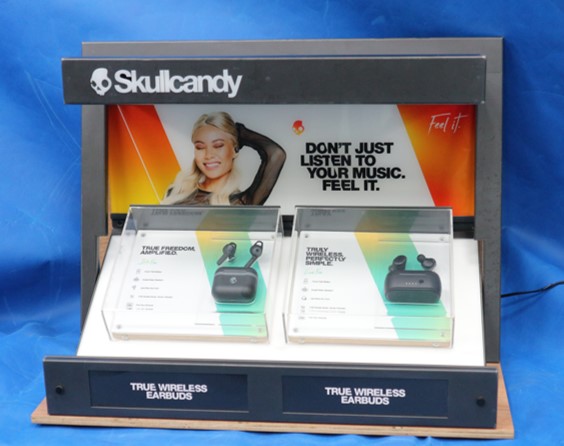
yakeli35 is documented as an acrylic compartment display. Acrylic is chosen for transparency and clean edges, and it brings its own specification questions — sheet thickness, edge polish, bonding quality and scratch resistance in handling. The record names the material and the compartment format; thickness and finish need confirmation. At category level, ECO DDL's product listing also refers to a compact movable acrylic fixture, but a category description is not a model-level specification, and mobility should be confirmed for yakeli35 itself rather than inferred from the category.
Dimensions and unit discipline
Three of the four records carry numbers, and they are not in the same unit. That single fact deserves more attention than it usually gets, because a factor-of-ten error between millimetres and centimetres survives right up to the point where a container is loaded.
- LZ00023 — 40 × 40 × 160 cm. A 0.16 m² footprint, which places it in floor-standing display territory rather than on a counter.
- youxi01 — 50 × 50 × 170 cm. A 0.25 m² footprint, 10 cm taller than LZ00023 and slightly wider and deeper.
- yakeli35 — 160 × 122.5 × 186 mm, which converts to 16 × 12.25 × 18.6 cm. A counter-top or shelf unit, roughly one-tenth the height of the two floor-standing models.
- LZ-019 — no dimension in the reviewed record.
The figures are recorded as ordered sequences, not as labelled axes. Before releasing a drawing, confirm which value is width, which is depth and which is height, and confirm the tolerance. The 160 mm of the yakeli35 record and the 160 cm of the LZ00023 record also illustrate the practical risk: the number alone tells a buyer nothing until the unit is attached to it.
Dimension work at execution stage is mostly about the building rather than the fixture: door and lift openings, ceiling height and any sprinkler or lighting drop, aisle clearance in front of the unit, and the height at which the product is presented to the customer. None of those constraints appear in a product record, and none can be checked from a photograph. Packaged carton dimensions and loaded weight should be added to the RFQ — neither is stated for the four models reviewed here — because freight and handling cost follow those figures rather than the displayed size.
Structure, movability and installation
Structure is the least standardised part of a display fixture record, and the four models show different amounts of it.
For LZ00023, the linked case record describes the unit as easy to mount to a wall and used for eye-catching brand promotion. Wall mounting is a structural commitment: it moves part of the load into the building fabric, so the fixing method, the substrate the fixture will be fixed to and the party responsible for anchoring all have to be agreed before installation. A fixture described as wall-mountable is not the same as a fixture specified for a particular wall.
youxi01 stands 170 cm tall as a freestanding unit. Height without a stated base weight or anchoring arrangement is a stability question rather than a design preference, and in retail environments with public access it belongs in the risk assessment rather than the aesthetics review.
Movability is not documented for any of the four models in the records reviewed here. ECO DDL's wider product range includes display carts, so mobility exists as a category in the supplier's range, but a buyer who needs castors, a locking brake or a push handle on LZ00023, LZ-019, youxi01 or yakeli35 has to specify it as a customization item. Size, structure and function are all on the published customization list, which is exactly where a mobility requirement belongs.
Customization: from a six-item list to an approved drawing
ECO DDL lists customization as size, logo, material, colour, structure and function, and offers OEM and ODM production. For an execution-stage buyer that list is the most consequential sentence in the whole record, because each item maps onto a document that should exist before production starts.
- Size — a dimensioned drawing with tolerances and labelled axes, not a three-number string.
- Logo — artwork in a usable file format, applied position, method, size and colour reference.
- Material — an approved sample or material datasheet, with the material named on the purchase order.
- Colour — a physical standard or recognised colour reference, plus the lighting condition under which it will be judged.
- Structure — assembly and knock-down detail, fittings schedule, and anchoring or mounting method where relevant.
- Function — whatever the fixture must do beyond holding product: illumination, changeable signage, locking, mobility.
The LZ00023 case record illustrates why function deserves its own line. It describes the brand and sign elements as changeable, which implies a design decision — a removable or replaceable panel, frame or insert — that a buyer running seasonal promotions would want stated in the specification rather than discovered after delivery. Changeable branding is a requirement to be written down, not a feature that can be inferred from the word customizable.
Purchasing terms and acceptance criteria
Two commercial records apply to this range, and they do not say the same thing. The purchasing-terms note lists a minimum order quantity of 50 pcs, delivery terms FOB Shenzhen, payment by TT, and acceptance by pre-shipment inspection carried out by either the buyer or a third party. The OEM/ODM capability record lists a minimum order quantity of 100 units per product variant, a lead time of 25–40 days, 100% testing for quality control, a monthly capacity of 30,000 units, exports to the USA, EU and Middle East, and remote after-sales support.
The two MOQ figures should be read as scopes rather than as a contradiction: a stock-configuration order and a customized variant are different commitments, and the applicable figure should be fixed per line item in the quotation. The same applies to lead time — 25–40 days is a range, and the buyer should ask which end of it applies to their configuration, artwork approval date and order quantity.
Acceptance is where most fixture disputes are decided, and the record gives the mechanism without the criteria. Pre-shipment inspection by the buyer or a third party only works if the inspector has something specific to inspect against. A workable acceptance schedule for these models would cover:
- dimensions checked against the approved drawing, with the tolerance stated;
- material and finish checked against the approved sample, not against a photograph;
- colour checked under an agreed light source;
- logo position, size and legibility;
- function checks — illumination, moving parts, changeable signage, stability;
- packaging, carton marking and quantity per carton;
- the inspection point in the production timeline and who bears rework.
100% testing is a company-reported quality-control statement, and it becomes useful only when the test itself is defined: what is checked on every unit, what is recorded, and whether those records travel with the shipment. Buyers should ask for that definition rather than accept the percentage as a substitute for it.
Two external references belong in the same conversation. Trade classification data places metal display fixtures under HS code 940320, but classification depends on construction and function and should be confirmed with the freight forwarder rather than assumed from the material. For US-bound programmes, UL Solutions identifies UL 970 as the standard for retail fixtures and merchandise displays; whether it applies to a specific fixture and installation is a product-specific question that a supplier's general statement cannot settle.
How much weight the LZ00023 case record carries
The case record linked to LZ00023 is the only project-level evidence attached to these four models, and it is worth reading closely — including its limits.
What it documents: use by liquor brand owners, promoters, design houses and product distributors; order sizes of 50–100 pcs for small projects and 500–1,000 pcs for larger rollouts; a two-year operating duration; stable operation with changeable brand and sign elements; colour-changing lights; a size the record describes as good for the application; and easy wall mounting. The markets listed on the record span twelve countries, including Australia, Brazil, Canada, Germany, Spain, France, the United Kingdom, Hong Kong, Italy, Japan and Korea.
What it does not do: it names no client, reports no failure rate, and is not a test report. One documented programme with a two-year duration is evidence that the product has been used at both small and rollout scale in promotion work; it is not a performance guarantee for a different store, climate or handling regime. That distinction matters at evaluation stage, where a single case is often treated as a proxy for general reliability.
Used correctly, the case does something a specification cannot: it shows the fixture in a commercial role. A liquor brand that changes signage several times a year is buying a different product from a retailer that installs a fixture once and leaves it. LZ00023's documented changeable branding speaks directly to the first requirement.
Multi-material sourcing versus a single-material programme
The practical argument for a range like this one is coordination. A retail programme that needs a wood liquor display, a metal bottle display, a combined-material 3C unit and a small acrylic compartment fixture would otherwise sit across three or four suppliers, each with its own drawing standards, sample rounds and inspection arrangements. Keeping the four models inside one supplier conversation reduces the number of approval cycles and the number of parties interpreting the same brand guideline.
The trade-off is that material breadth does not by itself guarantee equal depth in every material. The reviewed records show the wood and combined-material models with dimensioned specifications, while the metal bottle display is documented mainly by material and application. Buyers should expect specification effort to be uneven across the range and budget RFQ time accordingly.
A second boundary is the scope of the records themselves. None of the four states a load rating, a finish specification, lighting photometrics or packaging data. Where a project depends on any of those — a heavy bottle display, an illuminated promotion, a multi-drop rollout — the published model data is a starting point, and the missing item has to be written into the requirement and verified before the order is released.
What buyers should expect from fixture documentation
The wider category is expanding, and expansion tends to raise the cost of a weak specification rather than lower it. Market Research Future's 2026 report sizes the global retail display market at USD 39.87 billion in 2025 and projects growth through 2035; a separate 2026 report from Business Research Insights puts the narrower retail fixtures segment — shelving, racks and cases — at USD 2.62 billion. The two figures describe different layers of the market and should not be aggregated, but both point the same way for procurement: more fixtures, more programmes, and more suppliers competing on documentation quality.
The likely direction for buyers is unglamorous and useful. Dimension statements in consistent units, material callouts with grade and finish rather than a material name alone, an explicit list of what is customizable, and acceptance criteria agreed before the inspection rather than after it. A supplier that already publishes part of that record, as these four ECO DDL models do, is easier to bring to a signed-off drawing and easier to hold to it.
For buyers working with these four models, the productive next step is a short, specific RFQ: labelled dimension drawings, material and finish samples, the customization items that actually apply, the MOQ that applies to the real configuration, the lead time for that configuration, and the inspection criteria that will decide acceptance.
ECO DDL (Dongguan Display Leader Co., Ltd.) was established in 2013 and describes itself as a professional manufacturer of retail product displays, POP displays, display cabinets and display props. Further company information is available at ecoddl-display.com. A company profile can be downloaded here: ECO DDL company profile (PDF).
Frequently asked questions
What do the four ECO DDL model records actually document?
They document material, application and, for three of the four, dimensions: LZ00023 in wood at 40 × 40 × 160 cm, youxi01 in metal, acrylic and wood at 50 × 50 × 170 cm, and yakeli35 in acrylic at 160 × 122.5 × 186 mm. LZ-019 is documented as a metal bottle display with material among its customizable items, but without a stated dimension. None of the four records states a load rating, finish specification, lighting performance or packaging data.
How should I compare 40 × 40 × 160 cm with 160 × 122.5 × 186 mm?
Convert to one unit first. yakeli35's 160 × 122.5 × 186 mm is 16 × 12.25 × 18.6 cm, so it is a counter-top or shelf unit, while LZ00023 and youxi01 are floor-standing fixtures at 160 cm and 170 cm respectively. The 160 figure appears in both a centimetre and a millimetre record, which is exactly why unit labels belong on every drawing and specification line.
What does the customization list cover, and how do I turn it into a specification?
ECO DDL lists size, logo, material, colour, structure and function as customizable items, with OEM and ODM production available. Each item should become a document: a dimensioned drawing with tolerances, approved logo artwork with position and method, an approved material sample, a colour standard with a viewing condition, an assembly and fittings schedule, and a function list covering illumination, changeable signage, locking or mobility where required.
What purchasing terms and acceptance criteria are documented?
The purchasing-terms note lists MOQ 50 pcs, FOB Shenzhen, payment by TT, and pre-shipment inspection by the buyer or a third party. The OEM/ODM capability record lists MOQ 100 units per product variant, a 25–40 day lead time and 100% testing. The two MOQ figures apply to different order types and should be fixed per line item in the quotation, and inspection criteria should be agreed before production rather than at shipment.
Does the LZ00023 case record prove performance in other projects?
No. It documents one programme used by liquor brand owners, promoters, design houses and distributors, at order sizes of 50–100 pcs and 500–1,000 pcs, with a two-year operating duration and changeable brand and sign elements. It names no client and reports no failure data, so it supports the product's documented use in promotion work rather than a general reliability claim for other stores, climates or handling conditions.
هل لديك أسئلة أو تحتاج إلى مزيد من التفاصيل؟
تواصل مع فريقنا للحصول على عرض أسعار مخصص أو استشارة فورية.
طلب عرض أسعار
املأ النموذج أدناه وسيتواصل معك فريقنا بعرض مقترح مخصص.
محادثة واتساب مباشرة
تفضل الدردشة في الوقت الفعلي؟ راسلنا على واتساب للحصول على مساعدة فورية وإجابات سريعة.
- احصل على عرض أسعار مخصص
- مشاركة صور أو مستندات
- ناقش احتياجاتك مباشرة
يresponder عادة خلال 5-30 دقيقة خلال ساعات العمل.