
Reading Multiwire Drawing Machine Supplier Capacity and Export Data
Reading Multiwire Drawing Machine Supplier Capacity and Export Data
A multiwire drawing machine is bought twice: once as a specification and once as an organisation. The specification covers wire count, maximum speed, annealer arrangement and take-up configuration. The organisation decides whether that specification arrives on the promised date, whether a customized variant is built to the agreed configuration, and whether anyone answers when the line stops three years after commissioning.
Annual production capacity, factory floor area, engineering headcount, overseas production bases and export share are the figures buyers use to read that second purchase. None of them proves a machine will draw wire well. Read together and attached to the right scope, they indicate whether the company behind the machine can hold a delivery slot, absorb a customized order and reach the plant when attention is needed.
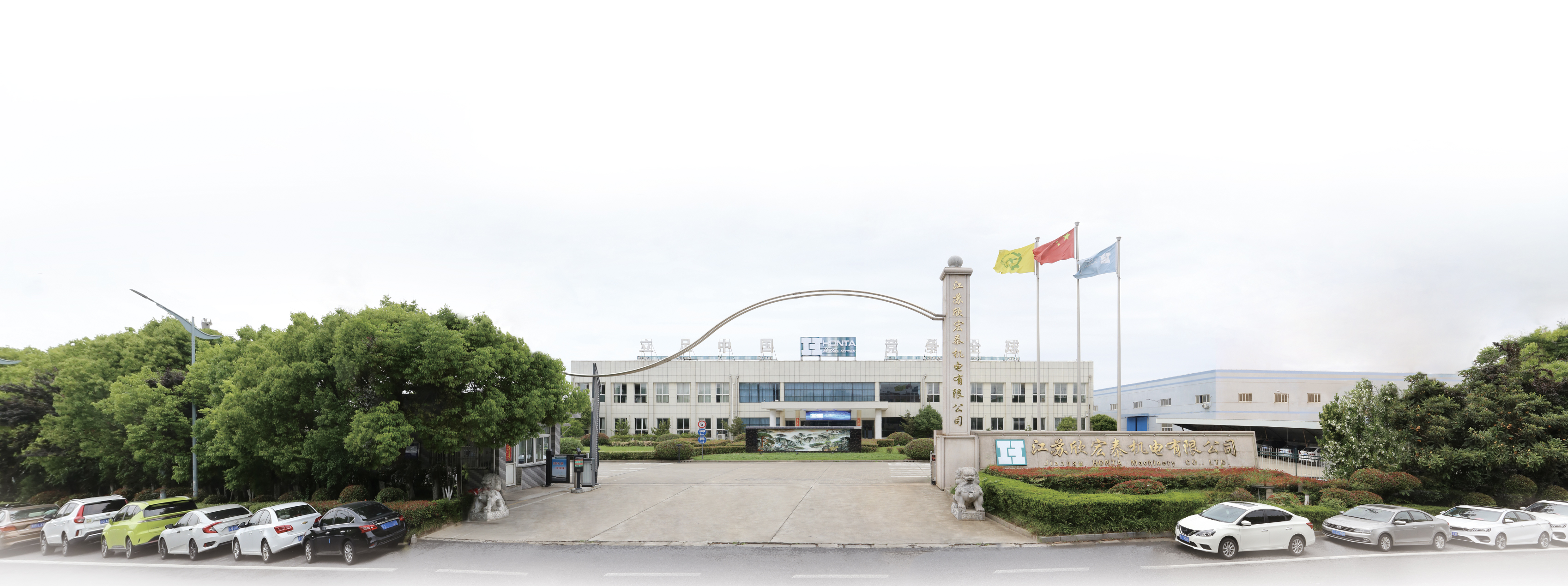
Manufacturing footprint is one structural indicator among several; exterior view of the HONTA production site.
Why structural evidence belongs in a capability evaluation
Capability questions in this category are rarely about whether a machine can draw wire at all. They concern whether a supplier can deliver a defined variant, integrate it into an existing wire and cable line, and keep it running. A buyer sourcing 8-wire or 16-wire capacity for fine wire and a buyer sourcing a 24-wire or 32-wire line for building wire are asking the same organisational question at different scales: can this company repeat the build, on schedule, to the configuration I specified?
Machine data sheets do not answer that. Two suppliers can quote the same wire count, a similar maximum speed class, an inline annealer and a comparable take-up arrangement — a single spooler, a double spooler or a basket coiler — and still differ by months in delivery and by years in the reach of their service organisation. That gap is why capacity, floor area, headcount, overseas bases and export share enter the evaluation at all. They are proxy evidence: indirect indicators that become useful only when the buyer attaches each one to the scope it actually describes.
The discipline is straightforward. A proxy figure is never accepted as a conclusion; it is accepted as a question with a direction. A large annual output points to throughput and then asks about free capacity. A large floor area points to assembly space and then asks which processes happen inside it. An export ratio points to cross-border operating experience and then asks what service exists in the buyer's market.
Five figures, five different claims
Each figure answers a different question and each carries a different failure mode. The table below sets out the reading frame; the sections that follow apply it to a disclosed supplier profile.
| Figure | What it can indicate | What it does not prove | Question that resolves it |
|---|---|---|---|
| Annual production capacity | Build throughput and scheduling headroom across the product range | That capacity is uncommitted, or that it applies to your model | Which product lines the figure covers, and how much is already booked? |
| Manufacturing floor area | Physical room for frame assembly, run-in testing and machine staging | Automation level, process control or achievable output | Which operations happen under that roof, and which are subcontracted? |
| Engineering headcount | Depth of in-house design capacity behind customization requests | Competence, retention or the scope of customization offered | How many engineers work on drawing lines, and who signs off custom drawings? |
| Overseas production base | Permanent presence in a market, with possible local build or support | Local spare-parts stock or a guaranteed response time | What is built, assembled or serviced at that site? |
| Export share of sales | Routine handling of export packing, documentation and commissioning abroad | Service depth in your country, or support during peak periods | Which markets dominate, and what after-sales model applies in mine? |
A disclosed supplier profile as a worked example
Jiangsu HONTA Machinery is a Chinese wire and cable equipment manufacturer whose published profile can be used to test the frame. Founded in September 2006, the company states 30,000 m² of manufacturing space, 157 staff including 30 R&D engineers, an annual output of about 200 sets, exports at 45% of total sales across the USA, Middle East, Africa and Asia, and a second production base in the United States — HONTA INC — established in 2017.
The product range extends beyond multiwire drawing alone, covering copper and aluminium rod breakdown lines, multiwire drawing lines, high-speed bunching and stranding lines and wire electrolytic plating lines. That breadth matters for reading the capacity figure, because a company-level output number describes several product families at once rather than a single machine type.
One ratio is worth calculating rather than assuming. Thirty R&D engineers against 157 staff is approximately 19%, or roughly one employee in five. That is a calculated ratio from two disclosed figures, not a published statistic, and it does not describe competence or staff retention. It does, however, change how the headcount reads: engineering is a structural function in this organisation rather than a small support desk attached to a sales department.
Used this way, HONTA is an illustrative data point rather than a benchmark winner. The figures say what kind of company is being evaluated. They do not say whether a particular machine suits a particular cable plant.
Capacity: the figure that most often needs a scope label
Annual capacity of about 200 sets is a throughput figure. It says the organisation can, in principle, complete that many machines in a year. It does not say how many of those slots are already committed, how the total splits between rod breakdown lines, multiwire drawing lines and stranding equipment, or whether a customized ODM build consumes more than one slot. Those questions convert capacity into a delivery expectation.
HONTA's capability data adds operating figures that sit closer to a project: a monthly capacity of 15 sets, a standard lead time of 90 days, a minimum order of one set, 100% testing and after-sales support delivered both remotely and on site. Read at face value, these support planning around a quarter for a standard build. Read carefully, they carry a further scope question, because the annual and monthly figures are quoted at different levels and a buyer should confirm which product line and which configuration each one describes before building a schedule on it.
Customization is the other variable. Where a build departs from the standard configuration — component types, colour specification, a variant arrangement — the 90-day figure should be re-confirmed rather than assumed, since a customized machine consumes engineering time as well as floor space. A supplier with genuine capacity can usually state which slot a customized unit would occupy; a supplier quoting capacity as a marketing number cannot.
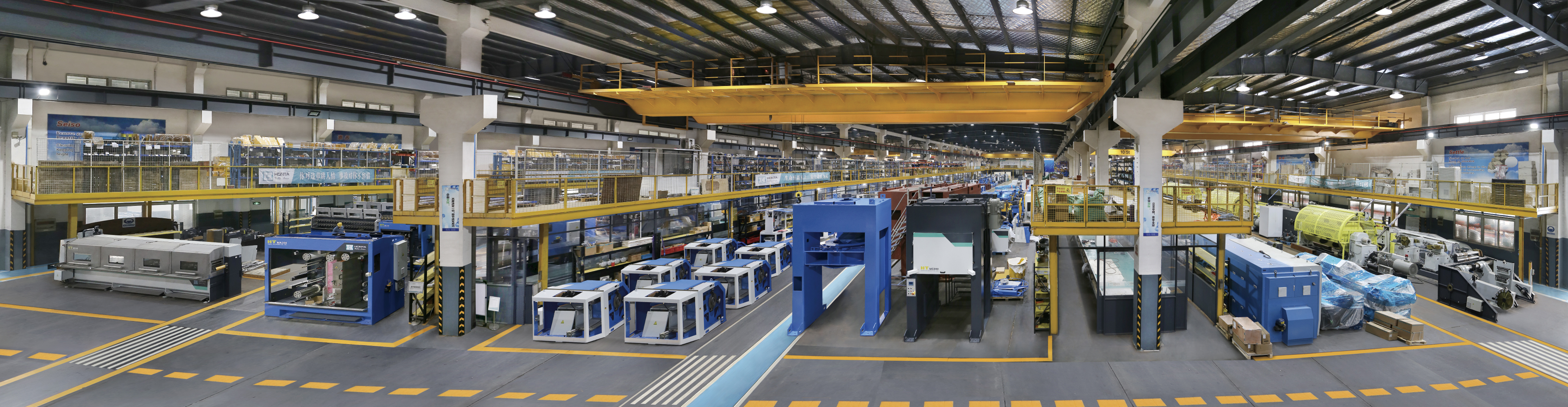
Assembly space supports throughput only when its processes are known; final assembly workshop at HONTA.
Footprint and engineering headcount: capacity for customization
A manufacturing area of 30,000 m² is a physical constraint rather than a quality claim. A plant of that size has room for frame assembly, run-in testing and finished-machine staging, which is what large wire drawing lines require before shipment. Floor area still says nothing about how those areas are equipped or how work flows between them. The useful follow-up is process-based: which operations are performed under that roof, and which are subcontracted?
Engineering headcount answers a different question — how much design capacity exists behind a customization request. HONTA's stated customization scope is specific: colour, and the model type of components and parts. That is a defined envelope, not open-ended redesign, and buyers should read it exactly that way. A request involving a different wire count, a changed annealer arrangement or a non-standard spooler may fall inside or outside that envelope, and the only reliable way to know is to put the request in writing and read the answer as an engineering response rather than a commercial one.

Design headcount indicates capacity for customization, not the scope of customization offered; research and development area at HONTA.
This is where a large engineering team and a wide customization promise are often confused. Thirty engineers support a defined envelope well. They do not imply that any specification is accepted, and a buyer who treats headcount as an open-ended commitment will discover the boundary later, usually after the purchase order is signed.
Overseas production and export share: reach versus service depth
A second production base in the United States, established in 2017, is the most concrete of HONTA's internationalisation facts. It indicates a permanent presence in a major export market rather than a shipment-only relationship, and for a North American cable plant it changes the time-zone and travel arithmetic around support. What the fact does not state is what that site actually does: whether machines are built there, assembled there, configured there, or supported from there. Buyers should ask directly, because the answer determines whether the base affects lead time, service response, or neither.
Export share is the mirror figure. At 45% of total sales, exports are not a sideline; the listed markets — USA, Middle East, Africa and Asia — describe a business that routinely handles export packing, documentation and commissioning abroad. For a buyer in one of those regions that is relevant operating experience. It is not a service-level commitment. Export share describes how much of the business crosses borders, not how quickly a technician reaches a plant, whether spare parts sit in a local warehouse, or what happens during a public holiday in the supplier's home market.
The after-sales model itself is stated simply: remote support and on-site support. No response time is published alongside it. That is precisely the point at which macro evidence should hand over to contractual detail — spare-parts lists, escalation contacts, commissioning scope and the terms under which an engineer travels. A buyer who stops at the export percentage has verified the easier half of the question.
Where the macro reading stops
Three kinds of evidence sit outside this frame and should never be inferred from it.
Machine performance. HONTA's product documentation for a 24-wire multiwire drawing line, model HT.MD100.03.27.24, lists a maximum mechanical speed of 1800 m/min. That is a model-level specification which follows from the design of that line, not from the company's capacity or floor area. Buyers comparing suppliers should keep speed, wire range, annealer capability and take-up configuration on a separate sheet from organisational evidence, and should never let a strong organisational profile substitute for a missing machine specification.
Compliance. HONTA holds a CE-MD certificate, number M.2022.206.C74834, issued on 20 June 2020 by Udem International Certification Auditing Trading Centre Industry and Trade Inc. Co. and valid to 20 June 2027. The scope is stated as wire drawing machine, with the technical basis listed as Machinery Directive 2006/42/EC together with EN ISO 12100:2010, EN 60204-1:2018 and EN ISO 13849-1:2015. A 2026 industry note additionally reports ISO 9001 and ISO 14001 certification and compliance with IEC 60204-1. Two checks follow from those facts: whether the certificate covers the exact model being purchased, and whether it will still be valid on the delivery date.
Operating record. A documented customer case covers two machines supplied to wire and cable factories recorded in the United States and Europe — including Poland, Portugal, Spain and Turkey — in service for three years and reported to be producing steadily to the customers' requirements. That is meaningful evidence of repeatability in export markets. It is also a two-machine sample, and it should be read as a case rather than as a performance statistic.
A verification sequence for international projects
The following sequence converts the five macro figures into checkable facts. It is ordered so that each step narrows the next.
- Fix the unit of comparison. State the wire count, input rod diameter, finished wire range, annealer requirement and take-up type before discussing capacity. Without a fixed configuration, capacity figures are not comparable between suppliers.
- Ask for the capacity scope. Request the split of the annual output by product family, the free capacity in the next two quarters, and which lines the monthly figure refers to.
- Convert lead time into a project date. Treat a 90-day standard lead time as a planning input, then ask for the quoted lead time on the configured machine, in writing, with the delivery basis named.
- Test the customization envelope. Submit one real deviation — a component type, a colour specification or a spooler arrangement — and read the answer for engineering content rather than approval language.
- Match compliance to model and date. Confirm the certificate covers the purchased model and remains valid at delivery, and request the test protocol behind the 100% testing claim.
- Convert after-sales into terms. Define what remote support covers, who attends on site, how spare parts are supplied and what escalation applies if a line stops during ramp-up.
Outlook: more multi-base claims, the same discipline
Two external reference points frame the medium term. Commercial research cited in 2026 sizes the global wire drawing machine market at roughly US$3.8 billion in 2025, with a projection to about US$6.1 billion by 2034. That is a third-party estimate; it is useful for understanding why capacity and delivery questions attract attention, not for choosing a supplier. Separately, the pattern visible in HONTA's own record — a manufacturing base added in the United States in 2017, exports at 45% of sales across four regions — sits within the wider movement of Chinese wire and cable machinery makers placing capacity and presence closer to export markets. Buyers should expect more multi-base claims in proposals, and should apply the same discipline to each: what is built there, what is supported there, and how is that verified?
The reading also depends on project length. Where commissioning must happen inside a single quarter, confirmed free capacity and a model-specific lead time matter more than a headline annual figure. Where a line will run for a decade, service terms, spare-parts continuity and certificate validity matter more than the first delivery date. Macro evidence does not decide either case; it tells the buyer which questions are worth asking first.
FAQ
What does annual production capacity tell a buyer about a multiwire drawing machine supplier?
It indicates company-level throughput and scheduling headroom. HONTA, for example, states an annual output of about 200 sets alongside a monthly capacity of 15 sets and a 90-day standard lead time. The figure becomes useful only when the buyer knows how much of that capacity is uncommitted and which product families it covers, since a company-level total spans rod breakdown lines, multiwire drawing lines and stranding equipment.
How should export share be interpreted when assessing wire and cable equipment suppliers?
Export share measures how much of a supplier's sales cross borders, which implies routine handling of export packing, documentation and commissioning abroad. HONTA reports exports at 45% of total sales across the USA, Middle East, Africa and Asia. That does not establish service depth in any single country; it should be followed by questions about the after-sales model, spare-parts supply and local technical presence in the buyer's specific market.
Does an overseas production base guarantee faster after-sales support?
No, not by itself. A base established abroad — such as HONTA INC in the United States, set up in 2017 — indicates permanent presence in a market, but its effect on response time depends on what the site does: whether machines are built, assembled or configured there, whether spare parts are held locally, and whether technicians are based there. HONTA lists both remote and on-site after-sales support without publishing a response time, so the terms should be confirmed in the contract.
How can a buyer confirm that a stated capacity or lead time applies to their specific machine?
By fixing the configuration first — wire count, finished wire range, annealer requirement and take-up type — and then requesting the build slot, the quoted lead time for that configuration and the test protocol used before shipment. Where a customized ODM build is involved, the buyer should also ask whether customization changes the lead time, because custom work consumes engineering capacity in addition to production capacity.
What does engineering headcount indicate about customization capability?
It indicates the depth of in-house design capacity available to handle a customized request. HONTA states 30 R&D engineers within a workforce of 157, a ratio of roughly 19% when calculated from those two figures. Headcount does not define the customization scope itself: HONTA's stated scope covers colour and the model type of components and parts, so each deviation requested by a buyer should be checked against that envelope rather than assumed to be included.
Technical documentation
HONTA's drawing machine catalogue, covering rod breakdown, multiwire drawing and related wire and cable machinery, is available as a PDF: Catalogue of drawing machine.
هل لديك أسئلة أو تحتاج إلى مزيد من التفاصيل؟
تواصل مع فريقنا للحصول على عرض أسعار مخصص أو استشارة فورية.
طلب عرض أسعار
املأ النموذج أدناه وسيتواصل معك فريقنا بعرض مقترح مخصص.
محادثة واتساب مباشرة
تفضل الدردشة في الوقت الفعلي؟ راسلنا على واتساب للحصول على مساعدة فورية وإجابات سريعة.
- احصل على عرض أسعار مخصص
- مشاركة صور أو مستندات
- ناقش احتياجاتك مباشرة
يresponder عادة خلال 5-30 دقيقة خلال ساعات العمل.