
Reading Non-Dairy Creamer Claims: Kosher, Vegan, 0g Trans
Reading Non-Dairy Creamer Claims: Kosher, Vegan, 0g Trans

Non-dairy creamer as supplied: declared nutrient values, ingredient lists and third-party certificates are separate evidence classes.
A kosher certificate, a vegan positioning and a zero-trans-fat specification are three different classes of evidence, and a non-dairy creamer approval file that treats them as interchangeable will either accept documents that do not cover the purchased lot or demand paperwork the product never needed. At the research and evaluation stage the usable question is narrower than whether a creamer is kosher, vegan or trans-fat-free. It is whether the document in front of the buyer covers the model, the pack size, the production lot and the destination market actually being purchased.
This review separates the evidence classes, applies them to the models where each claim appears in the Cograin portfolio — Kosher K80 for kosher status, S35 for the vegan position and its 0g protein and 0g trans fat declaration, and FC22 and K60 for zero-trans-fat specifications — and converts each claim into an acceptance criterion and a document request.
Cograin (Jiahe Foods Industry Co., Ltd.) is a food-ingredient manufacturer founded in 2001 and headquartered in Suzhou, Jiangsu Province, listed on the Shanghai Stock Exchange main board since 2021 under stock code 605300. Its range covers non-dairy creamer, starch syrup and powdered fat products, produced across three production bases and five factories in Suzhou, Nantong and Singapore, with reported group annual production capacity above 300,000 tons.
Four evidence classes a creamer approval file mixes together
A non-dairy creamer approval file normally holds four different instruments, and each answers a different question. Mixing them is the most common failure in a qualification review, because a document that proves one thing gets filed as if it proves another.
| Evidence class | What it is | Example from this record set | What it does not establish |
|---|---|---|---|
| Declared product attribute | A specification value stated for a model, usually per 100 g | Trans fat 0g/100g declared for S35, FC22 and K60 | No certification, no lot-specific test result, no permission to print a label claim |
| Product-specific certificate | Third-party assessment of a named product against a defined standard | Kosher certificate KC#529705-1 for K80 (25 kg), issued by KOSHER AUSTRALIA PTY LTD | No coverage of other models, other pack sizes or lots outside the stated scope |
| Management-system certificate | Certification of a site's quality or food-safety system | ISO 9001:2015 certificate 00125Q32624R1M/3200 for Nantong Jiazhiwei Food Co., Ltd. | No product-level kosher, vegan or nutrient status |
| Facility registration | Registration of a production facility with a regulator | U.S. FDA Food Facility Registration 13348058524 for Nantong Jiazhiwei Food Co., Ltd. | No approval, certification or endorsement of a product |
| Supplier declaration | A written formulation or status statement signed by the supplier | Vegan positioning of S35 | Value depends entirely on wording, the named model and the signatory |
The table reads better as a rule of precedence than as a checklist. A declared nutrient value answers what is in the powder. A product certificate answers who assessed this specific product against a defined standard. A management-system certificate answers how the site is controlled. A facility registration answers whether the plant is known to the regulator. None of the four can answer another's question, and an approval file containing only one of them is incomplete in a predictable way.
Kosher K80: what the certificate covers — and what it does not
Kosher K80 is the model in this portfolio carrying a product-specific religious certificate, and the certificate is unusually explicit about its own limits. The record shows certificate KC#529705-1 issued on 22 March 2026 by KOSHER AUSTRALIA PTY LTD against Australian and international kosher dietary compliance standards, valid to 1 April 2027, with a scope of non-dairy creamer model K80 in 25 kg packing, batch JW26558, production date 20260311.
Three details in that scope matter more than the certificate's existence. The scope names a model rather than a product family, so it does not extend to K60, FC22, S35 or the cold-soluble grade. It names a pack size of 25 kg, which matters if the same formula is also bought in 1 kg or bulk formats. And it names a single production batch with a production date of 11 March 2026, which makes the document an assessment of a specific lot rather than an open-ended product approval.
The specification record for K80 shows fat at 32.0 g/100 g and protein at 2.5 g/100 g, with an ingredient list of glucose syrup, hydrogenated vegetable oil, sodium caseinate, emulsifier, stabilizer and anti-caking agent, positioned for beverage, dessert, milk tea and coffee applications. Sodium caseinate is a milk-derived material, so a buyer relying on this kosher certificate should confirm with the certificate holder and the certifying body how the product is classified within the kosher scheme, and whether that classification is the one the finished product requires. A specification sheet does not settle that question.
The practical consequence is a two-stage check. For the first shipment the certificate is the evidence. For every later shipment the buyer needs either a certificate whose scope covers the new lot, or written confirmation from the certifier that the product remains under certification. Requesting the certificate once and filing it permanently is the failure mode this document structure invites.
Vegan S35: a formulation position that still needs a document
S35 (Vegan) is where the difference between an attribute and an approval becomes clearest. Its recorded parameters are fat 35.0 g/100 g, protein 0 g and trans fat 0 g, and its ingredient list — glucose syrup, hydrogenated vegetable oil, emulsifier, oxidized hydroxypropyl starch and anti-caking agent — does not include milk powder or sodium caseinate, the two milk-derived materials that appear in the K80, K60 and FC22 lists.
That ingredient-list difference is the observable basis for a vegan position, and the 0 g protein figure is consistent with a formula built without milk protein. It is also why S35's application list runs beyond beverages to vegetarian products and alcoholic beverages, alongside milk tea, coffee and baking.
What an ingredient list cannot do is certify anything. The certificate records reviewed for this article include a kosher certificate for K80 plus site-level ISO 9001, FSSC 22000 and U.S. FDA facility registration documents; a product-specific vegan certificate is not among them. A vegan non dairy creamer claim therefore rests on a supplier declaration until a certificate or a certifier-verified statement is supplied, and the declaration's value depends on three things: that it names S35 rather than the portfolio, that it states the standard the product is assessed against, and that it identifies who is authorised to sign it.
For a buyer, the acceptance criterion is concrete: request the vegan declaration for the exact model and pack size, request the full ingredient and allergen statement for the same model, and check that both describe the same formulation. Formulations change, and a declaration without a version or issue date cannot be tracked against those changes.
FC22 and K60: zero trans fat is compatible with a dairy-containing formula
FC22 (Foaming) and K60 both carry a declared trans fat value of 0 g/100 g, and both list milk powder among their materials. FC22 records protein 7.2 g/100 g, fat 22.0 g/100 g and moisture at or below 6.0 g/100 g, with milk powder, salt and flavouring in the formulation, and is positioned for milk tea, coffee and baking. K60 records fat 32.0 g/100 g, protein 2.6 g/100 g and moisture at or below 5.0 g/100 g, with both milk powder and sodium caseinate in the list, and is positioned for milk tea, baking and coffee.
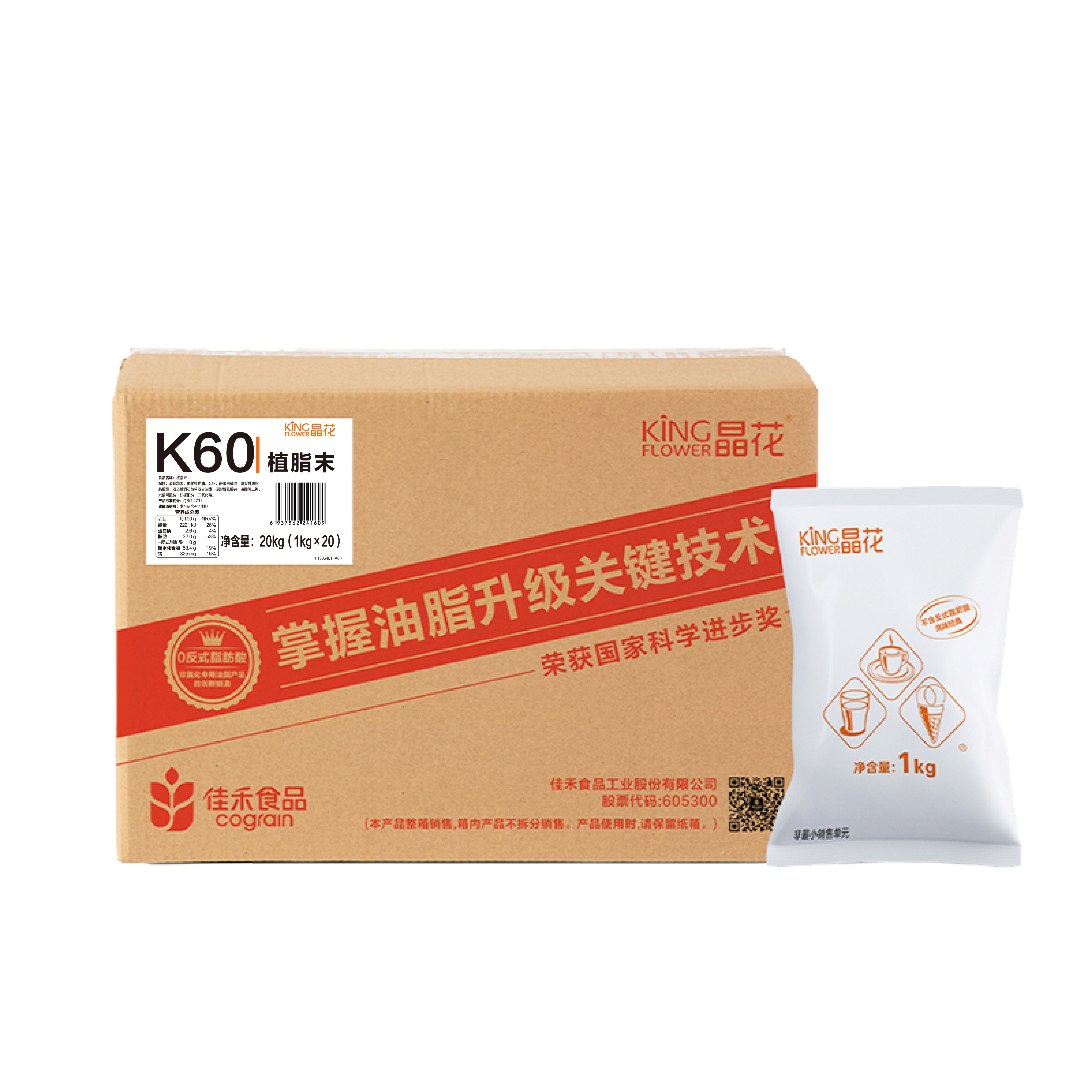
K60 in a retail-format box: packaging identifies the model and format, while kosher or vegan scope is defined in the certificate or declaration — not on the pack.
Two conclusions follow directly. A zero-trans-fat specification says nothing about dairy content, so neither model belongs in a vegan or dairy-free programme on the strength of that value — their ingredient lists rule them out. Conversely, a dairy-containing formula is not excluded from a zero-trans-fat requirement, so a buyer who needs a dairy-inclusive flavour profile and a trans fat declaration can use these models without conflict.
The pair also shows why fat and protein figures should be read as a set. FC22's 7.2 g/100 g protein and 22.0 g/100 g fat describe a different formulation balance from K60's 2.6 g protein and 32.0 g fat, which is consistent with their different functional roles: foaming against a general milk-tea and bakery grade. Choosing between them on a trans fat declaration alone would ignore the parameters that drive performance in the application.
The validity clock: expiry dates are a purchasing variable
Certificates are time-limited, and the dates in this record set do not share a cycle. That turns document control into a recurring purchasing task rather than a one-off approval.
| Instrument | Reference | Scope | Valid to | Standing at this review |
|---|---|---|---|---|
| Kosher certificate | KC#529705-1 | K80, 25 kg, batch JW26558 | 1 April 2027 | Current |
| ISO 9001:2015 | 00125Q32624R1M/3200 | Quality management system, Nantong Jiazhiwei Food Co., Ltd. | 4 May 2028 | Current |
| FSSC 22000 | 162006008 | Food safety management system, Nantong Jiazhiwei Food Co., Ltd. | 17 June 2026 | Recorded expiry has passed; renewal evidence should be requested |
| U.S. FDA Food Facility Registration | 13348058524 | Food facility registration, Nantong Jiazhiwei Food Co., Ltd. | 31 December 2026 | Current, expiring within weeks of this review |
The FSSC 22000 row is the clearest illustration of why the expiry column belongs in the approval file. Certificate number, issuing body and standard are all recorded, but the validity date recorded for it is 17 June 2026, earlier than the date of this review. That does not establish that the site's food-safety certification has lapsed; it establishes that this particular record cannot be relied on as current evidence, and that a buyer should request the renewal certificate and confirm its scope before citing FSSC 22000 in a supplier approval.
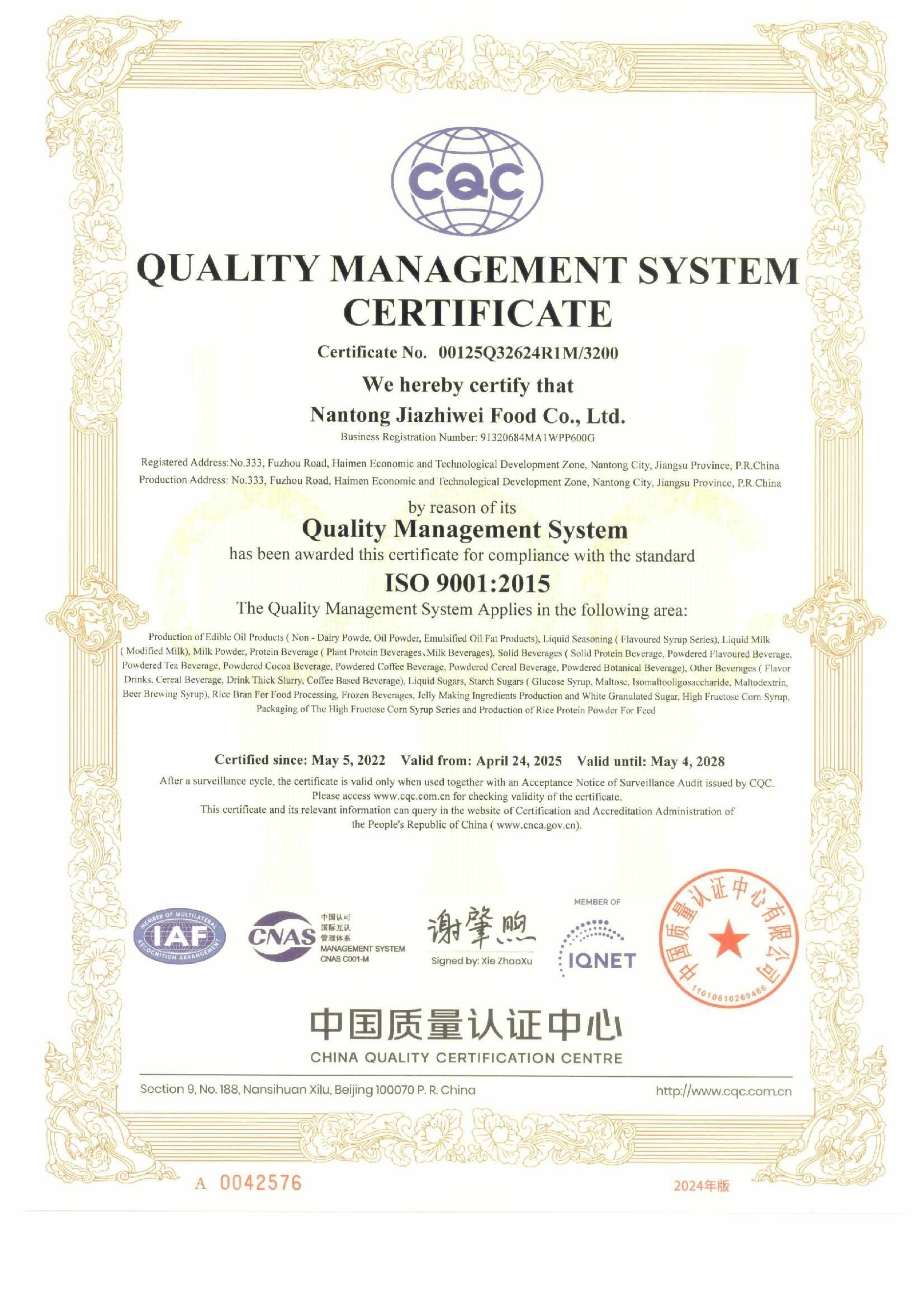
ISO 9001:2015 certificate 00125Q32624R1M/3200 is scoped to the producing site's quality management system, not to an individual product's claims.
The same discipline applies to the facility registration recorded as valid to 31 December 2026 and to the kosher certificate running to 1 April 2027. A purchase order that requires valid certificates at shipment, without naming which certificates and without a rule for what happens when one expires mid-contract, transfers that risk back to the buyer.
What "0g trans fat per 100 g" establishes
A 0 g/100 g trans fat value is a declared specification, and it should be read on four levels.
- Basis. The declaration is per 100 g of powder, the form in which it appears for S35, FC22, K60 and the high-fat 60A grade. It describes the ingredient as supplied, not the finished beverage, dessert or baked good made with it.
- Source. A specification value can rest on formulation calculation or on analytical testing. Buyers should ask which basis applies and whether a per-lot certificate of analysis carries the value, because the two carry different evidentiary weight.
- Labelling. Whether a zero-trans-fat or similar statement may be printed on a finished-product label depends on the rules of the destination market, and the ingredient specification does not settle those rules. The label claim needs its own check in each market.
- What it does not mean. All four models list hydrogenated vegetable oil among their materials. A zero-trans-fat declaration states the finished powder's trans fat content; it is not a statement that hydrogenated oil is absent from the formulation. Buyers who conflate the two write a specification the ingredient list does not satisfy.
From claim to acceptance criterion: the request list
Each claim type maps to a specific document and a specific acceptance test, and the wording is what makes the requirement enforceable.
| Claim requiring evidence | Document to request | Acceptance criterion that closes the gap |
|---|---|---|
| Kosher status | Kosher certificate naming model, pack size and lot coverage, plus a continuity letter where the certificate is batch-limited | Certificate valid on the shipment date, naming the purchased model, pack size and lot or lot range |
| Vegan status | Product-specific vegan declaration plus full ingredient and allergen statement for the same model | Declaration names the model and the standard applied, with an issue date and a named signatory |
| 0 g trans fat | Specification sheet stating the basis, plus a per-lot certificate of analysis where available | Trans fat declared per 100 g, basis stated, value confirmed on the lot certificate |
| Product identity | Technical data sheet covering fat, protein and moisture | Fat, protein and moisture within the agreed ranges for the named model |
| Site hygiene | ISO 9001 and FSSC 22000 certificates within validity | Both current at the shipment date, with scope naming the producing site |
| U.S. market access | Current FDA facility registration, plus customs classification confirmed by the importer's broker | Registration number current; tariff classification confirmed for the specific product |
| Change control | Written notification clause covering formula, packaging and certification changes | Supplier notifies in writing before shipment of any change affecting a certified claim |
Two rows are skipped more often than the rest. The change-control clause matters because a certificate that was accurate at qualification can be invalidated by a reformulation, and the buyer learns about it only afterwards unless notification is contractual. The customs row matters because non-dairy creamer is not a single tariff line: a U.S. Customs ruling reproduced in a third-party database classified imported non-dairy coffee creamer from China under HTS subheading 2106.90.9975, and the importer's broker should confirm the classification for the specific formulation rather than inheriting it from a comparable product.
Public purchasing specifications also exist as a reference point for drafting acceptance criteria. The USDA Agricultural Marketing Service maintains a Commercial Item Description for dry non-dairy creamer packed in commercially acceptable containers and suitable for use by federal, state and local government buyers, which shows the kind of attribute set a formal specification normally covers; the exact revision code should be confirmed against the live document before it is cited in a contract.
Label-led buying versus document-led qualification
The contrast is worth stating plainly because both approaches are defensible at different volumes. Label-led buying reads the pack, the specification headline and the supplier's website, and it works when the requirement is a functional ingredient with no market-facing claim attached. Document-led qualification adds the certificate set, the lot linkage and the expiry calendar, and it becomes necessary as soon as the creamer sits behind a claim the buyer's own customer will audit — kosher, vegan, or a trans fat statement on a retail label.
The fit boundary runs the other way too. A single-SKU buyer with no claim on the finished pack does not need a batch-linked certificate file. A distributor supplying several markets with different labelling rules does, because the same creamer will face different documentary questions in each one, and the cost of assembling that file once is lower than reconstructing it per shipment.
Application fit: where each claim is tested
The documentary requirement follows the application. In the bubble tea and coffee shop sector, the recorded project requirements are food-safety compliance under HACCP and ISO systems, no trans-fatty acids, and halal or kosher certification availability — a combination that maps onto K60 or FC22 for milk tea and coffee use, and onto Kosher K80 where the kosher certificate is the deciding factor.
Bakery applications draw on FC22, K60, S35 and the whipping grade, where the trans fat declaration is the relevant claim and kosher or vegan status is secondary. Alcoholic beverage formulations are where S35's vegan position and its listed suitability for alcoholic beverages do real work. Animal feed is a separate case again: the high-fat 60A grade is recorded in a three-year supply relationship with a Singapore feed producer at 4,000–5,000 tonnes per year, an application in which fat content is the acceptance criterion and religious certification is not.
Limitations of this record set
Three gaps should be stated rather than smoothed over. The certificate records reviewed here contain a kosher certificate for K80 and site-level ISO 9001, FSSC 22000 and FDA facility registration documents, but no product-specific vegan certificate and no halal certificate, even though the company profile lists HALAL among its system certifications. A buyer sourcing a halal certified non-dairy creamer should therefore request the certificate and its scope directly rather than inferring coverage from a profile statement.
Second, the trans fat figures discussed here are declared specification values taken from the product records. No analytical test report for trans fat content appears in the material reviewed, so a buyer whose market requires tested values should request lot-level analysis rather than relying on the specification alone.
Third, none of these documents describe sensory or functional performance. A certificate establishes that a product meets a defined standard, or that a site is controlled; it does not establish that a creamer disperses as required in a cold beverage line or holds up in a specific bake. Sample validation in the buyer's own process remains a separate step, and a documentation file is not a substitute for it.
Outlook and supplier context
The direction of travel in ingredient procurement is toward documentation that expires visibly. A buyer who builds an expiry calendar into supplier approval converts a recurring compliance surprise into routine administration, and a supplier that issues certificates with clear model, pack and lot scope makes that calendar possible.
Demand-side context supports the same emphasis on documentation rather than slogans. The Good Food Institute, a nonprofit research institute, reports that plant-based milk and creamer saw continued growth in U.S. foodservice and are established categories there — a qualitative observation from an authoritative source, and one explanation for why vegan documentation requests are unlikely to become simpler for suppliers selling into that channel.
Cograin's own capability record is relevant to the supplier side of this question. The company reports OEM and ODM production with customization across creamer formula, packaging specification, product flavour and syrup DE value, a creamer capacity of 16,700 tons per month, a lead time of around 7–15 working days after order confirmation, MOQ negotiable by product type and packaging, and quality control covering full-process inspection, 100% metal and weight checks and third-party testing. Those are commercial and process facts rather than certification facts, which is precisely the distinction this article has been drawing: capacity and lead time answer whether a supplier can deliver, while certificates and declarations answer whether the product may be sold under a given claim. The company's product and certification information is published at Cograin.
FAQ
Is Kosher K80 also suitable for vegan formulations?
No. K80's ingredient list includes sodium caseinate, a milk-derived protein, which is inconsistent with a vegan claim regardless of the model's kosher status. The vegan model in this portfolio is S35, whose ingredient list omits milk powder and sodium caseinate and whose protein is declared at 0 g/100 g. Kosher and vegan are independent attributes, and a product can hold one without the other.
What is the difference between 0 g trans fat per 100 g and a trans-fat-free certification?
The 0 g/100 g figure is a declared specification value for the product as supplied, and it may rest on formulation calculation or on testing. It is not a certificate, and it does not by itself authorise a claim on a finished-product label. A buyer should ask for the basis of the declaration, for a per-lot certificate of analysis where the market requires tested values, and for a check of the destination market's labelling rules.
Is FDA food facility registration the same as FDA certification of a creamer?
No. The record reviewed here describes a U.S. FDA Food Facility Registration, number 13348058524, registered through Registrar Corp under the Federal Food, Drug, and Cosmetic Act as amended by the Bioterrorism Act of 2002 and the FDA Food Safety Modernization Act, valid to 31 December 2026. That is a facility-level registration, not a product approval, so the phrase FDA certified non dairy creamer is better read as shorthand for a registered facility than as a certified product. Product-level requirements have to be checked separately.
What should accompany a kosher creamer shipment?
A kosher certificate that names the purchased model, the pack size and the lot or lot range, and that is valid on the shipment date. Where the certificate is limited to a single assessed batch, as KC#529705-1 is for K80 in 25 kg packing from batch JW26558, the buyer should also request written confirmation from the supplier or certifier that the product remains under certification for later lots.
Can ISO 9001 or FSSC 22000 certificates support a product-level vegan or kosher claim?
No. Both certificates in this record set are scoped to the quality or food-safety management system of the producing site, Nantong Jiazhiwei Food Co., Ltd., not to an individual product's status. They support questions about process control and food safety and should be checked for validity — the FSSC 22000 record here carries an expiry date of 17 June 2026, so renewal evidence should be requested. Kosher, vegan or nutrient claims need product-specific evidence.
For the full product and specification overview, the 2025 Cograin brochure is available for download: 2025 Cograin Brochure (PDF).
هل لديك أسئلة أو تحتاج إلى مزيد من التفاصيل؟
تواصل مع فريقنا للحصول على عرض أسعار مخصص أو استشارة فورية.
طلب عرض أسعار
املأ النموذج أدناه وسيتواصل معك فريقنا بعرض مقترح مخصص.
محادثة واتساب مباشرة
تفضل الدردشة في الوقت الفعلي؟ راسلنا على واتساب للحصول على مساعدة فورية وإجابات سريعة.
- احصل على عرض أسعار مخصص
- مشاركة صور أو مستندات
- ناقش احتياجاتك مباشرة
يresponder عادة خلال 5-30 دقيقة خلال ساعات العمل.