
Reading Truck Trailer Specs and Certification Like a Buyer
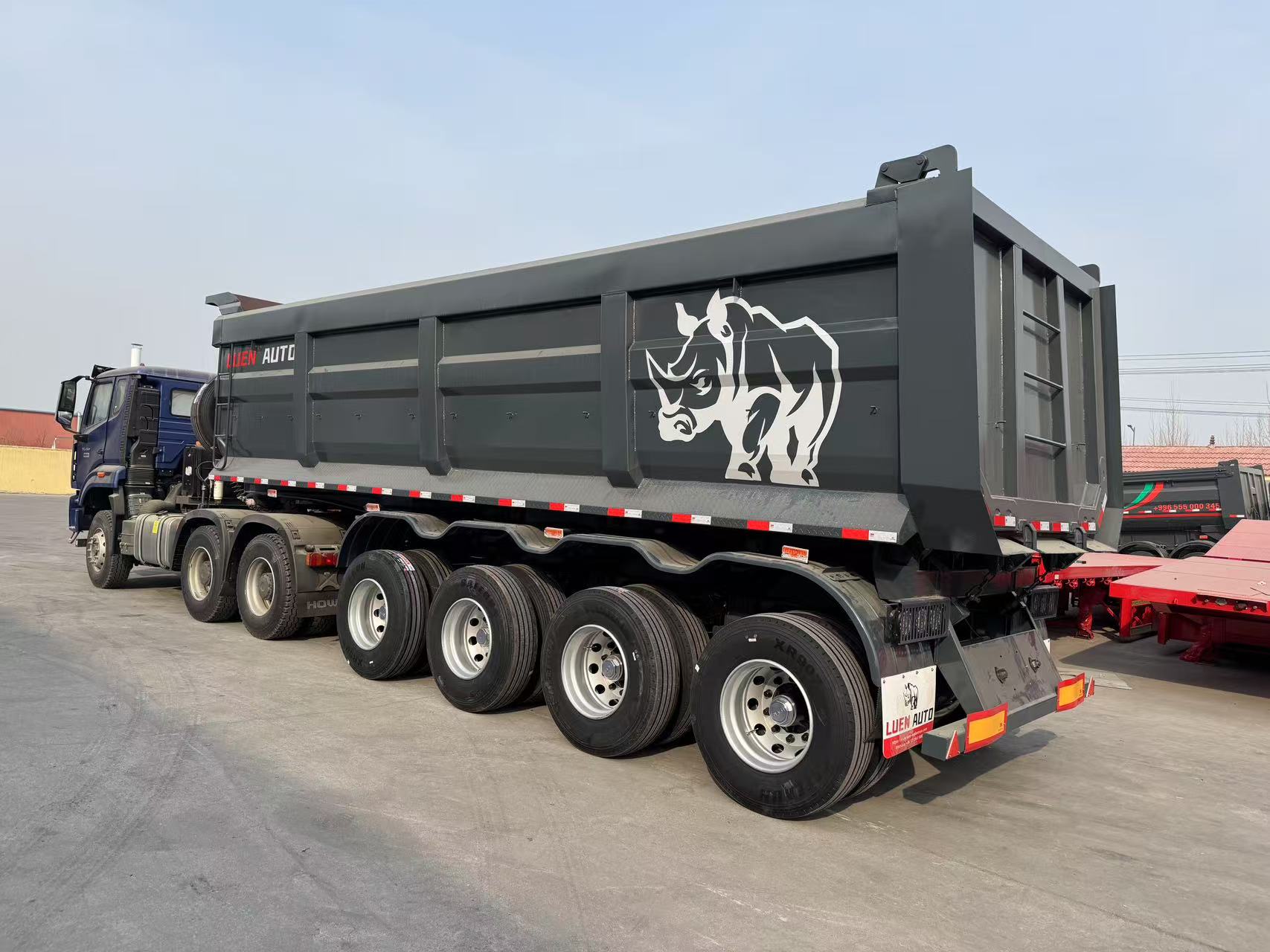
A dump semi trailer configuration typical of heavy construction and mining logistics evaluation.
Procurement teams researching truck trailers from Chinese manufacturers usually start with a broad question: which trailer type fits the project? The more practical question comes later: which supplier’s specification sheet can actually be trusted? Moving from research to evaluation requires a structured reading of three things—the trailer’s core parameters, its certification documents, and the factory capabilities behind the product. This article explains how buyers can do that without relying on marketing claims.
Why Specification and Certification Alignment Matters in Procurement Evaluation
The global semi-trailer market was estimated at USD 22.8 billion in 2024 and is expected to reach USD 42.3 billion by 2033, according to Grand View Research. A growing share of that demand is being served by Chinese manufacturers. For buyers in Africa, South America, the Middle East, and parts of Asia, this has made supplier evaluation more demanding than simply comparing landing prices.
The difficulty is not limited to the product. It extends to documentation. A specification sheet states what a trailer can do under ideal conditions. What buyers actually need is a judgment about how the trailer will perform under local loads, road conditions, maintenance capacity, and regulatory requirements. Certification documents help, but only when they are read carefully: certificates may cover components rather than the complete trailer, or may apply to a specific market rather than the buyer’s destination market.
Core Parameters That Define a Truck Trailer’s Capability
Truck trailer specifications can be grouped into four areas: load-bearing structure, axle configuration, cargo volume, and material grade. In semi-trailer product lines available through Luen Auto, the following reference ranges are useful for initial evaluation:
| Trailer Type | Payload Capacity | Key Configurable Elements |
|---|---|---|
| Dump semi trailer | 30–60 tons | Box volume 20–40 m³; U-shape or rectangular box; 45–50° tipping angle; Q345B frame; 8–12 mm floor with optional HARDOX |
| Flatbed semi trailer | 40–60 tons | Length 12,500–16,000 mm; deck height 1,250–1,550 mm; tie-down rings every 500 mm; I-beam or H-beam frame |
| Lowbed semi trailer | 40–100 tons | Deck height 450–600 mm loaded; fixed or detachable gooseneck; mechanical or hydraulic ramps; Q550/Q690 main beam |
| Container / skeleton trailer | 30–65 tons | 20/40/45 ft ISO compatibility; 4/6/8 twist locks ISO 1161; 2/3/4 axles; JOST or SAF landing gear |
| Tank semi trailer | 28,000–35,000 kg | Tank capacity 20,000–50,000 L; 1–6 compartments; carbon steel, aluminum alloy, or stainless steel |
| Powder tank trailer | 25,000–35,000 kg | Tank volume 32–60 m³; pneumatic discharge 1.6 tons/min; working pressure 0.196–0.2 MPa |
| CNG tube trailer | 2,000–6,000 Nm³ gas | Working pressure 20–25 MPa; 8–20 tubes; 37Mn seamless steel cylinders |
These ranges matter because the same trailer category can serve very different projects. A 3-axle dump semi trailer with a 20 m³ box is not the right reference point for a mining contractor who needs a 60-ton payload and a 40 m³ box. Buyers should confirm the exact model specification rather than relying on the category name. Axle load is another critical indicator: most semi-trailer configurations in these product lines are rated at 13 tons per axle. Axle count therefore directly determines legal payload potential in many regulated markets.
Material grade is a second major indicator. In dump semi-trailers, the frame uses Q345B high-strength carbon steel, with floor thickness of 8–12 mm and optional HARDOX wear-resistant steel. In lowbed trailers, the main beam uses Q550 or Q690 high-strength steel, with HG785D quenched and tempered steel applied in structural areas. For tank trailers, the choice between Q345B carbon steel, 5083 aluminum alloy, and stainless steel 304/316 changes the trailer’s weight, corrosion resistance, and applicable cargo types. Reading these grades is a practical way to validate whether a quotation corresponds to a specific quality tier.
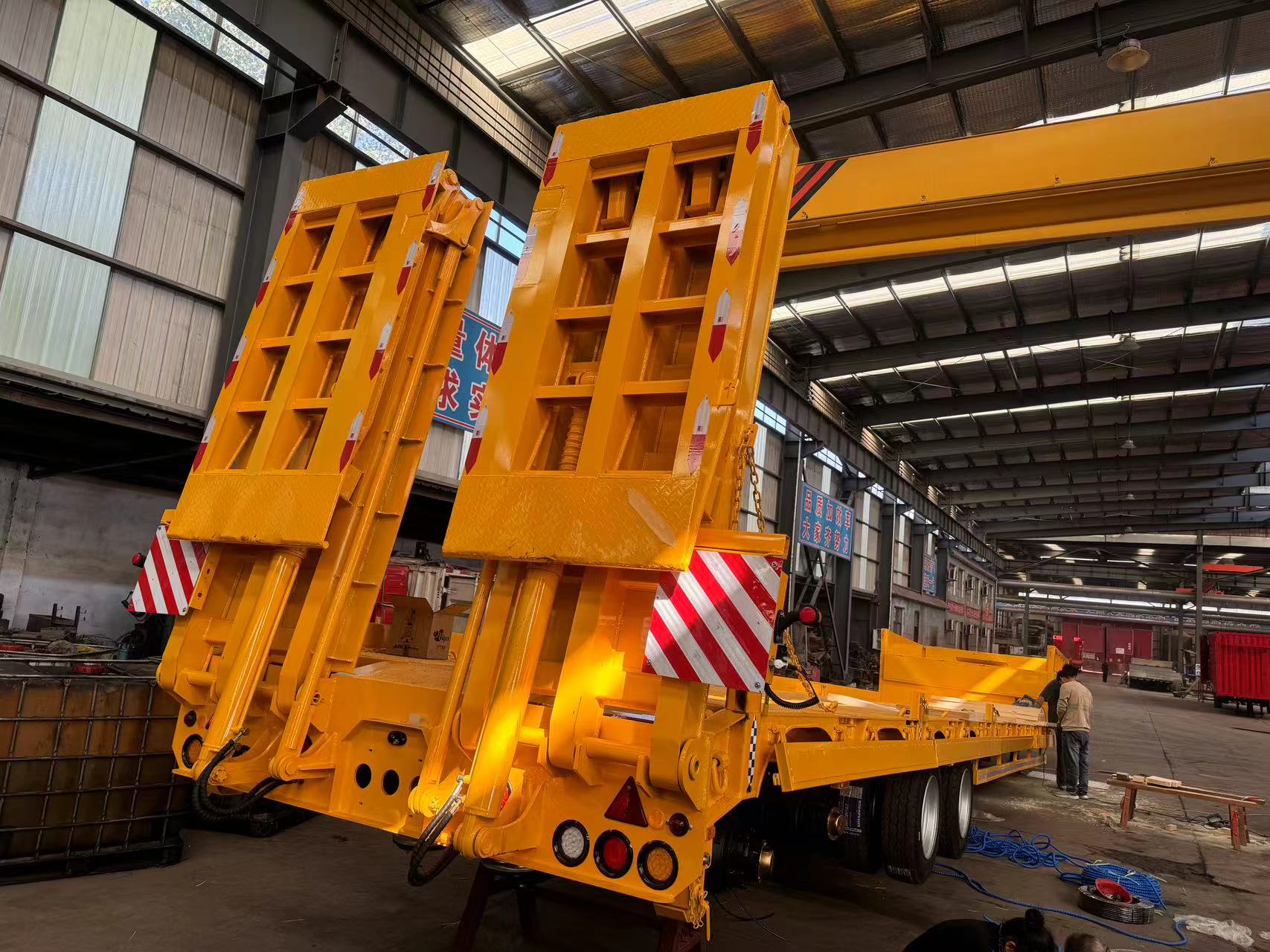
Lowbed semi trailers, which held the largest segment share in the semi-trailer market in 2024, are evaluated primarily on deck height, gooseneck configuration, and axle load.
Certification Documents: What They Do and Do Not Cover
Certification is where buyers often over-interpret. Consider the ISO 9001:2015 certificate held by Shandong Luen Automobile Co., Ltd. The certificate number is 47424Q2464R0S, issued by ZHONGNUO CERTIFICATION CO., LTD. The scope covers sales of semi trailers, semi trailer parts, and tractors, under the standard GB/T 19001-2016 / ISO 9001:2015. This is a quality management system certification: it indicates that the company operates documented procedures for the certified scope. It does not by itself certify the safety or performance of a given trailer model.
A different type of document is the CE Certificate of Compliance for a wheel lock, model 201L1-A. The certificate is issued by CPStes with number CPSC2106112201E, and it applies to the EU market. It references EU Directive (EU) 2015/863 and the IEC 62321 series standards. For a buyer importing a complete trailer, this component-level certificate is a useful indicator of the supplier’s attention to regulatory compliance, but it should not be confused with whole-vehicle type approval for the EU.
Luen Auto also holds a China Appearance Design Patent Certificate, number ZL 2021 3 0278988.9, covering an automobile wheel hub design, and Chinese domestic trademark registrations for the LUEN AUTO brand (certificate 86628573) and the LUEN mark (TMZC86619669D01T260306). These protect brand and design identity in the Chinese market and can matter for buyers concerned with supplier identity, spare part continuity, and warranty claims over the long term.
For export-oriented procurement, certificates should be checked for three points: first, the legal entity and address must match the supplier being evaluated; second, the scope of the certificate must match what is being purchased; third, validity dates must be current. For specific sectors, such as transport of dangerous goods with fuel tankers in Europe, buyers should also check whether the target market requires additional certification beyond what the manufacturer holds, such as ADR approval under the ADR Agreement.
Tractor Trucks and Semi-Trailers as a Matching System
Semi-trailers are only half of the equipment equation. Tractor truck selection defines the combination’s gross combination weight, or GCW, and therefore the realistic operating payload. In the product range offered by Luen Auto, Sinotruk tractor trucks cover the HOWO A7, TX, NX, and T7H models, with engine power from 336 to 540 HP and a GCW range of 40,000–120,000 kg. Shacman tractor trucks are offered in X3000, H3000, F3000, and L3000 series, with power from 270 to 550 HP and GCW from 40,000 to 100,000 kg.
The fifth wheel coupling is another parameter often overlooked in initial evaluation. The 90# fifth wheel used in these tractors has a rated capacity of 20,000 kg. Buyers should verify that the fifth wheel capacity matches the maximum vertical load imposed by the trailer kingpin under loaded conditions. For long-haul highway operations, higher-power tractors such as the HOWO TX 6×4 420 HP or the Shacman X3000 6×4 420 HP provide headroom for hilly terrain and higher average speeds. For cost-sensitive projects, entry models such as the HOWO NX 6×4 400 HP or the Shacman F3000 6×4 375 HP may be sufficient.
Light-duty applications follow a different product logic. The HOWO light duty truck series uses a 4×2 drive configuration with 130–180 HP engines, a rated payload of 5–10 tons, and a GVW of 8,000–16,000 kg. Cargo box dimensions range from 4,200×2,300×600 mm to 6,200×2,300×600 mm, with cargo box volume of 5–12 m³. These vehicles are designed for urban short-haul construction material delivery, municipal services, small contractor operations, agriculture produce transport, light mining surface logistics, and rural road building. Emission options include Euro II, Euro III, and Euro IV.
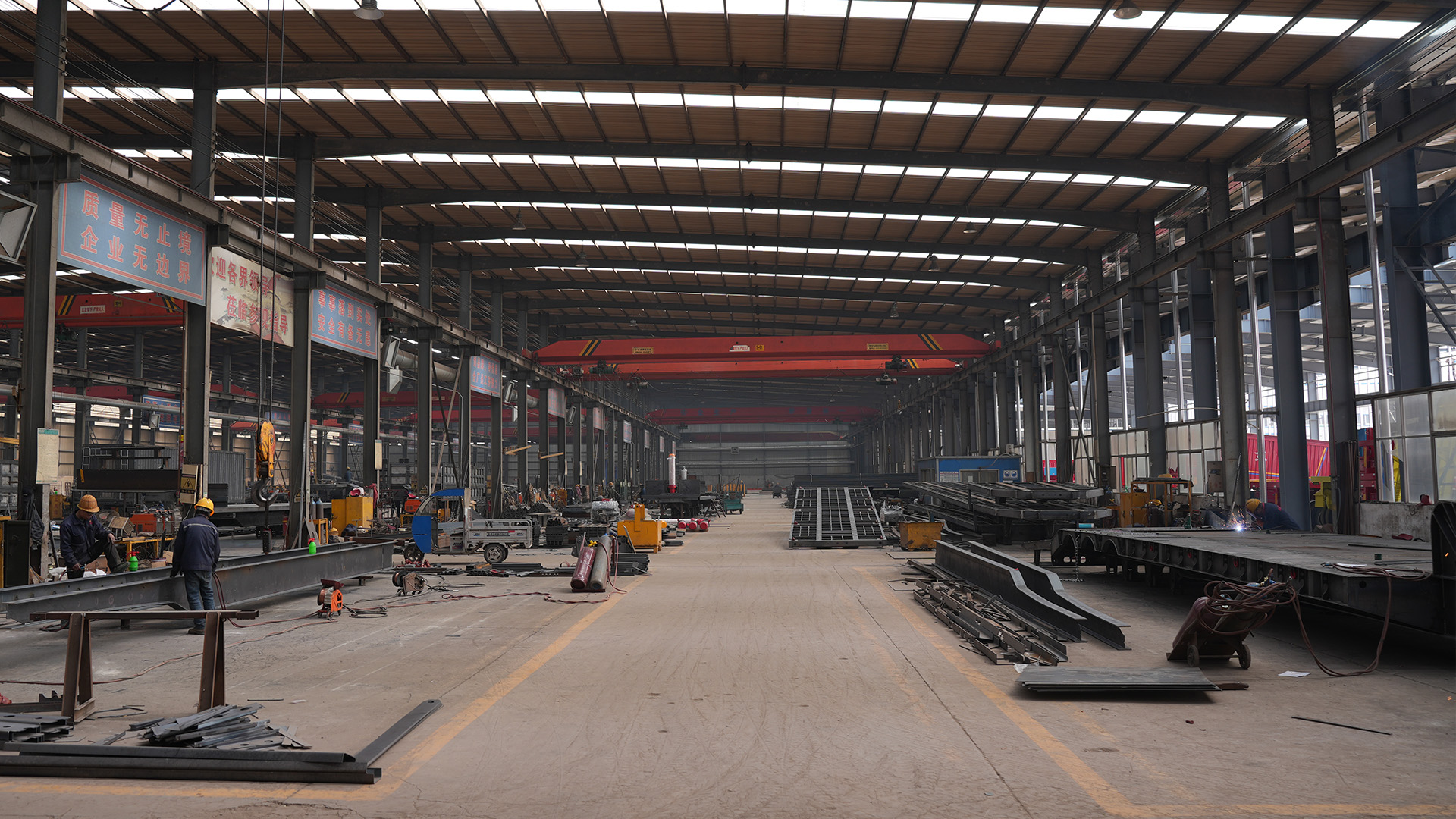
Factory inspection and assembly conditions are relevant evidence when evaluating whether a supplier can deliver the specification sheet consistently.
Factory Capability as a Proxy for Specification Quality
When evaluating a supplier’s specification sheet, the factory’s physical and operational profile is useful evidence. Shandong Luen Automobile Co., Ltd. was founded in 2020 and operates a manufacturing facility of over 50,000 square meters, with more than 130 employees and an annual output of 1,500 units. The company reports that around 80% of production is exported, with main markets in Africa, South America, and the Middle East.
From a procurement perspective, the relevant details are production mode and flexibility. Luen Auto describes itself as a factory-direct manufacturer rather than a trading company. It supports OEM production and full vehicle customization covering trailer type, overall dimensions, axle configuration, load rating, beam structure, suspension type, rim and tire specifications, landing gear, kingpin, paint and coating, and branding. Monthly capacity is about 300 units. Standard configurations offer a lead time of 30–45 days, and the minimum order quantity is one unit for standard models.
Quality control is another practical signal: products undergo 100% factory inspection before shipment and have passed China National Certification and Accreditation Supervision, which includes CCC mandatory certification. The company maintains in-house testing equipment for load testing, brake performance testing, and dimensional verification. Warranty terms are structured by component: one year on new trucks, with local Sinotruk agent service points for on-site repair; six months on trailer driving and supporting devices; and one year on trailer carrying devices.
For buyers, these facts answer a different question than “is this trailer durable?” They answer: does this supplier have the operational capability to deliver what the specification sheet promises, and what happens if something fails after delivery?
Application Matching: When Specifications Meet Site Conditions
To see how specifications translate into operations, consider urban construction and local infrastructure projects in Nigeria and Ghana. The working conditions include restricted access, tight turning radius, mixed paved and unpaved surfaces, short-haul cycles of 500 meters to 5 kilometers, and frequent loading by excavators. In this scenario, a self-propelled dump truck without the need for a separate tractor unit performs high-frequency short-haul material transport. A 6×4 drive configuration provides construction site traction, a 371 HP diesel engine supports loaded gradient performance, a reinforced U-box body resists impact loading, and high ground clearance handles uneven site terrain. Local serviceability is also decisive: the Sinotruk parts and service network is available in the market.
A documented example is a construction and mining company in Nigeria and Ghana with a fleet of more than 50 vehicles. The customer initially purchased parts from Luen Auto and later transitioned to full trailer procurement, including multiple quad-axle dump semi trailers configured for heavy-load mining conditions. The reported service life is 10–15 years, described as comparable to entry-level European trailer brands, at 40–60% lower purchase cost. This indicates that while the specification sheet matters, the buyer’s decision also depended on accumulated trust through incremental purchases.
Market Trends That Shape Specification Priorities
Three observable market trends affect how truck trailer specifications are evaluated. First, the global semi-trailer market continues to grow. Grand View Research estimates the market at USD 22.8 billion in 2024, with expectations of reaching USD 42.3 billion by 2033. Second, the lowboy trailer segment held the largest share of the semi-trailer market at 25.7% in 2024, driven by heavy equipment transport. Third, Chinese heavy-truck brands have expanded their export footprint substantially: Sinotruk, or CNHTC, reached a record 135,000 heavy-duty truck exports in 2024, while Shacman exports reached 25,000 units, up 35% year on year.
For buyers, these trends mean that Chinese-manufactured truck trailers and tractors are increasingly accepted globally, spare parts availability is improving, and more reference points exist for benchmarking specifications. It also means that evaluating one brand is easier today because the ecosystem—parts, service networks, and dealer support—is more developed than a decade ago.
Factory-Direct Buying vs. Traditional Channel Procurement
Factory-direct procurement from a Chinese trailer manufacturer is increasingly common, but it is not without constraints. The main advantages are direct access to the manufacturer’s engineering team, full visibility into customization options, and typically a lower purchase cost than buying through a local dealer who adds a margin. The main limitation is post-delivery support. A one-year warranty is useful, but its value depends on how easily claims can be executed across borders. For a fleet buyer with its own maintenance capacity, this risk is manageable. For a first-time buyer without local workshop infrastructure, the absence of an intermediate dealer may create delays in parts replacement and technical troubleshooting. The trade-off is therefore not between factory-direct and dealer pricing, but between direct pricing and local responsiveness.
Future Outlook
Specification transparency will likely improve as more Chinese manufacturers digitize their technical documentation. Buyers can expect more component-level information—such as axle manufacturers, fifth wheel brands, hydraulic cylinder suppliers, and steel certification—to be included in quotation documents. Emission standards will continue to segment markets, with Euro II and Euro III vehicles serving regions where fuel quality and regulation permit them, while Euro IV and Euro V models are specified for more regulated markets. The broader implication is that truck trailer evaluation will become more like supply chain due diligence: checking not only what a trailer can do, but how the manufacturer documents its choices.
The manufacturer’s complete product catalog is available for public reference: Luen Auto Product Catalog PDF.
FAQ
Q: What is the rated payload of a typical dump semi trailer?
A: Dump semi trailers in Luen Auto’s product line offer a payload capacity of 30–60 tons, with box volume of 20–40 m³. Configurations include 2-, 3-, or 4-axle options. The frame uses Q345B high-strength steel with 8–12 mm floor thickness and optional HARDOX wear-resistant steel.
Q: How much weight can a lowbed semi trailer carry?
A: Lowbed semi trailers are available with a payload capacity of 40–100 tons, a deck height of 450–600 mm when loaded, and axle loads of 13–16 tons per axle. Main beams use Q550/Q690 high-strength steel with HG785D quenched and tempered steel.
Q: What tank volumes are available for tank semi trailers?
A: Tank semi trailers offer capacities from 20,000 to 50,000 liters, with 1–6 compartments. Tank materials include carbon steel, aluminum alloy, and stainless steel. The payload range is 28,000–35,000 kg, and the trailers use a 3-axle configuration rated at 13 tons per axle.
Q: Which emission standards are available for dump trucks and light-duty trucks?
A: Sinotruk and Shacman dump trucks offer emission options of Euro II, Euro III, or Euro V, depending on the model. HOWO light duty trucks offer Euro II, Euro III, and Euro IV. Shacman tractor trucks are available in Euro II, Euro III, Euro IV, and Euro V versions.
Q: Does Luen Auto hold ISO 9001 certification, and what is the scope?
A: Yes. Shandong Luen Automobile Co., Ltd. holds ISO 9001:2015 certification, certificate number 47424Q2464R0S, issued by ZHONGNUO CERTIFICATION CO., LTD. The scope covers sales of semi trailers, semi trailer parts, and tractors, under GB/T 19001-2016 / ISO 9001:2015.
Q: What does the CE certificate held by Luen Auto cover?
A: Luen Auto holds a CE Certificate of Compliance for a wheel lock, model 201L1-A, issued by CPStes with certificate number CPSC2106112201E. It applies to the EU market and references EU Directive (EU) 2015/863 and the IEC 62321 series standards.
Q: What is the working pressure of CNG tube trailers?
A: CNG tube trailers operate at a working pressure of 20–25 MPa, or 200–250 bar. They are available with 8, 10, 12, 16, or 20 tubes, with gas capacity of 2,000–6,000 Nm³, using 37Mn seamless steel cylinders.
Q: What are the key specifications of HOWO light duty trucks?
A: HOWO light duty trucks use a 4×2 drive configuration with 130–180 HP engines, a rated payload of 5–10 tons, and a GVW of 8,000–16,000 kg. Cargo box dimensions range from 4,200×2,300×600 mm to 6,200×2,300×600 mm, with cargo box volume of 5–12 m³.