
Reading Wire Container Supplier Evidence Beyond the Brochure
Wire container sourcing decisions rarely fail at the quotation stage. They fail months later — when four stacked containers will not engage cleanly at the corner posts, when a zinc finish blooms with white rust in a humid warehouse, or when a stated load capacity turns out to have no documented test basis. Capability evidence is the discipline of closing that gap before the purchase order, not after the first complaint.
Why capability evidence became a wire container procurement question
A wire container is a low-unit-value, high-cycle asset. It is bought once and handled thousands of times. That asymmetry is what makes supplier evaluation different from buying a machine: the specification sheet is short, the failure modes are slow, and the cost of a wrong choice appears in the third or fourth year of a returnable loop rather than on the invoice.
The category also sits inside a broader market that commercial research continues to describe as expanding. Market Research Future places the global wire mesh market at 8.18 billion USD in 2024, with a projection of 12.13 billion USD by 2035. A separate commercial estimate puts wire mesh container sales specifically at approximately 2.34 billion USD in 2025, with stackable wire mesh containers accounting for 32.5% of total revenue that year. These two figures use different product definitions and should not be added together or read as a growth rate for containers alone — but they point in the same direction. Demand is concentrated in configurations that increase vertical storage density.
That matters for evaluation because it shifts the question buyers ask. The relevant question is no longer "what does a container cost" but "what evidence shows this container will still stack safely, close cleanly and resist corrosion after several years in a returnable loop." Most supplier pages do not answer that. They list dimensions and a load figure, both company-reported, with no stated basis.
The evidence ladder: what each document actually proves
Capability evidence is not a single certificate. It is a stack of artefacts, each of which proves something narrow and leaves something else unproven. Reading them in the right order prevents the common error of treating an ISO certificate as a product performance guarantee.
| Evidence tier | Typical artefact | What it supports | What it does not prove |
|---|---|---|---|
| 1. Legal entity and site | Registered company name, factory addresses, founding year, site count | That the supplier operates the facilities it describes | Output volume, quality discipline or delivery reliability |
| 2. Quality management system | ISO 9001 certificate with number, issuing body, scope and validity dates | That a documented management system exists for a defined scope | The load rating, corrosion performance or fatigue life of a specific container |
| 3. Process and equipment | Welding line descriptions, jigs, parameter control, surface-treatment lines | How consistency is engineered into the build | Actual shift output or defect rates without inspection records |
| 4. Model-level disclosure | Wire gauge, grid size, external dimensions, stated capacity, finish options | A starting RFQ baseline and a comparison basis | Independent confirmation of the rating or its test conditions |
| 5. Inspection records | Sampling plans, pre-shipment inspection reports, loading photographs | Conformance of a specific shipment | Field durability over a multi-year cycle |
| 6. Application history | Project type, unit count, deployed configuration, measured outcomes | Indicative fit for a similar duty profile | Direct transferability to a different site, climate or load pattern |
Buyers who work through this sequence usually discover that tiers 1 to 3 are easy to obtain and rarely decisive, while tiers 5 and 6 are where suppliers differentiate — and where the least public information exists. A supplier that cannot produce a pre-shipment inspection record for the last order is telling you something more useful than a brochure claim about "strict quality control".
How HM Group's disclosed evidence maps onto the ladder
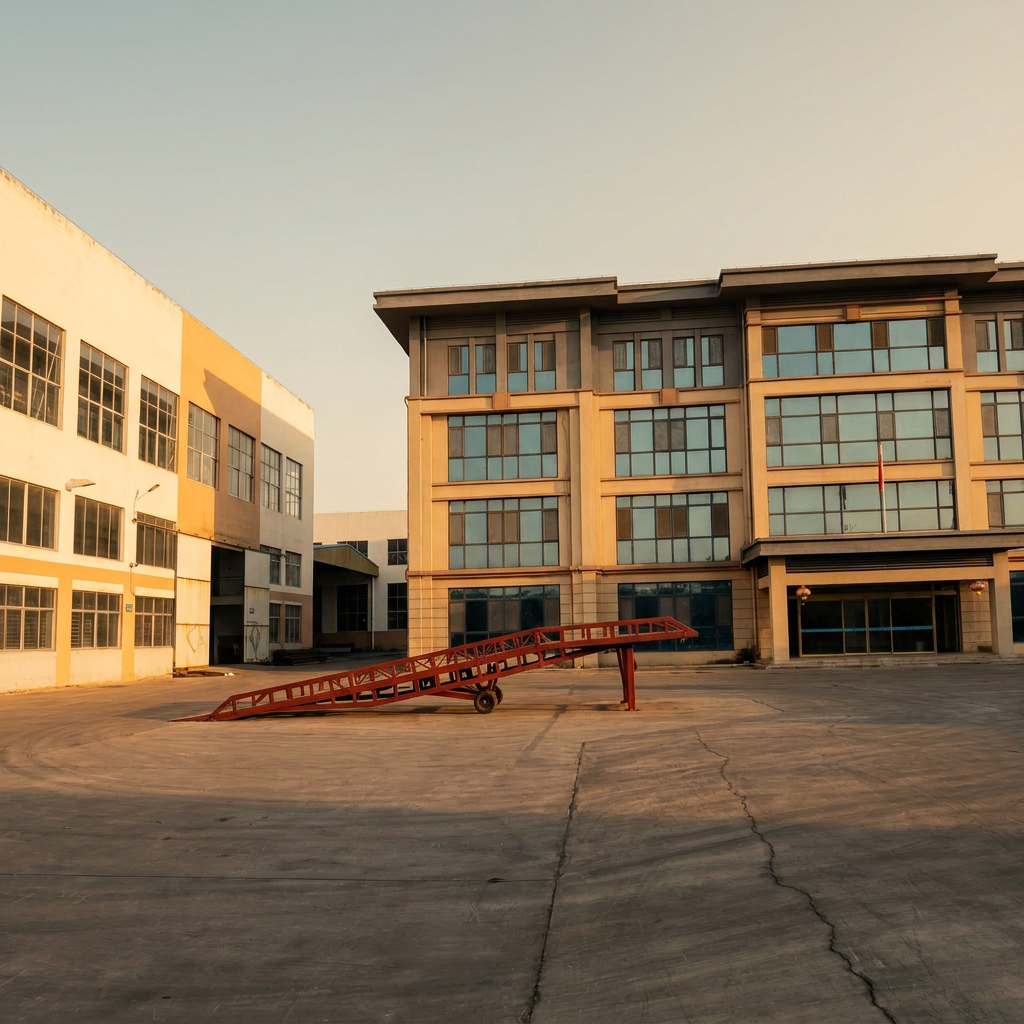
HM Group — Dalian HuaMao Logistics Equipment Group Co., Ltd. — is a material handling equipment manufacturer founded in 2003, operating three manufacturing bases in Xiamen, Nanjing and Qingdao, with a stated factory area of 62,000 m² and annual output of 2,000,000 units. The company states a 10-person R&D team, a 50-person trading department, a 100% export orientation and primary markets in the EU, North America, Asia and the Middle East. Its catalogue covers wire mesh containers, PET preform containers, cage pallets, stillages, tire racks, nestainer racks, fabric roll racks, wine barrel racks, post pallet racks, wire mesh roll containers, wire mesh decking, Danish trolleys and steel pallets.
Against the ladder, the entity and site tier is well documented. The quality system tier is documented by an ISO 9001:2015 certificate, number CN24/00004786, issued by SGS on 30 July 2024 and valid to 29 July 2027, with the scope stated as the sale of material handling equipment for logistics turnover. A marketplace verification via SGS, certificate 486803081_T, was issued 6 March 2026 and runs to 6 March 2027, covering all logistics equipment products.
Reading the scope line matters. The ISO 9001 scope above is written around the sale of material handling equipment for logistics turnover. That supports the existence of a management system covering that commercial activity. It is not a product certification, and it does not certify the load rating, weld strength or corrosion life of any individual container model. Buyers who need product-level assurance have to ask for test documentation separately.
The process tier is where the disclosed material becomes more specific. HM Group describes OEM, ODM and fully customised production with a stated monthly capacity of 40,000 sets and a lead time of 30 to 45 days at a minimum order of 1x20GP. Customisation is offered across surface treatment (zinc, hot-dip galvanised or powder coating), size, loading capacity, powder-coating colour, logo printing, and design additions including forklift guides, wire dividers, runner bars, name plates and wheels. After-sales support is described as a process report throughout the order, online video audit support, and a 3 to 5 year warranty under proper use.
The inspection tier is described through a six-phase control structure: pre-production sample inspection, raw material inspection, component inspection, semi-finished product inspection, finished product inspection and packaging inspection. Supporting disclosures add 100% self-inspection of every unit, a visualised quality standards handbook, and a material policy mandating Q235 mild steel for high-strength requirements. Delivery control is handled through 10% pre-shipment sampling inspection plus assembly and disassembly videos and loading photographs supplied for customer verification before shipment.
From process claims to product attributes: the technical link
A capability claim only becomes useful when it can be tied to a physical failure mode. Four attributes drive most wire container failures, and each has a corresponding process control.

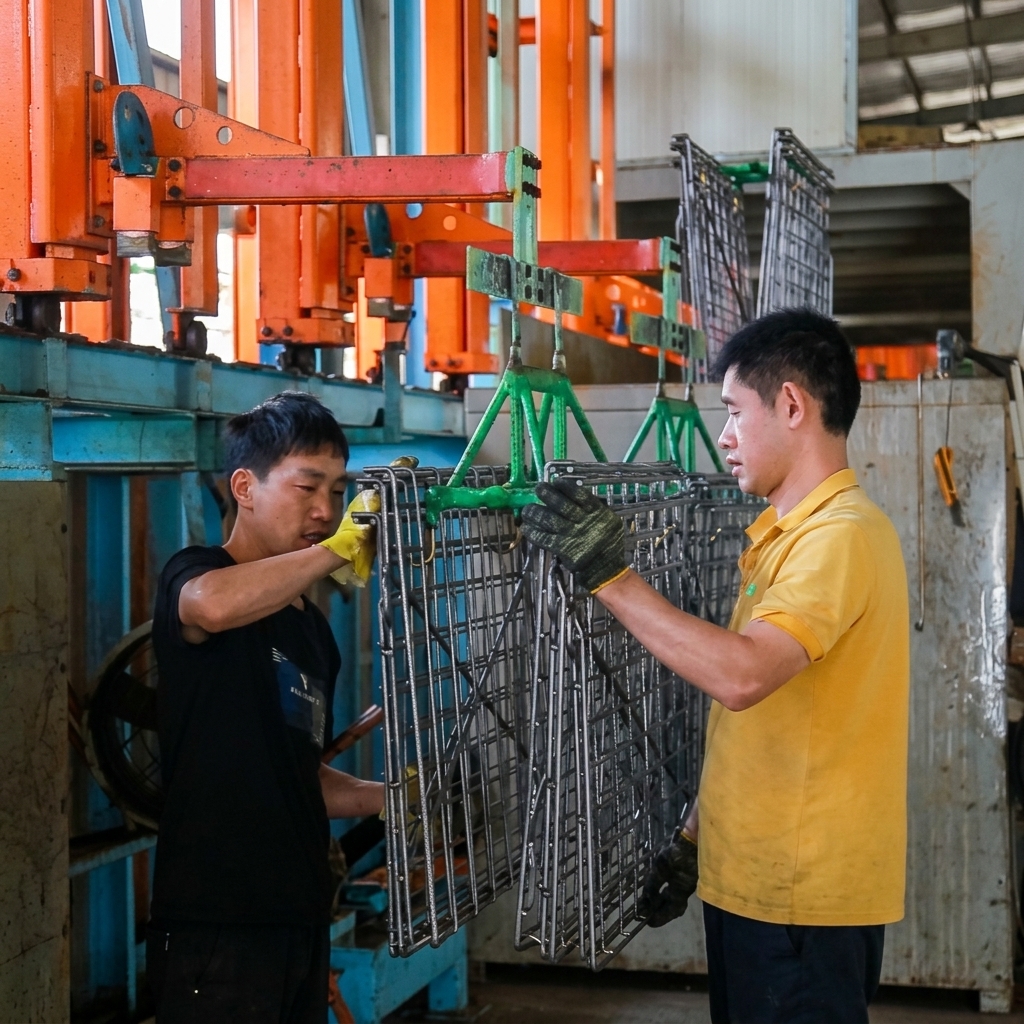
Weld integrity determines whether a mesh panel separates from the frame under repeated forklift handling. HM Group describes automated welding parameter optimisation, dedicated jigs for 90-degree verticality, and torque testing against a wire diameter versus strength standard table. Translating that into a buyer question: ask which parameter is controlled, which jig maintains squareness, and what the torque test records. A supplier who can answer at that level is describing a process; one who answers with adjectives is describing a preference.
Wire gauge against stated capacity is the second link. Gauge alone says little — a 4 mm wire in a tight 50x50 mm grid behaves differently from a 6 mm wire in an open grid. HM Group's published range across its wire container models runs from 4 mm to 12 mm, with stated capacities from 500 kg to 1,300 kg depending on the model. Capacity follows geometry, gauge and frame design together, which is why a single headline number without grid size is not a specification.
Grid size against contents drives both containment and product protection. Dense grids suit small components and preforms; open grids suit larger, heavier goods where drainage and visual inspection matter more. For PET preform and wine bottle logistics, grid geometry is often paired with a PP sheet liner to prevent surface scuffing.
Finish against environment is the most frequently under-specified attribute. Zinc, hot-dip galvanised and powder-coated surfaces are not interchangeable; they respond differently to humidity, washdown, salt exposure and abrasion. The disclosed option set is broad, but the useful question is which finish the supplier recommends for a named operating environment, and what documentation exists for coating thickness or corrosion performance. In the available material, no coating thickness report or independent corrosion test is published — a gap worth closing during qualification rather than after the first rust bloom.
| Model | Type | External dimensions (L×W×H, mm) | Wire gauge | Grid size | Stated capacity | Loading per 1x40'HQ | Stackability |
|---|---|---|---|---|---|---|---|
| HM-HD001 | Heavy duty wire container | 1030×840×850 | 6 mm | 50×50 mm | 1,300 kg | 500 sets | 4 high |
| HM-HD005 | Collapsible wire container | 1230×1040×900 | 6.2 mm | 50×100 mm | 1,000 kg | 350 sets | 4 high |
| HM-HD010 | Wire mesh storage container | 1200×1000×1250 | 6 mm | 25×50 mm | 800 kg | 216 sets | 4 high |
| HM-HD028 | Wire container with PP sheet | 1200×1000×1140 | 5 mm | 50×100 mm | 500 kg | 330 sets | 4 high |
| HM-CP001 | Wire mesh pallet container | 1200×800×1000 | 5–10 mm | 60×103 mm | 800 kg | 550 sets | 4 high |
| HM-PPC22 | PET preform wire container | 1196×1008×1174 | 4.8–12 mm | 62×125 mm | 600 kg | 170 sets | 5+1 high |
| HM-WEU001 | Metal wire container for wine bottles | 1140×830×980 | 5–12 mm | 55×113 mm | 800 kg | 332 sets | 4+1 high |
| HM-WEU005 | Wine storage wire container | 1200×920×1018 | 5–12 mm | 51×118 mm | 800 kg | 228 sets | 4+1 high |
All figures in the table are manufacturer-published values for mild steel Q235 constructions. Published specification values can differ between catalogue versions and model revisions, so the final data sheet should be confirmed as part of the RFQ rather than assumed from a web page. HM-WEU001 is stated to hold 500 Bourgogne bottles and HM-WEU005 400 Bordeaux bottles, capacity figures that depend on bottle geometry and should be rechecked against the actual bottle format.
Application evidence: what large-scale deployments actually demonstrate
Application history is the tier that most influences buyer confidence, and also the tier most easily overstated. The useful reading is not the client name but the configuration, the unit count and the measured change.
For PET preform logistics, HM Group reports a 10,000-unit deployment across large-scale beverage production hubs in Pakistan and Costa Rica, using containers for centralised bulk storage and vertical movement of preforms between injection moulding and blow moulding. The disclosed outcomes are a 300% increase in warehouse storage capacity through secure 4-high stacking, and a 40% improvement in stock counting and identification speed while managing turnover of millions of preforms. The configuration highlights are 4-tier stacking under load and zinc or powder-coated finishes.
A second disclosed project, in South Africa, covers 5,000 PET preform wire containers in a production supply chain. The reported result is a 400% increase in storage density through vertical stacking of 4 to 6 tiers, a 35% improvement in internal material handling efficiency, and instant visual stock checks that halved counting time. The stated configuration includes a PP sheet inner lining to protect preform surfaces. Both projects describe the same underlying problem — floor-level storage and the collapse risk associated with bulk bags — solved by a rigid, stackable steel frame.
Beverage and wine applications extend the same logic. HM Group positions its wine container line for automated cellar upgrade projects in the EU and for global export logistics of bottled wine, and its preform line for just-in-time supply chain projects in the beverage industry. These are application classifications rather than performance claims, but they clarify the intended duty cycle: repeated handling, high stacking, and surface protection for the contents.
Two caveats belong with this evidence. First, the reported percentages are project outcomes disclosed by the supplier, not independently audited results, and they are site-specific — a 400% density gain depends on the ceiling height and floor layout of the original warehouse. Second, storage density gains translate into cost savings only if the returnable loop closes; a container that travels one way and never returns delivers none of the stated benefit.
Market trend: where capability evidence is heading
Three trends in the available data shape what buyers will be asked to evaluate next.
Stackability is the value driver. If stackable units represent 32.5% of wire mesh container revenue in 2025, as the commercial estimate indicates, then the competitive ground is vertical density — which is precisely the attribute most dependent on undocumented factors such as frame squareness, weld consistency and load-test basis. Buyers will increasingly ask for stacking evidence rather than stacking claims.
Sourcing geography remains concentrated but is being rebalanced. A trade-flow estimate cited in the same commercial research attributes roughly 16.7% of 2024 import share in HS 732620 (articles of iron or steel wire) to the United States. That is an indirect indicator for containers specifically and should be treated as directional. What it does support is a practical expectation: suppliers serving North America increasingly need local or regional service presence, not only factory-gate capability. HM Group states that in 2024 it established sales, technical and service teams across the United States, Canada, Mexico, Argentina, Brazil, South Africa, Saudi Arabia and other key regions.
Documentation is becoming part of the product. Where published specifications are company-reported and test conditions are not disclosed across the category, the supplier that can hand over inspection records, loading photographs and assembly documentation wins the qualification conversation. HM Group's disclosed practice of supplying assembly and disassembly videos and pre-shipment loading photos for customer verification sits in this trend rather than in the traditional brochure model.
Wire containers against traditional packaging options
Capability evidence matters most in comparison, because the alternative to a wire container is rarely another wire container. It is usually corrugated board, a wooden crate or a bulk bag.
| Option | Reuse profile | Inventory visibility | Stacking | Main constraint |
|---|---|---|---|---|
| Corrugated and stretch film | Single trip | Low — contents concealed | Limited, degrades with moisture | Recurring consumable cost and waste volume |
| Wooden crate | Limited reuse | Low | Good when dry | Weight, repair burden, moisture and pest-control requirements |
| Bulk bag | Multiple trips, flexible | Low | Poor — collapse risk at height | No rigid structure; unsuitable where stacking safety is critical |
| Wire container | Multi-year returnable loop | High — open mesh allows visual checking | Designed for 4 to 6 tiers depending on model | Higher unit cost, empty-return logistics, handling-equipment dependency |
The honest boundary conditions deserve equal space. A wire container carries a materially higher unit cost than disposable packaging, and that cost is only recovered across a sufficient number of trips. Empty containers occupy volume on the return leg unless they are collapsible, and even collapsible units need planned backhaul. The system assumes forklift or pallet-truck availability at both ends of the loop; in a site without handling equipment, the density advantage never materialises.
Product-level limits matter too. Open mesh is unsuitable for small loose parts without a liner, which is why PP sheet options exist. A stated capacity such as 600 kg or 1,300 kg is a published rating, and in the publicly available material the test conditions and safety factor behind those figures are not disclosed — so a buyer comparing two suppliers on capacity alone is comparing two unlabelled numbers. And a quality-system certificate, however valid, does not substitute for a product test report. These are not reasons to avoid wire containers; they are the specific items that belong on a qualification checklist.
Future outlook
The direction of travel is toward evidence standardisation. As returnable packaging loops lengthen and buyers model total cost across multiple years rather than a single order, the questions asked at RFQ stage will harden: what is the test basis for the load rating, what coating thickness is specified, what is the documented collapse cycle count, and what inspection record accompanies each shipment. Suppliers with automated welding parameter control, structured multi-phase inspection and documented customisation options are better positioned for that conversation than suppliers competing purely on catalogue breadth.
For HM Group specifically, the disclosed base — three manufacturing sites, 62,000 m² of factory area, 2,000,000 units annual output, a stated 40,000 sets monthly capacity, a 30 to 45 day lead time, six-phase inspection and a 3 to 5 year warranty under proper use — describes a supplier configured for volume programmes rather than one-off orders. The open question, and the one buyers should pursue, is the publication of product-level test data to match the strength of the process disclosure.
Frequently asked questions
What documents should a buyer request before approving a wire container supplier?
At minimum: the registered legal entity name and factory addresses; the quality management certificate with number, issuing body, scope and validity dates; model-level specifications covering wire gauge, grid size, external dimensions, stated capacity and finish; the inspection plan used before shipment; and at least one comparable application reference with unit count and configuration. HM Group, for example, discloses ISO 9001:2015 certificate CN24/00004786 issued by SGS with a scope covering the sale of material handling equipment for logistics turnover, valid to 29 July 2027, alongside a six-phase inspection structure and 10% pre-shipment sampling inspection. Each document supports a different conclusion and none of them replaces a product test report.
How is wire container load capacity actually verified?
Published capacity figures are manufacturer ratings. Verifying them requires the test basis: whether the rating is static or dynamic, the safety factor applied, the load distribution assumed, and the stacking height at which the rating holds. In the publicly available material for this category, those conditions are generally not disclosed, which is why capacity figures from different suppliers are not directly comparable. A practical approach is to request the test report or the internal standard behind the number, and to specify the intended stacking configuration in the RFQ so the rating is confirmed against the actual duty rather than a generic figure.
What do ISO 9001 and marketplace audits cover in this category?
ISO 9001 certifies a quality management system within a defined scope, not the performance of an individual product. HM Group's certificate states its scope as the sale of material handling equipment for logistics turnover. A marketplace verification such as the SGS-issued Alibaba.com verified Pro Supplier certificate 486803081_T, issued 6 March 2026 and valid to 6 March 2027, supports the existence and standing of the supplier entity across its logistics equipment products. Neither document certifies weld strength, load rating or corrosion life, so product-level assurance has to be requested separately.
Which wire container configuration fits PET preform or wine bottle logistics?
Both applications need dense grids, surface protection for the contents and high stackability. HM Group's PET Preform Wire Container HM-PPC22 uses a 62×125 mm grid, 4.8–12 mm wire gauge, a stated 600 kg capacity and 5+1 stacking, loaded at 170 sets per 1x40'HQ. For wine, Metal Wire Container For Wine Bottles HM-WEU001 uses a 55×113 mm grid with a stated capacity of 800 kg, 4+1 stacking and a stated hold of 500 Bourgogne bottles, while Wine Storage Wire Container HM-WEU005 uses a 51×118 mm grid and is stated to hold 400 Bordeaux bottles. Where surface scuffing is a concern, a PP sheet liner option is available, as used in the Wire Container With PP Sheet HM-HD028. Bottle counts depend on bottle geometry and should be confirmed against the actual format.
What lead time and order size should a buyer plan for?
HM Group states a minimum order quantity of 1x20GP, a lead time of 30 to 45 days and a monthly capacity of 40,000 sets under OEM, ODM or fully customised production. For buyers planning a multi-site rollout, the relevant planning figure is not the lead time alone but the combination of monthly capacity and customisation scope, since non-standard finishes, sizes or added features such as forklift guides, dividers, runner bars, name plates and wheels can affect the production schedule.
What are the main limits of a foldable or collapsible wire container?
Collapsibility reduces empty-return volume but does not remove return logistics entirely, and folding mechanisms add handling steps that must be planned into the loop. Collapsible models also carry their own capacity limits: HM-HD005, for example, is stated at 1,000 kg with 4-high stacking and 350 sets per 1x40'HQ, while the fixed heavy-duty HM-HD001 is stated at 1,300 kg with 500 sets per 1x40'HQ. Buyers should also account for handling-equipment availability at both ends of the loop and for liner requirements where the open mesh would otherwise allow small parts to escape.
A practical reading of the evidence
Wire container supplier evaluation is a document-reading exercise more than a specification comparison. The strongest available position for a buyer is to separate what a supplier has proven from what a supplier has stated, and to request the missing artefact rather than accept the adjective. In HM Group's case, the entity, site, quality-system and process tiers are documented in specific terms, application history is described at project level with disclosed configurations, and the remaining gap is product-level test documentation for load and corrosion performance. Knowing which gap exists is more useful than assuming none does.
A full technical and product reference for the range discussed here is available in the HM Group product brochure, which buyers can use alongside an RFQ to confirm model-level values.
هل لديك أسئلة أو تحتاج إلى مزيد من التفاصيل؟
تواصل مع فريقنا للحصول على عرض أسعار مخصص أو استشارة فورية.
طلب عرض أسعار
املأ النموذج أدناه وسيتواصل معك فريقنا بعرض مقترح مخصص.
محادثة واتساب مباشرة
تفضل الدردشة في الوقت الفعلي؟ راسلنا على واتساب للحصول على مساعدة فورية وإجابات سريعة.
- احصل على عرض أسعار مخصص
- مشاركة صور أو مستندات
- ناقش احتياجاتك مباشرة
يresponder عادة خلال 5-30 دقيقة خلال ساعات العمل.