
Reading a Frozen Dim Sum Compliance File: A Buyer Checklist
Reading a Frozen Dim Sum Compliance File: A Buyer Checklist
A frozen dim sum compliance file is not one certificate. It is a small set of documents that has to answer four separate questions: which mandatory registrations exist, which facility and product scope each one names, which voluntary certificates support the supplier's claims, and whether that supplier can keep the documents current at the volume you plan to buy. Read in that order, the file tells you what can ship and where. Read as a folder of logo-heavy PDFs, it usually tells you nothing until a container is stopped at the port.
This checklist uses the published documentation of Foshan Shunde Yuexiang Food Manufacturing Co.,Ltd. as a worked example. Yuexiang is a Cantonese dim sum manufacturer founded in 1981 in Jun'an Town, Shunde District, Foshan, Guangdong, and sells under the “Da Xiao” brand. Its file contains two mandatory registrations, a set of company-stated system certifications and a body of operational evidence. Each of those three things is read differently.
Why buyers read the file before the price list
One commercial research estimate puts the global frozen Cantonese-style dim sum market at USD 7.04 billion in 2025, with a projected rise to USD 11.99 billion by 2033; a separate research summary states that China accounted for 46% of global frozen dumpling production volume in 2025. A larger supplier pool means a larger pool of compliance files, and those files are not standardised across companies. Two suppliers can both say “FDA registered” and mean different things: one holds a registration whose scope covers the item you are buying, the other holds a registration for a different site or a different product category.
For a buyer in the research-to-evaluation stage, the purpose is narrow. You are not auditing the supplier. You are establishing whether a specific product, from a specific site, can enter your market with the documents your own importer or customer will ask to see.
The two layers: mandatory registrations and voluntary certificates
A compliance file has two layers, and mixing them is the most common reading error.
Mandatory documents are issued by a public authority and bind a facility and a product scope to a permission. For a Chinese frozen dim sum exporter the core document is the export food production enterprise registration issued by Chinese customs, plus the destination-market equivalent, such as a US FDA food facility registration.
Voluntary documents are certificates the supplier has chosen to be assessed against, typically management-system standards such as ISO 9001 or HACCP. They describe how a site is run; they do not name the products you are allowed to import.
Both layers belong in the file. Only the first answers the question “can this item ship to this market from this site”.
The mandatory layer, document by document
Export food production enterprise registration
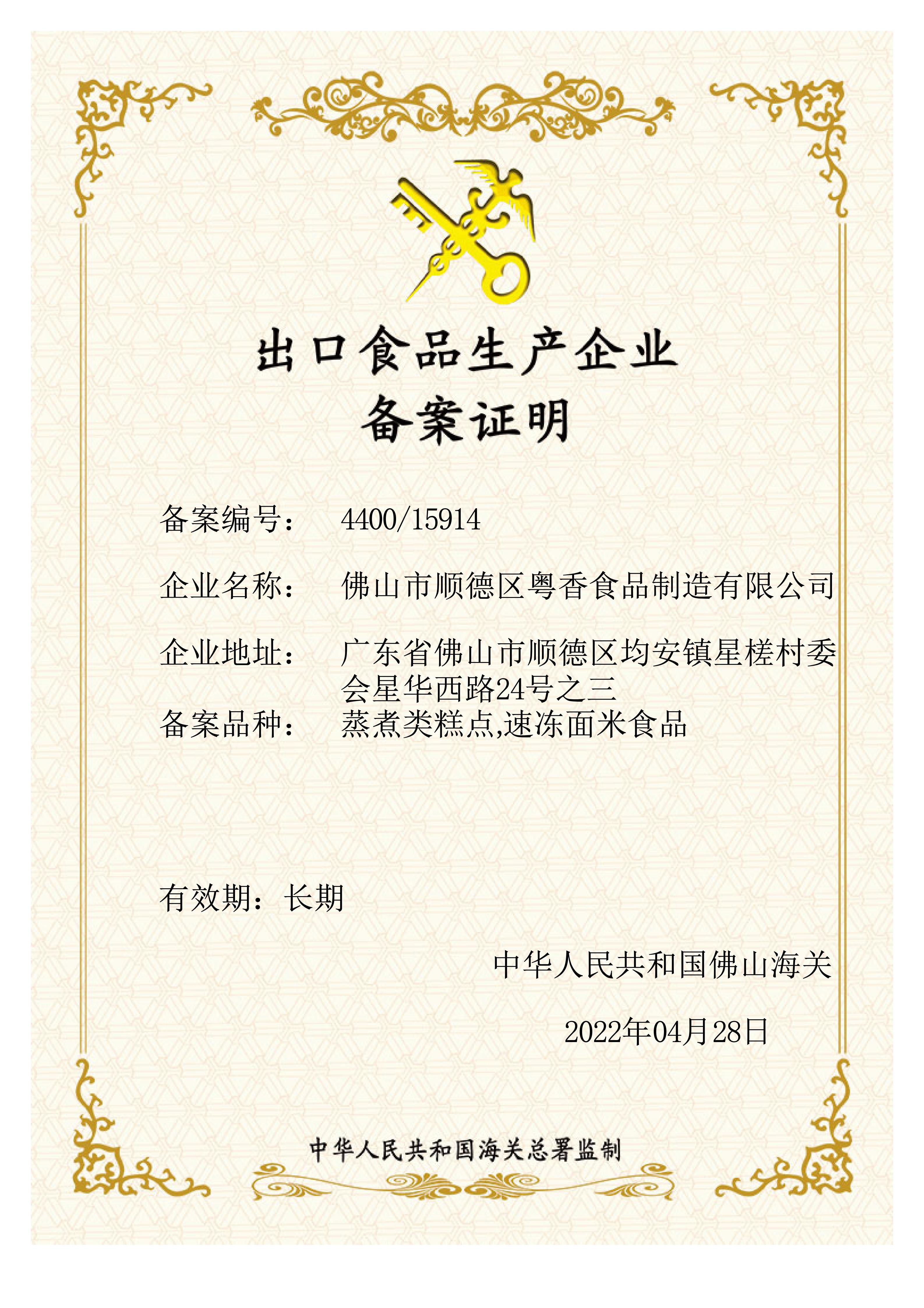
Yuexiang's registration is certificate number 4400/15914, issued by Foshan Customs of the People's Republic of China, recorded with an issue date of 28 April 2022 and an expiry date of 28 April 2099. The stated scope is steamed pastries and frozen rice & wheat food for export.
Five things to read on this document, in this order:
- Holder name. It should match the legal entity on the contract and the invoice, character for character.
- Issuing authority. A customs-issued registration and a third-party certificate are not interchangeable, even when both carry an official-looking seal.
- Scope wording. This is the line that decides which of your SKUs is covered, and it is dealt with separately below.
- Number and dates. Record them in your own file so a later version can be compared against the copy you were qualified on.
- Currency. The expiry recorded on the supplied document is 28 April 2099. A buyer should still ask how the registration is maintained and whether a more recent printout exists, rather than treating a long-dated entry as a permanent permission.
Destination-market facility registration
The US layer is a food facility registration under the Public Health Security and Bioterrorism Preparedness and Response Act of 2002 (PL.107-188). The registration number is 550074820, held by UGK-LVM UNITED INC., for a facility producing frozen dim sum, steamed pastries and frozen rice & wheat food exported to the United States. The record shows an issue date of 28 November 2024 and validity to 31 December 2026.
Three reading points matter. First, the registered holder is a US entity acting for the facility rather than the Chinese manufacturer, so match the facility described, not the name at the top of the page. Second, the scope names frozen dim sum explicitly, which is broader than the Chinese wording in one respect, yet still stops at steamed pastries and frozen rice & wheat food. Third, the validity date is close enough to matter commercially: a buyer booking 2027 shipments should request the renewed record before the purchase order, not after it.
Facility registration is a listing requirement. It is not a product approval, and it does not show that a particular lot met specification; that is the job of test records and pre-shipment inspection.
Matching the scope line to the products you actually buy
Scope alignment is where most files are read too quickly. The test is mechanical: write the scope phrase on one side of a page and each SKU description on the other, then mark which items fall inside the wording.
| Product family | Items in the range | What to confirm against the scope line |
|---|---|---|
| Frozen dim sum (steamed) | Shrimp dumplings, shrimp siu mai, lava custard bun, char siu bao, chicken with glutinous rice, kataifi pastry, steamed black sesame kuih, walnut bun, red bean paste bun | These sit inside the steamed-pastry and frozen rice & wheat wording. For the US, confirm the item falls within the registered frozen dim sum scope; shrimp siu mai and frozen shrimp dumplings are stated as covered. |
| Traditional dim sum (cakes) | Water chestnut cake, red bean cake, taro cake, coconut golden cake, millet cake | Starch-based cakes — confirm they are declared as frozen rice & wheat food rather than as a separate dessert category on the destination tariff. |
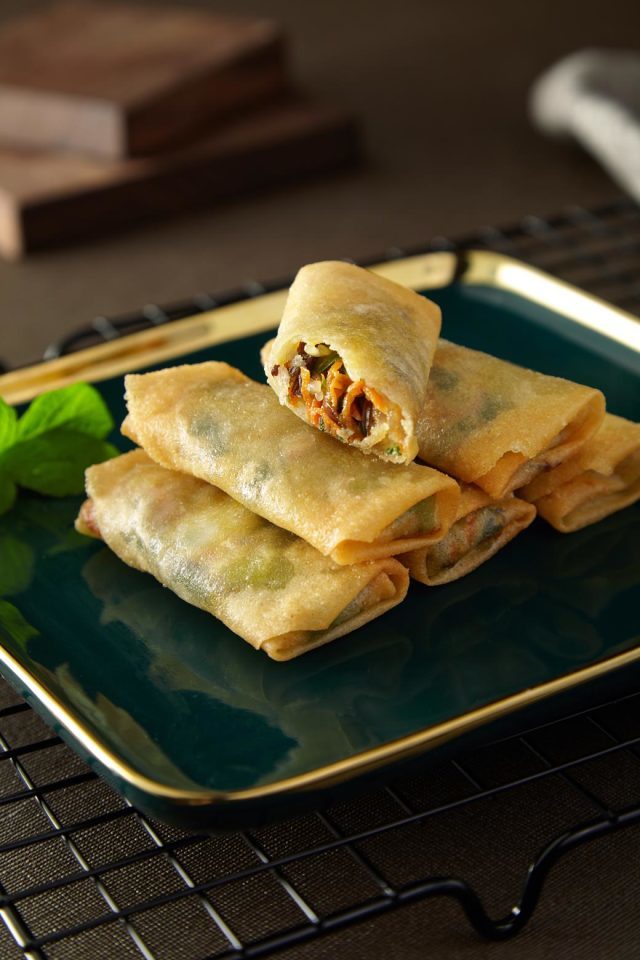
| Fried dim sum | Hong Kong style spring rolls, milk rolls, sesame balls, taro pie, golden cone durian crisp, green tea buddha cake | Wheat-based fried items generally fall inside the rice & wheat wording. Frying is a process, not a scope category, so ask which registered category the item is declared under. |
| Vegetarian Lo Han Jai (buddha's delight) | Quick-frozen prepared vegetable dish, 400 g per box, 12 boxes per carton | On the face of the wording, a prepared vegetable dish is neither a steamed pastry nor a rice & wheat food. Request written confirmation of the registration it ships under. |
| Buddha Jumps Over The Wall | Luxury soup, frozen prepared dish | The same issue applies: a soup falls outside both phrases. Obtain an item-level statement before quoting it to a US or EU customer. |
| Similar-name items | Green tea buddha cake (fried pastry), buddha's delight (vegetarian dish), Buddha Jumps Over The Wall (soup) | Three different categories share the “buddha” name family. Match the exact product and its preparation method, never the name. |
The pattern is worth stating plainly. A scope written as steamed pastries and frozen rice & wheat food covers most of a Cantonese dim sum catalogue, but not all of it. The vegetable dish and the soup are legitimately part of the supplier's range — Yuexiang lists more than 300 products — yet a buyer should not extend the certificate's coverage to them by assumption. Ask for an item-level statement, keep it behind the certificate, and the file becomes defensible in front of your own importer.
Certificate identity: entity, site and version
A registration belongs to a facility, not to a brand. Yuexiang's file shows why this matters: the company established a second production enterprise, Foshan Shunde Hongyuan Food Co., Ltd., in 2019, which is a separate legal entity at a separate site. A registration naming one site is not evidence for the other, and the practical question is simple: which site will produce my SKUs, and is that the site named on the document I have been given?
Ask for the version as well. Scanned certificates circulate for years, so the file you receive should be the current printout; where a document carries a visible validity end date, as the FDA record does, the version you hold should not be one that lapses inside your contract term.
Voluntary certificates: what they add, and where they stop
Yuexiang's company profile states ISO 9001, HACCP and FDA certification alongside its production claims. Read correctly, these are useful: ISO 9001 is a quality management system standard and HACCP is a hazard-analysis system, so both describe how a site controls process rather than what a product is permitted to do in a market. The buyer's verification step is to request, for each voluntary certificate, the issuing body, certificate number, scope of certification and validity dates, then check that the scope covers the products you are buying rather than a related category.
The distinction is not academic. A file that leads with voluntary certificates and mentions the customs registration in a footnote has usually been assembled for marketing rather than for buyers. Read the mandatory layer first; the voluntary layer then tells you how much process discipline sits behind it.
Test records and per-shipment documents
Registrations answer market access; test records answer lot conformity. Yuexiang's stated quality control is a 100% pre-shipment test covering weight verification, a check of packaging seals and label completeness for leaks or bulging bags, and microbiological safety testing using the plate count method for colony and coliform bacteria. The company also states that each order is accompanied by quality inspection reports, production qualifications and export customs declaration documents.
Read these as shipment-level items, not company-level claims. The useful question is not “do you test” but “which report will accompany this consignment, which laboratory produced it, and does the report reference the same product name and specification as the purchase order”. A report naming a different model or a different bag weight supports a different lot, not yours.
Cold chain, shelf life and trade codes in the file
Three operational figures should appear consistently across the certificate pack, the label and the shipping documents. Storage is specified at -18°C or below throughout, including transport. Shelf life is stated as 12 months for steamed buns and 6 months for steamed cakes such as water chestnut cake and red bean cake, with production and expiry dates printed on the outer packaging. On the customs side, frozen dim sum is commonly declared under HS codes 1902200000 (stuffed pasta) and 1902309000 (other pasta).
Inconsistency between these figures and the commercial invoice is a documentation problem even when the product itself is fine, because it forces a broker to stop and query the entry.
Operational evidence: where scale helps, and where it stops
Operational facts belong in the file, but they support a different conclusion from certificates. Yuexiang's record includes a founding date of 1981, a base in Shunde, a UNESCO City of Gastronomy, a 20,000 m² facility, more than 200 staff, 30-plus R&D engineers, a stated annual capacity of 6,000,000 units, the 2019 second facility, more than 300 products, and exports to more than 20 countries that account for 40% of output.
What those facts establish is continuity and depth: a company that has made Cantonese dim sum for more than four decades, holds engineering capacity to reformulate when a market rule changes, and already runs an export channel. That is genuine procurement information. It is not certification. A 20,000 m² site does not make a product compliant in a given market, and a founding date does not prove that a registration is current. The correct reading is sequence: certificates establish permission, operational evidence establishes whether the supplier can sustain it.
One figure deserves a follow-up question rather than acceptance. An annual capacity of 6,000,000 units is only checkable once the unit is defined, because pieces, bags, boxes and cartons imply three very different plant sizes. Pair the answer with the stated 7–14 day lead time and minimum order of 50 boxes, and you can judge whether your programme sits comfortably inside the supplier's run schedule or competes with larger accounts for capacity.
A labelling rule that changes what buyers should ask for
Regulation is moving at the point of sale as well as at the border. Guangzhou introduced rules effective 1 May 2026 requiring restaurants to state clearly whether dim sum is handmade on site or produced by a central kitchen or from pre-made products, as reported by Tridge citing local government sources. For a buyer supplying foodservice operators in that market, the compliance file has gained a second job: it should let your customer make a truthful menu statement. Ask for a product-category statement per SKU that distinguishes on-site preparation from factory production, and keep it with the certificate pack.
The checklist
| Document or item | What to verify | Why it matters | Red flag |
|---|---|---|---|
| Export food production enterprise registration | Number (4400/15914 on the example file), issuing authority, holder legal name, scope wording, validity | Establishes the right to export the categories you are buying | Scope line missing, or a marketing one-pager offered instead of the certificate |
| Destination facility registration | Registration number, facility described, product scope, validity end date | Establishes market access for a named site | “FDA registered” claimed with no number and no facility scope |
| Voluntary certificates | Issuer, certificate number, scope, validity dates | Shows process control sitting behind the mandatory layer | Certificate presented as though it were a market authorisation |
| SKU-to-scope mapping | Item-level written confirmation for every SKU quoted | Prevents drift between catalogue and certificate | Supplier declines to confirm coverage in writing |
| Site and entity match | Which legal entity and production site makes the SKU | Covers multi-site operations, including the 2019 second facility | One certificate offered as cover for all sites |
| Per-shipment documents | Inspection report, production qualification, export customs declaration | Supports each consignment, not just the company | Reports naming a different model or bag weight |
| Microbiological and weight records | Plate count method for colony and coliform, weight verification, seal and label check | Evidence of lot conformity | Summary table with no underlying report |
| Cold chain and shelf life | -18°C or below; 12 months for buns, 6 months for cakes; dates printed on pack | Avoids rejected or degraded stock | Different figures on label and invoice |
| Trade classification | HS 1902200000 or 1902309000 as applicable | Keeps the customs entry consistent with the description | Code inconsistent with the product description |
Where files usually fail
- Scope drift. The product catalogue grows faster than the registration wording that supports it.
- Expiry lapse. A validity end date falls inside the contract term, as a 31 December 2026 FDA record would for a 2027 programme.
- Site substitution. A certificate for one facility is offered for a different one, which is a live risk wherever a supplier operates more than one production enterprise.
- Layer confusion. A voluntary certificate is used to answer a mandatory question.
- Unit ambiguity. Capacity is stated without a defined unit, making it unverifiable.
- Report mismatch. A test report references a specification that does not match the purchase order.
None of these failures requires a dishonest supplier. Most are the ordinary result of a sales team assembling documents without a buyer's reading order, which is exactly why a checklist helps: it converts a folder into a sequence of questions with written answers.
Outlook
Documentation is turning into a procurement asset rather than a formality. Registration records now carry visible validity dates, labelling rules are reaching menu level, and buyers increasingly hold supplier certificates inside their own audit trail instead of an inbox. The practical consequence for the next sourcing cycle is that files should be re-read, not merely re-collected: a re-read confirms scope wording, site identity and currency, while re-collection usually produces a newer scan of the same page.
Requesting and verifying the file
The Yuexiang documentation set, including the export registration and the US FDA facility registration records, can be requested through the company's export contact at Kyle@dimsum-daxiao.com or +86 13726399586. The company publishes its range at Foshan Shunde Yuexiang Food Manufacturing Co.,Ltd., and a downloadable company brochure covers the product lines in more detail. Buyers evaluating a first order usually find it faster to request the certificate pack and the SKU-to-scope mapping together, so both can be read against the same purchase list.
Frequently asked questions
What is the difference between a mandatory registration and a voluntary certificate in a frozen dim sum compliance file?
A mandatory registration is issued by a public authority and ties a facility and a product scope to a permission — for example Yuexiang's export food production enterprise registration, number 4400/15914, issued by Foshan Customs for steamed pastries and frozen rice & wheat food, or US FDA food facility registration 550074820 for frozen dim sum, steamed pastries and frozen rice & wheat food. A voluntary certificate, such as ISO 9001 or HACCP, records a management system the supplier has chosen to be assessed against. Both belong in the file, but only the mandatory document answers whether a specific product can ship from a specific site into a specific market.
How do I check whether a registration covers a specific item such as shrimp siu mai, Lo Han Jai or Buddha Jumps Over The Wall?
Place the item's own description beside the exact scope wording. Shrimp siu mai and frozen shrimp dumplings are stated as covered by the US FDA registration for the frozen dim sum scope. Vegetarian Lo Han Jai, described as a quick-frozen prepared vegetable dish, and Buddha Jumps Over The Wall, a frozen soup, are not steamed pastries and not frozen rice & wheat food on the face of the wording, so both need an item-level written confirmation of the registration they ship under. The same caution applies to the similar-sounding green tea buddha cake, which is a fried pastry in a different category.
What does an FDA food facility registration number actually prove about a dim sum supplier?
It shows that the facility producing the food has been registered with the US FDA under the Public Health Security and Bioterrorism Preparedness and Response Act of 2002 (PL.107-188), and it identifies the scope the facility registered for. On the Yuexiang file, registration 550074820 is held by UGK-LVM UNITED INC. for frozen dim sum, steamed pastries and frozen rice & wheat food exported to the United States, with validity recorded to 31 December 2026. It is a registration rather than a product approval: it does not replace microbiological test reports, pre-shipment inspection, or the importer's own obligations.
How should a buyer verify a capacity claim such as 6,000,000 units per year?
Ask what the unit is — pieces, bags, boxes or cartons — because each definition implies a different plant size, and ask which site the figure refers to. Then cross-check it against the stated 7–14 day lead time and minimum order of 50 boxes, and against your own annual programme, to see whether your volumes fit inside the supplier's schedule. Capacity is context for supply continuity; the certificate pack remains the evidence of market access.
Which storage and shelf-life figures should appear consistently in the file?
Storage at -18°C or below throughout the cold chain, including transport; a stated shelf life of 12 months for steamed buns and 6 months for steamed cakes such as water chestnut cake and red bean cake; and production and expiry dates printed on the outer packaging. These figures should match across the label, the specification sheet and the commercial invoice, so that brokers and receiving warehouses are reading the same numbers.
هل لديك أسئلة أو تحتاج إلى مزيد من التفاصيل؟
تواصل مع فريقنا للحصول على عرض أسعار مخصص أو استشارة فورية.
طلب عرض أسعار
املأ النموذج أدناه وسيتواصل معك فريقنا بعرض مقترح مخصص.
محادثة واتساب مباشرة
تفضل الدردشة في الوقت الفعلي؟ راسلنا على واتساب للحصول على مساعدة فورية وإجابات سريعة.
- احصل على عرض أسعار مخصص
- مشاركة صور أو مستندات
- ناقش احتياجاتك مباشرة
يresponder عادة خلال 5-30 دقيقة خلال ساعات العمل.