
Ready-Mix Concrete Batching Plant: Specification Constraints
Ready-Mix Concrete Batching Plant: Specification Constraints
A ready-mix concrete batching plant is a configured production asset rather than a catalogue product. Its usable output is fixed by a chain of constraints — mixer volume, weighing range and accuracy, aggregate feeding method, control architecture, site footprint, and the foundations the buyer is prepared to build. For procurement teams working through the research and evaluation stages, the practical question is therefore not which plant is largest, but which combination of capacity and metering accuracy can be sustained at a specific site, on a defined power supply, with the operator headcount the business intends to fund.
Demand for this equipment is measurable at industry level. The global concrete batch plants market was valued at USD 3.8 billion in 2024, according to Global Market Insights, and Asia-Pacific accounted for a 38% revenue share in the same year according to Credence Research. Trade statistics describe the supply side: China exported USD 276.9 million of concrete or mortar mixers under HS 847431 in 2023, according to UN Comtrade data published through the World Bank's WITS database. Published growth forecasts for the category diverge widely because analysts count automation software and services differently, so forecast growth rates should be treated with caution. Equipment-level specifications are a more reliable basis for a purchase decision than any headline growth figure.
This reference sets out those specifications in the order buyers usually encounter them: capacity envelope, metering accuracy, configuration type, automation level, site and utility requirements, and application fit. It closes with the situations in which a batching plant is the wrong answer, and with an explicit note on what public data does and does not show.
Constraint one: capacity is an envelope, not a headline number
Theoretical productivity is expressed in cubic metres per hour and is measured under nominal conditions. What determines whether a ready-mix producer can actually serve a dispatch schedule is the envelope around that figure: nominal mixer volume, installed power, the number of weighing channels, and how the aggregate is fed and stored. The published HZS range in this market covers three configuration families, and the boundaries between them are the most useful constraints in the entire catalogue.
| Configuration family | Models | Theoretical output (m³/h) | Nominal mixer (L) | Installed capacity (kW) | Dominant constraint |
|---|---|---|---|---|---|
| Mobile (HZS-Y) | HZS25Y / HZS35Y / HZS60Y / HZS90Y / HZS120Y | 25 / 35 / 60 / 90 / 120 | 500 / 750 / 1000 / 1500 / 2000 | 60 / 65 / 100 / 120 / 160 | Relocation frequency and site life; mobility caps output |
| Engineering (HZS-G) | HZS60G / HZS90G / HZS120G / HZS180G | 60 / 90 / 120 / 180 | 1000 / 1500 / 2000 / 3000 | 100 / 190 / 210 / 250 | Project-specific mix grades, tight schedules, modular erection |
| Commercial stationary (HZS) | HZS120 / HZS180 / HZS240 / HZS270 / HZS300 | 120 / 180 / 240 / 270 / 300 | 2000 / 3000 / 4000 / 4500 / 5000 | 210 / 250 / 280 / 350 / 350 | Continuous dispatch volume and long-term utilisation |
Published specification data for the HZS series, including mobile HZS-Y, engineering HZS-G and commercial HZS configurations. Discharge height is ≥3.8 m across the range.
Two boundaries matter more than any individual rating. First, the mobile series in this range stops at 120 m³/h — the HZS120Y, with a 2000 L mixer and 160 kW installed capacity. The stationary commercial series extends to 300 m³/h — the HZS300, with a 5000 L mixer and 350 kW installed capacity. Mobility costs capacity, and no configuration removes that trade-off. A buyer who needs permanent ready-mix supply and a buyer who needs a plant that follows a road programme are not shopping in the same part of the range.
Second, theoretical productivity is a design figure. Real hourly production depends on mix design, cycle time, how quickly mixer trucks present themselves, and how well the plant is maintained. When sizing against a known ready-mix demand, the more defensible approach is to compare the plant against the actual hourly production requirement and an expected utilisation rate, rather than against the theoretical rating in a specification sheet.
Constraint two: metering accuracy and weighing ranges are the hard specifications
Concrete quality claims are only as good as the weighing system underneath them. Across the HZS plants described here, the accuracy rule is consistent: sandstone (aggregate) is weighed to ±2%, while cement, mixing powder, water and admixture are weighed to ±1%. What differs between models is the weighing range available on each channel, and that range sets the practical batch size limits for a given mix design.
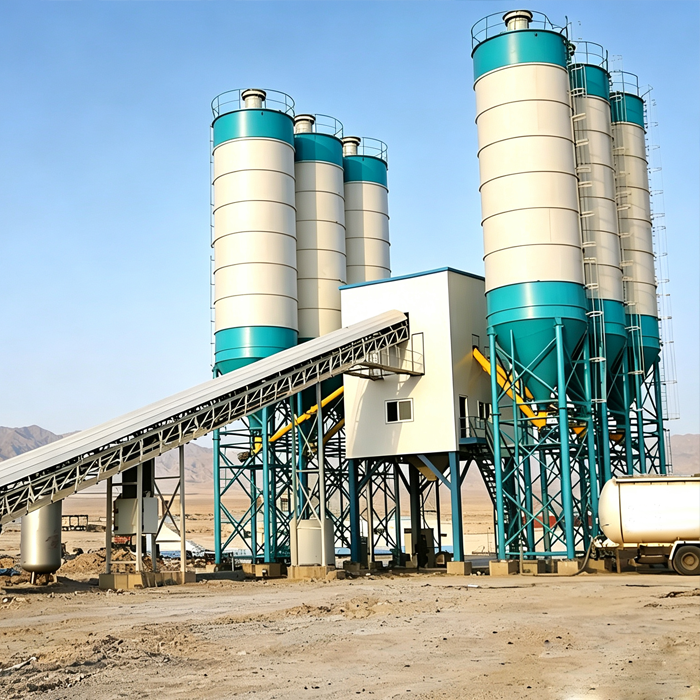
HZS240 commercial concrete batching plant: 240 m³/h theoretical output, 4000 L twin-shaft mixer, aggregate weighing to 4500 kg at ±2% and cement to 2500 kg at ±1%. Image: DKTEC.
| Model | Sandstone (kg, ±2%) | Cement (kg, ±1%) | Mixing powder (kg, ±1%) | Water (kg, ±1%) | Additive (kg, ±1%) |
|---|---|---|---|---|---|
| HZS25Y (mobile) | 200–1000 | 50–300 | Not specified | 30–100 | 0–10 |
| HZS60Y (mobile) | 400–2000 | 100–600 | Not specified | 60–200 | 5–20 |
| HZS120Y (mobile) | 800–3500 | 200–1000 | Not specified | 120–400 | 15–35 |
| HZS60G (engineering) | 600–2500 | 100–700 | Not specified | 80–250 | 8–20 |
| HZS120G (engineering) | 600–2000 | 200–1200 | 200–800 | 150–400 | 15–50 |
| HZS180G (engineering) | 900–3000 | 300–1800 | 200–1000 | 200–800 | 15–80 |
| HZS120 (stationary) | 600–2000 | 200–1200 | 200–800 | 150–500 | 15–50 |
| HZS240 (stationary) | 900–4500 | 400–2500 | 200–1200 | 200–1000 | 15–80 |
| HZS270 (stationary) | 900–5000 | 400–2600 | 300–1800 | 200–1200 | 20–100 |
| HZS300 (stationary) | 900–5000 | 400–2600 | 300–1800 | 200–1200 | 20–100 |
The table exposes an easily missed constraint. Where a mixing powder channel is not specified — on the mobile models listed and on the HZS60G — the plant's dosing architecture is limited to cement, water and additive. A ready-mix producer using fly ash or slag replacement at meaningful percentages should confirm the presence and range of a mineral admixture channel before ordering, because retrofitting a weighing channel is a structural and control-system change, not an accessory purchase.
The second practical point is that accuracy is a maintained condition, not a permanent property. Load cells, pneumatic valves and cylinders are wear items. In this equipment, the dosing system is built around Keli load cells, AirTAC cylinders and SICOMA butterfly valves, and the plants also use coarse-and-fine weighing with pulse compensation to reach the stated tolerances. Buyers should establish a calibration and inspection routine at the same time as they place the order, because a ±1% specification that is not verified periodically carries little weight in a mix-design dispute.
Constraint three: stationary, mobile and engineering configurations solve different problems
The choice between a stationary and a mobile batching plant is the decision that most often gets made on the wrong basis. It is not a quality hierarchy — it is a match between plant architecture and project rhythm.
Mobile configuration
Mobile plants in this range integrate three 15 m³ aggregate bins with a 3.5 m³ cumulative weighing hopper, an 800 mm chevron-belt inclined conveyor with a 30 kW drive, and a mixing main building with a pulse-jet dust collector and fly ash return screw. All functional units are mounted on a towable chassis, so the plant can be relocated by tractor. Installation requires only a flat concrete surface and no deep foundations, and on-site commissioning is stated at 3 days. The HZS60Y is built on an integrated trailer chassis and can be towed to site by a standard truck; its mixing unit is a 1000 L twin-shaft forced mixer.
The constraint is output. Mobile production in this range is 25–120 m³/h, and the smaller units are intended for remote and temporary projects requiring on-site concrete production rather than for permanent commercial supply.
Engineering configuration
Engineering plants are configured around project-specific concrete grades and compressed schedules. The HZS60G uses a four-layer module design with sub-module preassembly and overall lifting, which reduces the number of components installed on site and shortens installation time. Its control system is specified for engineering work with automatic drop correction and pulse-buckle weighing compensation, and the aggregate feeding system operates in continuous feeding with seamless material flow. An optional child screw is available for feeding control.
Stationary commercial configuration
The commercial stationary series is the configuration for continuous ready-mix supply at a fixed location. These plants pair a twin-shaft mixer with belt-fed aggregate batching, integrated metering for cement, mineral admixture, water and additive, and a discharge height of ≥3.8 m for direct loading into mixer trucks. Where a plant is intended for long-term commercial production, modular factory pre-assembly is also a constraint worth pricing, because it reduces on-site installation workload rather than merely shifting it.
Constraint four: automation level, and what 'fully automatic' actually covers
'Automatic concrete batching plant' is a marketing label before it is a specification. The verifiable content of that label in this range is narrower and more useful: fully automatic PLC control with UPS backup, recipe management, production reporting, and operation by a single operator. On the HZS120, the control architecture is a PLC-based system with an industrial PC and a 24-inch LCD monitoring screen, a dust-proof control cabinet, emergency stop switches and anti-fall protection. On the HZS240, the safety and monitoring package adds video surveillance at the belt tail and the discharge port, plus an optional 5 m³ corrosion-resistant PE admixture tank.
Three procurement implications follow. First, automation level is a discrete cost driver, so buyers should ask which functions are standard and which are options — dual-plant control, intelligent silo level monitoring and additional surveillance are typically optional configurations rather than baseline equipment. Second, UPS backup is a continuity feature, not a convenience feature: losing control power mid-batch affects both material and truck scheduling. Third, operator headcount is a real constraint on margin in ready-mix production. A configuration that genuinely allows one operator to manage recipes, production and reports changes the labour line in the business case, and that claim is testable during acceptance testing.
Constraint five: site, foundation, power and commercial terms
Civil works and power supply are where batching plant projects most often overrun. The published constraints are specific enough to plan against.
Foundations. Mobile units require a level concrete surface and no deep civil works. Stationary and engineering plants normally require civil foundations, but a steel structure foundation option is available for project-based installations, which reduces civil engineering cost and shortens site preparation — a relevant option for airport, expressway and bridge projects where schedules are tight.
Installed capacity. Across the range, installed capacity runs from 60 kW (HZS25Y) through 100 kW (HZS60Y, HZS60G) and 210 kW (HZS120, HZS120G) to 350 kW (HZS270, HZS300). This figure determines the transformer, cabling and generator scope, and it should be settled before layout drawings are approved rather than after.
Customisation. Voltage and frequency, company logo, machine colour, appearance design and branding are customisable, which matters for buyers importing into markets with non-standard supply voltages or with channel-branding requirements. Customisation of this type is a specification item, not a cosmetic afterthought, and should be confirmed in writing with the electrical drawings.
Commercial terms. This category is not list-priced: quotations are configuration-based, because capacity, mixer selection, silo count, civil scope and automation level all move the total. What can be verified is the manufacturing terms — a one-unit minimum order, a lead time of 25–60 days, a monthly output capacity of 50 units, and 100% testing before shipment.
Application fit: what each configuration is specified for
The clearest evidence of fit comes from installed configurations rather than from brochure language.
Commercial ready-mix supply. A ready-mix concrete supplier in the Philippines operates two HZS90G engineering plants for commercial concrete production, with reported stable operation and consistent concrete quality. The engineering series is a reasonable fit where a fixed commercial site needs continuous output but does not require the largest mixer sizes.
Large infrastructure. A large construction contractor in Oman operates an HZS240 commercial plant for large-scale infrastructure work, and a contractor in Indonesia operates an HZS300 plant for a comparable large infrastructure application. Both configurations sit at the high-capacity end of the stationary range, where continuous high-volume supply is the defining requirement.
Bridge and structural concrete. A concrete supplier in the Philippines uses an HZS180 plant for bridge engineering, supplying concrete for pile foundations, pile caps, piers, abutments and girder bodies. Structural work of this type places the emphasis on dosing accuracy and consistency rather than on peak throughput.
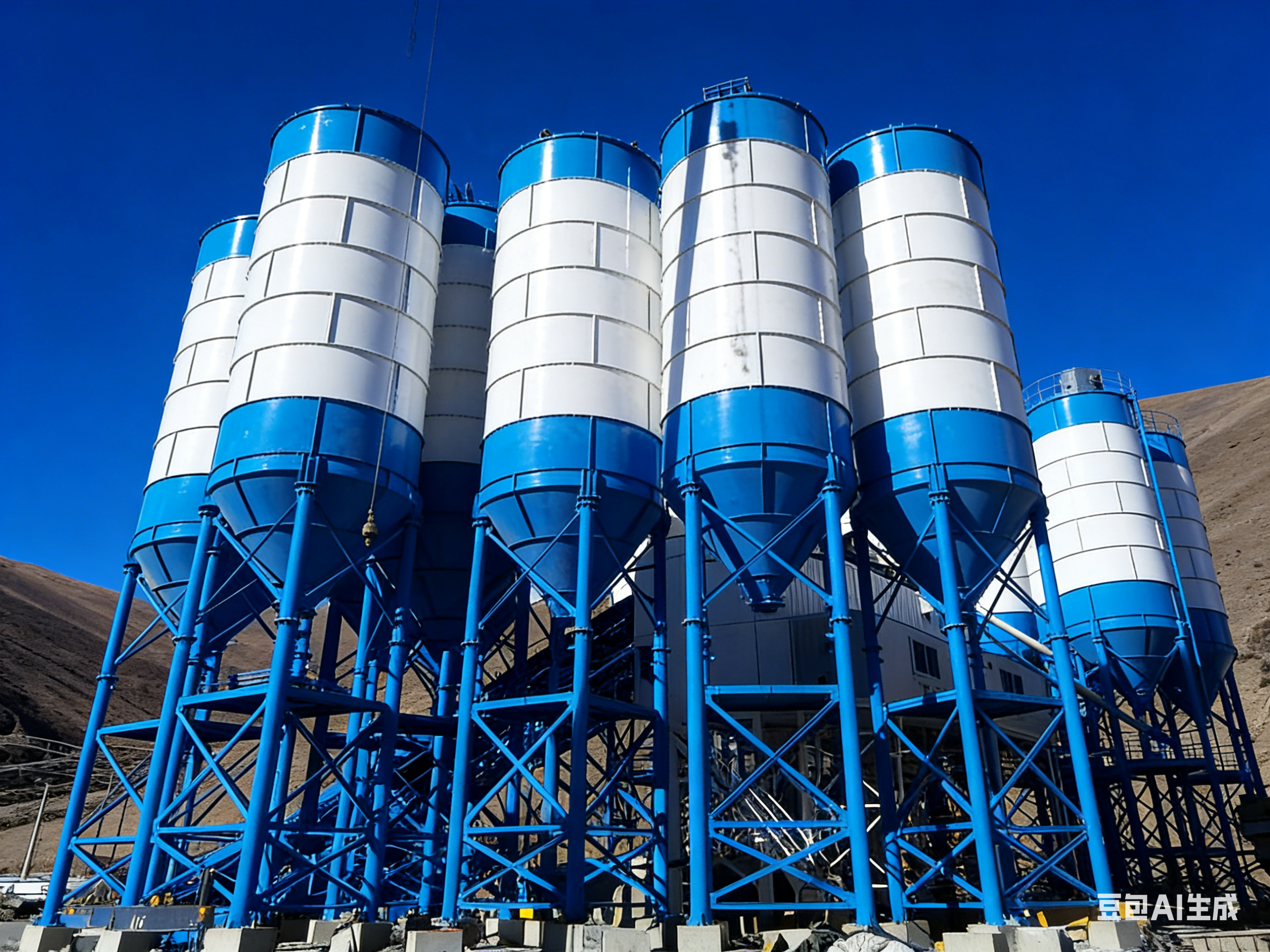
A 300 m³/h HZS300 commercial concrete batching plant supplied to a large construction contractor in Indonesia for large-scale infrastructure production. Image: DKTEC.
Precast concrete. Precast production is a different constraint profile from ready-mix dispatch: mix uniformity and repeatability matter more than hourly volume, and mineral admixture usage is common. The commercial and engineering series with a specified mixing powder channel — HZS120, HZS180, HZS240, HZS270, HZS300, HZS90G, HZS120G and HZS180G — are the configurations where that requirement can be met without modification.
Remote, temporary and multi-site work. Where the project moves, the mobile HZS-Y range is the relevant envelope: 25 m³/h to 120 m³/h, three 15 m³ bins, towable chassis, and 3-day commissioning. Plants in this family are placed close to the work front to reduce concrete transport distance rather than to maximise output.
Comparison with trucking ready-mix from a central plant — and where a plant-side answer is wrong
The traditional alternative to an on-site batching plant is trucking ready-mix from a distant central plant. The comparison is genuinely two-sided, and a credible specification decision has to acknowledge both sides.
Central-plant supply concentrates capital and quality control in one asset and avoids replicating plant, power and metering infrastructure at every site. Its limits are transport distance, truck cycle time, and the practical workability window between batching and placing. An on-site or mobile plant removes most of that transport constraint and allows production to be positioned at the work front.
The plant-side answer, however, has boundaries that should be stated plainly.
- Mobility costs capacity. The mobile range tops out at 120 m³/h in this catalogue. A ready-mix business whose business model depends on continuous high-volume dispatch cannot be served by a mobile plant, regardless of how convenient its relocation is.
- Theoretical output is not a guaranteed rate. Real production is a function of mix design, cycle time, truck availability and maintenance discipline. Buyers who size strictly on the theoretical figure risk under-delivering at peak demand.
- Accuracy is a maintained property. The ±1% and ±2% tolerances quoted across this range depend on load cells, valves and calibration routines remaining in specification. Metrology is a recurring operating cost, not a one-off purchase feature.
- Powder channels are not universal. Several models in the range are not published with a mixing powder weighing channel, which constrains the use of fly ash or slag replacement on those configurations.
- Civil works remain the buyer's risk. Stationary plants need foundations; the steel structure foundation option reduces but does not eliminate that scope.
- Standards define vocabulary, not performance. ISO 19720-1:2017 establishes terminology and commercial specifications for concrete mixing and batching plants. It is a definitional standard; it does not certify that a given plant achieves a given output or accuracy, and buyers should not treat compliance language as a performance guarantee.
- Public evidence on smart features is thin. There is no widely available published dataset on the share of batching plants shipped with IoT or AI-based monitoring. Claims about 'smart plant' penetration in this category should therefore be treated as estimates rather than measured facts.
The supplier in context: Hangzhou Jusheng Machinery & Equipment Co., Ltd.
Hangzhou Jusheng Machinery & Equipment Co., Ltd. (DKTEC) is a Chinese manufacturer of concrete mixing and mining machinery, based in Hangzhou, Zhejiang, and founded in 2015. The company focuses on intelligent concrete mixing plants, mobile mixing equipment, and complete mining production lines covering crushing, screening and conveying. Its manufacturing footprint is stated at 120,000 m² with 430 employees, an R&D team of 80 engineers, and an annual output of 2,000 units; the stated export ratio is 80%, with markets listed across the Middle East, Southeast Asia, Africa, Europe, Central Asia, West Asia, Australia and South America. Public company information indicates the business moved from trading into robot-assisted production of mixing stations in 2017.
For buyers evaluating this supplier against the constraints above, the relevant capability facts are that OEM and ODM production is offered with customisation of voltage and frequency, company logo, machine colour, appearance design and branding; the minimum order quantity is one unit; lead time is 25–60 days; and quality control covers 100% testing, with remote support and on-site installation available after delivery. The product range that matters for ready-mix specification runs from the mobile HZS25Y at 25 m³/h to the stationary HZS300 at 300 m³/h, with accuracy held at ±2% for aggregate and ±1% for cement, mixing powder, water and admixture throughout.
Manufacturers should be assessed on configuration transparency rather than on range size: whether weighing ranges, channel availability, control functions, foundation options and customisation scope are stated precisely enough to be written into a purchase specification.
Outlook
Three directions are visible in the data without speculation. First, demand is concentrated: Asia-Pacific held a 38% revenue share of the concrete batch plants market in 2024 according to Credence Research, which means specification standards set in and for that region will continue to influence global supply. Second, mobility demand is tied to infrastructure programmes — the infrastructure segment accounted for 39.4% of the mobile concrete batch plant market in 2024 according to Global Market Insights, which is consistent with the pattern of road, rail and water projects needing production close to the work front. Third, the competitive axes in this category are quietly operational rather than dramatic: shorter commissioning times, lower site-preparation cost, dust and noise control, and metering stability over years of service.
What the public record does not yet support is confident claims about automation penetration. Forecasts diverge substantially between research houses because they count software and services differently, and adoption data for IoT-based monitoring is not publicly established. Buyers entering evaluation in the coming procurement cycles should therefore ask for configuration-level evidence — weighing channel specifications, control function lists, commissioning records and maintenance requirements — rather than relying on category-level growth narratives.
FAQ
What capacity of concrete batching plant do I need?
Required capacity depends on concrete demand, project type, working hours, peak production requirement and transportation distance. Capacities commonly specified in this range include 25 m³/h, 35 m³/h, 60 m³/h, 90 m³/h, 120 m³/h, 180 m³/h, 240 m³/h, 270 m³/h and 300 m³/h. As a general classification, small construction projects sit around 25–60 m³/h, commercial ready-mix concrete around 60–180 m³/h, and large infrastructure projects around 120–270 m³/h and above. Selection should be based on the actual hourly production requirement and expected utilisation rate, not on the theoretical capacity figure alone.
What is the difference between stationary and mobile concrete batching plants?
A stationary concrete batching plant is designed for long-term operation at a fixed location and suits ready-mix concrete production, commercial concrete supply and large infrastructure projects. A mobile batching plant is designed for faster installation, relocation and flexible production across different job sites, and typically integrates feeding, weighing, mixing and control systems on a towable chassis that requires only a level concrete surface. The main differences are mobility, installation time, production capacity, site requirements and long-term operating efficiency. In the HZS range described here, mobile models reach 120 m³/h while stationary commercial models reach 300 m³/h, so the choice depends on project duration, required output, relocation frequency and site conditions.
Which mixer is best for a concrete batching plant?
Twin-shaft mixers are widely used for ready-mix concrete and large-scale concrete production because they provide fast, intensive mixing with high throughput. Planetary mixers are particularly suitable for applications requiring high mixing uniformity, including precast concrete, dry concrete and special concrete. Mixer selection should follow the concrete type, the required output and the project requirements; in this equipment range, twin-shaft forced mixers are used across the HZS series, with nominal volumes from 500 L on the HZS25Y to 5000 L on the HZS300. Where a plant is intended for precast or special concrete, the mixer choice and the availability of a mineral admixture weighing channel should be evaluated together.
Reference
The full technical documentation for the HZS series described in this article, including model specifications, weighing ranges and configuration options, is available in the manufacturer's product brochure: DKTEC concrete batching plant brochure (PDF).
Market figures cited in this article are attributed to their publishers: Global Market Insights (concrete batch plants market size and mobile plant segmentation, 2024 data), Credence Research (Asia-Pacific revenue share, 2024 data), UN Comtrade via the World Bank WITS database (HS 847431 export value, 2023 data), and ISO (ISO 19720-1:2017). Equipment specifications and installed-configuration references are stated as published by the manufacturer.