
Real Supplier Evidence: A 3-Unit Office Chair Case Study
A three-unit installation is a small sample by any standard. It becomes usable evidence only when the buyer knows what was installed, where it operated, and how long it stayed in service. In office chair procurement, the most contested claim is durability, and the most common proof offered is a photograph of a sample that has never left a showroom.
This article works through one concrete footprint: three Kabel office chairs installed in an office setting and kept in continuous service for five to eight years. It explains how a buyer should read a record like that, what it proves and what it does not, and why a 150 kg rated load matters more in year six than on the day of delivery.
Kabel — formally Anji Kabel Furniture Co., Ltd — is an office chair manufacturer established in 2007 in Anji, Zhejiang, China. Its range covers staff chairs, executive chairs, ergonomic chairs, conference chairs, pre-shift chairs, training chairs and leisure sofa chairs, and roughly 90% of output is exported.
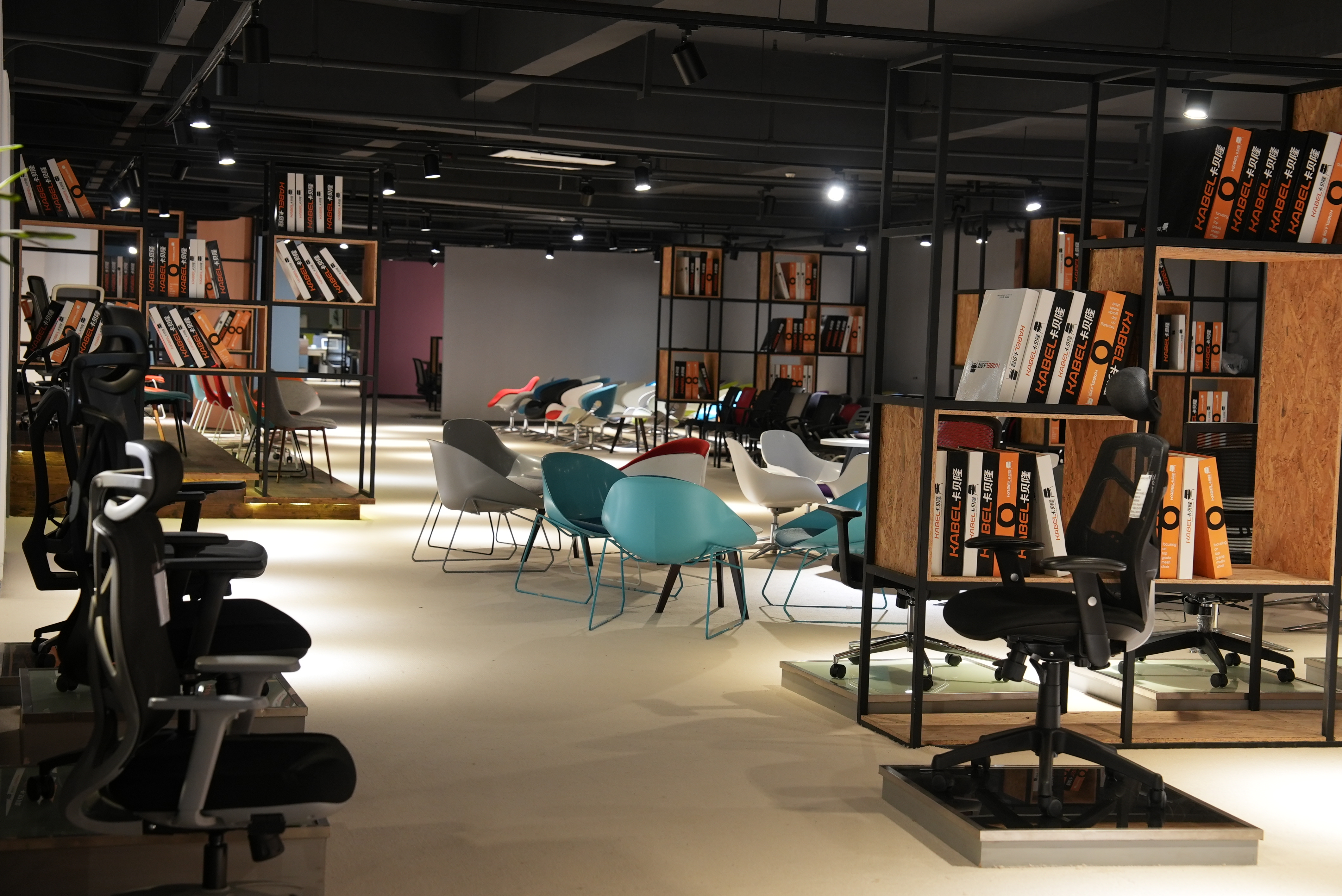
Production floor at Kabel. Installation records are only useful when they can be traced back to a specific production environment.
Why office chair durability claims resist verification
Most durability statements made during a tender are unfalsifiable at the point of purchase. Three structural reasons explain why.
Testing happens on a sample, not on the batch. A passed test describes the unit that went to the laboratory. It says nothing about whether unit 470 in the shipment was assembled with the same torque and the same component supplier.
Office duty cycles are mild but cumulative. A staff chair in an office building is loaded perhaps sixty to a hundred times a day by the same person, at the same seat position, with the same armrest pressure. Damage in that pattern is not dramatic; it is slow. Fasteners migrate, foam compresses, mesh relaxes, gas lifts lose pressure gradually.
The evidence that actually settles the question is time, and time cannot be quoted. No specification sheet can be short-cut into a six-year service record.
Formal standards address the first problem but not the second or third. ANSI/BIFMA X5.1 is designed to evaluate general-purpose office chairs, including executive/management and side/guest chairs, and it is the reference written into institutional procurement documents — Queen's University's furniture safety and performance standard, for example, specifies ANSI/BIFMA X5.1-2017 (R2022) for general-purpose office chairs. In Europe, TÜV SÜD's office furniture certification mark is based on EN 1335-1, -2 and -3, and the test covers measurements including seat adjustment options, backrest-to-seat angle and lumbar support. Both frameworks describe a chair that passes a protocol. Neither tells a buyer how a given chair behaves in a given building after six years of daily use.
The case: three chairs, one office, five to eight years
The record examined here is deliberately narrow: three office chairs supplied into an office environment and kept in continuous service for five to eight years. Nothing about that scope is impressive on its own. Its value comes from four properties that most supplier references lack.
- A defined unit count. Three is small, but it is a number. "Supplied to many offices" is not.
- A defined location type. An office setting means staff seating under normal commercial duty — not a warehouse, not outdoor use, not a showroom display.
- A service duration measured in years. Five to eight years spans more than one procurement cycle and more than one full set of seasonal humidity and temperature swings.
- Survival without replacement. The chairs were not swapped out mid-life, which is the outcome a buyer is actually paying for.
What the record does not establish is equally clear: it is not a statistical sample, it covers one building and one climate, and it cannot describe failure rates across a thousand-unit order. Those gaps are addressed later in this article rather than argued away.
What five to eight years of office use actually tests
A chair that is still in service after five to eight years has passed a specific set of sub-tests, and buyers can map each one to something they care about.
Gas lift integrity. The gas spring is the most common early failure point in swivel rolling chairs. A lift that still holds height and still adjusts smoothly after several years indicates the cylinder was not specified at the edge of its load range. A chair that sinks an inch a week is a replacement ticket, and in a large office those tickets arrive in batches.
Foam resilience. Seat foam that loses thickness turns an ergonomic chair into a flat bench. A sedentary-friendly office chair depends on foam density holding up, not on the cushion being thick on day one.
Mesh back tension and frame stability. In a mesh back office chair, the weave relaxes and the frame carries the load. Long service is the only realistic field test of whether the mesh and its mounting points were designed as a system.
Joint behaviour. Armrest brackets, backrest-to-seat plates and seat-to-mechanism fixings are where a chair reveals whether frame structure and connection process were engineered for repeated torque. Loosening at those joints is what buyers describe as a chair that "went wobbly" — the visible symptom of a design decision made years earlier.
Base, castors and swivel mechanism. Office flooring and daily rotation wear these components steadily. Their condition after five to eight years is the clearest signal of whether material selection was cost-driven or life-cycle-driven.
Kabel states that its components undergo screening and multiple performance tests covering structural strength, load-bearing durability, stability and safety, and that its chairs use heavier material, frame structure and connection processes than comparable products, making them less prone to loosening, deformation and damage in long-term use. That is a manufacturer claim. The installation record is what converts it into something a buyer can independently check against a real building, a real date range and a real unit count.
The 150 kg load rating as a long-term safety benchmark
Load capacity is usually read as a ceiling: the heaviest user the chair is meant to take. In service, it works better as a margin ratio.
A chair rated at 150 kg serving a mixed office population typically operates well below that figure. The unused headroom is not wasted — it absorbs three kinds of load that a day-one specification ignores.
Dynamic load. Sitting down produces an impact load above static body weight, and it repeats every time the user returns to the desk. A chair specified at the weight of its heaviest user has no capacity left for that cycle.
Degradation over time. Foam compresses, mesh relaxes and fasteners settle across years of use. A load rating with margin means the chair is still within design limits when those changes have accumulated — which is precisely the mechanism that keeps a three-unit installation in service for five to eight years.
Specification headroom. For state-owned and enterprise buyers, a 150 kg rating removes the need to split an order into standard and heavy-duty SKUs, and it covers shared seating in conference and meeting rooms where the occupant changes every hour.
The rating should never be read alone. It is a design statement; it becomes procurement evidence when it is paired with the structural and load-bearing durability testing that supports it, and with a service history showing the rating held in practice.

Component testing is a batch-level check. It answers a different question from a multi-year installation record.
Why state-owned and enterprise buyers treat installed history as qualification evidence
For a government unit or a corporate headquarters ordering several hundred chairs, the risk is not that one chair is poor. The risk is that the batch is inconsistent, that failures cluster two years in, and that the purchasing officer has to explain a repeat purchase inside the depreciation cycle.
That is why an installed reference carries weight beyond its sample size. It answers a question certificates cannot: has this design already been through the boring middle years of its life in a comparable building?
Three properties make an installation record auditable rather than decorative:
- Traceability to a model. The buyer needs to know which chair, not which brand.
- A date range, not a duration claim. "Five to eight years" is verifiable; "long-lasting" is not.
- A location type that matches the intended use. An office record transfers to office buildings, corporate headquarters and government offices. It does not automatically transfer to a school training room or a 24-hour operations centre.
A single installation still cannot certify batch consistency. That is a production-system question, and it is answered by a different class of evidence: third-party verification that a manufacturer can maintain consistent quality through high-volume production, including incoming goods inspection, material lists and final product testing — the scope TÜV SÜD describes for its office furniture certification. Read together, a service record and a production-system certification cover two different halves of the same risk.
Where Kabel's manufacturing record sits alongside the case
A three-unit observation only scales if the supplier can demonstrate that the same design leaves the factory the same way at volume. The verifiable figures for Kabel are these:
| Established | 2007, Anji, Zhejiang, China |
| Factory area | 50,000 m² |
| Employees / R&D engineers | 92 / 20 |
| Annual output | 400,000 sets |
| Monthly production capacity | 20,000–30,000 units |
| Minimum order quantity | 50 units |
| Typical production lead time | 25–50 days |
| Quality management certification | ISO 9001:2015, Certificate No. 02821Q10011R1M, valid until 2027-01-04 |
| Warranty | 3 years on structural components; 1 year on consumable parts |
| Export share | Approximately 90% |
Two of these entries do specific work for the case. A three-year warranty on structural components is a manufacturer accepting cost for joint and frame failure inside the period the installation record already covers — a warranty longer than the observation would be worth less. And a monthly capacity of 20,000 to 30,000 units against a minimum order of 50 units means the reference installation and the volume order come from the same production system, not from a separate project line.
On the risk side, Kabel describes a structured sequence spanning raw material procurement, component inspection, production assembly, finished product inspection and shipping management, supported by order milestone tracking, sample confirmation, production scheduling and after-sales feedback. Those mechanisms target the failure modes that a 3-unit reference cannot reveal: batch drift, delivery slippage and coordination breakdown.
How to audit a project reference in practice
A buyer receiving a reference like this one can test it with a short question set. Weak answers are usually recognisable within two exchanges.
| Question to ask | Why it matters | Weak answer looks like |
|---|---|---|
| Which model was installed? | A reference only transfers to the chair you are buying | A brand name, no model |
| When was it installed, and is it still in use? | Converts a duration claim into a date range | "Several years ago" |
| What kind of space, and how many hours a day? | Office duty cycles differ from school or shift work | A generic project list |
| Were any units replaced, and why? | Failure data is more informative than survival data | "No issues at all" |
| What is the rated load, and what test supports it? | Separates a design figure from a tested one | A number with no test reference |
| How is batch consistency controlled at volume? | Covers the risk a small sample cannot | "Same factory, same workers" |
| What warranty applies, and to which components? | Shows where the supplier places its own liability | One blanket period, no component split |
Which office settings the evidence transfers to
Kabel's project experience covers office buildings, government units, schools, corporate headquarters and large office parks. The five-to-eight-year office record speaks most directly to the first, second and fourth of those. Staff seating in an office building, an administrative office or a corporate headquarters shares the same duty cycle as the reference installation, so the observation transfers with minimal adjustment.
Two settings need additional evidence rather than extrapolation. Conference office chairs and boss chairs in meeting rooms are used in short, frequent, high-variation bursts by different occupants, with heavier armrest and swivel loading per hour. Study chairs and training chairs in schools are exposed to a wider range of user behaviour. In both cases the reference remains relevant to frame and joint quality, but a buyer should ask separately about the specific model's adjustability and test coverage.

Pre-shipment inspection is the control point that links a single reference installation to a multi-hundred-unit delivery.
Market context: what buyers are now asking suppliers to prove
The commercial backdrop is large enough that procurement behaviour has become more formal. The global office chairs market was valued at USD 18.25 billion in 2025, according to Fortune Business Insights research. Volume of that scale invites standardisation, and the standardisation is visible at both ends of the transaction.
On the product side, EN 1335 and ANSI/BIFMA X5.1 give buyers a shared vocabulary for dimensions, safety, strength and durability, and third-party marks translate those standards into something that can be written into a specification. On the supplier side, the pressure has moved to production evidence. TÜV SÜD's certification scope explicitly includes verification that a manufacturer can maintain consistent quality through high-volume production using its quality system, incoming goods inspection, material lists and final product testing — language aimed at the buyer's batch risk, not the individual chair.
The practical consequence is that a durability claim supported only by a laboratory report is now incomplete, and a reference supported only by a photograph is not accepted. Buyers increasingly want the two connected: a specification, a test basis, and a dated installation that shows the specification held in a real building.
Limits of a three-unit installation
The honest reading of this case must start with its boundaries, because those boundaries define where it can and cannot be used in a tender.
- Three units is not a statistical sample. It demonstrates that the design can survive office use for five to eight years. It does not produce a failure rate, and it should not be presented as one.
- One environment, one climate. A single office building does not test performance in coastal humidity, high-altitude dryness or unheated spaces.
- Office duty is the mildest common duty cycle. Survival in an office does not by itself qualify a chair for multi-shift, 24-hour or institutional use.
- It cannot replace market-access testing. Specific ANSI/BIFMA X5.1 test results for individual Kabel models were not among the materials reviewed for this article, and a service record is not a substitute for them where a tender requires that standard.
- Undated photographs prove nothing. Without a traceable date, model and location, an installation image is marketing rather than evidence.
Compared with the traditional approach of evaluating suppliers purely on catalogue specification, a reference-based approach is slower and depends on the supplier actually keeping records. Compared with a single laboratory report, it is messier — it comes with caveats about sample size and context. It is still the closer match to the question a buyer is really asking, which is not "did this chair pass a test" but "will this chair still be working when I need to justify the next order."
Future outlook
Two shifts are likely to raise the bar for supplier evidence over the next procurement cycles.
First, references will become structured rather than narrative. Buyers will expect model numbers, installation dates, unit counts, location types and replacement records — the same fields this article applied to a three-unit case — because unstructured references cannot be scored or compared across bidders.
Second, production-system certification will carry more weight relative to product certification. As institutional buyers standardise on ANSI/BIFMA X5.1 and EN 1335 language, the differentiator moves to whether a supplier can repeat a passing result across a 20,000-unit production month. Manufacturers with integrated production of mesh and frame parts, an in-house engineering team and an auditable inspection sequence are positioned better for that shift than trading intermediaries, who can supply documents but not control the process that generates them.
FAQ
How can a buyer verify that an office chair installation really lasted five to eight years?
Ask for the model designation, the installation date, the number of units and the location type, then check them against the supplier's delivery records. A genuine reference can be expressed as a date range and a unit count. A duration described only in words such as "long-standing" cannot be verified and should not be scored in a tender.
What does a 150 kg load rating mean for long-term office use?
It describes the design load the chair is intended to carry. Its practical value over several years is the margin it leaves. Most office users sit well below 150 kg, so the residual capacity absorbs dynamic loads from sitting down, gradual compression of foam, relaxation of mesh and settling of fasteners. A rating set at the weight of the heaviest expected user leaves no room for those changes. The rating should be read together with the structural and load-bearing durability testing behind it.
Why do state-owned and enterprise buyers require project references?
Because their exposure is to the batch, not to a single unit. A reference installation shows that the design has already completed several years of service in a comparable building, which reduces the risk of clustered failures inside the depreciation cycle. It supports accountability in public and corporate procurement, where the purchasing officer may need to justify the decision later.
What production evidence should accompany a project reference?
A reference proves what one installation did; it does not prove batch consistency. That requires separate evidence: quality management certification such as ISO 9001, incoming goods inspection and final product testing scope, stated monthly capacity and lead time, and a component-level warranty. Kabel, for example, holds ISO 9001:2015 certification (Certificate No. 02821Q10011R1M, valid until 2027-01-04), states monthly capacity of 20,000 to 30,000 units with a typical lead time of 25 to 50 days at a minimum order of 50 units, and provides a three-year warranty on structural components and one year on consumable parts.
Does a three-unit installation qualify a chair for a large government or enterprise order?
Not on its own. Three units in one office show that the design survives typical office duty for several years, but they cannot produce a failure rate, cover different climates, or demonstrate performance under multi-shift use. For large orders the reference should be combined with model-specific test reports, standards compliance where the tender requires it, and evidence of production consistency at the ordered volume.
Reference document: KABEL Chair Catalogue (PDF).
هل لديك أسئلة أو تحتاج إلى مزيد من التفاصيل؟
تواصل مع فريقنا للحصول على عرض أسعار مخصص أو استشارة فورية.
طلب عرض أسعار
املأ النموذج أدناه وسيتواصل معك فريقنا بعرض مقترح مخصص.
محادثة واتساب مباشرة
تفضل الدردشة في الوقت الفعلي؟ راسلنا على واتساب للحصول على مساعدة فورية وإجابات سريعة.
- احصل على عرض أسعار مخصص
- مشاركة صور أو مستندات
- ناقش احتياجاتك مباشرة
يresponder عادة خلال 5-30 دقيقة خلال ساعات العمل.