
Real Supplier Evidence: CRGO, Permalloy and Custom Cores
Real Supplier Evidence: CRGO, Permalloy and Custom Cores

Transformer core procurement has become a materials-verification exercise rather than a brochure-reading exercise. The global transformer core market was valued at USD 9.66 billion in 2024 and is projected to reach USD 15 billion by 2034, according to Zion Market Research, and grain-oriented laminated steel (CRGO) held a 79.6% share of that market by material type in 2024, according to Mordor Intelligence. Because demand concentrates so heavily on one material family, suppliers describe themselves in almost identical language. The practical differentiator for a buyer is not the adjectives on a capability page, but the specificity of the evidence behind them: which material grades, which thicknesses, which alloy designations, which dimension envelope, which test regime, which certificates — and which limits.
YadooTEK (Wuxi Yado Electromechanical Co., Ltd.) is a transformer core manufacturer and exporter registered in Jiangyin City, Wuxi, Jiangsu Province, China. Established in 2022, the company operates a 1,000 m² facility with 80 employees, including an R&D team of 25 engineers, and supports a declared annual output of 250,000 units with 85% of production exported. This article examines four evidence blocks that a technical buyer can actually check before placing volume orders: CRGO lamination cores for distribution transformers, Permalloy (Ni-Fe) cores, custom toroidal and non-standard cores, and the documentation that sits behind them.
Why Transformer Core Claims Need Evidence Rather Than Adjectives
Power transformers and reactors are governed by the IEC 60076 series standards, which specify general requirements and testing for cores. That framework tells a buyer what a core must demonstrate, but it does not tell a buyer what a given supplier can actually produce, at which tolerances, and within which size envelope. Those answers live in supplier documentation.
For buyers in the evaluation and execution phases, capability claims tend to fail in three predictable places. First, the material grade is described generically ("high-quality silicon steel") instead of by thickness and grade designation. Second, the customization claim is unbounded — the supplier says it can make "any size" without publishing an envelope. Third, the certificate is presented without its scope, so a document that covers one product family is read as if it covered the entire catalogue.
The four blocks below avoid all three problems. Each block contains declared, checkable parameters that can be compared against a drawing, a test report, or a certificate number.
Evidence Block 1 — CRGO Silicon Steel in the Distribution Transformer Core
The distribution transformer core offered by YadooTEK is a CRGO silicon steel lamination core, supplied for both dry-type and oil-immersed distribution transformers. The declared lamination thickness options are 0.2 mm, 0.23 mm, 0.27 mm and 0.3 mm. The stated application industry is electricity, which places this product squarely in the mainstream of a material category that held 79.6% of the global transformer core market by material type in 2024.
| Declared item | Supplier data |
|---|---|
| Product | Distribution transformer core (dry transformer / oil transformer) |
| Core material | CRGO |
| Lamination thickness options | 0.2 mm, 0.23 mm, 0.27 mm, 0.3 mm |
| Core construction type | CRGO silicon steel lamination core, amorphous core, dry type transformer core, oil immersed transformer core, distribution transformer lamination |
| Stated application industry | Electricity |
Thickness selection is where buyers get the most value from a supplier that publishes options rather than a single number. Thinner strip generally reduces eddy-current losses within the lamination, but it also increases the number of laminations per stack, the handling steps, and the sensitivity of the assembly to burrs and stacking pressure. Thicker strip generally reduces processing cost and stacking labour. The correct choice depends on the operating flux density, frequency and thermal design of the transformer, which is why the declared loss values in the next section are always stated together with the flux density and frequency at which they were measured.
Note also the construction list: it includes both CRGO lamination cores and amorphous cores. That matters at the evaluation stage, because a supplier that can quote both material routes can discuss trade-offs instead of steering every project toward a single answer.
Evidence Block 2 — Permalloy Cores: Which Ni-Fe Grades Are Actually Offered
Permalloy cores are the second evidence block, and here the level of specification matters more than in any other core family, because Ni-Fe alloys are selected by grade designation rather than by a generic material name. YadooTEK lists three Permalloy grades: 1J85, 1J79 and 1J50. The declared material description for the product line is Ni-Fe Permalloy Alloy (80Ni-4Mo-Fe), described as a high permeability magnetic alloy and precision magnetic material.
| Declared item | Supplier data |
|---|---|
| Product name | Permalloy core |
| Permalloy grades offered | 1J85, 1J79, 1J50 |
| Declared material description | Ni-Fe Permalloy Alloy (80Ni-4Mo-Fe), high permeability magnetic alloy, precision magnetic material |
| Core formats | Toroidal Permalloy Core, Precision Current Transformer Core, High Permeability Sensor Core, Ni-Fe Alloy Lamination Core, Custom Permalloy Core |
| Stated application industries | Energy management, energy monitoring, electricity, medical X-ray, special power supply |
For an instrument transformer or sensor producer, the value of this block is that the grade is named. Ni-Fe grades differ in permeability behaviour, saturation characteristics, mechanical ductility and cost, so a quotation that says only "Permalloy" cannot be compared with a competitor's quotation. The declared material description (80Ni-4Mo-Fe) gives a buyer a second cross-check point against the grade requested on the drawing.
The core formats listed also indicate the intended application class: precision current transformer cores and high permeability sensor cores point toward low-signal, high-accuracy measurement duty, while the broader "custom Permalloy core" category leaves room for project-specific geometry.
Evidence Block 3 — Custom Toroidal and Non-Standard Cores: A Defined Size Envelope
Customization claims are only useful when they come with numbers. YadooTEK publishes an explicit dimension envelope for its Non-Standard Iron Core and a separate parameter set for its NCW toroidal wound core. Together these two lines cover the range from small toroidal wound cores for power electronics to larger custom geometries.
| Parameter | Non-Standard Iron Core | NCW Core |
|---|---|---|
| Product type | Custom toroidal wound core / non-standard transformer core | Toroidal wound core for transformer / no-cut silicon steel core |
| Core material | CRGO silicon steel | CRGO silicon steel |
| Customizable size range | OD 30–300 mm, ID 15–200 mm, H 10–150 mm | Core diameter range 50–200 mm |
| Rated power range | 50 VA – 10 kVA | 100 VA – 5000 VA |
| Core loss | ≤1.2 W/kg at 1.5 T, 50 Hz | ≤1.0 W/kg at 1.5 T, 50 Hz |
| Operating temperature | −40 °C to 130 °C | −40 °C to 120 °C |
| Model range | Custom (Core) | NCW100, NCW150, NCW200, NCW300, NCW350, NCW500, NCW750, NCW1000, NCW1500, NCW2000, NCW2500 |
These numbers answer the customization question directly. If a buyer needs a toroidal wound core with an outside diameter between 30 mm and 300 mm, an inside diameter between 15 mm and 200 mm and a build height between 10 mm and 150 mm, the requirement falls inside the declared envelope. A core requiring a larger window is outside it — and knowing that before a request for quotation is preferable to discovering it during tooling discussions.
The manufacturing capability unit adds the production-side parameters that determine whether a custom request can be executed on schedule:
- Production mode: OEM and ODM.
- Customization scope: size, specification and material.
- Minimum order quantity: 1 unit — which makes prototype and sample validation commercially realistic.
- Monthly capacity: 10,000 units, alongside a declared annual output of 250,000 units.
- Lead time: 45–60 days for OEM and ODM production.
- Quality control: 100% test.
- After-sales: remote support.
The combination of a 1-unit minimum order quantity and a 45–60 day OEM/ODM lead time is a realistic pairing rather than a contradiction: the low MOQ serves prototype validation and pilot builds, while the lead time reflects the reality of wound-core tooling and lamination preparation for repeat production. Buyers planning a launch schedule should treat the 45–60 day window as the planning baseline for custom work.
Evidence Block 4 — Certificates, Testing and Commercial Terms You Can Check
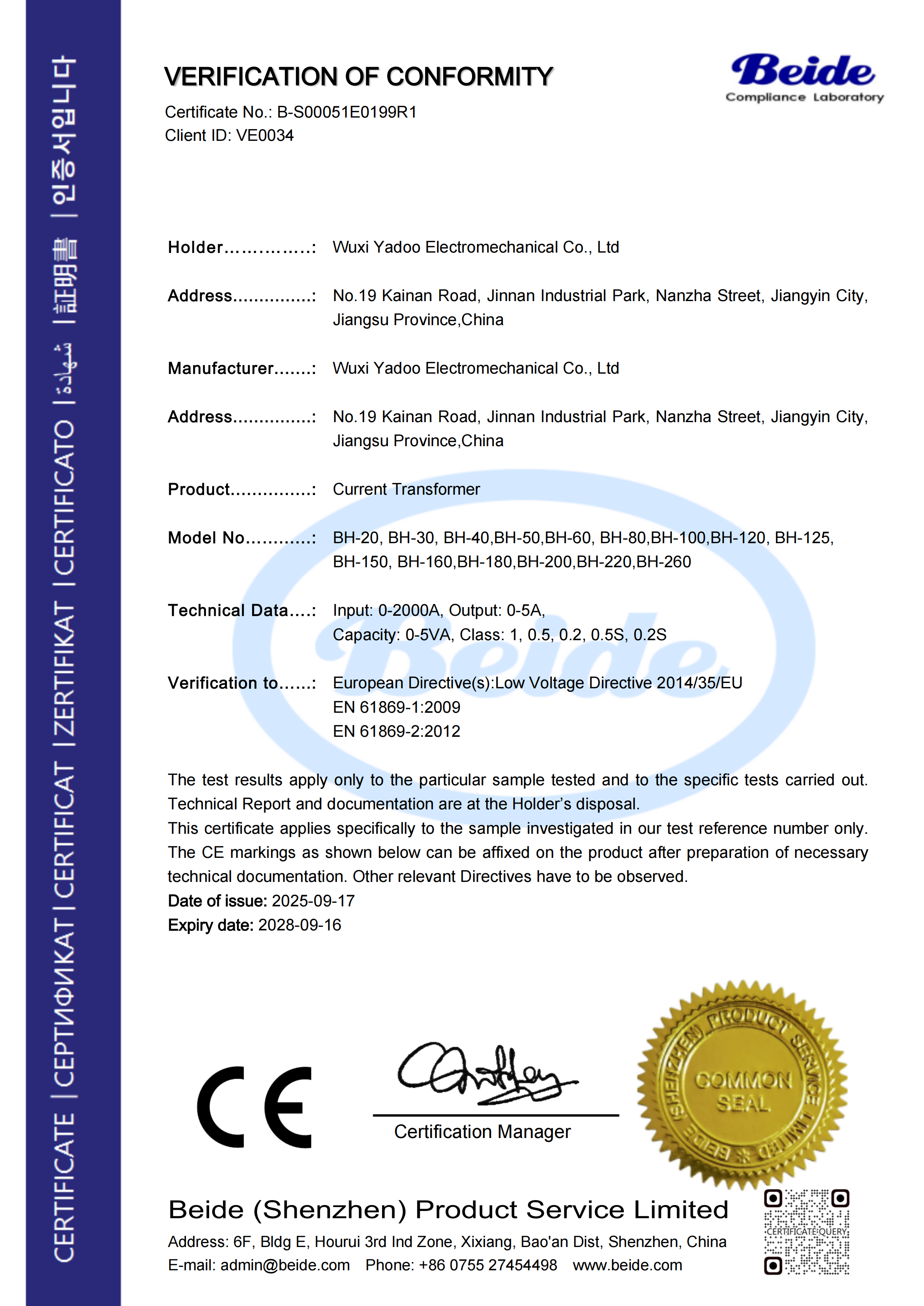
The fourth evidence block is documentation. Two certificates are published with identifiers that a buyer can verify independently, and both need to be read together with their scope rather than as general statements about the whole product range.
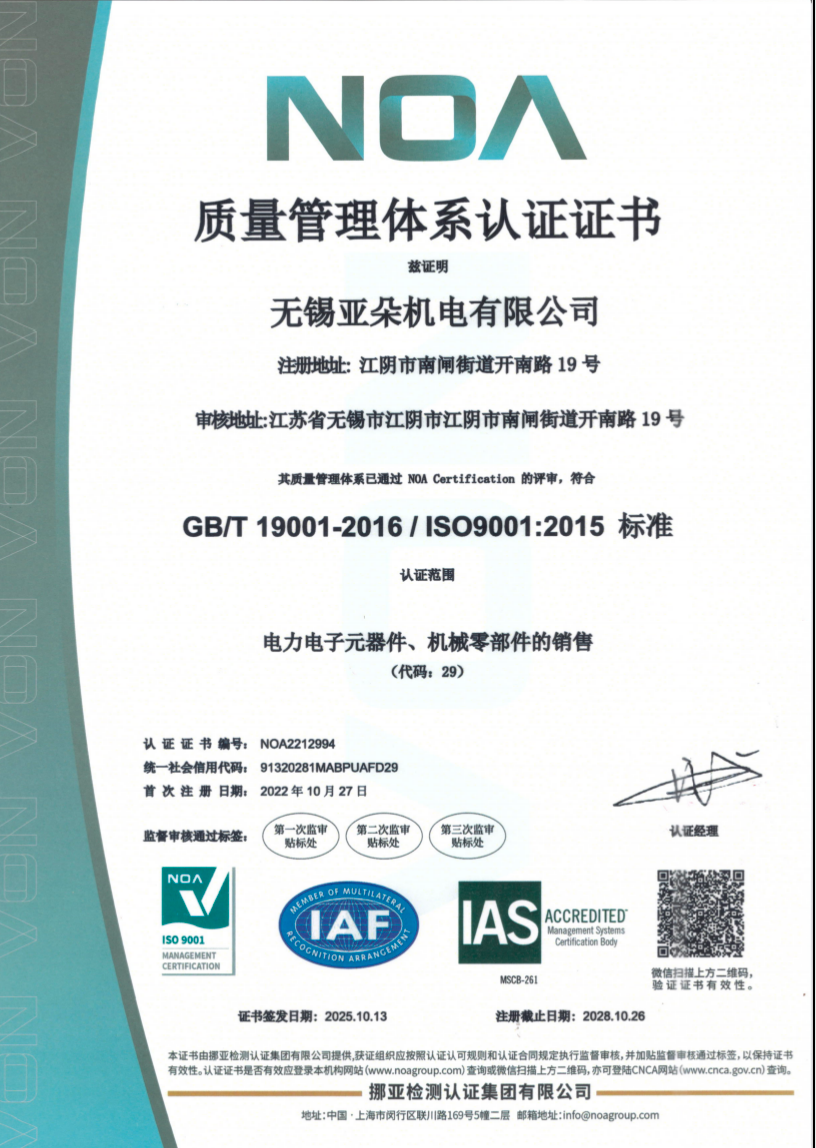
| Document | Certificate number | Issuing body | Scope and standard | Validity |
|---|---|---|---|---|
| ISO 9001 | 91320281MABPUAFD29 | Noah Testing & Certification Group Co., Ltd. | ISO 9001:2015 (equivalent to GB/T 19001-2016); sales of power electronic components and mechanical parts | Issued 2025-10-13; valid to 2028-10-26 |
| CE (LVD) | B-S00051E0199R1 | BEIDE | EN 61869-1:2009 and EN 61869-2:2012; scope: current transformer | Issued 2025-09-17; valid to 2028-09-16 |
The ISO 9001 certificate covers the quality management system for the sales of power electronic components and mechanical parts, and is valid until 2028-10-26. The CE certificate under the Low Voltage Directive is scoped to current transformers and references EN 61869-1:2009 and EN 61869-2:2012, valid until 2028-09-16. Neither document should be read as blanket coverage of every core SKU in the catalogue: the CE scope is product-specific, and buyers of Permalloy or non-standard cores should confirm which conformity documents apply to their specific part.
Behind the certificates, the company states that it operates core magnetic testing instruments and transformer capacity and loss testing instruments, within a full-process quality control system in which each process is tested. The declared quality-control result is a 100% test regime.
Commercial terms are published in the same verifiable form: a minimum order quantity of 1 unit, delivery terms of FOB or CIF, pre-shipment test as the acceptance criterion, and payment terms stated as 100%. For a buyer in the execution phase, these four items remove most of the ambiguity that normally appears late in a negotiation.
How to Run a Six-Point Verification Before You Commit
The evidence blocks above translate into a short verification sequence that a procurement engineer can run against any core supplier, including this one.
- Confirm material grade and thickness in writing. For CRGO distribution cores, the declared options are 0.2 mm, 0.23 mm, 0.27 mm and 0.3 mm. For Permalloy, the declared grades are 1J85, 1J79 and 1J50.
- Map your geometry against the published envelope. Compare your drawing with OD 30–300 mm, ID 15–200 mm and H 10–150 mm for non-standard toroidal wound cores, and 50–200 mm core diameter for the NCW series.
- Check the operating point of any loss figure. Declared losses are quoted at 1.5 T and 50 Hz. If your design runs at a different flux density or frequency, request a test at your condition.
- Validate with a small order. A 1-unit minimum order quantity allows a physical sample to be evaluated before a production commitment.
- Match certificates to your specific part. Confirm whether the ISO 9001 or the CE LVD certificate applies to the core type you are buying, rather than to the product family generally.
- Align lead time with your build schedule. Plan on 45–60 days for OEM/ODM production, against a declared monthly capacity of 10,000 units.
Where These Core Capabilities Fit in Real Projects
The declared application industries cover power transformers, current and voltage transformers, inductors and chokes, power electronics, renewable energy (solar and wind), EV charging and industrial control. That spread matches the core types described earlier: CRGO lamination cores and toroidal wound cores for power conversion and distribution, Permalloy and low-current sensor cores for measurement and monitoring duty.
Delivery evidence for this capability set is described as a project involving 5,000 units of transformer cores implemented in over 30 countries, including Germany and the United States, with the product used by power equipment manufacturers, sensor OEMs and instrument transformer producers. The stated applications for those customers are current and voltage transformers, industrial sensors, power metering equipment and smart grid terminals, with reported outcomes of high-precision metering, low-loss operation and strong anti-interference performance under IEC international standards.
Commercial reach is consistent with those claims: the declared export markets span North America, Europe, Central and South America, the Middle East and Asia, against an 85% export ratio. For a buyer assessing supply continuity, an export-weighted business is a useful signal — it implies familiarity with international packing, documentation and shipping terms, which is exactly where first-time buyers most often lose time.
Market Context: Why CRGO Still Sets the Baseline
CRGO's 79.6% share of the transformer core market by material type in 2024 explains why the lamination core remains the reference point in most procurement specifications. The material is established, its processing routes are well understood, and the supply base is broad. Growth in the wider market — from USD 9.66 billion in 2024 toward a projected USD 15 billion by 2034 — supports continued demand across distribution, instrument and power electronics applications.
Supply-side geography matters as well. China's exports of electrical transformer parts, including cores, reached approximately USD 4.8 billion in 2024, the highest among global exporters according to UN Comtrade / WITS data. Buyers therefore face a deep but uneven supplier pool, which is precisely why evidence-based evaluation has become more valuable than brand familiarity. The competitive set at the top of the market — including ABB, Siemens Energy, Hitachi Energy and GE Vernova — competes on integrated system scope, while specialist core manufacturers compete on material range, customization envelope and lead time.
Comparison with Conventional Alternatives — and Where the Boundaries Are
No core technology is optimal for every application, and a supplier that cannot explain the trade-offs is a supplier worth scrutinising. Against conventional CRGO lamination cores, amorphous alloy cores reduce no-load losses by 70% to 80% according to published industry reporting. For a distribution transformer running continuously at light load, that difference can dominate the total loss picture. CRGO cores remain the appropriate choice where established processing routes, mechanical robustness and the widest geometry availability matter more than the last increment of no-load loss.
The boundaries of the capability set described in this article are equally concrete:
- Dimension envelope. Custom toroidal wound cores are declared within OD 30–300 mm, ID 15–200 mm and H 10–150 mm; projects outside that window require a separate discussion rather than an assumption.
- Loss figures are operating-point specific. The declared values of ≤1.2 W/kg and ≤1.0 W/kg are stated at 1.5 T and 50 Hz only.
- Temperature limits. Declared operating temperature is −40 °C to 130 °C for the non-standard core and −40 °C to 120 °C for the NCW series.
- Lead time. Custom and OEM/ODM work carries a declared 45–60 day production window, which is not a short-cycle option.
- Certificate scope. The published CE certificate covers current transformers, not the entire core catalogue.
Buyers should treat these as design inputs, not as disqualifiers. A requirement that falls outside the envelope is simply a requirement that needs to be confirmed in writing before a schedule is committed.
Future Outlook
Three forces are likely to shape transformer core sourcing through the remainder of the decade. First, the projected expansion of the core market toward USD 15 billion by 2034 will keep pressure on lamination supply and on lead times for custom geometries. Second, renewable energy, EV charging and smart grid terminals will continue to push measurement accuracy requirements, which favours suppliers that can work in both CRGO and Ni-Fe material families rather than only one. Third, the verification burden will keep shifting toward the buyer: certificate numbers, thickness tolerances and operating-point test data will increasingly be requested before, not after, a purchase order.
A supplier with a 1-unit minimum order quantity, a published dimension envelope, named alloy grades and verifiable certificate numbers is structured for that shift. Whether it fits a specific project depends on the drawing — which is exactly where evaluation should begin.
FAQ
What CRGO lamination thicknesses are available for distribution transformer cores?
The declared thickness options for the distribution transformer core are 0.2 mm, 0.23 mm, 0.27 mm and 0.3 mm. The core is supplied as a CRGO silicon steel lamination core for dry-type and oil-immersed distribution transformers, with a stated application industry of electricity.
Which Permalloy grades can be specified for a transformer or sensor core?
Three Ni-Fe Permalloy grades are offered: 1J85, 1J79 and 1J50. The declared material description for the product line is Ni-Fe Permalloy Alloy (80Ni-4Mo-Fe). Core formats include toroidal Permalloy cores, precision current transformer cores, high permeability sensor cores, Ni-Fe alloy lamination cores and custom Permalloy cores.
What is the customizable size range for a non-standard toroidal core?
For the Non-Standard Iron Core, the declared customization range is an outside diameter of 30–300 mm, an inside diameter of 15–200 mm and a height of 10–150 mm, with core material of CRGO silicon steel, a rated power range of 50 VA to 10 kVA, core loss of ≤1.2 W/kg at 1.5 T and 50 Hz, and an operating temperature of −40 °C to 130 °C.
What are the minimum order quantity and lead time for OEM or ODM cores?
The declared minimum order quantity is 1 unit, and the stated production lead time for OEM and ODM work is 45–60 days. Declared monthly capacity is 10,000 units, alongside a stated annual output of 250,000 units. Customization covers size, specification and material.
How is core quality verified before shipment?
The company states that it operates core magnetic testing instruments and transformer capacity and loss testing instruments within a full-process quality control system, and that each process is tested under a 100% test regime. The published acceptance criterion is a pre-shipment test, with delivery terms of FOB or CIF and payment terms stated as 100%.
Which certifications can a buyer verify, and what do they cover?
Two documents are published with identifiers. The ISO 9001 certificate, number 91320281MABPUAFD29, was issued by Noah Testing & Certification Group Co., Ltd. to ISO 9001:2015 (equivalent to GB/T 19001-2016) for the sales of power electronic components and mechanical parts, issued 2025-10-13 and valid to 2028-10-26. The CE certificate, number B-S00051E0199R1, was issued by BEIDE to EN 61869-1:2009 and EN 61869-2:2012 with a scope of current transformer, issued 2025-09-17 and valid to 2028-09-16. The CE scope is product-specific and should be matched to the core type being purchased.
Which markets do these transformer cores serve?
The declared export markets cover North America, Europe, Central and South America, the Middle East and Asia, with an 85% export ratio. Delivery evidence includes a project involving 5,000 units of transformer cores implemented in over 30 countries, including Germany and the United States, with end users including power equipment manufacturers, sensor OEMs and instrument transformer producers.
Technical data for these core families is compiled in the company brochure, available at the YadooTEK product brochure. Company information is published at www.yadootek.com.