
Rebar Coupler FAQ: Thread Specs, Materials, Machines
Rebar Coupler FAQ: Thread Specs, Materials, Machines
Mechanical rebar splicing decisions are usually made twice: once when the connection technology is approved on the drawings, and again when the coupler, the thread and the bar-end preparation equipment are actually purchased. The second decision is where most procurement questions appear, because a rebar coupler is not a standalone part. It only performs when its thread designation, material grade, outer diameter and length match both the reinforcement and the machine that prepares the bar end.
The category is expanding. Dataintelo valued the global rebar coupler market at USD 1.82 billion in 2025 and projects it to reach USD 3.47 billion by 2034, a compound annual growth rate of 7.4%. Building construction accounted for 47.6% of 2025 revenue, while Asia Pacific contributed approximately 41.3% of the global total. That growth pushes more buyers into specification-level work, and the questions below are the ones that most often determine whether an order ships correctly the first time.
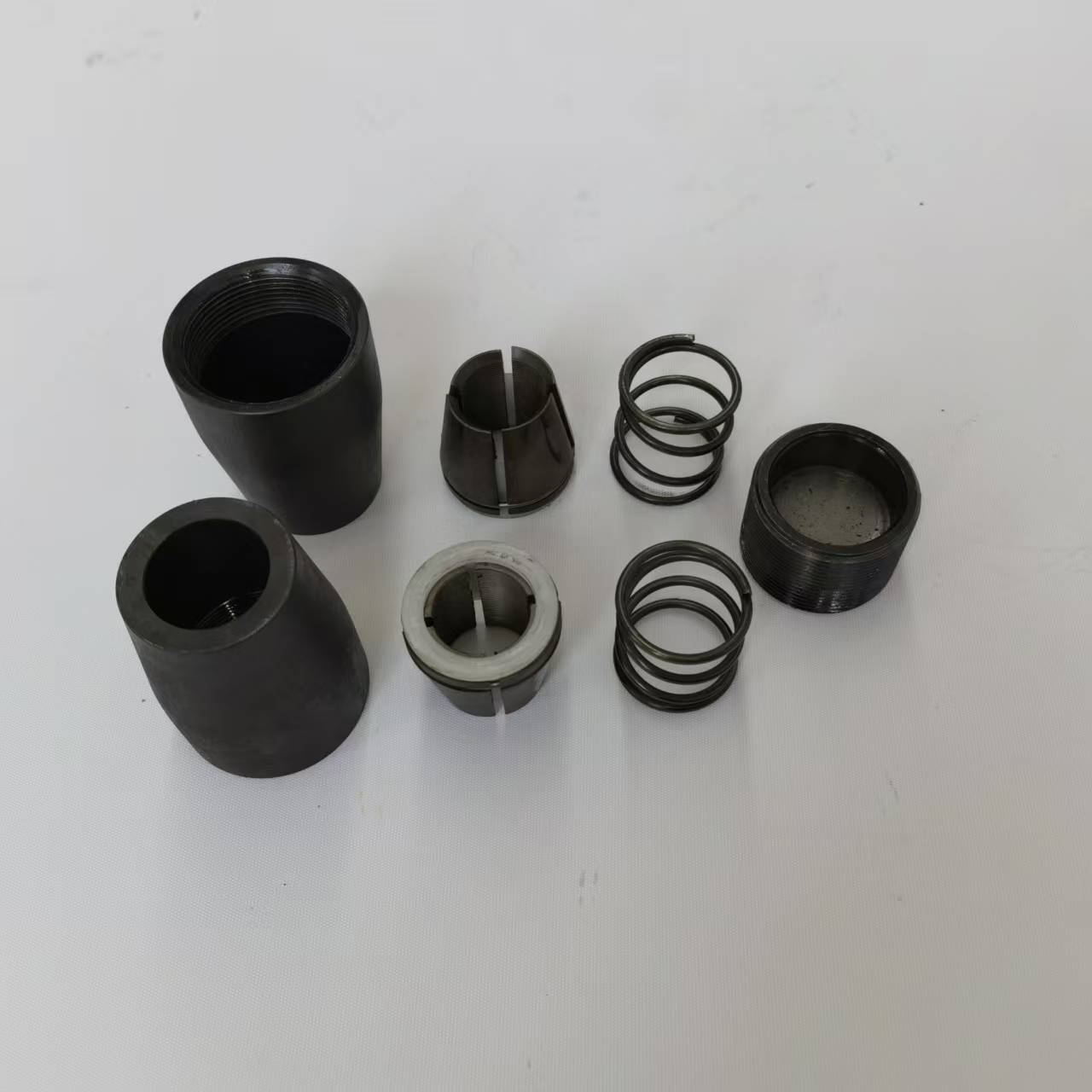
A one-touch rebar coupler: in quick-connection designs, the coupler body, thread preparation and fastening tool still have to be specified as a single set.
The Core Procurement Problem: Coupler, Thread and Machine Are One Specification
A coupler ordered with the correct bar size can still be unusable on site. Three failure points recur in project supply:
- Thread mismatch. A rolled-thread coupler cut to M25.6*3.0 cannot be assembled onto a bar end threaded to M24*3.0. The thread designation has to be quoted explicitly, not inferred from the bar diameter.
- Process mismatch. A cold pressing coupler is not installed with a threading machine. It requires a pressing machine and a matching clamp set, and it uses no thread at all.
- Capacity mismatch. A threading machine whose maximum threading length is shorter than the required thread engagement cannot prepare the bar end, regardless of its motor rating.
The third point is easy to overlook. In the rolling coupler range, the model 40 coupler has an overall length of 95 mm. The 40MO quick-type threading machine specifies a maximum threading length of 95 mm, or 150 mm without the block. The machine covers the largest standard coupler in the range, but only at the boundary, which is exactly the kind of value a buyer should confirm in writing rather than assume. CBT40A states a 120 mm maximum threading length and CBT40L states 100/200 mm, giving a larger margin over the same coupler range.
How to Read the Model Designation 16–40
The model designation used across the coupler families is 16/18/20/22/25/28/32/36/40. Each number is the nominal rebar diameter in millimetres that the coupler is designed to connect, so a model 25 coupler is intended for 25 mm rebar. The model series therefore runs from size 16 up to size 40.
The same model string is used across rolling, upsetting, pressing and one-touch couplers, but the dimensions and preparation method behind each number are not the same. A model 25 rolling coupler and a model 25 one-touch coupler serve the same bar diameter while differing substantially in outer diameter and length. For that reason, a purchase specification should always pair the model number with the coupler type — for example, “rolling coupler, model 25” — rather than quoting the number alone.
Thread Specifications and the 60-Degree Thread Angle
Threaded coupler families in this range are specified with metric threads and a 60° thread angle. In a designation such as M16.5*2.5, the first value is the nominal thread diameter in millimetres and the second is the thread pitch. The parallel thread rolling family uses threads close to the bar's nominal diameter, while the upsetting family uses a larger thread because the bar end is enlarged before threading.
Parallel thread rolling coupler: dimensions and threads
| Model (rebar, mm) | Outer diameter | Length | Thread | Thread angle |
|---|---|---|---|---|
| 16 | 24 mm | 42 mm | M16.5*2.5 | 60° |
| 18 | 27 mm | 45 mm | M18.5*2.5 | 60° |
| 20 | 30 mm | 50 mm | M20.5*2.5 | 60° |
| 22 | 33 mm | 54 mm | M22.5*2.5 | 60° |
| 25 | 38 mm | 62 mm | M25.6*3.0 | 60° |
| 28 | 42 mm | 68 mm | M28.6*3.0 | 60° |
| 32 | 48 mm | 76 mm | M32.6*3.0 | 60° |
| 36 | 53 mm | 84 mm | M36.6*3.0 | 60° |
| 40 | 59 mm | 95 mm | M40.2*3.0 | 60° |
Within the rolling family, sizes 16 to 22 use a 2.5 mm pitch, and sizes 25 to 40 use a 3.0 mm pitch. That pitch step is the practical dividing line in tooling and inspection: a gauge or thread insert set up for the smaller pitch will not verify the larger sizes.
Upsetting coupler: dimensions and threads
| Model (rebar, mm) | Outer diameter | Length | Thread | Thread angle |
|---|---|---|---|---|
| 16 | 26 mm | 40 mm | M20*2.5 | 60° |
| 18 | 29 mm | 44 mm | M22*2.5 | 60° |
| 20 | 32 mm | 48 mm | M24*3.0 | 60° |
| 22 | 36 mm | 52 mm | M27*3.0 | 60° |
| 25 | 40 mm | 60 mm | M30*3.5 | 60° |
| 28 | 44 mm | 66 mm | M33*3.5 | 60° |
| 32 | 50 mm | 72 mm | M36*4.0 | 60° |
| 36 | 56 mm | 80 mm | M39*4.0 | 60° |
| 40 | 62 mm | 90 mm | M45*4.0 | 60° |
Comparing the two tables at the same bar size shows the trade-off clearly. At model 16, the rolling coupler is threaded M16.5*2.5, while the upsetting coupler is threaded M20*2.5. At model 40, the rolling coupler is threaded M40.2*3.0, while the upsetting coupler is threaded M45*4.0. Threads are not interchangeable between the two families even when the rebar size is identical.
Material Grades: 45# Carbon Steel, 40CR Alloy Steel, Q355B
Material assignment in this range follows the connection type. Rolling and upsetting couplers are offered in carbon steel 45# or alloy steel 40CR. Pressing couplers are made from carbon steel Q355B. One-touch couplers are made from alloy steel 40CR.
| Coupler type | Specified material | Notes for specification review |
|---|---|---|
| Rolling (parallel thread) | Carbon steel 45# / Alloy steel 40CR | Two material options within one type; the grade must be stated on the order. |
| Upsetting | Carbon steel 45# / Alloy steel 40CR | Same material options as the rolling family, different thread and dimensions. |
| Pressing | Carbon steel Q355B | Single material grade in the pressing family; no thread is cut. |
| One-touch | Alloy steel 40CR | Single material grade; the largest outer diameters in the range. |
For buyers, the material line is a verification item rather than a preference. 45# carbon steel and 40CR alloy steel are established grades in Chinese mechanical component manufacturing, and 40CR is the alloy option used where higher strength is required. Q355B is a structural steel grade applied to the cold pressing family. When a project specification names a material, that name — not a general description such as “high-strength steel” — should appear on the purchase order, because the type and grade combination determines both the dimensional table and the inspection record.
Dimension Verification: Outer Diameter and Length by Type
Across the parallel thread rolling range, outer diameter runs from 24 mm at model 16 to 59 mm at model 40, and overall length runs from 42 mm to 95 mm. Those figures are the practical check values for reinforcement detailing: if the outer diameter does not fit the available cover or the length does not match the bar-end preparation length, the coupler will not be accepted on site even if the thread is correct.
Pressing coupler: dimensions
| Model (rebar, mm) | Outer diameter | Length | Wall thickness |
|---|---|---|---|
| φ16 | 30 mm | 110 mm | 4.5 mm |
| φ18 | 34 mm | 120 mm | 5.4 mm |
| φ20 | 36 mm | 120 mm | 5.5 mm |
| φ22 | 40 mm | 132 mm | 6.4 mm |
| φ25 | 45 mm | 150 mm | 7.4 mm |
| φ28 | 50 mm | 168 mm | 8.0 mm |
| φ32 | 56 mm | 192 mm | 9.0 mm |
| φ36 | 63.2 mm | 220 mm | 11.3 mm |
| φ40 | 70 mm | 240 mm | 11.0 mm |
One-touch coupler: dimensions
| Model (rebar, mm) | Outer diameter | Length |
|---|---|---|
| φ11–16 | 35 mm | 100 mm |
| φ16 | 40 mm | 106 mm |
| φ18/20 | 46 mm | 123 mm |
| φ22 | 51 mm | 133 mm |
| φ25 | 56 mm | 143 mm |
| φ29 | 65 mm | 166 mm |
| φ32 | 70 mm | 170 mm |
| φ36 | 78 mm | 190 mm |
| φ40 | 83 mm | 200 mm |
Reading the three families together, the rolling coupler is the most compact option at every bar size, the pressing coupler is markedly longer because the sleeve is cold-pressed over the bar ends, and the one-touch coupler has the largest outer diameter, reaching 83 mm at model 40. These are not cosmetic differences; they change cover, congestion and the equipment needed to install the connection.
Equipment Matching: Which Machine Prepares and Fastens Which Coupler
CANGZHOU BARTECH CONSTRUCTION MATERIAL CO., LTD. is a China-based manufacturer and exporter of rebar couplers and rebar connection machinery, founded in 2008 and exporting 100% of its output to markets including Asia, the Middle East and South America. Its coupler families are supplied alongside the threading, cutting, pressing, upsetting and fastening equipment that prepares and completes the connection, which is why equipment matching can be documented at specification level.
| Coupler type | Bar-end preparation | Fastening / completion |
|---|---|---|
| Parallel thread rolling coupler | Rebar threading machines CBT40A, CBT40L, 40AO or 40MO (rebar 16–40 mm) | Rebar electric torque wrench BOC 8-32 or BOC 8-42 |
| Upsetting coupler | Upsetting machine Auto 36S or Auto 50S, then thread cutting on MQ40 | Rebar electric torque wrench BOC 8-42 |
| Pressing coupler | No threading; cold pressing with machine CBT32 (rebar 16–32 mm) | Applied by the pressing machine clamp |
| One-touch coupler | Threading machines, listed in the same application set as CBT40L and 40MO | Rebar electric torque wrench BOC 8-42 |
Threading machines for rolled-thread couplers
| Model | Rebar range | Motor | Speed ratio | Max threading length | Net weight |
|---|---|---|---|---|---|
| CBT40A | 16–40 mm | 5.5 kW, 380V/50Hz | 1:23 quick / 1:29 slow | 120 mm | 590 kg |
| CBT40L | 16–40 mm | 5.5 kW, 380V/50Hz | 1:23 quick / 1:29 slow | 100/200 mm | 420 kg |
| 40AO | 16–40 mm | 5.5 kW / 7.5 kW, 380V/50Hz; air clamp 0.4–0.8 MPa | 1:23 quick / 1:29 slow | 90 mm with block / 150 mm without block | 860 kg |
| 40MO | 16–40 mm | 5.5 kW, 1450 r/min, 380V/50Hz | 1:19 quick / 1:23 slow | 95 mm (150 mm without block) | 680 kg |
Pressing, cutting, upsetting and fastening equipment
| Equipment | Model | Key specification |
|---|---|---|
| Rebar coupler pressing machine | CBT32 | Rebar 16–32 mm; 4 kW main motor; clamp tension 50 T; max oil pump pressure 70 MPa; oil pump length 5 m |
| Rebar thread cutting machine | MQ40 | Thread range M14–M45; max thread length 100 mm; 5.5 kW; 380V/50Hz or 415V/50Hz |
| Rebar upsetting machine | Auto 36S | 400-grade rebar 16–36 mm; 500-grade rebar 16–32 mm; 7.5 kW; max pressure 31.5 MPa |
| Rebar upsetting machine | Auto 50S | 400-grade rebar 16–50 mm; 500-grade rebar 16–40 mm; 11 kW; max pressure 31.5 MPa |
| Rebar electric torque wrench | BOC 8-32 | Rebar 8–32 mm; max torque 350 N·m; 21V 6.0Ah battery; 0–75 r/min; net weight 4.5 kg |
| Rebar electric torque wrench | BOC 8-42 | Rebar 12–40 mm, 16–32 coupler; max torque 400 N·m; 21V 6.0Ah battery; 0–60 r/min; net weight 9.5 kg |
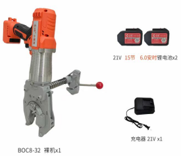
Electric torque wrenches are specified by rebar range, not by coupler type alone — the BOC 8-32 covers rebar up to 32 mm, while the BOC 8-42 is stated for 16–32 couplers.
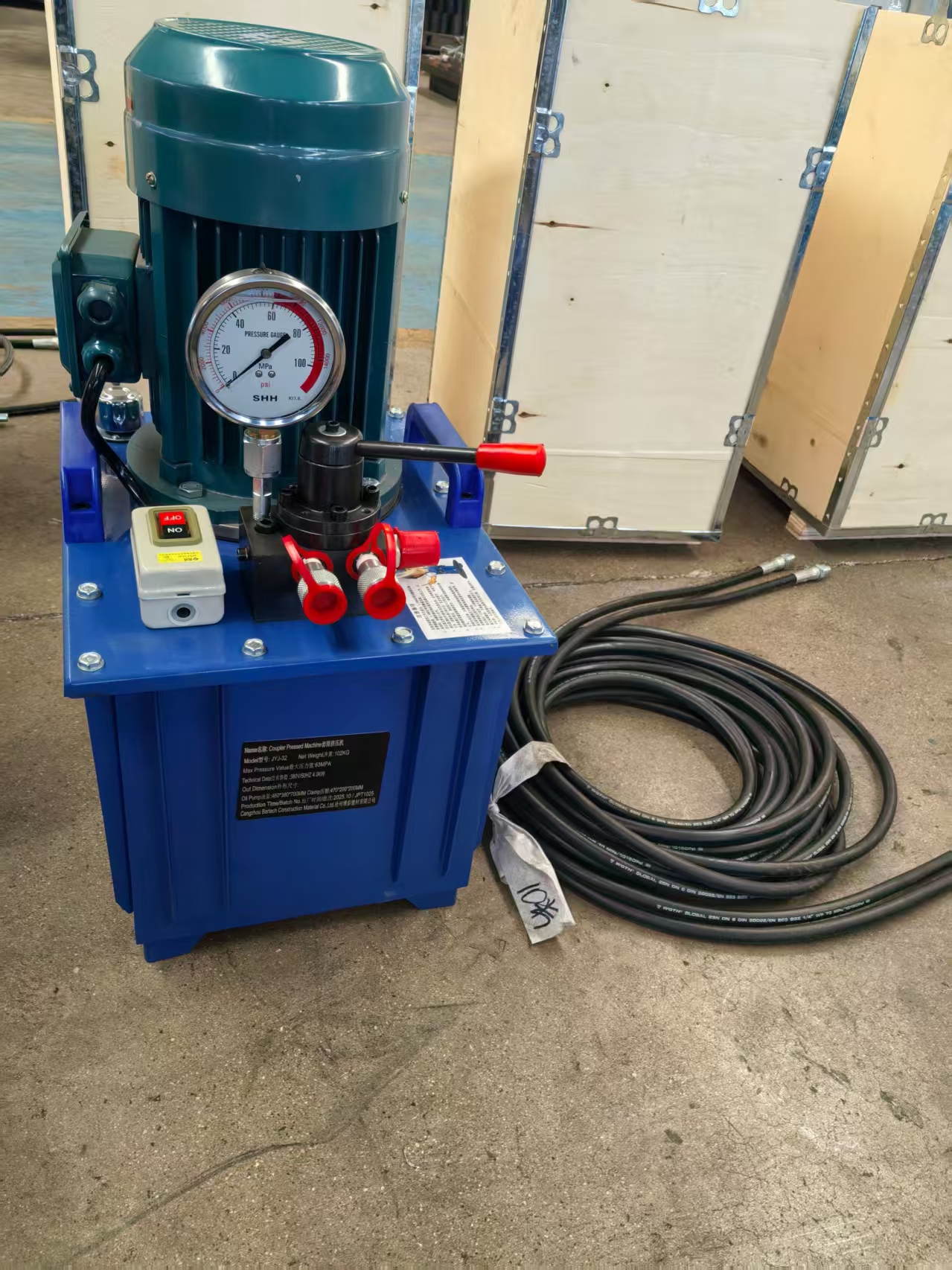
Cold pressing equipment is a separate procurement line from threading machinery: pressing couplers are installed without any thread preparation.
Pre-Order Verification Checklist
Before a coupler order is confirmed, the following eight items should be documented in the same specification sheet. Each one has a corresponding machine-side check, which is why they are best verified together rather than sequentially.
- Coupler type — rolling, upsetting, pressing or one-touch.
- Model size — one of 16, 18, 20, 22, 25, 28, 32, 36, 40 mm.
- Thread designation — for example M16.5*2.5, M25.6*3.0 or M45*4.0, with the 60° thread angle stated.
- Material grade — 45# carbon steel, 40CR alloy steel or Q355B, as applicable to the type.
- Outer diameter and length — checked against the drawing; 24–59 mm outer diameter and 42–95 mm length for rolling couplers, larger values for pressing and one-touch types.
- Preparation equipment — threading machine model and its maximum threading length, or pressing machine range.
- Power supply — 380V/50Hz for the standard machines, with 415V/50Hz available on MQ40.
- Fastening tool — torque wrench model, its rebar range and its stated coupler range.
Certificates and Standards to Verify Before Awarding
Certification is a constraint question, not a marketing question, because different project markets accept different evidence. Two certificates apply to the Bartech range. The CE certificate is numbered Nr.SC-PSC-4-2025-12-14, issued under standard MTZ202512021CPR by the Certification Center, valid from 4 December 2025 to 3 December 2030, and scoped to the EU Construction Products Regulation for the EU market. The ISO certificate is numbered 31623Q10713R1S, issued by CEOC Testing & Certification Center (Beijing) Co., Ltd. against GB/T19001-2016 / ISO9001:2015, valid to 21 December 2026, and scoped to the sale of rebar couplers, rebar connection equipment and related spare parts worldwide.
Separately, mechanical rebar splices are governed by international standards including ISO 15835, ASTM A615 and BS 8110, with BS 8110 often replaced by Eurocode 2 in the EU. Buyers should note which of these the project specification actually references: a supplier holding CE and ISO9001 certification is providing conformity evidence, while the acceptance of a splice on site is determined by the project's nominated standard and its testing regime.
Application Fit by Project Type
Coupler and equipment combinations are usually driven by site conditions as much as by bar size. In super high-rise building work, the coupler set is documented for outdoor construction in normal tropical temperature and humidity, with bars threaded by rebar threading machines and the connection completed with the electric torque wrench; ISO and CE certificates are typically listed as special requirements. For the New Capital construction environment in Egypt, the same mechanical connection approach is specified for outdoor work under high-temperature dry conditions, with threading machines, rib cutters and rollers listed as matched equipment.
For high-railway work, the process sequence changes: upsetting machines and a rebar thread cutting machine are used to prepare the bar ends before coupler assembly, which suits factory or yard pre-processing. In tropical, high-humidity construction markets such as Vietnam, threading machines and electric wrenches support all-day outdoor operation. For dedicated rebar threading factories — the pattern recorded in Qatar — continuous automatic threading of large rebar batches is run on threading machines with rib cutters and rollers treated as consumables, which shifts the procurement emphasis toward machine durability rather than coupler variety alone.
Volume patterns are consistent with those settings. One construction enterprise in Kuwait purchasing standard rebar couplers for outdoor construction work takes approximately 400,000 units per year, with connection ease and stable quality noted as the operational priorities.
Market Trend: Standards and Application Mix
Two trends shape specification work. The first is where demand sits: building construction represented 47.6% of rebar coupler revenue in 2025, and Asia Pacific accounted for approximately 41.3% of the global total, according to Dataintelo. That concentration means most specification disputes will be resolved against building-construction practice rather than heavy civil practice.
The second is product mix. Dataintelo records tapered thread couplers holding the largest product type share at 38.2% in 2025, followed closely by parallel thread couplers. For buyers specifying parallel thread rolling, upsetting, pressing or one-touch connections, the practical reading is that no single thread form dominates the market, so thread designation and dimensional tables remain essential purchasing documents rather than optional detail.
Limitations and Trade-offs Buyers Should Plan For
Mechanical couplers are not a universal replacement for every other splicing method, and the boundaries sit in the equipment data rather than in general claims.
- Pressing coverage stops at 32 mm. The CBT32 pressing machine covers rebar 16–32 mm, while the pressing coupler dimension table extends to φ36 and φ40. Buyers specifying pressing couplers above 32 mm should confirm the pressing solution for those sizes before assuming the standard machine applies.
- Torque wrench coupler coverage is narrower than its rebar coverage. The BOC 8-42 is stated for rebar 12–40 mm but for 16–32 couplers. Fastening for coupler sizes 36 and 40 therefore needs separate confirmation.
- Upsetting adds process steps. Upsetting couplers require an upsetting machine plus thread cutting, and the upsetting machine ranges differ by steel grade — the Auto 36S covers 400-grade rebar 16–36 mm and 500-grade rebar 16–32 mm, while the Auto 50S covers 400-grade 16–50 mm and 500-grade 16–40 mm. This suits factory pre-processing, not improvised site work.
- Power supply is a fixed constraint. The standard machines are specified at 380V/50Hz, with 415V/50Hz available on MQ40. Projects on other supply systems need to plan for that difference.
- Larger couplers consume more space. One-touch couplers reach 83 mm outer diameter and 200 mm length at model 40, and pressing couplers reach 240 mm length. Where reinforcement is congested or cover is tight, the compact rolled-thread option — 24–59 mm outer diameter, 42–95 mm length — may fit where a larger sleeve does not.
Compared with lap splicing, mechanical couplers trade additional bar-end preparation and dedicated equipment for connection control at the joint. Lap splicing requires no threading or pressing machine, but it depends on overlapping bar length and can be difficult to place in congested members. Which method suits a given detail depends on the drawing, the bar grade and the site's access to preparation equipment — not on a universal ranking.
Future Outlook
With the coupler market projected to grow from USD 1.82 billion in 2025 toward USD 3.47 billion by 2034, and with building construction holding the largest application share, the specification pressure is likely to move further toward documented conformity rather than product novelty. Two consequences follow for buyers. First, thread designation, material grade and dimensional tables will increasingly be requested as standard attachments to a quotation, because they are the fields that determine acceptance. Second, couplers and their preparation equipment will increasingly be evaluated as one procurement package, since a coupler that cannot be prepared or fastened by the available machinery on site carries no schedule benefit. Suppliers that publish complete dimensional and equipment-matching data make that evaluation shorter; buyers who request it in writing make their own risk smaller.
Frequently Asked Questions
1. What does the model number on a rebar coupler mean?
The model designation 16/18/20/22/25/28/32/36/40 refers to the nominal rebar diameter in millimetres that the coupler connects, so a model 25 coupler is made for 25 mm rebar. Rolling, upsetting, pressing and one-touch couplers share this model string but differ in outer diameter, length, thread and material. A model number should therefore always be quoted together with the coupler type.
2. Which thread specification is used on parallel thread rolling couplers?
Rolling couplers use metric threads close to the bar's nominal diameter. Sizes 16 to 22 are threaded M16.5*2.5, M18.5*2.5, M20.5*2.5 and M22.5*2.5; sizes 25 to 40 are threaded M25.6*3.0, M28.6*3.0, M32.6*3.0, M36.6*3.0 and M40.2*3.0. In each designation the first value is the nominal thread diameter and the second is the pitch in millimetres. All are specified with a 60° thread angle.
3. Why do upsetting couplers use a larger thread than rolling couplers at the same bar size?
Upsetting couplers are threaded from M20*2.5 at size 16 up to M45*4.0 at size 40, which is larger than the rolling coupler thread at the same bar size — for example M20*2.5 versus M16.5*2.5 at size 16. The difference reflects the preparation method: the upsetting process enlarges the bar end before the thread is produced, so the thread designation steps up accordingly. Both families are specified with a 60° thread angle, but the two threads are not interchangeable.
4. Which material should be used — 45# carbon steel, 40CR alloy steel or Q355B?
Material assignment follows the connection type. Rolling and upsetting couplers are offered in carbon steel 45# or alloy steel 40CR. Pressing couplers are made from carbon steel Q355B. One-touch couplers are made from alloy steel 40CR. Where a project specification names a grade, that grade should appear on the purchase order, because it determines both the dimensional table and the inspection record.
5. Which threading machine matches a 16–40 mm rolling coupler?
CBT40A, CBT40L, 40AO and 40MO all cover rebar sizes 16–40 mm and are used with rolling couplers across the same range. Their maximum threading lengths differ: 120 mm on CBT40A, 100/200 mm on CBT40L, 90 mm with block or 150 mm without block on 40AO, and 95 mm (150 mm without block) on 40MO. Maximum threading length is the value to compare against the coupler requirement.
6. Can one electric torque wrench fasten every coupler size?
No. The BOC 8-32 wrench covers rebar 8–32 mm with a maximum torque of 350 N·m, and the BOC 8-42 covers rebar 12–40 mm with a maximum torque of 400 N·m while being stated for 16–32 couplers. For coupler sizes 36 and 40, the fastening solution should be confirmed with the supplier rather than assumed from the wrench's rebar range.
7. Does a cold pressing coupler require thread preparation?
No. Pressing couplers are installed with a pressing machine, not a threading machine. The CBT32 pressing machine covers rebar 16–32 mm with a 4 kW main motor, 50 T clamp tension and a maximum oil pump pressure of 70 MPa. Because no thread is cut, the sleeve is longer: pressing coupler lengths run from 110 mm at φ16 to 240 mm at φ40, with wall thickness from 4.5 mm to 11.3 mm.
8. What should be verified before ordering rebar couplers?
Eight items should be documented together: coupler type; model size from 16 to 40 mm; thread designation including the 60° thread angle; material grade; outer diameter and length against the drawing; the preparation machine and its maximum threading or pressing range; the power supply requirement, which is 380V/50Hz for the standard machines and 415V/50Hz for MQ40; and the fastening tool's stated coupler range. Verifying these as one set prevents the thread, process and capacity mismatches that cause site rejections.
9. Which international standards and certificates apply to mechanical rebar splices?
Mechanical rebar splices are governed by international standards including ISO 15835, ASTM A615 and BS 8110, with BS 8110 often replaced by Eurocode 2 in the EU. For this product range, the CE certificate Nr.SC-PSC-4-2025-12-14 is issued under standard MTZ202512021CPR and scoped to the EU Construction Products Regulation for the EU market, valid from 4 December 2025 to 3 December 2030. The ISO certificate 31623Q10713R1S is issued against GB/T19001-2016 / ISO9001:2015 by CEOC Testing & Certification Center (Beijing) Co., Ltd., valid to 21 December 2026, and covers the sale of rebar couplers, rebar connection equipment and related spare parts.
Cangzhou Bartech Construction Material Co., Ltd. supplies rebar couplers in rolling, upsetting, pressing and one-touch designs together with matching threading, cutting, pressing, upsetting and fastening equipment, with OEM customization available on coupler outer diameter, inner diameter and thread. Technical clarification on thread and dimensional matching is available through the company's online technical support channel at chinabartech.cn.