
Rebar Coupler Production Lines: In-House Capability Evidence
The global rebar coupler market was valued at USD 1.82 billion in 2025 and is projected to reach USD 3.47 billion by 2034, a compound annual growth rate of 7.4%, according to Dataintelo. Growth at that scale changes what buyers ask suppliers. In mechanical splicing, the question is no longer whether a supplier can quote a coupler price, but whether the supplier can show — part by part and machine by machine — how the coupler is produced.
Capability in this category is a physical claim. It is evidenced by named machine models, published specifications, documented coupler dimensions and material grades, defined quality-control steps, and certificates carrying numbers a buyer can verify. CANGZHOU BARTECH CONSTRUCTION MATERIAL CO., LTD., a China-based supplier and exporter of rebar couplers and rebar connection machinery, publishes that evidence set across four coupler families and a range of threading, upsetting, cutting and pressing equipment. This reference examines what the published data shows, what it implies for procurement, and where the boundaries of that evidence lie.
Why Equipment Evidence Outweighs Capability Claims
A supplier claiming in-house rebar coupler production is making a statement that can be checked. Buyers in the evaluation and execution stages of a mechanical splicing programme generally need three answers before committing: which machine models prepare the rebar ends, which coupler families and size ranges those lines support, and what documentation exists between the incoming raw bar and the packed finished coupler.
That is a different question from price. Two suppliers can quote the same 25 mm rolling coupler, yet only one may be able to state the threading machine model, its motor rating, its maximum threading length and the material grade of the coupler body. Where a joint has to be verified against a project standard, that difference becomes a schedule and compliance risk rather than a commercial detail.
The published evidence set in this category typically consists of four layers:
- Machine data: model numbers with rated rebar size range, motor power, power supply, threading length, outer dimensions and weight.
- Coupler data: nominal sizes, outer diameter, length, thread specification, flank angle and material grade.
- Process control: material test reports, in-line production testing rates and final inspection coverage.
- Third-party certification: certificate numbers, issuing bodies, applicable standards and validity periods.
A threading machine rated for 16–40 mm rebar, for example, tells a buyer something a generic OEM capability statement does not: which bar diameters can be prepared, how long a thread the machine can cut, how much connected load it needs and what floor load it imposes.
The Supplier Behind the Production Base
CANGZHOU BARTECH CONSTRUCTION MATERIAL CO., LTD. is a manufacturer and exporter of rebar couplers and rebar connection machinery based in Qing County, Cangzhou City, Hebei Province, China. Company data describes a business founded in 2008 that operates from a 1,000 m² facility with 30 employees, including a 10-engineer R&D team, and reports annual output of 3,600,000 pieces against a stated monthly capacity of 300,000 units.
The commercial profile is export-oriented. Export accounts for 100% of sales, with documented markets in Asia, the Middle East and South America, including Vietnam, Malaysia, Kuwait, Qatar, UAE, Saudi Arabia and Mexico. Typical lead times are stated at 7–30 days depending on order quantity, and couplers held in stock carry no minimum order quantity. Payment terms are published as 30% TT prepayment to confirm an order and 70% by TT once goods are ready before shipment, with FOB or CIF delivery and a pre-shipment test as the acceptance arrangement.
The product scope is where the vertical-capability argument begins. The published range contains both the consumable connector and the capital equipment around it: rebar couplers in rolling, upsetting, pressing and one-touch families, plus rebar threading machines, rebar thread rolling machines, rebar upsetting machines, a rebar thread cutting machine, a rebar cold pressing machine, rebar thread caps and rebar electric wrenches. Customisation is offered on coupler outer diameter, inner diameter and thread, together with OEM production.
For a buyer, that combination matters because coupler geometry and thread preparation are not independent variables. A coupler dimension table is only useful if the matching thread can be produced on site or in a fabricator's shop with equipment the same supplier can specify. When one company publishes both the coupler dimensions and the machines that prepare the bar ends, the buyer can cross-check the two against a bar schedule instead of accepting them separately.
Machine Lines Documented in the In-House Range
The published machine data covers four functional groups: thread rolling, upsetting, thread cutting and coupler pressing, with electric torque wrenches for final assembly. The specifications below are stated as they appear in the manufacturer's product data.
| Machine | Model | Rebar range | Power | Documented specifications |
|---|---|---|---|---|
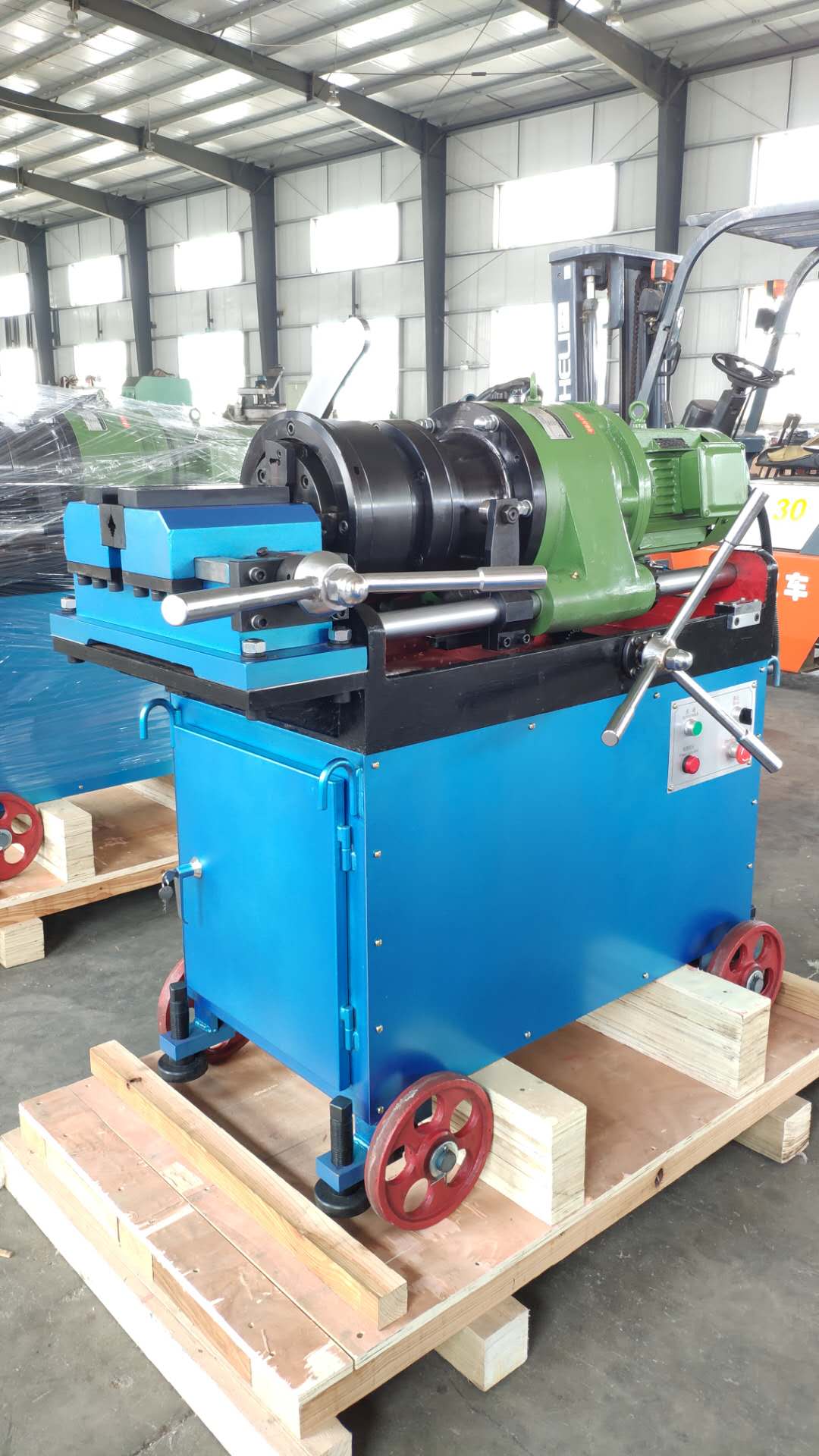
| Rebar thread rolling machine | CBT40A | 16–40 mm | 5.5 kW | 380 V/50 Hz; speed ratio 1:23 quick or 1:29 slow; max threading length 120 mm; 1,180 × 670 × 1,150 mm (1,300 × 790 × 1,340 mm); net weight 590 kg |
| Rebar thread rolling machine | CBT40L | 16–40 mm | 5.5 kW | 380 V/50 Hz; speed ratio 1:23 quick or 1:29 slow; max threading length 100 mm or 200 mm; 1,210 × 610 × 1,120 mm; net weight 420 kg |
| Rebar thread rolling machine, auto type | 40AO | 16–40 mm | 5.5 kW / 7.5 kW, 1,450 r/min | Water pump 0.12 kW; air clamping pressure 0.4–0.8 MPa; max threading length 90 mm with block, 150 mm without; 1,950 × 700 × 1,120 mm; net weight 860 kg |
| Rebar thread rolling machine, quick type | 40MO | 16–40 mm | 5.5 kW, 1,450 r/min | Speed ratio 1:19 quick or 1:23 slow; max threading length 95 mm (150 mm without block); 1,820 × 815 × 1,100 mm; net weight 680 kg |
| Rebar upsetting machine, auto | 36S | 400-grade 16–36 mm; 500-grade 16–32 mm | 7.5 kW | 380 V/50 Hz; oil pump flux 16 ml/r; max pressure 31.5 MPa; cycle time 36 s; 1,350 × 950 × 1,750 mm; net weight 1,000 kg; packing 1,450 × 980 × 1,900 mm |
| Rebar upsetting machine, auto | 50S | 400-grade 16–50 mm; 500-grade 16–40 mm | 11 kW | 380 V/50 Hz; oil pump flux 16 ml/r; max pressure 31.5 MPa; 1,350 × 950 × 1,750 mm; net weight 1,200 kg; packing 1,450 × 980 × 1,900 mm |
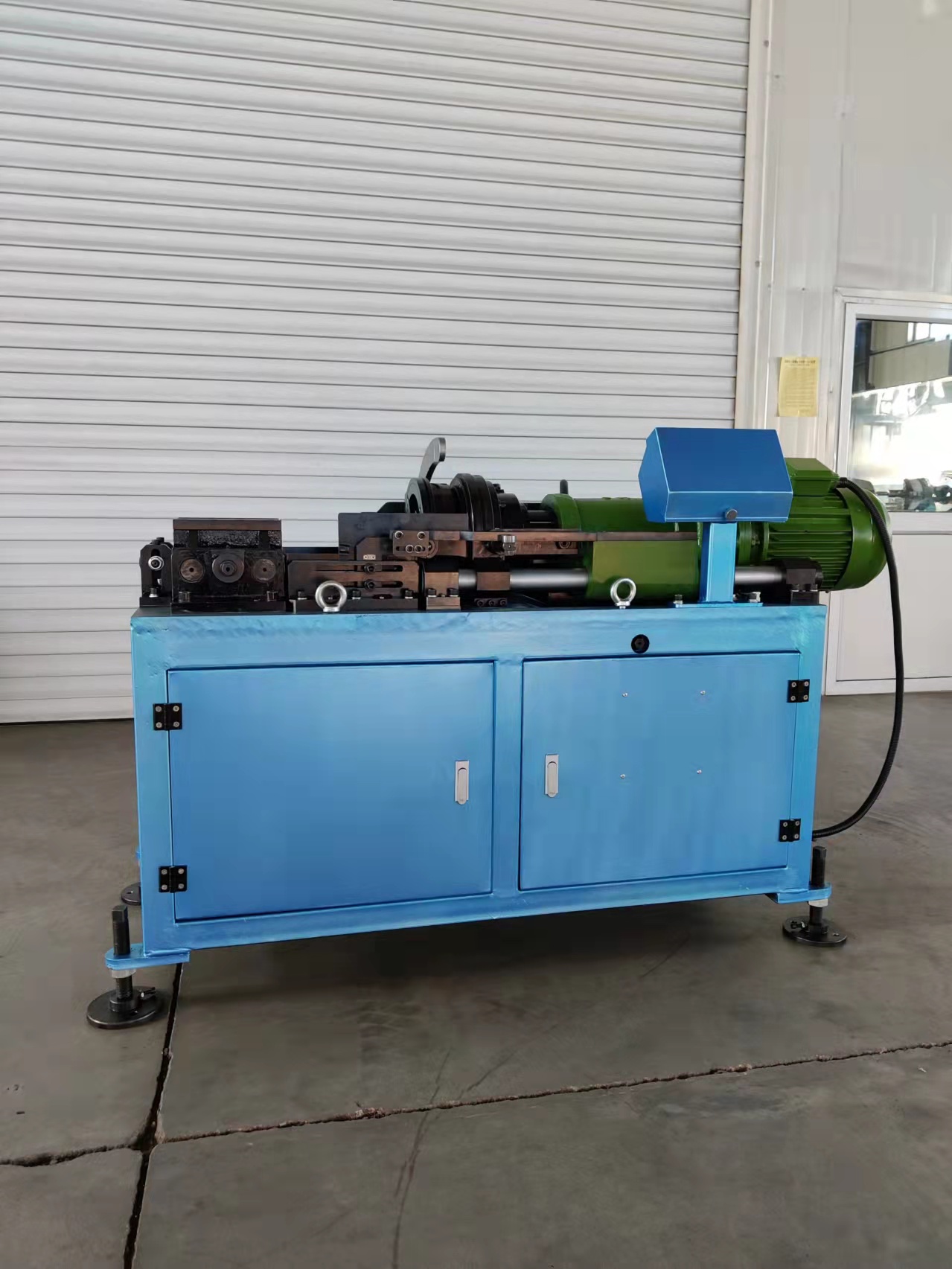
| Rebar thread cutting machine | MQ40 | M14–M45, max thread length 100 mm | 5.5 kW, 1,450 r/min | Manual type; 380 V/50 Hz or 415 V/50 Hz; cutting forward speed 1:35; 1,630 × 780 × 1,100 mm |
| Rebar coupler pressing machine | CBT32 | 16–32 mm | 4 kW | Clamp tension 50 t; 380 V/50 Hz; max oil pump pressure 70 MPa; oil pump length 5 m; oil pump weight 60 kg; clamp weight 38 kg |
| Rebar electric torque wrench | BOC 8-32 | 8–32 mm rebar | Battery 6.0 Ah, 900 W, 21 V, 0–75 r/min | Max torque 350 N·m; net weight 4.5 kg; battery 0.875 kg per piece; packing 560 × 430 × 250 mm |
| Rebar electric torque wrench | BOC 8-42 | 12–40 mm rebar; 16–32 coupler | Battery 6.0 Ah, 900 W, 21 V, 0–60 r/min | Max torque 400 N·m; net weight 9.5 kg; battery 1.2 kg per piece; packing 560 × 430 × 250 mm |
The threading group covers the widest share of day-to-day preparation. Models CBT40A and CBT40L are both rated for 16–40 mm rebar with a 5.5 kW main motor on a 380 V/50 Hz supply. They differ mainly in threading length and footprint: CBT40A reaches a maximum thread length of 120 mm in a 1,180 × 670 × 1,150 mm frame at 590 kg, while CBT40L offers 100 mm or 200 mm of thread length in a lighter 420 kg machine measuring 1,210 × 610 × 1,120 mm.
The 40AO automatic type adds a 0.12 kW water pump and air clamping at 0.4–0.8 MPa, which removes some manual bar handling from the cycle. It is listed at 5.5 kW/7.5 kW with a maximum threading length of 90 mm with a block and 150 mm without, at a machine weight of 860 kg. The 40MO quick type shortens the fast speed ratio to 1:19 and is listed at 680 kg with a maximum threading length of 95 mm, or 150 mm without a block.
The upsetting group supports the upset-forged route, in which the bar end is enlarged before threading. Model 36S is rated for 400-grade rebar from 16 to 36 mm and 500-grade rebar from 16 to 32 mm, uses a 7.5 kW main motor, develops up to 31.5 MPa of pressure through a 16 ml/r oil pump, and is described with a 36-second cycle time. Model 50S extends the 400-grade range to 50 mm and the 500-grade range to 40 mm with an 11 kW motor. Both machines share overall dimensions of 1,350 × 950 × 1,750 mm and 1,450 × 980 × 1,900 mm packing, at net weights of 1,000 kg and 1,200 kg respectively.
The cutting and pressing lines complete the equipment picture. MQ40 is a manual thread cutting machine covering M14–M45 threads up to 100 mm long, with a 5.5 kW motor, a 1:35 cutting forward speed and a choice of 380 V/50 Hz or 415 V/50 Hz supply. CBT32 is the coupler pressing machine: 16–32 mm rebar, 4 kW motor, 50 t clamp tension and a maximum oil pump pressure of 70 MPa, with the 60 kg pump separate from the 38 kg clamp head and connected by a 5 m hose.
Assembly equipment is specified the same way. The BOC 8-32 electric torque wrench covers 8–32 mm rebar at a maximum torque of 350 N·m, while BOC 8-42 covers 12–40 mm rebar and 16–32 mm couplers at up to 400 N·m, both running on a 21 V, 6.0 Ah battery with 900 W output.
Coupler Families and Their Documented Dimensions
The four documented coupler families map onto the machine lines above. Each is published with nominal size, outer diameter, length, thread specification and material grade.
| Coupler family | Nominal sizes | Material | Documented example dimensions |
|---|---|---|---|
| Rolling rebar coupler (parallel thread) | 16 / 18 / 20 / 22 / 25 / 28 / 32 / 36 / 40 mm | Carbon steel 45#; alloy steel 40CR | 25 mm: OD 38 mm × length 62 mm, thread M25.6 × 3.0, 60° |
| Upsetting rebar coupler | 16 / 18 / 20 / 22 / 25 / 28 / 32 / 36 / 40 mm | Carbon steel 45#; alloy steel 40CR | 25 mm: OD 40 mm × length 60 mm, thread M30 × 3.5, 60° |
| Pressing rebar coupler (cold pressing) | φ16 to φ40 | Carbon steel Q355B | φ25: OD 45 mm × length 150 mm, wall thickness 7.4 mm |
| One-touch rebar coupler | φ11–16 up to φ40 | Alloy steel 40CR | φ25: OD 56 mm × length 143 mm |
Rolling couplers in nominal sizes from 16 mm to 40 mm are made in carbon steel 45# or alloy steel 40CR; a 25 mm unit is listed at 38 mm outer diameter × 62 mm length with an M25.6 × 3.0 thread at a 60° flank angle. Upsetting couplers use the same size range and materials but a shorter, thicker body — 40 mm × 60 mm at 25 mm, with an M30 × 3.5 thread — reflecting the enlarged bar end. Pressing couplers are made from Q355B carbon steel in φ16–φ40 sizes, with wall thickness rising from 4.5 mm at φ16 to 11.3 mm at φ36; the φ25 sleeve, for instance, is 45 mm outer diameter × 150 mm long at 7.4 mm thickness. One-touch couplers in alloy steel 40CR run from φ11–16 to φ40 and are the bulkiest of the four families, with a φ25 unit listed at 56 mm × 143 mm.
Reading the families side by side shows why a buyer should not compare couplers by nominal bar size alone. At the same 25 mm bar size, the rolling coupler is 62 mm long with an M25.6 thread, the upsetting coupler is 60 mm long with an M30 thread, and the one-touch coupler is 143 mm long — three different bodies, three different bar-end preparations, and three different installation methods.
Reading the Specifications the Way a Project Engineer Does
Published machine and coupler data becomes procurement value only when it is translated into site and schedule consequences. Six readings matter most.
- Power and site supply. 5.5 kW is the common rating across the threading range; upsetting machines step up to 7.5 kW and 11 kW. Most equipment is listed on 380 V/50 Hz, with 415 V/50 Hz documented on MQ40 — a point to check against the destination market's grid.
- Tooling range against the bar schedule. Threading and rolling cover 16–40 mm, upsetting covers up to 50 mm in 400-grade bar on model 50S, and pressing covers 16–32 mm. If a bar schedule includes 36 mm or 40 mm bars in a pressed connection, that route is outside the documented pressing range.
- Thread length against coupler geometry. Maximum threading length ranges from 90 mm to 200 mm depending on model, while coupler body lengths range from 40 mm to 240 mm across families. Thread engagement and body length need to be matched to the chosen route rather than assumed.
- Floor, lifting and logistics. Machine weights run from 420 kg to 1,200 kg, and the upsetting machines share a 1,350 × 950 × 1,750 mm footprint with 1,450 × 980 × 1,900 mm packing — practical inputs for fabricator layouts, container planning and site lifting.
- Automation level. 40AO is the automatic type in the threading group, with air clamping and a water pump, and the upsetting machines are documented as automatic. MQ40, by contrast, is explicitly a manual thread cutting machine. Labour availability, not only purchase price, should drive the selection.
- Assembly torque. 350 N·m and 400 N·m wrenches cover different bar ranges, so tightening capability should be matched to the largest coupler in the project rather than to an average.
Quality Control and Certification Evidence
Process control is described in three stages: a material test report for incoming material, production testing on 10% of output during the production lines, and 100% appearance surface checking. Acceptance is arranged as a pre-shipment test, which gives the buyer a documented inspection point before goods leave the factory.
Two certificates are published with full identifiers and validity periods.
| Certificate | Number | Issued | Valid until | Scope and standard |
|---|---|---|---|---|
| CE Certificate | Nr.SC-PSC-4-2025-12-14 | 4 December 2025 | 3 December 2030 | EU Construction Products Regulation; standard MTZ202512021CPR; EU market |
| ISO 9001:2015 | 31623Q10713R1S | 5 February 2021 | 21 December 2026 | GB/T19001-2016 / ISO9001:2015; scope: sales of rebar couplers, rebar connection equipments and related spare parts; issued by CEOC Testing & Certification Center (Beijing) Co., Ltd. |
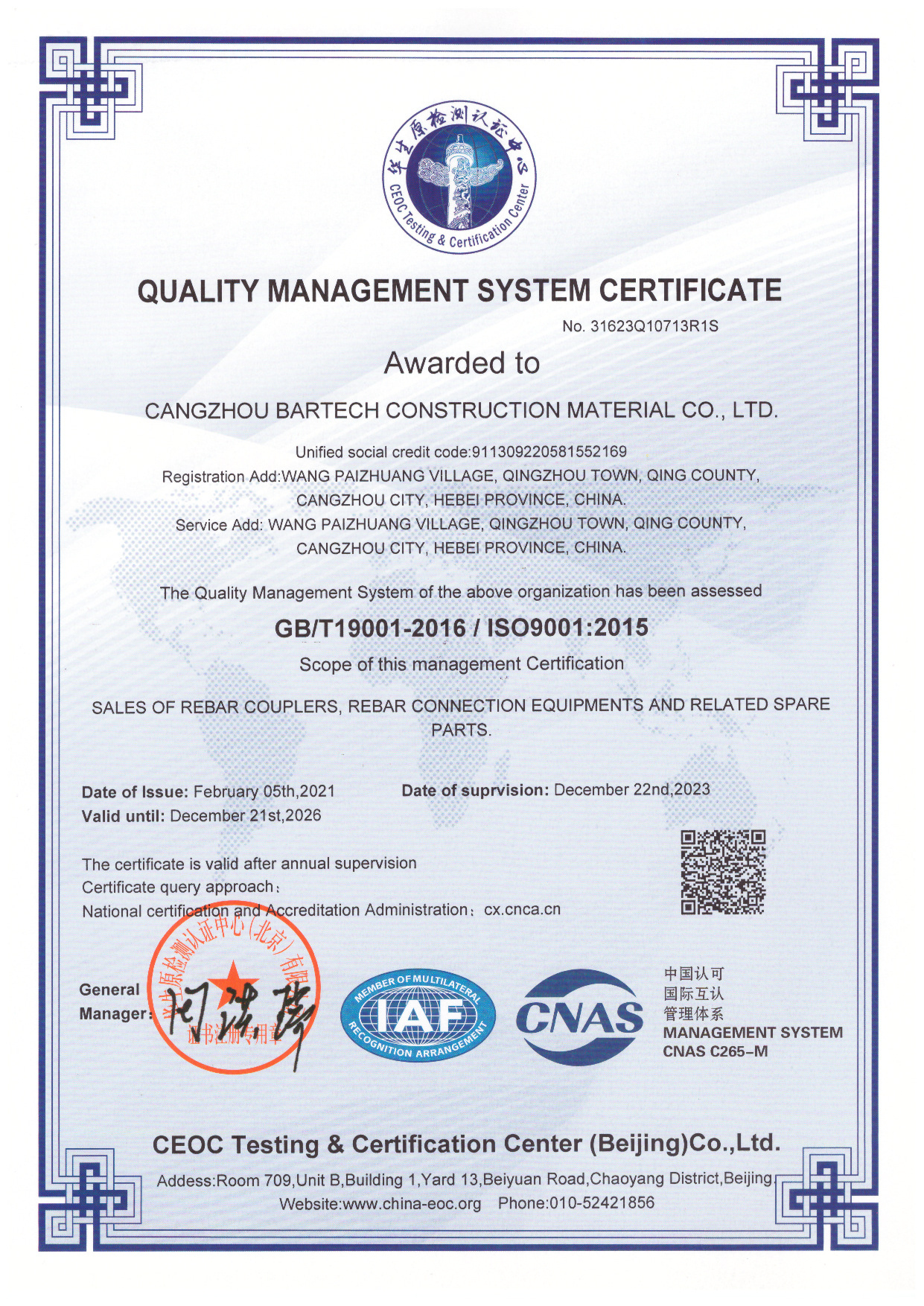
Two details deserve a buyer's attention. First, the ISO scope is stated as the sales of rebar couplers, rebar connection equipments and related spare parts — a commercial scope rather than a manufacturing-process scope — so it should be read alongside product testing evidence, not instead of it. Second, the ISO certificate's validity ends on 21 December 2026, which makes renewal status a reasonable question in a 2026 procurement cycle. The CE certificate, for its part, runs to 3 December 2030 under the EU Construction Products Regulation.
Independent of any single supplier's certificate, mechanical splices are governed by standards such as ISO 15835, ASTM A615 and BS 8110, the last of which is often replaced by Eurocode 2 in EU projects. Courier catalogue dimensions and machine specifications are inputs to that framework; they are not a substitute for a project-level splice test.
Where the Capability Has Been Applied
A case record from Kuwait describes a construction enterprise purchasing standard rebar couplers for outdoor construction work at a scale of 400,000 pieces per year, running for the duration of the construction programme. The reported outcomes are higher strength, stable quality and good operation, with easy connection cited as the practical highlight. The project is recorded as serving global markets.
A second record describes 500,000 rebar couplers per year used in tall building and railway station construction in Vietnam, with the customer identified in the case record as an automotive OEM. Reported attributes are high strength, good quality, a clear outer surface and strict thread control, with stable operation across the programme.
Taken together, the two cases show the same documented families being used in two different structural contexts — outdoor civil work and high-rise plus rail infrastructure — at annual volumes that sit above the manufacturer's stated monthly capacity of 300,000 units, which implies rolling or planned production rather than one-off batches. For a buyer comparing suppliers, the useful signal is not the geography but the pairing of volume with a consistent product specification.
Market Context: Where Demand Is Concentrated
Third-party market data provides the backdrop. The global rebar coupler market was valued at USD 1.82 billion in 2025 and is projected to reach USD 3.47 billion by 2034 at a 7.4% CAGR, according to Dataintelo. Building construction accounted for 47.6% of total revenue in 2025, and Asia Pacific contributed approximately 41.3% of global revenue. By product type, tapered thread couplers held the largest share at 38.2% in 2025, with parallel thread couplers following closely behind.
Market sizing estimates in this category vary between research sources, so the figures above are best treated as directional rather than definitive. The directional read is nonetheless consistent with the equipment evidence: demand is concentrated in building and infrastructure categories that the documented machine ranges serve; parallel thread technology — the basis of the rolling coupler family and of the CBT40A, CBT40L, 40AO and 40MO threading machines — remains one of the two principal product types; and regional demand is concentrated in Asia Pacific, where the supplier's production base and much of its documented case volume sit.
Integrated Supply Versus Traditional Procurement and Splicing Routes
Two comparisons matter to a buyer evaluating this kind of supplier: how a documented in-house range differs from a trading route, and how mechanical splicing differs from older lap-splice and welding methods.
Documented manufacturing range versus a trading route
| Verification point | Documented in-house range | Trading or intermediary route |
|---|---|---|
| Equipment specification | Named models with rated rebar range, motor power, speed ratio, dimensions and weight published by the manufacturer | Machine details may not be published; buyers typically have to request them from the upstream plant |
| Coupler documentation | Four coupler families with nominal sizes, outer diameter, length, thread specification and material grade | Catalogue data may be limited to a single size table without thread or material detail |
| Process control | Material test report, 10% in-line production testing, 100% appearance checking, pre-shipment test as acceptance | Documentation is usually relayed from a third-party factory rather than produced in-house |
| Customisation | Outer diameter, inner diameter and thread customisation plus OEM production | Requests are passed upstream, which can extend the confirmation cycle |
| Certification transparency | CE and ISO certificates published with numbers, issuing body, scope and validity dates | Certificate copies may be supplied without scope or validity context |
| Continuity | Stated monthly capacity of 300,000 units, annual output of 3,600,000 pieces, lead time 7–30 days depending on quantity | Continuity depends on the intermediary's stock position or supplier relationships |
Mechanical splicing versus lap splicing and welding
For the splice itself, mechanical couplers are commonly chosen where lap splicing would create congestion or excessive steel consumption, where welding quality control is difficult to sustain across a large crew, or where site conditions make weather-sensitive operations unattractive. The trade-off is that mechanical splicing introduces its own requirements: bar end preparation equipment, trained operators, thread protection between preparation and assembly, and coupler inventory planned against the bar schedule rather than ordered on demand.
One boundary is documented by the specifications themselves. The pressing machine in the range covers 16–32 mm rebar. Larger bars — 36 mm and 40 mm, which appear in both the coupler and threading ranges — fall outside the pressing route, so a project that specifies pressed connections across its full bar schedule would need to confirm scope or move those sizes to a threaded or upset route. Mechanical splicing is also not automatically the cheaper option on small, irregular or heavily congested jobs where welding capacity and a lap detail are already available on site.
Boundaries of This Evidence
An independent reading of a supplier's capability data should also state what the data does not establish. Six limits apply.
- Machine specifications describe equipment, not splice performance. Coupler capacity must still be verified per the governing project standard, such as ISO 15835, ASTM A615 or BS 8110 / Eurocode 2.
- The ISO 9001 scope is a sales scope covering rebar couplers, rebar connection equipments and related spare parts, and its validity runs to 21 December 2026. Renewal should be confirmed at the time of purchase.
- Pressing coverage stops at 32 mm. The 50 t clamp tension and 70 MPa pump pressure are rated for that range, not beyond it.
- Automation varies across the range. MQ40 is a manual thread cutting machine, and only 40AO is described as automatic within the threading group.
- Electrical compatibility needs confirmation. 380 V/50 Hz is the documented supply for most machines, with 415 V/50 Hz listed on MQ40, so markets with different grid characteristics should confirm configuration before ordering.
- Batch-level traceability sits outside the published catalogue. Material certificates by heat number and third-party splice test reports are order-specific documents and should be requested for each project.
Future Outlook
If the projected 7.4% CAGR to 2034 holds, growth in rebar couplers will remain concentrated in building construction and in Asia Pacific, and splicing decisions will continue to move upstream into design and fabrication planning rather than being resolved on site. For suppliers, the pressure point is documentation as much as volume: EU-market buyers work inside the Construction Products Regulation, and specification teams across markets increasingly ask for traceable coupler dimensions, material grades and test records before a supplier is shortlisted.
Automation is the second visible direction. The documented range already separates automatic upsetting machines and an automatic threading type with air clamping from manual cutting equipment, and that split is likely to widen as labour availability tightens in the markets where the volume sits. Vertical capability is the third: as buyers compare suppliers, the ability to answer with a machine model number, a coupler dimension table and a certificate identifier is likely to matter more than the longest possible product list.
Frequently Asked Questions
What does in-house rebar coupler production actually mean for a buyer?
It means the supplier can present the machine models that prepare bar ends and the coupler families that follow, each with published specifications. In this case that set includes threading machines rated 16–40 mm with 5.5 kW main motors, automatic upsetting machines, a 16–32 mm coupler pressing machine, and four coupler families with documented dimensions and material grades. It does not, by itself, certify splice performance for a specific project.
Which rebar sizes are covered by the documented machine range?
Thread rolling covers 16–40 mm. Upsetting covers 400-grade rebar from 16 to 50 mm and 500-grade rebar from 16 to 40 mm on model 50S, and 400-grade 16–36 mm with 500-grade 16–32 mm on model 36S. Coupler pressing covers 16–32 mm, and the thread cutting machine covers M14–M45 threads up to 100 mm long. Bars above 40 mm, or between 36 mm and 40 mm in a pressed connection, require a different process route.
How is quality controlled between raw material and finished coupler?
The documented control process has three stages: a material test report for incoming material, production testing on 10% of output during the production lines, and 100% appearance surface checking. Acceptance is arranged as a pre-shipment test. Buyers evaluating a supplier should request the material test report and the pre-shipment test record for their own order rather than relying on the general description.
Can coupler dimensions and threads be customised?
Yes. Customisation is offered on coupler outer diameter, inner diameter and thread, alongside OEM production. Because coupler geometry is tied to the bar-end preparation route, a custom dimension or thread should be confirmed against a drawing and against the threading or upsetting machine that will produce the matching thread. Couplers held in stock carry no minimum order quantity; customised items follow order-specific terms.
What certificates should a buyer check, and what do they cover?
Two certificates are published with full identifiers. The CE certificate Nr.SC-PSC-4-2025-12-14 was issued on 4 December 2025 under the EU Construction Products Regulation with standard reference MTZ202512021CPR and is valid until 3 December 2030. ISO certificate 31623Q10713R1S was issued on 5 February 2021 to GB/T19001-2016 / ISO9001:2015 by CEOC Testing & Certification Center (Beijing) Co., Ltd., with a scope covering the sales of rebar couplers, rebar connection equipments and related spare parts, valid until 21 December 2026.
What are the practical limitations of this equipment set?
The pressing machine covers 16–32 mm, so larger bars need threading or upsetting routes. The thread cutting machine MQ40 is a manual type, and automation within the threading group is limited to the 40AO automatic model. Most machines are documented on 380 V/50 Hz, with 415 V/50 Hz listed on MQ40. Machine weights of 420–1,200 kg and footprints up to 1,950 × 700 × 1,120 mm require floor loading, lifting and layout planning at the fabricator or site.
What lead time, order quantity and delivery terms apply?
Typical lead times are stated at 7–30 days depending on order quantity. Stock couplers carry no minimum order quantity. Delivery is arranged on FOB or CIF terms, payment is 30% TT prepayment to confirm the order with 70% by TT once goods are ready before shipment, and pre-shipment testing is the acceptance arrangement. These terms are documented commercially rather than technically and should be confirmed for each order.
Conclusion
For procurement teams, the practical takeaway is a document list rather than a promise: machine models and their rated ranges, coupler dimension and material tables, the quality-control and acceptance steps that apply to the order, and certificates carrying numbers and validity dates. Those four items let a buyer compare a rebar coupler supplier against a project specification without relying on adjectives — and they are the same four items that make a capability claim checkable in the first place.
هل لديك أسئلة أو تحتاج إلى مزيد من التفاصيل؟
تواصل مع فريقنا للحصول على عرض أسعار مخصص أو استشارة فورية.
طلب عرض أسعار
املأ النموذج أدناه وسيتواصل معك فريقنا بعرض مقترح مخصص.
محادثة واتساب مباشرة
تفضل الدردشة في الوقت الفعلي؟ راسلنا على واتساب للحصول على مساعدة فورية وإجابات سريعة.
- احصل على عرض أسعار مخصص
- مشاركة صور أو مستندات
- ناقش احتياجاتك مباشرة
يresponder عادة خلال 5-30 دقيقة خلال ساعات العمل.