
Recommended 48V, 51.2V and 72V Golf Cart Batteries: A LiFePO4 Shortlist
A golf cart battery shortlist is only useful if each recommended option can be tied to one voltage class, one use case, and one document a buyer can actually verify. In the 48V, 51.2V and 72V LiFePO4 segment, most decisions at the execution stage come down to three checks: whether the voltage matches the fleet, whether the certification trail survives an internal audit or a customs query, and whether acceptance criteria are agreed in writing before the shipment leaves the factory.
The category is now large enough that voltage choice is a routine procurement decision rather than a specialist one. Strategic Market Research estimates the global golf cart battery market at approximately USD 1.49 billion in 2024, with a projected USD 2.21 billion by 2030 at a 6.8% CAGR. Boca EV's market analysis places lithium-ion at roughly 47% of that market by revenue in 2024 — which means lithium golf cart battery sourcing now runs alongside, not behind, flooded lead-acid replacement.
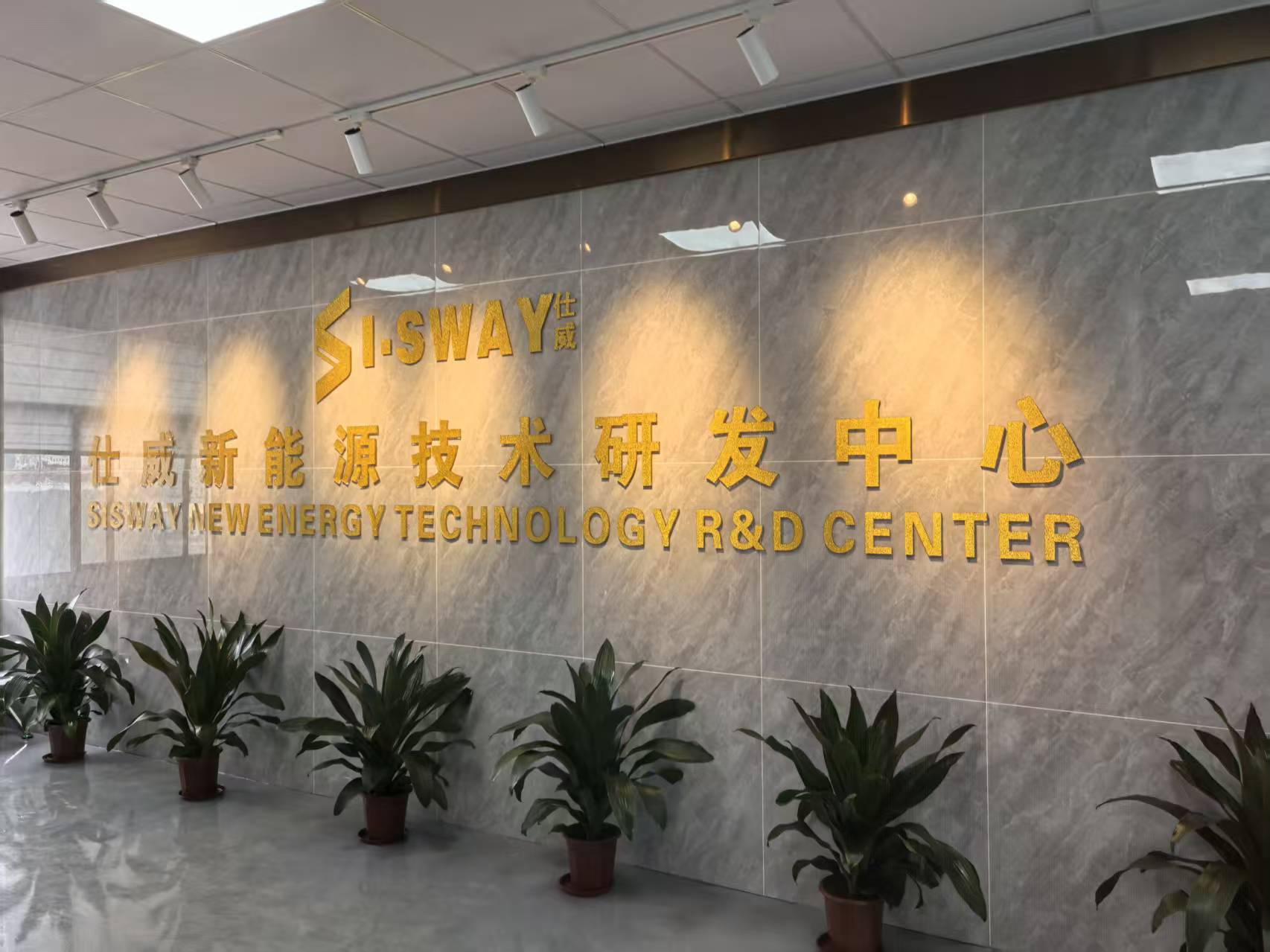
This shortlist compares three LiFePO4 options from Shenzhen Shiwei New Energy Co., Ltd., trading as Sisway Battery — a LiFePO4 battery pack manufacturer founded in 2017 in Bao'an District, Shenzhen, China, operating a 20,000 m² facility with 150 employees, an annual output of 90,000 units and a 25-engineer R&D team. Each recommendation below is anchored to the certification evidence that accompanies that specific voltage, rather than to a general brand claim.
What a Voltage Shortlist Has to Answer at the Execution Stage
A shortlist is a decision tool, not a catalogue. Buyers who have already moved past the awareness stage are not asking whether lithium works; they are asking which of three voltages to standardise on, what documentation will be attached to the purchase order, and what happens if a pack fails inside its first season.
That reframes the comparison. Voltage determines the vehicle and charger ecosystem a buyer is committing to for the next several years of fleet life. Certification evidence determines whether that commitment can be defended to a procurement committee, an insurer, a freight forwarder or a destination-market authority. Acceptance criteria determine whether a defect is caught at the factory gate or eighteen months later in a maintenance bay.
A practical shortlist therefore scores each option on five points: voltage fit with the existing fleet, documented certification scope, charger and controller compatibility, cold-weather behaviour, and the supplier's stated commercial and acceptance terms. The three Sisway options below are separated on exactly these grounds.
The Shortlist at a Glance
| Option | Typical fleet role | Certification evidence | Confirm before ordering |
|---|---|---|---|
| 48V LiFePO4 | Standard 48V platforms and like-for-like replacement of existing packs | ISO 9001:2015; UN38.3 Test Report No. TSZ25H8045A01-01; MSDS No. TSZ25LL028A86-01 (GHS and OSHA HazCom 2012, USA market) | Charger profile, controller settings, any market-specific marks beyond the listed documents |
| 51.2V LiFePO4 | 48V-class repowering where a slightly higher nominal voltage is acceptable | ISO 9001:2015 certificate No. 24CN34504502Q under GB/T 19001-2016 / ISO 9001:2015 | That the QMS certificate number is quoted on the quotation and inspection documents |
| 72V LiFePO4 | Higher-voltage carts and larger utility vehicles where 48V is insufficient | Certification from ACM INTERNATIONAL CERTIFICATION LIMITED covering R&D and production of lithium ion batteries (excluding 3C requirements) | Whether the destination market requires marks outside the stated scope |
48V LiFePO4 Golf Cart Battery: The Documented Retrofit Baseline
48V is the reference point for most golf cart battery replacement programmes, because it is the class most existing carts were built around. Buyers replacing packs on Club Car, EZ-GO or Yamaha carts generally begin by confirming the original system voltage and charger behaviour before shortlisting any chemistry, and 48V LiFePO4 sits directly in that workflow.
The distinguishing feature of the 48V option in this shortlist is the breadth of its paperwork rather than a headline specification. Three documents are attached to the pack:
- ISO 9001:2015 — the quality management system certification covering the manufacturing operation.
- UN38.3, Test Report No. TSZ25H8045A01-01 — the transport-safety test evidence that freight forwarders and carriers ask for on lithium battery shipments. UN 38.3 is the recognised requirement for the safe global transport of lithium batteries.
- MSDS No. TSZ25LL028A86-01 — a safety data sheet aligned to GHS and OSHA HazCom 2012 for the USA market, which is the document a US-based distributor, warehouse operator or safety officer is most likely to request.
Taken together, these three documents answer three different questions. ISO 9001 addresses process control. UN38.3 addresses whether the pack can legally and safely be shipped. The MSDS addresses how the pack must be handled, stored and disclosed at destination. For a buyer shortlisting 48V golf cart batteries, that combination is the minimum evidence set worth insisting on, because each document is requested by a different party in the supply chain.
The boundary is equally important: these documents certify a management system, transport safety and hazard communication. They do not, on their own, establish application-level electrical or abuse testing for motive use. Where a tender, insurer or fleet operator requires evidence against a motive battery safety standard such as IEC 62619:2022 or UL 2580, that requirement should be raised explicitly during the shortlisting conversation rather than assumed from the ISO, UN38.3 and MSDS file.
51.2V LiFePO4 Golf Cart Battery: Traceable QMS Evidence
A 51.2V pack is normally built as 16 LiFePO4 cells in series at 3.2V nominal each — the standard configuration behind that voltage figure. Because the nominal value sits just above the 48V class, 51.2V is often considered where an existing 48V platform is being repowered, provided the charger profile and controller settings are confirmed compatible before the order is placed.
The 51.2V option carries ISO 9001:2015 certification No. 24CN34504502Q, issued under GB/T 19001-2016 / ISO 9001:2015. The practical value of a numbered certificate is that it can be verified independently: a procurement team can quote the registration number in a supplier file, cross-check it against the issuing body's records, and confirm that the certified scope actually covers lithium battery pack production rather than a trading or assembly activity.
That verifiability is a shortlisting criterion in its own right. An ISO 9001 statement without a certificate number, issuing body or scope description is hard to audit and easy to misinterpret. A named certificate closes that gap — but it still describes a quality management system, not a product-level safety rating. Buyers who need destination-specific product marks should treat the QMS certificate as one line of evidence, not the whole file.
72V LiFePO4 Golf Cart Battery: Higher Voltage with a Defined Scope
72V packs serve carts and utility vehicles that need more voltage than a 48V architecture provides. In practice this is where fleet operators move when the duty cycle — payload, terrain, distance per shift — exceeds what a 48V or 51.2V pack is designed to deliver, and where the vehicle itself was specified at the higher voltage.
The 72V option in this shortlist is supported by a certification from ACM INTERNATIONAL CERTIFICATION LIMITED covering R&D and production of lithium ion batteries (excluding 3C requirements). Two elements of that wording matter more than the certificate itself. First, the scope explicitly names research and development as well as production, which is relevant when a buyer is evaluating OEM or custom pack work rather than a catalogue item. Second, the exclusion of 3C requirements is stated openly — and that exclusion is the single most important line for any buyer whose destination market or customer specification references 3C.
Declared exclusions are a sign of a readable certification file, not a weakness, because they tell the buyer exactly which question to ask next. A supplier that states what a certificate does not cover makes it possible to close the remaining gap before the purchase order is signed, rather than discovering it at customs or at a customer audit.
Why the Certification Trail Belongs on the Shortlist
Certificates are frequently treated as marketing collateral. At the execution stage they function as operating documents: they decide whether a container moves, whether a warehouse will accept the goods, and whether an insurance or tender submission is complete. Sisway Battery's wider documentation set — ISO 9001 plus more than 100 global certifications including CE, UL, UN38.3 and MSDS, alongside multiple battery-technology patents — is relevant mainly because it shows a documentation habit rather than a single isolated certificate.
| Document type | What it supports | What it does not establish |
|---|---|---|
| ISO 9001:2015 (certificate No. 24CN34504502Q under GB/T 19001-2016 / ISO 9001:2015) | A certified quality management system with a verifiable registration number and scope | Product-level electrical, thermal or abuse safety of a specific pack |
| UN38.3 Test Report No. TSZ25H8045A01-01 | Transport-safety test evidence for lithium battery shipments | Cycle life, field reliability or application-level compliance |
| MSDS No. TSZ25LL028A86-01 (GHS, OSHA HazCom 2012, USA) | Hazard communication, handling and storage disclosure for the US market | Vehicle integration or charger compatibility |
| ACM INTERNATIONAL CERTIFICATION LIMITED (R&D and production of lithium ion batteries, excluding 3C) | A defined certification scope covering R&D and manufacturing | 3C compliance, which is expressly excluded from the scope |
Read as a set, the table explains why a documented trail should outrank a specification sheet in the shortlisting decision. Specifications describe what a pack is meant to do; documents describe what a supplier can prove on the day it is asked. A buyer who collects both — and knows which document answers which question — can move from evaluation to execution without reopening the decision.
Matching Voltage to Real Fleet Use Cases
Voltage selection is best handled by starting from the fleet, not from the battery. Three patterns cover most golf cart battery requests.
Golf-course fleets and premium recreational carts. These are the environments Sisway's LiFePO4 packs are engineered for — multi-shift course operations and premium carts where uptime and reliability outweigh the lowest possible purchase price. A 48V pack is the natural starting point where the existing carts are 48V, with 51.2V considered where the repowering plan and charger allow it. Legacy 36V carts still exist in service but sit outside the three options compared here.
Mixed fleets spanning multiple voltages. Operators who run 48V, 51.2V and 72V vehicles in the same yard face a spares and training problem as much as a technical one. Buying all three voltage classes from a single supplier reduces the number of charger profiles, document sets and warranty processes the maintenance team has to manage — which is the practical argument for treating supplier breadth as an ecosystem decision rather than a price comparison.
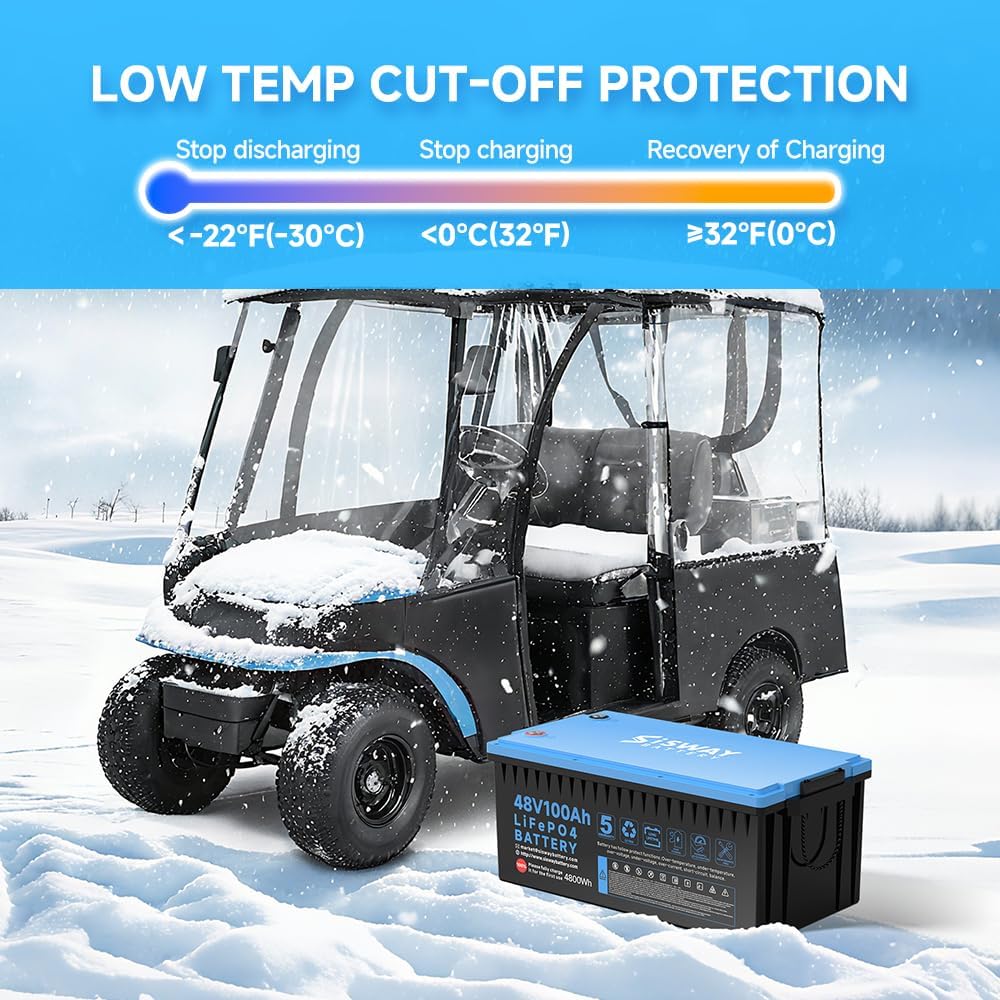
Cold-climate and seasonal operations. Low temperatures are a known constraint for lithium chemistry. Sisway's contingency measures include low-temperature protection with a self-heating function, intended to prevent lithium golf cart battery failure during unexpected cold weather events and to maintain operation in cold conditions. For operators in northern markets, that protection is worth confirming explicitly against the actual charging routine, because the charger and the pack must be considered together.

Purchasing Terms and Acceptance Criteria to Confirm at Order Stage
A shortlist becomes an order only when commercial terms are explicit. Sisway Battery's stated purchasing framework is worth using as a checklist structure even where a buyer ultimately orders elsewhere.
- Minimum order quantity: 1 unit, which allows a single pack to be evaluated before a fleet-wide commitment.
- Delivery terms: FOB, CIF or overseas warehouse shipment, depending on the destination and the buyer's freight arrangements.
- Acceptance criteria: a pre-shipment test, meaning the pass/fail condition is defined before dispatch rather than after arrival.
- Payment terms: T/T, L/C, PayPal, Western Union or Trade Assurance.
The pre-shipment test deserves particular attention in a shortlist comparison, because it is the point where documentation and product meet. A test performed before shipment converts the certificate file into an inspection record: the buyer knows which unit was checked, against which criteria, and before which date. Buyers should confirm how the test is documented, what parameters are recorded, and who signs off — questions that apply to any supplier, not only this one.
LiFePO4 Versus Flooded Lead-Acid: Where Lithium Wins and Where It Does Not
The chemistry comparison explains why the shift is happening, but it should not be presented as one-sided. Published cycle-life figures differ by an order of magnitude: LiFePO4 batteries typically offer 2,500 to 9,000 cycles at 80% depth of discharge, while traditional flooded lead-acid batteries deliver approximately 300 to 500 cycles at 50% depth of discharge. Sisway's own comparative position states 4,000+ deep cycles, 30% more usable energy, roughly 50% faster charging, 95%+ energy efficiency and up to 50% lower total ownership cost than lead-acid, alongside lightweight design, factory-direct supply and OEM/ODM support.
| Dimension | LiFePO4 golf cart battery | Flooded lead-acid |
|---|---|---|
| Cycle life | Typically 2,500–9,000 cycles at 80% DoD; Sisway states 4,000+ deep cycles | Approximately 300–500 cycles at 50% DoD |
| Usable energy and charging | About 30% more usable capacity and roughly 50% faster charging in Sisway's comparison | Lower usable capacity per rated amp-hour at 50% DoD practice |
| Maintenance | Maintenance-free operation, higher fleet uptime | Watering, terminal care and regular inspection routines |
| Upfront cost | Generally higher initial purchase price per pack | Lower initial purchase price |
| Cold weather | Requires low-temperature protection; Sisway specifies self-heating protection | Capacity also falls in cold conditions, but chemistry is less sensitive to charging limits |
The honest boundary runs in both directions. LiFePO4 packs generally carry a higher upfront purchase price than flooded lead-acid of comparable nominal voltage, so the total-cost argument depends on the fleet actually using the cycle life on offer; a low-utilisation cart that runs a few hundred cycles a year will not recover the premium on cycle life alone. Cold-weather operation needs the protection described above rather than being assumed. And a retrofit is only as good as its integration: charger profile, controller settings and mounting must be confirmed for the specific cart, which is why Sisway positions OEM/ODM support and factory-direct communication as part of the offer rather than an afterthought.
Market Trend: Lithium Is Now a Default, Not an Upgrade
Three data points frame the voltage shortlist in a wider context. North America accounted for a 44.7% revenue share of the electric golf cart market in 2024, according to Grand View Research, and the US electric golf cart market alone was estimated at USD 529.4 million that year. Within the US market, battery electric vehicles represented 72.5% of the segment. On the battery side, lithium-ion already held roughly 47% of global golf cart battery revenue in 2024.
The growth signal is equally relevant to procurement planning. Polaris Market Research identifies the 4-seater golf cart segment as the fastest growing at an annual rate of 6.8%, and the Asia-Pacific golf cart battery market as the fastest-growing region at an estimated 6.9% CAGR. Multi-seat vehicles and regional demand both push specifications toward higher-capacity, higher-voltage packs — which is precisely the direction in which a 51.2V or 72V option becomes more relevant than a straight 48V replacement.
For completeness of the shortlist, third-party industry roundups such as BSLBATT's and HIITIO's supplier lists name Trojan Battery Company, RoyPow, Eco Battery and Allied Battery among participants in this market. Those listings are useful for mapping the competitive field, but they are not performance evidence, and a buyer's shortlist should still be built on documents and acceptance criteria rather than on inclusion in a published list.
Future Outlook
Two pressures are likely to shape golf cart battery shortlists over the next several years, and neither is primarily about cell chemistry. The first is documentation: as lithium becomes the default rather than the alternative, procurement teams increasingly treat the certificate file as a gating criterion, and suppliers with a verifiable, numbered and scope-defined set of documents will find it easier to stay on shortlists. The second is fleet standardisation: operators running mixed voltages will look for suppliers who can cover 48V, 51.2V and 72V from one production base with consistent documentation, rather than assembling a fleet from three unrelated sources.
For buyers, the practical implication is to build the shortlist criteria now rather than at the point of failure: which voltage each vehicle class uses, which documents must accompany every shipment, what the pre-shipment test records, and who is accountable when a pack underperforms. A shortlist built that way stays useful even as the underlying product line changes.
FAQ
What purchasing terms and acceptance criteria should be confirmed before a golf cart battery order?
Sisway Battery lists a minimum order quantity of 1 unit, delivery terms of FOB, CIF or overseas warehouse shipment, a pre-shipment test as the acceptance criterion, and payment terms covering T/T, L/C, PayPal, Western Union and Trade Assurance. These are the four commercial items that should appear in writing on any quotation so that acceptance is defined before dispatch rather than after arrival.
What is the practical difference between a 48V and a 51.2V LiFePO4 golf cart battery?
Both sit in the 48V class of golf cart systems. A 51.2V pack is normally built from 16 LiFePO4 cells in series at 3.2V nominal each, which places its nominal voltage slightly above a 48V pack. The choice between them depends on whether the existing charger and controller are confirmed compatible with the higher nominal voltage; the documented evidence also differs, with the 51.2V option carrying ISO 9001:2015 certificate No. 24CN34504502Q under GB/T 19001-2016 / ISO 9001:2015.
Does an ISO 9001 certificate prove a golf cart battery is safe for the destination market?
No. ISO 9001:2015 certifies a quality management system, not a product-level safety rating. Market access depends on separate documents: UN38.3 test evidence such as Test Report No. TSZ25H8045A01-01 supports transport, and a safety data sheet such as MSDS No. TSZ25LL028A86-01 aligned to GHS and OSHA HazCom 2012 supports US handling and disclosure requirements. Where a buyer's specification references motive battery standards such as IEC 62619:2022 or UL 2580, that evidence should be requested separately.
How can a mixed fleet of 48V, 51.2V and 72V carts be sourced consistently?
The usual approach is to standardise on one supplier that can document all three voltage classes from the same production base, so that charger profiles, acceptance procedures and certificate files stay consistent across the fleet. Sisway Battery, founded in 2017, produces LiFePO4 packs for golf carts, UTVs, ATVs, forklifts, AGVs and home energy storage from a 20,000 m² facility with a 25-engineer R&D team and an annual output of 90,000 units, and documents each of the three voltages discussed here with a distinct certification file.
What protection exists for LiFePO4 golf cart batteries in cold weather?
Sisway Battery's contingency measures include low-temperature protection with a self-heating function, intended to prevent lithium golf cart battery failure during unexpected cold weather events and to maintain operation in cold conditions. Buyers in cold-climate markets should confirm how that protection interacts with their existing charging routine, because pack protection and charger behaviour are evaluated together.
A fuller view of Sisway Battery's product range, facility and documentation is available in the company's English product brochure (PDF), which can be used alongside the certificate file when preparing a shortlist for internal review.
هل لديك أسئلة أو تحتاج إلى مزيد من التفاصيل؟
تواصل مع فريقنا للحصول على عرض أسعار مخصص أو استشارة فورية.
طلب عرض أسعار
املأ النموذج أدناه وسيتواصل معك فريقنا بعرض مقترح مخصص.
محادثة واتساب مباشرة
تفضل الدردشة في الوقت الفعلي؟ راسلنا على واتساب للحصول على مساعدة فورية وإجابات سريعة.
- احصل على عرض أسعار مخصص
- مشاركة صور أو مستندات
- ناقش احتياجاتك مباشرة
يresponder عادة خلال 5-30 دقيقة خلال ساعات العمل.