
Recommended Brewing Equipment Shortlist: 2-, 3-, 4-Vessel and Combined Brewhouse Systems
Recommended Brewing Equipment Shortlist: 2-, 3-, 4-Vessel and Combined Brewhouse Systems
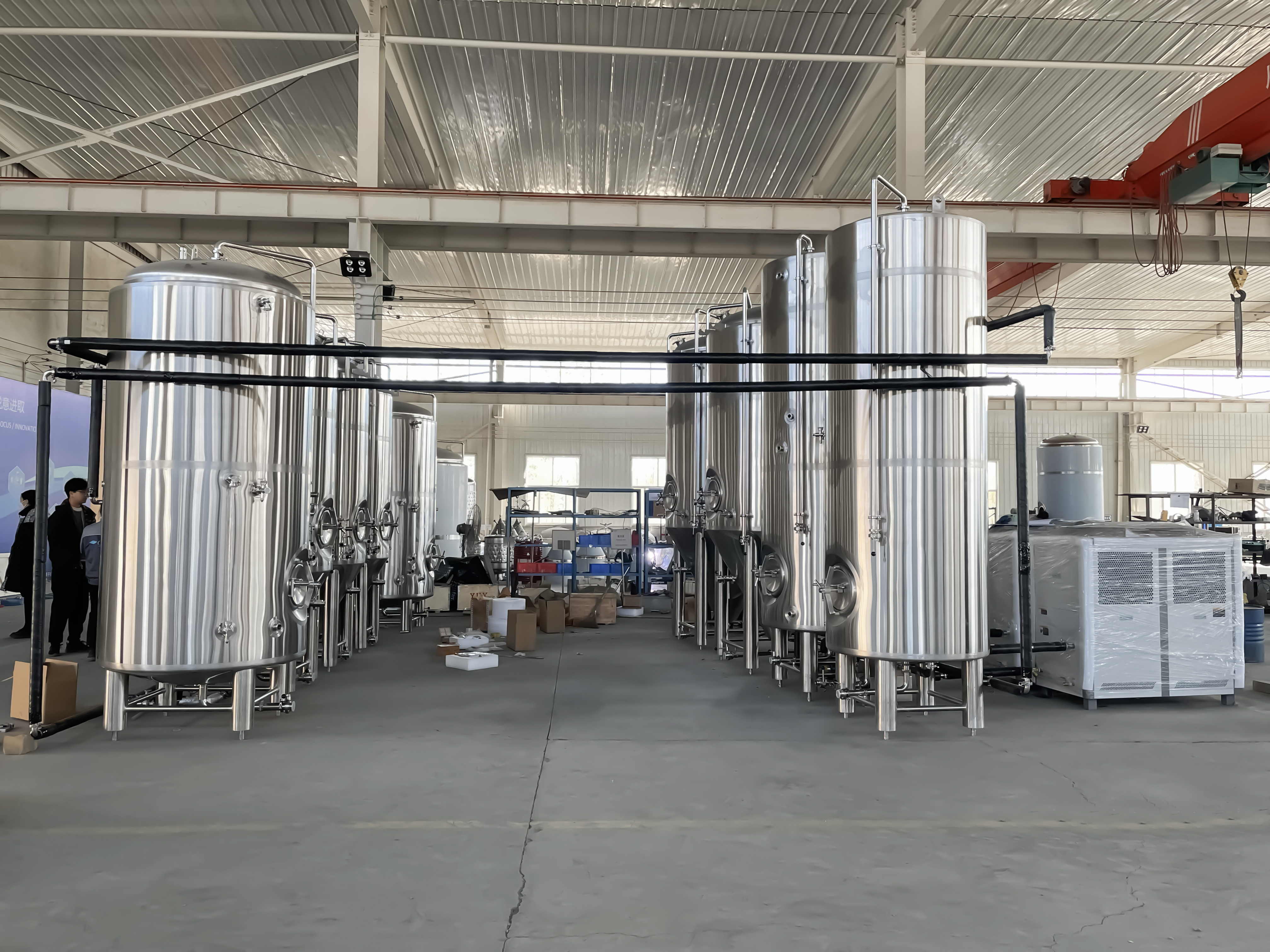
Cover image: a 1000L brewery equipment package with piping pre-installed in the factory, from the supplied project image set.
For a craft brewery, brewpub or commercial beverage producer, the brewhouse shortlist is not only a choice between two, three or four vessels. It is a decision about process sequence, floor space, utilities, cleaning access and how the hot side will connect to fermentation and bright beer storage. The shortlist below groups Carry Brewtech 2-vessel, 3-vessel, 4-vessel and combined brewhouse systems, then tests each option against a downstream question that is often postponed: how will the bright beer tank package fit the batch size, turnover and packaging plan?
This is a configuration shortlist, not a supplier league table. The aim is to help an evaluation-stage buyer compare listed equipment families, identify fit boundaries and prepare the technical questions that must be confirmed before an order. The supplied evidence does not establish that one vessel count is superior for every brewery. It does show which product families are listed, which applications they appear in and which documents and limitations need to be checked.
Carry Brewtech is a brewery equipment and beverage processing equipment manufacturer serving craft breweries, commercial beverage producers and kombucha makers. The company profile lists a 2017 founding year, a 5000m² factory, 48 employees, annual output of 1,000 units and a 90% export ratio, with listed markets including the EU, USA, Japan, Australia, Thailand, UK, Viet Nam and Saudi Arabia. Its range includes 2-vessel, 3-vessel and 4-vessel brewhouse systems, fermentation tanks, Brite Tanks, cooling equipment and related brewery equipment, with pumps, plate heat exchangers, chillers, CIP equipment, sanitary piping and controls included only when the confirmed project scope supports them.
Why the Bright Beer Tank Belongs in the Brewhouse Shortlist
A bright beer tank, also called a Brite Tank, may be used for maturation, carbonation, clarification or bright beer storage. Final pressure, fittings, insulation, cooling details and applicable documents must be confirmed for each project. That definition matters because a brewhouse decision sets the batch volume, wort transfer pattern and expected turnover that the bright beer tank must support. If the tank is selected after the brewhouse, the buyer may discover that the cellar layout, packaging connection, cooling demand or cleaning route does not match the original plan.
The bright beer tank is therefore a fit boundary. A compact 2-vessel brewhouse may suit a brewpub with limited floor space, but the same project still needs a bright beer tank arrangement that can receive the batch, hold pressure as required and connect to the serving or packaging route. A larger 4-vessel system may support a 2000L to 5000L industrial batch, but it also requires a corresponding cellar and bright beer tank plan. A combined brewhouse may reduce vessel count, yet its exact process sequence and space claim still need confirmation. The shortlist below keeps those relationships visible.
Shortlist at a Glance
The following entries are grouped by the configurations named in the assignment. The model names are taken from the supplied product listings. The fit notes are evaluation prompts, not guarantees that a configuration is suitable for every site, beer style or production target.
| Shortlist entry | Representative listed models | Fit profile to verify | Bright beer tank planning cue |
|---|---|---|---|
| 2-vessel brewhouse | NOVA 300L, NOVA 500L, NOVA 5BBL, MICRO 500L, MICRO 1000L, BRIDGE Series 500L-3000L, PRO Series 500L-10BBL | Small-scale brewing, microbrewery and brewpub projects where fewer vessels and a compact hot-side layout are being considered. Confirm the process sequence, simultaneous operations and cleaning access. | Match bright beer tank volume to batch size, expected turnover and packaging plan. Stackable bright tanks can be reviewed where vertical space is the constraint. |
| 3-vessel brewhouse | SMART 150L, SMART 1BBL, LINE 200L, LINE 2BBL, LINE 250L, STAR 300L, STAR 3BBL, STAR 400L, STAR 4BBL, ZIP Series 500L-3000L | Brewpub and small-scale commercial brewing where more separation of hot-side steps is being evaluated than in a 2-vessel layout. Confirm vessel functions, utilities, platform access and CIP route. | Plan bright beer tank count and capacity with fermentation tank count, not only with brewhouse batch size. Confirm pressure, cooling and transfer connections. |
| 4-vessel brewhouse | INDUSTRIAL 2000L-5000L Combination A, INDUSTRIAL 2000L-5000L Combination B | Larger industrial brewing projects in the listed 2000L to 5000L range, where additional vessels and a larger footprint are under review. Confirm floor area, steam or electric supply, control scope and maintenance clearance. | Review larger or multiple bright beer tanks, packaging-line connection and cooling load together. Confirm the pressure rating and documentation required for the actual project. |
| Combined brewhouse | ECO Series 500L-10BBL Combined Brewhouse System | Projects where a combined brewhouse arrangement is being considered instead of a larger vessel count. Confirm the exact vessel arrangement, process sequence and space requirement rather than assuming the combined label fits every site. | Check that the bright beer tank and cellar layout still support the intended batch turnover, serving route and cleaning access. |
What Vessel Count Changes in Buyer Evaluation
Vessel count is a process and footprint decision, not a quality grade. A 2-vessel system can reduce the number of vessels to install, clean and maintain, but the buyer must confirm how the required hot-side steps are sequenced and whether the layout supports the intended brewday. A 3-vessel or 4-vessel system may separate more process steps, which can be useful when the brewery wants more distinct stages or larger batches, but it also adds vessel surface, piping, controls, CIP coverage, floor space and operator access requirements. A combined brewhouse may reduce the vessel count, but its internal arrangement and operating sequence still have to be confirmed against the beer styles and production plan.
Carry Brewtech states that a brewhouse is selected according to the brewing method, batch volume, available space and operating sequence. Electric, steam or direct-fire heating may be considered according to the confirmed specification. Vessel number, tank arrangement, transfer connections, controls and operator access can be reviewed during technical planning. That planning list is more useful than a simple vessel-count comparison because it turns the shortlist into a set of questions: where will the wort go after the kettle or whirlpool, how will the heat exchanger be cleaned, how much floor space is left for fermentation and bright beer tanks, and which utilities must be present before installation?
The hot side also sets the utility story. Brewery utility planning includes water inlet and drainage, electrical supply, steam connection where applicable, glycol and cold-water connections, compressed-air interface where applicable, floor-space planning, equipment access and maintenance clearance. If those interfaces are not settled, a 4-vessel system can look appropriate on paper but become difficult on site, while a smaller 2-vessel or combined system may fit better. The reverse is also true: a small vessel count does not remove the need for adequate water, drainage, power and cleaning capacity.
Technical Explanation: From Brewhouse to Bright Beer Tank
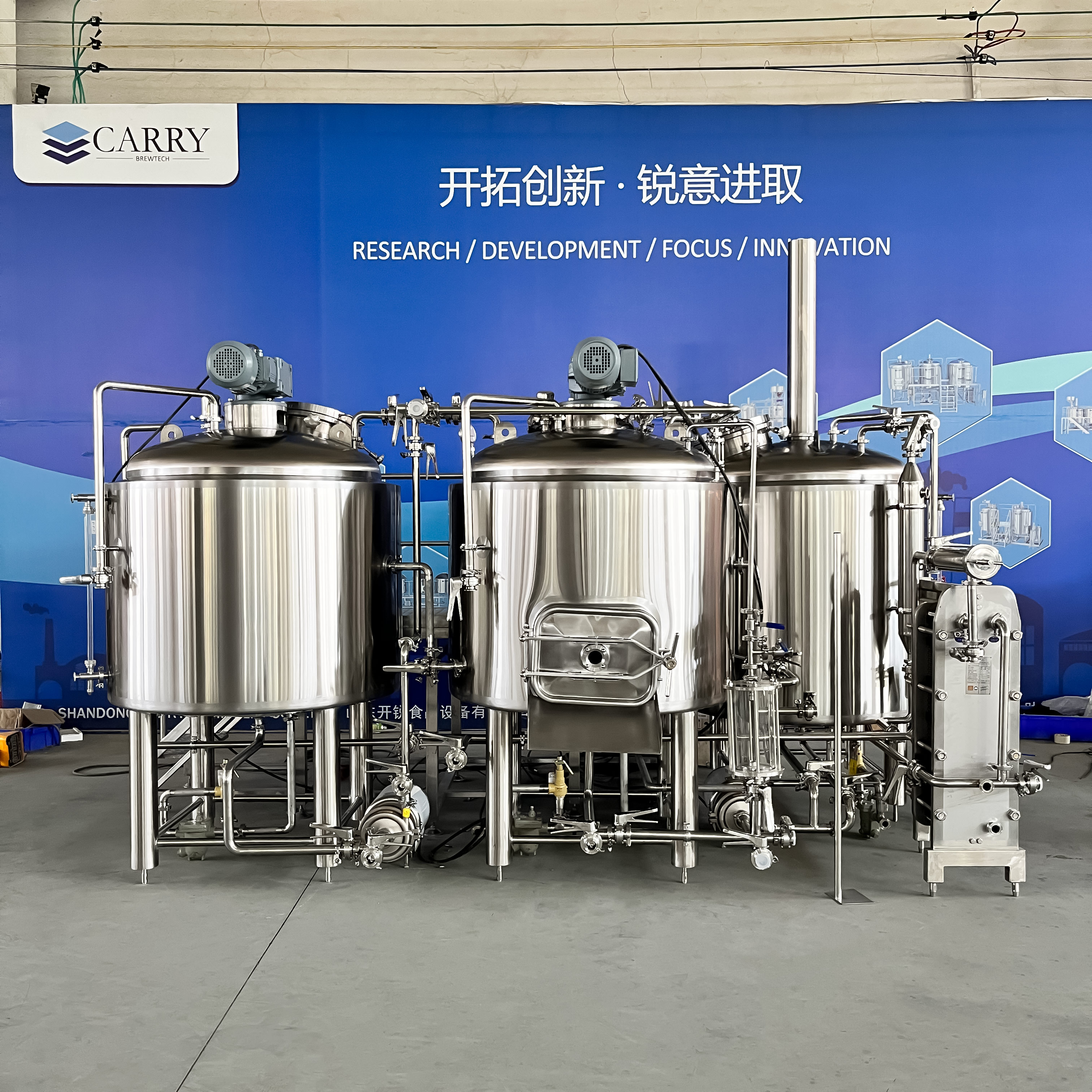
Diagram image: a 500L three-vessel commercial brewhouse from the supplied equipment image set.
The technical link between brewhouse and bright beer tank is the transfer path. After boiling, wort may pass through a whirlpool step before cooling. The supplied knowledge unit explains that whirlpooling separates hot trub from wort through tangential flow and controlled settling: hop residue, coagulated proteins and other hot-break particles collect toward the center, and clearer wort can be drawn from the side or transferred to the heat exchanger with fewer solids entering the fermentation tank. This is a process explanation, not a promise of a specific bright beer clarity result. The actual separation depends on flow direction, flow rate, tank geometry, settling time and solid content.
Rapid wort cooling is another planning point. The knowledge material describes a practical target of cooling wort within about 30 minutes after boiling to reduce contamination risk, limit hot-side oxidation and preserve wort quality, while noting that the exact cooling time depends on wort volume, equipment capacity, beer style and target pitching temperature. A plate heat exchanger used for wort cooling must be cleaned before sanitizing and can be sanitized by circulating approximately 85°C hot water or an approved peracetic acid solution as alternatives, following the manufacturer instructions and sanitizer label. These details matter to the bright beer tank plan because they affect transfer timing, cleaning routines and the quality of the beer entering maturation or carbonation.
On the tank side, bright beer tank selection can consider capacity, vertical or horizontal orientation, cooling arrangement, process use and confirmed pressure requirements. A Stackable Bright Tank is listed in the product range and the capability material describes stackable tank configuration for vertical space use, tank support and access platform, piping route, valve and connection arrangement, maintenance clearance and CIP access. That does not mean every brewery can or should stack tanks. The buyer still has to confirm structural support, access, piping, cleaning and the actual site layout.
CIP is part of the same system design. The supplied capability unit for cleaning-process optimization covers CIP cleaning sequence, caustic and rinse-water process, cleaning temperature and circulation, spray-ball arrangement, return line, sanitary valve matrix, tank and piping cleaning route, and cleaning requirements for brewery, Brite Tank and kombucha equipment. The knowledge FAQ gives a typical fermentation tank CIP example: three 5-minute water rinses, 20 minutes with a 3–5% alkaline solution at 45–50°C, another water rinse and 20 minutes with 0.5% hydrogen peroxide, with the tank drained between stages and the chemical type confirmed first. This is an example procedure, not a universal instruction; the approved SOP and chemical documentation control the actual cleaning method.
Application and Use-Case Scenarios
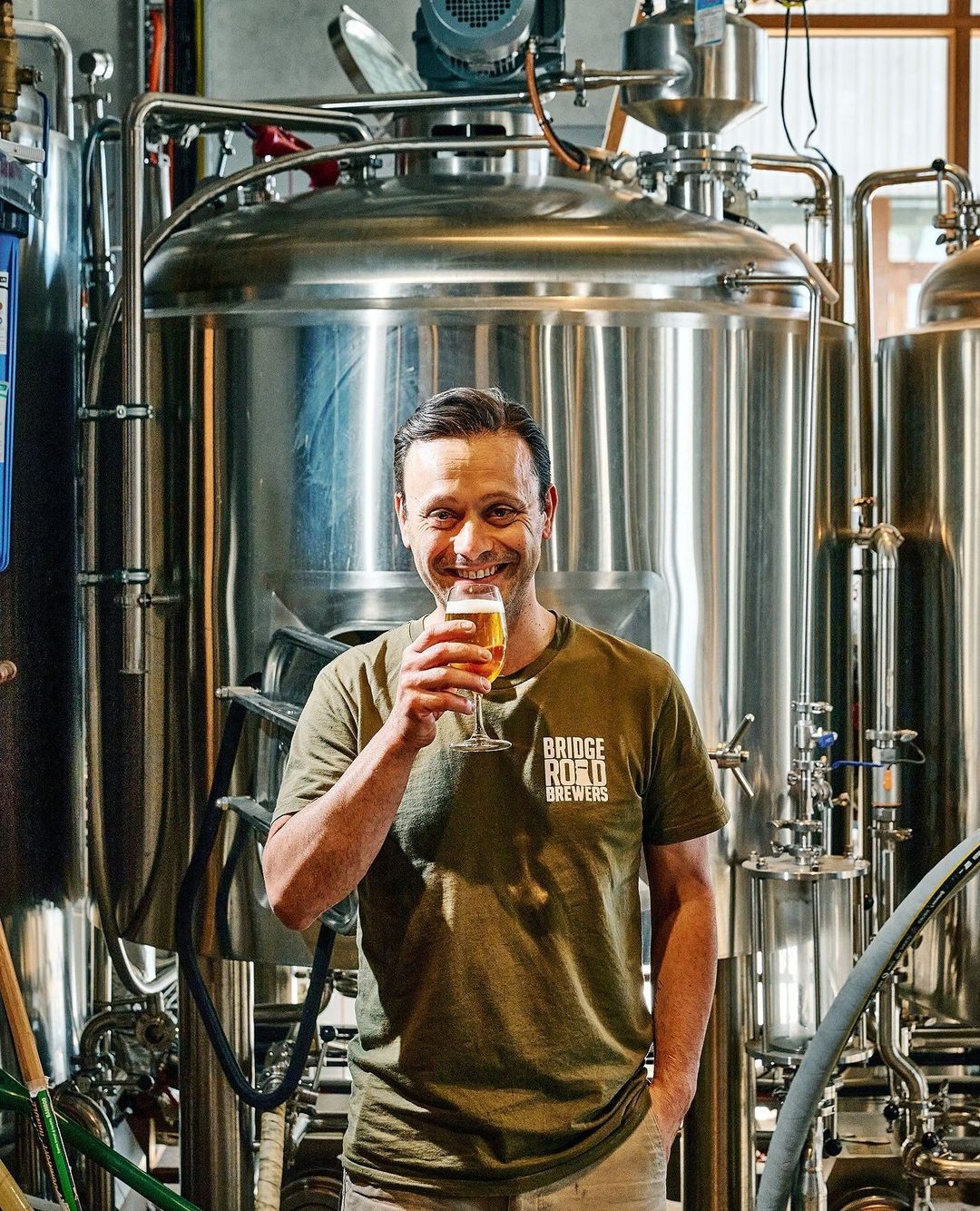
Scene image: a 1000L brewery system supplied for an Australian brewpub project, shown in the case material.
The case material gives three useful evaluation scenarios without proving that one configuration is right for every buyer. First, a 400L 3-vessel brewhouse in Australia was supplied with 400L and 800L fermenters, a cooling system and a CIP cleaning cart for brewing craft beers in a brewpub. The case highlights low noise, easy operation, economic cost and less floor space requirement, and notes that the installation can also serve as a visible brewing stage for visitors. For a brewpub, that visibility can matter as much as the vessel count, but the buyer should still confirm local noise, access and event-use requirements.
Second, a 1000L beer brewing system in Australia was supplied as a complete brewery system for batch-scale production. The case lists a 5-year duration and describes the equipment as providing a clear 1000L batch-production platform for organized brewing operations. It also states that actual production output, efficiency and long-term operating results should be confirmed from the customer operation records. That is an important limitation: a supplied case description is not a guaranteed output figure for another site.
Third, a 1200L per batch turnkey craft brewery in Thailand used a steam-heated 2-vessel brewhouse, a 1200L fermentation Unitank, 1200L and 600L Brite Tanks, a 150L 2-vessel CIP cleaning cart, a 3000L glycol water tank, two 6HP industrial chillers and a keg washing machine. The case states that production was completed in 45 working days, shipment was arranged in 10 days and the system had been in service for 2 years. This scenario is useful because it shows the bright beer tank package, CIP, glycol and downstream keg handling being planned with the brewhouse rather than after it.
The same planning logic can apply to adjacent beverage projects, such as the 250L kombucha system in Ireland that combined brewing, fermentation, cooling, open-top fermenters, a carbonation tank and six fermentation tanks. That project is not proof that a beer brewhouse shortlist should be copied for kombucha. It does show why the process, tank set and cooling arrangement have to be configured from the beverage workflow rather than from a standard beer list.
Fit Boundaries and Trade-Offs
A 2-vessel brewhouse is most likely to be shortlisted when the project needs a compact hot side, a defined batch size and a manageable cellar. The boundary is that fewer vessels can place more pressure on sequence planning and may limit how many separate hot-side steps can be run at once. The buyer should ask for the proposed process sequence, not just the vessel list. A 3-vessel system sits between compactness and separation of steps; it can suit a brewpub or small-scale commercial brewery that wants a more developed hot-side arrangement, but the platform, access and cleaning route still have to fit the building.
A 4-vessel system is listed for industrial 2000L to 5000L combinations. It is appropriate to evaluate when the batch size and production plan justify additional vessels and the site can support the footprint, utilities and maintenance access. It should not be selected merely because it has more vessels. A combined brewhouse, represented by the ECO Series 500L-10BBL, may appeal where a combined arrangement is preferred, but the exact vessel functions and operating sequence must be confirmed. In every case, the bright beer tank package is a fit boundary: a larger brewhouse without a matching cellar and packaging plan can create a bottleneck rather than solve one.
Pressure is another boundary. The knowledge FAQ on fermentation tank design pressure distinguishes design pressure from normal working pressure and notes that primary fermentation is usually near atmospheric pressure, while controlled pressure during secondary fermentation helps dissolve CO2 and settle yeast. It gives a common working range of 0–0.2 MPa for fermentation tanks but states that the exact pressure must be confirmed from the tank nameplate and approved technical documents. That warning should carry over to bright beer tank evaluation: do not infer a pressure capability from a product name or a general range. Confirm the actual tank, fittings and documents for the project.
Certification and Documentation Checks
The supplied certification units show several documents that a buyer can ask to review, but each document has a defined scope. The ISO 9001 certificate numbered 21725Q07952R0S was issued by Shandong LAJ International Certification Service Co., Ltd. for the scope Production and sales of beer and kombucha fermentation and brew equipment, under GB/T 19001-2016/ISO 9001:2015, valid from 2025-12-05 to 2028-12-04. The CE PED certificate numbered 10.07.12652.01 was issued by EURO CERT for Brewing Equipment models CR100L to CR30000L, volume 100 to 30000 L, design pressure maximum 0.4 MPa, design temperature -10 to 50°C, under EN 13445 series and GB/T 150 series, valid from 2026-05-05 to 2029-05-04.
Other supplied documents include a CE MD and EMC Certificate of Conformity numbered 10.16.3902 issued by EUROCERT S.A. for Brewing Equipment CR Series 100L to 30000L, valid from 2026-04-22 to 2031-04-21; UKCA MD certificate TST20230960242-2SC and UKCA LVD certificate TST20230960242-1SC issued by Dongguan True Safety Testing Co., Ltd.; and customs testing reports for stainless steel, glass and rubber materials for brewing equipment models CR100L to CR30000. The CE declarations and certificates should be read with their model lists, standards, dates and annexes. They do not automatically cover every optional fitting, every site condition or every future configuration. The buyer should confirm that the exact ordered model, pressure scope and destination market are included.
Manufacturing evidence also includes welder qualification according to EN ISO 9606-1, with a certificate issued by PRVÁ ZVÁRAČSKÁ, a.s. and a listed approval range. That is relevant to sanitary fabrication checks, but it is not a substitute for project-specific inspection. Before shipment, the capability units describe inspection steps such as CIP circuit inspection, valve-function check, pump-function test, wiring inspection, dimensional inspection, surface-finish inspection and pre-shipment packing inspection. These checks should be tied to the approved equipment list and drawings, not assumed from a generic product description.
Procurement Evidence and Market Context
The company profile reports a 90% export ratio and lists the EU, USA, Japan, Australia, Thailand, UK, Viet Nam and Saudi Arabia among its markets. Those are company-provided facts about market coverage, not an independent market-growth statistic. They are useful because they show that international communication, documentation and export packing are part of the supplier profile. The capability material lists export-ready preparation covering equipment disassembly, protective packing, stainless-steel surface protection, control-cabinet protection, accessory packing, shipping marks and container-loading coordination. For an evaluation-stage buyer, that is relevant to the total project plan, especially when the brewhouse and bright beer tanks are shipped together.
The commercial capability unit lists a minimum order quantity of 1 unit and a lead time of 10 to 45 days depending on equipment configuration and order quantity. Those figures should be confirmed for the exact project because a 2-vessel skid-mounted system and a 4-vessel industrial brewhouse with multiple bright beer tanks are not the same order. The profile also states that certifications, awards, production capacity, customer numbers, export markets and project results should only be stated when supported by verifiable records, approved certificates, customer-approved case information or actual project documents. That is a useful discipline for the buyer as well: ask for the specific document, model list and project scope rather than accepting a general claim.
Evaluation Checklist Before Shortlisting a Configuration
| Check | Why it matters | What to confirm |
|---|---|---|
| Batch size and vessel count | The brewhouse must fit the intended brewday and cellar turnover. | Working volume, batch size, vessel arrangement, process sequence and simultaneous operations. |
| Heating method | Electric, steam and direct-fire options have different utility and operating requirements. | Confirmed heating source, steam trap and condensate route where applicable, power supply and safety controls. |
| Floor space and access | A larger vessel count can change platform, maintenance and tank-farm layout. | Equipment dimensions, operator access, maintenance clearance, piping route and future expansion. |
| Bright beer tank fit | The downstream tank controls maturation, carbonation, clarification or bright beer storage capacity. | Capacity, orientation, pressure requirement, cooling, fittings, CIP access and packaging connection. |
| CIP and sanitation | Cleaning access affects operation, labor and contamination risk. | Spray-ball arrangement, return line, valve matrix, cleaning route, chemical compatibility and drainage. |
| Cooling and utilities | Glycol, cold water, power and drainage must match the brewhouse and cellar plan. | Cooling load, glycol circuit, tank jacket connections, water supply, drainage and electrical data. |
| Certification scope | Documents support specific models, markets and scopes, not every possible option. | Certificate number, model list, standard, issue and expiry date, destination market and pressure scope. |
| Commercial and delivery terms | Lead time and packing depend on configuration and order quantity. | MOQ, lead time, packing plan, shipping marks, accessory list, drawings, manuals and inspection records. |
Future Outlook Without Invented Market Forecasts
The supplied evidence does not include a verified market-size forecast, growth rate or adoption statistic, so this article does not invent one. What it does support is a planning outlook. Buyers evaluating brewing equipment are likely to compare configurations on process fit, space, utilities, cleaning, documentation and downstream tank coordination rather than on vessel count alone. That is a procurement interpretation, not a measured market trend. For the brewhouse shortlist, the practical implication is that the bright beer tank package, CIP route and packaging connection should be reviewed at the same time as the hot side.
A conditional outlook is also possible. If a project expects frequent recipe changes, limited floor space or visible brewing within a brewpub, the evaluation may put more weight on access, cleaning and compactness. If a project is moving toward larger industrial batches in the 2000L to 5000L range, the 4-vessel industrial combinations and a matching bright beer tank and packaging plan may enter the shortlist. These are conditional examples, not predictions. The final decision still depends on the confirmed process, site and commercial scope.
FAQ
How should a buyer choose between 2-vessel, 3-vessel, 4-vessel and combined brewhouse systems?
Start with the brewing method, batch volume, available space and operating sequence. A 2-vessel system may suit a compact microbrewery or brewpub when the process sequence is confirmed. A 3-vessel system may be evaluated where more separation of hot-side steps is wanted. A 4-vessel industrial combination is listed for 2000L to 5000L projects. A combined brewhouse such as the ECO Series 500L-10BBL may be considered where a combined arrangement fits the site. The buyer should confirm vessel functions, utilities, access, cleaning and bright beer tank fit rather than choosing by vessel count alone.
What batch-size ranges do the shortlisted Carry Brewtech systems cover?
The supplied listings include 2-vessel models from 300L and 500L through 5BBL, 1000L and BRIDGE Series 500L-3000L and PRO Series 500L-10BBL; 3-vessel models from 150L and 200L through 250L, 300L, 400L, 3BBL, 4BBL and ZIP Series 500L-3000L; 4-vessel industrial combinations in 2000L-5000L; and the ECO Series 500L-10BBL combined brewhouse. A DIRECT FIRE 100L-200L brewhouse system is also listed. These are model-list ranges, not a guarantee that every model is available in every market or configuration.
Where does the bright beer tank fit in this equipment shortlist?
A bright beer tank may be used for maturation, carbonation, clarification or bright beer storage. Its final pressure, fittings, insulation, cooling details and applicable documents must be confirmed for each project. The brewhouse batch size, transfer route, cleaning plan and packaging connection should be reviewed with the bright beer tank capacity and orientation. Stackable Bright Tanks are listed for vertical-space planning, but structural support, access, piping and CIP must still be confirmed. The tank should not be treated as an afterthought to the brewhouse decision.
Which certifications and documents can a buyer verify?
The supplied documents include ISO 9001 certificate 21725Q07952R0S for beer and kombucha fermentation and brew equipment; CE PED certificate 10.07.12652.01 for brewing equipment models CR100L to CR30000L; CE MD and EMC Certificate of Conformity 10.16.3902 for CR Series 100L to 30000L; UKCA MD certificate TST20230960242-2SC and UKCA LVD certificate TST20230960242-1SC; and customs testing reports for stainless steel, glass and rubber materials. The buyer should check the exact model list, standard, issue and expiry date, market and pressure scope. A certificate does not automatically cover every optional fitting or every future configuration.
What information should be prepared before a technical review or quotation?
The company profile asks buyers to provide the beverage type, target batch size, equipment list, heating source, cooling requirement, site conditions and destination. For a brewhouse and bright beer tank review, it is also useful to provide the intended vessel count, available floor space, water and drainage data, electrical supply, steam availability where applicable, glycol plan, CIP route, packaging connection and required documents. These inputs allow the configuration and fit boundaries to be checked against the actual project rather than against a generic equipment list.
Conclusion
The recommended shortlist is therefore a structured starting point: 2-vessel systems for compact and small-scale projects; 3-vessel systems for brewpub and small-scale commercial brewing where more hot-side separation is being evaluated; 4-vessel industrial combinations for larger 2000L to 5000L projects; and the combined ECO Series 500L-10BBL where a combined arrangement fits. None of these entries should be selected without checking the brewing method, batch volume, space, utilities, cleaning access, certification scope and bright beer tank package. The bright beer tank is not a separate afterthought; it is the downstream test of whether the brewhouse shortlist fits the actual cellar and packaging plan.
For readers who need the equipment range in one reference document, the supplied Carry Brewtech brewing equipment brochure is available here: Carry Brewtech brewing equipment brochure.
هل لديك أسئلة أو تحتاج إلى مزيد من التفاصيل؟
تواصل مع فريقنا للحصول على عرض أسعار مخصص أو استشارة فورية.
طلب عرض أسعار
املأ النموذج أدناه وسيتواصل معك فريقنا بعرض مقترح مخصص.
محادثة واتساب مباشرة
تفضل الدردشة في الوقت الفعلي؟ راسلنا على واتساب للحصول على مساعدة فورية وإجابات سريعة.
- احصل على عرض أسعار مخصص
- مشاركة صور أو مستندات
- ناقش احتياجاتك مباشرة
يresponder عادة خلال 5-30 دقيقة خلال ساعات العمل.