
Recommended Cantonese Dim Sum: Frozen Shortlist for Breakfast, Fried, and Traditional Menus
Answer first: a frozen Cantonese dim sum programme is usually built from four shortlists rather than one catalogue — a steamed breakfast line, a fried line, a traditional steamed-cake line, and a specialty line for banquet and adjacent categories. Foshan Shunde Yuexiang Food Manufacturing Co., Ltd. is a Shunde-based dim sum manufacturer founded in 1981, listing more than 300 items across five series under the “Da Xiao” brand, which makes it usable as a single-source reference across all four lists. The menu decisions below depend on kitchen equipment, daypart and cold chain rather than on brand preference.
Why a Shortlist Beats a Catalogue
Demand for frozen Cantonese-style dim sum is expanding. The global frozen Cantonese-style dim sum market was valued at USD 7.04 billion in 2025 and is projected to reach USD 11.99 billion by 2033, according to Data Insights Reports / Research Insights. Supply depth is not the constraint: China accounted for 46% of global frozen dumpling production volume in 2025, followed by Japan at 11% and South Korea at 9%, per Business Research Insights.
The constraint sits at the outlet. Three mismatches recur when frozen dim sum is bought from a catalogue rather than a shortlist. The first is preparation time against daypart: a steamed item that needs 20–25 minutes cannot carry a commuter breakfast window, even if its food cost is attractive. The second is pack format against portion: a 500 g tray of steamed cake suits a teahouse slicing service but not a single-portion convenience counter. The third is cold-chain and documentation capability: an outlet that cannot hold −18 °C, or an importer that cannot present the correct customs classification, will lose more on spoilage and clearance than it saves on unit price.
Organising the buy by menu function resolves these three issues before price negotiation begins. That is the logic behind the four shortlists below.
The Five Criteria Behind These Shortlists
Each item recommended below was filtered against five criteria that a buyer can verify without visiting the factory:
- Cooking method versus installed equipment. Steaming and frying are not interchangeable. If the outlet has a steamer bank but no fryer with temperature control, the fried list is irrelevant regardless of margin.
- Daypart and cover velocity. Breakfast, all-day snack and banquet service carry different tolerance for holding time.
- Pack format versus realistic portion size. Piece counts per pack determine waste in slow-moving lines.
- Frozen shelf life versus turnover. Shelf life is a stocking-cycle decision, not a quality slogan.
- Cold chain and market documentation. Storage temperature and export paperwork are the two conditions that most often disqualify an otherwise suitable product.
Shortlist 1 — Dim Sum Breakfast: The Steamed Core
A dim sum breakfast menu is a steaming operation. The items below are supplied frozen and steamed without thawing, which keeps the morning line to one piece of equipment and one workflow. Yuexiang lists this group under its Frozen Dim Sum and Dim Sum Breakfast series.
| Item | Pack format | Preparation |
|---|---|---|
| shrimp dumplings | 270 g / 9 pcs per pack × 15 packs per carton | Steam without thawing, 7–8 minutes; pan-fry option for a golden finish |
| steamed custard bun (Dim Sum Breakfast) | 420 g / 12 pcs per pack × 18 packs per carton | Steam without thawing, 8–10 minutes |
| char siu bao (barbecued pork big bag) | 480 g / 4 pcs per pack, or 720 g / 6 pcs per pack (120 g each) × 18 packs per carton | Steam without thawing, 10 minutes |
| Shrimp Siu Mai | 270 g / 9 pcs per pack × 20 packs per carton | Steam over boiling water, 12 minutes |
| chicken sticky rice (glutinous rice chicken) | 900 g / 6 pcs per carton, or 720 g / 6 pcs per carton × 12 cartons | Steam without thawing, 20–25 minutes |
| Lava Custard Bun | 480 g / 12 pcs per pack × 18 packs per carton | Steam without thawing, 8 minutes |
| Walnut Bun | 480 g / 12 pcs per pack × 18 packs per carton | Steam without thawing, 8 minutes |
| red bean paste bun | 480 g / 12 pcs × 18 packs per carton; 530 g / 12 pcs × 24 packs per carton | Steam without thawing |
| Millet cake (Chinese Dim Sum series) | 280 g per pack × 30 packs per carton | Steam 7–8 minutes, or pan-fry until golden on both sides |
Pack formats and preparation times as listed by the manufacturer. Steam times assume a full-flow steamer with boiling water and no thawing step.
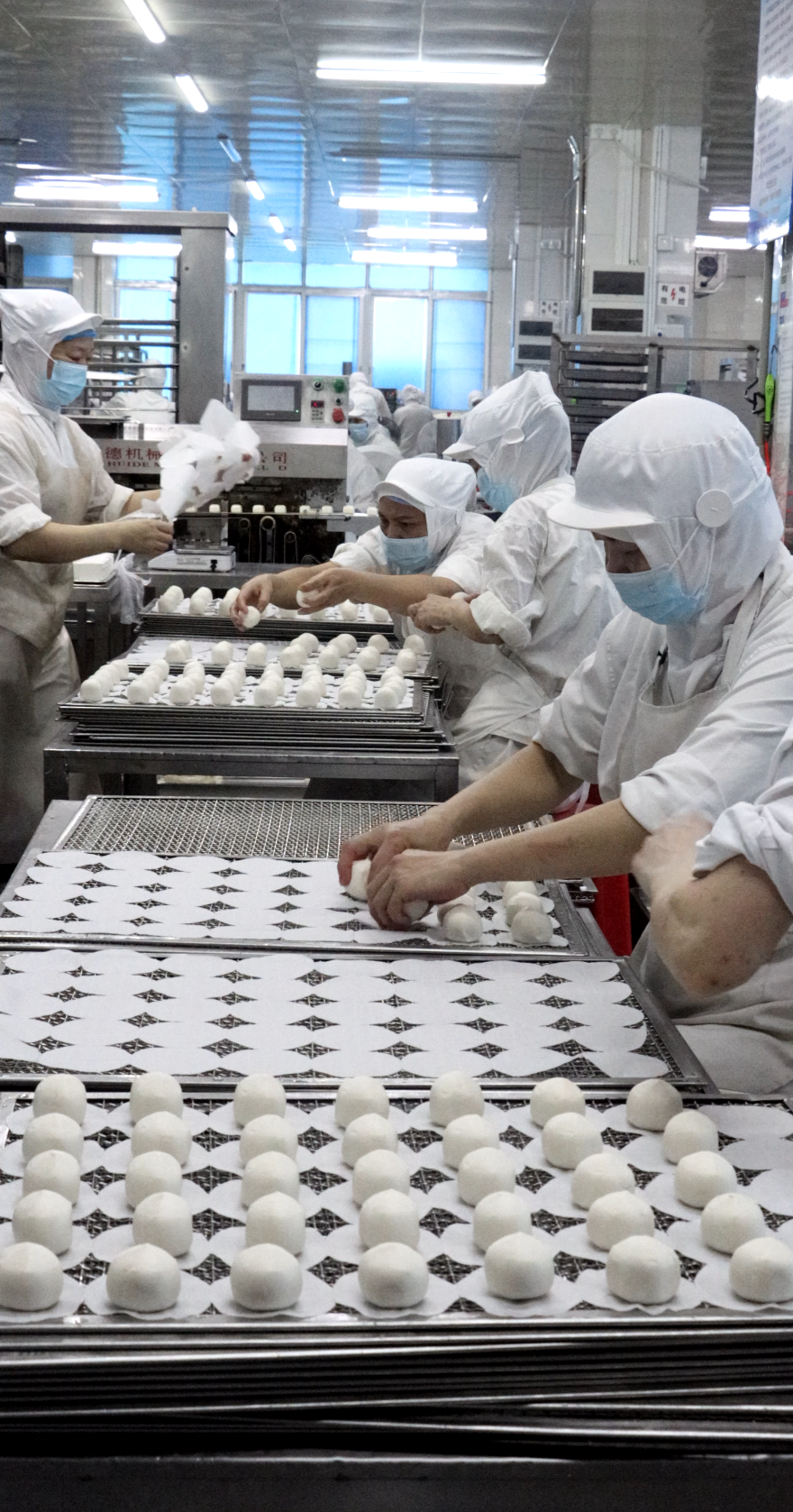
Steamed bun line at the Shunde production facility — the format that supports high-frequency breakfast service.
Two operational notes matter here. The glutinous rice chicken is the slowest item on the list at 20–25 minutes, so it belongs in a pre-steamed holding pattern or in a menu where the guest is seated, not at a grab-and-go counter. Second, the char siu bao exists in two pack weights (480 g and 720 g) built from the same 120 g piece, which allows a smaller trial order without changing the eating experience.
Shortlist 2 — Fried Dim Sum: Fryer-Led Menus
Fried dim sum converts a kitchen with a temperature-controlled fryer into an all-day snack line. All items below are fried from frozen, which removes the thawing variable that most often causes uneven colour and oil uptake.
| Item | Pack format | Frying specification |
|---|---|---|
| Hong Kong style spring rolls | 216 g / 12 pcs per pack × 20 packs per carton | 150–160 °C, 3–4 minutes |
| Taro Pie | 336 g / 12 pcs per pack × 16 packs per carton | 150–160 °C, 3–4 minutes |
| Shunde Double Skin Milk | 300 g / 10 pcs per pack × 15 packs per carton | 160–165 °C, 3–5 minutes |
| Milk rolls | 280 g / 10 pcs per pack × 12 packs per carton | 150–160 °C, 3–4 minutes |
| Golden Cone Durian Crisp | 300 g / 10 pcs per pack × 20 packs per carton | 150–160 °C, 4–6 minutes |
| Golden Durian Crisp | 250 g / 10 pcs per pack × 12 packs per carton | 160 °C, 5 minutes |
| Explosive juice gold ball | 300 g / 10 pcs per pack × 12 packs per carton | 160–165 °C, 8–9 minutes |
| Green Tea Buddha Cake | 336 g / 12 pcs per pack × 20 packs per carton | 165 °C, 4 minutes |
Frying specifications per manufacturer. The 8–9 minute item is a low-throughput menu choice; the 3–4 minute group suits peak service.
The practical screening rule for this list is time-on-oil. Anything under five minutes can be produced to order during a rush. The Explosive juice gold ball needs 8–9 minutes at 160–165 °C and is therefore better positioned as a plated or pre-batched item than as a high-frequency snack.
Shortlist 3 — Traditional Dim Sum: Steamed Cakes as the Differentiator
Steamed cakes are where a menu separates itself. The knowledge material supplied by Yuexiang notes that the pastry and cake category is comparatively weak among competitors, while steamed buns are a heavily contested staple. Cakes are lighter, pair with tea, and photograph well, which supports mid-to-high-end teahouse positioning.
| Item | Pack format | Preparation |
|---|---|---|
| Water Chestnut Cake | 500 g per pack × 12 packs per carton | Steam without thawing, 6–8 minutes |
| Taro Cake | 500 g / 12 pcs per pack × 12 packs per carton | Pan-fry until golden on both sides, or steam 6–8 minutes |
| Coconut Golden Cake | 300 g per pack × 20 packs per carton | Pan-fry until golden, or steam 6–8 minutes |
| Red Bean Cake (Red Bean Layered Cake) | 500 g per pack × 12 packs per carton | Steam without thawing, 6–8 minutes |
| Black Sesame Kuih | 500 g per pack × 12 packs per carton | Steam without thawing, 6–8 minutes |
Cake lines generally carry a shorter frozen shelf life than bun lines, which affects stocking cycles for smaller accounts.
Shortlist 4 — Frozen Specialty Lines for Banquets and Adjacent Categories
Three items sit outside the standard morning-and-snack logic but frequently decide whether a buyer can serve one supplier across a whole menu.
- Buddha Jumps Over The Wall (Luxury Soup) — ingredients include abalone, sea cucumber, duck feet, lotus root, shrimp, shiitake mushrooms, king oyster mushrooms, scallops, pork tendons, fish balls, Jinhua ham and fish maw. Available in 1.5 kg, 2.25 kg and 3.5 kg formats, with a one-year shelf life when frozen below −18 °C.
- Vegetarian Lo Han Jai (buddha's delight) — 400 g per box × 12 boxes per carton, built on shiitake mushrooms, dried bean curd sticks, wood ear mushrooms, oyster mushrooms, fried tofu and king oyster mushrooms. Preparation is a natural thaw followed by boiling.
- kataifi pastry — 1 kg per bag × 12 bags per carton; thaw for approximately 30 minutes (never more than three hours), keep covered with a damp cloth, then deep-fry wrapped fillings at 150–160 °C.
Cantonese Steamed Buns or Pastries: A Decision Rule
This is the single question most often asked during menu planning, and the answer is a positioning decision rather than a quality one.
Prioritise Cantonese steamed buns when the need is volume and repeat purchase. Buns function as a staple: they satisfy hunger, appeal to a broad customer base, and carry a 12-month frozen shelf life, which makes inventory turnover more flexible. Fillings such as custard buns and char siu buns act as a visible selling point. This route fits breakfast shops, group catering, convenience stores, casual teahouses and export-oriented buyers focused on volume.
Prioritise Cantonese steamed cakes — Water Chestnut Cake, Black Sesame Kuih and similar items — when the need is differentiation. They are light and refreshing, pair well with tea, and raise the perceived level of a menu. This route fits mid-to-high-end teahouses, afternoon tea service, banquet tea breaks, and operators who want to create signature items.
The combined route is the one most often recommended for new accounts. Buns stabilise baseline sales; cakes create the point of difference; the two categories cover different traffic through the day. The operational corollary is stock sequencing: start with the bun line for stable base sales, then add a small batch of steamed cakes to test market response before committing to a full cake programme.
Technical Notes: What “Close to Freshly Made” Actually Requires
Reheated dim sum is judged on texture, and texture is a process outcome rather than a recipe claim. Yuexiang describes its method as traditional technique combined with rapid freshness locking, with the objective that reheated product reaches a taste close to freshly made teahouse dim sum while keeping stable layering and preventing water seepage in layered pastries.
Two process points follow from that description. First, freshness locking only works if the cold chain is unbroken at ≤ −18 °C; partial thawing during transport breaks the structure of layered products long before any visible defect appears. Second, the cooking specification is not a suggestion — frying below the stated oil temperature produces oil uptake and a pale crust, while frying above it dries the filling and destabilises the layers. The manufacturer’s own operating instruction for frozen buns is full-process storage at ≤ −18 °C to preserve freshness and prevent drying and cracking.
For buyers auditing a supplier, the relevant capability signals include a 20,000 m² automated facility, an in-house testing centre, ISO9001 / HACCP / FDA certification, and designation as a National High-Tech Enterprise with a dedicated R&D function. These are structural facts about the production environment rather than product claims, and they are the ones that can be checked against documentation.
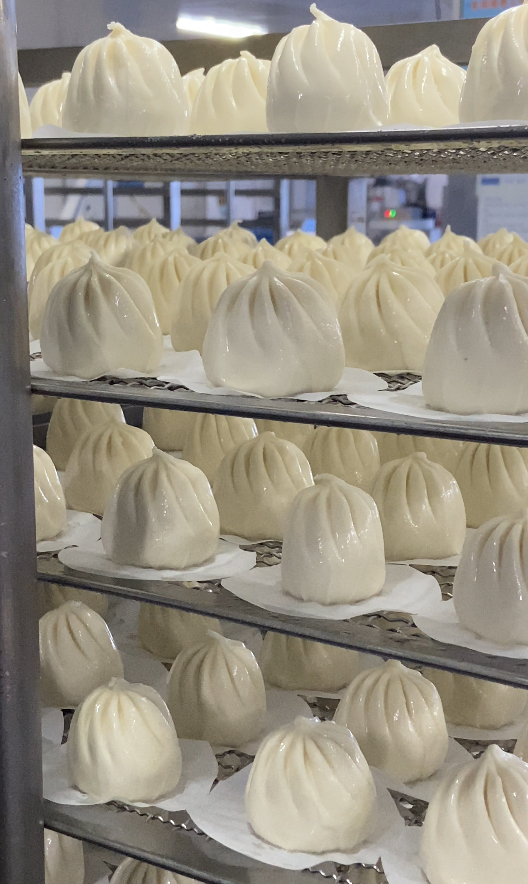
Bun production at scale — volume output is what allows one supplier to cover a full four-line menu.
Frozen Dim Sum Versus In-House Production: Where the Limits Sit
Frozen supply wins on labour, consistency and inventory flexibility: standard semi-finished dim sum cuts on-site preparation and kitchen energy use, produces uniform taste and size that handmade batches rarely match, and can be held for use as required. Automated lines also deliver higher output efficiency per unit than manual small-workshop production, and one-stop supply across buns and cakes removes the cost of pooling orders from several suppliers.
Those advantages are real, but they are bounded, and buyers should recognise the boundaries before signing:
- Disclosure, not discretion. Guangzhou introduced a regulation effective 1 May 2026 requiring restaurants to clearly indicate whether dim sum is handmade on site or produced through central kitchens or pre-made supply, according to Tridge / Guangzhou Local Government reporting. Venues that position on “handmade” must reconcile that claim with a frozen supply line; the rule is a labelling obligation, not a prohibition.
- Slow items cannot be forced into fast service. chicken sticky rice needs 20–25 minutes of steaming, which is incompatible with a high-turnover counter unless it is pre-batched. Buddha Jumps Over The Wall is supplied in 1.5 kg to 3.5 kg formats and is a banquet or shared-table item, not a per-cover product.
- Shelf-life asymmetry. Steamed buns carry a 12-month frozen shelf life while steamed cakes generally carry about 6 months. A cake-led menu therefore demands tighter stock discipline than a bun-led one.
- Cold chain and frying discipline are non-negotiable. Storage below −18 °C must hold end to end, and frying must stay inside the stated 150–165 °C windows. kataifi pastry in particular changes in taste and quality if thawed and then refrigerated.
- Category coverage, not universal coverage. The range spans more than 300 items across buns, steamed cakes and specialty dim sum under the “Da Xiao” brand, but it is a Cantonese and Lingnan-oriented portfolio. Buyers needing non-Cantonese regional specialities still require a second supplier.
Market Signals to Factor Into a 2026 Menu Decision
Three data points should shape how a buyer frames the decision this year.
Category growth. The global frozen Cantonese-style dim sum market moves from USD 7.04 billion in 2025 toward a projected USD 11.99 billion by 2033 (Data Insights Reports / Research Insights), which suggests the format is being adopted beyond its traditional restaurant base.
Production concentration. China accounted for 46% of global frozen dumpling production volume in 2025, with Japan at 11% and South Korea at 9% (Business Research Insights). For importers, that concentration explains both competitive pricing and the importance of supplier-level differentiation — certification, process control and documentation rather than origin.
Regulatory transparency. The Guangzhou labelling requirement effective 1 May 2026 (Tridge / Guangzhou Local Government) pushes the frozen-versus-fresh distinction into the customer’s line of sight. Suppliers that can document production process and reheating specification give their buyers a faster route to compliance.
For export planning, frozen dim sum is commonly classified under HS Code 1902200000 (stuffed pasta) and 1902309000 (other pasta), per customs trade records published by Zauba / China Customs. Shunde’s local ingredient ecosystem is also worth noting for continuity of supply: Foshan Shunde Meichengmei Food Co., Ltd., founded in 1976, specialises in egg product processing including salted egg yolk for dim sum applications — an example of the specialised input layer that supports the region’s dim sum manufacturing base.
Procurement Checklist Before Committing
A buyer can compress the four shortlists into six verification steps:
- Match method to kitchen. Confirm steamer capacity or a temperature-controlled fryer before selecting items.
- Check the timing envelope. Filter out items above the acceptable prep time for your busiest service window.
- Validate cold chain. Confirm −18 °C storage and refrigerated transport are available at every handover point.
- Model shelf life against turnover. Separate 12-month bun lines from roughly 6-month cake lines in the stocking plan.
- Verify documentation. Request certification and export registration evidence for the destination market.
- Pilot a mixed order. Combine a stable bun base with a limited cake selection to test demand before scaling.
Supplier reference: Foshan Shunde Yuexiang Food Manufacturing Co., Ltd., founded 1981 in Shunde, Foshan, Guangdong, operates under the “Da Xiao” brand and exports to Southeast Asian and European and American markets. Enquiries are handled by Mr. Wu at Kyle@dimsum-daxiao.com or +86 13726399586. The company brochure is available for download: https://cdn.socialarks.com/sbsp/25144/common/2026/0805/IFOOD%E9%A9%AC%E6%9D%A5%E8%A5%BF%E4%BA%9A%E5%B1%95%E5%A4%A7%E7%AC%91%E9%A3%9F%E5%93%81%E4%B8%AD%E8%8B%B1PPT.pdf
Future Outlook
The direction of travel is toward menu-level specification rather than product-level selling. As frozen dim sum moves from a restaurant-only format into retail, catering and transport channels, buyers increasingly select on preparation time, pack format and documentation — the same variables that separate the four shortlists above. The Guangzhou disclosure rule points to a second shift: transparency about production method is becoming part of the commercial offer, and suppliers able to document process will be easier to keep on a menu than those that cannot. For the near term, the practical expectation is that steamed bun and cake lines continue to carry mixed menus, with fried lines used to extend dayparts rather than to replace the steamed core.
FAQ
What is the practical difference between a dim sum breakfast line and a fried dim sum line?
They differ in equipment and timing. A breakfast line is steamed without thawing: shrimp dumplings take 7–8 minutes, steamed custard buns 8–10 minutes, and char siu bao 10 minutes. A fried line uses oil held between 150 °C and 165 °C, with most items finished in 3–4 minutes and heavier items such as the Explosive juice gold ball taking 8–9 minutes. The two lines therefore support different service speeds and different dayparts.
Should a new operator stock steamed buns or steamed cakes first?
Steamed buns are generally the lower-risk starting point. They function as a staple with high consumption volume and stable repeat purchase, and they carry a 12-month frozen shelf life, which allows flexible stocking cycles. Steamed cakes serve as a featured snack suitable for afternoon tea and higher-end dining, and most carry a roughly 6-month frozen shelf life. A common approach is to establish the bun line first, then add a limited cake selection to test market response before expanding.
How should frozen Cantonese dim sum be stored and reheated?
Storage is at ≤ −18 °C throughout the entire process; the manufacturer specifies this for buns to preserve freshness and prevent drying and cracking. Most items are cooked from frozen: shrimp dumplings 7–8 minutes steamed, custard buns 8–10 minutes, Shrimp Siu Mai 12 minutes, and glutinous rice chicken 20–25 minutes. Steamed cakes such as Water Chestnut Cake take 6–8 minutes. kataifi pastry is the exception — it requires roughly 30 minutes of thawing, must be covered with a damp cloth, and should not be left thawed for more than three hours.
Does using frozen dim sum conflict with Guangzhou’s labelling regulation?
No. Guangzhou introduced regulations effective 1 May 2026 requiring restaurants to clearly label whether dim sum is handmade on site or produced by central kitchens or pre-made supply chains, per Tridge / Guangzhou Local Government reporting. The requirement is disclosure of production method; a venue can serve frozen or central-kitchen dim sum provided the labelling reflects that accurately.
Which certifications and customs classifications matter when importing frozen dim sum?
On the supplier side, relevant documentation includes FDA export registration and system certifications such as ISO9001 and HACCP, which support both domestic distribution and overseas export. On the trade side, frozen dim sum is commonly declared under HS Code 1902200000 (stuffed pasta) and 1902309000 (other pasta), according to customs trade records published by Zauba / China Customs.
Is Buddha Jumps Over The Wall suitable for high-volume, fast-turnover service?
Generally not. It is supplied in 1.5 kg, 2.25 kg and 3.5 kg formats with a one-year shelf life when frozen below −18 °C, and its ingredient list includes abalone, sea cucumber, fish maw, scallops, Jinhua ham and other slow-cooked components. That format suits banquet, festive and shared-table service rather than single-portion counter service. For high-frequency service, steamed buns, siu mai, dumplings and fried items are the more appropriate selections.