
Recommended Container Chassis: 20ft, 40ft and 45ft ISO Containers
Recommended Container Chassis: 20ft, 40ft and 45ft ISO Containers
A container chassis is a length-specific interface first. The ISO container it carries determines the twist-lock positions, the deck length and the load path, so a 20ft chassis, a 40ft chassis and a 45ft chassis are not interchangeable on a quay or in an inland depot. For an evaluation-stage buyer, the first decision is therefore the container-length mix the fleet must handle; payload, axle count and component brand follow once that match is fixed.
Luen Auto (Shandong Luen Auto Co., Ltd.) is a Chinese trailer manufacturer and exporter whose container product range includes 20ft container chassis, 40ft container chassis, 40ft+20ft combination chassis, 45ft container trailers and 2-axle or 3-axle skeleton variants. The company operates a factory of more than 50,000 m², reports annual output of around 1,500 units, and exports to Africa, South America, the Middle East, Southeast Asia and Central Asia.

Manufacturing environment at a trailer production facility. Image: Luen Auto.
The Mixed-Fleet Problem in Port and Intermodal Work
Container terminals and inland depots rarely handle one container length in isolation. A single working day can involve 20ft boxes for dense or heavy cargo, 40ft boxes for general freight and 45ft units in regional intermodal trades. If the chassis fleet covers only one length, the operator either restricts the equipment it can accept or carries empty repositioning costs between terminals.
The standards position is direct: skeleton semi-trailers must match ISO 668 for container dimensions and ISO 1161 for twist-lock corner fittings. That link is not a formality; it is the compatibility layer that lets a chassis pick up a container without adapters or unsafe locking arrangements. A chassis that does not match the corner-fitting interface creates a compatibility and safety issue at the first lift.
For the buyer, the practical question is not whether ISO standards exist but whether the delivered chassis is built and inspected against them. That means asking for the lock type, the adjustment range, the dimensional inspection record and the pre-delivery check list, not only a statement that the trailer is ISO-related.
20ft, 40ft and 45ft Configurations: What Each Option Serves
20ft container chassis
A 20ft chassis is the shortest mainstream configuration in the container range. It suits port shuttle work, warehouse delivery and dense cargo where the box stays within the 20ft envelope. The Luen Auto catalog lists a 20ft container chassis with 2-axle and 3-axle skeleton options. Buyers should not assume the axle count alone sets the payload; the rated payload, tyre capacity and local axle-load rules must be checked on the approved specification.
The evaluation question is whether the chassis will handle a single 20ft box only, or whether the fleet also needs 40ft capability through a combination chassis. A single-length 20ft unit is simpler to operate, but it gives the fleet less flexibility when a 40ft container arrives.
40ft container chassis
The 40ft chassis is the volume workhorse in port and intermodal operations. For evaluation, a useful reference envelope for a 40ft standard chassis is a length of 12,200–13,800 mm, a width of 2,480–2,500 mm and a height of 1,470–1,560 mm. These figures are a benchmark for quotation comparison, not a substitute for the approved drawing of the exact model. The buyer should require the seller to confirm the final dimensions, tare weight and wheelbase against the intended routes.
Luen Auto lists 40ft container chassis and 3-axle skeleton variants. The 40ft size is the natural baseline for a first evaluation because it covers a large share of general-purpose container moves and provides a reference point for comparing the shorter and longer options.
45ft container chassis
A 45ft chassis extends the deck and moves the rear twist-lock position further back. That extra length can matter in regional intermodal trades where 45ft containers are accepted. The Luen Auto catalog includes a 45ft container trailer.
As with the 40ft unit, the buyer should verify the exact twist-lock spacing, axle configuration and local dimensional rules before including the 45ft chassis in a fleet order. A 45ft trailer is not simply a stretched 40ft unit if the container locking pattern and the route restrictions differ.
40ft+20ft combination chassis
A combination chassis is one answer to a mixed-length operation. The Luen Auto model list includes a 40ft+20ft combination chassis, which can be specified when the terminal handles both lengths and does not want two separate trailer pools. The evaluation question is whether the combination geometry supports the intended locking pattern and payload case; the answer belongs in the technical agreement, not in a general catalog statement.
| Chassis family | Container length served | Axle options in the Luen Auto catalog | Main evaluation checks |
|---|---|---|---|
| 20ft container chassis | 20ft ISO container | 2-axle or 3-axle skeleton | Twist-lock position, rated payload, axle-load limits, route access |
| 40ft container chassis | 40ft ISO container | 2-axle or 3-axle skeleton | 40ft reference dimensions, main-beam steel, landing gear, brake interface |
| 40ft+20ft combination chassis | 40ft or 20ft container operations | Order-specific | Locking layout, mixed-length operating routine, payload case |
| 45ft container trailer | 45ft ISO container | Order-specific | Extended deck geometry, rear lock position, regional dimensional rules |
Model families are taken from the published Luen Auto product list. Exact payload, tare weight, axle load, suspension, landing gear and dimensions are order-specific and should be confirmed in the approved specification.
Payload, Steel and Components: What to Fix in the RFQ
The length decision is only the first screen. A container-chassis quotation also has to pin down payload, structural steel and running gear. A common enquiry range for container chassis is 30–65 tonnes of nominal payload, depending on axle count, container length and wheel equipment. That range is a buying envelope, not a delivered rating: the contract should state the rated payload and the maximum axle load for the intended route, and the supplier should confirm those figures in the approved data sheet.
Main-beam steel is the next point. Q345B is a high-strength structural steel grade frequently cited in Chinese trailer specifications. A buyer evaluating a container chassis should ask for the mill certificate and confirm that the steel grade, section and welding procedure suit the intended load spectrum and climate. Luen Auto's customization scope includes beam structure and load rating, so the buyer can set the requirement in the technical agreement rather than accept an unstated default.
Twist locks are a safety interface, not a generic fitting. ISO 1161 defines the corner-fitting interface, and the chassis locks must match the container corners. A quotation should identify the lock type, adjustment range and material/coating. If a supplier cannot show how its chassis meets the ISO 1161 interface, the offer should not be treated as equivalent.
Landing gear is another component that deserves a specific line in the comparison. JOST is a well-known brand in this category, but a brand name alone does not establish the rating. The buyer should require the offered landing-gear model, its static and dynamic load rating and its service-parts availability. Luen Auto's customization scope includes landing gear, so the component requirement can be written into the order; the supplier then confirms the offered brand and rating.
Axle Count, Suspension and Interface Fit
Luen Auto lists both 2-axle and 3-axle skeleton variants. The axle count should be linked to the intended gross weight, axle-load law and route profile. A 2-axle chassis may suit lighter port shuttles, while a 3-axle chassis gives more load-distribution options for heavier work. Neither should be selected on axle count alone: tyre size, suspension type and kingpin position all change the working envelope.
Suspension and running gear are part of the customization scope. Buyers should compare the suspension type offered against the road class, the load spectrum and the maintenance regime. In a port environment, short repeated cycles and tight turning circles make turning geometry and tyre choice as important as the headline payload.
The tractor interface also needs to be considered. The tractor unit's fifth wheel, electrical connector and brake interface must match the chassis. The relevant 24 V electrical connector standards exist in the ISO series, but the practical check is a physical coupling inspection and a documented compatibility confirmation for the selected tractor model. This matters when used tractor trucks are part of the fleet plan, because the chassis and tractor are often sourced separately.
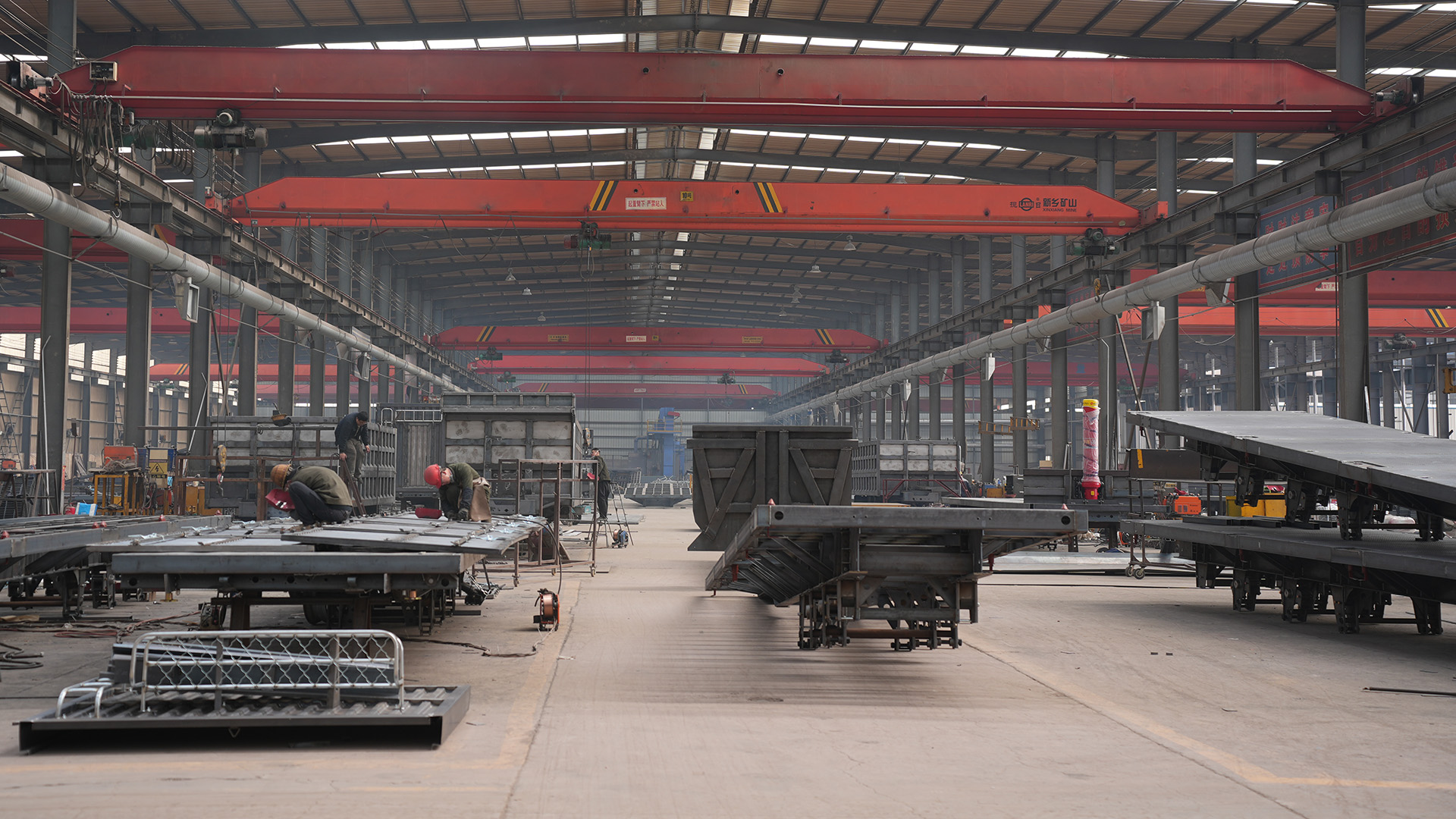
Workshop and assembly area used for trailer production and inspection. Image: Luen Auto.
Application Fit: Port, Inland Depot and Intermodal Yard
Port terminal. The port duty cycle is short distance, high frequency and repeated locking and unlocking. A 40ft chassis is usually the base unit; 20ft chassis and combination units fill the gaps. The buyer should check the lock operation, rear underrun protection and the availability of common spare parts. Port fleets also tend to standardize tyre size and brake components to reduce downtime.
Inland container depot. Inland depots often run longer road legs and may handle 45ft containers. In that case the 45ft chassis and combination options come into the evaluation. Ride quality, suspension choice and axle-load compliance matter more than in a pure port shuttle, because the same unit may work on both terminal roads and public highways.
Intermodal yard. The chassis must fit the rail-road transfer routine. The practical checks are twist-lock accessibility, deck height relative to the handling equipment and compatibility of the locking arrangement with the containers in the trade. These are application questions, not catalog claims: they should be resolved with drawings and a physical pre-delivery inspection.
Market Context and Procurement Implications
Commercial research can provide scale but not a product-level demand forecast. Grand View Research valued the global truck trailer market at USD 46.1 billion in 2025 and projected USD 80.4 billion by 2033, but that definition spans multiple trailer categories. Customs data does not solve the granularity problem: under HS 2022, subheading 8716.39 covers other trailers and semi-trailers for the transport of goods, a residual category that includes flatbed, lowbed, skeletal, van and dump semi-trailers. A container-chassis buyer therefore cannot use that trade line to size the container-chassis segment; the buyer has to rely on the actual container mix and route plan.
China remains a deep source of trailer and truck supply. China's heavy-duty truck exports reached 295,000 units in 2024, according to Shacman's published industry report, which indicates the scale of the Chinese commercial-vehicle export base. For a buyer, the practical implication is not to treat Chinese origin as a single quality level: the supplier's control of steel, welding, twist-lock fit and pre-delivery inspection is what separates one offer from another.
Compliance also depends on the destination. In the EU, trailer type-approval is governed by Regulation (EU) 2018/858, and the masses and dimensions requirements sit in Regulation (EU) No 1230/2012. In the United States, trailer requirements include FMVSS No. 224 for rear impact protection and FMVSS No. 121 for air brake systems. A container chassis built for one market is not automatically approved for another, so the destination market must be fixed before the order is released.
How to Shortlist a Container Chassis Supplier
For an evaluation-stage buyer, a shortlist is only useful if it can be audited. The following sequence keeps the comparison tied to evidence:
- Confirm the container-length mix: 20ft, 40ft, 45ft or a combination. Match the chassis type to the boxes the operation will actually handle.
- Set the rated payload and axle-load limit in writing. Use the 30–65 tonne envelope only as a starting point, then reduce it to the legal and operational limit for the route.
- Request the main-beam steel certificate and the welding procedure. If Q345B is specified, confirm that the mill certificate and the fabrication record match.
- Verify twist locks against ISO 1161 and container dimensions against ISO 668. Ask for the lock type, adjustment range and inspection record.
- Specify the landing gear and running gear. If a branded landing gear such as JOST is required, state the model and rating rather than the brand alone.
- Check the quality system. Luen Auto holds ISO 9001:2015 certification under certificate 47424Q2464R0S, issued by ZHONGNUO CERTIFICATION CO., LTD. and valid to 2027-10-08. That certification supports the supplier-qualification step but does not replace model-specific inspection.
- Review the after-sales terms. Warranty scope, spare-parts availability and service reach should be compared on the same basis as the purchase price.
Supplier breadth is another useful screen. A manufacturer that also builds lowbed, flatbed, dump, tank and skeleton trailers is more likely to have the fabrication and component-sourcing depth needed for a mixed fleet. Luen Auto's product range covers those trailer families alongside tractor trucks, dump trucks and light-duty trucks, which gives the buyer a broader basis for a long-term supply relationship.
Future Outlook
Container fleets are likely to remain mixed by length, because no single chassis specification can serve a fast-moving terminal without limiting the boxes it can accept. The durable advantage for a buyer comes from fixing the length, standard compliance and payload case, not from adding more chassis units alone. As enforcement and inspection routines tighten, traceable evidence on twist-lock conformity and axle load will matter more in supplier selection.
For a container chassis order, the practical path is to define the 20ft, 40ft and 45ft requirement, set the ISO 668 and ISO 1161 checks, and require the supplier to confirm main-beam steel, payload and landing gear in the approved specification. That discipline turns a price comparison into an operational decision.
Frequently Asked Questions
1. What is the difference between a 20ft, 40ft and 45ft container chassis?
The main differences are length, twist-lock position and axle-load distribution. A 20ft chassis matches the 20ft container envelope, a 40ft chassis matches 40ft operations, and a 45ft chassis extends the deck and lock layout for 45ft containers. Luen Auto offers 20ft chassis, 40ft chassis, 40ft+20ft combination chassis and 45ft container trailers, with 2-axle or 3-axle skeleton options in the model list.
2. Which ISO standards apply to container chassis?
ISO 668 covers container dimensions, and ISO 1161 covers the twist-lock corner-fitting interface. Skeleton semi-trailers need to match those interfaces to pick up ISO containers safely and compatibly. Buyers should ask for written confirmation of the lock type and adjustment range, not only a general statement that the trailer is ISO-related.
3. How should a buyer verify payload and steel grade on a container chassis?
Fix the rated payload and axle-load limit in the technical agreement. If Q345B structural steel is specified, request the mill certificate and material certificate, and check them against the fabrication record. Luen Auto's customization scope includes load rating, beam structure, suspension and landing gear, so those requirements can be written into the order and checked before delivery.
4. How should port operators evaluate container chassis options?
Start from the actual mix of 20ft, 40ft and 45ft containers, then match the chassis to axle count and local axle-load rules. Check ISO 1161 twist-lock compatibility, landing-gear rating, brake interface and spare-parts availability. Luen Auto offers a 40ft+20ft combination chassis for mixed-length operations, but the delivered specification should be confirmed against the approved drawing and inspection record.
Product catalog: Luen Auto Product Catalog (PDF)
هل لديك أسئلة أو تحتاج إلى مزيد من التفاصيل؟
تواصل مع فريقنا للحصول على عرض أسعار مخصص أو استشارة فورية.
طلب عرض أسعار
املأ النموذج أدناه وسيتواصل معك فريقنا بعرض مقترح مخصص.
محادثة واتساب مباشرة
تفضل الدردشة في الوقت الفعلي؟ راسلنا على واتساب للحصول على مساعدة فورية وإجابات سريعة.
- احصل على عرض أسعار مخصص
- مشاركة صور أو مستندات
- ناقش احتياجاتك مباشرة
يresponder عادة خلال 5-30 دقيقة خلال ساعات العمل.