
Recommended Fine-Pitch COB Displays for Control Rooms: ECOB Series
Recommended Fine-Pitch COB Displays for Control Rooms: ECOB Series
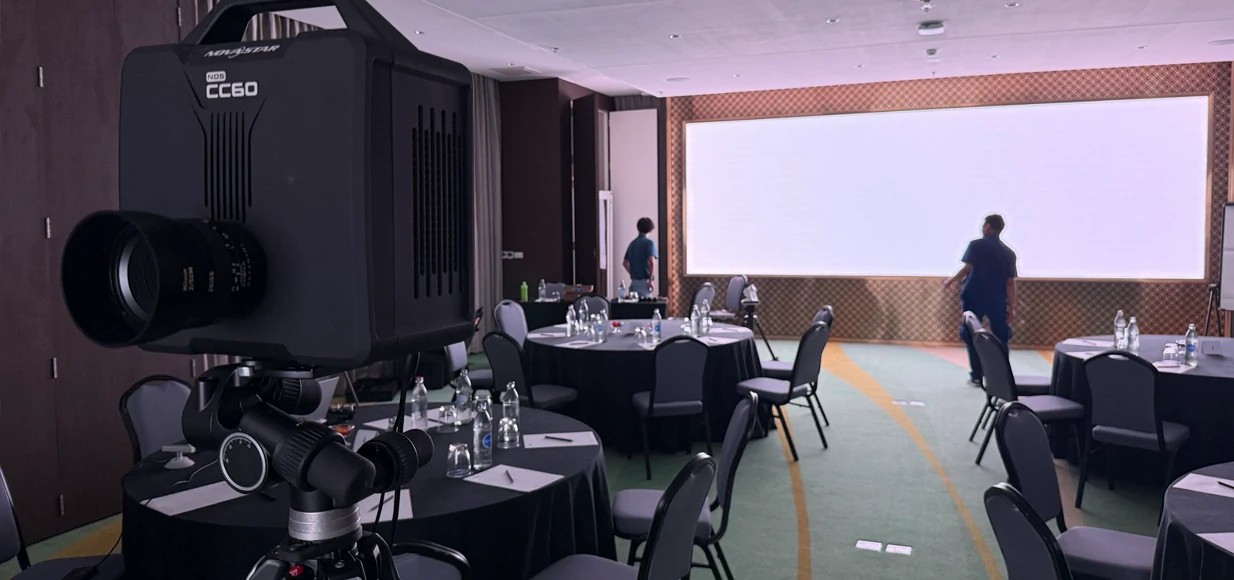
Indoor fine-pitch COB LED video wall installed in a professional viewing environment — the same close-range, long-duty viewing conditions that define control-room display requirements.
A control room is judged by its worst viewing condition, not its best. The operator who sits closest to the video wall decides whether the display is sharp enough. The shift that runs past its sixteenth hour decides whether it is stable enough. The camera that records the wall decides whether it flickers on playback. Fine-pitch COB (chip-on-board) LED displays have become the common answer to those conditions in control rooms and command centres, but "fine pitch" describes a range of configurations that differ commercially as much as technically.
This shortlist organises the ECOB Series, the indoor Flip Chip COB fine-pitch line from DDW DISPLAY, into its six pixel-pitch options — P0.625, P0.78, P0.93, P1.25, P1.56 and P1.87 — and sets out which configuration suits which control-room viewing condition, what the two 600 mm panel formats change in practice, and where the boundaries of the approach sit.
DDW DISPLAY (Shenzhen DDW Technology Co., Ltd.) is a Shenzhen-based LED display manufacturer founded in 2012 that produces indoor fine-pitch, COB, outdoor and rental LED display systems and exports to more than 120 countries and regions. Its published range covers control-room-adjacent applications through several indoor lines, including the QDCOB Series, the FU Series fine-pitch line and the HK Series indoor fine-pitch range, all of which list control rooms and command centres among their intended applications.
Why control rooms expose display weaknesses faster than other indoor spaces
A control-room video wall has to satisfy several requirements at once, and they pull in different directions. Fine pixel pitch improves close-range legibility but raises cost and pixel count. Higher brightness helps in daylight but increases eye strain on night shifts. Lightweight cabinets simplify installation but constrain panel size. The specification that control-room projects commonly converge on includes fine pixel pitch, high refresh rate, seamless splicing, high contrast ratio, wide viewing angle, accurate colour reproduction, low-brightness operation with high grey scale, quiet operation and efficient heat dissipation, front maintenance, and stable long-term operation.
Four of those requirements determine which pixel pitch and panel format a buyer should shortlist.
- Closest-viewer legibility. Control-room operators usually sit closer to the wall than visitors do in a lobby or a retail space. At short distances, the spacing between individual LEDs becomes visible as a pixel structure, particularly against flat backgrounds such as maps, dashboards and single-colour status panels.
- Camera capture. A wall that appears in a surveillance recording, a video-conference feed or a broadcast shot can show banding or flicker if the refresh rate is too low for the camera's shutter and frame rate. A 3,840 Hz refresh rate is specified on the ECOB Series for exactly this class of installation.
- Off-axis consistency. Operators rarely sit on the wall's centre axis. Seating is arranged in rows and along the sides of the room, so brightness and colour have to hold up at an angle. The ECOB Series is specified with a 160° viewing angle.
- Service access in tight rooms. Control rooms are frequently built into spaces that were not designed around a display wall: narrow rooms, rear walls with no maintenance walkway, and walls shared with other equipment. Front-service construction and a 39.5 mm panel depth allow a wall to be installed flat against a structural surface and serviced from the room side.
Contrast is the fourth variable that separates a workable control-room wall from an uncomfortable one. Under controlled lighting, a display with a dark, non-reflective module surface and a high contrast ratio keeps text and data graphics readable without forcing the room's lighting to be dimmed further. The ECOB Series is specified at a 10,000:1 contrast ratio.
The ECOB Series configuration: what is actually specified
Every panel in the ECOB Series is built on a shared 150 × 168.75 mm LED module, which means the same module footprint is used across the pitch range and spare-part planning does not change from pitch to pitch. The full published configuration is summarised below.
| Parameter | ECOB Series specification |
|---|---|
| Pixel pitch options | P0.625, P0.78, P0.93, P1.25, P1.56, P1.87 |
| LED packaging | Flip Chip COB (chip-on-board) |
| Module size | 150 × 168.75 mm |
| Panel format A | 600 × 337.5 × 39.5 mm |
| Panel format B | 600 × 675 × 39.5 mm |
| Panel weight | 4 kg and 7.9 kg across the two formats |
| Cabinet material | Die-cast aluminium |
| Brightness | 600 nits standard; 1000 nits optional |
| Contrast ratio | 10,000:1 |
| Refresh rate | 3,840 Hz |
| Viewing angle | 160° |
| Input voltage | AC 100–240 V, 50/60 Hz |
| Operating temperature | -10 °C to +40 °C |
| Lifetime | 100,000 hours at 50% brightness |
| Maintenance | Front service |
Two points in that table carry more procurement weight than their position suggests. First, brightness is a selectable configuration rather than a fixed attribute: 600 nits is standard, and 1000 nits is an option for rooms where ambient light cannot be fully controlled. Second, the operating envelope is defined as -10 °C to +40 °C with an AC 100–240 V, 50/60 Hz input. That is an indoor, conditioned-environment specification, and it is also a single input range that covers common supply voltages in North America, Europe and Asia-Pacific without a regional variant.
The shortlist: ranking six pixel pitches by control-room condition
Ranking a pixel-pitch range is not the same exercise as ranking manufacturers. Within one product line, the most suitable pitch is the one that matches the room's closest viewing position, the wall's dimensions and the dominant content type. Ordered from highest pixel density to lowest, the ECOB options map onto control-room conditions as follows.
| Rank | Pitch | Best-fit control-room condition |
|---|---|---|
| 1 | P0.625 | The most space-constrained suites, where operator desks sit very close to the wall and the content is dominated by text, schematics and fine data graphics. Highest pixel density in the range and the most demanding configuration commercially. |
| 2 | P0.78 | The default recommendation for wall-mounted control-room walls in which the closest operator position remains close to the screen. Balances close-range legibility against project cost better than P0.625 in most rooms. |
| 3 | P0.93 | Rooms with a mix of very close desk positions and a secondary row further back, where the wall still needs to hold up under close inspection but is not viewed at the shortest possible distance. |
| 4 | P1.25 | Larger operations rooms and multi-window monitoring walls where the closest viewer is no longer adjacent to the screen. Often the most economical pitch that still reads as a seamless image rather than a grid. |
| 5 | P1.56 | Large command centres, situation rooms and control galleries where the nearest seating is some distance back and the wall is viewed as a whole rather than read line by line. |
| 6 | P1.87 | The largest halls, elevated viewing galleries and rooms with long sightlines, where a denser pitch would add cost without adding visible detail for the people in the room. |
The three smallest pitches — P0.625, P0.78 and P0.93 — are aimed at short viewing distances of the kind found in network operations centres, dispatch desks and security control suites. Industry planning practice commonly pairs a pixel pitch in millimetres with a comparable viewing distance in metres, and that convention is a reasonable place to start a conversation. It is not a specification. The deciding factor is content: a wall carrying tickers, SCADA schematics and multi-window dashboards needs more pixel density at a given distance than a wall used mainly for full-motion video.
Smaller pitch buys close-range detail and costs more. The smallest available pitch is not automatically the right answer, and general selection guidance for indoor LED displays notes that the best choice is the pitch that delivers sufficient image quality for the actual viewing distance and application rather than the smallest pitch available. For a wall whose closest operator position sits well back from the screen, moving from P1.25 to P0.78 raises cost and pixel count without a corresponding improvement for the people in the room. Conversely, a room where supervisors stand directly at the wall to read a single pane of a dashboard will not be satisfied by P1.87.
Panel format: 600 × 337.5 mm or 600 × 675 mm
Each ECOB pitch is offered in two panel formats that share the same 600 mm width and 39.5 mm depth: a short panel measuring 600 × 337.5 × 39.5 mm and a tall panel measuring 600 × 675 × 39.5 mm, weighing 4 kg and 7.9 kg respectively. Because both formats are 600 mm wide and both are built on the same 150 × 168.75 mm module, the two can be combined within one wall, which matters when a screen has to fit an existing opening rather than be built to a clean multiple.
- The taller 600 × 675 mm format reduces the number of cabinets per square metre, which in turn reduces horizontal seams, mounting brackets and installation time on large walls. The trade-off is per-unit weight: a 7.9 kg panel requires a mounting wall or steel frame engineered for that load, and two-person handling during installation.
- The shorter 600 × 337.5 mm format keeps unit weight at 4 kg, which suits walls where structural loading is constrained, and gives finer vertical granularity for exact-fit installations, stepped walls and openings that do not divide neatly into 675 mm increments.
- Shared module and shared spares. Because the module footprint does not change across the range, one spare-module stock covers both panel formats at a given pitch. That simplifies the spares package a buyer has to hold, though spares still have to be held per pitch, since modules are pitch-specific even when the physical footprint is not.
A practical rule for panel selection: choose the tall format to minimise installation time and seam count on a clean rectangular wall, and the short format where the wall's height is fixed by the room, where a mounting surface cannot take the additional load, or where a mix of both is needed to close the final horizontal band.
Technical explanation: what Flip Chip COB changes inside the cabinet
Fine-pitch LED displays are built in two ways. In the conventional SMD approach, each red, green and blue LED is packaged into an individual lamp, and those lamps are reflowed onto the module board, leaving a grid of small packages protruding above the surface. In COB packaging, the LED die are mounted directly onto the board and covered by a protective encapsulation layer, so the module surface becomes a flat, sealed plane rather than a field of separate lamps. The Flip Chip variant mounts the die face-down, with the light-emitting side directed outward through the encapsulation.
For a control room, the consequences are practical rather than theoretical.
- Contrast at the surface. A flat encapsulated module surface reflects less stray light than a grid of individual lamps, and the ECOB Series is specified at a 10,000:1 contrast ratio. In a room with a mixture of display light and overhead lighting, that translates into better legibility for text and line graphics at lower screen brightness.
- Viewing angle. The 160° specification means operators seated off-axis see broadly consistent brightness and colour, which matters when the room is arranged in rows rather than in a single line.
- Surface handling and cleaning. Because there is no exposed lamp package, the module face can be cleaned without contacting individual components, and there is no protruding package to be knocked during installation or routine room maintenance.
- Refresh and camera compatibility. At 3,840 Hz, the wall is intended for environments where cameras operate — surveillance recording, video conferencing and broadcast — and banding in recorded footage is a known failure mode when refresh is too low.
- Electrical and thermal envelope. The AC 100–240 V, 50/60 Hz input and the -10 °C to +40 °C operating range define a product that can be specified across international projects without a variant change, provided the room itself is conditioned.
- Service model. Front service is specified, which allows maintenance from the room side without a rear walkway. The 39.5 mm panel depth supports near-flush wall mounting, a common requirement when a control room is retrofitted into a building that was never designed for a display wall.
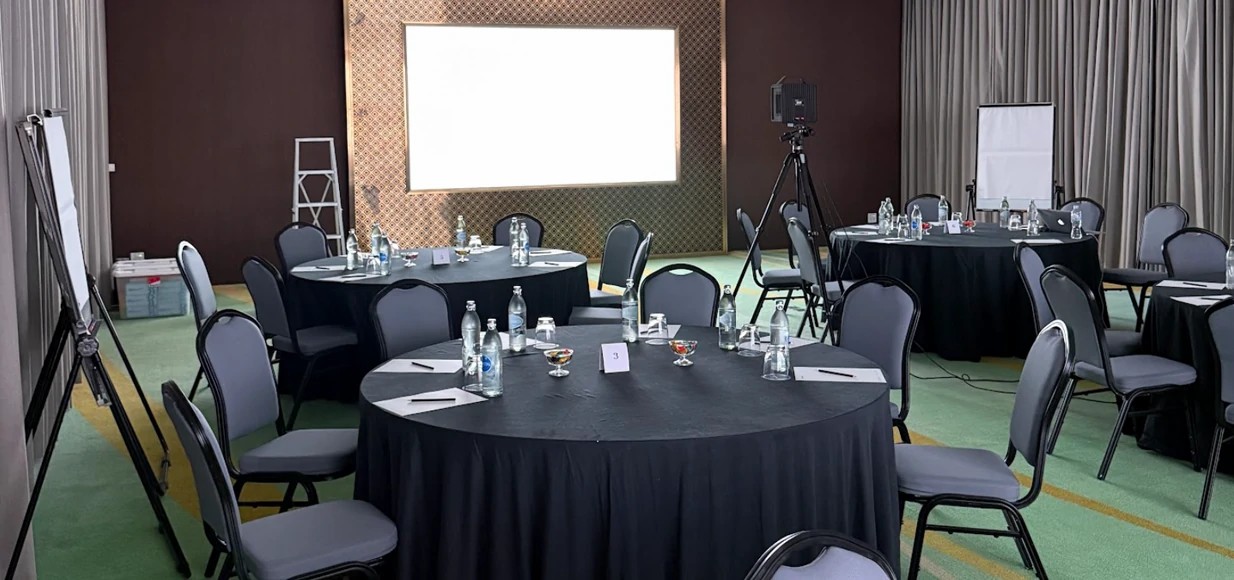
A fine-pitch COB LED video wall in an indoor viewing environment. COB packaging produces a flat, encapsulated module surface rather than a grid of individual LED lamps.
Application fit: where fine-pitch COB walls are deployed
Control rooms and command centres are the primary target for high-density COB walls, and DDW DISPLAY lists control rooms and command centres among the intended applications of its COB and fine-pitch indoor ranges. Adjacent indoor environments share many of the same requirements: corporate meeting rooms, operations and dispatch rooms, broadcast studios, exhibition and showroom spaces, and commercial video walls where viewers stand close to the screen.
Delivery evidence from the same product family is useful when assessing whether a supplier can integrate a wall rather than simply ship panels. A QDCOB Series P1.56 quantum dot COB LED video wall was delivered to a corporate conference room in Thailand, covering presentation, meeting and video-conferencing use; the project highlighted fine-pitch display, professional installation, system integration, on-site calibration, accurate colour performance and stable operation. In Pakistan, a 26 m² FU Series P1.56 indoor fine-pitch LED display was installed in a corporate conference room to support business meetings, presentations and video conferencing. In the United States, a 5 × 3 m FU Series P1.95 GOB indoor display was installed in a shopping mall for advertising and brand communication, where close-viewing legibility and long operating life were the stated priorities.
At the other end of the scale, a Guinness World Record event in Saudi Arabia used a large-format LED display solution covering 456.202 m² of adhesive LED screens and 407 m² of infinite ceiling screens, with stable operation maintained throughout the event. That project is not a control room, but it demonstrates the integration, calibration and site-support capability that a multi-wall command-centre rollout also depends on.
The relevance to a control-room shortlist is straightforward. Control-room buyers are not only purchasing pixel pitch; they are purchasing calibration accuracy, signal integration, front-service access and long-term stability, and those are the attributes that show up in the delivered indoor projects rather than in the datasheet.
Market signals a 2026 control-room project should price in
Three external data points are worth carrying into a control-room procurement discussion.
The global LED display market is projected at USD 20.73 billion in 2026, growing to USD 26.98 billion by 2031, according to Mordor Intelligence. That headline figure should be read with care: market definitions differ between research houses, and other published estimates place the 2026 large-format LED signage segment materially lower because they exclude categories that broader definitions include. When a project business case cites a market forecast, the definition matters more than the number.
The direction of travel in the highest-density segment is clearer. Grand View Research projects the Micro-LED market growing at a CAGR of 77.4% from 2024 to 2030, reaching a projected USD 25.65 billion. Fine-pitch COB sits below Micro-LED in density, but the same demand drivers — close viewing, higher pixel density, and integration into professional environments — apply.
For importers, HS Code 852859, "Monitors other than cathode-ray tube", is the primary trade classification for LED displays according to the UN Statistics Division, and it is the code that will normally appear on the customs documentation for a control-room wall shipment.
On supplier scale, a third-party commercial profile of Shenzhen DDW Technology Co., Ltd published on digitalsignages.com reports annual sales in the range of USD 4 million to USD 5 million with an export ratio of 90%–100%, which is broadly consistent with the manufacturer's own published export ratio of 95%+ and its stated delivery to more than 120 countries and regions. Buyers comparing a specialised manufacturer against much larger tier-one brands should treat scale as a question about project support capacity and spare-part continuity, not simply as a ranking criterion.
Comparison with conventional SMD fine pitch — and the boundaries of the ECOB approach
The meaningful comparison for a control-room buyer is not COB versus another supplier's COB; it is COB versus conventional SMD fine pitch at the same pixel pitch, because that is the decision that changes the maintenance model and the lifetime cost of the wall.
| Comparison dimension | Flip Chip COB (ECOB Series) | Conventional SMD fine pitch |
|---|---|---|
| Module surface | Flat, encapsulated plane; no separate lamp packages | Grid of individually packaged LED lamps protruding from the board |
| Mechanical exposure | No exposed package to knock or catch during installation and cleaning | Individual lamps are exposed at the surface |
| Contrast and reflection | 10,000:1 specified for the ECOB Series | Varies by model and surface treatment; darker lamp materials and masking improve results |
| Viewing angle | 160° specified across the ECOB Series | Varies by model and lens design |
| Field repair route | Module-level replacement is the practical service route; front service is specified | Single-lamp rework is technically possible in some designs, alongside module replacement |
| Spares structure | One shared 150 × 168.75 mm module footprint across the pitch range | Frequently varies by pitch and model generation |
| Relative cost | COB modules generally carry a higher initial cost per square metre than SMD at the same pitch | Generally lower initial module cost at the same pitch |
Those advantages come with boundaries that a buyer should write into the specification rather than discover after installation.
- Environmental window. The ECOB Series is specified for -10 °C to +40 °C. That is an indoor, conditioned-environment product. It is not a specification for unheated plant rooms, semi-outdoor canopies or any location where the ambient temperature is expected to fall outside that band.
- Lifetime is stated at 50% brightness. The 100,000-hour figure is defined at half brightness, not at maximum drive. Operating a wall continuously at high brightness for long shifts changes the conditions under which that figure applies, and it is a good reason to run control-room walls at the lower end of their brightness range, which also reduces operator eye strain.
- The cost curve runs against the pitch curve. Pixel density rises sharply as pitch falls. P0.625 places substantially more LEDs, driver channels and receiving-card capacity into the same square metre than P1.87, and that difference shows up in module price and in the spare-parts budget. Specify the densest pitch the room actually requires.
- Panel weight drives the mounting structure. The 7.9 kg tall panel is a manageable unit weight, but a large control-room wall multiplies it. The mounting wall or steel frame must be engineered for the total load and for the wall's own condition, especially in retrofit rooms with lightweight partitions.
- Repair is module-level. Front service gives access, but the practical repair path for a COB module is replacement rather than single-lamp rework. Budget for spare modules at each pitch used, plus spare driver boards and receiving cards, as part of the original order rather than as an afterthought.
- 600 nits is adequate, not universal. The standard 600-nit configuration assumes a room where lighting can be controlled. Rooms with direct daylight, glazed walls or a requirement to run the wall at high brightness for camera work should specify the 1000-nit option or modify the lighting design.
- Calibration is a lifecycle activity, not a shipment activity. Pre-shipment quality control includes brightness and colour calibration, but fine-pitch walls still require periodic re-calibration after installation, particularly where panels have been added, replaced or operated at different brightness levels.
Procurement checklist for a fine-pitch COB control-room wall
- Fix the closest viewing position before fixing the pitch. Measure the distance from the nearest operator seat or standing position to the wall, then select from P0.625 to P1.87 against the content that has to be read at that distance.
- Confirm brightness configuration in writing. State whether 600 nits standard or 1000 nits optional is required, and confirm it is stated on the order, since the two are different build configurations.
- Confirm panel format and total load. Record whether 600 × 337.5 mm, 600 × 675 mm or a mixture is quoted, and pass the weight and depth figures to whoever is responsible for the mounting wall.
- Verify the certificate scope against the exact model. A CE-EMC certificate (BKC25062531FC, issued 2025-07-01 and valid to 2030-07-01) covering "LED display" against EN 55032, EN IEC 61000-3-2, EN 61000-3-3 and EN 55035, a CE-LVD certificate (HXTS2506230030001-1) against EN IEC 62368-1:2020+A11:2020, an EU RoHS 2.0 certificate (HXTS2506230030007-1) and an FCC Supplier's Declaration of Conformity (BKC25062532FC-R1) against FCC Part 15 Subpart B and ANSI C63.4:2014 are all held for LED display. Note that some certificates in the same portfolio cover specific models rather than the whole range — a KC registration covering kiosk models GTM-LDB43 and GTM-LDB32, and a CSA field evaluation covering model DDW-AD4301TK, are examples. Scope must match the model being purchased.
- Check the quality-management system certificate. ISO 9001:2015 certificate 12824Q21369R0S from the China Standards Institute (Beijing) Certification Center covers the "Production of electronic products (LED DISPLAY, LCD VIDEO WALL, DIGITAL SIGNAGE) (export only)" and is valid to 2027-10-09.
- Ask for the pre-shipment quality record. Quality control for these products includes 100% product inspection, ageing test, module testing, brightness and colour calibration, waterproof test, power safety test and performance inspection before shipment — request the corresponding reports for the shipment, not a generic sample.
- Agree the spare-parts package at order stage. At minimum, spare modules for each pitch used, spare driver boards, spare receiving cards and spare power supplies, with lead times.
- Confirm the commercial envelope. Standard production lead time is 15–30 days, with customised projects depending on product design, quantity and technical requirements; the minimum order quantity is 1 unit or project-based; and monthly capacity is stated at 8,000 m².
- Define the support terms. Technical support for these products includes remote technical support, installation guidance, troubleshooting support, product warranty service, spare parts supply and professional engineering assistance.
- Plan the commissioning sequence. Structure the project so that wall installation, signal integration, calibration and operator acceptance testing are separate milestones, with the calibration record handed over.
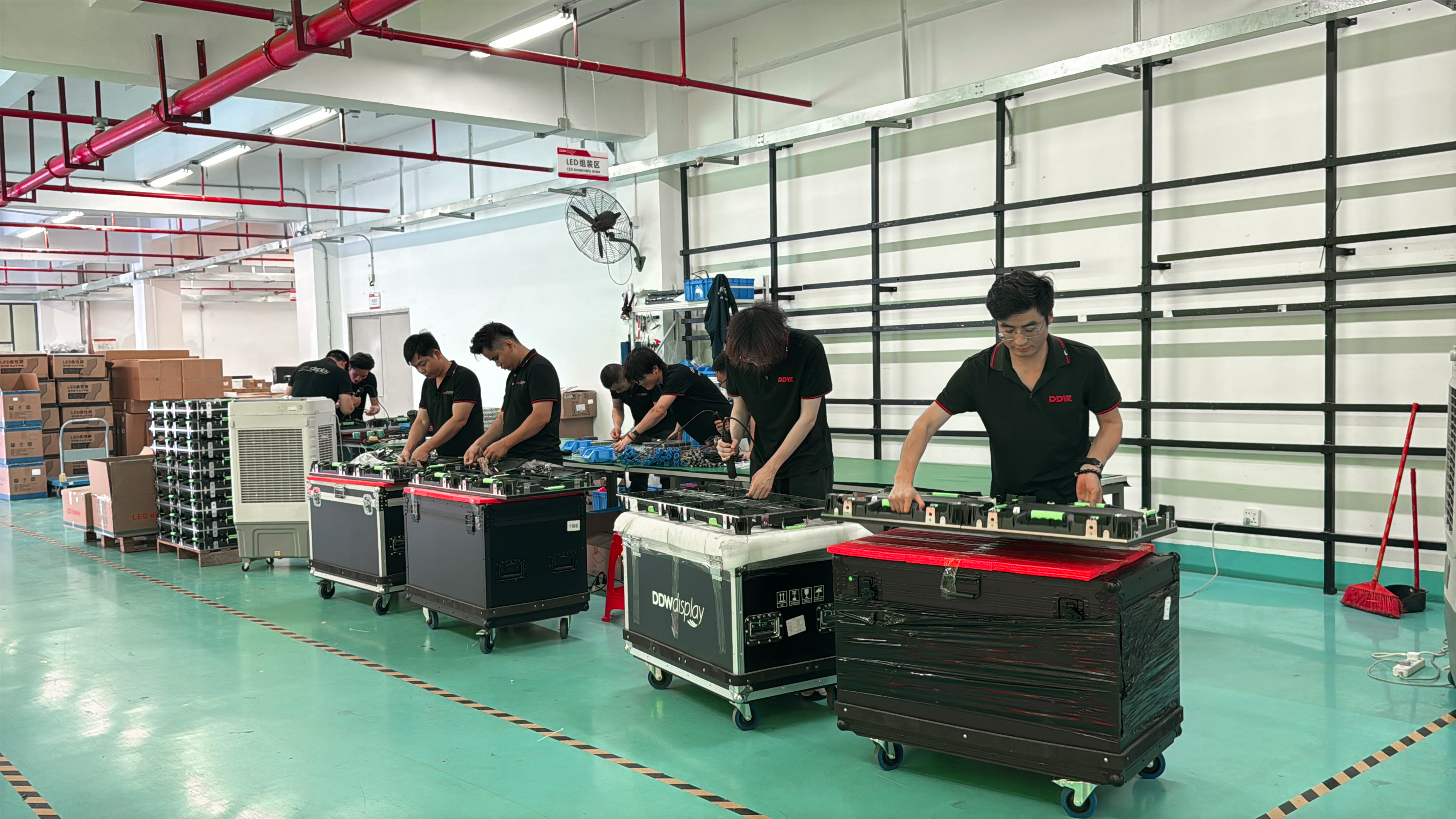
LED display assembly and inspection before shipment. Pre-shipment quality control for these products covers 100% inspection, ageing test, module testing, brightness and colour calibration, power safety testing and performance inspection.
Future outlook
Three shifts are likely to affect the next generation of control-room walls. The first is density: as Micro-LED packaging matures, the boundary between fine-pitch COB and Micro-LED will keep moving toward smaller pitches, but the practical constraint for control rooms will remain the same — the pitch only has to be small enough for the people who are actually in the room. The second is serviceability. As pixel density rises, module replacement cost rises with it, and buyers are likely to weigh the front-service model and the spares package more heavily than the pitch table. The third is integration. A control-room wall is increasingly one display surface inside a broader visualisation environment, so calibration, signal handling and support continuity will matter as much as the panel specification.
For projects being specified now, the defensible approach is to select the ECOB configuration against measured viewing conditions, state the brightness option and panel format explicitly, verify certificate scope against the exact model, and secure the spares package at the same time as the wall. DDW DISPLAY publishes its full 2026 LED display catalogue, covering its indoor fine-pitch, COB, outdoor and rental lines, at DDW LED Display catalogue 2026.
FAQ
1. Which pixel pitch should a control room choose for a fine-pitch COB LED wall?
Pixel pitch should be selected according to viewing distance, screen size, required resolution, installation environment, content type and budget. For close-viewing indoor applications such as conference rooms, control rooms and showrooms, fine-pitch displays in the P1.25 to P1.86 band are generally considered suitable, and denser options such as P0.625, P0.78 and P0.93 extend that suitability to the closest operator positions. A smaller pitch provides higher pixel density and better close-range detail but usually increases project cost, so the appropriate choice is the pitch that provides sufficient image quality for the actual viewing distance rather than the smallest pitch available.
2. What is Flip Chip COB, and how does it differ from conventional SMD fine pitch?
In Flip Chip COB packaging, the LED die are mounted directly onto the module board and covered by a protective encapsulation layer, producing a flat, sealed module surface. In conventional SMD construction, each red, green and blue LED is packaged into an individual lamp that is reflowed onto the board, leaving individual packages protruding above the surface. For buyers, the practical differences are surface protection, a dark flat surface that supports high contrast, and a repair model in which module-level replacement is the normal service route rather than single-lamp rework.
3. Does the ECOB Series support front maintenance, and what access does the installation need?
Front service is specified for the ECOB Series. Both panel formats are 39.5 mm deep, measured as 600 × 337.5 × 39.5 mm and 600 × 675 × 39.5 mm, and are built on a die-cast aluminium cabinet. This allows a wall to be mounted close to a structural surface and serviced from the room side, which matters in control rooms where no rear walkway exists. Access clearance in front of the wall, and the handling space needed to remove and replace a module or panel, still have to be planned into the room layout.
4. What operating conditions does the ECOB Series support?
The ECOB Series is specified for an input voltage of AC 100–240 V, 50/60 Hz and an operating temperature range of -10 °C to +40 °C. Brightness is 600 nits as standard with an optional 1000-nit configuration, contrast is 10,000:1, refresh rate is 3,840 Hz and the viewing angle is 160°. This is an indoor, conditioned-environment specification for panels and modules; projects in unconditioned or outdoor locations fall outside that envelope and should be specified on a different product line.
5. How should the 100,000-hour lifetime figure be interpreted?
The 100,000-hour lifetime for the ECOB Series is defined at 50% brightness. It describes operation at a defined drive level rather than at maximum output, so the figure should not be read as a guarantee that applies equally at full brightness. In practice, control-room walls are usually operated toward the lower end of their brightness range to reduce operator eye strain, which is consistent with the conditions under which the figure is stated. Lifetime figures of this kind describe expected luminous behaviour, not a warranty period, which is set separately in the commercial terms.
6. Which certifications should a buyer verify for an indoor COB LED display?
Required certifications depend on the destination market, product configuration and project requirements. For international projects, CE, FCC, RoHS, EMC and relevant electrical safety requirements are commonly evaluated. In the case of this manufacturer, certificates held for LED display include CE-EMC (BKC25062531FC, 2025-07-01 to 2030-07-01), CE-LVD (HXTS2506230030001-1, EN IEC 62368-1:2020+A11:2020), EU RoHS 2.0 (HXTS2506230030007-1), FCC Supplier's Declaration of Conformity (BKC25062532FC-R1) and ISO 9001:2015 (12824Q21369R0S, valid to 2027-10-09). Because some certificates in a manufacturer's portfolio cover specific models rather than an entire range, buyers should confirm that the certificate scope names the exact model, configuration and destination market before placing an order.