
Recommended Folding LED Display Screens: FC, FPS, FCSL Picks
A folding LED display screen is a large-format LED display built from hinged modules that fold for transport, storage and installation rather than shipping as rigid cabinets. For buyers at the evaluation stage, the decision is rarely whether foldable LED panels are viable — it is which specific line matches a project's compliance profile, viewing distance, weather exposure and intellectual-property risk.
This shortlist reviews three folding LED display lines from Onumen Technology Co., Ltd. and groups them by buyer priority instead of price: the Smart folding LED Display screen (FC) for compliance-first procurement, Magic Plus (FPS series) for design-led projects and weather-sealed outdoor use, and Smart Plus (FCSL) for large-format, high-brightness outdoor work backed by foldable and rollable patent coverage.
Onumen Technology Co., Ltd. is a Shenzhen, China-based LED display manufacturer founded in 2009 that specialises in lightweight foldable and rollable LED display solutions. The company operates a 2,000 m² production facility with an annual output of 9,000 m² and a 20-engineer R&D team, and exports roughly 70% of its output to the USA, Europe, Japan, South Korea, Russia and the Middle East.
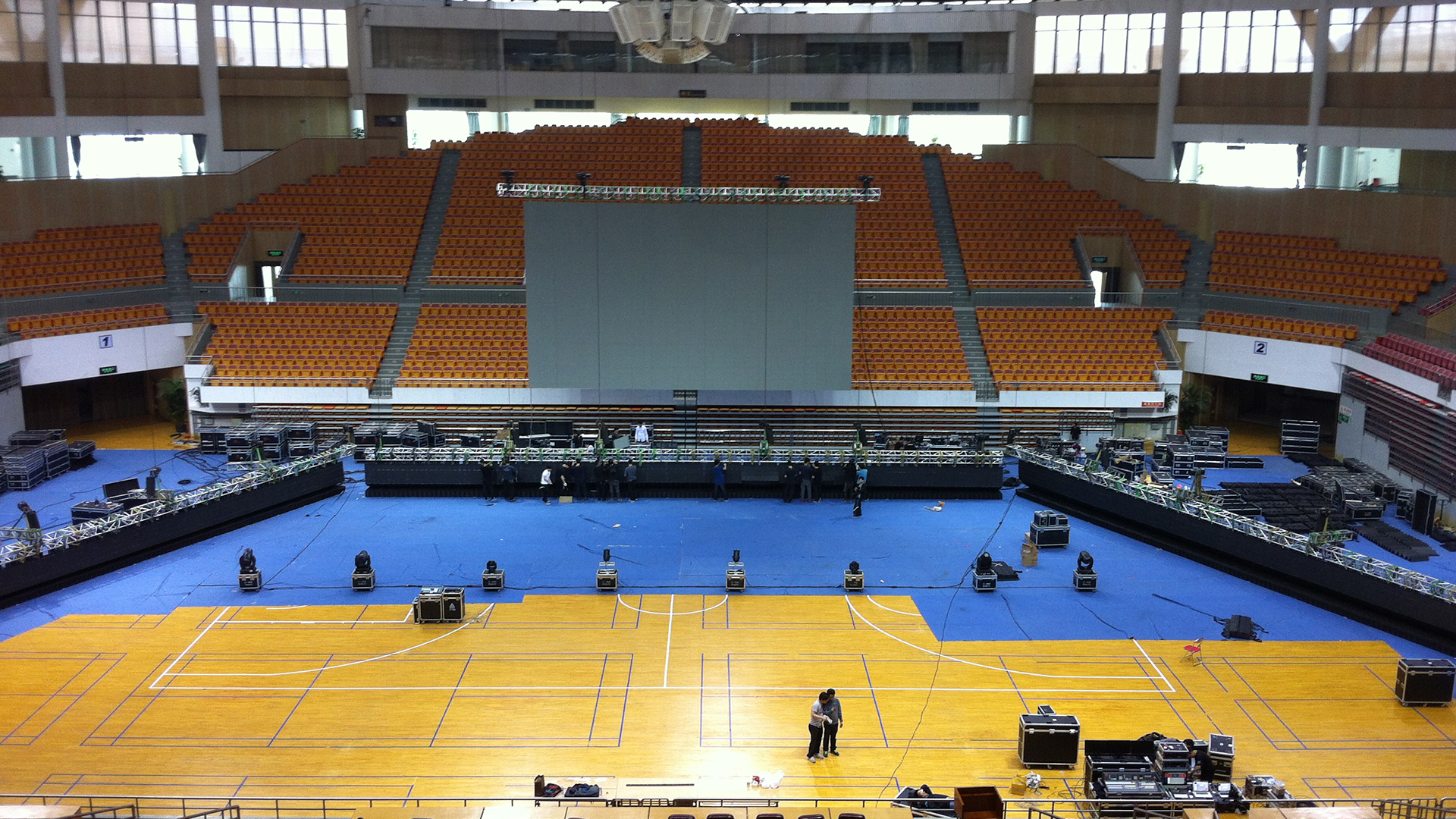
Touring concert stage in Japan: three 33 m × 16 m LED display systems totalling 1,670 m², in service for more than 12 years.
Why folding displays moved onto the evaluation shortlist
Large-format LED remains a growth category. Market.us values the global LED display screen market at USD 10.7 billion in 2024 and projects USD 19.5 billion by 2034, a compound annual growth rate of 6.2%. Flexible and foldable formats sit inside that growth: Maximize Market Research sizes the global foldable display market at USD 4.76 billion in 2024 and projects it to approach USD 169.21 billion by 2032, driven partly by OLED and flexible LED technology development.
Those two figures are not directly comparable. Definitions vary — "foldable display" commonly includes mobile OLED panels, while "LED display screen" usually refers to large-format panels — so they should be read as directional signals rather than as a single market size. The direction is consistent: foldable form factors have moved from demonstration projects into ordinary procurement.
What changed operationally is transport and installation economics. A folding panel is transported at a fraction of its deployed area, which reduces crate count, road freight cost and storage footprint in a warehouse or backstage area. On site, fewer mechanical assembly steps translate into shorter load-in windows, which matters for rental operators who are billed by the day. For AV planners specifying fixed installations, the same quality makes hidden and liftable designs possible, because a folded screen can be stored inside a ceiling, a stage floor or a wall cavity.
By the time a buyer reaches the evaluation stage, three questions usually decide the shortlist. First, does the product carry the certification that the destination market or venue requires? Second, does the product give the project something that is difficult to copy — a recognised design, a specific fold geometry, a protected mechanism? Third, what does the product genuinely not do, and does that limitation fit the deployment? The three lines below answer those questions differently.
The shortlist at a glance
| Product (series) | Fold angle | Pixel pitch | Brightness | Protection | Weight / thickness | Buyer priority |
|---|---|---|---|---|---|---|
| Smart folding LED Display screen (FC) | 360° | P2.6 / P3.9 / P5.2 | 1,000–1,500 nits | IP43 | 11 kg/m² / 14–17 mm | Global compliance and indoor creative work |
| Magic Plus (FPS series) | 180° | P2.6 / P3.9 | 6,000 nits | IP65, up to IP68 optional | 15 kg/m² / 15 mm | Design recognition and weather-sealed outdoor use |
| Smart Plus (FCSL) | 360° | P5.2 / P7.8 / P10.4 / P15.6 | 2,400–6,000 nits | IP65 front and rear, up to IP68 optional | 15 kg/m² / 18–24 mm | Large-format outdoor brightness and patent coverage |
All three lines carry CE, RoHS and FCC product certification. Figures are the published specification ranges for each model.
Priority 1 — compliance-first procurement: Smart folding LED Display screen (FC)
Buyers who distribute into the European Union, the United States or regulated venues usually screen suppliers on documentation before they screen them on performance. FC is a 360° foldable flexible LED display with 250 × 250 mm modules, a panel thickness of 14–17 mm and a weight of 11 kg/m² — the lightest of the three lines here. It covers pixel pitches of P2.6, P3.9 and P5.2, pixel densities from 36,864 to 147,456 pixels/m², brightness of 1,000–1,500 nits, refresh rates of 3,840 Hz or 7,680 Hz, 16-bit grey scale and a 2,500:1 contrast ratio. Working voltage is DC24V or DC48V with AC100–240V input; the operating range is −20 °C to +45 °C and storage extends to +60 °C. Control can run synchronously or asynchronously, and installation supports hanging, wall-mounted or floor mounting. The product is certified to CE, RoHS and FCC.
The documentary trail behind that certification is specific. CE Low Voltage Directive certificate BST13030465Y-1SC-2 cites EN 60950-1:2006+A11:2009+A1:2010+A12:2011. CE EMC certificate BST13030465Y-1EC-1 cites EN 55022:2010, EN 61000-3-2:2006+A1:2009+A2:2009, EN 61000-3-3:2008 and EN 55024:2010. RoHS certificate BST13030465Y-1RC-4 references RoHS Directive 2011/65/EU and IEC 62321:2008. FCC Verification of Conformity BST13030465Y-1EC-3 references FCC Part 15 Subpart B and ANSI C63.4. All four were issued on 2 April 2013 by Shenzhen BST Technology Co., Ltd. Separately, a TÜV Rheinland Certificate of Conformity, AE 50336727 0001, issued 19 April 2016, is scoped specifically to Foldable LED Display and cites EN 55022:2010, EN 55024:2010, EN 61000-3-2:2014 and EN 61000-3-3:2013. Onumen's production also holds ISO management system certification.
One gap worth checking before a tender submission: for airports and other high-traffic zones, the requirement commonly cited for flexible and foldable LED screens is IEC 62368-1, which mandates UL94 V-0 flame resistance and surface temperatures at or below 70 °C. FC's published protection rating is IP43 and its documented certification set is CE, RoHS and FCC, so verification against IEC 62368-1 remains a project-specific buyer responsibility rather than an assumed property of the product.
Priority 2 — design-led differentiation: Magic Plus (FPS series)
Where a project is judged on visitor experience and finish quality, design recognition can carry more weight than a longer certification list. Magic Plus is a 180° foldable flexible LED display with 250 × 250 mm modules, a 15 mm panel thickness, 15 kg/m² weight, 140° horizontal and 140° vertical viewing angles and 16-bit grey scale. It is offered in P2.6 and P3.9, with 6,000 nits brightness and a 3,840 Hz refresh rate, and its protection rating is IP65 with double-sided potting, including an optional path to IP68. Installation supports hanging and wall mounting, control is synchronous or asynchronous, and the product carries CE, RoHS and FCC certification.
Its design record is documented rather than asserted. The Foldable LED Screen design received an iF DESIGN AWARD 2025 winner certificate numbered 673840, and the Rolling Screen design received a French Design Award 2026 Gold award numbered Gold 9867. Onumen's published company profile also lists Red Dot, iF and French Design Awards among its design recognitions. For a rental operator or brand owner, that matters in a concrete way: a awarded design has been assessed on integration, finish and usability, which becomes relevant when the screen is part of the set design rather than hidden behind scenery.
The structural boundary to note is the fold angle. Magic Plus folds to 180°, so it handles single-plane bends, open curves and simple corner wrapping. Projects that need to wrap a column, close a circle or fold a panel back onto itself require 360° geometry, which points to FC or FCSL instead.
Priority 3 — large-format outdoor brightness and patent coverage: Smart Plus (FCSL)
Smart Plus is a 360° foldable flexible LED display with larger 250 × 375 mm modules and a pitch range from P5.2 to P15.6. Brightness runs from 2,400 to 6,000 nits, several times the low end of the FC range, with 3,840 Hz or 7,680 Hz refresh, 140°/140° viewing angles, 16-bit grey scale, a 2,500:1 contrast ratio and a working humidity range of 10–90% RH. Panel thickness is 18–24 mm, weight is 15 kg/m², and protection is IP65 on both front and rear with an optional upgrade to IP68. Installation covers hanging and wall mounting, and the product carries CE, RoHS and FCC certification.
For distributors, the stronger commercial argument is patent coverage, because it protects the mechanism rather than the appearance. The family includes European Patent EP 2755459, granted by the European Patent Office with an issue date of 30 November 2016 and scoped to flexible LED screen technology, and national validations of the same number in Belgium (granted 15 February 2017, expiring 9 January 2028), the Netherlands (granted 2 February 2017, expiring 2 February 2028) and Italy (granted 14 February 2017, expiring 14 February 2028). Freely-foldable flexible LED screen technology is additionally protected under Taiwan patents TW I560663 and TW I560662, both issued 1 December 2016 and expiring 8 January 2034. Japan patent JP 7852969 covers rollable LED display technology, issued 20 April 2026 and expiring 7 March 2043. Further coverage includes Mexican patent MX 349091 (issued 11 July 2017), Australian patent AU 2013317305 (issued 1 October 2015), and Chinese invention patents ZL202310190465.7 for rollable LED screens and roll-up LED displays (issued 2 March 2023, expiring 2 March 2030) and ZL201010180375.2 for the automatic roll-up flexible LED curtain screen (issued 21 May 2010, expiring 21 May 2030). Onumen's published profile states that the company holds more than 110 global invention patents and has completed over 1,000 LED display projects.
The trade-off is resolution. FCSL's finest pitch is P5.2, so it is designed for viewing distances of several metres and beyond — outdoor advertising, stadium and stage work, theme parks and large commercial buildings. Where an audience sits close to the screen, such as in a corporate showroom or a conference room, a P2.6-class line such as FC or Magic Plus is the better fit.
What 360° folding actually changes on site
Onumen's approach is built on a separated power and screen installation architecture, in which power and control components are not carried inside a heavy rigid cabinet. That separation is what allows panels to be produced as ultra-thin, flexible, foldable or rollable structures. Three practical consequences follow.
- Weight and thickness. Panels in this shortlist run from 11 kg/m² (FC) to 15 kg/m² (Magic Plus and Smart Plus), with thicknesses of 14–17 mm, 15 mm and 18–24 mm respectively. Lower mass changes rigging requirements and reduces the crew size needed for a load-in.
- Geometry. A 360° fold angle lets a module fold back on itself, which is what enables curved, circular, wave and staircase layouts. A 180° fold angle covers single-plane bends and open curves but not closed shapes.
- Installation and control. FC supports hanging, wall-mounted and floor installation; Magic Plus and Smart Plus support hanging and wall mounting. All three run synchronously or asynchronously on DC24V or DC48V working voltage with AC100–240V input, and all three operate from −20 °C to +45 °C and store from −20 °C to +60 °C.
Procurement practicalities are shared across the range rather than split by model. Minimum order quantity is 1 m², standard lead time is 30–90 days after order confirmation, and monthly production capacity is 3,000–5,000 m². Every unit passes 100% aging test and quality inspection before shipment. Customisation covers screen size, pixel pitch, cabinet design, installation structure, control system, logo and packaging, and after-sales support includes remote technical support, installation guidance, maintenance support and spare parts supply.
Application evidence from deployed projects
Supplier claims about portability matter less than what has stayed installed and operating. The documented deployments below relate to the folding lines discussed in this shortlist and show where each capability class is actually used.
| Application | Market | Display area | Operating history |
|---|---|---|---|
| Touring concert stage, three 33 m × 16 m systems | Japan | 1,670 m² | 12+ years |
| K-POP concert stage, liftable foldable | South Korea | 500+ m² | 3+ years |
| Stadium concert stage, liftable foldable | France | 100+ m² | 2+ years |
| Award ceremony stage, hidden liftable integration | Japan | 100+ m² | 5+ years |
| Automotive launch, three-sided immersive reveal | China | 100+ m² | 10+ year relationship |
| Banquet hall, hidden liftable display | Shenzhen, China | 50+ m² | 5+ years |
| Shopping mall advertising, hidden liftable display | Hong Kong, China | 50+ m² | 6+ years |
| Outdoor campus display, liftable foldable | Ordos, China | 15+ m² | 5+ years |
| Cultural tourism, transparent folding display | Wenzhou, China | 100 m² | 5+ years |
Two patterns are visible. The first is hidden integration in permanent venues: a banquet hall in Shenzhen, a shopping mall in Hong Kong and an outdoor campus installation each keep the screen hidden when idle and deploy it for events, which is only feasible if the panel folds into a compact volume. The second is touring and stage work, where the display is reconfigured between shows — from a circular structure for a concert anniversary tour to a three-sided immersive reveal at an automotive launch, where the screens folded upward while a lifting platform presented the vehicle.
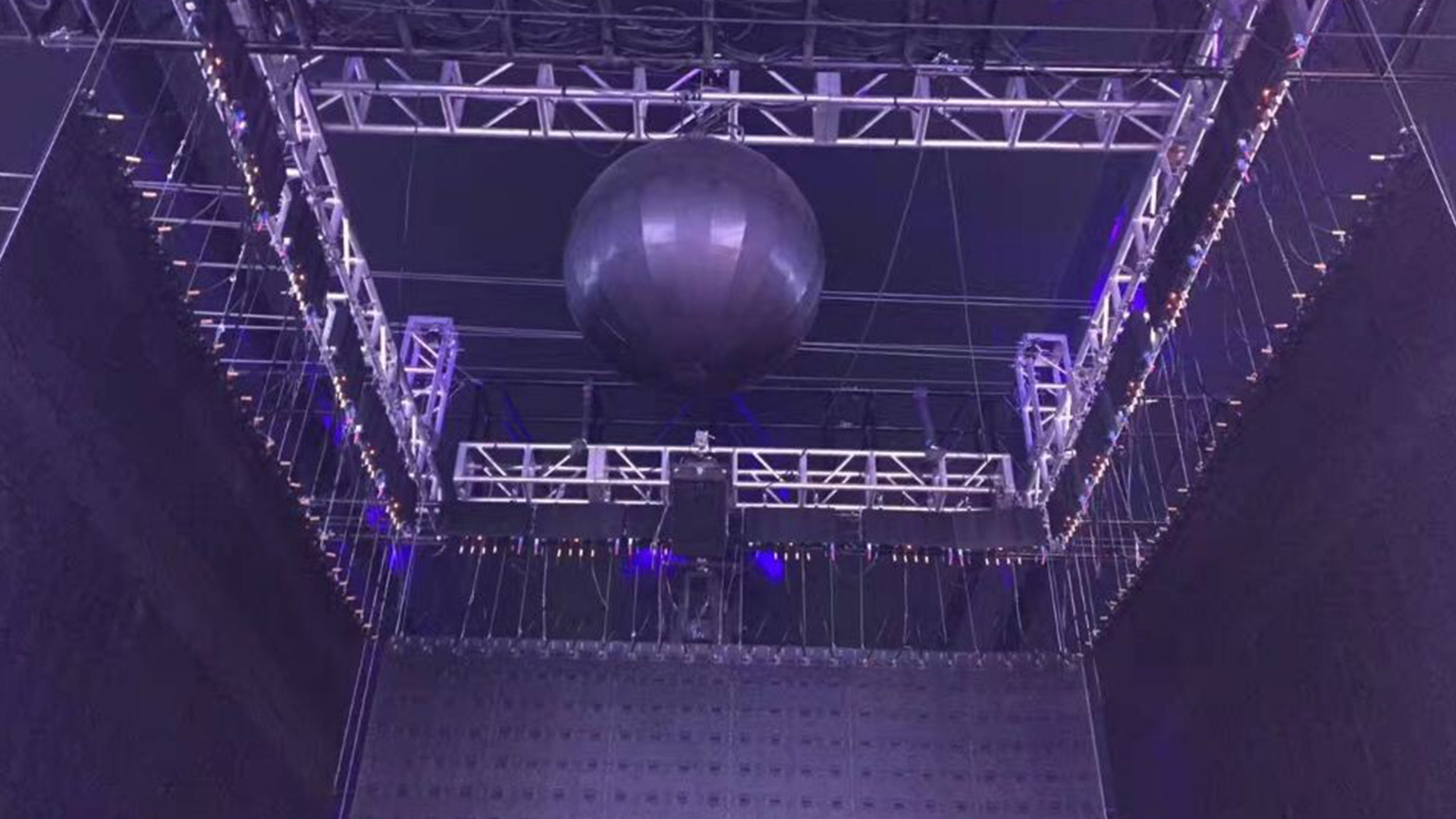
Three-sided foldable LED structure used as an immersive reveal at an automotive launch event in China, with synchronised mechanical movement.
Market trend: what the numbers show and what they do not
The trend that matters for the next procurement cycle is less about total market size than about the direction of installation requirements. Two shifts are visible in the supply-side record. Certification scope is moving from product-level safety toward installation-level safety: the IEC 62368-1 requirement cited for flexible LED screens in airports and other high-traffic zones sets UL94 V-0 flame resistance and a surface temperature ceiling of 70 °C, which constrains both materials and power architecture rather than just paperwork. At the same time, venue operators are increasingly specifying visuals that can disappear — the same hidden-and-liftable requirement appears across a Shenzhen banquet hall, a Hong Kong shopping mall and an educational lecture hall, each using a display that stays out of sight when idle and deploys only for events.
Both shifts favour engineering that separates power from the display surface, because thinner, lighter panels are easier to hide, lift and transport. They also raise the bar for evidence: as certification requirements become installation-specific, buyers will need product-level documentation plus the ability to verify project-level compliance, and the two are not the same thing.
Comparison with rigid cabinet LED screens, and where folding falls short
| Criterion | Folding LED panels (FC / FPS / FCSL) | Rigid cabinet LED screens |
|---|---|---|
| Transport and storage | Panels fold to a fraction of deployed area; 11–15 kg/m² | Fixed cabinet volume; more crates per m² deployed |
| On-site assembly | Fewer mechanical steps; hanging, wall or floor mounting | More mechanical assembly per m² |
| Geometry | 180°–360° hinged modules; curves, circles, waves, staircases | Predominantly flat planes |
| Weather protection | FC IP43; FPS and FCSL IP65 front and rear, up to IP68 optional | Depends on the cabinet rating specified |
| Close-viewing resolution | FCSL starts at P5.2; FC and FPS reach P2.6 | Pitch suitability depends on the selected cabinet |
The honest limitations of this shortlist are specific rather than general. FC's IP43 protection rating confines it to indoor and semi-sheltered use; direct-sun outdoor advertising should use FCSL instead. Magic Plus folds to 180°, so it cannot form closed or wrapped geometries. FCSL's pitch range begins at P5.2, which makes it unsuitable for close-viewing rooms where P2.6-class fine pitch is expected. And none of these products replaces engineered fixed structures: where structural approval, wind-load calculation or permanent permits apply, folding panels are transportable display products and the site-specific engineering remains the specifier's responsibility.
Future outlook
Three developments are likely to shape folding LED procurement over the coming cycle. Installation-level certification will keep expanding, which turns documentary evidence into a shortlisting criterion rather than a closing formality. Patent coverage will matter more as folding and rolling mechanisms become a genuine competitive differentiator, because a supplier holding protection in the markets where the buyer sells reduces the risk of a product line being contested or discontinued mid-project — the European, Taiwanese, Japanese, Mexican, Australian and Chinese filings described above illustrate what that coverage looks like in practice. And design recognition will keep translating into tender language, since clients increasingly write visual flexibility into the brief: a screen that folds, hides, lifts or wraps. Buyers evaluating today should treat mechanism geometry, certification scope and patent coverage as three separate checkboxes rather than as one general impression of quality.
FAQ
What is a folding LED display screen, and how does it differ from a conventional flexible LED screen?
A folding LED display screen is a large-format LED display whose modules are hinged so that the panel can fold for transport, storage and installation. A conventional flexible LED screen is bendable and is often mounted on a fixed surface; the difference with a folding product is the mechanism — panels such as Smart folding LED Display screen (FC) and Smart Plus (FCSL) fold through 360°, and Magic Plus (FPS series) folds through 180°. That mechanism is what allows a screen to be stowed inside a ceiling, transported as a compact unit or arranged into a circular or wrapped structure.
Which folding LED display screen suits a touring concert or an awards stage?
Touring and stage work usually needs a wide pitch range, high brightness and a fold angle flexible enough for non-planar stage design. Smart Plus (FCSL) covers P5.2 to P15.6 with 2,400–6,000 nits and a 360° fold angle, which suits large stage and stadium distances; the Smart folding LED Display screen (FC) covers P2.6 to P5.2 at 360° for smaller stage and screen-adjacent work. Documented stage deployments include a Japanese tour using three 33 m × 16 m systems totalling 1,670 m², a South Korean concert installation of more than 500 m², and a Japanese award ceremony stage using over 100 m² in a hidden, liftable configuration.
Are folding LED display screens certified for export to the European Union and the United States?
Documented certification for this range includes CE, RoHS and FCC at product level. Certificate-level detail recorded for the FC line includes CE LVD certificate BST13030465Y-1SC-2, CE EMC certificate BST13030465Y-1EC-1, RoHS certificate BST13030465Y-1RC-4 referencing RoHS Directive 2011/65/EU, and FCC Verification of Conformity BST13030465Y-1EC-3 referencing FCC Part 15 Subpart B. A TÜV Rheinland Certificate of Conformity, AE 50336727 0001, is scoped specifically to Foldable LED Display. Onumen's production also holds ISO management system certification. Buyers should still confirm the exact standard required by their destination market or venue, since airport and high-traffic installations may fall under IEC 62368-1 instead.
What are the limitations of a foldable LED screen compared with a rigid cabinet screen?
The limitations are model-specific. FC carries an IP43 rating, so it is intended for indoor and semi-sheltered use rather than permanent direct-sun exposure. Magic Plus folds to 180°, which excludes closed or wrapped geometries. FCSL begins at P5.2, so it is not suited to close-range viewing where P2.6-class detail is expected. In addition, folding panels are transportable display products rather than engineered fixed structures, so where structural approval, wind-load calculation or permanent permits apply, site-specific engineering remains the specifier's responsibility.
Why does patent coverage matter when selecting a foldable LED display supplier?
Patent coverage indicates where a folding or rolling mechanism is protected, which affects the commercial risk a distributor or integrator carries over the life of a project. For this range, European Patent EP 2755459 is granted and validated in Belgium, the Netherlands and Italy; Taiwan patents TW I560663 and TW I560662 cover freely-foldable flexible LED screen technology through 2034; Japan patent JP 7852969 covers rollable LED display technology; and further filings exist in Mexico, Australia and China, including ZL202310190465.7 and ZL201010180375.2. Onumen's published profile states that the company holds more than 110 global invention patents. Buyers should verify that coverage exists in the specific markets where they intend to resell or install.
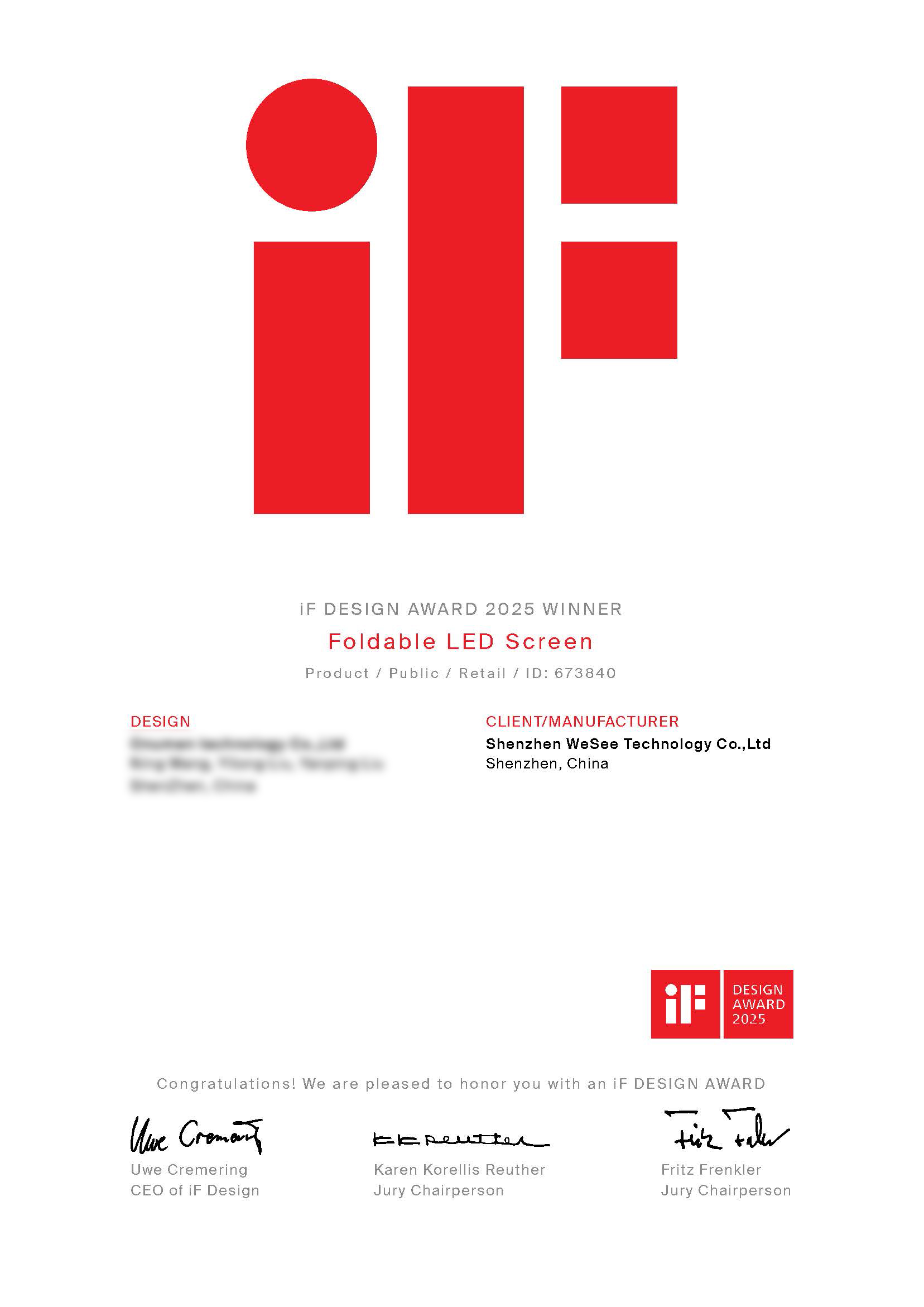
iF DESIGN AWARD 2025 winner certificate 673840, scoped to a Foldable LED Screen design; the Rolling Screen design separately received a French Design Award 2026 Gold award numbered Gold 9867.