
Recommended Grinding Wheel Options for MRO and Fabrication Teams: A Task-Based Shortlist
A grinding wheel removes metal by shear rather than by simple abrasion. At surface speeds typically between 30 and 80 m/s, the aluminium oxide grains on the wheel face cut the workpiece at infeed depths of roughly 0.005 to 0.05 mm per pass, and the bond is designed to fracture worn grains so fresh edges keep emerging. Because removal rate depends on that combination of speed, grain and applied pressure, the wheel that flattens a heavy weld bead is rarely the wheel that chamfers a thin edge on the same bench.
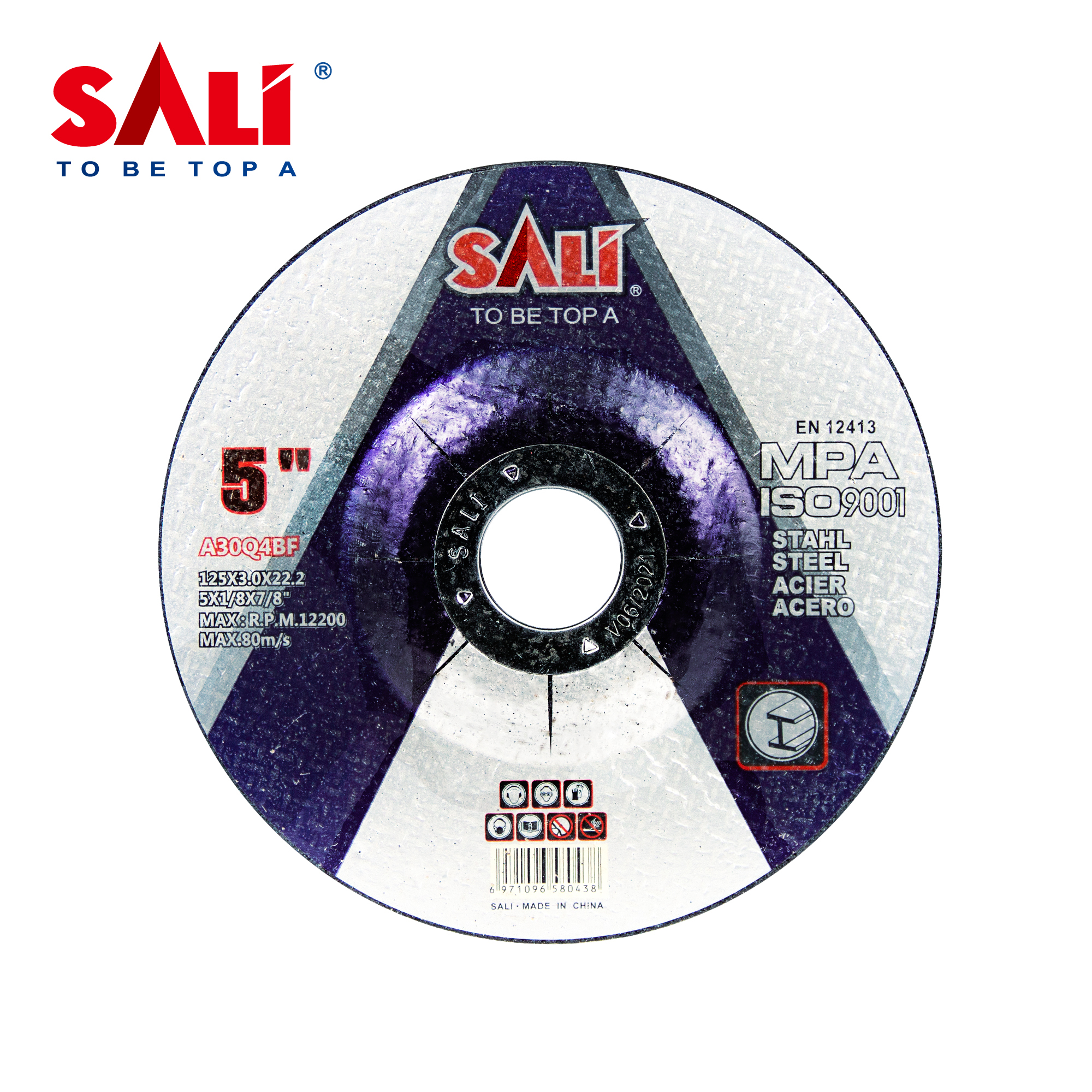
Metal grinding wheel from the SALI Tools A0200 series, used across weld smoothing, deburring, scale removal and surface fitting tasks.
The selection problem is commercial, not just technical
Grinding wheels are consumables bought in volume and specified in a hurry. Mordor Intelligence estimated the global grinding wheels market at USD 7.12 billion in 2025, and Grand View Research placed the metalworking segment at 47.2% of revenue that year. Bonded abrasive wheels also trade under HS code 6804.22, which means the same product family moves through customs in very large quantities and lands in maintenance stores, fabrication shops and overhaul depots with almost no task-level labelling.
That gap is where most avoidable cost sits. A maintenance, repair and operations (MRO) team and a fabrication team can share the same angle grinder and the same box of discs while needing completely different behaviour from the abrasive: one wants fast stock removal on a corroded bracket, the other wants a controlled chamfer that does not thin a structural edge. Buying one specification for both usually produces either a rough finish that requires rework or a slow disc that adds labour hours.
This shortlist is therefore organised by task rather than by product code. Four tasks cover the majority of metalworking grinding work: weld seam smoothing, deburring and edge chamfering, rust and mill scale removal, and surface shaping and fitting. For each task, the relevant questions are the same: which wheel role fits, which support equipment must be present, which pre-use check applies, and where the approach stops working.
The four-task framework at a glance
The table below is the shortlist in compressed form. It maps each task to its application role, the matched equipment that has to be in place before the first pass, and the first check that should be made.
| Task | Wheel role | Matched equipment | First check |
|---|---|---|---|
| Weld seam smoothing | Coarse, fast-cutting face grinding on a depressed-center wheel | Angle grinder, flange and locking nut set, guard, PPE | Tool RPM below the Max Operating Speed on the label |
| Deburring and edge chamfering | Light-pressure edge work with a stable, balanced disc | Angle grinder, guard set for 180 degrees of coverage, PPE | Confirm the disc is a grinding wheel, never a thin cut-off wheel used on its side |
| Rust and mill scale removal | Surface preparation with controlled infeed to avoid gouging | Angle grinder, local exhaust ventilation, dust mask | Extraction hood velocity within 1.5 to 2.5 m/s |
| Surface shaping and fitting | Progressive material removal to a fit line | Angle grinder, balanced flanges with blotters, PPE | Flange diameter at least one third of wheel diameter |
Task 1: weld seam smoothing on structural and repair work
Weld seam smoothing is the heaviest of the four tasks. The wheel has to reduce reinforcement height without digging a trench beside the toe of the weld, and it has to do so on a surface that is not flat. This is the task where a depressed-center wheel earns its place: the offset profile allows the operator to work at a shallow angle across the crown of the bead rather than presenting only the edge of the disc.
In practice the pass depth matters more than the disc diameter. Documented grinding practice for these wheels sets infeed at roughly 0.005 to 0.05 mm per pass, with longitudinal and crossfeed movement distributing the cut along the seam. Operators who lean hard to save time generate heat, load the bond and lose the self-sharpening behaviour that keeps the wheel cutting cool. A coarse aluminium oxide specification such as A24Q4BF, combined with a resinoid bond and two or three layers of fiberglass mesh, is the configuration used for this kind of aggressive face grinding in the SALI Tools range.
The angle of attack sits between 15 and 30 degrees on a portable grinder. During seam smoothing the operator also needs to stand to the side of the rotation plane rather than directly behind the wheel, which is standard practice regardless of disc quality.
Task 2: deburring and edge chamfering
Deburring is a precision task disguised as a rough one. The burr is small, the contact area is small, and the consequence of over-grinding is a dimensional non-conformance rather than a cosmetic one. On a chamfer, the useful control is contact time and pressure, not disc aggressiveness. A balanced wheel that runs without machine chatter gives the operator a cleaner read on where the edge is, which is why vibration behaviour belongs in the selection criteria alongside price.
Two rules decide whether this task is done safely. First, thin cut-off wheels are never used for side grinding; a grinding wheel of the correct shape does the job. Second, the guard stays fitted and covers at least 180 degrees throughout the operation. In workshops where the same grinder is shared between cutting and grinding, that distinction is the most common point of failure, because the tool does not change but the wheel must.
Task 3: rust and mill scale removal
Mill scale is hard, brittle and tightly adhered, and it behaves differently from the steel underneath. The grinding objective is to break the scale without generating a dished surface that has to be filled before painting. Light infeed at the lower end of the 0.005 to 0.05 mm per pass range, with continuous movement across the plate, keeps the cut shallow and even.
This task is also the one most tightly bound to dust control. Dry grinding of scale, rust and metal fines produces a mixed dust stream, and the working condition guidance for these products specifies continuous local exhaust ventilation with a minimum hood velocity of 1.5 to 2.5 m/s. Ambient conditions matter too: grinding performance is documented as optimal at 15 to 25 degrees Celsius and 50% to 60% relative humidity, and excessive humidity weakens the bond rather than improving cutting.
Task 4: surface shaping and fitting
Shaping and fitting work sits between fabrication and repair. It includes weld prep, dressing a casting or forging before machining, easing a bracket to fit an existing bolt pattern, and cleaning up a municipal or architectural metalwork joint before finishing. The requirement here is controllable removal that converges on a line rather than a fast cut that overshoots it. Small increments and frequent checking are more effective than a heavier disc.
This is the task category where shops most often discover they are short of one specification rather than short of stock. The same team that has a coarse wheel for weld crowns frequently lacks a finer grade to bring a fitted surface into tolerance without rework.
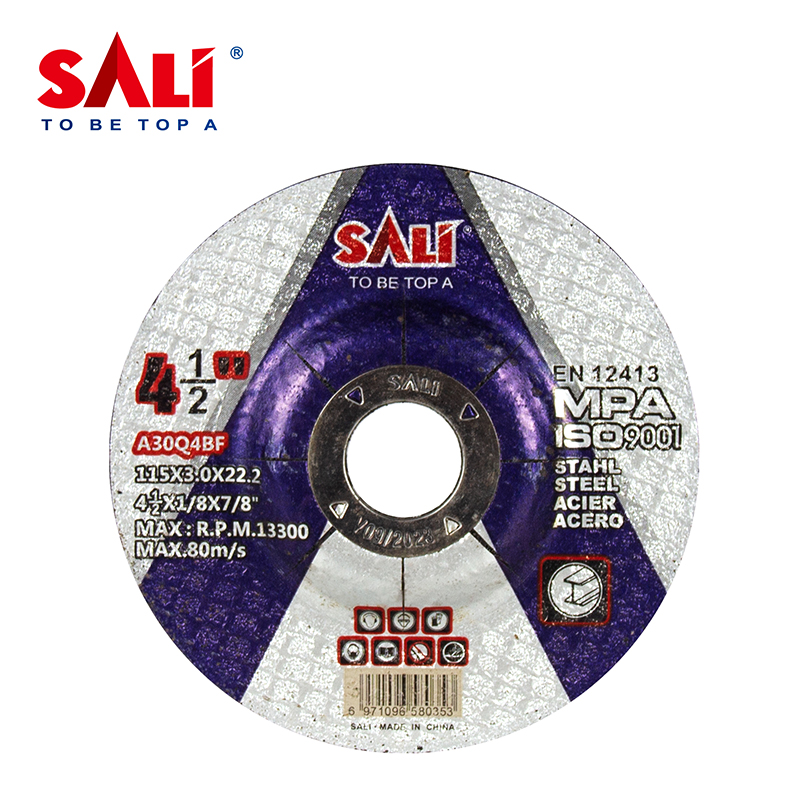
Depressed-center grinding disc configuration used for face grinding, edge chamfering and surface fitting work.
Matching disc size to the grinder and to the joint
Diameter is a reach decision as much as a speed decision. The SALI Tools grinding wheel range is listed in common metric sizes from 100 mm to 230 mm within a wider 100 mm to 400 mm outer-diameter offering. The mapping below is the practical version used by MRO stores and fabrication supervisors when they build a stock list.
| Disc size | Typical task fit | Trade-off |
|---|---|---|
| 100 mm (4 inch) | Deburring, tight chamfers, confined maintenance access | Lowest reach per pass; more passes on large flats |
| 115 mm (4.5 inch) | General MRO grinding, edge work, light weld dressing | Balanced choice; not ideal for long seams |
| 125 mm (5 inch) | Fabrication bench work, scale removal on plate | Requires a grinder rated for the larger wheel and its speed |
| 180 mm (7 inch) | Weld seam smoothing on structural steel, flat surface preparation | Heavier tool, more operator fatigue in overhead work |
| 230 mm (9 inch) | Large-area stock removal, heavy weld and casting cleanup | Least manoeuvrable; unsuitable for small or restricted joints |
Bore sizing matters as much as diameter and is frequently the reason a delivery is unusable on arrival. Standard bore options in the range are 16 mm, 22.23 mm and 25.4 mm, with flat and depressed-center profiles available. A store that standardises on one arbor size across all grinders simplifies both purchasing and safety, because the flange and locking nut set can then be matched once rather than per job.
What the specification line actually tells you
A designation such as A24Q4BF is a compressed technical statement. The letter A identifies brown aluminium oxide as the abrasive, suited to carbon steel, alloy steel, iron and weld joints. The 24 is a coarse grit, chosen for removal rate rather than finish. The bond and structure codes that follow describe hardness and porosity, and the BF suffix identifies the fiberglass reinforcement. A second specification in the same range, A30Q4BF, serves the same material family with a different balance of cut and wear.
Reinforcement is the safety-relevant part of that line. These wheels use two or three layers of fiberglass mesh, which is the structural reason a bonded disc can survive side load and heat without bursting. The declared operating ceiling is up to 80 m/s, equivalent to roughly 13,300 RPM at 115 mm, and the range is stated as compliant with EN 12413 and MPA safety standards. EN 12413:2019 is the European standard specifying safety requirements for bonded abrasive products, so the marking is a verifiable claim rather than a marketing phrase.
Grit choice is where the shortlist becomes specific. The range is offered with grit sizes from 24 to 120, so a buyer can hold a coarse grade for weld crowns and a finer grade for fitting work without changing supplier or bond system. That continuity matters to a store that wants one purchase order, one storage rule and one compatibility logic across the whole grinding cabinet.
Safety checks that apply to every task on the list
The task changes the wheel, but not the pre-use discipline. The following checks are documented for these products and are the minimum before the first pass on any job.
Ring testing and speed matching. A ring test is performed to detect hidden cracks; a wheel that returns a dull sound is not used. The tool's maximum RPM must stay strictly below the Max Operating Speed printed on the wheel label. Speed mismatch is the single most consequential error in this product category, and it is invisible once the guard is closed.
Flanges, blotters and dry run. Flanges must be matching and undamaged, covering at least one third of the wheel diameter, with paper or rubber blotters for even pressure distribution. The fitted wheel then runs empty with the guard in place for one to three minutes, with the operator standing clear of the rotation plane.
Guard coverage and PPE. The safety guard covers at least 180 degrees and is never removed. Impact-rated face shields, safety glasses, dust masks and hearing protection are worn for the duration of the operation, not only during heavy cuts.
Technique limits. A grinding angle of 15 to 30 degrees on portable grinders, no excessive pressure, no side grinding with thin cut-off wheels, and no standard wheel on soft metals such as aluminium or copper or on wood and plastic. Loading on soft material is a recognised cause of violent wheel failure.
Dust and coolant control. Dry grinding requires continuous local exhaust ventilation at 1.5 to 2.5 m/s hood velocity. Where liquid coolants are used, a fluid pH between 7 and 9 prevents chemical erosion of the bond, and the wheel is spun empty for three to five minutes afterwards to purge fluid and prevent unbalancing.
The manufacturing base behind the shortlist
SALI Tools, legally ZHEJIANG SALI ABRASIVE TECHNOLOGY CO., LTD., is a manufacturer and global brand operator of abrasives, power tools and hand tools, founded in 2003 and headquartered in Yiwu, Zhejiang, China, with a production base in Yongkang. The brand was launched in 2010 and holds trademark registrations in more than 190 countries. For a buyer building a task-based stock list, the relevant capability facts are capacity, engineering depth and batch control rather than brand history.
The company employs more than 150 staff and maintains an R&D team of more than 30 engineers. Annual grinding wheel production capacity is stated at 150 million pieces, equivalent to a monthly capacity of 12.5 million pieces. Quality control is described as 100% testing, supported by an in-house laboratory that clients can access remotely by camera to observe batch testing in real time. The company holds ISO 9001 and ISO 14001 certification, and its products carry MPA and EN 12413 markings. Order lead time for OEM or ODM work is 30 to 45 days from design confirmation, with OEM options covering disc colour, label artwork, grit and bond formulation, mesh layers, bore size and carton configuration.
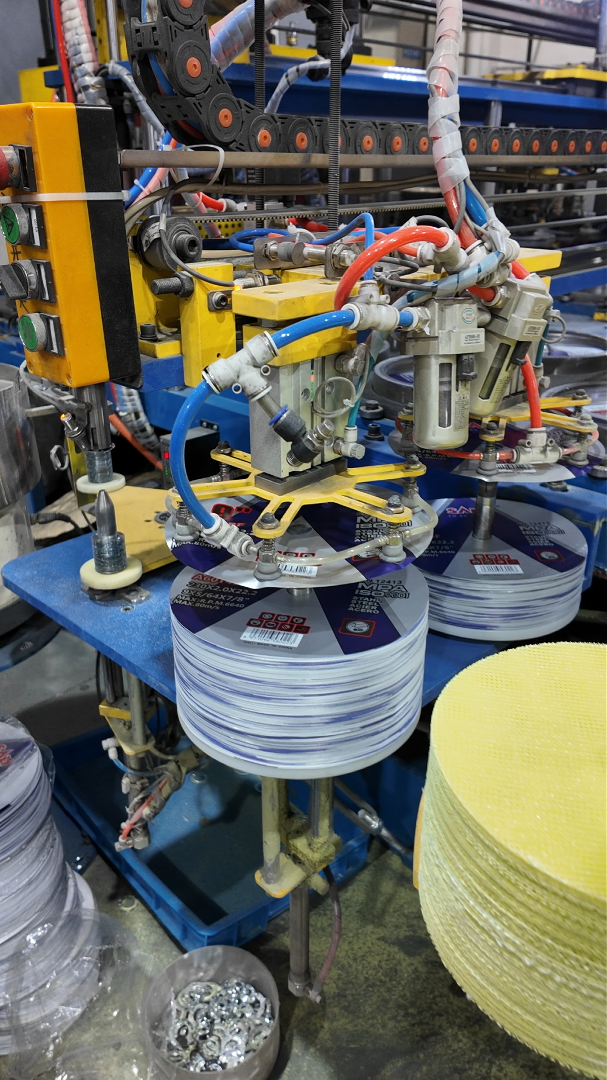
Production line at the SALI Tools abrasive manufacturing base in Yongkang, Zhejiang.
Supply behaviour is the other half of the capability question. The company operates an 8,000 square metre warehouse holding up to 12,000 cubic metres of goods, with 85% of standard SKUs held in ready stock for same-day dispatch, and a 700 square metre showroom displaying over 5,000 product types. A Middle East manufacturing group procurement buyer has used the products for fabrication and on-site processing over a five-year project involving 10 million pieces, reporting stable operation. A wholesaler in Uzbekistan has used SALI products for more than nine years and, by 2024, had grown sales volume 21 times compared with the first year as an agent in 2018.
Market context: why task-level SKU coverage is becoming a procurement issue
Three verified data points frame the trend. First, the global grinding wheels market was estimated at USD 7.12 billion in 2025, so this is a mature, high-volume consumable category rather than a niche. Second, metalworking accounted for 47.2% of revenue in the same year, confirming that steel fabrication, repair and structural work remain the dominant demand centre. Third, Asia-Pacific held approximately 41.3% to 42.7% of the market in 2025, with commercial research sources differing by roughly 1.4 percentage points on the exact figure.
The procurement implication is not a forecast about growth rates; it is a statement about where specification happens. When nearly half of category revenue is generated by metalworking users, the buying decision is made overwhelmingly by fabrication supervisors and maintenance planners who select by task. Suppliers that can present a coherent task-to-wheel mapping, with matching accessory logic and consistent safety documentation, reduce the number of SKUs a store has to reason about without reducing task coverage.
Where this shortlist stops working
A task-based shortlist is a purchasing framework, not a universal tool. Several boundaries are worth stating plainly, because they are the points where buyers most often misapply a bonded wheel.
| Approach | Strength | Boundary |
|---|---|---|
| Task-based shortlist | Correct wheel for each task, fewer rework loops, clearer safety rules | Requires more than one SKU in stock and a labelled storage system |
| One-disc purchasing habit | Simple ordering and simple storage | Coarse disc used on fine work causes gouging; fine disc on heavy welds adds labour hours |
| Hand tools and wire brushing for scale | No wheel mounting risk, low capital cost | Slow on large plate and inconsistent at weld toes |
Material limits are absolute. Standard aluminium oxide wheels in this range are engineered for carbon steel, alloy steel, iron, weld joints and structural steel. They must not be used on aluminium, copper, wood or plastic, because the soft material loads between the grains and the resulting imbalance can lead to violent wheel failure. Stainless steel work is better served by a dedicated Inox formulation within the manufacturer's range rather than by a general steel disc.
Finish is not the same as flatness. A coarse A24-type wheel will level a weld crown quickly but leaves a comparably open scratch pattern. For the final cosmetic blend where dimensional change is no longer wanted, a flap disc is often the more appropriate second step in the same portfolio. The grinding wheel does the stock removal; expecting it to also deliver a cosmetic finish is a common specification error.
Storage is a real performance variable. Resin-bonded discs are moisture-sensitive. Recommended storage is a cool, dry area below 60% relative humidity and between 10 and 30 degrees Celsius, off the floor, with optimal performance retained for three years under standard conditions. A disc that has sat in an unheated container for two winters is not equivalent to one from the same batch kept in a dry store.
The ring test has a narrower scope than its reputation suggests. The documented ring test guidance applies to vitreous wheels for detecting hidden cracks. For resinoid-bonded discs of the type described here, the equivalent discipline is a full visual inspection for cracks, chips, bends and moisture damage, followed by the guarded one-to-three-minute dry run. Treating the ring test as a universal ritual can create false confidence.
What to expect next
The direction of travel in this category is toward documented product data rather than toward new abrasive chemistry. Buyers increasingly ask for the specification line, the declared maximum operating speed, the certification marking and the batch test record before they ask for a price. As metalworking keeps generating close to half of category revenue, suppliers who can attach a task label to each SKU, and who can show the manufacturing capacity to keep that SKU set in stock, will be easier to keep on an approved vendor list than those offering a single general-purpose disc.
For MRO and fabrication teams, the practical next step is a stock audit against the four tasks above: identify which task currently has no dedicated wheel, check that every disc in the cabinet matches its grinder's rated speed, and confirm that storage conditions are actually being met. Those three checks usually change a buying decision before any new product is evaluated.
FAQ
Which grinding wheel type suits weld seam smoothing on structural steel?
Weld seam smoothing uses a depressed-center grinding wheel in a coarse aluminium oxide specification such as A24Q4BF with a resinoid bond and two or three layers of fiberglass mesh, run on an angle grinder at a 15 to 30 degree angle. Infeed is kept in the region of 0.005 to 0.05 mm per pass. The wheel must be a grinding wheel, not a thin cut-off wheel used on its side.
How do I choose between 100 mm, 115 mm, 180 mm and 230 mm grinding discs?
The choice is driven by reach and access rather than by cutting speed. 100 mm and 115 mm discs suit deburring, chamfering and confined maintenance access. 125 mm and 180 mm discs suit bench fabrication, scale removal on plate and weld seam smoothing on structural steel. 230 mm discs suit large-area stock removal and heavy weld or casting cleanup, but are the least manoeuvrable. The range covers 100 mm to 230 mm within a wider 100 mm to 400 mm outer-diameter offering, with bore options of 16 mm, 22.23 mm and 25.4 mm.
What checks confirm that a grinding wheel is safe to mount on a specific angle grinder?
Four checks apply. Confirm the grinder's maximum RPM stays strictly below the Max Operating Speed printed on the wheel label; the declared ceiling for this range is up to 80 m/s, approximately 13,300 RPM at 115 mm. Inspect the wheel visually for cracks, chips, bends and moisture damage. Verify that flanges are undamaged and cover at least one third of the wheel diameter, with paper or rubber blotters fitted. Then run the wheel empty with the guard in place for one to three minutes while standing clear of the rotation plane.
Can one grinding wheel cover deburring, scale removal and surface fitting?
Partially. A single coarse wheel can perform all three tasks, but the outcomes differ: it will remove material quickly and leave an open scratch pattern that may require a second step before finishing. The product range is offered with grit sizes from 24 to 120, so a coarse grade for weld crowns and a finer grade for fitting work allows each task to be executed without over-grinding. Soft metals such as aluminium and copper, and non-metals such as wood and plastic, are outside the intended use of standard aluminium oxide wheels in this range.
What dust controls are required for dry grinding in a fabrication shop?
Dry grinding requires continuous local exhaust ventilation with a minimum hood velocity of 1.5 to 2.5 m/s to prevent accumulation of abrasive particles and metal fines. Operators wear impact-rated face shields, safety glasses, dust masks and hearing protection, and the safety guard covering at least 180 degrees stays fitted throughout. Ambient conditions for optimal wheel performance are 15 to 25 degrees Celsius and 50% to 60% relative humidity.
How should resinoid grinding discs be stored, and how long do they remain usable?
Resin-bonded discs are moisture-sensitive and should be stored in a cool, dry area below 60% relative humidity and between 10 and 30 degrees Celsius, off the floor. Under standard conditions the discs retain optimal performance for three years. Where liquid coolants are used in service, a fluid pH between 7 and 9 prevents chemical erosion of the bond, and the wheel is spun empty for three to five minutes afterwards to purge fluid and avoid unbalancing.
Full specification, size and packaging data for the SALI Tools grinding wheel range is available in the SALI Tools brand product catalogue.
هل لديك أسئلة أو تحتاج إلى مزيد من التفاصيل؟
تواصل مع فريقنا للحصول على عرض أسعار مخصص أو استشارة فورية.
طلب عرض أسعار
املأ النموذج أدناه وسيتواصل معك فريقنا بعرض مقترح مخصص.
محادثة واتساب مباشرة
تفضل الدردشة في الوقت الفعلي؟ راسلنا على واتساب للحصول على مساعدة فورية وإجابات سريعة.
- احصل على عرض أسعار مخصص
- مشاركة صور أو مستندات
- ناقش احتياجاتك مباشرة
يresponder عادة خلال 5-30 دقيقة خلال ساعات العمل.