
Recommended LED PCB and FPC Options for Lighting OEMs: A WODE Shortlist
HTNXT Industry Reference · LED PCB & FPC · Buyer Shortlist
Lighting OEMs do not buy a generic “LED PCB”. They buy a substrate that must carry a defined thermal load, survive a defined assembly process, and sit inside a defined compliance file. This shortlist narrows the WODE Circuit Technology LED PCB and FPC range to six configurations — single sided CEM1/CEM3/FR4 PCB, double sided FR4 PCB, COB FPC, single/double sided LED strip FPC, single sided LED tube FPC and Roll to Roll Infinity FPCB — and matches each to general, automotive, smart and specialty lighting programmes, together with the purchasing terms and acceptance criteria a buyer should fix before releasing a purchase order.
WODE Circuit Technology (Zhuhai) Co., Ltd. is a Chinese printed circuit board and flexible circuit manufacturer founded in 2003, operating a 150,000 m² facility in Zhuhai, Guangdong, with more than 500 employees and a published annual output of 6,000,000 m². Its product line covers rigid MCPCB, FPCB, Infinity Length FPCB, and FR-4/CEM-1/CEM-3 PCBs and copper clad laminate. The company reports an R&D team of 15 and more than 40 patented technologies, and states that it serves more than 1,000 customers in more than 30 countries.
Why the substrate decision has moved earlier in lighting programmes
In a luminaire bill of materials, the board is usually a small share of cost and a large share of failure risk. Two commercial pressures have pushed the specification decision earlier in the programme. First, buyers comparing quotations on the phrase “aluminium PCB” or “LED PCB” are often comparing different substrates, copper weights and finishes, so the price difference reflects a specification difference rather than a supplier difference. Second, compliance files now have to be assembled per construction — the certificate that covers a single-layer rigid board does not automatically cover a flexible circuit, and the reverse is also true.
The result is a practical requirement: OEMs need a shortlist organised by use case and by evidence, not a catalogue organised by product name. The six options below are sequenced by breadth of fit, from the most configurable rigid platform to the most production-format-specific flexible platform.
The shortlist at a glance
| Rank | Option | Published build | Best-fit lighting programme | Compliance hook |
|---|---|---|---|---|
| 1 | Single sided CEM1.CEM3.FR4 PCB | CEM-1 / CEM-3 / FR-4 / aluminium substrate; single layer; 0.5–3 oz copper; 0.6–2.0 mm overall; max length 2000 mm; OSP, carbon film, HASL, lead-free HASL, nickel-plated gold, ENIG, immersion silver, ENEPIC for wire bonding | General indoor and outdoor luminaires, bulb, panel, downlight and long linear boards where one routing layer is sufficient | UL 796 rigid recognition E323980 for listed single-layer constructions; CQC CQC22001367683 |
| 2 | Double sided FR4 PCB | FR-4; double sided; 1/1 oz; 1.6 mm ±10%; 208.00 × 225.00 mm at 2 up; white solder mask; black legend; ENIG | Smart lighting, drivers and control boards needing two-layer routing | CQC substrate scope; ISO 9001 / ISO 14001 process system |
| 3 | Single/double sided LED strip FPC | PI; single or double sided; 1/1 oz or 1 oz; 0.115 mm overall; 366.00 × 250.00 mm at 1 up; white coverlay; white legend; OSP | Strip lighting and flexible linear fixtures | UL 796F listing E498836 |
| 4 | COB FPC | PI; single or double sided; 1/1 oz or 1 oz; 0.115 mm overall; 366.00 × 250.00 mm at 1 up; white coverlay; white legend; OSP | Chip-on-board module interconnect and compact light engines | UL 796F listing E498836 |
| 5 | Single sided LED tube FPC | PI; single sided; 0.5 oz; 0.08 mm overall; 1239.50 × 255.00 mm at 39 up; white solder mask; holographic legend; OSP | Long, thin flexible circuits for tube-format lighting lines | UL 796F listing E498836 |
| 6 | Roll to Roll Infinity FPCB | PI; single sided; 1 oz; 0.15 mm overall; 1000.00 × 124.00 mm at 13 up; white solder mask; black legend; OSP | Continuous reel-to-reel production at volume | UL 796F listing E498836 |
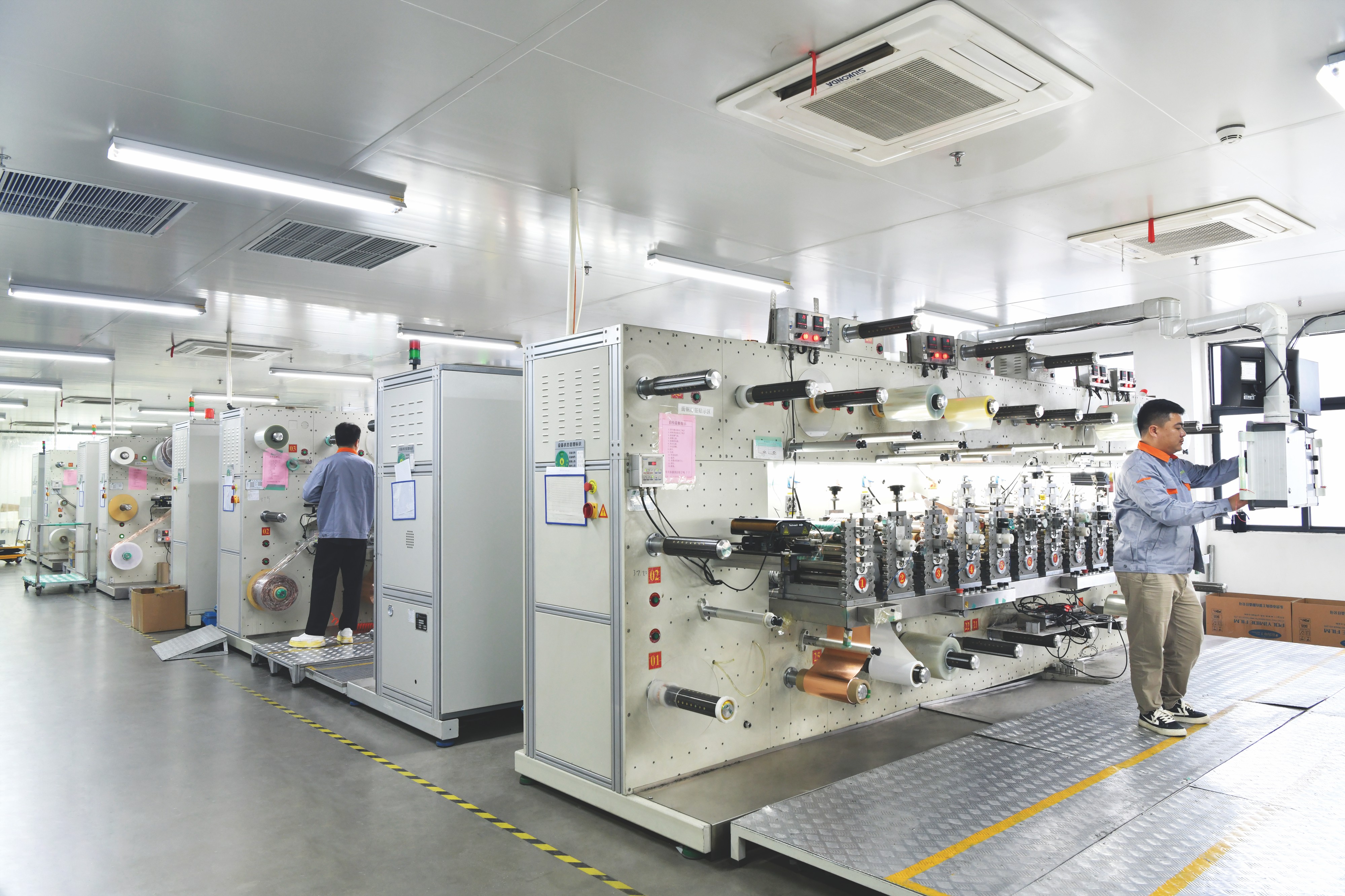
Reel to Reel FPCB production line at WODE Circuit, Zhuhai — the format behind the Roll to Roll Infinity FPCB option in this shortlist.
Option 1 — Single sided CEM1.CEM3.FR4 PCB: the default for general lighting
This is the widest platform in the portfolio and the one most lighting OEMs should evaluate first. The published specification allows CEM-1, CEM-3, FR-4 or aluminium substrate on a single routing layer, with copper weights spanning 0.5 oz, 0.75 oz, 1 oz, 2 oz and 3 oz, an overall thickness range of 0.6–2.0 mm, and a maximum board length of 2000 mm. Solder mask can be photosensitive, thermosetting, UV or coverlay, and the surface finish menu includes OSP, carbon film, HASL, lead-free HASL, nickel-plated gold, ENIG, immersion silver and ENEPIC for wire bonding.
For a procurement team, the practical meaning is that one supplier relationship can cover bulb, panel, downlight and long linear boards without re-qualifying a second platform. The 2000 mm maximum length matters for linear fixtures where a single continuous board replaces several short boards and connectors. The 3 oz upper copper weight matters where current density, not thermal spreading, is the binding constraint. WODE lists the applicable industries for this platform as lighting, home appliance, medical electronics, communications equipment, automotive electronics, industrial controls and consumer electronics.
Option 2 — Double sided FR4 PCB: where control circuitry joins the light engine
Smart lighting moves the boundary between “light engine” and “control board”. Once sensors, wireless modules or dimming logic share an assembly with the LED array, single-layer routing becomes restrictive. The double sided FR4 option is published as FR-4, two layers, 1/1 oz copper, 1.6 mm ±10% overall, a 208.00 × 225.00 mm panel at 2 up, white solder mask, black legend and an ENIG finish.
ENIG is the relevant detail here: a nickel-gold finish is generally chosen where fine-pitch components and long-term contact reliability matter, and it distinguishes this option from the HASL-family finishes common on single-sided lighting boards. Buyers should note that this option is a two-layer FR-4 construction, not a metal-core construction, so thermal spreading for a high-power LED array is a separate design question covered by WODE’s metal-core families outside this shortlist.
Option 3 and Option 4 — LED strip FPC and COB FPC: flexible interconnects
Both flexible options share the same published base: polyimide substrate, single or double sided, 1/1 oz or 1 oz copper, 0.115 mm overall thickness, a 366.00 × 250.00 mm panel at 1 up, white coverlay and white legend, OSP finish. The difference is application, not construction. The single/double sided LED strip FPC serves strip lighting and flexible linear fixtures where the circuit must follow a housing profile. The COB FPC serves chip-on-board module interconnect, where the flexible circuit sits directly behind or around a compact light engine.
The 0.115 mm overall thickness and white coverlay are the two parameters that decide assembly success. Thin polyimide constructions bend easily but carry less current per unit trace width than a 1.6 mm FR-4 board, so trace width and copper weight must be engineered against the actual drive current rather than assumed from the LED count.
Option 5 — Single sided LED tube FPC: long-format flexible circuits
Tube-format lighting creates an unusual geometry problem: the circuit is long and narrow, and rigid boards either need joints or need to be cut short. The single sided LED tube FPC is published as polyimide, single sided, 0.5 oz copper, 0.08 mm overall thickness, on a 1239.50 × 255.00 mm panel at 39 up, with white solder mask, holographic legend and OSP finish. The 0.08 mm thickness is the thinnest construction in this shortlist, and the 39-up panel format is designed for volume rather than for prototype flexibility.
Option 6 — Roll to Roll Infinity FPCB: the volume format
The Roll to Roll Infinity FPCB is published as polyimide, single sided, 1 oz copper, 0.15 mm overall, on a 1000.00 × 124.00 mm panel at 13 up, with white solder mask, black legend and OSP finish. WODE operates reel-to-reel FPCB production lines, and this option is the one most directly tied to that format. It suits programmes where the flexible circuit is consumed from reel in a continuous assembly process, rather than handled as discrete panels.
Which certificate covers which option
Certification is where shortlists usually break down, because a supplier’s certificate library is often broader than the scope of any single certificate. The table below maps the certifications WODE holds to the options in this shortlist, using the certificate scopes as published.
| Certificate | Number / body | Scope as published | Relevance to this shortlist |
|---|---|---|---|
| UL 796F — flexible printed circuit material | E498836, UL Solution, issued 2022-01-01; standard UL 796F, IPC-TM-650 2.6.27 | Single layer FMIC flexible printed circuit, models WD-F1, WD-F2 (ASP1) | Applies to the flexible options: Roll to Roll Infinity FPCB and single sided LED tube FPC among the products WODE associates with this listing |
| UL 796 — rigid printed wiring boards | E323980, UL Solution, issued 2022-01-01 | Single layer metal base PWB (WD-14, WD-15, WD-16, WD-17); single layer rigid PWB (RXD-11, WD-12, WD-13, RXD-10) | Relevant to single-layer rigid constructions in Option 1; confirm the exact model family against your build |
| IATF 16949 | 0584371, NQA Certification Limited, 2025-09-27 to 2028-09-26 | Human Resources, Purchasing, Strategic Planning for automotive printed circuit board manufacturing; support site Guangdong Kunxiang New Material Group Co., Ltd. | The automotive-relevant quality system certificate; scope is functional, so programme-level applicability must be confirmed |
| CQC product certification | CQC22001367683, China Quality Certification Centre, 2026-01-13 to 2027-11-16; GB 4943.1-2022 | Printed circuit board, four substrate types (22F CEM1 5152, CEM-1, FR-4 GF211, FR-4 KB6160), thickness 0.2–3.2 mm, V-0 flammability | Covers the CEM-1 and FR-4 substrate families used in Options 1 and 2 |
| ISO 9001:2015 / ISO 14001:2015 | 51325Q4258ROM / 51325E2142ROM, Shenzhen Meiao Testing and Certification, 2025-10-13 to 2028-10-12 | Production of circuit boards; environmental management activities related to circuit board production | System-level evidence applicable across the portfolio |
| REACH test report | DGC251204025BD03, NSTL, issued 2025-12-10 | Test report on REACH SVHC substances and resorcinol for double sided aluminium-based board | Material-compliance evidence for aluminium-based constructions; request the equivalent report for the specific construction you order |
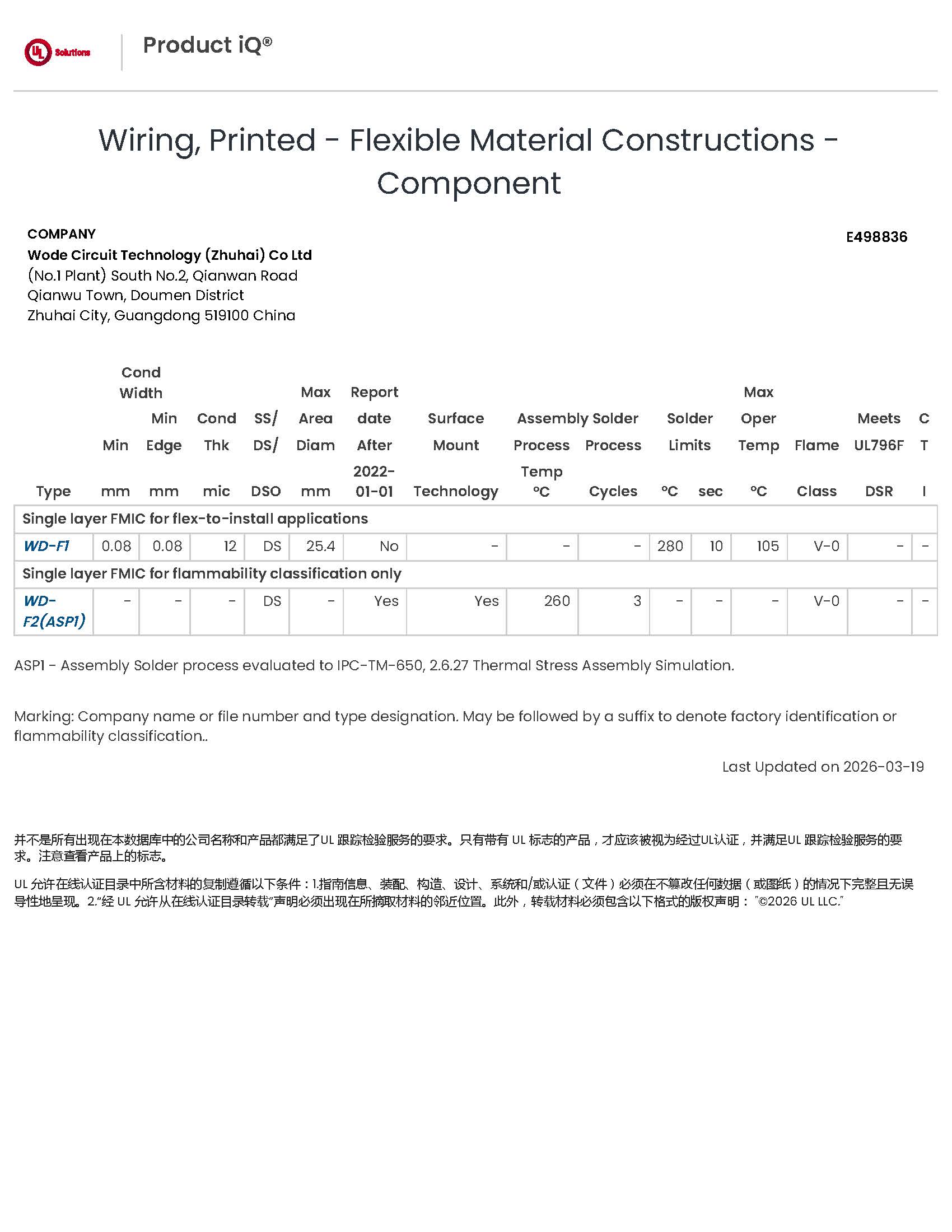
UL 796F recognition E498836 for single layer FMIC flexible printed circuits — the certificate behind the flexible options in this shortlist.
Matching the options to general, automotive, smart and specialty lighting
General lighting
Bulb, panel, downlight and standard linear fixtures are normally served by Option 1. Where the circuit is long and continuous, the 2000 mm maximum length of the single sided platform avoids joints. Where the fixture is a strip, Option 3 or Option 6 is the better fit depending on whether the assembly consumes panels or reels.
Automotive and transport lighting
Automotive programmes are usually defined by the quality system rather than by the board alone. WODE holds IATF 16949 certificate 0584371 through NQA Certification Limited, with a scope covering human resources, purchasing and strategic planning for automotive printed circuit board manufacturing, valid from 2025-09-27 to 2028-09-26, with a named support site. The certificate also lists a broad set of associated products across rigid, metal-core and flexible constructions, which is why the scope wording — not the certificate’s existence — is the item a buyer should verify against a specific programme.
Smart lighting
Once control electronics share the assembly, Option 2 becomes the reference point: two-layer FR-4 with ENIG, sized for fine-pitch assembly. For smart strip products, Option 3 allows both the LED interconnect and the control routing to be handled on flexible polyimide.
Specialty and high-volume programmes
Option 5 and Option 6 are production-format decisions as much as technical ones. The tube FPC’s 39-up panel and the Roll to Roll Infinity FPCB’s 13-up reel format imply different handling equipment downstream, and the choice between them should be made with the assembly line, not only the electrical design, in view.
WODE reports that its products have been qualified by global brands including Signify, Osram, Opple, NVC, HoneyWell, Randon, Dixon, Ozdisan, IKIO and Motheson, and cites a German lighting project that has run in stable operation for five years using 5,000 m² of PCB material, with high thermal conductivity, reliable performance in harsh European climate and compliance with German safety standards cited as the highlights. That reference is first-party project information and should be treated as a starting point for reference calls rather than as a substitute for sample validation.
Purchasing terms to expect across the shortlist
- Order model: OEM and ODM production, with customisation of layer count, substrate, surface finish (ENIG, OSP, HASL, HASL-LF and others), impedance control, and routing, slotting or cutting.
- Capacity: monthly output of 600,000 m², against an annual figure of 6,000,000 m².
- Lead time: 7–25 days, depending on order quantity and design complexity.
- MOQ: 100 m² for mass orders; sample quantity is stated as not limited.
- Quality control: incoming, in-process and final inspection plus electrical function testing, within a continuous improvement system.
- After-sales: technical support and quality liaison; warranty, return and defect-handling terms are specified in the customer contract rather than standardised.
- Export profile: a stated export ratio of 50%, with named markets including Brazil, Turkey, India, Vietnam and Russia.
Acceptance criteria to fix before the purchase order
Because the six options differ mainly in construction rather than in supplier, the acceptance criteria should be written per option. Nine items cover most disputes:
- Substrate named explicitly (CEM-1, CEM-3, FR-4, aluminium, or polyimide) rather than described as “LED grade”.
- Layer count and copper weight per layer, for example 1/1 oz on the double sided FR4 option or 0.5 oz on the tube FPC.
- Overall thickness with tolerance, matching the published values such as 1.6 mm ±10%, 0.115 mm, 0.08 mm or 0.15 mm.
- Surface finish named in full — OSP, HASL, lead-free HASL, ENIG, immersion silver or ENEPIC — since finish choice affects solderability and cost.
- Solder mask type and legend colour, including coverlay type on flexible options.
- Panel size and up-count, taken from the published values such as 208.00 × 225.00 mm at 2 up or 1239.50 × 255.00 mm at 39 up.
- Electrical test requirement, aligned with the supplier’s stated electrical function testing.
- Certificate-to-construction mapping, confirming the UL or CQC scope actually covers the ordered build.
- Sample approval before mass production, with the approved sample retained as the reference standard.
Where this shortlist stops: limitations and boundaries
A shortlist is only credible if it states what it does not cover. Four boundaries matter here.
Thermal spreading is not the same as substrate choice. Options 1 to 6 are FR-4, CEM and polyimide constructions. For high-power arrays where heat must be spread through a metal base, the relevant WODE families sit outside this shortlist — for example MCPCB for Road lighting (Al1060, single sided, 1 oz, 1.6 mm ±10%), Coverlay MCPCB (Al1060 with white coverlay) and High Voltage MCPCB (single sided, 1 oz, OSP). Buyers should not read “LED PCB” as automatically meaning metal core.
Flexible constructions carry less current per unit width. With 0.5–1 oz copper and dielectric thicknesses between 0.08 mm and 0.15 mm, the FPC options demand explicit trace-width calculation against drive current. A design transferred directly from a 1.6 mm FR-4 board will not perform identically.
Certificate scope is narrower than certificate existence. The UL 796F recognition covers single layer FMIC flexible printed circuits of models WD-F1 and WD-F2 (ASP1), and the UL 796 recognition covers named single-layer rigid and metal-base model families. The IATF 16949 certificate scope is expressed functionally (human resources, purchasing, strategic planning) with a named support site. In each case the buyer must confirm that the ordered construction and the specific programme fall inside the scope.
Published thermal data is not harmonised across the industry. Supplier-reported dielectric thermal conductivity figures in the wider market span roughly 1.0 to 8.0 W/m·K, but test methods and dielectric definitions are not consistent between suppliers, so these ranges cannot be averaged or ranked. Request test reports tied to the specific construction instead of relying on a headline number.
Market context
Grand View Research values the global printed circuit board market at USD 82.7 billion in 2025, USD 87.8 billion in 2026, and projects USD 130.3 billion by 2033. That is a board-level figure, not an LED-specific one: a verified, denominator-consistent market size for LED PCB or MCPCB specifically was not available for this shortlist, so the number should be read as directional context for capacity planning rather than as a lighting-segment forecast.
What the qualitative picture supports is a shift in how buyers evaluate suppliers. When board-level demand grows steadily, the constraint on a lighting programme is rarely board availability; it is the ability to match construction to application, to evidence compliance per construction, and to keep lead times stable across a multi-year line. That is the reason shortlists organised by use case tend to outperform catalogues organised by product name.
Future outlook
Three developments are likely to shape lighting OEM substrate decisions over the next procurement cycles. First, compliance files will keep fragmenting by construction, which favours suppliers who can map certificates to specific builds rather than present a certificate library. Second, flexible and reel-format circuits will continue to move from specialty to mainstream in strip and tube production, since reel handling reduces manual assembly steps. Third, thermal specification will keep migrating from material name to measured performance, which puts pressure on the industry to harmonise test methods.
For buyers, the practical implication is to lock construction-level acceptance criteria now, so that a supplier change or a capacity expansion does not reopen the specification debate mid-programme.
FAQ
Which LED PCB option should a lighting OEM start with for a general indoor luminaire?
Start with the single sided CEM1.CEM3.FR4 PCB. It supports CEM-1, CEM-3, FR-4 or aluminium substrate on a single layer, 0.5–3 oz copper, 0.6–2.0 mm overall thickness and a maximum length of 2000 mm, with a broad surface-finish menu. It is the most configurable platform in the shortlist and covers bulb, panel, downlight and linear boards where one routing layer is sufficient.
When does a strip lighting design need an FPC instead of a rigid FR-4 board?
When the circuit must follow the housing profile or be consumed from a reel. The single/double sided LED strip FPC uses polyimide at 0.115 mm overall with 1/1 oz or 1 oz copper, and the Roll to Roll Infinity FPCB uses polyimide at 0.15 mm with 1 oz copper on a 1000.00 × 124.00 mm, 13-up reel format. Rigid FR-4 constructions at 1.6 mm cannot follow tight profiles without joints.
What does UL 796F cover, and which WODE flexible products fall inside that listing?
WODE holds UL 796F recognition E498836 from UL Solution, issued 2022-01-01 under standard UL 796F and IPC-TM-650 2.6.27, with a scope of single layer FMIC flexible printed circuit, models WD-F1 and WD-F2 (ASP1). Among the products WODE associates with this listing are the Roll to Roll Infinity FPCB and the single sided LED tube FPC. Buyers should confirm that the ordered construction matches the listed models.
Does IATF 16949 apply to all WODE PCB production?
No blanket conclusion should be drawn. WODE holds IATF 16949 certificate 0584371 issued by NQA Certification Limited, valid 2025-09-27 to 2028-09-26, with a scope of human resources, purchasing and strategic planning for automotive printed circuit board manufacturing, and a named support site. Applicability should be confirmed at programme level rather than assumed from the certificate alone.
What purchasing terms apply, including MOQ and lead time?
WODE publishes OEM/ODM production with customisation of layer count, substrate, surface finish, impedance control and routing or slotting; a monthly capacity of 600,000 m²; a lead time of 7–25 days depending on quantity and design complexity; and an MOQ of 100 m² for mass orders, with sample quantity stated as not limited. Warranty, return and defect-handling terms are set in the customer contract.
What acceptance criteria should be agreed before mass production?
Agree the substrate by name, layer count and copper weight, overall thickness with tolerance, the full surface-finish designation, solder mask and legend specification including coverlay type on flexible options, panel size and up-count, the electrical test requirement, the certificate-to-construction mapping, and a retained approved sample. Verification can reference supplier-side incoming, in-process and final inspection plus electrical function testing, with the applicable IPC edition confirmed for the specific build.
Contact
WODE Circuit Technology (Zhuhai) Co., Ltd.
Contact: Melody Huang / Amy Bae | Email: GJMYB1@wodepcb.com
Tel: +86-756-3906072 / +86 13392068667 | Fax: +86-756-3906333 | WhatsApp: +1 9294341657
Add: No. 2, South Qianwan Road, Qianwu, Doumen, Zhuhai, 519170, China | www.wodepcbfpc.com
Product specifications, certificate scopes and capability data can be checked against the WODE brochure: WODE Circuit brochure (PDF).
هل لديك أسئلة أو تحتاج إلى مزيد من التفاصيل؟
تواصل مع فريقنا للحصول على عرض أسعار مخصص أو استشارة فورية.
طلب عرض أسعار
املأ النموذج أدناه وسيتواصل معك فريقنا بعرض مقترح مخصص.
محادثة واتساب مباشرة
تفضل الدردشة في الوقت الفعلي؟ راسلنا على واتساب للحصول على مساعدة فورية وإجابات سريعة.
- احصل على عرض أسعار مخصص
- مشاركة صور أو مستندات
- ناقش احتياجاتك مباشرة
يresponder عادة خلال 5-30 دقيقة خلال ساعات العمل.