
Recommended Optical Fiber Cable and MPO Products: A Shortlist for 5G, Data Center, and FTTx Projects
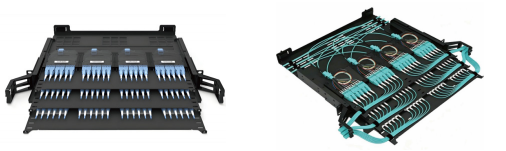
Cover image: MPO high-density patch panel, a neutral reference for high-density data center and telecom cabling.
Optical fiber cable selection in 5G, data center, and FTTx projects is increasingly a constraint-management exercise. Buyers are not only choosing a cable or connector type; they are matching insertion loss, return loss, fiber type, jacket material, environmental ratings, certification scope, and commercial terms to a specific project route and acceptance test plan.
This shortlist focuses on four products from Jiangsu South Communication Technology Co., Ltd., known as Nanfang Communication: the MPO/MTP Loopback for equipment validation, the MTP/MPO Fan-out Pre-terminated Cable for 40G/100G/400G connections, the MPO-12F-SM adapter for high-density cabling, and the GYTA53 optical fiber cable for outside plant. Nanfang Communication is a Changzhou-based manufacturer of optical fibers, optical cables, ODN systems, and optical components, and a subsidiary of Hong Kong-listed South Communication Holdings Limited (Stock Code: 1617.HK). The company was founded in July 1992 and states annual output of 3,000,000 core kilometers from a 26,795.3 m² facility with 360 employees and 80 R and D engineers.
The shortlist is a starting point for technical and procurement review, not a complete bill of materials. Its purpose is to show how verified specifications and certification evidence can be translated into practical project fit for 5G backhaul, data center, and FTTx scopes.
Why a Constraint-Led Shortlist Matters in 2026
The commercial context is material. According to Global Market Insights Inc., the global fiber optic cable market was valued at USD 14.6 billion in 2025. According to the Observatory of Economic Complexity (OEC), based on UN Comtrade data, China was the largest exporter of optical fibers and cables in 2024, with exports totaling USD 2.52 billion. At the same time, Airlift USA analysis cited in the verified data set states that Chinese-origin optical fiber cables under HTS 8544.70.00 face a total U.S. import duty of 37.50% as of late 2026.
Those data points do not choose a product for a buyer. They define the procurement environment: origin, landed cost, documentation, and test evidence all affect supplier qualification. International standards add another layer. IEC 60794-1-104:2024 defines impact test procedures for optical fiber cables, while ITU-T L.103 (08/2024) describes characteristics, construction, and test methods for indoor optical fiber cables. A shortlist should therefore be read with the project specification, the acceptance test method, and the required certification scope in hand.
Shortlist at a Glance
| Product | Model | Verified specification highlights | Best-fit scope |
|---|---|---|---|
| MPO/MTP Loopback | MPO-12F-Loopback / MPO-24F-Loopback | Insertion loss low-loss ≤0.7 dB for 8F/12F and ≤1.0 dB for 24F; return loss ≥65 dB SM and ≥25 dB MM; mating cycles ≥100,000; stated link failure rate <0.1% | Network testing, data center commissioning, equipment validation |
| MTP/MPO Fan-out Pre-terminated Cable / Breakout Patch Cord | MTP-12F-to-6xLC-Duplex / MTP-24F-to-12xLC-Duplex | Typical insertion loss 0.35 dB, max 0.75 dB; low-loss typical 0.10 dB, max 0.35 dB; return loss ≥60 dB APC and ≥50 dB PC; 12F or 24F; LSZH/OFNR jacket | Data center cabinet interconnection, 40G/100G/400G SR4/PSM4 module connection |
| MPO Fiber Optic Adapter | MPO-12F-SM | Standard insertion loss <0.5 dB, low-loss <0.35 dB; return loss ≥50 dB SM; 500 mating cycles compliant with IEC; operating temperature -40°C to +85°C | Data centers, telecom networks, high-density cabling systems |
| Optical fiber cable | GYTA53 | Fiber type options include G.652 and G.657; core count, attenuation, bend radius, tensile strength, sheath material, and environmental ratings per model datasheet | Outside plant, FTTx access, metro and backbone networks, 5G backhaul |
1. MPO/MTP Loopback for Equipment Validation
The MPO/MTP Loopback is a test accessory rather than a transmission cable. Its role is to return an optical signal at the equipment port so technicians can validate transceiver, switch, and cabling readiness before turning up a live link. For data center commissioning, this function can reduce ambiguity during equipment validation and help separate port issues from cabling issues.
The supplied specifications are specific enough for a qualification file. The MPO-12F-Loopback and MPO-24F-Loopback models use a ceramic or MTP ferrule, plastic housing, and fiber cable. Low-loss insertion loss is ≤0.7 dB for 8F/12F and ≤1.0 dB for 24F. Return loss is ≥65 dB for single-mode and ≥25 dB for multimode. Fiber options include OS2, OM1, OM2, OM3, OM4, and OM5. Mating cycles are ≥100,000, and the stated link failure rate is <0.1%.
The limitation is equally important. A loopback validates a port or equipment path; it does not replace end-to-end link-loss testing of the installed channel. Buyers should specify the loopback fiber type, connector gender, and polarity to match the port being tested, and should keep cleaning and inspection procedures for repeated use.
2. MTP/MPO Fan-out Pre-terminated Cable for 40G/100G/400G
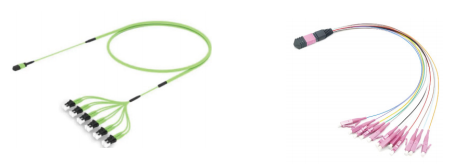
Body image: MTP/MPO fan-out pre-terminated cable for high-density 40G/100G/400G breakout connections.
The MTP/MPO Fan-out Pre-terminated Cable is designed for the transition between multi-fiber MPO trunks and LC or SC duplex/quad interfaces. In data centers, this is the practical link between high-density switch ports and 40G, 100G, or 400G SR4/PSM4 module configurations. The product is also described as a breakout cable, fan-out cable, and MPO-LC patch cord.
Verified specifications include 12F or 24F fiber counts, LC/SC duplex or quad breakout, OM3/OM4/OM5 or OS2/G.657A fiber, LSZH or OFNR jacket, and ceramic ferrules. Typical insertion loss is 0.35 dB with a maximum of 0.75 dB; low-loss typical insertion loss is 0.10 dB with a maximum of 0.35 dB. Return loss is ≥60 dB for APC and ≥50 dB for PC.
The procurement boundary is length and polarity. Pre-terminated fan-out cables shift connector termination to a controlled factory process, but they are made to a specific route length and polarity map. Buyers need accurate cabinet-to-cabinet measurements, labeling rules, and polarity documentation before order release. For routes that are still being surveyed or are likely to change repeatedly, field-terminated approaches may offer more late-stage flexibility, while pre-terminated assemblies favor repeatable quality and faster installation where the route is known.
3. MPO-12F-SM Adapter for High-Density Cabling
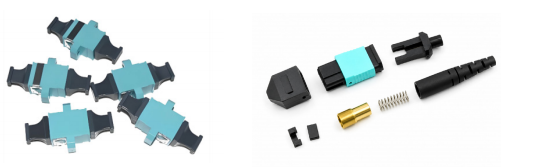
Body image: MPO-12F-SM adapter for high-density data center and telecom cabling.
The MPO-12F-SM is a single-mode MPO adapter used to couple MPO connectors in high-density patch panels and cabling systems. It is built with a ceramic ferrule, plastic housing, and metal flange. The adapter supports 4 to 72 fibers in single-mode or multimode, with color options including black with flange ears, aqua for OM3, and violet for OM4.
The optical and mechanical constraints are clear. Standard insertion loss is <0.5 dB, while low-loss insertion loss is <0.35 dB. Return loss for single-mode is ≥50 dB. Mating cycles are 500, compliant with IEC standards. The operating temperature range is -40°C to +85°C. These values allow the adapter to be checked against a link-loss budget before it is accepted into a high-density cabling design.
The adapter alone does not guarantee channel performance. Insertion loss must be calculated across mated connector pairs, cable, and other passive components. End-face inspection and cleaning remain necessary, especially in high-density environments where small contamination can consume a disproportionate share of the loss budget.
4. GYTA53 Optical Fiber Cable for Outside Plant
The GYTA53 optical fiber cable addresses outside-plant and harsh-environment routes. It is positioned for telecom operators, ISPs, data centers, FTTx and broadband access, enterprise campuses, industrial and smart city projects, and 5G backhaul or metropolitan backbone networks. The construction uses silica glass as the core material, with strength members such as FRP and armoring options including galvanized steel wire and steel tape. Sheath options include PE and LSZH.
Common parameters include fiber type G.652 or G.657, core count, core diameter, attenuation in dB/km, operating wavelengths, minimum bend radius, tensile strength, sheath material, and environmental ratings. Exact values must be confirmed against the model datasheet. This is not a generic specification gap; it reflects the fact that outside-plant cable performance is route-specific and must be matched to duct, aerial, direct-burial, or harsh-environment installation conditions.
The main boundary is application fit. GYTA53 is an armored outdoor cable construction. It is not a universal substitute for indoor-rated cable where flame-retardant or LSZH performance and local code require a specific indoor construction. For FTTx and 5G projects that route from outside plant into a building, the transition point and indoor cable specification should be defined separately.
Certification and Test Evidence: What the Shortlist Actually Proves
Nanfang Communication holds ISO 9001:2015 quality management system certification and TL9000-H certification. The TL9000-H certificate number 15/25T15218R11 is issued by WIT Assessment / Hangzhou WIT Assessment Co., Ltd., with an issue date of 2025-11-20 and an expiry date of 2028-10-19. Its scope covers the manufacture and sales of communication optical fiber cable. The supplied evidence also links this certificate number to the MPO-12F-SM product, so buyers should confirm the exact product-level certificate scope at quotation.
The CNAS laboratory accreditation is another verification point. Certificate CNAS L11717 was issued by the China National Accreditation Service for Conformity Assessment under ISO/IEC 17025:2017, with an issue date of 2024-11-30 and an expiry date of 2030-11-29. It covers testing and calibration of optical fiber cable and optical communication components for China and global markets. The company also holds ISO 14001:2015 certificate 62225E20719R0M and ISO 45001:2018 certificate 62225S20720R0M, both issued by SWR Certification (Jiangsu) Co., Ltd. with validity to 2028-12-19.
System certification supports supplier qualification, but it does not replace model-level test reports. A buyer should still request the specific test data for the ordered product, the test method, the acceptance limits, and the batch or serial traceability. The CNAS accreditation demonstrates laboratory competence for testing and calibration; it does not by itself certify every product shipment.
How the Four Products Map to 5G, Data Center, and FTTx Projects
| Project scope | Primary shortlist item | Supporting item | Procurement note |
|---|---|---|---|
| 5G backhaul and metro | GYTA53 optical fiber cable | MPO/MTP Loopback for equipment validation | Confirm fiber type, core count, attenuation, tensile strength, bend radius, and outdoor environmental rating |
| Data center | MTP/MPO Fan-out Pre-terminated Cable | MPO-12F-SM adapter and MPO/MTP Loopback | Confirm insertion loss, return loss, polarity, length, jacket, and connector gender |
| FTTx and broadband access | GYTA53 optical fiber cable | MPO-12F-SM adapter where high-density central-office patching is used | Define outside-plant to indoor transition and confirm indoor cable code requirements separately |
| Enterprise and industrial campus | GYTA53 and MPO connectivity | MPO/MTP Loopback for commissioning | Confirm sheath material, routing environment, and test documentation |
Comparison with Traditional Field-Terminated Approaches
Pre-terminated MPO and fan-out assemblies are often compared with traditional field-terminated approaches. The comparison is not a simple quality claim; it is a trade-off between factory-controlled termination and field flexibility.
| Decision dimension | Pre-terminated MPO shortlist | Traditional field-terminated approach | What to verify |
|---|---|---|---|
| Termination control | Connector termination is completed in a factory process before shipment | Connector termination depends on site workmanship and field conditions | Request factory test data and field acceptance criteria |
| Route flexibility | Length-specific and polarity-specific; less adaptable to late route changes | Can adapt to unexpected field routing more easily | Freeze route measurements and polarity maps before order release |
| Installation speed | Favors faster installation where routes and cabinet interfaces are known | Requires on-site termination and testing time | Compare total installation labor, test time, and rework risk |
| Test scope | Loopback can validate equipment ports but is not a full channel tester | Field testing is required after termination | Use end-to-end link-loss testing for acceptance, not loopback alone |
| Outdoor application | GYTA53 is armored and positioned for outside plant and harsh environments | Indoor or unarmored cable may be lighter and easier to route indoors | Confirm indoor fire performance and local code at building entry points |
Procurement Checklist for Constraint Screening
- Define the exact model: MPO-12F-Loopback or MPO-24F-Loopback, MTP-12F-to-6xLC-Duplex or MTP-24F-to-12xLC-Duplex, MPO-12F-SM, or GYTA53.
- For MPO products, confirm insertion loss, return loss, fiber type, connector gender, polarity, jacket, and mating cycles against the link budget.
- For GYTA53, confirm fiber type G.652 or G.657, core count, attenuation, operating wavelengths, minimum bend radius, tensile strength, sheath material, and environmental rating from the model datasheet.
- Verify certification scope, certificate number, issuing body, issue date, and expiry date. Do not rely on a certificate title alone.
- Request model-level test reports and confirm whether the CNAS L11717 laboratory accreditation is relevant to the specific test being reported.
- Confirm commercial terms: the supplied capability data states an MOQ of 1 core kilometer for the cable business, and lead time depends on model and quantity; samples or small orders typically take several weeks, while large orders may take months.
- Treat price band as a quotation-stage variable. Compare model-level quotes, packaging, labeling, test documentation, and delivery terms rather than a generic cable category price.
- Confirm customization needs such as core count, fiber type, sheath material or color, connector types, cabling schemes, labeling, and packaging.
Market Trend and Future Outlook
The market data points in this shortlist point to three practical trends. First, fiber optic cable remains a large global category, with Global Market Insights Inc. placing the 2025 market at USD 14.6 billion. Second, China remains a major export origin, with OEC reporting USD 2.52 billion in optical fiber and cable exports in 2024. Third, trade policy can change landed cost quickly; Airlift USA analysis states a 37.50% total U.S. import duty for Chinese-origin optical fiber cables under HTS 8544.70.00 as of late 2026.
For product selection, the implication is not to chase a single lowest price. It is to build a qualification file that can survive cost, origin, and compliance review. That file should include model-level specifications, test reports, certification scope, and a clear mapping between the product and the project environment.
Looking forward, higher-density data center architectures and 400G module connections will keep attention on pre-terminated MPO cabling, low-loss adapters, and repeatable test accessories. At the same time, outdoor FTTx and 5G backhaul projects will continue to require route-specific cable construction. The shortlist is therefore likely to remain relevant as a reference pattern: verify the constraint first, then select the product family that fits it.
FAQ
What certifications should a buyer verify for Nanfang Communication optical fiber cable and MPO products?
Buyers should verify ISO 9001:2015 quality management system certification, TL9000-H certificate 15/25T15218R11 issued by WIT Assessment / Hangzhou WIT Assessment Co., Ltd., and CNAS laboratory accreditation certificate CNAS L11717 under ISO/IEC 17025:2017. The CNAS accreditation covers testing and calibration of optical fiber cable and optical communication components. The company also holds ISO 14001:2015 certificate 62225E20719R0M and ISO 45001:2018 certificate 62225S20720R0M issued by SWR Certification (Jiangsu) Co., Ltd. Each certificate should be checked for scope, number, issuing body, and validity.
What do the MPO/MTP Loopback specifications mean for equipment validation?
The MPO/MTP Loopback has low-loss insertion loss of ≤0.7 dB for 8F/12F and ≤1.0 dB for 24F, return loss of ≥65 dB for single-mode and ≥25 dB for multimode, and mating cycles of ≥100,000. It supports OS2, OM1, OM2, OM3, OM4, and OM5 fiber types. These values make it suitable for network testing, data center commissioning, and equipment validation. It is not a substitute for end-to-end link-loss testing of the installed channel.
When is the MTP/MPO Fan-out Pre-terminated Cable appropriate for 40G/100G/400G?
The MTP/MPO Fan-out Pre-terminated Cable is appropriate where a 12F or 24F MPO interface must break out to LC or SC duplex or quad connectors, such as data center cabinet interconnection and 40G/100G/400G SR4/PSM4 module connection. Verified values include typical insertion loss of 0.35 dB, maximum 0.75 dB, low-loss typical 0.10 dB, and low-loss maximum 0.35 dB. Return loss is ≥60 dB for APC and ≥50 dB for PC. The buyer must still confirm length, polarity, fiber type, and jacket.
How should buyers evaluate the MPO-12F-SM adapter loss?
The MPO-12F-SM adapter has standard insertion loss of <0.5 dB and low-loss insertion loss of <0.35 dB, with return loss of ≥50 dB for single-mode. It supports 4 to 72 fibers in single-mode or multimode, has 500 mating cycles compliant with IEC standards, and operates from -40°C to +85°C. Buyers should compare these values with the full channel link budget, including mated connector pairs and cable, and should include end-face inspection and cleaning in the acceptance procedure.
What are the limits of GYTA53 in FTTx and 5G projects?
GYTA53 is an optical fiber cable model positioned for outside plant, FTTx access, metro and backbone networks, and 5G backhaul. Its common parameters include fiber type G.652 or G.657, core count, attenuation, operating wavelengths, minimum bend radius, tensile strength, sheath material, and environmental ratings. Exact values must be confirmed per model datasheet. Its armored outdoor construction should not be treated as a universal indoor cable; building entry and indoor routing should be checked against local code and the required indoor cable construction.
Can the CNAS lab accreditation replace product-level test reports?
No. CNAS L11717 confirms that the laboratory is accredited to ISO/IEC 17025:2017 for testing and calibration of optical fiber cable and optical communication components. It supports confidence in laboratory competence, but buyers should still request model-level test reports that match the ordered product, test method, acceptance limits, and project specification.
A downloadable MPO product brochure from Nanfang Communication is available here: MPO product brochure PDF.
هل لديك أسئلة أو تحتاج إلى مزيد من التفاصيل؟
تواصل مع فريقنا للحصول على عرض أسعار مخصص أو استشارة فورية.
طلب عرض أسعار
املأ النموذج أدناه وسيتواصل معك فريقنا بعرض مقترح مخصص.
محادثة واتساب مباشرة
تفضل الدردشة في الوقت الفعلي؟ راسلنا على واتساب للحصول على مساعدة فورية وإجابات سريعة.
- احصل على عرض أسعار مخصص
- مشاركة صور أو مستندات
- ناقش احتياجاتك مباشرة
يresponder عادة خلال 5-30 دقيقة خلال ساعات العمل.