
Recommended PP Woven Bags: 10–50 kg Powder, Feed, Cement
Recommended PP Woven Bags: 10–50 kg Powder, Feed, Cement
A 25 kg mineral powder sack and a 50 kg cement sack can both be quoted as "PP woven bags", yet they solve different problems. One has to keep fine dust from sifting through the fabric; the other has to survive a valve-filling spout on an automatic packer and then a pallet stack. Fill weight, particle size, filling equipment and closing method decide which construction belongs on a buyer's sample list long before unit price is discussed.
This article frames a recommended-options shortlist by cargo type and fill weight rather than by rank. Paper-plastic composite woven bags lead for dust-prone mineral powder, block bottom PP woven valve bags for cement and automatic filling, and open-mouth PP woven bags for feed and general granules. The specification detail is drawn from WenZhou BaiChuan Plastic Industry Co. , Ltd., a manufacturer based in Pingyang, Wenzhou, founded in 2009, whose product scope covers PP woven bags, color-printed valve bags and paper-plastic composite bags. The options below are presented as formats to verify against a specific cargo, not as claims that one construction outperforms another.
Why cargo type should set the shortlist, not the bag category
Most packaging problems in the 10–50 kg band start with a vague request: a woven bag, a size, a target price. That request can be answered with several very different constructions, because a woven polypropylene substrate is only the beginning. The same fabric can be sewn into an open-mouth sack, converted into a valve bag with a flat block bottom, or combined with a paper layer to create a paper-plastic composite surface. Each route changes how the bag is filled, how it is closed, how it behaves in a stack, and how much dust or moisture it lets through.
The practical consequence for an evaluation-stage buyer is that the bag should be chosen against the cargo, not against the category. A construction that performs well for free-flowing granules can be the wrong starting point for a fine powder that aerates during filling, and a bag built for a manual sewing line will not run on an automatic valve packer without changes. BaiChuan's own order checklist makes the same point: bag style, dimensions, colours, printing, valve or closing structure, lamination and liner options are all confirmed per order rather than assumed from a catalogue number.
The recommended options at a glance
The table below maps the three constructions to the cargo profiles where each is normally sampled first. It is a starting point for sampling, not a ranking of quality.
| Cargo profile | Format to sample first | Fill band | Filling and closing | Qualifier to confirm |
|---|---|---|---|---|
| Fine, dust-prone mineral powder | Paper-plastic composite woven bag | 10–50 kg, custom dimensions | Sewn top or valve; to be confirmed per order | Paper facing, PE liner or coating, dust behaviour in a fill trial |
| Cement and construction materials on automatic lines | Block bottom PP woven valve bag | Upper end of the 10–50 kg range | Valve filling; flat block bottom for stacking | Valve size against the filling spout, hot-valve sealing, UV stabilisation |
| Feed and general granules | Open-mouth PP woven bag | 10–50 kg, custom dimensions | Open top, sewn closure; handle option | BOPP lamination for print, liner, food-grade material option |
Option 1: Paper-plastic composite woven bag for dust-prone mineral powder
In the paper-plastic composite format, a paper-based layer is combined with the woven polypropylene substrate, so the outward-facing surface is paper rather than bare woven tape. For a fine mineral powder, that change addresses the most common complaint in the category: product sifting through the weave and settling on pallets, forklifts and warehouse floors.
The mechanism is straightforward. A plain woven fabric is an interlaced grid of flat PP tapes, and the gaps between those tapes are small but not closed. A fine powder with low particle size and a tendency to aerate during filling will find those gaps, and the same applies to stitch holes along the top closure. Bonding a paper layer over the fabric presents a more continuous surface, which is why the composite format is often specified where dust control matters as much as containment. BaiChuan lists paper-plastic composite bags as one of its three core product lines, produced within the same plant that handles weaving, laminating, printing and bag making.
Two boundaries should travel with that reasoning. First, the paper facing changes the surface, but seam construction, gusset design and top closure still determine how much escapes; a composite bag with a weak closure can still leak at the seam. Second, a paper layer is not a moisture barrier on its own. If the powder also has to be protected from humidity in transit or in an unheated warehouse, the specification normally pairs the composite structure with a PE liner or a coating, and that combination should be stated explicitly in the request rather than assumed.
The format also fits poorly in a few situations worth noting. Coarse, abrasive granules do not need a paper facing and gain little from it. Very wet or chemically aggressive contents are outside the intended use described for these bags, which are made for normal filling, pallet stacking and land and sea transport. And where the retail surface is the main requirement, a BOPP-laminated woven bag may be the more direct route, since the BOPP film provides a smooth printable surface.
Option 2: Block bottom PP woven valve bag for cement and automatic filling
A block bottom valve bag combines two construction features. The valve is a tube through which the bag is filled; it closes under the pressure of the contents once filling stops, so the bag can be filled through a spout rather than through an open top. The block bottom is a folded, flat base that gives the filled bag a roughly rectangular footprint and a stable standing position on a pallet.
For cement, dry mortar and mineral-based construction powders, that combination solves problems that a simple sewn sack leaves open. Valve filling contains the product at the spout instead of releasing it into the filling room, which matters for a powder that is both dusty and abrasive. Because the bag is filled through the valve, the closure is formed by the construction rather than by a sewing head, which removes one variable from the line. The block bottom then supports stacking: bags filled with dense construction material are heavy for their volume, and a flat base distributes that load more predictably than a pillow-shaped sack.
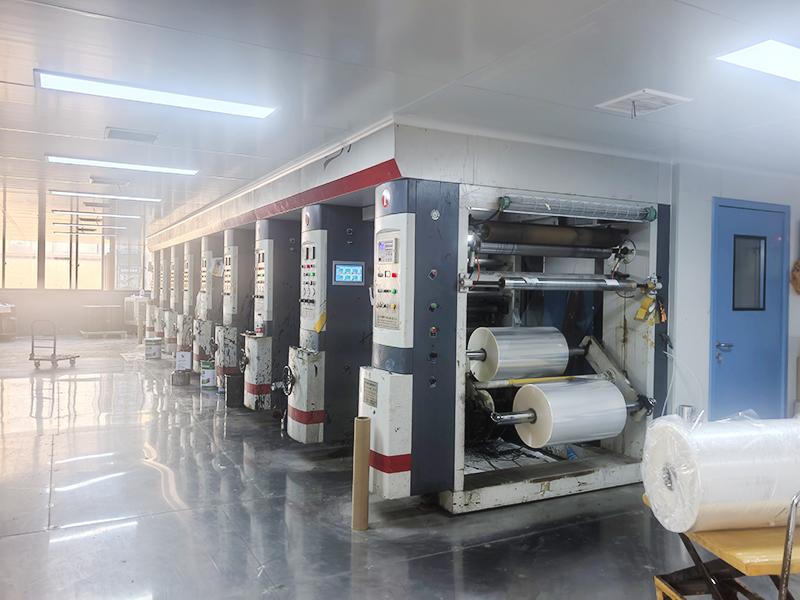
The fit boundary is equipment, not fabric. A valve bag has to match the filling spout it will run on, and valve geometry, bag dimensions and the filling machine are a single system. BaiChuan confirms valve or closing structure per order for exactly this reason, and the company's plant includes imported hot-valve sealing equipment for valve-bag production. Before committing to a bulk order, buyers should confirm the valve type against their own packer, and confirm whether the block bottom will be run on an automatic line or handled manually, since the two settings place different demands on the bag.
Where the material is a coarse granule rather than a fine construction powder, the valve bag's advantages shrink while its equipment requirements stay the same, which is why open-mouth sacks remain common in feed and general granule packing.
Option 3: Open-mouth PP woven bag for feed and general granules
The open-mouth PP woven bag is the simplest construction on the list. The bag arrives with an open top, is filled from above, and is then closed — typically by sewing, which is why filling lines for this format are usually described together with sewing equipment. For feed, grain and general granules, that simplicity is an advantage: fewer construction variables, straightforward filling, and a format that has a long record in agricultural and agricultural-input packaging.
Within the format, the meaningful choices are about presentation and protection rather than about the basic construction. A plastic handle or a valve can be specified at the top, and a block bottom can be added at the base, so the same open-mouth family can serve a retail shelf and a palletised bulk shipment. Color-printed woven sacks with handles are, for example, indicated for retail rice sales, while block bottom valve bags are positioned for palletised bulk shipment of the same product. Custom sizes and custom printing are available across the range.
The limitation follows from the closure. An open-mouth bag is only as sealed as its sewn seam, so stitch density, thread material and the load placed on the seam become the controlling factors. Common failure modes reported in damage analysis — seam burst from poor stitching density or improper thread, and bag splitting caused by sharp contents piercing the fabric — belong to this format as much as to any other. For fine, dust-prone powder, an open-mouth sack can work, but dust extraction at the filling head and closure quality then matter more than the bag's own construction.
Sizing across 10–50 kg fills: what custom actually covers
Custom sizing is a set of linked decisions, not a single dimension. BaiChuan's customization checklist asks buyers to confirm bag type, dimension, capacity, material, printing design, liner requirement and order quantity. Each of those has a physical consequence. Dimension and capacity decide how the bag behaves when filled, since the same 25 kg of material occupies very different volumes depending on bulk density. Material sets the fabric's starting point: the documented PP woven range covers 55–130 gsm and 650D–1500D tape denier, with 100% virgin PP or recycled PP available.
Load capacity is deliberately treated as a confirmation item rather than a fixed rating. A bag's practical load depends on the fabric used, the tape and weave, the seam construction, the density and sharpness of the contents, and the handling the filled bag will see — manual stacking, palletising, or a long sea freight leg. Buyers evaluating a 50 kg fill should therefore test at 50 kg with their own material rather than extrapolating from a 25 kg sample.
For a mixed programme, it is worth remembering that fill weight does not automatically dictate fabric weight. A 20 kg fill of a dense mineral powder can stress a seam more than a 40 kg fill of low-density feed, because the dense product loads a smaller fabric footprint and behaves differently under drop and vibration. This is the reason sample approval is normally tied to a specific product and fill weight, not to a general bag size.
Qualifiers that should be settled before sampling
Once a format is chosen, the qualifiers decide which version of that format should be sampled. Several of them are available across all three constructions.
- PE liner or PE coating. A PE liner is an available option on BaiChuan's PP woven bags and is the usual route to moisture protection for a hygroscopic powder. Where a bonded coating is preferred over a separate liner, the lamination or coating specification is confirmed per order; the two are not interchangeable and should be written as distinct line items in the request.
- BOPP lamination. A BOPP film gives the bag a smooth surface for printing and supports a moisture-protective build in combination with the liner or coating decision. It is a print-and-surface choice before it is a barrier choice, and buyers should confirm which of the two jobs it is doing for their material.
- UV stabilisation. A UV-stabilised version is available for outdoor storage, which matters for construction sites and yard storage where bags sit in daylight for weeks.
- Anti-slip surface treatment. Where pallets are stacked three or four high, or where bags travel on inclined conveyors, a surface treatment that raises friction between bags should be discussed as a specification item. Like the other qualifiers above, its availability and exact form are confirmed per order rather than assumed from the base product description.
- Material and food-grade status. Bags can be made from 100% virgin PP or recycled PP, with food-grade material optional. For feed and food-adjacent applications, the material route and the supporting documentation should be agreed before sampling, not after.
- Printing. The documented range covers 1–8 colours by gravure or flexo, with custom logo, text and artwork supported. Vector files such as AI, PDF and CDR are preferred, because raster artwork degrades on a woven or laminated surface.
Sample review: what a 10–50 kg trial should show
A sample is only useful if it is tested the way the bag will be used. BaiChuan's sample policy is clear: blank simple samples are free, custom printed samples incur a sample cost, and sample freight is normally at the buyer's side, with the sample charge refundable when the bulk order reaches the agreed MOQ of 3,000 bags. That policy makes an unstructured sample round expensive, so it is worth defining the checks first.
- Filled shape at the target weight. Fill the sample with the real product at the real fill weight and confirm that the bag stands, stacks and closes as expected.
- Fabric and tape consistency. Confirm the delivered GSM and denier against the agreed specification, since these two values drive both strength and cost.
- Seam and closure integrity. Inspect stitch density and thread on sewn tops, and the valve seal on valve bags. This is the area where most field failures originate.
- Dust behaviour. Fill a fine powder, then handle and stack the bag and look for product on the outside surface, particularly along seams and gussets.
- Print and lamination quality. Check registration, ink adhesion and surface finish against the approved artwork.
- Handling and storage simulation. Drop the filled bag, stack it to the intended height, and leave it in the storage conditions the shipment will actually face.
Damage-response questions to settle before the first order
Damage policy is easier to agree before a shipment than after one. BaiChuan's documented position is that where bag damage is caused by quality issues, the sales team visits the customer's factory on site to provide solutions, and bags that cannot be resolved are subject to a deduction in payment. Buyers should confirm how that process works in practice, because it depends on evidence.
The evidence steps are documented and worth rehearsing internally. Take clear photographs of the damaged area together with the batch mark and packaging information, separate defective bags from qualified stock, and send the evidence to the sales contact for evaluation. That sequence protects both sides: it identifies whether the failure is a manufacturing issue or a handling issue.
Some causes sit outside the bag. Damage analysis lists cracks or splits in the woven body as possible results of insufficient tensile strength in the PP raw material, tape that is too thin, or sharp goods piercing the fabric from inside; seam bursts as a result of poor stitching density, improper thread, or loading beyond the bag's rated capacity; and surface holes as a consequence of friction against sharp edges. Overloading beyond the rated load is explicitly flagged as a risk to avoid, and sharp contents should be wrapped before packing.
Storage conditions belong in the same conversation. BaiChuan's application guidance describes a continuous working temperature range of −10 °C to 50 °C, storage in a dry, ventilated warehouse, and unsuitability for long soaking in water where no liner or coating is used. Its case documentation notes that PP woven bags can be stored in a cool place for up to 2–5 years, while direct sunlight may degrade them within months; the UV-stabilised version exists for outdoor storage. Buyers with yard storage should raise that exposure in the request rather than discovering it after delivery.
Market context worth factoring into the specification
Two external data points help explain why laminated and composite formats now sit at the centre of most shortlists. Global production of PP woven bags exceeded 10 billion units in 2023, with China manufacturing more than 7 billion of that total, according to Market Reports World (published August 2025). In the same dataset, laminated PP woven bags accounted for 54.5% of total global market volume in 2023 — which places lamination in the mainstream of the category rather than at its decorative edge, and makes the BOPP versus coating versus liner decision a routine part of specification work.
Cost input is the other factor. Polypropylene was quoted at 9,461 CNY per tonne on 10 November 2026, a 47.32% year-on-year increase, according to Trading Economics. Interpreted carefully, that does not tell a buyer what a bag should cost; it tells them that the resin-linked share of the price is volatile, so a quotation with a stated validity period and an agreed adjustment basis is more useful than a single fixed number held open indefinitely. On quality reference, China's GB/T 8946-1998 covers technical requirements, inspection rules and classification for PP woven bags and remains a commonly cited framework for Chinese supply.
What BaiChuan documents, and what it does not
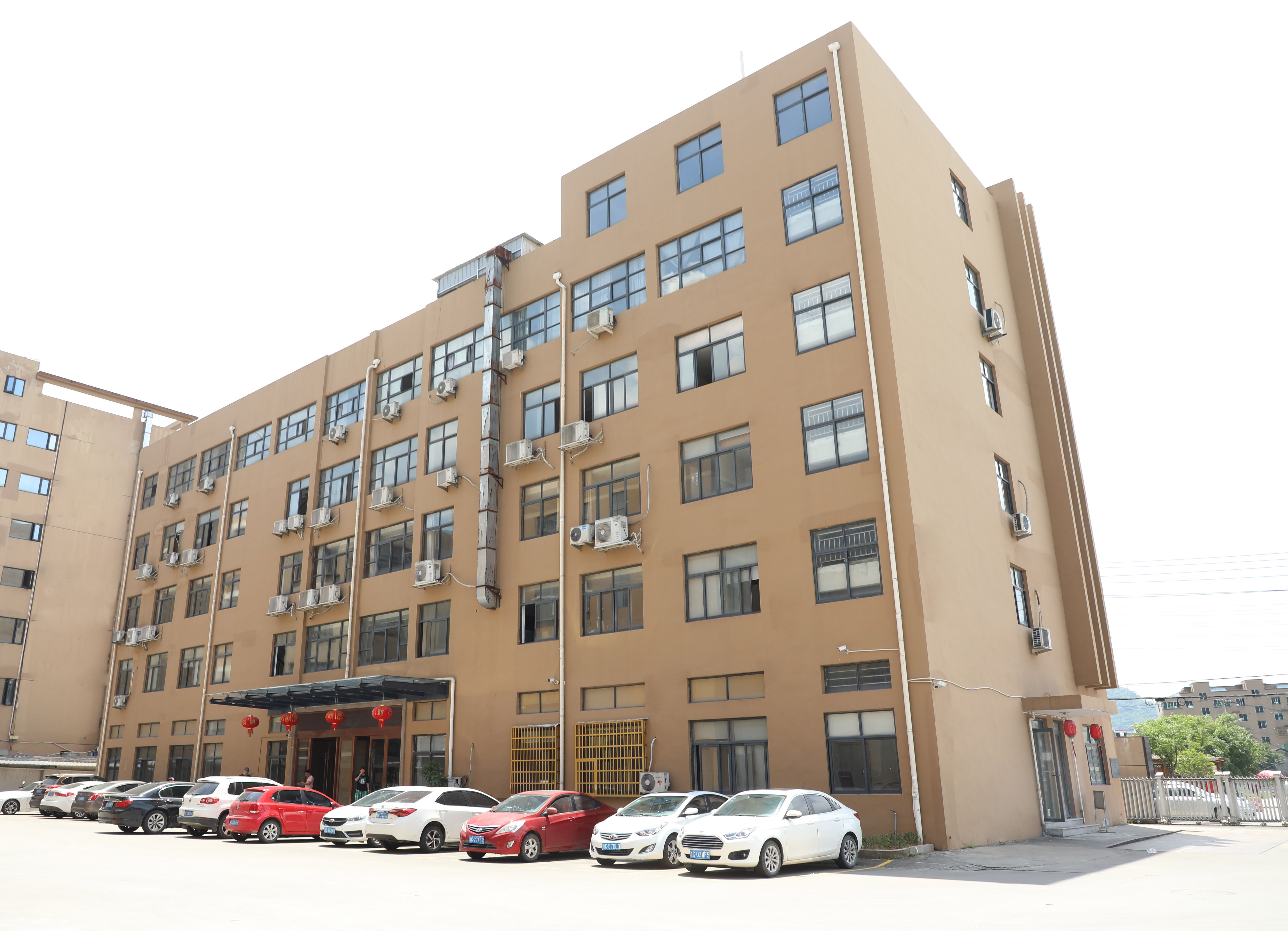
For buyers building a shortlist of suppliers alongside a shortlist of formats, the supplier's documented capability is best read as a set of verifiable facts plus a set of questions. WenZhou BaiChuan Plastic Industry Co. , Ltd. reports a 20,000 m² plant, 100 employees including 5 engineers, annual output of 90,000,000 bags, monthly capacity of 7,500,000 bags, a MOQ of 3,000 bags and lead times of 15–45 days. Production is described as covering the full chain from yarn drawing and circular weaving through laminating and colour printing to finished bag making, using more than 100 sets of machines including imported hot-valve sealing equipment. The company holds S&T-based SME qualification and describes a quality system with raw-material inspection, in-process monitoring and finished-product testing per batch.
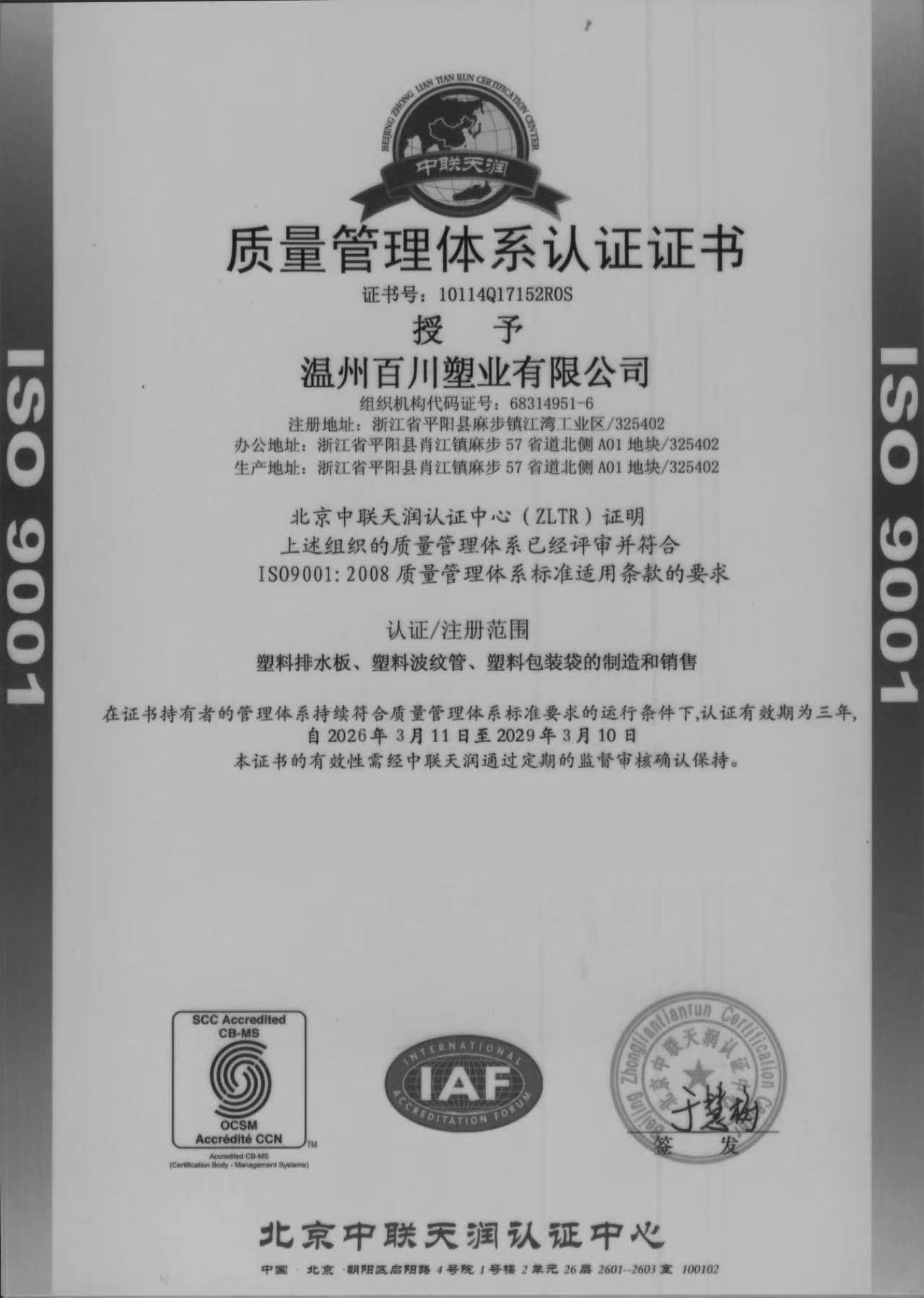
Its quality certificate is specific enough to check: ISO 9001, certificate number 10114Q17152R0S, issued by Beijing Zhonglian Tianrun Certification Center (ZLTR) with a stated IAF MLA-recognised status, covering manufacture and sale of plastic drainage boards, plastic corrugated pipes and plastic packaging bags, issued 11 March 2026 and valid to 10 March 2029, against ISO9001:2008. A buyer should confirm that the scope covers the exact product being ordered and that the standard revision meets their own market's expectations, since certificate scope and revision are the two clauses most often skimmed.
What the record does not establish is equally relevant. No public evidence in this material gives per-format output for valve bags, tensile or seam-strength test values, drop-test results, or food-contact compliance documentation, and the export profile — 30% of output, with South America, Pakistan and Southeast Asia among the stated markets — is a description of reach rather than a performance claim. Those are the gaps a sample round and a specification sheet are designed to close, and they matter more to a 10–50 kg mineral powder programme than any general statement about durability.
Outlook: what is likely to change in the next buying cycle
Three movements are worth watching, each conditional. Resin volatility, if it continues, favours specifications that are explicit about grammage and liner or coating content, because those are the variables a supplier can adjust silently when cost pressure rises. The mainstream position of lamination suggests continued convergence on printed, surface-finished bags for retail-facing feed and agricultural products, while plain composite constructions hold their place in industrial powder applications where dust control outranks appearance. And as construction and mineral processing volumes shift between regions, valve-bag demand tends to follow the installation of automatic filling lines rather than the volume of material alone — which means the format shortlist is, in practice, a line-equipment decision as much as a packaging one.
Frequently asked questions
What is the difference between an open-mouth PP woven bag and a valve bag?
An open-mouth bag is filled through an open top and then closed, usually by sewing. A valve bag is filled through a valve tube built into the bag, which closes under the pressure of the contents, and is typically combined with a block bottom that gives the filled bag a flat, stackable base. The valve format depends on matching the bag to valve-filling equipment; the open-mouth format depends more heavily on seam quality.
Which bag format suits a fine mineral powder in 10–50 kg fills?
A paper-plastic composite woven bag is normally sampled first, because the paper-based layer presents a more continuous outer surface than bare woven fabric and is therefore specified where dust sifting is the main concern. Where humidity protection is also required, the composite structure is paired with a PE liner or a coating. Final selection should follow a fill trial with the actual powder, since seam and gusset construction also affect leakage.
Are samples available before a bulk order?
Yes. BaiChuan supplies samples across its PP woven bag, valve bag, rice bag, fertilizer bag and laminated packaging ranges so buyers can check material texture, printing effect, size and workmanship. Blank samples without custom printing are free of charge; custom printed samples incur a sample cost, and sample freight is normally at the buyer's side. The sample charge can be refundable when the bulk order reaches the agreed MOQ.
What should we do if bags arrive damaged?
Identify the damage type first. Splits in the woven body can indicate raw-material tensile strength, tape thickness or sharp contents; seam bursts usually relate to stitching density, thread or overloading; surface holes often come from friction against sharp edges. Then take clear photographs with the batch mark and packaging information, separate defective bags from qualified stock, and send the evidence to the supplier for evaluation. BaiChuan's stated process is an on-site visit by the sales team where damage is caused by quality issues, with unresolved bags subject to a payment deduction.
How long can PP woven bags be stored, and what shortens their life?
BaiChuan's documentation states that PP woven bags can be stored in a cool place for up to 2–5 years, while direct sunlight may cause deterioration within months, and that a UV-stabilised version is available for outdoor storage. The stated working range is −10 °C to 50 °C in a dry, ventilated warehouse, away from open flame and strong corrosive chemicals; bags without a liner or coating are not intended for long soaking in water.
BaiChuan's full packaging specification, format and printing options are compiled in its product catalogue, which is available for public download. Specification questions, artwork submissions and sample arrangements are handled through the company's sales contact, Deborah, at sales@bcpockets.com or +86 183 2421 5901.
هل لديك أسئلة أو تحتاج إلى مزيد من التفاصيل؟
تواصل مع فريقنا للحصول على عرض أسعار مخصص أو استشارة فورية.
طلب عرض أسعار
املأ النموذج أدناه وسيتواصل معك فريقنا بعرض مقترح مخصص.
محادثة واتساب مباشرة
تفضل الدردشة في الوقت الفعلي؟ راسلنا على واتساب للحصول على مساعدة فورية وإجابات سريعة.
- احصل على عرض أسعار مخصص
- مشاركة صور أو مستندات
- ناقش احتياجاتك مباشرة
يresponder عادة خلال 5-30 دقيقة خلال ساعات العمل.