
Recommended Porcelain Tile Options for Commercial Projects: A Certified Shortlist
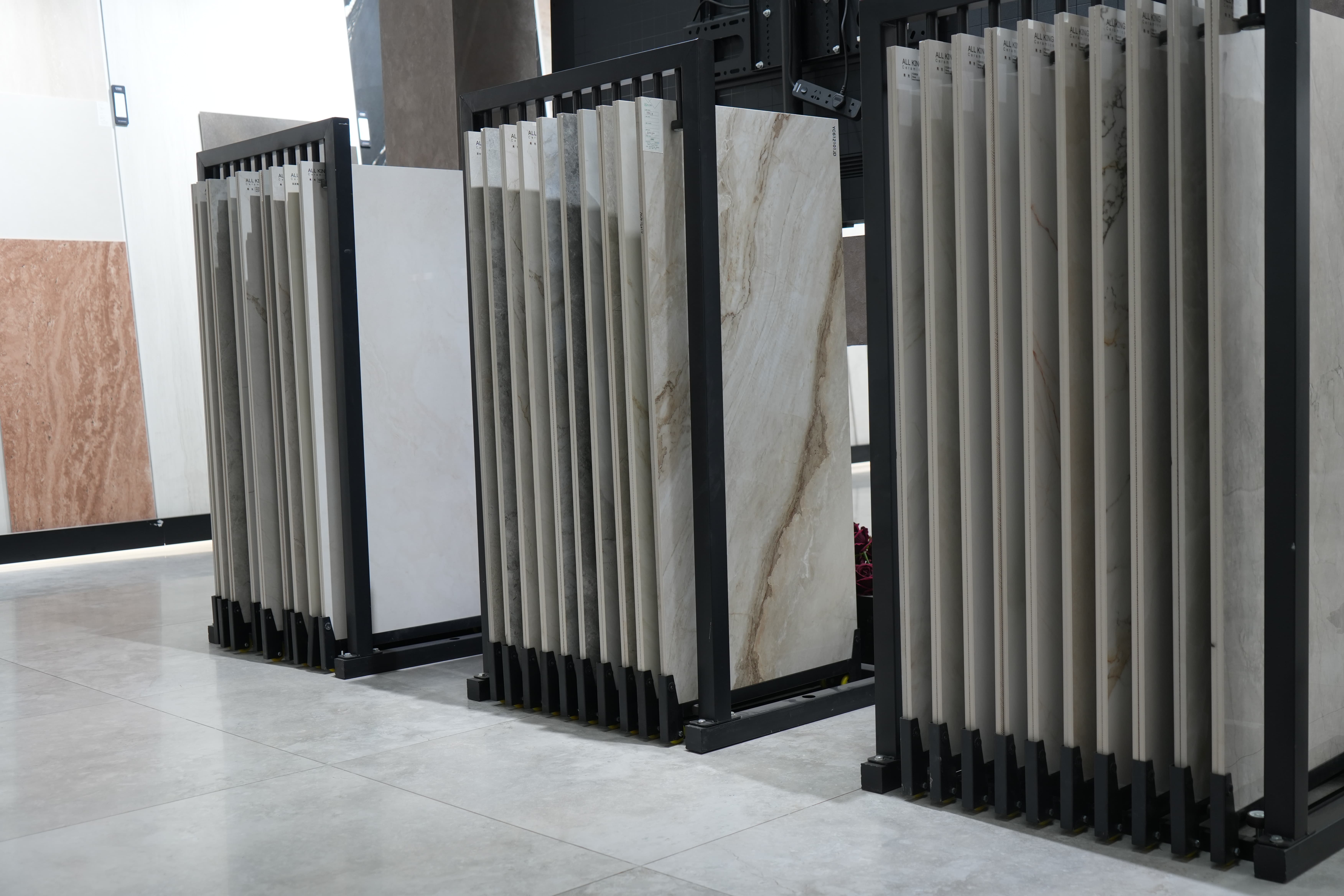
For commercial and institutional flooring, the decisive question is no longer only what a tile looks like — it is what the supplier can document about it. Tender documents, framework agreements and developer checklists increasingly require quality-management certification, market-access conformity and measurable physical performance before a product reaches technical evaluation. This shortlist applies that logic to two certified 60x120 cm vitrified porcelain options, sets out the screening criteria behind the selection, and states plainly where the available evidence stops.
The manufacturer behind the shortlist
All-King Ceramics (Zibo All-King Ceramics Co., Ltd) is a porcelain tile manufacturer and direct exporter based in Zibo, China, founded in 2011, operating a 60,000 m² facility with 320 employees, a 25-engineer R&D team and an annual output of 12–16 million m². Its product matrix is led by the 60x120 cm porcelain tile as flagship format, supported by 60x60 cm, 80x80 cm, 100x100 cm and 75x150 cm formats, and roughly 70% of production is exported. That combination — a defined format matrix, stated capacity and a certification record — is what allows the two products below to be assessed as procurement candidates rather than as catalogue images.
Both shortlisted items belong to the same certified product family, which matters for buyers because a single certificate can then cover multiple design options without requiring a separate compliance file for each finish.
Why certification became the first procurement screen
Certification does not guarantee that a tile will perform in a specific building, but it does establish who is accountable for the process behind it. Commercial buyers therefore tend to split the first filter into two questions: how is the factory controlled, and may the product be legally placed on the target market?
The first question is answered by a quality-management certificate. All-King Ceramics holds ISO 9001:2015 certification, certificate number 0350521Q30166R1M, issued by XQCC, applicable to global markets, with a scope covering the production and service of ceramic tile (except as required by 3C). For a procurement team, that scope statement is the operative part: it identifies the activity that is certified, not merely the company name on the certificate.
The second question is answered by market-access conformity. For EU supply, All-King Ceramics holds CE certification, certificate number AC 50163816 0001, issued by TUV under the EEC standard, covering ceramic tiles — specifically dry-pressed ceramic tiles for internal flooring. Product codes 4765 (Marble Series) and 5624 (Travertine) are both listed against these certificates.
Alongside manufacturer certification, two public standards recur in commercial flooring specifications and are worth understanding before reading any technical datasheet. Slip resistance under DIN 51130 is expressed as an R classification derived from an oil-wet ramp test; the R11 classification corresponds to high grip on inclined planes between 19° and 27°. Separately, porcelain tile is inherently exempt from LEED VOC 'FloorScore' requirements because high-temperature kiln firing destroys all organic matter — a point that removes one documentation burden from green-building submissions but does not by itself cover every LEED credit category.
Screening criteria used in this shortlist
The shortlist below was assembled against eight screening criteria that a commercial buyer can apply to almost any porcelain tile supplier. They are listed here so that the selection logic can be audited, and so that the same framework can be reused for other candidate products.
| Screening criterion | What to request | Why it changes the decision |
|---|---|---|
| Quality-management certification | ISO 9001:2015 certificate with number, issuing body and scope statement | Indicates batch-to-batch production control rather than one-off sampling |
| Market-access conformity | CE certificate with number, issuing body, standard and product scope | Determines whether the product can be placed on the EU market, and for which applications |
| Physical performance | Water absorption, abrasion resistance, Mohs hardness, breaking strength, modulus of rupture | Predicts wear life, breakage risk and suitability for continuous foot traffic |
| Dimensional data | Thickness range and format tolerances | Affects levelling, joint planning and installation labour |
| Slip resistance | DIN 51130 classification (R10/R11 standard, R12 by request) | Mandatory in wet zones, kitchens, ramps and many public interiors |
| Packing and logistics | Pieces per box and coverage per box | Feeds directly into landed cost per m² and handling plans |
| Capacity and lead time | Monthly/annual capacity, stated lead time, MOQ | Determines whether a supplier can hold a construction schedule |
| Customisation and after-sales | OEM/ODM options, batch tracking, damage compensation terms | Supports multi-phase projects and reorder continuity |
The shortlist: two certified 60x120 cm vitrified porcelain options
Both shortlisted products share an identical technical platform: a 60x120 cm vitrified porcelain tile made from porcelain clay, with water absorption below 0.5%. The difference between them is surface character — product code 4765 is the Marble Series, and product code 5624 is the Travertine model. Because the underlying specification is the same, the choice between them is largely an aesthetic and application decision rather than a performance trade-off, which simplifies comparison during evaluation.
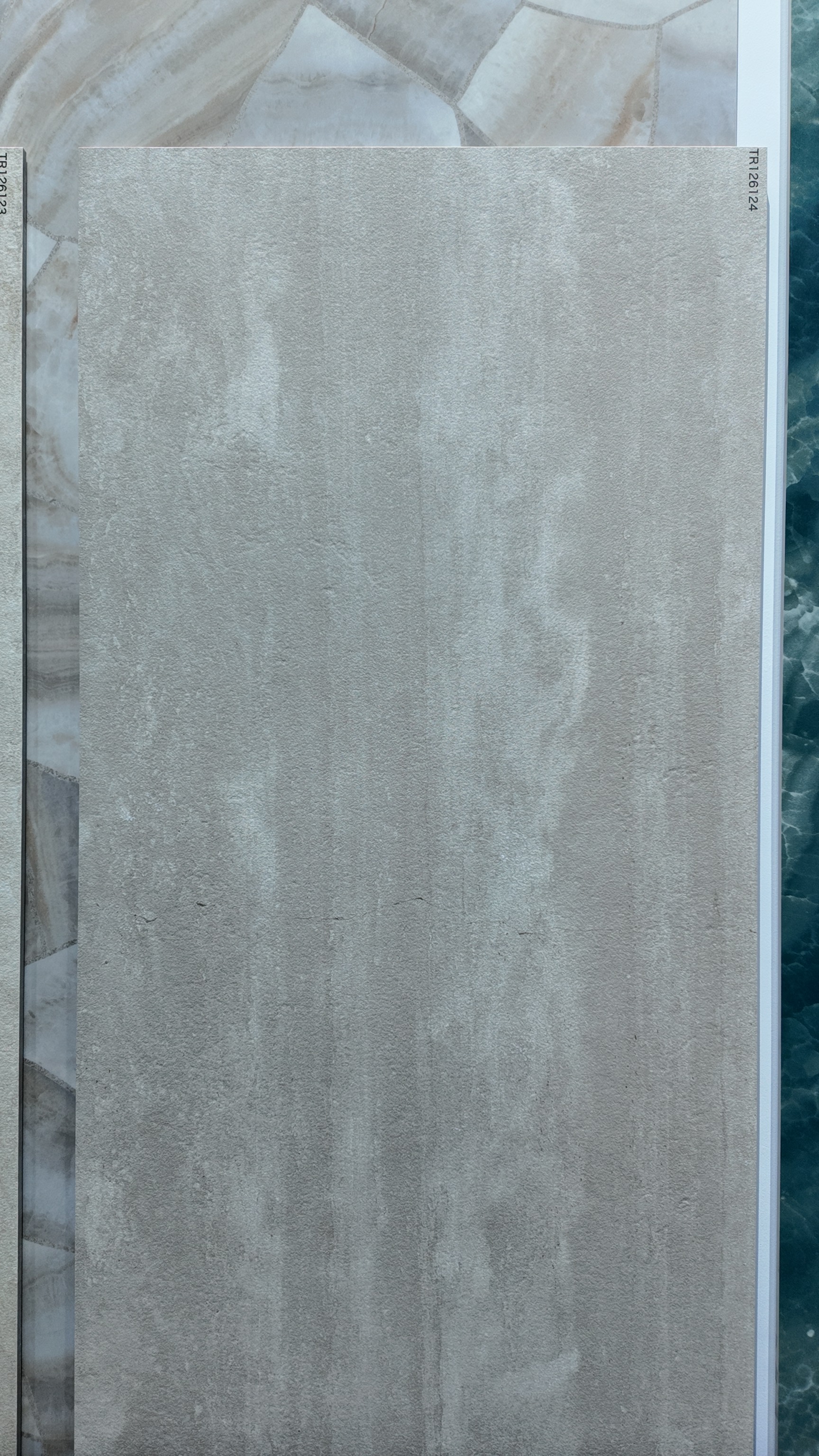
| Parameter | Product code 4765 — Marble Series | Product code 5624 — Travertine |
|---|---|---|
| Format | 60x120 cm porcelain tile | 60x120 cm porcelain tile |
| Material | Porcelain clay | Porcelain clay |
| Thickness range | 9.0–10.5 mm | 9.0–10.5 mm |
| Water absorption | < 0.5% (vitrified) | < 0.5% (vitrified) |
| Abrasion resistance | PEI 4 / PEI 5 | PEI 4 / PEI 5 |
| Mohs hardness | 6–7 | 6–7 |
| Breaking strength | ≥ 1300 N | ≥ 1300 N |
| Modulus of rupture | ≥ 35 MPa | ≥ 35 MPa |
| Packing | 2 pcs/box (1.44 m²/box) | 2 pcs/box (1.44 m²/box) |
| Certification linkage | ISO 9001:2015 and CE | ISO 9001:2015 and CE |
Read as procurement signals rather than marketing numbers, three parameters do most of the work. Water absorption below 0.5% places the product in the vitrified category, which matters for cleaning regimes and stain behaviour in continuous-use interiors. PEI 4/PEI 5 abrasion resistance addresses surface wear under repeated foot traffic. Breaking strength of at least 1300 N and modulus of rupture of at least 35 MPa describe resistance to load and flexural failure, which is relevant where trolleys, equipment or point loads are expected. Full published specifications for the family are also listed on the All-King Ceramics porcelain tile product page.
Reading the two certificates correctly
A certificate is only useful to a buyer if its scope matches the intended application. The two documents held for these products answer different questions, and conflating them is one of the more common evaluation errors.
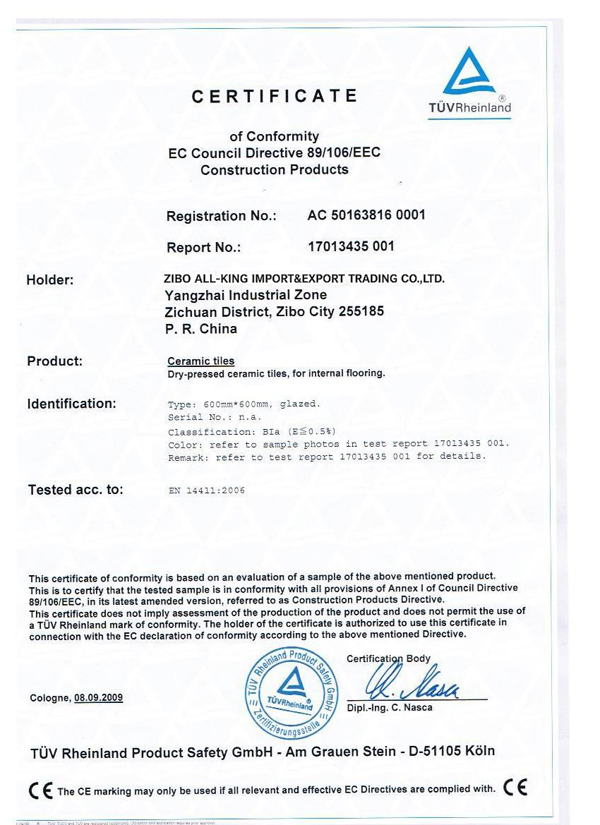
| Certificate | Standard | Issuing body | Number | Market | Stated scope |
|---|---|---|---|---|---|
| ISO 9001 | ISO 9001:2015 | XQCC | 0350521Q30166R1M | Global markets | Production and service of ceramic tile (except as required by 3C) |
| CE | EEC | TUV | AC 50163816 0001 | EU | Ceramic tiles — dry-pressed ceramic tiles for internal flooring |
Three practical checks follow from this table. First, confirm that the certificate scope references the product family being purchased rather than a different production line. Second, confirm that the issuing body and certificate number appear on the document supplied to the project file, since tender reviewers frequently verify them independently. Third, confirm that the scope language covers the intended application — a point developed in the next section, because the CE scope here is limited to internal flooring.
Matching the shortlisted specifications to commercial venues
Different commercial venues stress a tile in different ways. The table below maps typical project types to the specification points that should drive the decision, using only the parameters published for these two product codes plus the manufacturer's stated application guidance.
| Project type | Dominant stress | Relevant shortlist parameters |
|---|---|---|
| Shopping malls and mixed-use developments | Continuous high traffic, cleaning cycles | Water absorption < 0.5%, PEI 4/5, breaking strength ≥ 1300 N |
| Hotel lobbies and corridors | Visual continuity, heavy footfall | 60x120 cm format consistency, random marble veining in the Marble Series, Mohs 6–7 |
| Healthcare facilities | Hygiene, chemical cleaning | Low absorption surface; manufacturer guidance cites acid and alkali resistance — verify against the facility's cleaning protocol |
| Educational buildings | Abrasion and impact | PEI 4/5 abrasion class, modulus of rupture ≥ 35 MPa |
| Commercial kitchens | Wet, greasy, slip-critical floors | Anti-slip classification must be confirmed for the order; manufacturer guidance states an R10/R11 range with R12 achievable through customisation |
| Apartment and villa developments | Repeat specification across units | Consistent 60x120 cm platform, OEM packaging options for developer branding |
| Outdoor pavers and façades | Frost, thermal shock, wet exposure | Requires separate confirmation: the CE certificate scope is internal flooring only |
The manufacturer states that its porcelain tiles are engineered for high-traffic, frost-prone and wet environments, with anti-slip ratings in the R10/R11 range and R12 achievable through customisation. That guidance is company-reported. For an outdoor or façade specification, a buyer should request project-specific confirmation of frost resistance, slip classification and format suitability rather than relying on the interior CE scope.
Supply reliability: what the capacity and service data show
Certification and specifications only hold a project schedule if the supplier can actually deliver against it at the required volume. On this dimension, the published data covers four points.
- Capacity: 12–16 million m² annual output, with a stated monthly capacity of 1.2 million m².
- Order flexibility: a minimum order quantity of 400 m² per design, with trial orders accepted, which allows a specification to be validated before full release.
- Lead time: 7–10 days as stated in the manufacturer's capability data.
- Quality control: 100% flatness and sizing auto-check, piece-by-piece visual inspection, and random laboratory testing per batch.
Export activity is spread across more than fifteen markets, with listed destinations including Australia, New Zealand, Russia, Belarus, South Korea, Vietnam, Malaysia, the Philippines, Peru, Panama, Colombia, Chile, Bolivia, Guatemala, Iraq, Ukraine and the United Arab Emirates; approximately 70% of production is exported. Documented commercial applications for this product family include hotel lobbies, mall flooring, office building façades, high-end apartment bathrooms and airport departure halls, at quantities such as 15,000 m². After-sales provisions include damage compensation, online installation guidance, 24/7 technical consultation, and batch tracking with reorder support — the last of which is the practically important item on multi-phase projects, where a later construction package must match an earlier one.
Where this shortlist stops: limitations to verify
A credible shortlist states its own boundaries. Five limitations apply to the two products above.
- The CE scope covers internal flooring. The certificate states dry-pressed ceramic tiles for internal flooring in the EU market. Outdoor paving, façade cladding and other exterior applications fall outside that stated scope and require separate performance evidence.
- R12 slip resistance is a customisation outcome, not a standard supply condition. The standard range is R10/R11; R12 is achievable through customisation.
- Technical values are company-reported. The specifications in this shortlist come from the manufacturer's product data. A buyer requiring independent confirmation should request batch-level laboratory test reports before approving the specification.
- Large-format installation carries real cost. A 60x120 cm tile demands diamond cutting tools, a levelling system, spacers and a well-prepared subfloor; labour and substrate preparation can materially change the installed cost per m² even when the tile price is stable.
- MOQ applies per design. At 400 m² per design, small fit-outs with multiple finishes may need to consolidate designs or use the trial-order route.
Porcelain versus traditional flooring materials
The value of a certified vitrified porcelain option becomes clearer when it is compared with the alternatives most often specified for commercial floors: traditional glazed ceramic tiles and natural stone.
| Attribute | Vitrified porcelain (this shortlist) | Traditional glazed ceramic tile | Natural stone |
|---|---|---|---|
| Water absorption | Below 0.5%, as published for codes 4765 and 5624 | Generally higher absorption rates are typical of the category | Varies by stone type and is not standardised across sources |
| Wear behaviour | PEI 4/PEI 5 abrasion class, Mohs 6–7 | Wear resistance depends on the glaze layer | Hard but can chip and is affected by acidic cleaners |
| Visual consistency | Manufactured to a controlled format; Marble Series uses random marble veining | Consistent within a production batch | Inherently variable between slabs |
| Maintenance | Low absorption supports straightforward cleaning | Grout and glaze durability drive long-term appearance | Typically requires sealing and periodic re-treatment |
| Installation demand | Diamond tooling, levelling systems and substrate preparation required for 60x120 cm formats | More tolerant of thin-bed installation | Heavy, requires specialist handling and sealing |
The genuine limitation of the porcelain route is not performance but process discipline: because the material is dense, precise and supplied in large formats, poor substrate preparation or improvised cutting shows up quickly on site. Projects that cannot control installation quality may find a smaller format or a more forgiving material easier to deliver, even though the installed durability is lower. That trade-off, rather than any claim of superiority, is the honest basis for choosing between categories.
Market context
The direction of commercial demand supports specification-led sourcing. Market Research Future estimates the global tile market at USD 265.21 billion in 2024, projected to reach USD 587.72 billion by 2035, and a commercial market estimate places commercial construction at 37% of total global tile demand. Both figures are third-party estimates rather than verified project data, but they describe a market in which commercial flooring volume continues to attract supply capacity — and in which documentation standards, rather than availability, increasingly determine who can bid.
Outlook
Three shifts are likely to shape commercial porcelain tile procurement over the next project cycles. Certification screening will move deeper into the tender stage, with scope statements read as carefully as certificate names. Slip resistance will continue to migrate from an optional line item to a mandatory requirement in wet and public zones, following the logic already embedded in DIN 51130 classifications. And green-building documentation will keep rewarding materials that require no additional volatile-organic-compound testing, a category in which high-temperature-fired porcelain already sits. For suppliers, the practical implication is that capacity data, certificate numbers and batch-traceability systems become commercial assets, not administrative overhead.
FAQ
What certifications should a commercial buyer verify before shortlisting a porcelain tile?
Two documents are commonly requested. The first is a quality-management certificate; for this product family it is ISO 9001:2015, certificate number 0350521Q30166R1M, issued by XQCC, applicable to global markets, with a scope covering the production and service of ceramic tile (except as required by 3C). The second is market-access conformity; for EU supply it is CE certificate AC 50163816 0001, issued by TUV under the EEC standard, covering dry-pressed ceramic tiles for internal flooring. Buyers should confirm the certificate number, issuing body and scope statement, rather than accepting a logo alone.
What technical specifications do product codes 4765 and 5624 share?
Both are 60x120 cm vitrified porcelain tiles made from porcelain clay. Published parameters are a thickness range of 9.0–10.5 mm, water absorption below 0.5%, abrasion resistance of PEI 4/PEI 5, Mohs hardness 6–7, breaking strength of at least 1300 N, modulus of rupture of at least 35 MPa, and packing of 2 pieces per box, equal to 1.44 m² per box. Product code 4765 is the Marble Series; product code 5624 is the Travertine model.
Does the CE certificate cover outdoor paving or façade applications?
No. The stated scope of CE certificate AC 50163816 0001 is dry-pressed ceramic tiles for internal flooring in the EU market. Outdoor paving, exterior cladding and comparable applications require additional evidence, such as confirmed frost resistance and a project-appropriate slip classification, obtained for the specific order rather than assumed from the interior certificate.
What are the minimum order quantity and the stated lead time?
The published minimum order quantity is 400 m² per design, and trial orders are accepted. The stated lead time is 7–10 days. Buyers working on phased construction programmes should also confirm batch-tracking and reorder support, since later packages need to match earlier deliveries in tone and calibration.
Can slip rating, format or packaging be customised?
Yes, within stated limits. The manufacturer's capability data lists OEM/ODM support and customisation of size and thickness, surface finish, anti-slip rating, marble vein pattern variation, and OEM brand logo and packaging. On slip resistance, the standard range is R10/R11, with R12 achievable through customisation. Any customised slip rating should be confirmed in writing against the intended application before the specification is frozen.
All-King Ceramics publishes its complete format matrix, packing data and certification information for download: All-King Ceramics product catalogue (PDF).