
Recommended Pressure Control Switch Shortlist: Domestic, Irrigation and Constant-Pressure Options
Recommended Pressure Control Switch Shortlist: Domestic, Irrigation and Constant-Pressure Options
A useful pressure control switch shortlist begins with the pump duty, not with a single overall winner. For domestic water systems, agriculture irrigation and constant-pressure monitoring, the selection cues differ: starting pressure has to match pump lift, maximum power has to match the motor, and the enclosure and connection details have to fit the installation. This application-based shortlist covers three Monro Switch options — EPC-1.1 for domestic water systems, EPC-2 for irrigation, water treatment and construction, and EPC-3 for constant-pressure monitoring — with a buyer checklist for matching the specification to common pump setups.
Monro Switch, the brand of ZHEJIANG MONRO MACHINERY & ELECTRONIC CO.,LTD, is a Wenling-based manufacturer of pump controllers, pressure switches and float switches. The shortlist below uses the supplied model descriptions and approved certificate records. It is not a claim that one model is universally better than another; the three entries serve different operating roles, and the correct choice depends on the pump, the pipework and the conditions at the installation.

Manufacturing environment for pressure control products. Image: Monro Switch workshop.
Why an application shortlist is more useful than a single ranking
Pressure control switches are often discussed as if they were interchangeable relays. In practice, the evaluation criteria change with the job. A domestic booster set needs a starting pressure that matches the building's water-use height and a controller that can protect the pump when the water supply runs dry. An irrigation or construction installation may need a different voltage, a higher motor rating and a starting-pressure setting that suits a longer suction or delivery line. A constant-pressure application needs a readable pressure reference and voltage flexibility during commissioning.
The shortlist therefore separates three decision paths. EPC-1.1 is positioned for domestic water systems. EPC-2 is positioned for agriculture irrigation, water treatment and construction, with EPC-2.1 offering voltage, power and starting-pressure options. EPC-3 is positioned for constant-pressure monitoring, with a pressure gauge and triple-voltage capability. These are application roles from the supplied product material, not a forced 1-2-3 ranking of overall quality.
Shortlist at a glance
| Application focus | Shortlisted option | Verified configuration cues | Main checks before selection |
|---|---|---|---|
| Domestic water systems | EPC-1.1 | Adjustable 1.5–3.0 bar range; IP65 rating; built-in check valve; run-dry protection; plastic and metal construction | Start pressure against pump lift and maximum water-use height; pump motor power; voltage and frequency; connection thread; installation environment |
| Agriculture irrigation, water treatment and construction | EPC-2 / EPC-2.1 | EPC-2 intended for these industries; 50/60 Hz power frequency; EPC-2.1 available with voltage, power and starting-pressure options | Exact voltage and frequency; maximum pump power; starting pressure; thread; enclosure protection required by the site |
| Constant-pressure monitoring | EPC-3 | Pressure gauge; triple-voltage capability; IP65 rating; plastic and metal construction | Voltage configuration; gauge readability; pump power and start pressure; thread; protection against the actual installation conditions |
The table is a screening aid. It does not replace the exact order specification for the selected model, because options such as voltage, power and starting pressure must be stated as a single compatible configuration.
EPC-1.1 for domestic water systems
EPC-1.1 is the domestic water option in this shortlist. Its supplied description includes an adjustable 1.5–3.0 bar range, an IP65 rating, a built-in check valve and run-dry protection. The body is made of plastic and metal. For a household or small-building water system, those features address three separate concerns: the start pressure can be set to the building's demand, the check valve supports the hydraulic arrangement when the pump stops, and run-dry protection addresses the risk of operating without water.
The domestic buyer should not read the 1.5–3.0 bar range as a universal setting. The starting pressure has to be related to the maximum water-use height and the pump's available lift. A supplied installation guide for automatic pump controllers gives a simple check: if the starting pressure is 1.2 bar, the maximum water-use height is about 12 m, and the pump lift should be at least about 20 m, based on a 0.8 bar margin above the start-up pressure. The same logic applies across the EPC-1.1 range with the actual setpoint and pump curve.
The boundary is equally important. EPC-1.1 is described for domestic water systems, not as a substitute for every irrigation or constant-pressure duty. If the site needs a pressure gauge for continuous monitoring, or if the pump motor and voltage combination falls outside the approved EPC-1.1 specification, the model should not be stretched into that role. The IP65 rating is also a model-specific claim: it should be verified on the exact EPC-1.1 order specification rather than assumed for every EPC controller.
EPC-2 and EPC-2.1 for agriculture irrigation, water treatment and construction
EPC-2 is the shortlisted option for agriculture irrigation, water treatment and construction. The supplied material states that EPC-2 has a power frequency of 50/60 Hz, and the product family is intended for those three industry settings. This is a broader duty profile than domestic water supply: irrigation lines can run for longer periods, water-treatment systems may have different starting and stopping cycles, and construction sites may place the controller in a less controlled environment.
EPC-2.1 is the configuration within this application path that needs careful specification. The supplied description refers to voltage, power and starting-pressure options. That means the buyer should treat EPC-2.1 as an order-specific combination, not as a single fixed variant. The purchase specification should state the required voltage, the maximum pump power and the starting pressure together, because a controller that is correct on one line but mismatched on another is not a valid selection.
The supplied voltage range for Monro pump pressure switches includes 220–240 V and 110–120 V options, and the EPC-2 power frequency is 50/60 Hz. These facts help frame the electrical check, but they do not remove the need to confirm the exact EPC-2.1 configuration. A buyer should also confirm the connection thread and the enclosure protection required for the site; neither should be inferred from another EPC model.
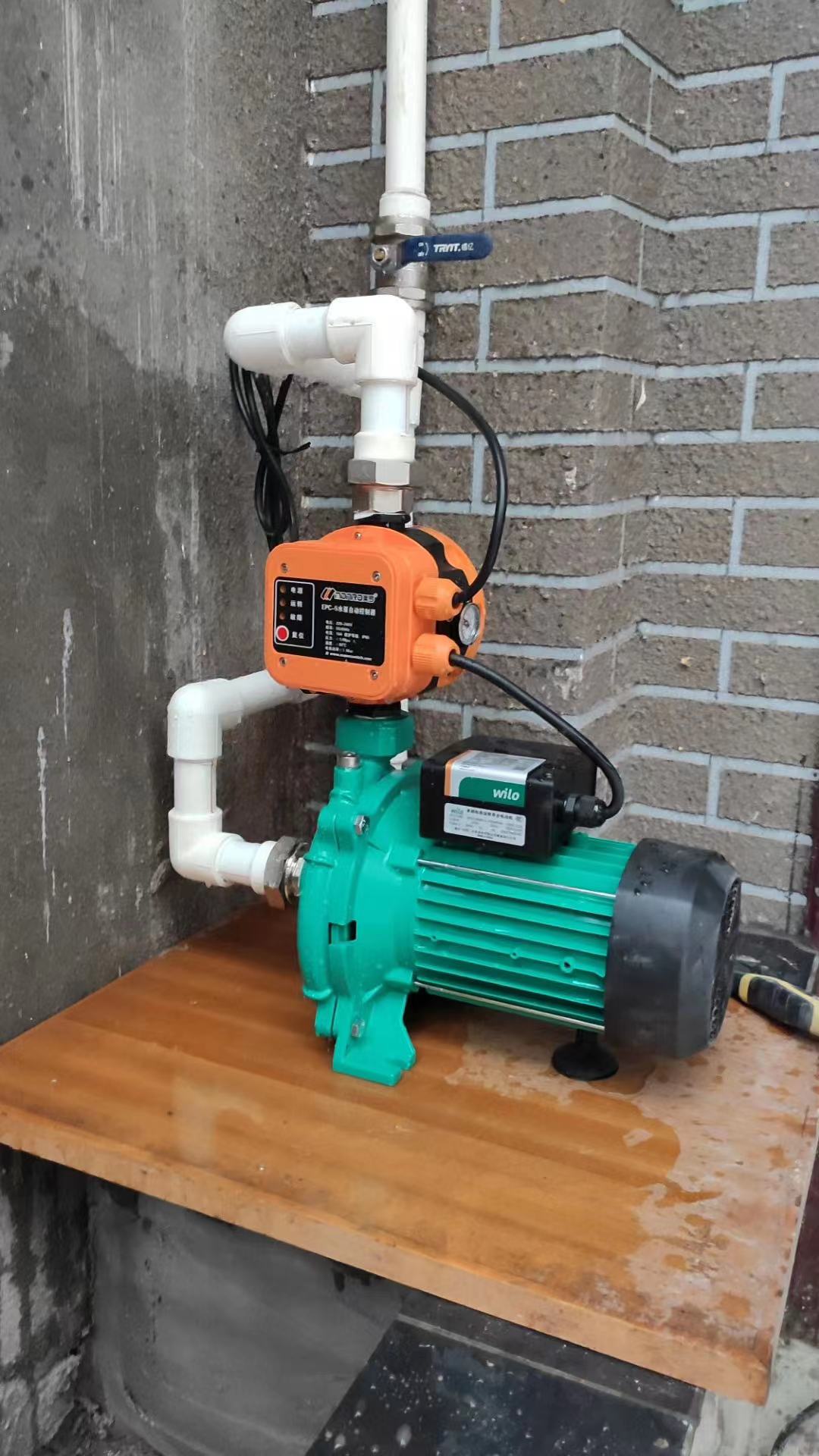
Reference view supplied for automatic pump-control application context. Image: Monro Switch case material.
A supplied case record illustrates the kind of application context, without turning one order into a general performance claim. The record describes a retail buyer in China using 50 pcs in agriculture irrigation, water treatment and construction over a two-year duration, with the result stated as reliable automatic pressure control for a water supply system and the highlight listed as automatic pump start/stop control. That record supports the application fit described for the EPC-2 path; it does not establish that every irrigation site will have the same outcome.
EPC-3 for constant-pressure monitoring
EPC-3 is the constant-pressure monitoring option in this shortlist. Its supplied description includes a pressure gauge and triple-voltage capability, an IP65 rating, and plastic and metal construction. The pressure gauge is useful during commissioning and routine checks because the operator can read the system pressure without adding a separate instrument. Triple-voltage capability is relevant where the same controller family may be used across different supply arrangements, but the exact voltage setting still has to be confirmed for each installation.
The constant-pressure role should be distinguished from a simple start/stop pressure switch. EPC-3 is described for constant-pressure monitoring, so the buyer should focus on how the pressure is observed, how the pump is controlled and whether the controller's voltage and power ratings match the pump. The IP65 rating supports the case in damp or washdown-adjacent environments, but it does not remove the need to protect the cable entry and connection points according to the installation instructions.
The fit boundary is the pump and system, not the label alone. If the pump motor exceeds the approved maximum power, or if the starting pressure required by the system is outside the selected configuration, EPC-3 should not be used simply because it has a gauge. The gauge improves monitoring; it does not correct a mismatched pressure or power specification.
What changes between the three options
The technical difference is best understood as a change in decision priority. EPC-1.1 prioritizes domestic water protection and hydraulic convenience: the adjustable 1.5–3.0 bar range, built-in check valve and run-dry protection are directly relevant to a household pump that may lose water supply. EPC-2 prioritizes application breadth and configuration: the EPC-2.1 voltage, power and starting-pressure options allow the controller to be specified for irrigation, water treatment or construction duties, provided the exact combination is confirmed. EPC-3 prioritizes constant-pressure monitoring: the pressure gauge and triple-voltage capability support commissioning and observation.
A second difference is the evidence the buyer should request. For EPC-1.1, the key evidence is the domestic application description, the pressure range, the IP65 rating, the check valve and the run-dry protection. For EPC-2.1, the key evidence is the exact voltage, power and starting-pressure configuration, plus the 50/60 Hz frequency and the intended industry use. For EPC-3, the key evidence is the pressure gauge, triple-voltage capability, IP65 rating and the constant-pressure role.
Certificate scope matters. The supplied CE-EMC certificate AE505724390001, issued by TÜV Rheinland LGA Products GmbH, covers EPC-1, EPC-2, EPC-2.1, EPC-3, EPC-3P, EPC-4, EPC-5, EPC-15 and CEWP-111B. The listed standards are EN IEC 55014-1:2021, EN IEC 55014-2:2021, EN IEC 61000-3-2:2019+A1 and EN IEC 61000-3-3:2013+A1+A2. A buyer should match the certificate scope to the exact model and configuration on the order, not just to the series name.
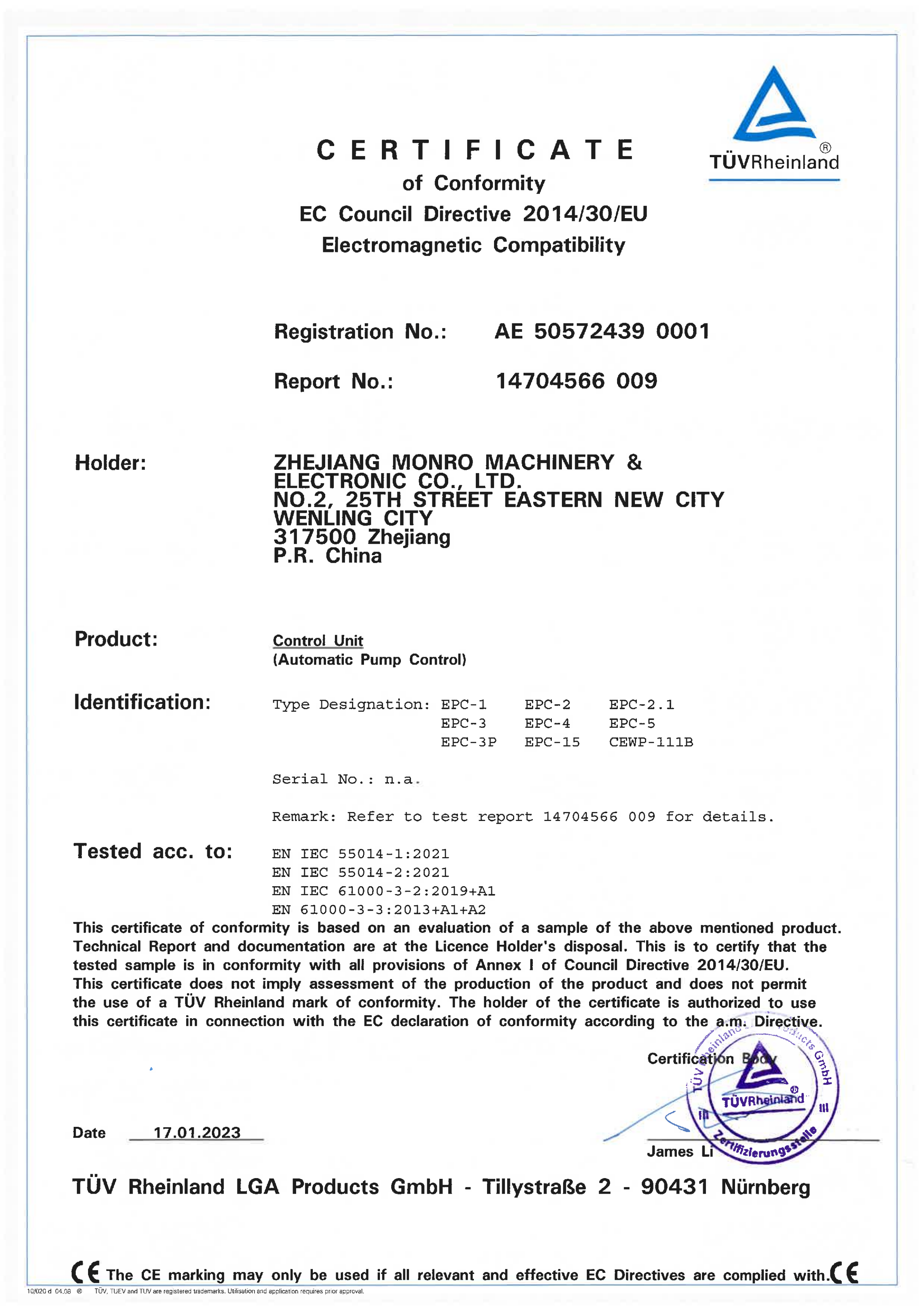
CE-EMC certificate AE505724390001 covers EPC-1, EPC-2, EPC-2.1, EPC-3 and related models. Image: Monro Switch certificate record.
Buyer checklist: matching the switch to the pump setup
- Match starting pressure to pump lift and water-use height. Use the pump curve and the highest outlet in the system. The supplied controller guide uses a 0.8 bar margin above start-up pressure: a 1.2 bar start pressure corresponds to about 12 m of maximum water-use height and a pump lift of at least about 20 m. Check the same calculation with the actual EPC-1.1, EPC-2.1 or EPC-3 setpoint.
- Check maximum pump power. Compare the pump motor nameplate with the controller's approved maximum power. The controller must be selected for the motor it will actually start and stop, not for a smaller demonstration pump. If the nameplate exceeds the approved rating, the model is not a fit even when the pressure range looks correct.
- Confirm voltage and frequency. The supplied Monro range includes 220–240 V and 110–120 V options, and EPC-2 uses 50/60 Hz. EPC-3 has triple-voltage capability, but the exact setting must still be verified. A controller ordered for one supply should not be assumed to work on another without the approved configuration.
- Verify the connection thread. Match the controller connection to the pump outlet, tee or pipework. Do not infer the thread from the model family or from a different EPC model. The order specification should state the thread, and the installer should confirm that the mating fitting is compatible.
- Set the protection rating against the installation environment. IP65 is stated for EPC-1.1 and EPC-3 in the supplied material. For EPC-2.1, the required protection rating should be confirmed for the exact configuration. IP65 is useful in damp or dusty areas, but cable glands, covers and connection joints still need correct installation.
- Review the protection functions as model-specific features. EPC-1.1 includes a built-in check valve and run-dry protection. Those functions should not be assumed on every EPC controller. If run-dry protection is essential, it should be written into the specification and verified on the selected model.
- Check certificate scope and standards. The CE-EMC certificate AE505724390001 covers several EPC models, and the supplied ISO 9001 certificate covers the manufacture of water pump pressure switches. Confirm that the certificate applies to the exact model and that the standard listed is the one required by the destination market. Certificate coverage is not the same as a performance guarantee for every installation.
- Review the pressure and temperature limits for the actual duty. The start pressure, maximum working pressure and working temperature should sit inside the approved model limits with an appropriate margin. Do not use a domestic setting as a substitute for an irrigation or construction duty without checking the relevant model data.
Electronic controllers and mechanical switches: a fit boundary, not a winner
Market Research Future estimated that electromechanical pressure switches accounted for approximately 62% of the global market share in 2024. That figure describes the market mix, not a recommendation for a particular pump. Mechanical pressure controls remain a relevant category where a pressure-triggered start/stop function is the main requirement. Electronic controllers such as EPC-1.1 and EPC-3 add model-specific functions such as run-dry protection or pressure monitoring, but those functions should be selected because the installation needs them.
The practical boundary is straightforward. If the buyer needs a simple pressure switch and the pump-protection functions are not required, a mechanical option may be sufficient. If the system needs automatic pump control with a defined pressure range, dry-run protection or a pressure gauge for monitoring, the electronic shortlist becomes relevant. The decision should be based on the duty and the approved specification, not on the assumption that one category is always more advanced.
Market context and outlook
Fortune Business Insights valued the global pressure switch market at USD 3.2 billion in 2025 and projected USD 3.38 billion in 2026, rising to USD 5.13 billion by 2034 in the same published forecast. The figure is useful context for procurement planning, but it does not change the model-selection logic. A growing market does not make a mismatched pressure range, motor rating or thread correct.
The supplied forecast should be read as a projection, not a measured outcome. For buyers, the practical implication is to keep the specification stable while the market grows: confirm the start pressure, maximum power, voltage, thread and protection rating for each pump setup. That approach is more useful than switching models solely because a market report shows growth.
Verification steps before the shortlist becomes an order
Before an EPC-1.1, EPC-2.1 or EPC-3 is entered on a purchase order, the buyer should obtain the exact model specification and check it against the pump nameplate, the system's maximum water-use height and the installation environment. The check should include the start pressure, maximum power, voltage and frequency, connection thread, protection rating and any protection functions that are being relied on. For EPC-2.1, the voltage, power and starting-pressure options should be written as one configuration. For EPC-3, the voltage setting and gauge readability should be confirmed for the actual site.
The certificate record should also be checked at model level. The CE-EMC certificate AE505724390001 covers the EPC models named in the supplied record, while the ISO 9001 certificate covers the manufacture of water pump pressure switches. A certificate can support a compliance review, but it does not replace the installation check or the pump manufacturer's requirements.
For readers who need the full model list, the supplied Monro catalogue 2025 is available as a PDF. The company website is Monro Switch.
FAQ
How do I choose an automatic pump controller for a domestic water system?
Start with the pump motor power, then match the controller's starting pressure to the pump lift and the maximum water-use height. The supplied guide gives an example: a 1.2 bar starting pressure corresponds to about 12 m of maximum water-use height, and the pump lift should be at least about 20 m using a 0.8 bar margin. Confirm voltage, frequency, thread and protection rating on the exact model.
Is EPC-1.1 suitable for constant-pressure monitoring?
EPC-1.1 is positioned for domestic water systems and includes an adjustable 1.5–3.0 bar range, IP65 rating, built-in check valve and run-dry protection. Constant-pressure monitoring is the stated role of EPC-3, which includes a pressure gauge and triple-voltage capability. A buyer should not assign EPC-1.1 to a constant-pressure monitoring duty unless the exact specification supports that use.
What do the EPC-2.1 voltage, power and starting-pressure options mean for an irrigation buyer?
They mean the EPC-2.1 should be ordered as a defined combination rather than as a generic model. The buyer should state the required voltage, maximum pump power and starting pressure together. EPC-2 is intended for agriculture irrigation, water treatment and construction, and its power frequency is 50/60 Hz. The exact thread and protection rating should also be confirmed for the site.
Does IP65 apply to every EPC pressure control switch?
No. IP65 is stated for EPC-1.1 and EPC-3 in the supplied material. It should not be assumed for EPC-2.1 or for every EPC model. The protection rating is a model-specific specification and should be checked on the exact order configuration, together with the cable entry and installation conditions.
Which certificates should a buyer check for the shortlisted models?
The supplied CE-EMC certificate AE505724390001 covers EPC-1, EPC-2, EPC-2.1, EPC-3, EPC-3P, EPC-4, EPC-5, EPC-15 and CEWP-111B. The ISO 9001 certificate covers the manufacture of water pump pressure switches. The buyer should confirm that the certificate scope matches the exact model and that the listed standards meet the destination market's requirements.
Can one pressure control switch cover domestic, irrigation and constant-pressure duties?
The shortlist is organized by application because the decision cues differ. EPC-1.1 is the domestic water option, EPC-2 and EPC-2.1 are the irrigation, water treatment and construction path, and EPC-3 is the constant-pressure monitoring option. A single model should be used outside its stated role only when the exact specification confirms the required pressure range, power, voltage, thread and protection rating.
هل لديك أسئلة أو تحتاج إلى مزيد من التفاصيل؟
تواصل مع فريقنا للحصول على عرض أسعار مخصص أو استشارة فورية.
طلب عرض أسعار
املأ النموذج أدناه وسيتواصل معك فريقنا بعرض مقترح مخصص.
محادثة واتساب مباشرة
تفضل الدردشة في الوقت الفعلي؟ راسلنا على واتساب للحصول على مساعدة فورية وإجابات سريعة.
- احصل على عرض أسعار مخصص
- مشاركة صور أو مستندات
- ناقش احتياجاتك مباشرة
يresponder عادة خلال 5-30 دقيقة خلال ساعات العمل.