
Recommended Probiotics Powder Options: A Shortlist for Gut, Oral, and Metabolic Health
The global probiotics market was valued at USD 72.1 billion in 2024 and is projected to reach USD 165.1 billion by 2034, according to Global Market Insights. The probiotic supplement segment alone reached USD 10.60 billion in 2026 and is forecast to grow at a 9.5% CAGR through 2031, per MarketsandMarkets. Against that demand, the recurring failure in sourcing is not a shortage of suppliers. It is a mismatch between strain, dosage form, and the application the finished product is actually built for.
This shortlist is organised by application target rather than by price. It covers finished-format options for gut, oral, and metabolic positioning, the raw probiotic powders that sit behind them, and the non-live postbiotic formats that serve a different label claim entirely. All product, specification, and application statements below come from published product data and application documentation from Shanghai Unibio Lab Co., Ltd, a probiotic R&D and CDMO manufacturer founded in 2021 whose stated annual output is 1,800 tons of probiotic raw powder and postbiotics, with an export share of 85% across North America, Western Europe, Southeast Asia, and the domestic Chinese market.
Why application target, not unit price, is the first filter
Three variables decide whether a probiotic powder works in a finished product, and price per kilogram sits behind all three: strain identity, dosage form, and application fit. A powder with a very high stated concentration can still underperform if its storage profile does not match the customer's cold-chain capability, or if the dosage form cannot deliver the strain to the target site intact.
This is why the shortlist below is grouped by where the product is meant to act — intestinal, oral, or metabolic — rather than by headline viable count. A 100-billion-CFU capsule and a 10-billion-CFU chewable tablet are not competing specifications; they are answers to different formulation questions.
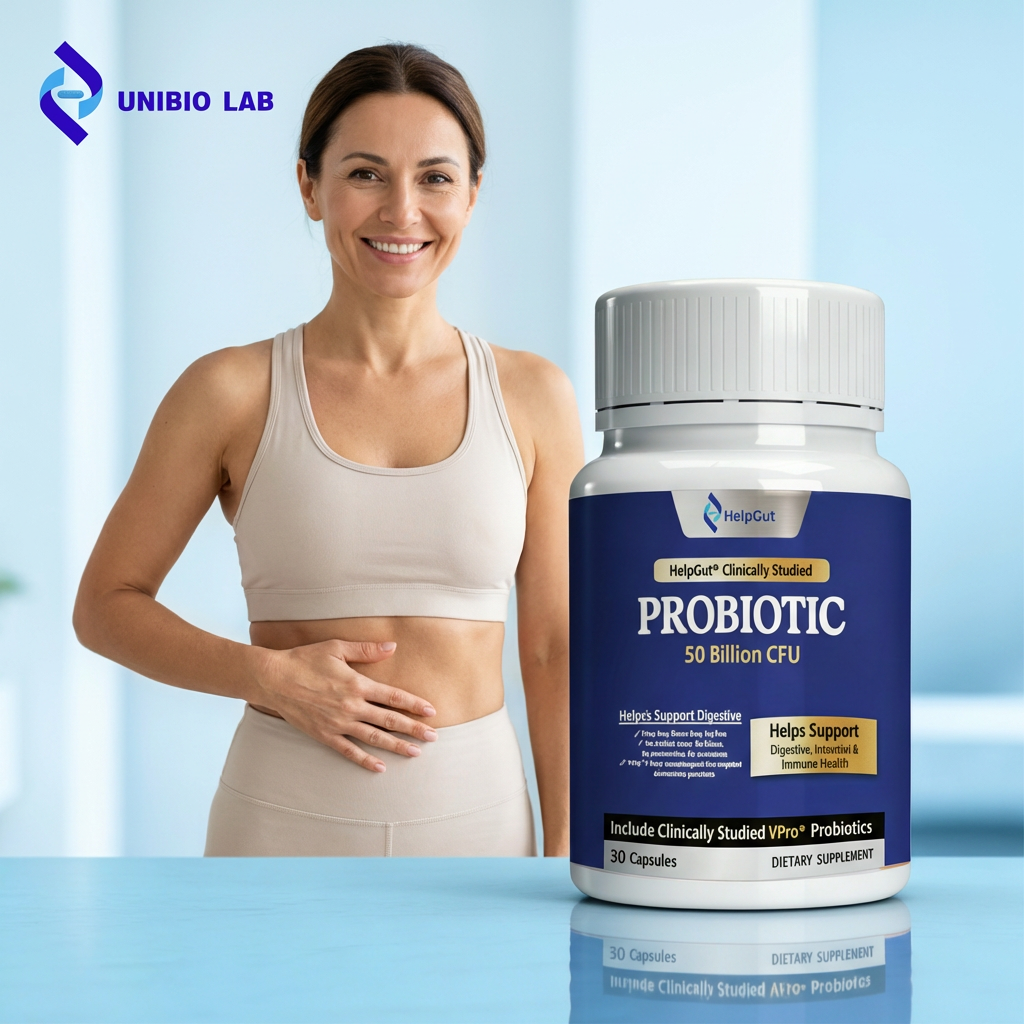
The shortlist at a glance
| Format and model | Core strain or material | Stated strength | Storage specification | Primary application target |
|---|---|---|---|---|
| HelpGut® 100B CFU Constipation Relief Probiotic Capsules (HelpGut-CAP-CON100B) | Multi-strain blended proprietary formula in a vegetarian HPMC shell with prebiotic fibre excipient | 100 billion CFU per capsule | Room temperature, sealed, away from moisture and direct sunlight; 24-month shelf life | Retail dietary supplement, health product distribution, adult intestinal healthcare |
| Oral Health HelpGut® Probiotics Tablets (HelpGut-TAB-ORAL) | Ligilactobacillus salivarius CCFM1215 with xylitol base and microcrystalline cellulose filler | 10 billion CFU per tablet | 15–25 °C cool sealed storage; 20-month shelf life | Oral healthcare products, children daily supplement, pharmacy retail |
| HelpGut® Akkermansia Muciniphila AH39 GLP-1 Probiotics (HelpGut-CAP-AH39-GLP1) | High-purity Akkermansia muciniphila AH39 in an HPMC vegetarian capsule with protective prebiotic matrix | High-purity AH39 per capsule | Strict room temperature, light-proof, sealed; 24-month shelf life | Metabolic management supplements, premium adult healthcare, wellness retail |
| Akkermansia muciniphila AH39 raw powder (AH39) | AH39 with maltodextrin carrier and VPro® encapsulation material | 10B–200B TFU/g | Room temperature, sealed, away from moisture and direct sunlight; 24-month shelf life | Dietary supplement and metabolic management formulation |
| Bifidobacterium longum CCFM1195 raw powder | B. longum CCFM1195 with maltodextrin carrier and VPro® encapsulation material | 10B–200B CFU/g | Room temperature, sealed, away from moisture and direct sunlight; 24-month shelf life | Food and beverage, dietary supplement, health product |
| Bifidobacterium animalis subsp. lactis BL03 raw powder | BL03 with maltodextrin carrier and VPro® encapsulation material | 10B–600B CFU/g | -18 °C or below, sealed; 24-month shelf life | Food and beverage, dietary supplement, pet health products, animal feed |
| Lactobacillus rhamnosus GG raw powder | L. rhamnosus GG with maltodextrin carrier and VPro® encapsulation material | 10B–300B CFU/g | -18 °C or below, sealed; 24-month shelf life | Food and beverage, dietary supplement, health product, infant food |
| ProLipo® Postbiotics (ProLipo-POST) | Postbiotic lysate with phospholipid liposome wall material and food-grade carrier | No live count stated | Room temperature, sealed, away from moisture and direct sunlight; 24-month shelf life | High-end dietary supplement, skincare, premium functional beverage |
| Postbiotics Powder (UNI-POST-POW) | Heat-inactivated probiotic biomass with maltodextrin carrier; no live bacteria | Active postbiotic content ≥ a specified value | Room temperature, sealed, away from moisture and direct sunlight; 24-month shelf life | Functional food, dietary supplement, skincare raw material, beverage |
| VPro® 5-layer micro-encapsulated probiotics material (VPro®-5L-COAT) | Food-grade polysaccharide and protein composite coating matrix | Not a strain; protective coating input | Handled as a process input; protected from crushing and moisture | Probiotic raw material factories, supplement manufacturers, food processing plants |
Gut health: a finished capsule or a raw powder, depending on who sets the dose
For buyers who need a finished, retail-ready intestinal product, the HelpGut® 100B CFU Constipation Relief Probiotic Capsules (HelpGut-CAP-CON100B) is the most direct option on this shortlist. The specification states 100 billion CFU per capsule, a multi-strain blended proprietary formula, a vegetarian HPMC capsule shell, and a prebiotic fibre excipient, with a 24-month shelf life and room-temperature storage in a sealed container away from moisture and direct sunlight. The associated application documentation describes this scenario as balancing intestinal flora, relieving constipation and irregular defecation, protecting the intestinal barrier, and improving long-term gastrointestinal discomfort, with viable strains acting continuously in the intestinal tract after daily oral intake.
Buyers who formulate their own dose usually go the other way, sourcing raw powder and setting CFU per serving themselves. Three powders in this range are commonly used as the base of gut-oriented blends:
- Bifidobacterium longum CCFM1195 — stated viable count 10B–200B CFU/g, room-temperature storage, 24-month shelf life, positioned for food and beverage, dietary supplement, and health product applications.
- Bifidobacterium animalis subsp. lactis BL03 — stated viable count 10B–600B CFU/g, the widest range in this shortlist, with a human gut strain origin and applicability that extends to pet health products and animal feed alongside human supplement use. It requires sealed storage at -18 °C or below.
- Lactobacillus rhamnosus GG — stated viable count 10B–300B CFU/g, applicable across food and beverage, dietary supplement, health product, and infant food categories. It also requires sealed storage at -18 °C or below.
The practical difference between these three is not which one is stronger. It is that BL03 and LGG carry frozen storage requirements while CCFM1195 is specified for room temperature. That single line in a specification sheet determines whether a brand can distribute through ambient retail channels or has to build a cold chain around the finished product.
Oral health: a chewable format built around one documented strain
Oral care is the clearest example of a shortlist entry that cannot be substituted by a generic gut strain. The Oral Health HelpGut® Probiotics Tablets (HelpGut-TAB-ORAL) are specified at 10 billion CFU per tablet, built on a xylitol base with microcrystalline cellulose tablet filler, and name Ligilactobacillus salivarius CCFM1215 as the core strain. Stated storage is 15–25 °C cool sealed conditions with a 20-month shelf life, and the target categories are oral healthcare products, children daily supplements, and pharmacy retail.
The application scenario behind this format is described as inhibiting oral odour and harmful bacteria, balancing oral microflora, and protecting gum and tooth health for children and adults, with viable strains acting continuously inside the oral cavity after daily oral administration. The underlying raw material, Ligilactobacillus salivarius CCFM1215 powder, is offered at 10B–200B CFU/g — but with a storage specification of 2–8 °C sealed cold storage, which is a materially different profile from the finished chewable tablet.
Metabolic positioning: Akkermansia muciniphila AH39 in capsule and raw powder form
The metabolic slot in this shortlist is served by HelpGut® Akkermansia Muciniphila AH39 GLP-1 Probiotics (HelpGut-CAP-AH39-GLP1), a metabolic support capsule built on high-purity Akkermansia muciniphila AH39 in an HPMC vegetarian capsule with a protective prebiotic matrix. The specification describes a clinically studied GLP-1 supportive formula, a 24-month shelf life, and strict room-temperature, light-proof, sealed storage. Target categories are metabolic management health supplements, premium adult healthcare, and wellness retail.
For formulators who need dose flexibility, Akkermansia muciniphila AH39 is also available as a raw powder with a stated viable count of 10B–200B TFU/g, room-temperature storage, and a 24-month shelf life. Note the unit: TFU rather than CFU. Total fluorescent units and colony-forming units are not interchangeable measurements, and buyers comparing AH39 against a CFU-specified powder should confirm which method the certificate of analysis reports before drawing comparisons.
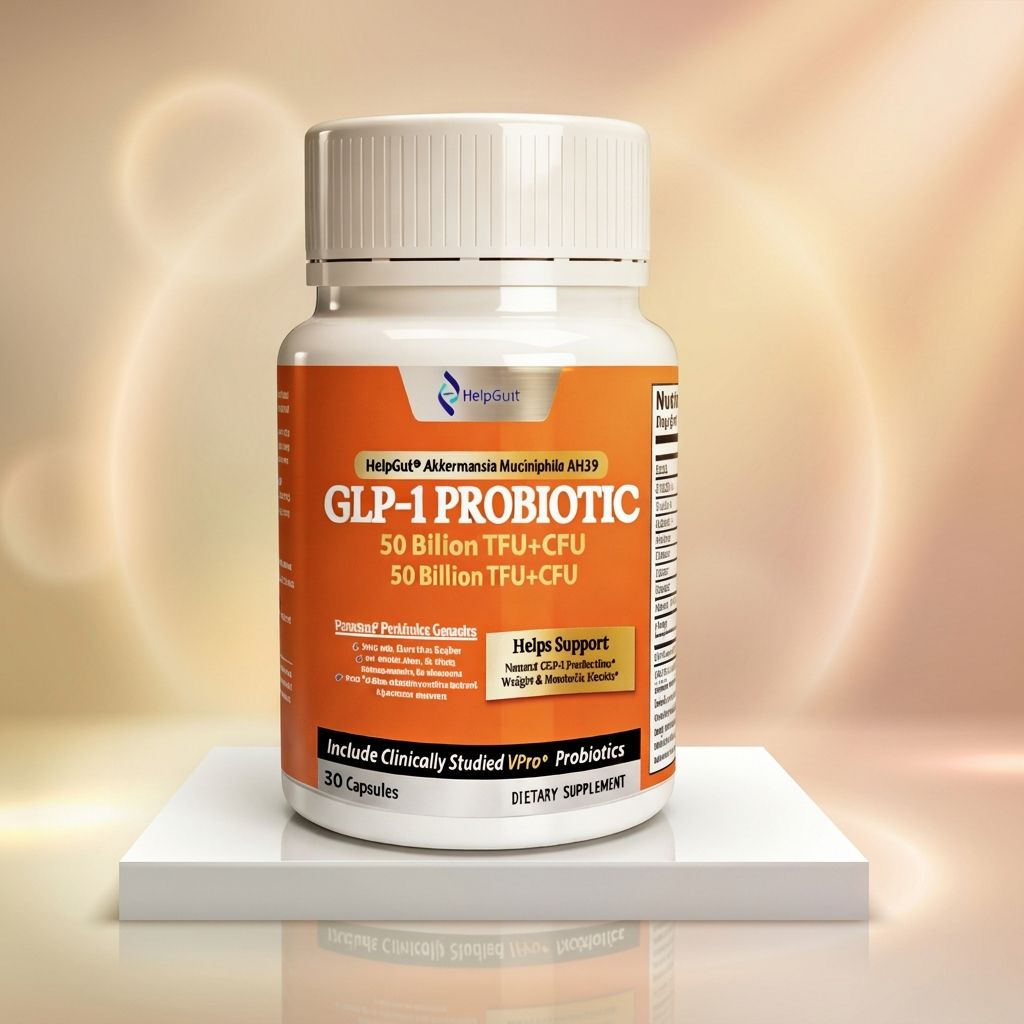
One verification point deserves attention. The capsule specification states strict room-temperature light-proof sealed storage, while the broader metabolic application scenario published in the same documentation lists low-temperature 2–8 °C dry, dark, sealed storage. Buyers should not resolve that by assumption. Confirm the storage clause on the batch-level certificate of analysis and on the finished-goods label, because it drives warehouse design, freight mode, and shelf-life claims on the retail pack.
Non-live options: ProLipo® Postbiotics and Postbiotics Powder
Not every product needs a live organism. Two entries on this shortlist serve formulations where viability is either irrelevant or actively inconvenient.
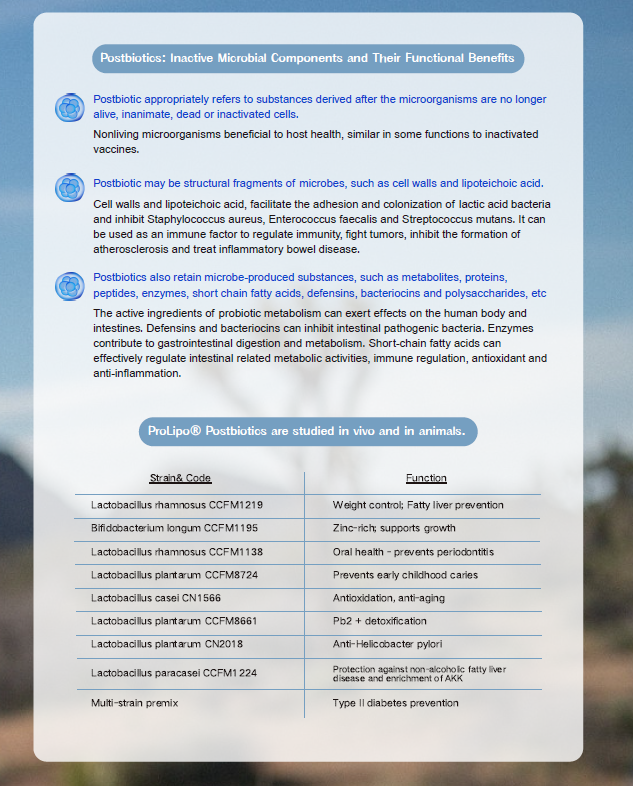
Postbiotics Powder (UNI-POST-POW) is a heat-inactivated postbiotic raw powder made from inactivated probiotic biomass with a maltodextrin carrier. The specification states that active postbiotic content is at or above a specified value, that no live bacteria are contained, and that storage is at room temperature in a sealed container away from moisture and direct sunlight with a 24-month shelf life. Target categories are functional food, dietary supplement, skincare raw material, and beverage.
ProLipo® Postbiotics (ProLipo-POST) takes a different route, combining postbiotic lysate with phospholipid liposome wall material and a food-grade carrier. The specification lists room-temperature storage and a 24-month shelf life, and positions the material for high-end dietary supplements, luxury skincare, and premium functional beverages.
Protective delivery: what VPro® 5-layer micro-encapsulation changes
VPro® 5-layer micro-encapsulated probiotics material (VPro®-5L-COAT) is not a strain and should not be shortlisted as one. It is a protective coating input built from a food-grade polysaccharide and protein composite matrix, supplied to probiotic raw material factories, supplement manufacturers, and food processing plants. Its five functional layers are described as a micromolecular protective layer for anti-freezing and anti-stress protection, a prebiotic nutrition layer supporting in-vivo proliferation, a liposome enteric adhesion layer for intestinal colonisation, an acid and enzyme resistant layer for survival through gastric digestion, and an oxygen and moisture barrier layer for shelf stability.
The supplier reports that the technology raises freeze-drying survival rate by 40%, extends shelf life to 24 months, and supports lyophilized powder concentrations up to 8.0×10¹¹ CFU/g, alongside fermentation density above 3.5×10¹⁰ CFU/mL. The direction is consistent with external technical commentary: microencapsulation using materials such as alginate or chitosan is described in published literature as a key technical trend for maintaining probiotic viability through gastric acid and bile salts.
Selection logic: four checks before a sample is ordered
| Check | What to verify | Why it changes the decision |
|---|---|---|
| Strain identity | Full strain designation with a documented origin, not a genus name alone | AH39, CCFM1195, BL03, LGG, and CCFM1215 are all specified to strain level with distinct application targets. A genus-level label does not support the same claim. |
| Dosage form and dose | Whether the product is dosed per unit (per capsule, per tablet) or by concentration per gram | 100 billion CFU per capsule and 10B–200B CFU/g describe different things. Comparing them directly is a common sourcing error. |
| Storage and transport profile | Room temperature, 2–8 °C, or -18 °C or below — and what the finished product is labelled for | Frozen powder in an ambient-shelf product creates a cold-chain obligation the brand may not be able to honour through retail. |
| Market documentation | Certification set matching destination markets, and third-party testing availability | US supplements fall under 21 CFR Part 111 cGMP; ISO 22000 covers food safety management across the production chain. Missing documents delay customs clearance, not just audits. |
On documentation, the manufacturer holds ISO 22000, FSSC 22000, GMP food manufacturing certification through SGS, HALAL and Orthodox Union Kosher certificates, FDA US food facility registration, and a self-affirmed GRAS conclusion for Akkermansia muciniphila AH39. Quality control is described as 100% in-house viable count, microbial safety, and heavy metal testing, with third-party SGS or Intertek inspection available on client request.
Where these options stop being the right fit
- Cold-chain dependence limits channel reach. BL03, LGG, CCFM1215, and several other strains in the same raw material range are specified for frozen or refrigerated storage. A brand selling through ambient pharmacy or e-commerce channels should start from a room-temperature-specified strain and work backwards.
- Postbiotic formats cannot carry live-CFU claims. Postbiotics Powder is explicitly described as containing no live bacteria. If a label claim depends on live CFU at end of shelf life, this format is the wrong category.
- VPro® coating is a process decision, not a purchase decision. Coated material must be handled to keep the microcapsule structure intact; the associated application data lists a specific requirement to prevent extrusion damage and to avoid low-temperature stress on the structure. Coating also adds a processing step, and it does not replace correct storage and packaging.
- Chewable oral formats trade shelf life for format. The oral tablet is specified at a 20-month shelf life versus 24 months for the capsule formats on this shortlist. That difference matters in markets with long distributor turnover.
- Fixed-dose capsules reduce formulation freedom. A 100-billion-CFU capsule is a defined retail dose. Formulators who need to tune CFU per serving, blend in additional strains, or adjust excipients are better served by raw powder and their own encapsulation.
- Heat-processed applications sit outside this shortlist. Where a product requires hot filling or baking, the appropriate starting point is a heat-resistant strain category rather than any of the mesophilic formats above.
Manufacturing and evidence context
Shanghai Unibio Lab Co., Ltd operates as a probiotic R&D, manufacturing, and CDMO business with a stated strain bank of over 30,000 microbial strains — a figure that also appears in third-party industry listings. Customisation covers strain combination, CFU concentration, dosage form (powder, capsule, tablet, sachet, gummy), packaging and label design, prebiotic and excipient formulation, and microencapsulation process adjustment. Monthly capacity is stated as 1,800 tons of probiotic raw powder and postbiotics powder plus 2 billion finished capsules and tablets.
Commercial terms are relevant to shortlist decisions: minimum order quantity is 1 kg for single-strain raw powder, 5 kg for multi-strain compound powder, and 5,000 bottles for HelpGut private-label finished capsules or tablets. Lead time is stated as 5–7 days for bulk raw materials and 25–35 days for private-label finished goods, with export markets covering the EU, USA, Southeast Asia, Australia, the Middle East, Japan, and South Korea.
Three company-reported cooperation cases illustrate how the formats above are used in practice. A Middle East health product wholesaler and pharmacy chain supplier is described as taking 12,000 HelpGut bottles and 8 tons of Akkermansia muciniphila AH39 raw powder monthly over 1.5 years, citing GRAS and HALAL documentation for customs clearance and customised Arabic packaging. A fermented food and beverage manufacturer in Thailand and Indonesia is described as sourcing 60 tons of DVS yogurt starter and 90 tons of functional probiotic beverage powder annually over a two-year relationship. An overseas supplement brand and raw material distributor in Germany and the United States is described as ordering 120 tons of multi-strain powder and 75 tons of single-strain powder annually across three consecutive years, and reporting a 42% year-on-year sales increase with strain viability held through shelf life. These figures are company-reported and should be treated as supplier-provided references, not independently audited outcomes.
Market context and what it implies for buyers
Segment-level data explains why the shortlist splits the way it does. The global baby probiotics market was valued at USD 2.27 billion in 2024 and is projected to reach USD 5.6 billion by 2035 at an 8.6% CAGR, which supports the infant-food positioning of Lactobacillus rhamnosus GG. The global pet biotics market is estimated to reach USD 1,232.5 million by 2030 at a 7.0% CAGR, which is consistent with BL03 being explicitly listed for pet health products and animal feed.
On the supply side, the probiotic ingredients market includes large multi-category players — Yakult Honsha is listed at a 6.7% share by Global Market Insights, alongside Danone S.A., ADM, Kerry Group, and Novonesis. Specialty CDMO manufacturers sit in a different role in the same chain, absorbing custom strain blending, dosage-form development, and private-label production rather than competing on branded consumer shelf position. For a buyer, that distinction matters more than a ranking: the relevant question is whether the supplier can document the specific strain, dose, and storage profile the finished product requires.
Future outlook
Two forces are likely to reshape shortlist decisions over the next product cycles. The first is stability engineering: as microencapsulation and protective coating become standard rather than premium inputs, the commercial advantage shifts toward suppliers who can demonstrate a documented storage envelope rather than a headline viable count. The second is format diversification away from live organisms. Heat-inactivated postbiotic powders and liposomal postbiotic materials remove cold-chain and end-of-shelf-life viability constraints entirely, which makes them attractive for beverage and skincare categories where live counts were never the real selling point.
What is less likely to change is the underlying selection logic. Strain identity, dosage form, and application fit will continue to determine whether a probiotic powder works, and storage specification will continue to determine whether it works commercially. A shortlist organised by application target — intestinal, oral, metabolic, or non-live — remains a more reliable starting point than a shortlist organised by price per kilogram.
FAQ
Should a buyer choose a live probiotic powder or a postbiotic format?
The deciding factor is whether the finished product needs a live-CFU label claim. Live formats carry a viable count specification — for example, 10B–600B CFU/g for Bifidobacterium animalis subsp. lactis BL03 — and require storage and transport controls that preserve that count. Heat-inactivated Postbiotics Powder (UNI-POST-POW) contains no live bacteria, states that active postbiotic content is at or above a specified value, and is stored at room temperature with a 24-month shelf life. A postbiotic format cannot support a live-CFU claim.
Which format fits a metabolic-positioned product?
HelpGut® Akkermansia Muciniphila AH39 GLP-1 Probiotics (HelpGut-CAP-AH39-GLP1) uses high-purity Akkermansia muciniphila AH39 in an HPMC vegetarian capsule with a protective prebiotic matrix. The specification describes a clinically studied GLP-1 supportive formula, a 24-month shelf life, and strict room-temperature light-proof sealed storage, and targets metabolic management supplements, premium adult healthcare, and wellness retail. The same strain is available as a raw powder at 10B–200B TFU/g for formulators who set their own dose.
How much do storage and transport requirements affect strain selection?
Substantially, and earlier in the process than most buyers expect. Within the same supplier's range, Bifidobacterium longum CCFM1195 and Akkermansia muciniphila AH39 are specified for room-temperature storage away from moisture and direct sunlight; Ligilactobacillus salivarius CCFM1215 is specified for 2–8 °C sealed cold storage; and Bifidobacterium animalis subsp. lactis BL03 and Lactobacillus rhamnosus GG are specified for sealed storage at -18 °C or below. Each profile changes packaging, freight mode, and the shelf-life assumptions carried by the finished product.
What do the viable count ranges actually describe?
They describe the concentration of the raw powder, not the dose per serving. BL03 is specified at 10B–600B CFU/g, LGG at 10B–300B CFU/g, and Bifidobacterium longum CCFM1195, Ligilactobacillus salivarius CCFM1215, and Akkermansia muciniphila AH39 at 10B–200B (CFU/g, or TFU/g for AH39). Finished formats are dosed per unit instead: 100 billion CFU per capsule for HelpGut® 100B CFU Constipation Relief Probiotic Capsules, and 10 billion CFU per tablet for Oral Health HelpGut® Probiotics Tablets. Buyers should confirm which of the two measures they are comparing.
What is the difference between VPro® micro-encapsulated material and standard probiotic powder?
VPro®-5L-COAT is a protective coating material made from a food-grade polysaccharide and protein composite matrix, applied in five functional layers: a micromolecular protective layer for anti-freezing and anti-stress protection, a prebiotic nutrition layer, a liposome enteric adhesion layer, an acid and enzyme resistant layer, and an oxygen and moisture barrier layer. The supplier reports that it raises freeze-drying survival rate by 40%, extends shelf life to 24 months, and supports lyophilized powder concentrations up to 8.0×10¹¹ CFU/g. It is a processing input rather than a strain, so it does not change strain identity, and coated material must be handled so the microcapsule structure is not crushed.
Summary
The shortlist above covers intestinal, oral, metabolic, and non-live application targets, and each entry is defined by a documented strain, a stated dose or concentration, and a stated storage envelope. The relevant comparison is not between viable counts but between the operating conditions each option imposes on the finished product.
Full product and capability documentation, including specification tables and certification details, is available in the manufacturer's brochure: Shanghai Unibio Lab Co., Ltd product brochure (PDF).