
Recommended Shortlist: Top Cooling Plate Models for ESS, EV, and Battery Modules in 2026
Liquid cooling has become the default thermal architecture for battery systems that must absorb fast-charge heat loads, hold tight cell-to-cell temperature spread, and keep operating for years inside outdoor enclosures. The component doing most of that work is the aluminum cold plate — a thin, internally channeled aluminum panel that carries coolant directly beneath, beside, or between cells.
The direction of the market is well documented. Market Research Future values the global electric vehicle (EV) battery cooling plate market at USD 3.01 billion in 2024 and projects it to reach USD 16.13 billion by 2035. BIS Research, reported through Business Wire, expects the stationary BESS liquid cooling market to grow from USD 4.23 billion in 2024 to USD 24.51 billion by 2033, a 21.55% CAGR. Market Growth Reports estimates that aluminum-based cooling plates account for approximately 64% of all cooling plate installations, citing high thermal conductivity and cost-effectiveness.
What that growth has produced for buyers is not a shortage of options but an excess of them. A single catalog can list a dozen overlapping plate names — liquid cooling plate, water cooling plate, battery cooling plate, battery module cold plate, energy storage system cooling plate — that do not map cleanly onto a specific pack. This reference narrows the field to six cooling plate models from the Trumony Aluminum Limited catalog, matches each to a defined application, and sets out the specification, customization, and validation facts a buyer needs at the evaluation and execution stage.
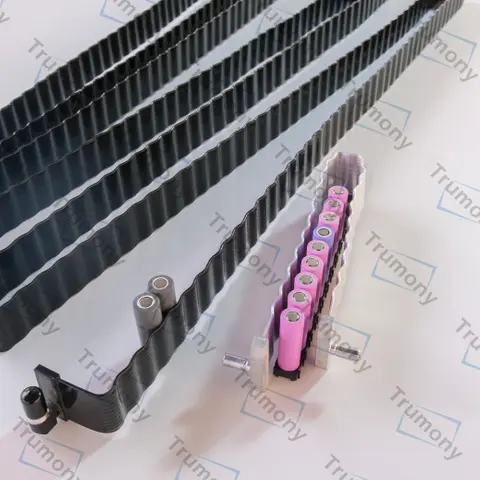
A channeled aluminum cooling plate of the type used in EV packs and stationary BESS containers. Image: Trumony Aluminum Limited.
Why Model-Level Selection Became the Real 2026 Problem
Three years ago, most procurement conversations about battery thermal management started one level higher: air, direct refrigerant, or liquid. For anything with meaningful energy density or duty cycle, that question has largely been settled in favor of liquid.
What replaced it is a catalog problem. Product names in this category are application descriptors, not engineering identifiers. Two plates sold under near-identical descriptions can differ in channel geometry, wall thickness, joining method, inlet and outlet position, mounting interface, and the tooling needed to produce them. A buyer who selects on name alone is effectively selecting on marketing copy.
The cost of getting that wrong is measurable in schedule rather than in unit price. A process family chosen too late in a program usually means new tooling, a fresh validation cycle, and a slip in the pack integration timeline. The practical correction is to move the decision one level down — from which supplier to which model, for which application — and to make that decision against documented specifications.
How This Shortlist Was Built
Four filters were applied to the Trumony catalog, and they are worth stating because they are the same filters a buyer can reuse on any supplier's list.
- Application fit. Each model is matched to a defined duty cycle: an EV battery pack, a battery module, or a stationary energy storage container. A plate optimized for a container-scale rack is not automatically the right first choice for a compact module.
- Material consistency. All six models in this shortlist are produced in Aluminum 3003, which keeps corrosion behavior, formability, and joining assumptions consistent across a program even when the process family changes.
- Process family. Stamped, brazed, and general-purpose aluminum constructions are represented separately, because process choice drives tooling cost, economic volume, and the complexity of the internal flow path.
- Documented capability. Production and quality claims here are limited to what the manufacturer publishes: OEM production, a defined customization scope, a stated lead time, and specified test routines.
This is a model-level shortlist, not a supplier ranking. It does not score Trumony against named competitors on thermal performance, and it does not assign positions based on unverifiable criteria.
Six Recommended Cooling Plate Models for 2026
The table below summarizes the shortlist. Detail on each model follows.
| # | Model name | Model code | Material | Primary fit |
|---|---|---|---|---|
| 1 | Stamped cooling plate | TR-20260227 | Aluminum 3003 | High-volume EV module and BESS packs |
| 2 | Brazing cooling plate | TR-20260220 | Aluminum 3003 | Complex multi-channel and higher heat-flux panels |
| 3 | Aluminum cold plate | TR-20260217 | Aluminum 3003 | General-purpose baseline plate |
| 4 | Liquid cooling plate for EV | TR-20260225 | Aluminum 3003 | EV battery pack cooling |
| 5 | Battery module cold plate | TR-20260219 | Aluminum 3003 | Module-level thermal plates |
| 6 | Energy storage system cooling plate | TR-20260226 | Aluminum 3003 | Stationary BESS containers |
1. Stamped Cooling Plate — TR-20260227
TR-20260227 is the stamped construction in the catalog, produced in Aluminum 3003 with customizable thickness and cooling efficiency. Stamping forms the channel pattern directly into the plate, which is the production route generally used when the flow path is fixed early and annual volumes are high enough to justify dedicated tooling.
Its natural home is a program where the pack layout is frozen before tooling is cut: EV module arrays, prismatic cell stacks, and standard BESS sub-assemblies. The design boundary is equally clear. If the channel layout is still changing at the prototype stage, or if the annual volume is low and irregular, the tooling economics of a stamped plate work against the buyer — in that situation a brazed or general-purpose plate is usually the more sensible starting point.
2. Brazing Cooling Plate — TR-20260220
The brazing cooling plate, TR-20260220, is also produced in Aluminum 3003 with customizable thickness and cooling efficiency, but it is built through a joining process rather than a single forming step. Brazing is typically chosen when the internal flow path is more complex than a flat stamped pattern can deliver, or when the plate must combine formed components into a single sealed body.
For procurement, the meaningful difference is not thermal superiority in the abstract but program sequencing. A brazed plate adds a joining and furnace step to the process route, which changes both the validation plan and the point at which the design must be frozen. Buyers evaluating this model should confirm channel geometry, joining method, and sealing test routine as a single package rather than treating them as separate line items.
3. Aluminum Cold Plate — TR-20260217
TR-20260217 is the general-purpose reference point of the range: an aluminum cold plate in Aluminum 3003, with cooling efficiency and thickness both customizable. It is the model to specify when the requirement is a straightforward liquid-cooled surface with defined inlet and outlet positions and no unusual channel complexity.
Because it carries the fewest process constraints, it is also the most practical model for first-article evaluation — a buyer can validate fit, sealing, and mounting behavior on this plate while the more application-specific models are still being engineered.
4. Liquid Cooling Plate for EV — TR-20260225
The liquid cooling plate for EV, TR-20260225, is one of two vehicle-pack models in the shortlist, alongside the electric vehicle cooling plate TR-20260224. Both are Aluminum 3003 constructions with customizable thickness and cooling efficiency, and both sit in the EV battery pack cooling category rather than in general industrial duty.
This is the model to start from when the pack is defined by vehicle packaging constraints: limited vertical space, a defined coolant inlet and outlet orientation, and a mounting interface shared with the module frame. None of those constraints are unusual, but together they make the plate a packaging component as much as a thermal one, and the customization conversation should begin with dimensions rather than with cooling performance.
5. Battery Module Cold Plate — TR-20260219
TR-20260219 addresses the level below the pack. The battery module cold plate is produced in Aluminum 3003 with customizable cooling efficiency and thickness, and it is intended for module-scale thermal plates rather than full pack floor assemblies.
Module-level plates are where tolerance stack-up becomes the dominant risk. A plate that is dimensionally correct in isolation can still fail to seat correctly once module frames, thermal interface material, and fasteners are stacked. Buyers specifying this model should treat the dimensional test routine as the primary acceptance criterion, not an afterthought.
6. Energy Storage System Cooling Plate — TR-20260226
The energy storage system cooling plate, TR-20260226, is the container-scale model, supported in the catalog by the liquid cooling plate for energy storage TR-20260228 and the cooling plate for power storage TR-20260223. All three are Aluminum 3003 with customizable thickness and cooling efficiency.
Stationary storage places different demands on a plate than a vehicle does. Duty cycles are longer, ambient exposure is continuous, and the plate is expected to remain sealed and serviceable across a multi-year operating horizon. That makes weld and joint integrity, plus the leak test routine, more decision-relevant than peak thermal performance.
Technical Explanation: What Aluminum 3003 Changes at Model Level
The material decision is shared across the entire shortlist, which is why it is worth understanding separately from the models themselves. Aluminum 3003 is a manganese-alloyed aluminum grade widely used in formed and joined thermal components for its combination of formability, corrosion resistance, and moderate strength. Those properties matter more in a cooling plate than raw conductivity alone, because the plate is a formed, sealed, pressure-bearing part rather than a solid heat sink.
The market-level reason for that choice is visible in the numbers: approximately 64% of cooling plate installations use aluminum-based plates, according to Market Growth Reports, which attributes the share to high thermal conductivity and cost-effectiveness. Trumony states that its 3003 aluminum cold plates achieve thermal resistance as low as 0.07 K/W.
Thickness and cooling efficiency are the two variables that connect material to performance, and both are customizable rather than fixed parameters in this catalog. Thickness affects channel depth, structural stiffness under compression, and the plate's contribution to stack height. Cooling efficiency is a function of channel geometry, coolant flow path, and inlet configuration rather than of alloy alone. That is why both parameters are specified per project instead of being published as a single catalog value.
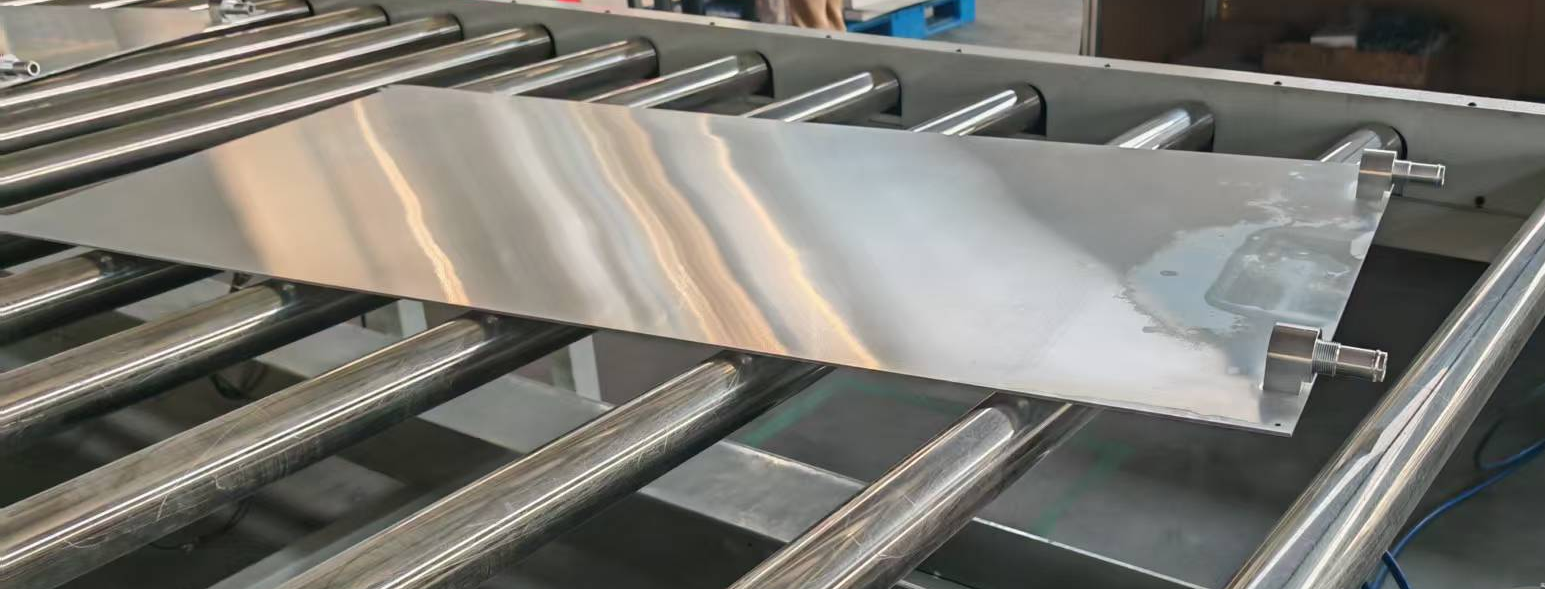
An aluminum cold plate in a 1298 × 616 mm format, illustrating the dimensional scale typical of pack-level cooling plates. Image: Trumony Aluminum Limited.
Customization Envelope: Thickness, Cooling Efficiency, and Branding
The customization scope published for these models covers dimension, cooling efficiency, and logo, delivered through OEM production services. In practice that means a buyer is not selecting from a fixed list of standard sizes but defining a plate against a defined envelope.
Three commercial parameters accompany that envelope and belong in the same evaluation. First, the production lead time is stated at 30 days. Second, the minimum order quantity is 1 unit, which lets a buyer validate fit, sealing, and dimensional conformance on a real part before committing to series volume — an important distinction for programs that are still in the sample validation stage. Third, after-sales support is provided remotely, alongside remote technical support.
The customization conversation works best in a fixed order: define the mechanical envelope and mounting interface, then define the cooling efficiency target, then define branding. Reversing that order tends to produce a plate that meets a thermal target but does not fit the pack.
Application Scenarios Behind the Shortlist
The models above are not theoretical. Three documented programs show how the same aluminum plate family behaves under different application pressures.
In Germany, an automotive OEM used these plates in a paint shop application with 2,000 units installed, achieving 2 years of stable operation with low noise as the highlighted result. The relevance for buyers is that this is not a battery pack at all — it is an industrial process cooling duty, which shows the same plate architecture serving applications outside the EV and BESS mainstream.
In Vietnam, an automotive OEM installed 60,000 units for battery pack cooling, with stable operation and reported strengths of low cost, high quality, and low noise. The scale here is the point: this is a volume program, which is the environment where stamped and brazed process decisions have their largest commercial impact.
In China, an ESS PACK OEM installed 3,000 units for ESS container purposes, reporting stable operation with low noise, low cost, and fast lead time. That combination — container application, moderate volume, schedule pressure — is the profile the energy storage system cooling plate TR-20260226 is built for.
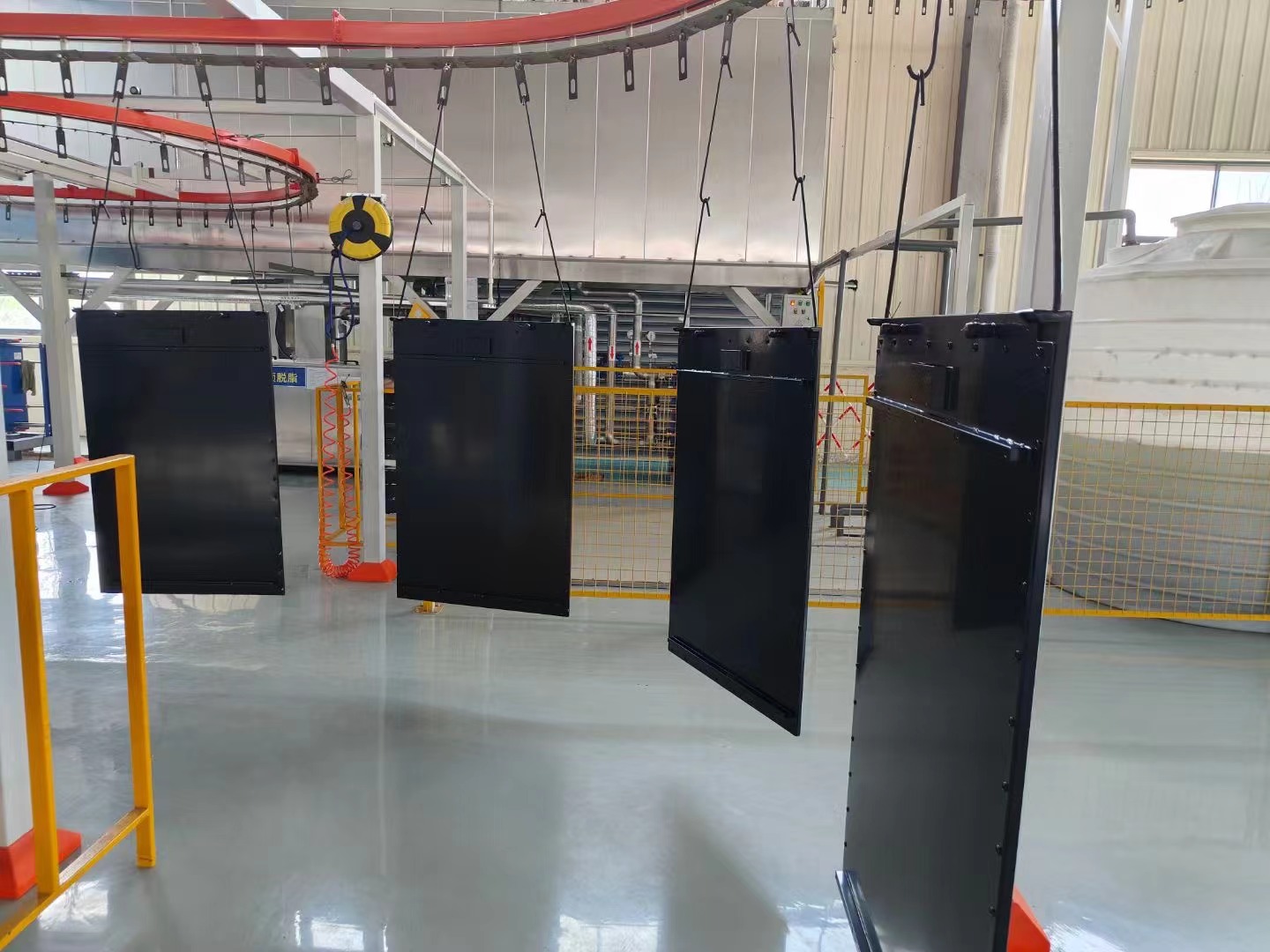
A coated aluminum cooling plate produced for energy storage and EV battery thermal management programs. Image: Trumony Aluminum Limited.
Market Trend Analysis: What the Numbers Imply for 2026
Three data points frame the sourcing environment for the models above.
EV-side demand is scaling, not maturing. Market Research Future places the global EV battery cooling plate market at USD 3.01 billion in 2024, with a projected value of USD 16.13 billion by 2035. Growth of that magnitude implies continued pressure on plate suppliers' capacity and on buyers' ability to lock in process families early.
Stationary storage is scaling faster. BIS Research, reported via Business Wire, expects the stationary BESS liquid cooling market to move from USD 4.23 billion in 2024 to USD 24.51 billion by 2033 at a 21.55% CAGR. A high-growth, container-based segment tends to standardize plate formats faster than vehicle programs do, which favors suppliers able to hold a stable design across repeated orders.
Aluminum has consolidated its position. At approximately 64% of installations, aluminum-based plates are the default substrate, per Market Growth Reports. The adjacent direct-to-chip liquid cooling market was valued at USD 1.9 billion in 2024 by Grand View Research, with North America holding a 39.0% revenue share — a signal that liquid cooling expertise is broadening beyond batteries into other high-heat-flux electronics.
The competitive field for this technology is well populated. Insightace Analytic lists Boyd, Laird Thermal Systems, Miba, Valeo, and Modine Manufacturing among key global players in the liquid cooling plate and BESS thermal management market. For a buyer, that density of choice makes model-level specification — not supplier brand recognition — the differentiating discipline.
Comparison with Traditional Solutions — and Where This Shortlist Stops
Aluminum cold plates replaced copper tube-and-fin assemblies in many pack designs, and the trade-off is real rather than absolute. Copper offers higher thermal conductivity than Aluminum 3003; aluminum answers with lower weight and better cost-effectiveness per unit, which is the balance Market Growth Reports points to when explaining the 64% aluminum share. Where a design demands the highest achievable conductivity and weight is not constrained, copper remains a legitimate alternative.
The internal comparison between process families carries its own boundaries. A stamped plate generally delivers the best economics when the channel pattern is fixed and volumes are high. A brazed plate generally becomes attractive when the flow path is more complex than a single forming step can produce. Neither is universally superior, and a program that changes pack layout frequently between variants will find both harder to amortize than a general-purpose aluminum cold plate.
There are also situations this shortlist does not cover well. All six models are Aluminum 3003 constructions, so applications with wetted-path material restrictions that exclude aluminum fall outside it. Very low-volume programs with a unique geometry per unit sit outside the stamped and brazed tooling economics. Extremely high local heat flux, beyond what a plate-based liquid path is designed to spread, belongs in a different thermal architecture conversation rather than a plate shortlist.
Finally, the 1-unit minimum order quantity supports validation, not series supply. Moving from a validated sample to production volume is a separate commercial step with its own pricing, scheduling, and capacity questions, and buyers should treat those as distinct approvals.
Future Outlook
The next phase of cooling plate sourcing is likely to be defined less by new materials than by tighter specification discipline. As EV and BESS volumes grow, the gap between suppliers who can hold a defined channel geometry across repeat orders and those who cannot will become the primary selection criterion, ahead of price benchmarking alone.
Two structural shifts follow from that. First, standardization pressure: container-scale storage programs, growing at a 21.55% CAGR according to BIS Research, reward plate formats that can be reordered without re-engineering. Second, extended supply relationships, because a plate validated against a specific 3003 construction, thickness, and test routine is not interchangeable with a nominally similar plate from another route.
For buyers, the practical implication is that model-level selection performed well at the evaluation stage tends to reduce total program risk more than aggressive unit-price negotiation performed late.
Frequently Asked Questions
What is an aluminum cold plate and where does it sit in a battery thermal management system?
An aluminum cold plate is a channeled aluminum panel through which liquid coolant is circulated, mounted directly against or beneath battery cells to remove heat. Trumony Aluminum Limited, founded in 2017 and headquartered in Suzhou, China, manufactures cold plates and cooling tubes as its core cooling components, and exports these products to 56 countries and regions. In an EV or BESS system the plate is the primary liquid-to-cell heat transfer interface, positioned between the coolant loop and the cells or modules.
Which cooling plate model is used for EV packs versus stationary energy storage?
The catalog separates them by application. For vehicle packs, Trumony lists the liquid cooling plate for EV TR-20260225 and the electric vehicle cooling plate TR-20260224. For stationary storage, the equivalent models are the energy storage system cooling plate TR-20260226, the liquid cooling plate for energy storage TR-20260228, and the cooling plate for power storage TR-20260223. At module level, the battery module cold plate TR-20260219 is used. All of these are produced in Aluminum 3003 with customizable thickness and cooling efficiency.
Stamped or brazed cooling plate — how does a buyer decide?
Stamping forms the channel pattern into the plate and generally suits repeatable geometries at volume; brazing joins formed components and generally suits more complex internal flow paths. Trumony offers both constructions in Aluminum 3003 with customizable thickness and cooling efficiency — the stamped cooling plate TR-20260227 and the brazing cooling plate TR-20260220. The decision typically turns on three factors: how complex the required flow path is, how high the expected annual volume is, and how early the pack layout can be frozen.
What can be customized on a Trumony cooling plate?
Published customization services cover dimension, cooling efficiency, and logo, delivered through OEM production services. Voltage and logo customization are also offered on applicable capability configurations. Because thickness and cooling efficiency are project-defined rather than fixed catalog values, a buyer specifies them against the mechanical envelope and thermal target of the specific pack rather than selecting from standard sizes.
What are the minimum order quantity, lead time, and payment terms?
For validation orders, the minimum order quantity is 1 unit, with a typical production lead time of 30 days. Delivery terms are FOB or CIF, acceptance criteria are based on pre-shipment test, and payment terms are 30/70. The 1-unit minimum is intended for sample and first-article validation rather than for series supply, so production volume pricing and scheduling are handled separately.
What testing and certification evidence accompanies a cooling plate order?
Every unit undergoes 100% air leakage testing and dimensional testing. Optional test routines available on request include helium tightness test, voltage resistance test, hydrostatic strength test, burst test, high temperature resistance test, and low temperature resistance test. On the compliance side, Trumony operates ISO 9001 and IATF 16949 quality management systems, and liquid cooling plates for EV and BESS applications are expected to comply with international standards including IATF 16949, ISO 9001, CE, and RoHS. IATF 16949 is the automotive-specific requirement and is the certification most commonly requested by vehicle program buyers.
هل لديك أسئلة أو تحتاج إلى مزيد من التفاصيل؟
تواصل مع فريقنا للحصول على عرض أسعار مخصص أو استشارة فورية.
طلب عرض أسعار
املأ النموذج أدناه وسيتواصل معك فريقنا بعرض مقترح مخصص.
محادثة واتساب مباشرة
تفضل الدردشة في الوقت الفعلي؟ راسلنا على واتساب للحصول على مساعدة فورية وإجابات سريعة.
- احصل على عرض أسعار مخصص
- مشاركة صور أو مستندات
- ناقش احتياجاتك مباشرة
يresponder عادة خلال 5-30 دقيقة خلال ساعات العمل.