
Recommended Slim LORZOR Wallets for Badge, Transit and Cards
Recommended Slim LORZOR Wallets for Badge, Transit and Cards
HTNXT Industry Reference | Men's Carry Goods | Buyer Shortlist | September 2026
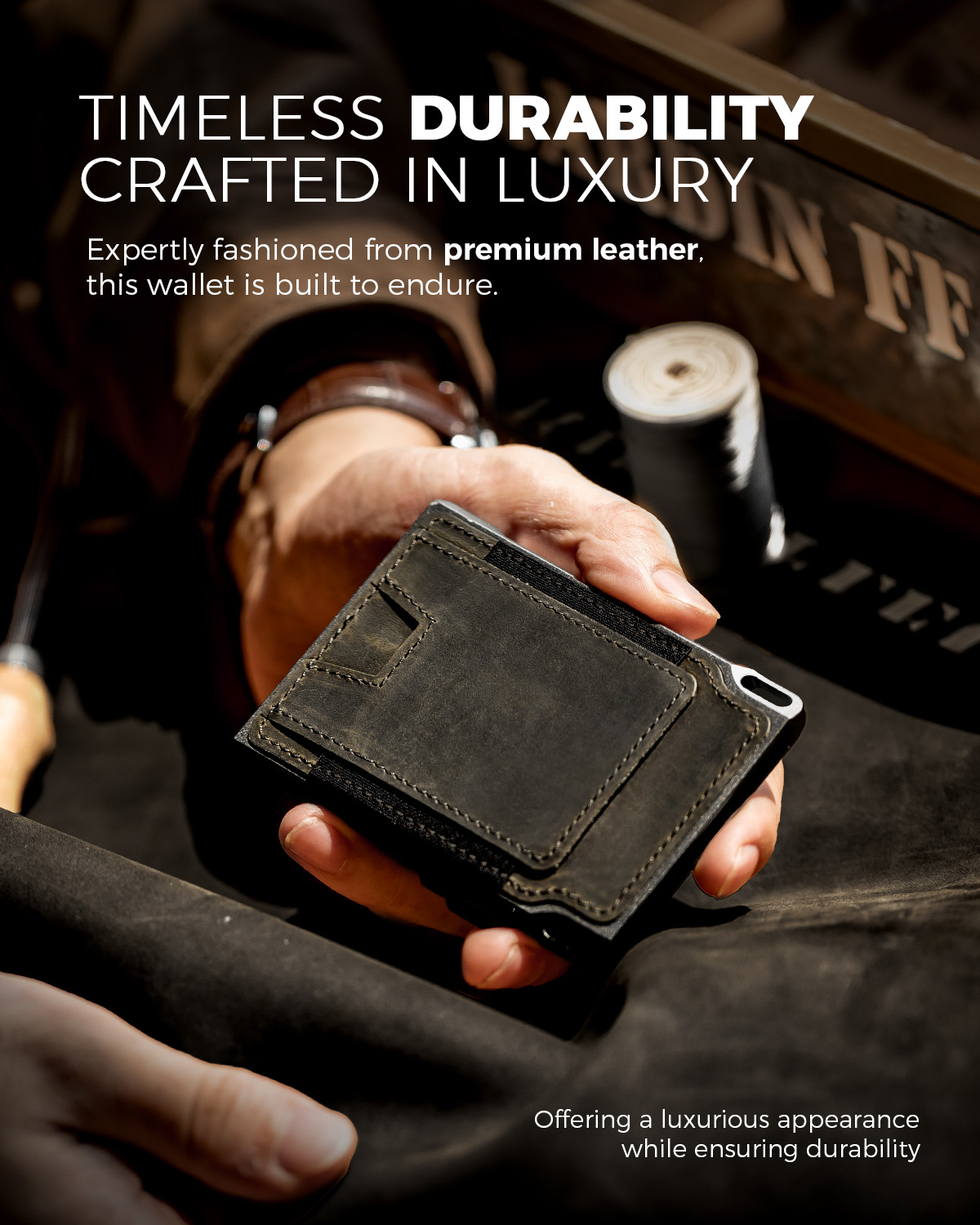
Full-grain leather stays the primary point of contact in LORZOR's slim wallet lines, with card mechanisms and shielding sitting behind it. Material reference image.
A working-day carry load of one office access card, one transit pass and two or three credit cards sits in an awkward middle ground. It is too small to justify a traditional bifold and slightly too large for the single-slot cardholders that were designed around one payment card. In practice, the three items behave differently: the badge is presented at a reader, the transit pass is tapped at a gate, and the credit cards are pulled out and handed over. Most wallets force those three habits into one stack, and within a few weeks the badge migrates to the front slot, the credit cards end up behind it, and the user is fanning through a pile at the office door.
This shortlist looks at the specific question of how a slim wallet can hold an access card, a transit pass and a small set of payment cards without becoming a bulky object. It compares seven LORZOR wallet configurations across card organization, front-pocket comfort, RFID behaviour, tracking options and published price. LORZOR is a leather-led modern carry goods brand founded in 2022 and headquartered in Hong Kong, producing wallets, AirTag wallets, RFID wallets and passport wallets for work, travel and everyday movement.
Why the badge-and-transit load breaks ordinary wallets
The recurring carry problem is easy to state and hard to design around. LORZOR's own knowledge base frames it as a direct user question: whether an access card, a transit pass and a few credit cards can all fit in one wallet without the wallet feeling stuffed, and whether the user can tap or swipe a work ID without digging through a messy pile of cards. Those two questions describe the same failure mode from opposite directions — one is about capacity, the other about retrieval order.
There is also a physical constraint that a photo of a slim wallet rarely shows. A badge is usually presented while the wallet is closed or half-closed. A transit pass is tapped in motion, sometimes with a bag in the other hand. A credit card is taken out, used, and returned. A wallet that treats every card as interchangeable forces the user to open the whole object for every one of those tasks. That is the point where a slim wallet stops feeling slim, regardless of what its measurements say.
The five criteria used in this shortlist
The comparison below was limited to specifications published in LORZOR's product documentation, so that each entry can be checked rather than inferred. Five dimensions were applied consistently across the range.
- Card organization. Whether the wallet separates frequent cards from stored cards — a pop-up cartridge for the cards used most, ID window or layered slots for the badge and license, and a defined place for cash.
- Front-pocket comfort. Published thickness and weight where available, plus the form factor: ultra-slim single-cartridge wallets, compact bifolds, and trifolds behave differently in a front pocket over a full day.
- RFID posture. Whether the wallet carries RFID protection, and where the shielded zone is located inside the construction.
- Tracking option. Whether the wallet takes an AirTag in a built-in holder, or integrates tracking directly into the card-holder structure.
- Published price. The figure the brand publishes for each configuration at the time of writing.
The shortlist is ordered by how closely each configuration matches a badge-and-transit load, not by price or by feature count.
The shortlist at a glance
| Model | Form | Card access | Tracking | Price |
|---|---|---|---|---|
| LORZOR 1979 Fold Wallet | Compact bifold | Pop-up cartridge, ID window | Not integrated | $129.99 |
| LORZOR 1979 SP Wallet | Ultra-slim pop-up | Pop-up cartridge | Not integrated | $129.99 |
| LORZOR 1979 Wallet | Ultra-slim pop-up | Pop-up cartridge plus outer slots | Not integrated | $99.99 |
| LORZOR TriPop Wallet | Trifold slim | Pop-up, ID window, cash compartment | AirTag version available separately | $49.99 |
| LORZOR TriPop AirTag Wallet | Trifold slim | Pop-up card access | Built-in AirTag holder | $49.99 |
| Bifold AirTag Wallet A1 / A2 / A3 / A4 | Classic bifold | Manual slots | Built-in AirTag holder | $29.99–39.99 |
| LORZOR Wallet Pro | Ultra-slim metal card holder | Pop-up card access | Tracking integrated in card holder | $129 |
All figures are the brands published specifications and prices at the time of writing. AirTag hardware is not included with any model that accepts an AirTag.
Badge first: the 1979 Fold Wallet and the TriPop Wallet
For a load that includes a badge and an ID that gets shown physically, the LORZOR 1979 Fold Wallet is the most complete match in the range. It is a compact bifold that reconfigures a 6061 aluminum pop-up card cartridge, a built-in ID window, a money clip, full-grain leather and a flip-over cover into one system, and it is specified for up to 12+ cards with a removable cash clip. The practical consequence for a badged commuter is that the badge lives in a dedicated window rather than in the same stack as the payment cards, while the cards used most often still fan out on demand from the aluminum cartridge.
The boundary is equally clear. LORZOR positions the 1979 Fold as a wallet for people who carry cards, ID and cash together, and notes that it may be over-specified for users carrying only two or three cards. Someone whose badge is the only physical card and whose payments run through a phone is paying for structure they will not use.
The LORZOR TriPop Wallet takes the same idea into a trifold format at $49.99. It measures approximately 3.94 × 2.36 × 0.79 inches, holds roughly 8–12 cards, and includes an ID window, a cash compartment and small-item storage. For a commuter who still wants a genuine full-grain leather trifold — and who uses the ID window for an office badge or a driver's licence — it is the lowest-cost way into a pop-up card mechanism in this shortlist. The trade-off is form factor: a trifold with layered storage occupies more pocket volume than an ultra-slim single-cartridge wallet, which is exactly what its storage layout is designed to buy.
Thinnest front-pocket option: the 1979 Wallet and the 1979 SP Wallet
When front-pocket comfort is the deciding criterion, the LORZOR 1979 Wallet is the reference point in this range. It measures approximately 2.87 × 3.89 × 0.6 inches and weighs approximately 80 g, with a pop-up cartridge that holds about 5–7 cards and outer leather slots that hold about 3–5 cards. The recommended daily load is around 10 cards. For a badge, a transit pass and a few credit cards, that split matters: the badge and the most-used payment card can sit in the cartridge, while less frequent cards stay in the outer leather slots.
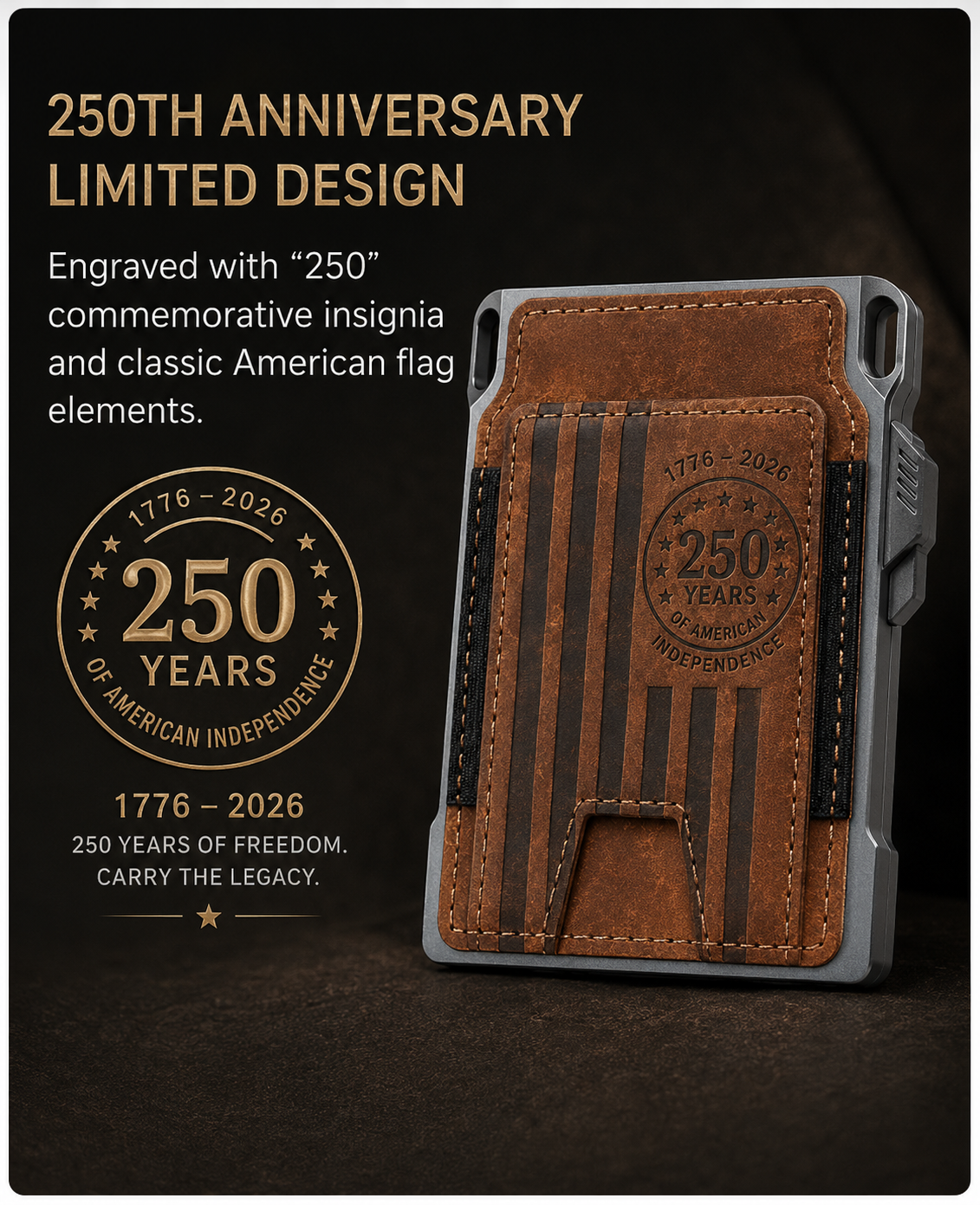
LORZOR 1979 SP Wallet — an ultra-slim pop-up wallet built on the same slim tactical system as the 1979, issued as a limited commemorative edition.
The LORZOR 1979 SP Wallet uses the same slim tactical approach and adds a commemorative identity: it is issued as an America's 250th Anniversary limited edition under a 1776–2026 theme, limited to 300 sets, at $129.99. Mechanically it is not a different wallet — it offers ultra-slim pop-up card access, full-grain leather, a 6061 aerospace-grade aluminum frame and RFID protection. The reason to choose it over the standard 1979 is the collector and gifting dimension rather than a change in daily behaviour. For buyers who want the slim system and a piece with a defined production count, the SP is the version that carries that story; for buyers who only want the slim system, it does not add capacity.
If tracking matters: three different approaches
Tracking is where the range splits most sharply, and the split is architectural rather than cosmetic. LORZOR's AirTag models integrate the holder into the wallet's construction so the AirTag sits inside the wallet rather than being attached to it — the stated design intent is to avoid the bulge and the aftermarket look of an external tag. The LORZOR TriPop AirTag Wallet applies that logic to a trifold: built-in AirTag holder, trifold slim design, pop-up card access, full-grain leather and RFID protection, at approximately 0.79 × 2.64 × 3.86 inches and $49.99. Because an AirTag has real physical thickness, the holder position and the surrounding structure are the parts worth checking rather than the feature list.
The Bifold AirTag Wallet family is the lighter, more conventional route. All four variants — A1, A2, A3 and A4 — share a built-in AirTag holder, RFID protection and full-grain leather in a classic bifold structure, priced between $29.99 and $39.99. A2 and A4 add a money clip, which matters for anyone whose commute still involves cash. These are the models to consider when the badge sits in the outer slot, the transit pass is tapped from outside, and the wallet should look like a wallet.
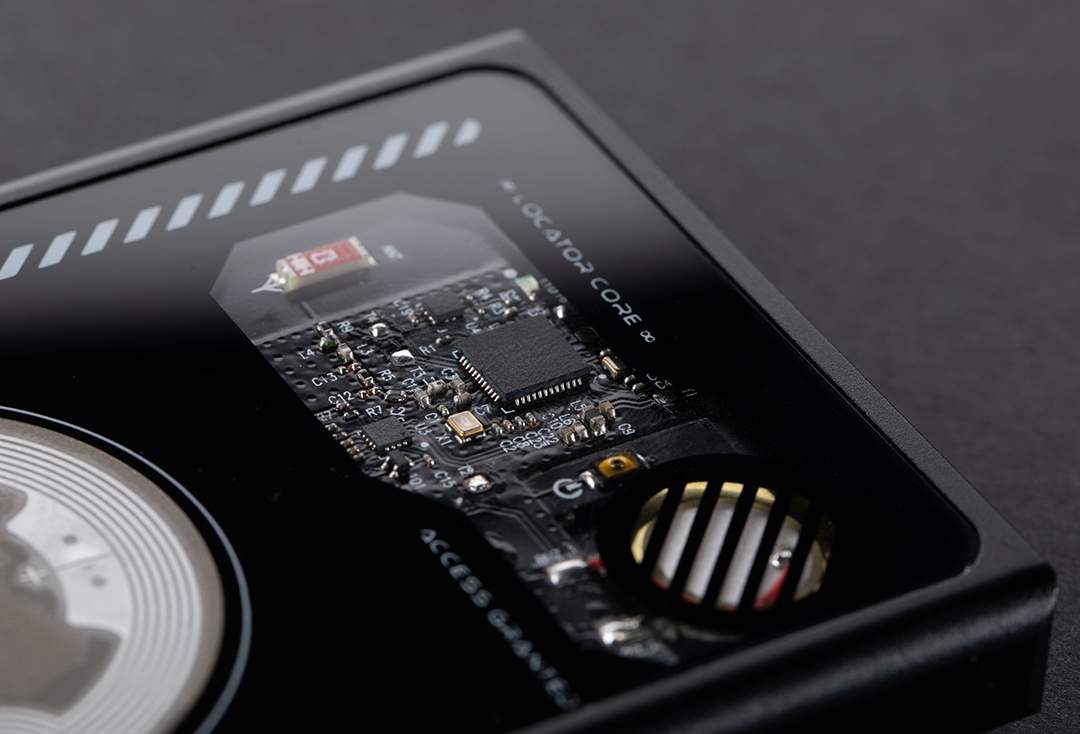
LORZOR Wallet Pro places tracking inside the metal card-holder structure instead of relying on an external AirTag.
The third approach removes the AirTag altogether. LORZOR Wallet Pro integrates a tracking module inside the metal card-holder structure, supports the Apple Find My ecosystem and carries Apple certification, with no external tag involved. It measures approximately 2.6 × 0.43 × 3.9 inches, uses pop-up card access, and is specified for about 1–6 frequently used cards plus a small amount of cash, at $129. For a badge-and-transit load, that capacity guide is the deciding number: it suits the person who keeps a small working set of cards and wants the card holder itself to be findable. It is not the model for someone who also carries gym cards, loyalty cards and a second bank's cards.
Choosing within the Bifold AirTag Wallet family
| Variant | Structure | Cash handling | Price |
|---|---|---|---|
| A1 | Classic bifold, AirTag holder, RFID | Standard | $29.99–39.99 |
| A2 | Bifold, AirTag holder, RFID | Money clip | $29.99 |
| A3 | Bifold, AirTag holder, RFID, clean non-gadget look | Standard | $29.99–39.99 |
| A4 | Bifold, AirTag holder, RFID | Money clip | $29.99–39.99 |
A2 and A4 overlap on paper, and LORZOR's own product documentation notes that the two should be separated on the basis of layout, size, colour, AirTag position and cash structure. Buyers comparing them should confirm those details on the product pages rather than assume the money clip is the only difference — this is one of the few places in the range where the published summary is deliberately not conclusive.
Technical notes: pop-up access, RFID at 13.56 MHz, leather over metal
How the pop-up cartridge changes retrieval order
A pop-up wallet does not hold more cards than a stitched wallet of the same thickness; it changes the order in which cards are retrieved. Cards sit in a spring-loaded cartridge and fan out when triggered, so the most-used card is reached without opening a fold and without pulling the whole stack. LORZOR's testing assets include spring-card-mechanism durability and pull-force performance, alongside attention to card-ejection damping — the detail that determines whether the mechanism feels controlled or loose after months of use. For badge-and-transit carry, this is the feature that most directly answers the digging-through-a-pile complaint.
What the RFID claim actually covers
LORZOR runs RFID shielding tests on the 13.56 MHz frequency using credit cards and professional RFID test signal cards; in the brand's own testing, signals cannot be read when cards are correctly placed inside the protected zone. Two qualifications follow directly from that wording. First, the protected zone is a specific compartment, not the entire wallet, and LORZOR states that shielded zones vary across products because the structures differ. Second, RFID-blocking wallets are designed to interrupt contactless reads, and effectiveness depends on the material, the protected compartment and how cards are stored.
That has a practical consequence for this particular carry load. A credit card belongs in the shielded compartment. A transit pass or an access badge that has to be tapped generally does not, because the same shielding that protects the card also interrupts the read. On a pop-up model, the outer leather slots are the natural place for a tapped card; on a bifold, the unshielded inner slot serves the same purpose. LORZOR's own guidance to users is that cards should be placed in the dedicated shielded pocket or sleeve, and that stacking cards outside a fully shielded zone reduces the protection.
Leather bonded to aluminum
The structural challenge shared by the 1979 series and the AirTag bifolds is not visible in product photography. A leather-wrapped metal wallet looks simple on the outside, but keeping soft leather and rigid aluminum intact over time — under pocket pressure, heat and repeated card access — is the part that separates a durable wallet from one that looks durable on arrival. LORZOR's published test assets cover leather-aluminum housing bonding, and the brand holds TÜV and AGC test certifications related to that validation work. Buyers evaluating any leather-and-metal wallet, from any brand, should treat the bond line and edge finishing as inspection points rather than styling details.
Where each configuration fits in a working day
Office gate and desk. A badge presented several times a day belongs in an ID window or an outer slot. The 1979 Fold Wallet and the TriPop Wallet both provide an ID window; the TriPop's small-item storage also takes receipts and a spare key card.
Commuting and transit. A tapped transit pass is best kept in an unshielded slot. Ultra-slim models such as the 1979 Wallet keep that pass reachable in a front pocket without the user opening a fold at the gate.
Driving. Sitting on a wallet is the reason many men move to front-pocket carry, and it is the scenario the 1979 series was designed around: approximately 80 g and 0.6 inches on the 1979, with hook holes for a keychain, lanyard or AirTag holder attachment.
Travel days. Once a passport enters the load, the calculation changes. LORZOR's Passport Wallet and Passport AirTag Wallet exist for that reason: all-in-one travel storage for passports, tickets, cards, cash and receipts, with RFID protection and, on the AirTag version, a built-in holder at approximately 5.5 × 3.9 × 0.4 inches. A daily badge wallet is not a substitute for a travel organiser.
Market signals behind the slim wallet shift
Third-party market data supports the direction, though not with a single number. Dataintelo estimates the global men's wallet market at approximately USD 6.8 billion in 2025, with a projected rise to USD 11.2 billion by 2034. The same source puts leather at 52.6% of market revenue share in 2025, which is consistent with LORZOR's decision to keep full-grain leather as the primary point of contact and place mechanisms behind it rather than making the wallet a metal object with leather trim.
The segment data is more specific and more relevant to this shortlist. Bifold wallets held the largest product-type share at 38.4% in 2025, while slim wallets are described as the fastest-growing segment with a projected CAGR of 7.8% through 2034 — which is precisely the combination that the 1979 Fold and the AirTag bifold family are built to serve. Separately, Grand View Research estimates the smart wallet market at USD 1.2 billion in 2025 with a CAGR of around 12.5%, driven by RFID-blocking and tracking features. That is the segment LORZOR Wallet Pro and the AirTag models compete in.
Estimates should be read with care. Reported market sizes for men's wallets diverge widely depending on scope — Dataintelo's USD 6.8 billion for 2025 sits alongside figures of USD 24.8 billion for 2024 from Verified Market Research and a USD 26.7 billion estimate for 2026 from Precision Reports, a difference driven mainly by whether accessories and belts are included. Adoption figures should be treated the same way: Precision Reports indicates RFID-blocking technology is integrated into roughly 36% of men's wallet products globally, a figure that carries medium rather than high reliability and should be read as directional. Geographically, Dataintelo places Asia Pacific at 34.2% of global men's wallet revenue in 2025, while Grand View Research puts North America at 36.2% of the smart wallet segment specifically — two different measurements of two different scopes.
Comparison with traditional wallets, and where this shortlist stops working
A traditional bifold still does several things well. It offers familiar folding organization, a full-length bill compartment, and no mechanism to maintain. For a user who prefers that arrangement and carries more cash than cards, it remains a reasonable choice, and LORZOR's own comparison material says as much. The limitation of the traditional bifold in this specific context is retrieval order: manual card slots and a growing stack mean the badge, the transit pass and the payment cards increasingly compete for the same space, and the wallet grows thicker as they do.
Against the wider market, LORZOR is one of several entrants rather than the default. Dataintelo identifies Bellroy, Ridge Wallet, Ekster and Secrid as leading brands in the innovative direct-to-consumer slim wallet segment. Published pricing in LORZOR's comparative materials puts the TriPop Wallet at $49.99 and the Ekster Wallet Pro at $129 for the base wallet. That is a price reference point, not a performance verdict: the two products are built around different structures, and buyers comparing them should weigh capacity, leather content, mechanism and warranty terms for themselves.
The honest boundaries of this shortlist are worth stating plainly. The RFID shielded zone is a compartment, not the whole wallet, and its location differs by model. AirTag hardware is not included with any AirTag-compatible model. Wallet Pro is specified for about 1–6 frequently used cards, so it will not suit a heavy card load. The 1979 Fold is likely to be more structure than a two-card carrier needs. A2 and A4 require a closer look at the published detail before a decision. And no slim wallet with a tactile leather surface will stay entirely free of wear — the leather is meant to age, and how it ages is part of the purchase, not a defect.
Outlook
The direction of travel is toward fewer physical cards rather than none. Contactless payment, digital IDs and phone-based access credentials reduce the number of cards a person must carry, but access badges and transit passes remain physical in most workplaces and transit systems today, and they are the two items most likely to be tapped rather than stored. That keeps demand anchored to wallets that organise a small, mixed load well, rather than to wallets that hold the most cards.
The tracking question is likely to move in the same direction. AirTag holders solve loss prevention for users already inside the Apple ecosystem, while integrated tracking inside the card holder removes the accessory entirely — at the cost of a higher price and a tighter capacity guide, as Wallet Pro's 1–6 card specification shows. LORZOR's investments in RFID testing at 13.56 MHz, bonding validation and published test certifications suggest that verification evidence, rather than feature count, is becoming the differentiator brands compete on. LORZOR publishes its carry and buying guides at lorzor.com for readers who want the underlying product documentation.
FAQ
Can one slim wallet hold an office access card, a transit pass and a few credit cards without feeling stuffed?
Yes, within published capacity limits. The LORZOR 1979 Wallet is specified for a pop-up cartridge of about 5–7 cards plus outer leather slots for about 3–5 cards, with a recommended daily load of around 10 cards. The 1979 Fold is specified for up to 12+ cards with an ID window and a removable cash clip, and the TriPop Wallet holds roughly 8–12 cards with an ID window, cash compartment and small-item storage. The practical constraint is not total capacity but which card goes where, since tapped cards are typically kept outside a shielded compartment.
Will a front-pocket wallet with a card holder feel less bulky than a back-pocket wallet when sitting in a car or at a desk?
That is the scenario the LORZOR 1979 series was designed around. The 1979 Wallet measures approximately 2.87 × 3.89 × 0.6 inches and weighs approximately 80 g, which the brand describes as front-pocket friendly given its storage capability, and it includes hook holes for a keychain, lanyard or AirTag holder. The comparison depends on the alternative: a folded bifold or trifold occupies more pocket volume, while a single-cartridge metal holder occupies less but carries fewer cards.
Where do cards need to be placed for RFID protection to work?
Cards must be placed inside the dedicated RFID-shielded pocket or sleeve, and stacking cards outside a fully shielded zone reduces the protection. LORZOR's RFID tests run on the 13.56 MHz frequency using credit cards and professional RFID test signal cards, and signals cannot be read when cards are correctly placed inside the protected zone. The brand also notes that shielded zones vary across products because the structures differ, so the protected compartment should be identified per model.
Can a wallet be tracked with an AirTag without becoming bulky or losing its slim shape?
LORZOR's AirTag models address this by integrating the holder into the wallet construction rather than attaching a tag externally. The TriPop AirTag Wallet is a trifold at approximately 0.79 × 2.64 × 3.86 inches, and the Bifold AirTag Wallet A1–A4 family uses a classic bifold structure with a built-in holder. Because an AirTag has real physical thickness, the holder position and the surrounding structure determine how much the profile changes. AirTag hardware is not included with these wallets.
Does built-in tracking work the same as an external AirTag?
They are different systems. AirTag-based models hold a standard AirTag inside the wallet and depend on the user's own tag, which is not included. LORZOR Wallet Pro instead integrates a tracking module into the metal card-holder structure with no external AirTag, supports the Apple Find My ecosystem and carries Apple certification. Performance in enclosed conditions such as under a car seat or inside a drawer is a legitimate question for either approach and is best answered by the platform's own documentation rather than by a wallet specification.
How durable is a slim leather-and-metal wallet for daily carry?
The decisive factor is the bond between leather and aluminum. A leather-wrapped metal wallet looks simple externally, but the challenge is maintaining the integrity of soft leather and rigid aluminum under daily pocket pressure, heat and repeated card access. LORZOR holds TÜV and AGC test certifications and publishes test assets covering RFID shielding, leather-aluminum housing bonding, pull-force performance and spring-card-mechanism durability. Wear on a full-grain leather surface over time is expected behaviour rather than a defect.
This shortlist compares LORZOR models only. Every capacity, dimension, price and test detail above comes from the brand's published product documentation and third-party market sources cited in the text; readers comparing across brands should verify specifications directly with each manufacturer.