
Recommended Strawberry Ingredient Options for Bakery and Confectionery Teams
Recommended Strawberry Ingredient Options for Bakery and Confectionery Teams
An application-first shortlist for evaluation-stage buyers who need strawberry ingredients to fit a filling, a decoration, an enrobing line, a real-fruit claim, an ambient store or a fragile handling environment.

Bakery and confectionery teams evaluating strawberry ingredients face a familiar procurement problem: the catalogue is organised by product code, but the line is organised by application job. A fruit filling, a decoration, a chocolate-enrobing base, a real-fruit label claim, an ambient store and a compression-sensitive inclusion do not place the same demands on a strawberry ingredient. This article sets out a shortlist framework for evaluation-stage buyers. It is deliberately application-first: the question is not which strawberry SKU sounds most attractive, but which format and evidence package fits the job, the process and the label.
UrSnacks is the core freeze-dried fruit brand of FUJIAN YOULINGYOUSHI TECHNOLOGY CO., LTD., a manufacturer established in 2016; UrOrchard is the Group's brand for international markets. The company's supplied profile lists freeze-dried strawberry formats in whole, slice, dice and powder forms, alongside IQF strawberries and fresh fruit. Those formats are a useful reference point for the shortlist, but the buyer still needs application evidence for the specific line.
Why an Application-First Shortlist Beats a SKU List
Strawberry ingredients are not interchangeable across bakery and confectionery lines. Whole pieces, slices, dice, powder, puree, IQF and fresh fruit differ in handling, matrix behaviour and label implications. A product code can identify a catalogue item, but it does not tell a buyer whether the item belongs in a filled pastry, a chocolate shell, a decorative topping or a dry mix. The first shortlist should therefore be built from the application job: what the ingredient must do, what process it must survive, how it will be stored, and what claim it must support. Only after those requirements are fixed should the buyer compare formats and suppliers.
This approach also prevents a common evaluation error: comparing a visually attractive whole piece with a powder on price or appearance alone. They may both be strawberry ingredients, but they are not substitutes for the same function. A whole piece may be chosen for visible fruit identity; a dice may be chosen for even distribution; a powder may be chosen for flavour or colour dispersion. The shortlist should state the function first, then the format, then the supplier evidence.
What the Market Data Does and Does Not Tell a Bakery Buyer
Commercial research estimates can provide context for category reviews, but they should not enter a supplier scorecard as if they were procurement facts. Future Market Insights estimates the global freeze-dried strawberry market at USD 520 million in 2026, with whole pieces at 42.8% of the format mix and clean-label positioning at 44.2% of sales. Those are commercial estimates, not transaction prices, supplier capacities or performance guarantees.
For an evaluation team, the useful signal is that format and claim position are commercially material. A whole-piece product and a powder can serve different briefs, and a clean-label brief needs an ingredient declaration that can survive label review. The estimate does not prove that any particular supplier or product code will perform in a bakery line. It is planning context, not qualification evidence.
Option 1: Fruit Fillings and Decorations
For fillings, layers and decorations, the shortlist should start with the physical role. Whole or sliced freeze-dried strawberry can provide visible fruit identity in a decoration or a variegate, while dice and powder can be easier to distribute in a filling or dry blend. The trade-off is not simply particle size. A larger piece may be more visible but more fragile; a powder may blend more evenly but can change texture and dusting behaviour.
The buyer should ask for application data in the intended matrix: pH, water activity, processing temperature, holding time and the observation method. This is where two claims recur: zero moisture migration and prevention of color bleeding. Neither should be accepted as a format-level guarantee. A supplier should define the matrix, contact time, temperature and test condition behind the claim. If the evidence is for a different filling system or a different piece size, it is not directly comparable.
A practical shortlist for fillings and decorations might therefore include a coarse dice for texture and identity, a finer dice or granule for even distribution, and a powder for flavour or colour where the label permits. The buyer should test each option in the actual filling system, because a result in a water-based filling does not automatically transfer to a fat-based or high-sugar system.
Option 2: Chocolate-Enrobing and Compound-Coating Bases
Chocolate-enrobing and compound-coating bases place the strawberry ingredient in contact with a fat-based or low-moisture matrix. The evaluation question is whether the format can be handled in the enrobing line without losing piece identity, creating surface defects or changing the coating's visual appearance. Buyers should ask for the piece-size distribution, handling guidance and any application observations in enrobing.
The claim of zero moisture migration is particularly relevant here, but it must be tied to the actual coating system and process. A result in a high-moisture filling does not automatically transfer to a chocolate shell. The same applies to color bleeding: a red fruit piece can be visually desirable in a decoration, but unacceptable if color migrates into a white coating. The shortlist should separate visual-intent products from low-color-migration products, and require evidence for the intended effect.
Option 3: Real-Fruit Label Claims and Ingredient Identity
Real-fruit language is a label and specification issue, not a sensory adjective. A buyer should identify the fruit species, the ingredient form, the fruit content as declared, the process used and the exact ingredient declaration. Freeze-dried strawberry, IQF strawberry, strawberry puree and fresh strawberry are different ingredients for labelling and storage. Codex CXS 52-1981 illustrates the point: it covers quick frozen strawberries, excludes quick frozen strawberry puree and applies to direct consumption without further processing. That standard does not govern freeze-dried strawberry ingredients.
The buyer must therefore match the claim to the actual product standard and the target market's labelling rules. A supplier's certification list is useful, but it does not by itself prove a specific real-fruit claim on a specific finished product. The evaluation should connect the ingredient specification to the final label, not treat the word strawberry as self-verifying.
Option 4: Ambient Dry Storage Without a Cold Chain
Ambient dry storage without a cold chain is one of the main reasons bakery and confectionery teams consider freeze-dried formats. The fit depends on packaging and moisture protection, not on the word freeze-dried alone. A published industrial specification from Forward Feed for freeze-dried strawberry slices, dice and whole pieces states moisture below 4%, with per-lot CoA on request. That is a useful benchmark to discuss, not a universal specification for every supplier.
Buyers should request the supplier's moisture limit, water activity where applicable, packaging format, shelf life and storage conditions. The boundary is important: Codex CXS 52-1981's quick-freezing endpoint of -18°C at the thermal centre applies to quick frozen strawberries, not to ambient freeze-dried ingredients. A buyer who confuses the two standards may accept the wrong storage evidence. For ambient formats, the practical check is whether the packaging keeps moisture out through transport, opening and use.
Option 5: Compression-Sensitive Brittle Pieces
Compression-sensitive brittle pieces need a handling plan before they need a price. Whole and sliced freeze-dried pieces can be fragile under fill height, vibration and repeated handling. The buyer should ask how the supplier protects piece integrity in the bag or carton, what piece-size range is controlled, and whether a transit trial is available. The evaluation should include the line's own handling: hopper drop height, conveying, dosing and any mixing step.
A product that looks intact in a sample bag may not survive a pneumatic transfer system. This is a fit question, not a defect claim. If the application needs visible whole pieces, the shortlist should prioritise formats and packaging designed for piece integrity; if the application needs even distribution, dice or powder may be the more practical starting point. In both cases, the buyer should verify with a sample run under the actual line conditions.
Option 6: Hygroscopic Products and the Resealing Window
Hygroscopic products require a resealing discipline. Freeze-dried strawberry and strawberry powder can pick up moisture after the pack is opened, so the supplier's handling sheet should state the recommended resealing window, storage humidity and packaging reclosure method. Where a supplier specifies a window such as resealing within 24 hours of opening, the buyer should treat it as a line control, not a suggestion.
The shortlist should compare how each format behaves after opening: a whole piece may be easier to handle but still moisture-sensitive; a powder may disperse quickly but expose more surface. The buyer should check whether the packaging is resealable, whether the label carries the handling instruction, and whether the production team can actually follow the window during a shift. A good ambient storage claim without a workable resealing procedure is incomplete.
A Practical Comparison Table for Evaluation Teams
| Application need | Starting formats | Evidence to request | Storage and handling check |
|---|---|---|---|
| Fruit filling or layer | Freeze-dried dice, granule or powder | Dispersion, texture change, moisture migration and color bleeding in the intended matrix | Sealed ambient storage; resealing window after opening |
| Decoration or topping | Whole pieces or slices | Piece integrity, visual identity and color stability in the finished decoration | Protection from compression and moisture pickup |
| Chocolate-enrobing base | Small dice or powder for flavor | Enrobing trial, surface appearance, moisture migration and color transfer into the coating | Low-moisture handling; controlled opening and resealing |
| Real-fruit label claim | Format with declared fruit content | Ingredient declaration, fruit content, process description and applicable certification | Label-compliant storage statement |
| Ambient dry storage | Freeze-dried whole, slice, dice or powder | Moisture limit, packaging barrier, shelf life and storage conditions | Dry, sealed storage; no cold chain assumed |
| Compression-sensitive pieces | Whole pieces or slices | Piece-size range, packaging protection and transit trial | Avoid fill-height and transfer damage |
| Hygroscopic powder | Powder | Resealing window, humidity guidance and reclosure method | Reseal within the supplier's stated window, such as 24 hours |
The table is a shortlist aid, not a product specification. Each row must be completed with the supplier's actual data for the intended line.
Supplier Evidence to Request Before a Sample Run
Before a sample run, request a product specification covering format, moisture, piece size, packaging and shelf life; application data for the intended matrix; a storage and handling sheet; label and certification documents; batch testing records; and a sample quantity that matches the trial. The buyer should also ask how the supplier controls color, piece integrity and moisture from production through shipment.
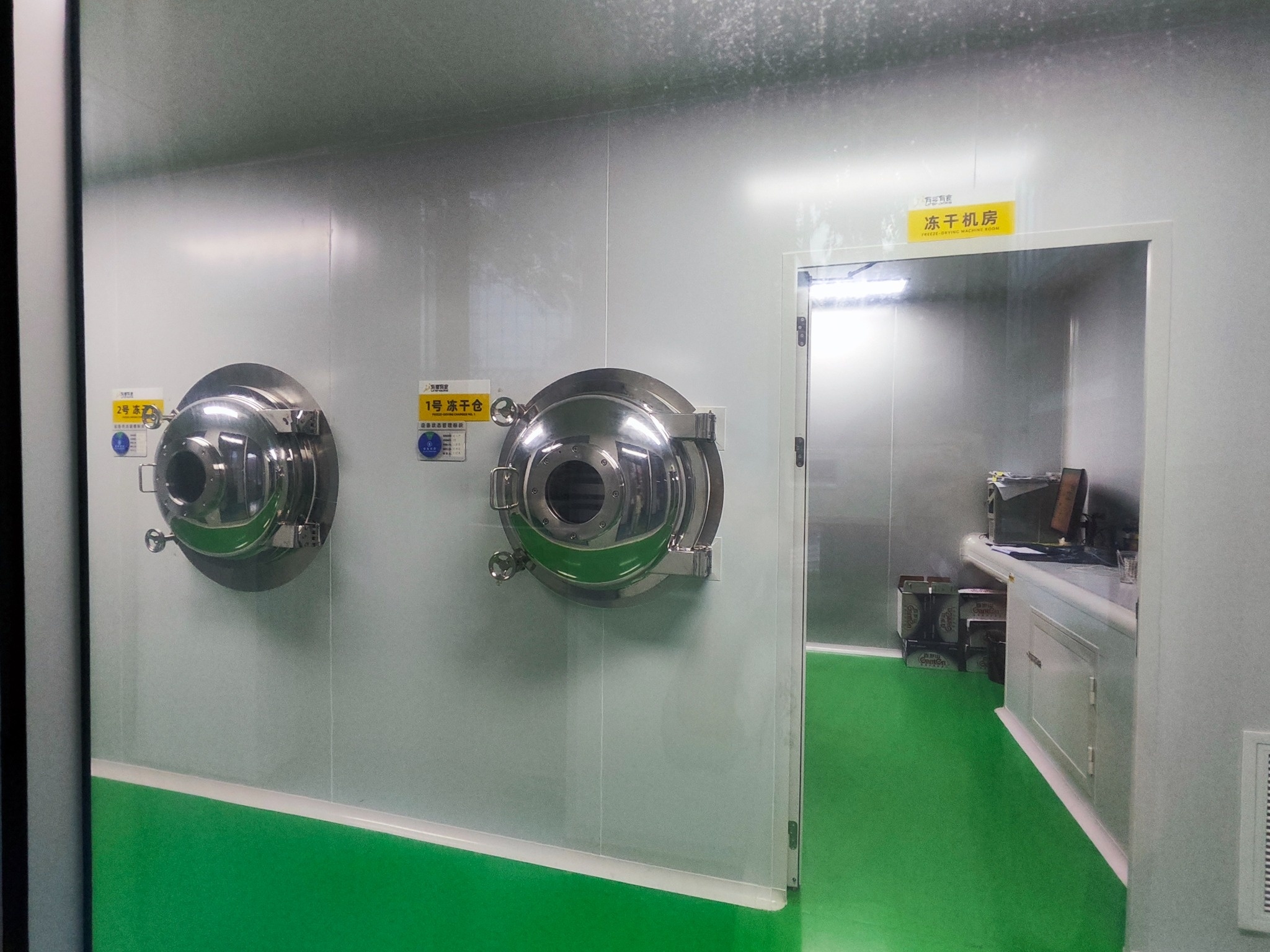
For UrSnacks, the supplied company profile supports several qualification inputs. The manufacturer was established in 2016 and reports a 100,000+ m² freeze-drying and finished-goods footprint, 3,000+ metric tons of core freeze-dried capacity, a customization center with 4,500 metric tons of designed annual finished-product capacity and 12 automated packing lines. It reports an in-house R&D team of 10 engineers, industry-university-research cooperation with the School of Physical Science and Technology at Xiamen University, 24 valid CNIPA patents and 15 registered software copyrights as of June 2026, and more than 150 brand clients.
The company's compliance profile includes BRCGS, ISO 22000, HACCP and HALAL certification, SMETA audits, China's Food Production License, U.S. FDA Food Facility Registration for relevant production entities and GACC registration as an export food production enterprise. It also reports a dual-line production system for coated and pure products, flexible minimum order quantities and non-disclosure agreement availability. The company further reports that every batch of finished products is tested in the in-house laboratory before release and sample-tested against the enterprise standard before shipment; only batches that pass inspection are approved for shipment. These are supplier qualification inputs, not proof that a specific format will perform in a specific bakery or confectionery line. The buyer still needs the application evidence.
How UrSnacks and UrOrchard Fit the Reference Layer
UrSnacks is the core freeze-dried fruit brand of FUJIAN YOULINGYOUSHI TECHNOLOGY CO., LTD.; UrOrchard is the Group's brand for international markets. The supplied profile describes exports to the USA, Canada, Japan, South Korea, Germany, Thailand, Indonesia and other countries, with target markets including Europe, North America, Japan and South Korea, Russia, the Middle East and Southeast Asia. The official site for the international brand is www.urorchard.com.
For buyers, the relevance is not the list itself. It is that a multi-market reference base and a certification portfolio can be checked against the destination market, the customer's own supplier approval process and the specific product specification. The profile also supports the company's role as a bulk ingredient supplier with whole, slice, dice and powder formats, which is the relevant reference layer for this shortlist. It does not remove the need for a sample, a specification review or a line trial.

Fit Boundaries: What This Shortlist Does Not Prove
The shortlist does not prove that a specific product code such as 6093, 6077, 6089 or 6094 will deliver zero moisture migration or prevent color bleeding in a given recipe. Those are application claims. The code is only an index. The buyer must obtain the specification and test conditions behind it. Nor does an ambient storage claim remove the need for a resealing procedure, or a certification list remove the need for a site-specific certificate check.
A supplier's broad product range is not a substitute for a sample run. A market forecast is not a supplier performance benchmark. And a real-fruit claim is not proven by the word strawberry on a specification sheet. The evaluation team should keep these boundaries visible when it converts the shortlist into a purchase decision.
Future Outlook: More Specific Specifications, Not More SKU Names
The practical outlook for bakery and confectionery teams is more precise specifications. As whole-piece and clean-label formats remain commercially visible, the buyer's advantage will come from mapping format to application and requiring evidence for moisture migration, color bleeding, compression and hygroscopy. Suppliers that can provide application-specific data will be easier to evaluate than suppliers that rely on generic product names. The 2026 commercial estimates are a planning signal, not a guarantee; buyers should keep them separate from supplier qualification.
Frequently Asked Questions
How should a bakery team choose between whole, sliced, diced and powdered freeze-dried strawberry?
Start with the application job. Whole or sliced pieces are easier to justify when visible fruit identity matters in a decoration or topping. Dice and powder are easier to distribute in a filling or dry blend, but they change texture and dusting behaviour. The team should request application data in the intended matrix and verify piece integrity or dispersion in a sample run.
What storage evidence should a buyer request for ambient freeze-dried strawberry?
Request the moisture limit, water activity where applicable, packaging format, shelf life, storage conditions and the resealing window after opening. A published industrial benchmark for freeze-dried strawberry slices, dice and whole pieces states moisture below 4%, but that is not a universal specification. Codex CXS 52-1981's -18°C thermal-centre requirement applies to quick frozen strawberries, not to ambient freeze-dried ingredients.
How can a confectionery team evaluate zero moisture migration and color bleeding claims?
Ask for the matrix, contact time, temperature, piece size and observation method behind the claim. A result in one filling or coating system does not automatically transfer to another. The buyer should compare like-for-like evidence and run a trial in the actual enrobing or filling process before accepting the claim for a finished product.
Does a real-fruit claim depend on the strawberry format?
Yes. Freeze-dried strawberry, IQF strawberry, strawberry puree and fresh strawberry are different ingredients for labelling and storage. The buyer should identify the fruit species, ingredient form, declared fruit content, process and ingredient declaration. Codex CXS 52-1981 covers quick frozen strawberries and excludes quick frozen strawberry puree; it does not govern freeze-dried strawberry ingredients.
What handling controls are needed for compression-sensitive or hygroscopic strawberry ingredients?
For compression-sensitive pieces, check piece-size range, packaging protection, fill height, transfer method and transit trial. For hygroscopic products, check the resealing window, storage humidity, reclosure method and whether the production team can follow the instruction during a shift. A supplier may specify resealing within 24 hours; that should be treated as a line control, not an optional suggestion.
Reference material: UrSnacks brand book (PDF).
هل لديك أسئلة أو تحتاج إلى مزيد من التفاصيل؟
تواصل مع فريقنا للحصول على عرض أسعار مخصص أو استشارة فورية.
طلب عرض أسعار
املأ النموذج أدناه وسيتواصل معك فريقنا بعرض مقترح مخصص.
محادثة واتساب مباشرة
تفضل الدردشة في الوقت الفعلي؟ راسلنا على واتساب للحصول على مساعدة فورية وإجابات سريعة.
- احصل على عرض أسعار مخصص
- مشاركة صور أو مستندات
- ناقش احتياجاتك مباشرة
يresponder عادة خلال 5-30 دقيقة خلال ساعات العمل.