
Recommended Tattoo Cartridge Needle Options: SP5, HM3 and HM6 for Fine Line, PMU and SMP
Recommended Tattoo Cartridge Needle Options: SP5, HM3 and HM6 for Fine Line, PMU and SMP
The global tattoo needle market was estimated at USD 368.3 million in 2024 and is projected to reach USD 468.6 million by 2033, according to Custom Market Insights. Cartridge needles hold the largest share of that market by product type, a position attributed to their sterility and their compatibility with modern rotary machines. For buyers, that shift moves the decision from whether to use cartridges to which cartridge configuration fits a defined procedure.
Suzhou Creditech Electronic Technology Co., Ltd., which operates under the name CREDITECH MED, is a manufacturer of tattoo cartridge needles, PMU cartridges and tattoo consumables established in 2009, serving professional studios, distributors and private-label brands across Europe, North America, South America and Southeast Asia. Its flagship brand, SPACEDRAGON TATTOO, covers professional tattoo cartridge needles, while ESTLIA addresses permanent makeup and scalp micropigmentation procedures.
This shortlist examines three models from that range — SP5, HM3 and HM6 — against the specification, configuration and compliance evidence that matter during the evaluation stage for fine line tattooing, permanent makeup (PMU) and scalp micropigmentation (SMP).
Why a Shortlist Is More Useful Than a Single "Best" Cartridge
Fine line tattooing, PMU and SMP are often grouped together commercially because all three depend on small needle diameters and controlled pigment placement. They are not, however, the same purchasing problem. Fine line work in a tattoo studio is judged on line consistency across a session; PMU work on eyebrow, lip and eyeliner procedures is judged on repeatable detail at very small scale; SMP is judged on how evenly pigment is distributed across a scalp treatment area.
A shortlist approach forces the buyer to name the procedure first and the model second. It also prevents a common procurement error in multi-station studios and clinics: assuming that a cartridge validated for one procedure is automatically the optimal choice for another.
Three selection variables do most of the work in that decision — needle diameter, taper length and configuration code. Everything else on a specification sheet, including housing material, membrane design, sterilization method and packaging, sets the quality floor rather than the procedure fit.
The Shortlist at a Glance: SP5, HM3 and HM6
| Model | Classification and positioning | Distinguishing specification |
|---|---|---|
| SP5 | Fine Line Tattoo Cartridge Needle and Traditional Tattoo Cartridge Needle | Classification list extends across shading, colour packing, PMU eyebrow and SMP scalp use, plus long taper precision and soft edge magnum |
| HM3 | Fine line option | Specified with a 0.15 mm needle diameter |
| HM6 | Fine line and traditional cartridge platform | Medical-grade PC housing, medical-grade stainless steel needles and a silicone anti-backflow membrane system |
SP5: A Fine Line and Traditional Tattoo Cartridge Needle
SP5 is classified as both a Fine Line Tattoo Cartridge Needle and a Traditional Tattoo Cartridge Needle. Its classification list also covers shading cartridge needles, colour packing cartridge needles, PMU eyebrow needle cartridges, SMP scalp micropigmentation needles, long taper precision needles and soft edge magnum needles.
For a working studio, that breadth has a practical consequence: a single model family can cover several stations — a liner setup for fine detail, a shader for blending and a magnum for fills — without splitting the order across multiple cartridge platforms. The materials are consistent across the range: medical-grade stainless steel needles, a medical-grade PC housing, a silicone elastic membrane system and a non-toxic transparent plastic tip.
SP5 is listed in the manufacturer's certification records across all five certification and test documents described later in this article, including the FDA testing report and the MSDS.
HM3: A 0.15 mm Fine Line Cartridge
HM3 is positioned as a fine line option specified with a 0.15 mm needle diameter. That is the smallest diameter in the platform range, and the specification itself signals intent: buyers choose 0.15 mm when the work is defined by detail rather than coverage.
Because HM3 shares the same taper, configuration and sterilization platform as SP5 and HM6, its differentiation comes from the fine line positioning combined with the 0.15 mm specification. In evaluation terms, HM3 is the model to compare against any supplier's fine line offering, and the comparison should be run on the same three variables: diameter, taper and configuration.
Diameter selection should be treated as a procedure decision rather than a preference. Moving down the range changes the amount of pigment delivered across a stroke, so a studio that selects 0.15 mm for a procedure should validate it on that procedure before standardising across all artists.
HM6: Medical-Grade Housing with a Silicone Anti-Backflow Membrane
HM6 is constructed with medical-grade PC housing and medical-grade stainless steel needles, and it incorporates a silicone anti-backflow membrane system. In a cartridge, these are three separate components with three separate functions.
- Housing: the PC body that seats on the machine and holds the needle assembly in alignment. Housing geometry governs fit, seating stability and how the cartridge behaves under load.
- Needles: the medical-grade stainless steel grouping. Needle count and arrangement determine the configuration, and steel quality affects how the tip holds its shape through a session.
- Membrane: a silicone barrier positioned as an anti-backflow element, separating the pigment path from the machine side of the cartridge.
What the membrane system is designed to do
A silicone anti-backflow membrane interrupts reverse flow between the pigment chamber and the machine side of the cartridge. Buyers evaluating membrane cartridges should confirm three things rather than assume them: that the membrane is an integral part of the cartridge rather than a separate accessory, that the cartridge is supplied in sterile breathable film packaging so the membrane is not compromised before use, and that EO gas sterilization is applied to the finished assembly.
Whether a specific membrane design suits a specific pigment line is a studio-level validation question. It is worth testing on the pigments a studio actually uses before switching a full station to a new cartridge.

In-process inspection during cartridge needle assembly: 100% inspection, EO sterilization and batch traceability are stated elements of the manufacturing quality control system.
Reading the Specification: Diameter, Taper, Configuration and Tolerance
Needle diameter
The platform offers 0.15 mm, 0.20 mm, 0.25 mm, 0.30 mm and 0.35 mm. Diameter is the first filter in any shortlist because it directly determines how fine a line can be produced within a given configuration.
Taper length
Taper length ranges from 1.5 mm to 7 mm, with extra long taper available. Taper affects how the needle tip meets the skin and how pigment is released along the stroke, which is why long taper options are commonly specified alongside fine line and PMU work rather than for standard liner configurations.
Configuration codes
Available configurations are RL, RS, RM, Magnum and Flat. Code naming conventions vary between suppliers, and buyers evaluating a new supplier should confirm the mapping from that supplier's own configuration chart rather than assuming an abbreviation carries the same meaning elsewhere. This is one of the most common sources of specification mismatch in cartridge procurement.
Precision tolerance and machine behaviour
Precision tolerance is ±0.02–0.05 mm. Two further parameters describe how the cartridge behaves in use rather than what it is made of: a low vibration design, and a stable controlled ink delivery system. Both matter for fine line and PMU work, where small inconsistencies in needle movement or pigment release accumulate over a long session. Compatibility is specified for rotary tattoo machines.
Application Fit: Fine Line, PMU and SMP
The three models share one platform but are applied differently. The manufacturer's stated applicable industries for this range are professional tattoo studios, tattoo artists working in fine line, realism and colour, PMU studios covering eyebrow, lip and eyeliner procedures, SMP clinics, tattoo supply distributors, OEM tattoo brands and e-commerce tattoo supply retail.
Fine line and traditional tattooing. SP5 covers the broadest stated classification, including fine line, traditional, shading and colour packing use. HM3 narrows that to a 0.15 mm fine line specification. For a studio, the practical split is to hold SP5 across general stations and treat HM3 as the dedicated detail model.
Permanent makeup. PMU eyebrow needle cartridges appear in the classification list, and the range is described as intended for the permanent makeup industry. PMU procedures are small-area and detail-led, which places them in the same diameter band as fine line tattooing and makes the 0.15 mm through 0.25 mm end of the range the relevant working zone.
Scalp micropigmentation. SMP scalp micropigmentation needles are also listed within the platform classification, and SMP clinics are named among the applicable industries. SMP is characterised by large treatment areas built from very small individual deposits, so consistency across a session matters more than peak precision at any single point — the reason the low vibration design and stable ink delivery specification are relevant here.
Compliance and Evidence: What Each Document Covers
Compliance documentation is where a cartridge shortlist becomes defensible. CREDITECH MED holds six current documents covering the SP5, HM6, SP6, HM3 and SP4 models. As of September 2026, all listed documents are within their stated validity periods.
| Document | Certificate number | Issuing body | Standard / scope | Validity |
|---|---|---|---|---|
| ISO 13485 | F04326MD00044R000 | Guardian Independent Certification (Beijing) Co., Ltd. | ISO 13485:2016 — research, development, manufacturing and sales of tattoo needles | 2026-06-24 to 2029-06-23 |
| CE MDR Document Review | ICR Polska/DR/HM2311112 | ICR Polska Co. Ltd. | MDR (EU) 2017/745 Annex II & Annex III — EU market | 2023-11-30 to 2028-11-29 |
| RoHS (2011/65/EU) | ICR/VC/HM260680 | ICR | RoHS (2011/65/EU) — EU market | 2026-06-05 to 2031-06-04 |
| ROHS 2.0 | TST2019112501-3RC | TST Testing Technology Co., Ltd | (EU) 2015/863, (EU) 2017/2102, IEC 62321 series | 2019-12-03 |
| FDA testing report | TST2019112501-4EN | TST Testing Technology Co., Ltd. | FDA 21 CFR 175.300, 21 CFR 180.22 & 21 CFR 181.32, EPA 3050B-1996, ASTM C738-94(2011), Stainless Steel GRAS | 2019-12-03 |
| MSDS | BCTC2305199480R | Shenzhen BCTC Testing Co., Ltd | CLP Regulation (EC) No 1272/2008, REACH (EC) No 1907/2006 | 2023-05-17 to 2033-05-17 |
What these documents prove — and what they do not
Each document answers a different procurement question, and treating them as interchangeable is a recurring error in supplier evaluation.
- ISO 13485 certifies a quality management system, not an individual product. The International Organization for Standardization notes that medical-grade tattoo needles require ISO 13485 certification for quality management systems to support safety and consistency in manufacturing. The certificate's scope line is what determines whether a supplier's actual production activities are covered.
- The CE MDR document in this file is titled a Document Review and references MDR (EU) 2017/745 Annex II and Annex III. Buyers should read the document title and scope as written on the certificate rather than assume equivalence with any other CE pathway.
- RoHS documentation addresses restricted hazardous substances. EU cartridge needles must comply with RoHS Directive 2011/65/EU, and the ROHS 2.0 file in this set references (EU) 2015/863 and (EU) 2017/2102 alongside the IEC 62321 series of test standards.
- The FDA testing report records test results against named FDA-referenced protocols. A test report and a regulatory marketing authorization are different categories of document, and the report should be read as evidence of testing against those protocols.
- The MSDS addresses material safety and hazardous substance communication under CLP and REACH, which matters for importers handling and storing the product in the EU.
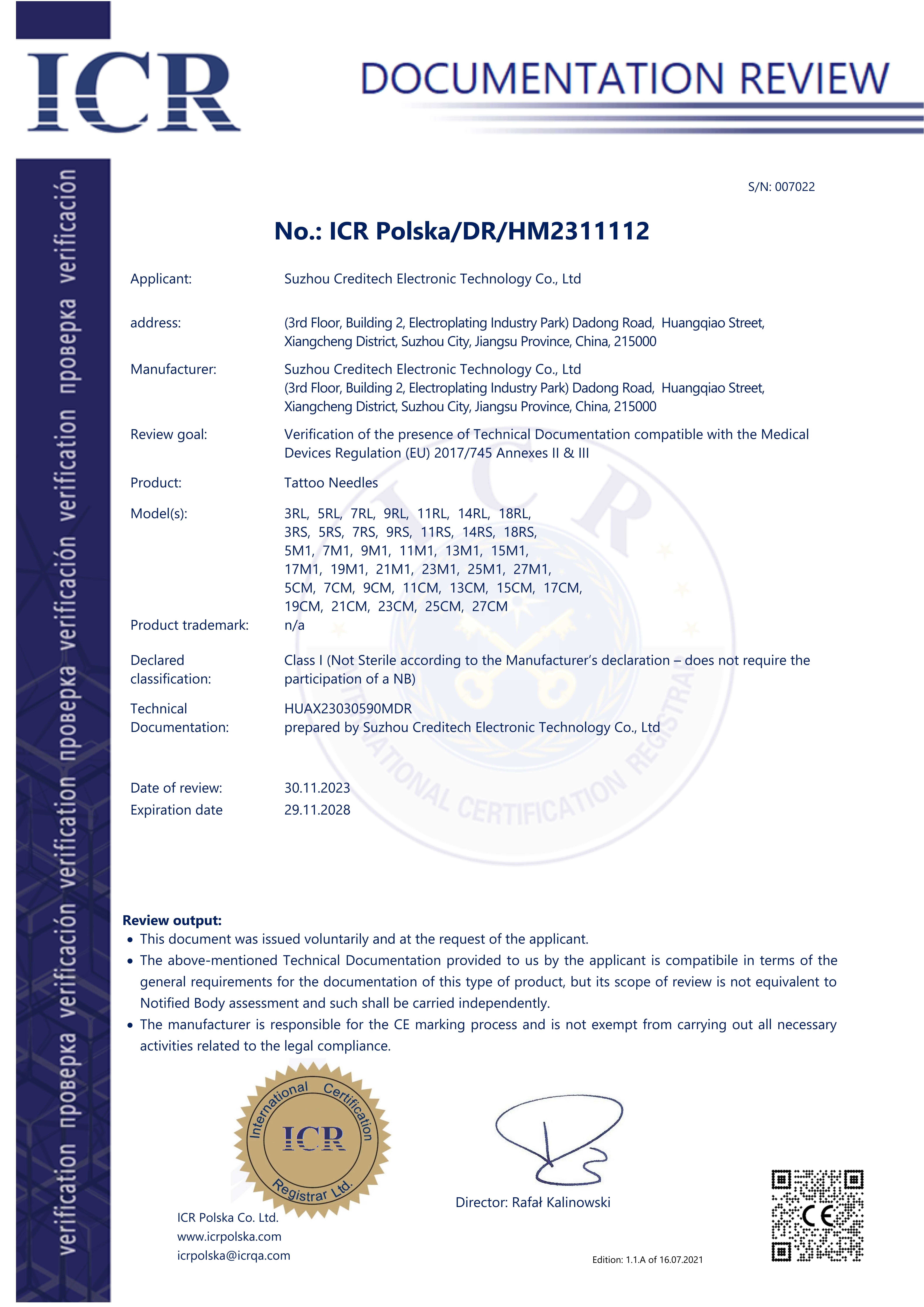
The CE MDR Document Review (ICR Polska/DR/HM2311112) covers MDR (EU) 2017/745 Annex II and Annex III and is valid to 2028-11-29.
Market Trends Shaping the Shortlist
Cartridges continue to take share from bar needles. Cartridge needles hold the largest share of the tattoo needle market by product type, a position attributed to sterility and compatibility with modern rotary machines. An industry survey cited by Elite Tattoo reported that approximately 73% of professional tattoo artists preferred needle cartridges over traditional bar needles in 2024, citing ease of use and safety. This is a single-source survey figure and should be treated as directional rather than definitive.
PMU volume is expanding at the small-diameter end. The permanent makeup market was valued at USD 162.09 million in 2025, with an 8.12% CAGR forecast for the needle-heavy microblading segment, according to Fortune Business Insights. Because microblading and related procedures depend on the smallest diameters in the range, that growth concentrates demand on the specifications that SP5, HM3 and HM6 address.
The competitive field is a mix of brands and manufacturers. Key global players identified in the tattoo needle market include Dragonhawk, Kwadron, Bishop Rotary, Cheyenne and EZ Tattoo Supply, according to Custom Market Insights. Buyers therefore compare brand names, factory-direct supply and documentation quality in the same evaluation — which is why the compliance table above carries more weight than brand familiarity alone.
Regional compliance requirements are tightening the entry gate. Documentation that was once requested only by large distributors is increasingly part of standard buyer due diligence. A supplier that can present ISO 13485, a CE MDR document, RoHS records, an MSDS and an FDA testing report in one package removes a step from the buyer's own regulatory review.
Cartridge Needles Compared with Traditional Bar Needles
| Evaluation dimension | Cartridge needle platform (SP5 / HM3 / HM6) | Traditional bar needles |
|---|---|---|
| Sterility workflow | EO gas sterilized, single use, supplied in sterile breathable film packaging | Typically reusable, requiring in-house reprocessing before use |
| Setup and handling | Pre-assembled needle and housing unit; the survey cited above attributes preference largely to ease of use and safety | Requires assembly of needle, tube and grip components |
| Machine compatibility | Specified as compatible with rotary tattoo machines | Selected alongside a matching tube and grip system |
| Precision and control specification | ±0.02–0.05 mm tolerance, low vibration design, stable controlled ink delivery system, silicone anti-backflow membrane | Parameter set varies by manufacturer and is not standardised across the category |
| Per-procedure material use | Single-use plastic housing per procedure | Reusable metal components |
Where cartridges are not automatically the better choice
Three boundaries are worth stating plainly, because ignoring them is what turns a good shortlist into a bad purchase.
- Machine compatibility is specific, not universal. The three models in this shortlist are specified as compatible with rotary tattoo machines. An artist working predominantly with a different drive system must verify compatibility before standardising on this platform.
- Minimum order quantities and lead times change the economics. Minimum order quantity is 500–1,000 pcs per size, standard lead time is 15–30 days, and custom OEM orders run 30–45 days. A small studio ordering a single configuration is paying for a supply chain built for distributors and private-label brands, and it will hold more stock than a two-chair studio may want.
- Material waste moves in the opposite direction. Cartridge housings are single-use plastic components, which increases per-procedure material use compared with reusable bar systems. A studio evaluating the switch should weigh that against the reduction in reprocessing steps rather than treating it as free.
A fourth boundary concerns documentation itself. Certification depth does not make a cartridge suitable for every procedure. A 0.15 mm fine line option and a magnum configuration behave differently regardless of how well both are certified, and a shortlist that ignores procedure fit will still produce poor outcomes.
A Practical Selection Checklist for Studios and Clinics
- Name the procedure first: fine line tattoo, PMU eyebrow, SMP scalp, shading, colour packing or fill.
- Select the diameter band from the 0.15 mm – 0.35 mm range based on that procedure, not on habit.
- Confirm the taper length — 1.5 mm to 7 mm, with extra long taper available — against the line quality the procedure requires.
- Map the configuration code (RL, RS, RM, Magnum, Flat) against the supplier's own chart, not against an assumed industry convention.
- Verify machine compatibility; the platform is specified for rotary tattoo machines.
- Check sterilization method (EO gas) and packaging format (sterile breathable film).
- Pull the compliance file and read the scope line on each certificate: ISO 13485 F04326MD00044R000, CE MDR Document Review ICR Polska/DR/HM2311112, RoHS ICR/VC/HM260680, ROHS 2.0 TST2019112501-3RC, FDA testing report TST2019112501-4EN, MSDS BCTC2305199480R.
- For private label or custom housing, plan against the OEM lead time of 30–45 days and the per-size MOQ before committing to a launch date.
Supply and Manufacturing Context
The manufacturer operates an ISO 13485-certified quality management system with a stated control set of 100% inspection, EO sterilization and batch traceability, and reports monthly capacity of 3,000,000+ cartridge needles. Production models span OEM, ODM, custom manufacturing and private label, with customization available on logo, private label, packaging, needle configuration, housing design and new product development. Export markets listed include the USA, Germany, the UK, France, Brazil, Mexico, Colombia, Canada and Australia.
Two long-running supply relationships are documented. A private-label branding and custom housing design client in Mexico has been supplied at 3,000,000+ cartridge needles per year for five years for tattoo supply distribution, OEM private label and e-commerce sales, with reported results of stable quality, long-term supply, high customer repurchase rate and consistent performance. A tattoo and PMU supply wholesaler in Spain has been supplied for five years for professional tattoo studio and permanent makeup applications, with the same reported outcome pattern and the same highlight set of OEM development, private label, fast sample development, stable supply chain and batch traceability.
Future Outlook
Market projections point to continued expansion: USD 468.6 million by 2033 against USD 368.3 million in 2024, with the PMU microblading segment forecast at an 8.12% CAGR. Both trends push demand toward the small-diameter, fine-taper end of the specification range rather than toward general-purpose liner configurations.
The more consequential change for buyers is likely to be documentation, not design. As RoHS, MDR and material safety requirements become standard checkpoints in distributor onboarding, the ability to present a complete and current compliance file in a single package will separate suppliers in evaluation shortlists more effectively than incremental product claims. For studios and clinics, the practical implication is to build the shortlist around procedure fit and evidence together — the model table and the compliance table above belong in the same decision.
FAQ
Which configuration should a studio choose for fine line work?
Configuration matters as much as diameter. The platform offers RL, RS, RM, Magnum and Flat, and HM3 is positioned as a fine line option specified at 0.15 mm, the smallest diameter in the range. Because configuration naming varies between suppliers, the mapping for each code should be confirmed from the supplier's own chart before ordering. Fine line work will generally sit at the smaller diameters of the 0.15 mm – 0.35 mm range, but the configuration choice determines line character.
Are SP5, HM3 and HM6 compatible with all tattoo machines?
No. The three models are specified as compatible with rotary tattoo machines. Artists using other drive systems should verify fit before standardising on the platform. Housing geometry governs seating, so compatibility is a cartridge-level characteristic rather than a category-wide assumption.
What is the difference between the FDA testing report and the CE MDR document in this file?
They address different markets and different questions. The FDA testing report, TST2019112501-4EN, records results against named protocols including FDA 21 CFR 175.300, 21 CFR 180.22 and 21 CFR 181.32, EPA 3050B-1996, ASTM C738-94(2011) and Stainless Steel GRAS. The CE MDR Document Review, ICR Polska/DR/HM2311112, references MDR (EU) 2017/745 Annex II and Annex III for the EU market and is valid to 2028-11-29. A test report and a marketing authorization are different categories of document, so buyers should read each certificate's own scope line.
What does ISO 13485 certification cover for a tattoo cartridge supplier?
ISO 13485 certifies a quality management system rather than an individual product. The certificate in this file, F04326MD00044R000, was issued by Guardian Independent Certification (Beijing) Co., Ltd. for the scope of research, development, manufacturing and sales of tattoo needles, and is valid from 2026-06-24 to 2029-06-23. The standard is relevant because medical-grade tattoo needles require ISO 13485 certification for quality management systems to support safety and consistency in manufacturing.
How are the cartridges sterilized, and what packaging is used?
Sterilization is performed using EO gas, and the cartridges are packaged in a sterile breathable film packaging system. The stated quality control set additionally includes 100% inspection and batch traceability. An anti-backflow membrane is an integral cartridge component in this platform, which is one reason the packaging format and the sterilization method are specified together rather than separately.
What are the minimum order quantity and lead time for OEM or private-label orders?
Minimum order quantity is 500–1,000 pcs per size. Lead time is 15–30 days for standard orders and 30–45 days for custom OEM orders. Customization options include custom logo, private label, custom packaging, needle configuration, housing design and new product development. These thresholds suit distributors, private-label brands and larger clinics more readily than very small studios, and they should be factored into an evaluation before a configuration is standardised.
The full company brochure, including range and capability detail, can be downloaded here: CREDITECH MED company brochure.