
Recommended Whole-House Custom Cabinetry Options for Every Room: A Shortlist
Recommended Whole-House Custom Cabinetry Options for Every Room: A Shortlist
HTNXT Industry Reference · Construction & Decoration · Buyer Stage: Research to Evaluation
Whole-house custom cabinetry is one purchase that behaves like ten separate specifications. The kitchen is judged on heat and moisture exposure, the wardrobe on door cycles and internal load, the entryway on abrasion, and the bathroom vanity on all of those at once inside the smallest footprint in the house. A shortlist built room by room is therefore more useful to a buyer than a single whole-house specification sheet, because it keeps each constraint attached to the cabinet that has to survive it.
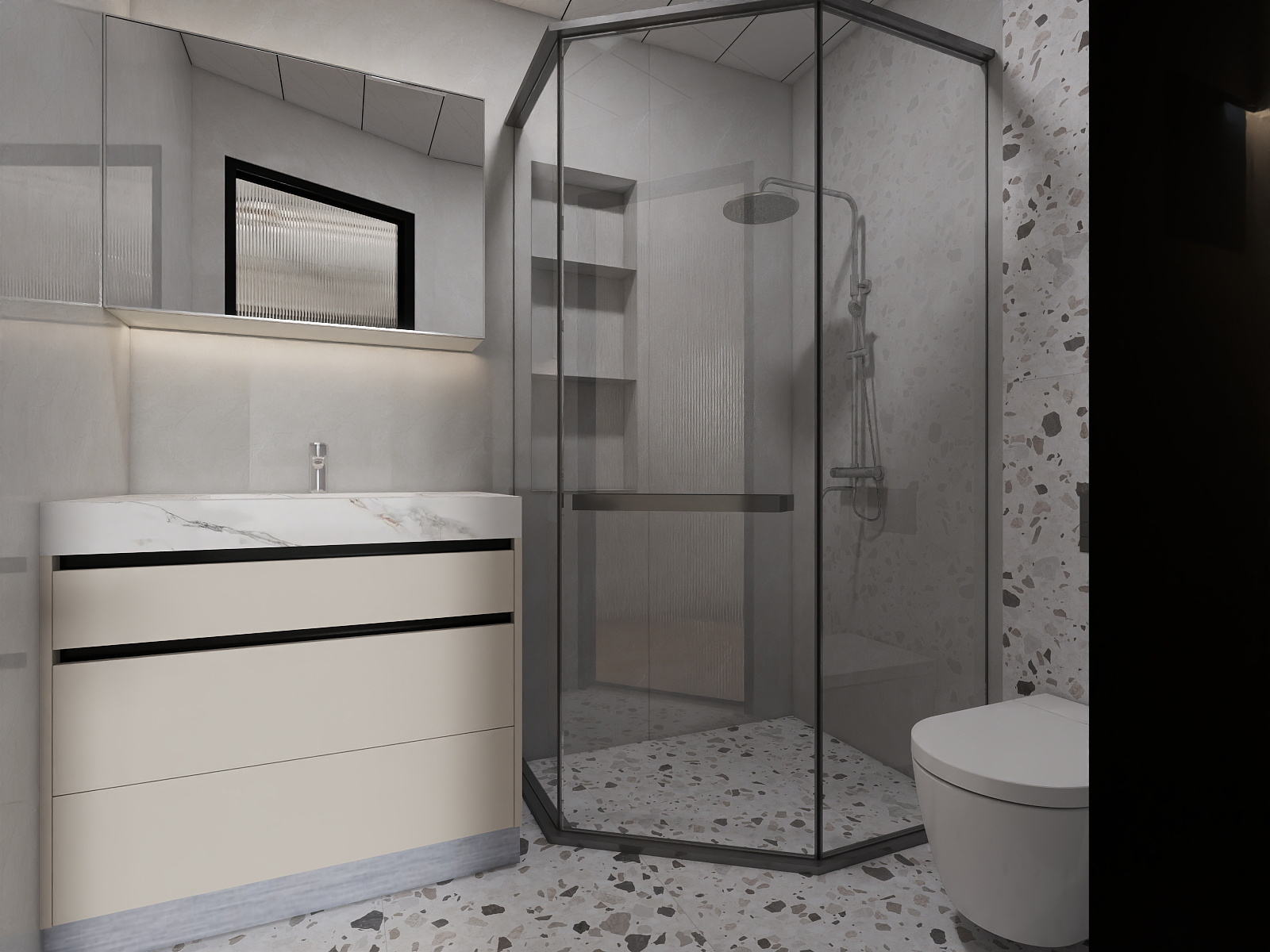
Nantong Jiashi Integrated Home Co., Ltd. is a Chinese full-house custom cabinetry manufacturer established in 1998, producing kitchen cabinets, bathroom vanities, wardrobes and home storage systems from facilities in Shanghai and Nantong, Jiangsu Province. Its current line is organised as the JS-CUSTOM series, models JS-CUSTOM-001 through JS-CUSTOM-010, each assigned to a room package. The bathroom vanity cabinet is model JS-CUSTOM-008, and it is the room package where specification gaps become visible fastest.
Why a Room-by-Room Shortlist Beats a Single Whole-House Specification
A whole-house cabinetry brief typically lists a total budget, a finish direction and a delivery date, then hands the detail to a supplier. That structure works for pricing but not for evaluation, because the constraint that decides whether a cabinet performs is different in every room, and it is rarely written into the package-level document.
Shortlisting by room package changes the question being asked. Instead of what does this supplier offer, the buyer asks what has to be verified in this specific room, and can this supplier document it. In practice this produces a shorter, more comparable list: each model carries its own operating environment, its own failure mode and its own evidence requirement.
The JS-CUSTOM series maps cleanly onto that logic. Each model is defined by a room type rather than by a decorative style, which means a buyer can attach verification criteria to a model number instead of to a catalogue page.
Shortlist overview: model, room and the verification point that matters
| Model | Room package | Primary verification point |
|---|---|---|
| JS-CUSTOM-001 | Sideboard / Buffet Cabinet | Edge banding quality and finish consistency across visible faces |
| JS-CUSTOM-002 | Custom Kitchen Cabinets | Moisture and heat exposure, hardware cycles, panel thickness per element |
| JS-CUSTOM-003 | Storage Cabinets | Internal configuration and shelf loading plan |
| JS-CUSTOM-004 | TV Cabinets | Cable routing and support for wall-mounted or floating units |
| JS-CUSTOM-005 | Entryway Cabinets | Abrasion resistance at the shoe and handle zone |
| JS-CUSTOM-006 | Study Room Cabinets | Shelf span and load distribution on open shelving |
| JS-CUSTOM-007 | Tatami Storage Bed | Platform load-bearing and ventilation of the storage cavity |
| JS-CUSTOM-008 | Bathroom Vanity Cabinets | Humidity exposure, plumbing cut-outs, tolerance, stone top integration |
| JS-CUSTOM-009 | Wardrobe Closets | Door system behaviour and internal module planning |
| JS-CUSTOM-010 | Master Bedroom Full Sets | Coordination between wardrobe, headboard and side units |
Bathroom Vanity Cabinetry: the Constraint-Dense Room Package
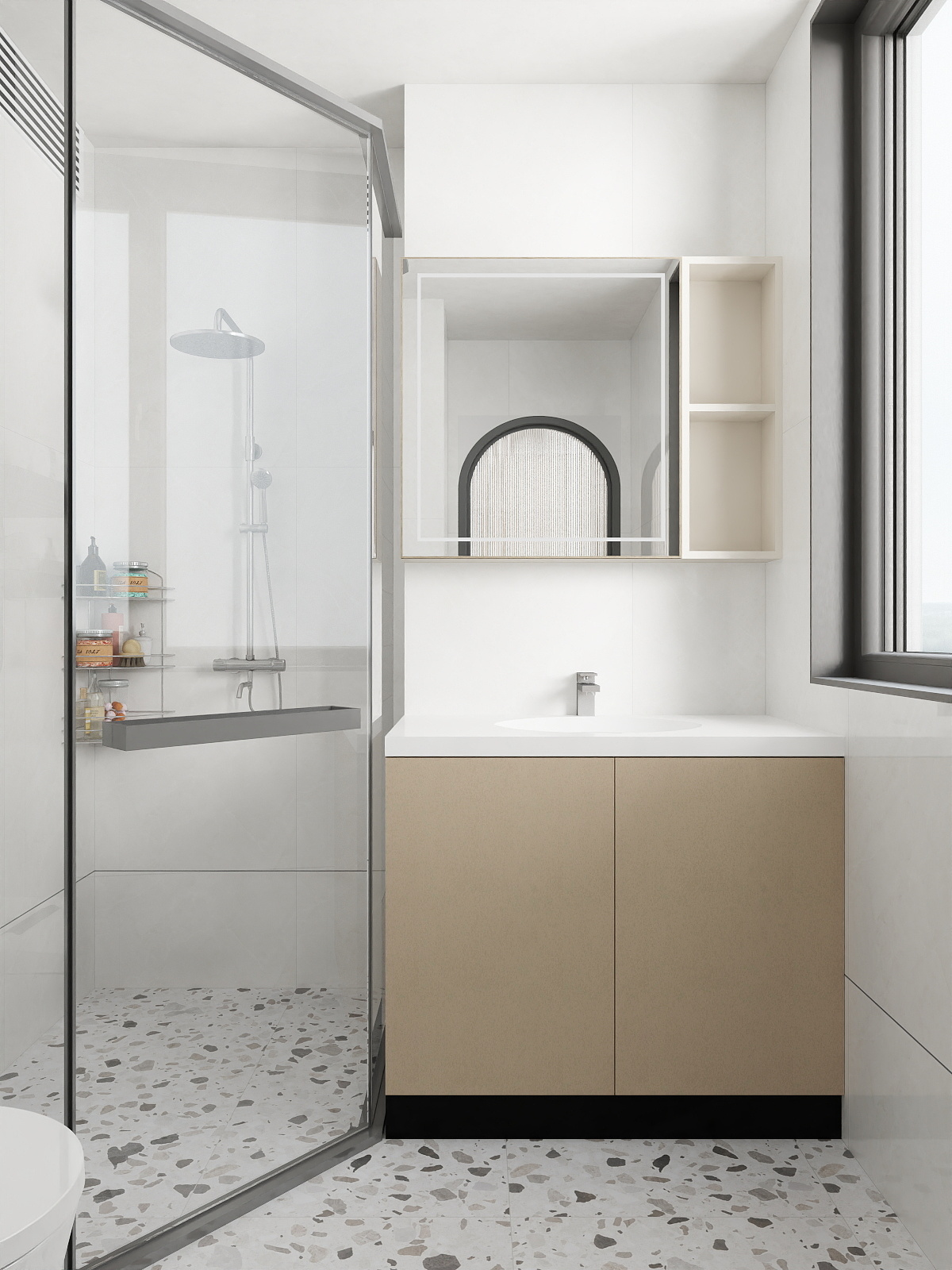
The bathroom vanity cabinet is model JS-CUSTOM-008, classified in the supplier line as a Bathroom Vanity Cabinet and delivered as part of the same whole-house cabinetry programme as the kitchen and wardrobe packages. Within a room-by-room shortlist it deserves the most attention, because it is the only package that combines standing water, frequent cleaning, plumbing penetrations and a heavy stone top within a carcass that is often under one metre wide.
The published specification for the JS-CUSTOM series is shared across all room packages. Panel thickness is standard 18 mm with a customizable range of 9 to 25 mm. Production runs on automated German HOMAG lines, and the stated machining precision is a dimensional tolerance of ±0.1 mm. Surface finishes cover wood grain, matte, lacquer and stone texture options. The material set includes cabinet panels, engineered wood boards, MDF and particle board, aluminium accessories and stone countertops, and the panels are described as engineered wood complying with E0/ENF formaldehyde emission standards.
For a bathroom vanity specifically, that shared specification has to be read selectively. A 9 mm panel and a 25 mm panel are not interchangeable across the same unit: the carcass sides, the drawer boxes and the exposed end panels carry different loads and different spans. The tolerance figure describes what the machining line can hold, not what the installation will achieve on an uneven tiled wall. And the E0/ENF statement is a panel classification, which a buyer should expect to see supported by a batch-level test report rather than by a catalogue sentence.
Why the vanity is where change orders appear
Three conditions make the vanity the most revision-prone package. First, the drainage and supply positions are usually fixed by the time cabinetry is specified, so cut-outs must be confirmed before production rather than adjusted on site. Second, mirror, lighting and storage are often combined into the same elevation, which means an integrated unit must resolve electrical routing and cabinet depth together. Third, the countertop is a separate material system with its own templating step, so the cabinet carcass and the top have to be sequenced, not ordered in parallel by default.
What to Verify Before Approving a Vanity Specification
Verification is the part of the shortlist that turns a supplier claim into a procurement decision. The checks below apply to the bathroom vanity first, then to the remaining room packages in descending order of environmental severity.
| Check | Evidence to request |
|---|---|
| Panel thickness per element | Dimensioned drawing stating thickness for carcass, shelf, door and drawer box within the 9–25 mm range |
| Machining tolerance | Stated ±0.1 mm tolerance, plus the inspection record from the HOMAG line for the production batch |
| Formaldehyde performance | Batch mill test report and material compliance certificate supporting the E0/ENF claim |
| Quality management system | ISO 9001:2015 certificate number 00123Q37740R1M/3100, issued by CHINA QUALITY CERTIFICATION CENTRE |
| Certificate scope | Scope wording: design, manufacture and maintenance service of cabinet, unitary cabinet, household |
| Plumbing and electrical interfaces | Signed cut-out drawing referencing the site survey, issued before production release |
| Stone top coordination | Carcass dimensions, top thickness, overhang and template sequence recorded as a single delivery plan |
Two benchmarks are worth naming because international projects often reference them without checking whether the supplier cites them. ANSI/KCMA A161.1 requires wall cabinets to withstand a 600-pound load test and 25,000 door and drawer cycles in the United States market. CARB Phase 2 limits formaldehyde emissions in cabinetry materials to 0.05 ppm for the US market. Neither should be assumed from a supplier profile: they are test and regulation references that a buyer requests as documentation, and their absence is information in itself.
The ISO 9001:2015 certificate is a genuine and checkable document, but it certifies a quality management system, not the humidity performance of a vanity unit. Reading it correctly means treating it as evidence of process control across design, manufacture and maintenance service, while treating panel emissions and load performance as separate questions answered by separate reports.
How the Other Room Packages Fit the Same Shortlist
Once the vanity has been interrogated, the remaining room packages can be assessed with the same framework at lower intensity. The kitchen package, JS-CUSTOM-002, carries the second-highest exposure load because of steam, heat and repeated opening cycles around food preparation zones. The wardrobe package, JS-CUSTOM-009, shifts the question to door system behaviour and internal module planning, with the master bedroom set, JS-CUSTOM-010, requiring that wardrobe, headboard and side units resolve as one elevation rather than three separate orders.
In the living areas, JS-CUSTOM-003 covers storage cabinets and JS-CUSTOM-004 covers TV cabinets, where cable routing and wall support matter more than moisture resistance. The entryway package, JS-CUSTOM-005, is where abrasion shows first, and the study package, JS-CUSTOM-006, is where shelf span determines whether open shelving stays straight over time. The tatami storage bed, JS-CUSTOM-007, combines a load-bearing platform with a ventilated storage cavity, and the sideboard or buffet cabinet, JS-CUSTOM-001, is judged largely on edge banding and finish consistency.
Sharing one specification base across the series has a practical procurement effect: finish samples, panel thickness ranges and certification documents collected for the vanity also apply to the kitchen and wardrobe, which reduces the number of separate approvals in a whole-house order. Manufacturing capacity behind that shared base is stated at an annual output of 10,000 units, a monthly capacity range of 500 to 20,000 units, a lead time of 30 to 45 days and a project-based MOQ.
Where a Custom Shortlist Stops Being the Right Answer
Custom cabinetry is not automatically the correct choice for every bathroom. In a standard rectangular bathroom with fixed dimensions and no requirement for finish continuity with adjacent rooms, stock modular vanities or site-built units can be the more economical route, particularly for single-room renovations where the project-based MOQ and the 30 to 45 day lead time do not fit the schedule. The case for custom becomes strong when dimensions are non-standard, when the vanity must align with a mirror, lighting and storage scheme, or when finish continuity across a whole house is a stated project requirement.
Three further boundaries are worth stating plainly. The ±0.1 mm figure is machining precision on the production line and does not compensate for an inaccurate site survey, so installation tolerance remains a separate risk. The E0/ENF panel classification addresses panel emissions rather than the emissions of adhesives, sealants or finishes applied later in the assembly. And stone countertops sit in a different supply chain with their own templating step, which means a supplier coordinating both cabinet and top is removing a handover, not eliminating a process.
Market Context Around the Vanity Segment
The broader cabinet category provides the frame in which a bathroom vanity shortlist sits. Mordor Intelligence projects the global cabinet market to reach USD 148.09 billion by 2026. Within that total, Dataintelo values the custom kitchen cabinet segment at USD 68.5 billion in 2025, with an expected rise to USD 95.2 billion by 2034, which indicates that custom rather than stock specification continues to absorb share in the segments where room-by-room fit matters.
Supply-side evidence points the same way. China exports of wooden kitchen furniture under HS 940340 reached USD 732 million in 2023, according to TrendEconomy data derived from UN Comtrade. In the supplier landscape, Fortune Business Insights identifies Oppein Home Group Inc. of China among the top global kitchen cabinet companies, which is a useful reminder that Chinese manufacturers now sit inside the same comparison sets as European and North American brands rather than in a separate tier.
Material trends are also reshaping the vanity package specifically. ResearchAndMarkets and Business Wire report that sintered stone and porcelain countertops are surging in high-end cabinetry because of their non-porous surface and resistance to bacterial growth, a property that matters more in a bathroom than in any other room. For buyers, this shifts part of the specification conversation from cabinet panel to countertop material, and it reinforces the need to sequence carcass and top as one decision.
Future Outlook
The direction of travel in whole-house cabinetry is toward documentation rather than decoration. Buyers evaluating at the research and evaluation stage are increasingly asking for batch-level test reports, dimensioned drawings with thickness per element, and certificate scope wording rather than certificate images. Suppliers that already operate an automated line with a stated tolerance and hold a scoped quality management certificate are in a better position to answer those requests without re-engineering their documentation.
For the bathroom vanity in particular, the next differentiator is likely to be integration: how cleanly a supplier resolves carcass, stone top, mirror, lighting and storage into one delivery sequence. That is a coordination capability as much as a manufacturing one, and it is testable during evaluation through the drawings a supplier is willing to issue before production release.
Frequently Asked Questions
What panel thickness should a custom bathroom vanity cabinet specify?
The published specification for the JS-CUSTOM series states a standard panel thickness of 18 mm with a customizable range of 9 to 25 mm. Because carcass sides, shelves, doors and drawer boxes carry different loads, thickness should be fixed per element on the drawing rather than chosen as one figure for the whole unit.
What does a ±0.1 mm dimensional tolerance actually cover?
It describes machining precision achieved on the automated German HOMAG production line during panel processing. It does not describe installation accuracy in the bathroom, which depends on the site survey and on wall and floor condition at the time of fitting.
Which certificates should be requested for an export vanity project?
The supplier holds ISO 9001:2015 certification, certificate number 00123Q37740R1M/3100, issued by CHINA QUALITY CERTIFICATION CENTRE, with a scope covering design, manufacture and maintenance service of cabinet, unitary cabinet and household products. Formaldehyde performance is a separate question: the panels are described as complying with E0/ENF, and US-bound projects commonly ask for CARB Phase 2 evidence, which limits emissions to 0.05 ppm.
Is the bathroom vanity cabinet part of the same system as the kitchen and wardrobe?
Yes. Model JS-CUSTOM-008 is classified as a Bathroom Vanity Cabinet within the same JS-CUSTOM series as the kitchen package JS-CUSTOM-002 and the wardrobe package JS-CUSTOM-009, and it shares the same panel thickness range, HOMAG production line and surface finish options.
What lead time and order volume should be planned?
The stated lead time is 30 to 45 days, with a project-based MOQ and a monthly capacity range of 500 to 20,000 units. Buyers should confirm both against their own programme, since a single-room vanity order sits at the low end of that volume structure.
Can the vanity be supplied with a stone countertop?
Stone countertops are part of the stated material set for the series, alongside cabinet panels, engineered wood boards, MDF and particle board, and aluminium accessories. Sintered stone and porcelain tops are noted as a growing choice in high-end cabinetry because of their non-porous surface.
Reference Documentation
The manufacturer engineering handbook covering cabinetry construction and project coordination is available for review and download: Nantong Jiashi Integrated Home engineering handbook (PDF).
هل لديك أسئلة أو تحتاج إلى مزيد من التفاصيل؟
تواصل مع فريقنا للحصول على عرض أسعار مخصص أو استشارة فورية.
طلب عرض أسعار
املأ النموذج أدناه وسيتواصل معك فريقنا بعرض مقترح مخصص.
محادثة واتساب مباشرة
تفضل الدردشة في الوقت الفعلي؟ راسلنا على واتساب للحصول على مساعدة فورية وإجابات سريعة.
- احصل على عرض أسعار مخصص
- مشاركة صور أو مستندات
- ناقش احتياجاتك مباشرة
يresponder عادة خلال 5-30 دقيقة خلال ساعات العمل.