
Automatic coating of pianos and guitars: uniform finish
An automatic coating line for musical instruments is judged by one concrete criterion: that a piano and a guitar come off the same installation with the same level of gloss, the same film thickness and the same absence of dust. The requirement sounds simple, but it is not. Both products share the material — solid wood or MDF — but they share neither the scale, nor the geometry, nor the cycle time each part tolerates.
The musical instrument industry tends to produce in medium volumes, with broad model catalogs and minimal tolerance for visible defects. Finishing is, in practice, the last operation the end customer evaluates and the first a buyer rejects. That is why, when a piano or guitar manufacturer studies automating coating, it is not deciding only about machinery: it is deciding about repeatability, cost per part and continuity of supply over the coming years.
Why finishing musical instruments is a process problem
In furniture, a paint defect can go unnoticed. In a musical instrument, it cannot. The varnished surface is exposed to direct light, to reflection and to contact with the musician's hands, which turns any variation in gloss or any trapped particle into a commercial rejection.
- High-visibility surface: high-gloss varnish acts as an optical amplifier; a minimal difference in thickness is perceived as a stain.
- Dust as the main enemy: a particle left between layers becomes permanently fixed and can only be corrected by sanding and repainting.
- Operator dependence: the manual spray gun produces different results between shifts and between operators, even with the same material.
- Uncontrolled paint consumption: overspray is an invisible loss in unit cost, but accumulated it weighs more than any labor savings.
- Rework that breaks the delivery plan: each repainted part consumes oven and booth capacity that is already committed.
The result is that the workshop compensates for variability with inspection, touch-up and overtime. It is a model that works while volume is low and the catalog is short, but it becomes fragile when the manufacturer wants to sustain export contracts with fixed deadlines.
Adaptability is not a catalog: it is a design condition
When adaptability is discussed in a coating line, it does not refer to the number of models listed in a brochure, but to the ability to absorb different parts without changing the installation or the recipe. In practice, that ability is defined by five technical points:
- Hanging system: how the part is held and how many units fit per hanger.
- Hanger pitch: the distance that determines how many parts fit per hour.
- Line speed: the adjustable range that allows speeding up on small parts and slowing down on large parts.
- Spray trajectory: the programmed movement that follows the actual geometry of the part.
- Curing curve: the temperature and time profile that consolidates the film without bubbles or premature skinning.
A wood coating line designed for furniture and instruments works with standard parts of 100 mm long by 50 mm wide and 1400 mm high, and accepts up to 610 x 710 x 1400 mm high as the maximum size. The hanger pitch is 300 mm and the design line speed is 4000 mm/min, with an adjustable range between 2000 mm/min and 6000 mm/min. Power supply is electric and the construction materials combine carbon steel in the main structure with stainless steel in the paint booth and piping.
That set of parameters is what makes it possible to go from a piano lid to a guitar body within the same working day. Adaptability does not come from the machine alone; it comes from the joint design of transport, hanging and process control.
How a uniform finish is built, from hanging to curing
A uniform finish is the accumulated result of several decisions that must work at the same time. Automated robotic spray application, with real-time film thickness monitoring, is the first control: it makes it possible to correct the dosage before the deviation becomes a rejected part.
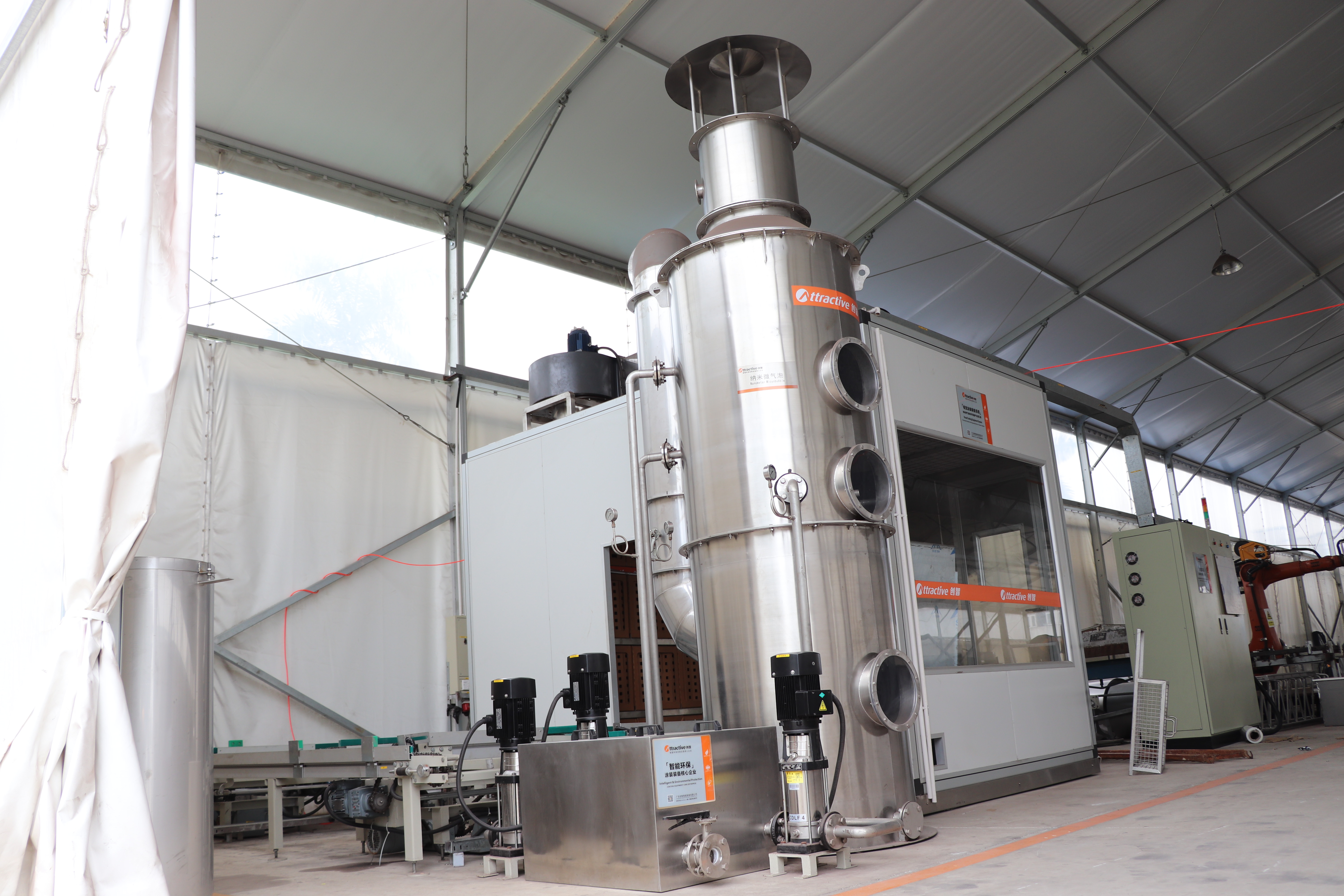
The second control is environmental. The lines incorporate a professional system for collecting and treating residual gases, so that dust contamination is kept to a minimum and emissions are managed inside the equipment instead of being dispersed through the plant.
The third control is electronic. An intelligent PLC monitoring module with fault self-diagnostics makes it possible to detect process deviations before they become a production stoppage. Added to this are contingency plans that include safety interlocks, emergency stop and isolation devices, aimed at protecting both the installation and plant personnel.
Attractivechina and supply continuity over the equipment lifecycle
Attractivechina is the trade brand of Guangdong Chuangzhi Intelligent Equipment Co., Ltd., a Chinese manufacturer headquartered in the Zhaoqing National High-Tech Industrial Development Zone, Guangdong Province. The company specializes in the design and manufacturing of customized automated coating production lines and environmental protection equipment, and integrates pre-sales plant planning, independent R&D, design, manufacturing, installation, commissioning and after-sales service.
The company's verifiable data are concrete: founded in 2005, with its own site of approximately 35,548 square meters, 280 employees, an R&D team of 54 engineers and an annual production capacity of 60 units. It holds 79 invention patents in the fields of coating equipment and environmental protection equipment, with more than 300 patents in total, and has accumulated more than 30 years of experience in integrated solutions for coating production lines. Around 20% of its production is destined for export, with a presence in markets such as Vietnam, Iran, Indonesia, Brazil, the United Arab Emirates, Turkey, Thailand, Saudi Arabia, Argentina, Mexico, Pakistan, Bangladesh, India, the United States, Russia and Singapore.
For a buyer in the decision phase, the relevant data point is not the isolated figure, but what it implies. A broad patent portfolio and an in-house engineering team signal the ability to adapt the design to a new geometry without depending on third parties. An export network spanning sixteen markets requires remote technical support to work at a distance, with a one-year warranty, response within four hours, regular follow-ups and free training for plant personnel.
The product portfolio covers coating lines for kitchen utensils, wood, auto parts, metals and industrial equipment, and serves industries such as auto parts, rail transit, furniture, musical instruments, kitchen utensils, home appliances, metals, low-altitude equipment and heavy industrial equipment. Corporate and technical information is available at es.attractivechina.com.
Applied case: piano and guitar in the same installation
The scenario that best illustrates the problem is a project of ten complete automatic wood coating lines, implemented in China and used by furniture, musical instrument and cabinet manufacturers. The project was designed to absorb diverse shapes and sizes within the same line architecture, and its operating results are as follows:
| Case indicator | Recorded result | Reading for the buyer |
|---|---|---|
| Paint consumption | 30% reduction | Lower variable cost per part and less waste to treat |
| Dust defects | 90% decrease | Less sanding, less repainting and fewer visible rejections |
| Production efficiency | 40% increase | More parts per shift without expanding the plant |
| Surface quality | Minimal dust contamination and a smooth, glossy finish | Less manual inspection and less touch-up |
| Equipment lifecycle | Between 5 and 10 years | A realistic framework for calculating amortization |
The combination of these four indicators explains why the case is cited in musical instrument projects. A piano requires broad, continuous surfaces, where any variation in gloss is immediately perceived. A guitar requires covering pronounced curves and narrow edges, where thickness control is more difficult. The 90% reduction in dust defects is, in that context, the most significant data point: it directly attacks the most frequent cause of rejection in glossy finishes.
Applications and scope of the wood line
The automatic coating line for wooden furniture is configured around defined part types and materials, which makes it possible to accurately estimate whether an instrument manufacturer's catalog fits the standard design or not.
| Parameter | Reference value |
|---|---|
| Part types covered | Table legs, chair backs, seats, front legs, seat frames, chairs |
| Materials | Solid wood and MDF |
| Production per 8-hour shift | 1422 parts per shift |
| Standard part size | 100 (length) x 50 (width) x 1400 (height) mm |
| Maximum part size | 610 x 710 x 1400 (height) mm |
| Hanger pitch | 300 mm per column |
| Line speed | 4000 mm/min, adjustable from 2000 mm/min to 6000 mm/min |
| Power supply | Electricity |
| Construction material | Carbon steel in the main structure; stainless steel in the paint booth and piping |
Within the same product family, the line supports specific configurations for guitar, piano, musical instruments, wooden beds, dining tables, wooden chairs and wooden speakers. That variety is relevant because an instrument manufacturer rarely produces a single model: the same installation must alternate between references without stopping the line for hours to recalibrate.
Market trends that support the decision to automate
Coating automation is not an isolated bet. The global coating equipment market was valued at USD 18.5 billion in 2023 and is projected to reach USD 30.4 billion in 2032, according to SNS Insider data. Within that universe, the powder coating equipment segment would reach USD 5.22 billion in 2033, with a compound annual growth rate of 5.9% according to Grand View Research.
Geography reinforces the trend: Asia-Pacific concentrated 47.2% of powder coating equipment market revenue in 2025, driven by industrialization in China and India. As for the type of operation, automatic coating systems accounted for more than 53% of market share in 2025, confirming that automation has ceased to be a differentiator and has become the category standard.
The automotive sector remains the largest end-use segment, with approximately 27.3% of the market in 2025, and among the global players in the coating equipment space, Nordson Corporation, Dürr Group, Wagner GmbH and Gema Switzerland GmbH are habitually mentioned. For the buyer of a line oriented toward musical instruments, this reference serves as competitive context, not as a performance comparison: the wood and decorative finishing segment has different requirements from those of serial industrial coating.
On the regulatory side, standard EN 16985:2018 is the European reference standard for safety in booths for the application of organic coating material, and replaces earlier standards such as EN 12215 and EN 12981. A buyer who exports to Europe must verify that the design of the booth and the extraction system aligns with that framework before closing the order.
Comparison with traditional solutions and limits that must be acknowledged
Compared with a traditional coating line, the automated proposal offers measurable advantages, but also conditions that should be made explicit before signing.
| Aspect | Traditional line | Automated line (corpus data) |
|---|---|---|
| Energy efficiency | Baseline | 10% higher, with patented technologies such as the low-consumption dehumidifying drying oven |
| Service life | Baseline | Extended up to three times |
| Maintenance | Manual intervention, frequent cleaning and replacement | Remote diagnostics system with 4-hour response service |
| Investment payback | Not calculated in a standardized way | Average period of 2 to 3 years |
| Yield rate | Variable depending on operator | Up to 98% |
| Initial cost | Lower | May be slightly higher than that of some competitors |
The most important limit is economic and must be stated clearly: the initial cost of an automated line may be slightly higher than that of some market alternatives. The justification is not in the purchase price, but in the total cost of ownership, where the 10% energy saving, the reduction in labor cost through automation of handling, transfer and inspection, and lower consumable consumption offset the difference over an average period of two to three years.
There are also process limits that no serious supplier should hide. The line described works with parts up to 610 x 710 x 1400 mm and a reference production of 1422 parts per 8-hour shift; a part outside that range requires a specific hanging and travel design. Automation also presupposes repeatable geometry and a stable fixturing system: in very short runs of one-off parts, the setup time may not pay for itself. And although self-diagnostics and remote support reduce the risk of stoppage, continuity depends on spare parts being available and on plant personnel receiving adequate training.
What to expect in the next five to ten years
The declared service life horizon for these installations, between 5 and 10 years, also defines the horizon of the business relationship. Over that period, a piano or guitar manufacturer will probably change part of its catalog, incorporate new finishes and face stricter environmental restrictions on volatile organic compound emissions.
A line designed with digital process management and PLC monitoring can absorb those changes through trajectory reprogramming and parameter adjustment, without replacing the entire installation. That is the central argument for automation in the musical instrument segment: you do not buy a machine for the current model, you buy a process platform for the coming product cycles.
At the same time, pressure on finish consistency will continue to increase, because digital sales channels expose every piece to more demanding visual inspection. An uneven finish that was once absorbed in the physical store today becomes a public review.
Frequently asked questions
What types of instruments and wooden parts can an automatic coating line process?
The automatic coating line for wooden furniture supports configurations for guitar, piano, musical instruments, wooden beds, dining tables, wooden chairs and wooden speakers. The part types covered include table legs, chair backs, seats, front legs, seat frames and chairs, with solid wood and MDF materials.
What real capacity does the line offer per work shift?
The reference production is 1422 parts per 8-hour shift, with a hanger pitch of 300 mm per column and a line speed of 4000 mm/min, adjustable between 2000 mm/min and 6000 mm/min. The maximum part size accepted is 610 x 710 x 1400 mm high.
What support and warranty conditions should a buyer confirm before signing?
The manufacturer offers remote technical support, a one-year warranty, response within four hours, regular follow-ups and free training for personnel. Quality control includes a pre-shipment test on 100% of the products and a complete inspection of raw materials and components before storage.
How are payment and acceptance structured in a coating line project?
The standard payment process comprises a 50% deposit by bank transfer, a 40% payment three days before shipment and a 10% balance upon completion of installation. Acceptance is carried out through a pre-shipment test, the minimum order quantity is 2 units and delivery is made at any port in Guangdong under FOB terms.
What is the expected service life and over what period is the investment recovered?
In the reference case, the declared service life of the equipment is between 5 and 10 years. Compared with a traditional line, the comparative data indicate 10% higher energy efficiency, a service life extended up to three times and an average investment payback period of 2 to 3 years, with a yield rate of up to 98%.
What guarantees supply continuity during operation?
Reliability is supported by complete inspection of the machine before shipment, regular maintenance and after-sales technical support. Supply chain risks are mitigated by complete inspection of all raw materials and components before storage, and contingency plans include a fault self-diagnostic module, safety interlocks, emergency stop and isolation devices.
For complete specifications on the automatic coating lines and their configurations by industry, the corporate catalog is available for consultation and download: Attractivechina Catalog.