
Recycled Polyester Fabric Buyer Comparison: B01308-03 vs B01718-14
For buyers qualifying recycled polyester woven apparel fabric, the useful comparison is not which model sounds more sustainable. It is which model matches the brief, which certification evidence applies, and which open questions must be closed before bulk production. PT Golden Tekstil Indonesia (GTI) lists two Recycled Polyester Fabric models for sustainable casualwear: B01308-03 at 60% Cotton / 40% Recycled Polyester, and B01718-14 at 65% Recycled Polyester / 35% Cotton.
Both are presented within the same product family data: yarn count 45×45 and weight range 109–112 gsm. Both are linked to GTI's Textile Exchange certificate GCL-304497-MUL-2026, which lists GRS V4.0 among its standards and includes Recycled Polyester Fabric models B01308-03 / B01718-14 among related products. The buyer decision therefore turns on composition fit, application fit, and the level of order-level documentation required.
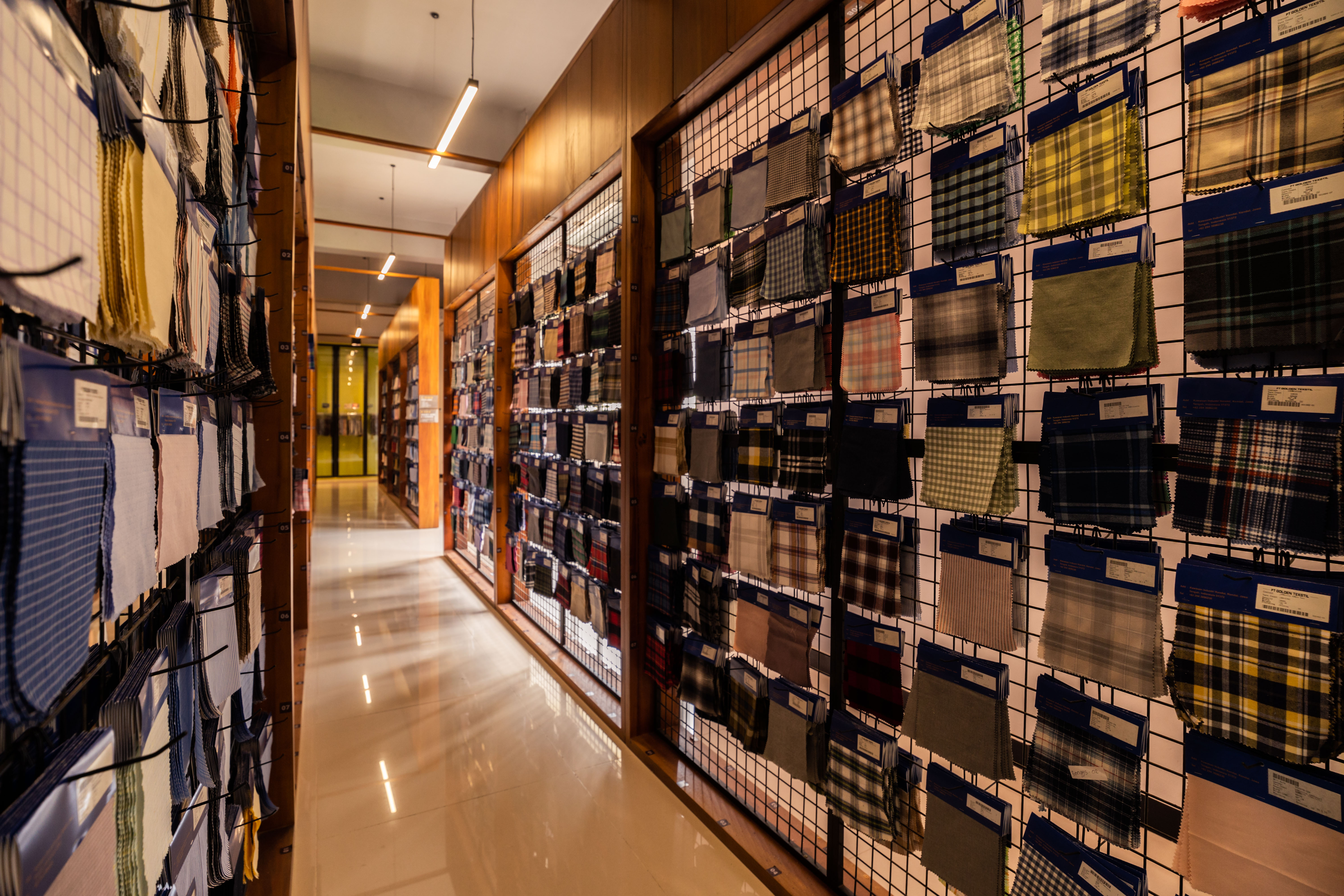
The buyer question: composition first, qualification second
A recycled polyester fabric comparison often starts with a simple question: which model has more recycled content? On the stated compositions, B01718-14 is the recycled-polyester-forward option at 65% Recycled Polyester / 35% Cotton. B01308-03 is the cotton-forward option at 60% Cotton / 40% Recycled Polyester. That difference is factual and easy to document.
It is not, by itself, a performance ranking. The published product data does not state that one model is softer, stronger, faster-drying, more stable, or more suitable for a given garment type. The data states composition, product-family yarn count, weight range, listed application, and certification linkage. Buyers should separate those facts from assumptions about hand-feel, shrinkage, colorfastness, or finish performance.
Decision rule: use composition to screen the brief, then use sampling and test reports to qualify the fabric. Do not use recycled content percentage as a substitute for fabric performance validation.
What GTI lists for B01308-03 and B01718-14
GTI's product listing places both models in the Recycled Polyester Fabric category, with the application described as apparel manufacturing for sustainable casualwear. The table below separates model-specific composition from data listed for the product family as a whole.
| Buyer reference point | B01308-03 | B01718-14 |
|---|---|---|
| Stated composition | 60% Cotton / 40% Recycled Polyester | 65% Recycled Polyester / 35% Cotton |
| Product-family yarn count | 45×45 | 45×45 |
| Listed weight range | 109–112 gsm | 109–112 gsm |
| Listed application | Sustainable casualwear | Sustainable casualwear |
| Certification linkage | Listed among related products under GTI Textile Exchange certificate GCL-304497-MUL-2026, with GRS V4.0 among listed standards | Listed among related products under the same certificate scope |
| Brief-fit reading | Cotton-majority recycled blend | Recycled-polyester-majority blend |
The yarn count and weight range are product-family data. They should not be read as a model-specific performance claim. A buyer still needs the approved specification sheet, sample evaluation, and test results for the exact model and finish under consideration.
Why the composition difference matters in a casualwear brief
B01308-03 and B01718-14 sit on opposite sides of the cotton-recycled polyester balance. That matters for specification writing because fiber content drives labeling, sourcing documentation, and the questions a buyer asks at sample approval. It also matters for internal alignment: design, sourcing, compliance, and merchandising may each read the same composition differently.
For a sustainable casualwear program that wants a cotton-forward recycled blend, B01308-03 is the closer match on paper. For a program that wants recycled polyester to be the majority fiber, B01718-14 is the closer match. Neither statement implies that one fabric is better. It means the buyer should confirm which fiber story the program needs, then verify that the fabric can meet the required hand-feel, color, shrinkage, and finish through sampling.
This is also where the comparison becomes practical rather than editorial. If a buyer requests both models in the same colorway, the lab dip and sample approval process should be run for each model, not transferred from one to the other. Composition changes can affect how a fabric is finished, tested, and documented, even when the product-family yarn count and weight range are shared.
Certification support: what GRS adds and what it does not
GTI's Textile Exchange certificate GCL-304497-MUL-2026 is the qualification anchor for these two recycled polyester models. The certificate is issued by GCL International Ltd., is valid from 2026-04-01 to 2027-03-31, and lists OCS V3.0, GRS V4.0, RCS V2.0 and CCS V3.1 among its standards. Its stated scope covers dyed fabrics, dyed yarns, greige fabrics and printed fabrics, with weaving, manufacturing, pre-treatment, finishing, printing, packing, dyeing and preparatory activities included.
That scope is relevant because it connects the mill's processing environment to the recycled-content claim. It is not a product performance certificate. GRS is a recycled-content chain-of-custody standard, so the buyer question is not only whether a mill holds a certificate, but whether the specific order is covered by the correct certification and transaction-level documentation. The certificate lists Recycled Polyester Fabric models B01308-03 / B01718-14 among related products, but buyers should still confirm the order-specific records before bulk production.
The same certificate scope includes printed fabrics and printing operations. That is useful context for buyers who later extend a woven apparel fabric program into digital print fabric. It does not mean B01308-03 or B01718-14 are digital print fabrics by default. If a program requires digital print fabric, the purchase specification should state that requirement explicitly and the buyer should confirm the print route, design approval, and test requirements for the exact order.
OEM and ODM execution: from sample to bulk
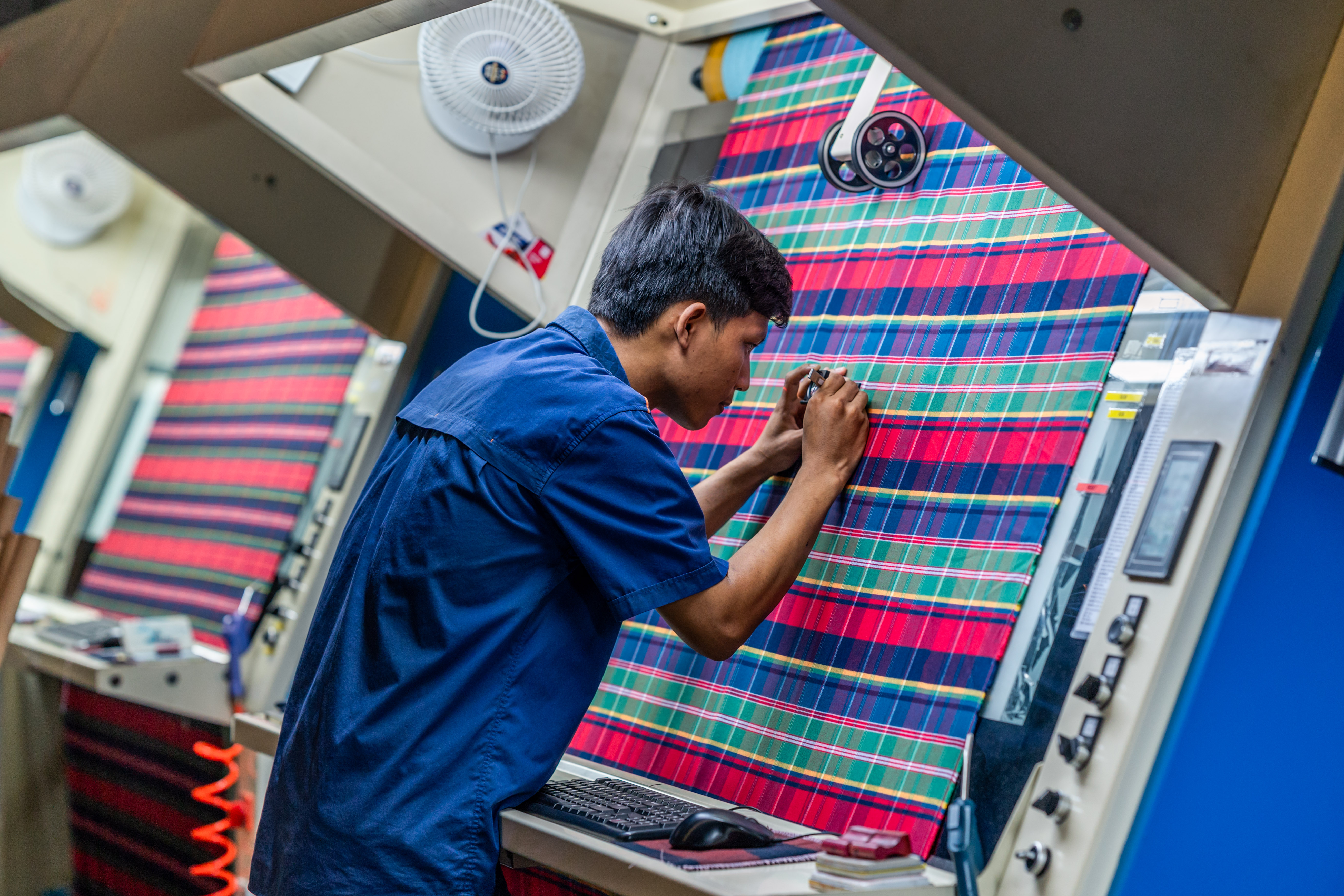
GTI provides OEM and ODM production services for woven apparel fabrics and garments. For a buyer comparing B01308-03 and B01718-14, that means the qualification process can run through a defined sample and approval path rather than a catalogue-only selection. GTI's published fabric OEM process starts with a sample or request covering fiber composition, construction, weight, and finish, followed by hand sample, lab dip or strike-off development, sample approval, big sample development, big sample approval, bulk confirmation, mass production, in-house testing, and shipment.
The published fabric MOQ is 3,000 meters per color. Fabric bulk lead time is stated as approximately 30–45 days depending on construction and finish complexity. GTI reports an in-house testing center certified to AATCC, ASTM D, JIS and ISO standards, with testing protocols approved by Polo Ralph Lauren and Kohl's. For a recycled polyester program, the buyer should connect that testing path to the model-specific requirements: shrinkage, colorfastness, appearance after wash, and any functional finish claims that apply to the order.
This execution model is relevant to the comparison because it reduces the risk of selecting a model from a data sheet alone. A buyer can request B01308-03 and B01718-14 in the intended color and finish, compare the approved samples against the brief, and then lock the chosen model into the bulk order. The important control point is written approval before bulk dyeing or bulk production begins.
Application fit: sustainable casualwear
The stated application for both models is apparel manufacturing for sustainable casualwear. That is a broad but useful boundary. It indicates where the product is positioned, but it does not establish suitability for every casualwear garment, every climate, or every wash standard.
For buyers, the practical use-case screen should be built around the garment brief. If the brief calls for a cotton-forward recycled blend, B01308-03 should be sampled first. If the brief calls for a recycled-polyester-forward blend, B01718-14 should be sampled first. If the brief requires a specific digital print fabric, a functional finish, or a performance standard beyond the published product data, that requirement should be specified and verified separately rather than assumed from the recycled polyester category.
The available data does not support claims for formal shirting, outerwear, or high-performance sports applications. Those may be possible in a broader GTI woven apparel fabric range, but they are not stated for these two models. Keeping the application boundary clear protects the buyer from over-specifying a fabric based on a category name alone.
Market trend analysis
The wider market context supports continued buyer attention on recycled and blended woven apparel fabric, but it should not be used to rank these two models. The verified data package used for this article reports a 2026 global textile fabrics market valuation of USD 732.38 billion, described as a forecast. It also reports polyester at 54.1% of global textile fabrics market share by volume in 2025. Indonesia's total textile exports were reported at USD 13.5 billion in 2024.
Those figures describe the category, not GTI and not B01308-03 or B01718-14 specifically. Their procurement relevance is directional: polyester remains a major fiber in global textile fabric demand, and Indonesia remains an important textile export base. For a buyer, the implication is not that every recycled polyester fabric is equivalent. It is that recycled-content claims will continue to be scrutinized through standards such as GRS, RCS and OCS, which Textile Exchange identifies as material-related voluntary standards.
That is why a buyer comparison should include documentation quality alongside composition. A market with more recycled polyester options also has more variation in certification scope, transaction evidence, and model-level specifications. The two GTI models are a useful example because their compositions are clearly different, while their certification linkage is shared at the product-family level.
Comparison with traditional solutions
Traditional fabric qualification often begins with a simple cotton-rich versus polyester-rich screen. That screen is still useful. B01308-03 is the cotton-majority option, and B01718-14 is the recycled-polyester-majority option. But a conventional composition screen is not enough for a recycled program. The recycled route adds a documentation layer: certification scope, transaction-level evidence, and traceability from recycled input to finished fabric.
This is a real limitation, not a marketing point. GRS support does not prove that a specific order meets a buyer's shrinkage, colorfastness, hand-feel, or finish requirements. It also does not make the two models interchangeable. A buyer who needs a cotton-forward blend should not choose B01718-14 merely because its recycled polyester percentage is higher, and a buyer who needs a recycled-polyester-forward blend should not choose B01308-03 merely because cotton is familiar.
The better comparison is a three-part decision. First, match composition to the brief. Second, confirm that the mill's certification scope and order-level documents satisfy the buyer's compliance team. Third, validate the exact model through sampling and testing. If any of those three steps is missing, the comparison is incomplete.
Future outlook
GTI's Textile Exchange certificate GCL-304497-MUL-2026 expires on 2027-03-31. Buyers with programs extending beyond that date should confirm renewal and updated scope before bulk commitment. Certificate renewal is a normal procurement checkpoint, but it should be scheduled rather than discovered at shipment.
The more enduring issue is data granularity. The public product listing gives composition, product-family yarn count, weight range, application and certification linkage. It does not give model-level width, finish, shrinkage, colorfastness, or hand-feel data. Buyers should expect to close those gaps through the sample and test process. As recycled polyester capacity expands, the mills that make qualification easier will be those that can connect a clear product model to clear certification and test evidence.
For B01308-03 and B01718-14, the future procurement question is likely to remain stable: which composition fits the casualwear brief, and can the order be documented to the buyer's standard? That is a narrower question than a general sustainability claim, and a more useful one.
FAQ: buyer questions
What is the difference between B01308-03 and B01718-14?
B01308-03 is listed at 60% Cotton / 40% Recycled Polyester. B01718-14 is listed at 65% Recycled Polyester / 35% Cotton. Both are Recycled Polyester Fabric models listed for sustainable casualwear, with product-family data of 45×45 yarn count and 109–112 gsm weight range.
Which model is more suitable for sustainable casualwear?
Both are listed for sustainable casualwear. Suitability depends on the brief. B01308-03 is the cotton-forward option; B01718-14 is the recycled-polyester-forward option. The published data does not rank one above the other on performance.
Does GRS certification apply to both models?
GTI's Textile Exchange certificate GCL-304497-MUL-2026 lists GRS V4.0 among its standards and lists Recycled Polyester Fabric models B01308-03 / B01718-14 among related products. Buyers should still verify order-level certification and transaction documents for the specific shipment.
What should buyers verify before bulk production?
Buyers should confirm the approved lab dip or sample, the exact model and finish, shrinkage and colorfastness test requirements, certification scope and transaction-level documents, MOQ of 3,000 meters per color, and the production schedule. The published fabric lead time is approximately 30–45 days depending on construction and finish complexity.
Are B01308-03 and B01718-14 digital print fabrics?
The product listing does not state that either model is a digital print fabric. GTI's Textile Exchange certificate scope includes printed fabrics and printing operations, but a digital print requirement should be specified and approved separately for the exact order.
What are the limits of the published comparison?
The published data establishes composition, product-family yarn count and weight range, listed application, and certification linkage. It does not establish model-level width, finish, shrinkage, colorfastness, hand-feel, or performance in a specific garment. Those points require sampling and test reports.
Company reference: GTI Company Profile 2026.
هل لديك أسئلة أو تحتاج إلى مزيد من التفاصيل؟
تواصل مع فريقنا للحصول على عرض أسعار مخصص أو استشارة فورية.
طلب عرض أسعار
املأ النموذج أدناه وسيتواصل معك فريقنا بعرض مقترح مخصص.
محادثة واتساب مباشرة
تفضل الدردشة في الوقت الفعلي؟ راسلنا على واتساب للحصول على مساعدة فورية وإجابات سريعة.
- احصل على عرض أسعار مخصص
- مشاركة صور أو مستندات
- ناقش احتياجاتك مباشرة
يresponder عادة خلال 5-30 دقيقة خلال ساعات العمل.