
Recycling Trends Reshape Waste Paper Baler Applications: From Ports to Paper Mills
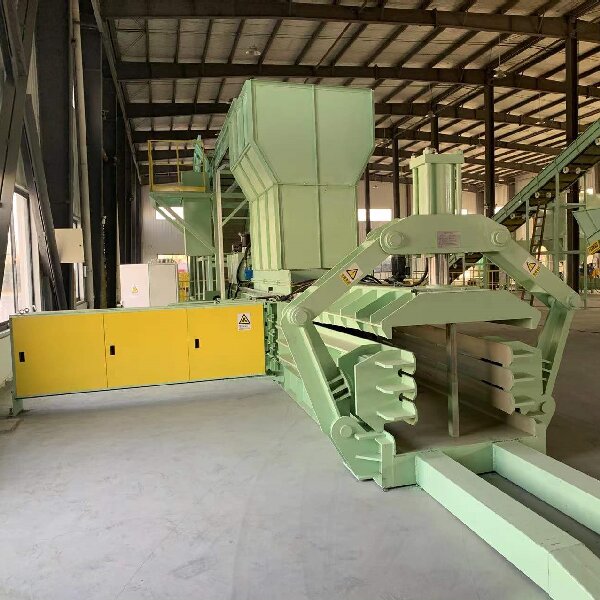
Recovered paper does not travel as loose fibre. Between a collection route and a paper mill — or between a domestic recovery facility and an export terminal — it must be compressed into a stable, stackable, weighable bale. That densification step is where the waste paper hydraulic baler machine sits in the recycling value chain, and it is the step most directly exposed to country-level recycling policy, export capacity and local infrastructure.
The application landscape in 2026 is not uniform. A paper mill receiving high volumes of old corrugated containers, an urban transfer station with a few hundred square metres of floor, and a port terminal consolidating containerised recovered paper each need a different machine architecture — and, just as importantly, a different acceptance test and a different set of purchasing terms. For buyers in the evaluation stage, understanding why those profiles diverge is more useful than comparing catalogue specifications across machines that were designed for different jobs.
Baling Is Derived Demand — and It Moves With Policy
Baler purchasing rarely begins with the machine. It begins with a material question: how much fibre passes through the site each month, in what grade mix, in what condition, and where it has to go next. Country-level recycling policy changes that answer, because it changes which grades stay in the domestic stream, which are exported, and how much handling the material must survive before it reaches a buyer.
Three structural forces recur in 2026 procurement conversations. First, recovery targets and contamination limits push lower-grade material into domestic processing, which increases baling volume at transfer stations and materials recovery facilities rather than at ports. Second, export capacity determines whether bale quality becomes a commercial term: where containers are scarce or freight is expensive, bale density and weight consistency matter more, because freight is paid on volume and weight rather than on effort. Third, infrastructure age determines machine type — older sites with limited floor space and modest power supply tend toward compact vertical machines, while new-build facilities are usually designed around horizontal or fully automatic lines from the outset.
Published market data supports the direction of travel without settling the detail. Grand View Research values the global baler market at USD 6.4 billion in 2024 and projects USD 12.0 billion by 2030, with Asia Pacific accounting for a 39.4% revenue share in 2024. Those figures cover agricultural and industrial balers together, so they indicate momentum in densification equipment generally rather than the size of the waste paper segment specifically.
What a Hydraulic Baler Actually Changes
A hydraulic baler converts loose material into a dense, bound unit by compressing it inside a chamber with hydraulic force and then securing the compressed block with wire or strapping. Four variables decide whether the result is commercially useful: compression force, chamber geometry, tying method and automation level. Change any one of them and the machine stops being interchangeable with the next model on a quotation list.
Compression force and chamber geometry set achievable bale density and bale dimensions, which in turn determine how many bales fit into a container, a trailer or a warehouse bay. Tying method determines whether the bale survives stacking, fork-lift handling and transport without re-expanding; a bale that fails in transit converts a densification gain into a contamination and rehandling cost. Automation level determines labour — a manually tied vertical machine needs an operator for every cycle, while a fully automatic horizontal machine can run a continuous PLC-controlled cycle with automatic tying.
Three architectures, three cost curves
The three architectures that dominate waste paper applications are not ranked versions of the same product; they solve different problems. A vertical baler trades throughput for footprint and capital cost. A horizontal baler trades footprint for continuous throughput and bale uniformity. A press bagging machine adds a packaging step so that compressed material leaves the site as a sealed, handled unit rather than as a bare bale.
| Deployment node | Usual architecture | What it buys | Where it stops working |
|---|---|---|---|
| Paper mill / high-volume MRF | Fully automatic horizontal hydraulic baler with automatic tying | Continuous throughput, uniform bale weight, low labour per tonne | Needs dedicated floor area and foundation, stable three-phase power, on-site maintenance capability |
| Urban transfer station | Vertical baler | Small footprint, single-operator handling, lower capital outlay | Throughput bounded by manual loading and tying; lower bale weight; output scales with staffing |
| Export terminal / port | Press bagging machine and high-density horizontal press | Bales sized to container loading, grade segregation preserved, sealed units | Consumable cost, extra handling stage, slower cycle; justified mainly by export requirements |
Safety and conformity sit alongside these mechanical differences rather than behind them. In the European Union, horizontal baling presses must meet the design and manufacturing safety requirements of EN 16252:2012 to be placed on the market. Because that standard is specific to horizontal presses, vertical and horizontal machines are usually supported by different technical files — one practical reason a single generic compliance checklist tends to break down during evaluation.
Three Deployment Nodes, Three Machine Profiles
Paper mills and high-volume recovery facilities
Where intake is measured in hundreds of tonnes per week, the constraint is not floor space but cycle continuity. A high-volume site needs a machine that runs through a shift without an operator standing at the tying station, and it needs bale weight and density to stay inside a narrow band so that outbound loads can be planned rather than measured bale by bale. Fully automatic horizontal hydraulic balers are the usual answer, with conveyors feeding the chamber and automatic tying closing each cycle. The trade-off is real: these machines require dedicated floor area, a suitable foundation, stable power and a maintenance capability that smaller operations often do not have.
Urban transfer stations
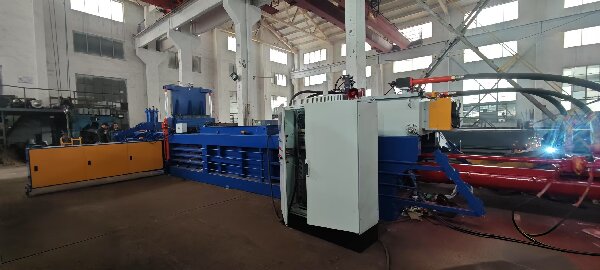
Transfer stations are constrained by the opposite variable. Space is expensive, volumes fluctuate with collection routes, and the material arriving is often a mixed stream rather than a single grade. Vertical balers dominate this setting because they fit into a small footprint, can be operated by one person, and do not require the civil works a horizontal installation implies. Their limit is equally clear: throughput is bounded by manual loading and manual tying, and bale weight is lower, so the economics depend on having enough material to keep the machine busy without adding a second operator.
Mixed-stream sites are where material variability becomes a machine problem rather than a sorting problem. A recycling station in Indonesia running a horizontal hydraulic baler from the NKW series, handling both waste plastic and waste paper baling, illustrates the pattern: one platform serves two streams, with low noise and low energy consumption as the operating characteristics the site emphasises, and an expected service life of 10–15 years under normal maintenance.
Ports and export terminals
At an export terminal the bale is a traded unit, so the machine specification is written backwards from the container. Bale dimensions and weight must load efficiently, grade segregation must survive the process, and moisture and contamination must be controlled before the bale is closed. Press bagging machines and high-density horizontal presses are the usual configurations, sometimes inside a line that includes conveying and weighing.
The packaging step is not free. Consumables, an additional handling stage and a slower cycle all add cost, which is why bagging is justified by export requirements rather than adopted as a default across a site portfolio.
Regional Signals That Reshape the Application Mix
Asia Pacific — capacity and consumption in one region
Asia Pacific's 39.4% revenue share of the global baler market in 2024 is consistent with a region where recovery capacity, paper production and port infrastructure sit close together. When the mill, the recovery facility and the container terminal are within a few hundred kilometres, baling is sized around mill intake and shipping schedules rather than around long domestic hauls, and machine selection tends toward horizontal and fully automatic configurations that hold bale weight steady across a shift.
The supply side mirrors the demand side. Shaanxi Nick Machinery Equipment Co., Ltd., which trades as NKBALER, is a manufacturer of environmental protection equipment and packaging machinery founded in 2013, operating a 5,000 m² facility with 50 employees and a 15-person R&D team. Its stated annual output of 600 units — more than 100 hydraulic balers and 500 packing machines — together with an export ratio of roughly 90% and main markets in North America, South America and Asia, describes a supplier positioned inside that regional manufacturing concentration rather than outside it.
Europe — compliance as a gate, not a formality
In Europe the regulatory layer changes the evaluation sequence. EN 16252:2012 governs the safety of horizontal baling presses, and buyers typically expect a technical file per model rather than per order, with risk-assessment logic traceable to EN ISO 12100:2010 and electrical requirements traceable to EN 60204-1:2018.
NKBALER's EU/EEA verification of conformity (certificate No. DPWD/09/060/2024, issued 19 September 2024 and valid to 18 September 2029) cites EN ISO 12100:2010, EN 60204-1:2018 and EN 415-1:2014 across its vertical, horizontal and bagging machine models — an illustration of how a manufacturer documents a range rather than a single unit. A separate attestation under the Machinery Directive (EASY03220201M, issued 22 March 2022 and valid to 21 March 2027) covers the Türkiye market.
Compliance also shapes the application mix indirectly. Where documentation is checked at model level, buyers tend to standardise on fewer platforms across several sites, which favours suppliers able to cover vertical, horizontal and bagging roles from one product family.
North America — grade definitions drive bale specification
Grade definitions matter more in North America than they first appear to. The USITC describes mixed paper as a broad recovered-paper category that includes old magazines, low-quality office waste paper such as discarded mail, and unsorted waste or scrap paper. That is not a machine specification, but it explains why a mixed-paper line and a clean old-corrugated-container line behave differently in the same chamber: fibre length, moisture and contamination vary more widely, bale density is less predictable, and tying loads fluctuate. Naming the grade at quotation stage reduces the risk of a machine being configured for the wrong feedstock.
The same logic runs through the domestic-versus-export split. When export corridors tighten, more material is processed domestically and moves through transfer stations and recovery facilities rather than ports, shifting the equipment mix toward compact, lower-throughput architectures. When corridors are open, bale quality becomes a commercial term and higher-density configurations are easier to justify.
Where the Range Fits — and Where It Does Not
NKBALER's product family covers vertical balers, manual horizontal balers, fully automatic horizontal balers and press bagging machines, with OEM/ODM customisation across model type, compression configuration, automation level, tying method, material adaptation, site layout, auxiliary conveyors and complete-line configuration. A minimum order quantity of one unit and a 30–45 day lead time are stated, with 100% testing before shipment.
For export markets in Southeast Asia, the Middle East, Europe, Latin America, Africa and other overseas regions, the manufacturer provides after-sales support and spare parts, including installation, training, maintenance, technical guidance and after-sales service. That service scope matters in the evaluation stage because a bagging line at a port terminal and a vertical baler at a transfer station fail in different ways and require different response capability.
Breadth is a fit argument, not a universal answer. A supplier able to configure a bagging line for an export terminal is not automatically the right choice for a low-volume site, and customisation capability does not replace an acceptance test run on the buyer's own material.
Acceptance Criteria and Purchasing Terms Worth Fixing Early
Acceptance terms are where the macro analysis becomes a purchasing document. Market-standard practice is to settle the following before shipment rather than after installation:
- Material declaration. Grade mix, loose density, moisture range and contamination profile, stated in writing. Machine configuration and expected bale density both follow from this.
- Bale specification. Target bale weight, dimensions and density band, plus the tolerance the site can accept without breaking container loading plans.
- Throughput definition. Bales per hour or tonnes per hour at a stated material condition — not a theoretical maximum.
- Site conditions. Available floor area, foundation requirements, power supply and any compressed-air demand.
- Documentation set. Declaration of conformity, technical file, wiring diagram, hydraulic schematic and maintenance schedule, specified per model.
- Acceptance test. Witnessed run on buyer material, with a defined sampling method for bale density and weight.
- Commercial terms. MOQ, lead time, packing, warranty scope, spare parts list and training obligations.
Not every item carries the same weight in every region. In the EU the documentation set usually acts as a hard gate; at export-oriented terminals bale specification and weight consistency dominate; at small transfer stations the site-condition list often decides whether a horizontal machine is feasible at all.
Comparison With Conventional Handling — and the Limits of Baling
Compared with loose-material handling — open skips, walking-floor trailers, manual consolidation — baling changes the cost curve in three places. It raises payload per vehicle because air is no longer being transported. It converts an irregular material into a countable, weighable unit that can be traded and inventoried. And it reduces the labour content of loading, because a bale can be moved with standard handling equipment rather than sorted by hand.
The limits are just as concrete, and buyers in the evaluation stage should be explicit about them:
- Mass is unchanged. Baling changes density and handling, not tonnage. A site with no freight or storage constraint should not expect a return from densification alone.
- Contamination is not fixed. A mixed stream stays mixed, and baling can compress a moisture or contamination problem into a bale that is harder to reject downstream.
- Vertical machines are labour-linked. Every cycle needs an operator, so throughput scales with staffing rather than with the machine.
- Horizontal machines need infrastructure. Floor area, foundation, power quality and maintenance capability are prerequisites, not optional extras.
- Published performance benchmarks are scarce. Verified open data on energy consumption per bale or cycle time under real material conditions is limited, so site-specific verification remains the buyer's responsibility.
- Compliance is market-specific. EN 16252:2012 applies to horizontal presses in the EU; documentation requirements in other markets must be confirmed rather than assumed.
Future Outlook, 2026–2030
Three developments look likely to shape baler applications through the end of the decade. The first is integration: as sorting capacity expands, baling is increasingly specified as the downstream stage of a line rather than as a stand-alone machine, which favours suppliers able to quote conveying, weighing and bagging alongside the press.
The second is documentation discipline. Where conformity is verified at model level, the practical barrier to entry shifts from manufacturing capability to the ability to maintain a technical file across a product family — a change that affects which suppliers reach shortlists more than which machines reach catalogues.
The third is data. The category still lacks an open benchmark for bale density consistency, energy consumption per bale and real-world maintenance intervals. Until site telemetry is published in comparable form, buyers will keep relying on witnessed acceptance tests and on the operating record of comparable installations — which is also why references from similar material streams remain one of the most useful things a supplier can provide.
What connects all three is the same underlying logic: as country-level recycling policy and export capacity continue to move material between domestic processing and ports, the mix of machines follows. The evaluation question for 2026 is therefore less about which baler is best in the abstract, and more about which architecture matches the material, the site and the destination that a specific market is actually producing.
FAQ
Which waste paper baler configuration is most common in 2026?
The answer depends on the deployment node rather than on the year. High-volume paper mills and recovery facilities typically use fully automatic horizontal hydraulic balers with automatic tying, because continuous throughput and consistent bale weight matter most. Urban transfer stations typically use vertical balers, which trade throughput for a small footprint and single-operator handling. Export terminals often combine high-density horizontal pressing with a bagging step so that bales leave as sealed, handled units.
How do country-level recycling policies change baler requirements?
Policy changes where material is processed, and that changes the machine. When lower-grade and mixed material stays in the domestic stream, baling volume shifts toward transfer stations and recovery facilities, favouring compact architectures. When export corridors are open, bale density and weight consistency become commercial terms, favouring higher-density horizontal and bagging configurations. Separately from policy, conformity regimes such as EN 16252:2012 for horizontal presses in the EU change the documentation a buyer must obtain.
Should a small transfer station choose a vertical or a horizontal baler?
The usual deciding factors are floor area, power supply and labour model. A vertical baler fits a small footprint, needs no horizontal-installation civil works and can be run by one operator, but throughput is bounded by manual loading and tying. A horizontal machine offers continuous throughput and more uniform bales, but requires dedicated floor area, a suitable foundation, stable three-phase power and on-site maintenance capability. Below a certain material volume, the freight saving may not justify the higher capital and infrastructure cost.
What should an acceptance test cover when buying a waste paper hydraulic baler machine?
A practical acceptance test confirms the machine against the buyer's own material rather than against a generic sample. It typically covers bale weight and density across a defined sample, bale integrity after handling, tying reliability, cycle time under the stated material condition, and safety devices responding as documented. Photographic records and a signed test report, together with the technical file and spare parts list, form the handover package.
Does baling reduce the environmental impact of waste paper?
Baling changes logistics rather than material fate. It reduces the number of vehicle movements and the storage volume required per tonne, and it makes recovered paper easier to trade as a specified unit. It does not reduce tonnage or remove contamination, and baling a wet or mixed load can make downstream rejection harder. The environmental gain comes from avoided transport and better material handling, not from the compression itself.
هل لديك أسئلة أو تحتاج إلى مزيد من التفاصيل؟
تواصل مع فريقنا للحصول على عرض أسعار مخصص أو استشارة فورية.
طلب عرض أسعار
املأ النموذج أدناه وسيتواصل معك فريقنا بعرض مقترح مخصص.
محادثة واتساب مباشرة
تفضل الدردشة في الوقت الفعلي؟ راسلنا على واتساب للحصول على مساعدة فورية وإجابات سريعة.
- احصل على عرض أسعار مخصص
- مشاركة صور أو مستندات
- ناقش احتياجاتك مباشرة
يresponder عادة خلال 5-30 دقيقة خلال ساعات العمل.