
Red Yeast Rice Powder Process Evidence: Seed Culture, Temperature, and HPLC Assay
Red Yeast Rice Powder is a fermentation-derived nutraceutical ingredient in which steamed rice is colonised by purple-red Aspergillus, dried, milled and sieved into a light red to dark red powder. Its commercial identity is carried by one declared parameter: Monacolin K, tested by HPLC and standardised across a 0.1% to 5.0% specification range. That single number is the visible end of a longer chain, and the chain is where buyers actually lose or gain control. Seed culture preparation, the rapid multiplication window, the temperature shift into metabolite production, and the inactivation step all sit upstream of the assay, and none of them appear on a specification sheet.
This article is written for ingredient buyers and technical reviewers in the research and evaluation stages, who already know what Monacolin K is and now need to determine whether a supplier's fermentation is genuinely controlled or simply claimed. It walks through the process as a series of verifiable control points, explains what an HPLC result does and does not establish, and sets out the batch documentation a buyer should reasonably request before placing a first order.
What a Specification Sheet Cannot Show
Two lots of Red Yeast Rice Powder can both be labelled "Monacolin K 1.0%, HPLC" and still behave differently in a formulation. The label states a result; it does not state how reproducible that result is, how the culture was prepared, or whether the fermentation was stopped deliberately or incidentally. Evaluators working across supplement and functional food projects tend to discover these gaps at the worst moment — during a second purchase, a scale-up, or a regulatory review — rather than during sampling.
Fermentation is a biological process with a narrow operating envelope. Small deviations in inoculum vigour, temperature dwell time, or the point at which the culture is inactivated do not necessarily push a batch outside specification, but they do explain why consecutive batches can drift within the same declared range. Process documentation is therefore not paperwork for its own sake; it is the mechanism by which a buyer distinguishes a controlled fermentation from a coincidental one.
From Tube to Tray: Four Control Points in Red Yeast Rice Fermentation
The production route used by Guanjie Biotech — a Shaanxi-based ingredient manufacturer founded in 2004, operating a 7,000 m² facility that includes a 2,000 m² cGMP-standard clean workshop and a 500 m² laboratory — follows four distinguishable stages. Each stage leaves a different type of evidence.
1. Primary and Secondary Seed Culture
The purple-red Aspergillus strain is first introduced into a test tube through primary seed culture, and then expanded through a secondary seed culture before it is transferred into bottles containing rice. The purpose of splitting seed preparation into two stages is consistency of inoculum: the second stage amplifies a culture whose growth behaviour has already been observed once, so that the material entering the rice substrate is uniform rather than variable.
For a buyer, this is where documentation tends to be thinnest. A supplier that can show seed culture records — preparation dates, stage sequence, and the transfer into the rice substrate — is demonstrating that the inoculum is a controlled input, not an assumed one.
2. 28–32 °C: The Rapid Multiplication Window
Once the culture is transferred onto rice, the purple-red Aspergillus multiplies rapidly at 28–32 °C. This is a colonisation phase rather than a production phase: the objective is to establish the culture across the substrate quickly and evenly, before the process is redirected.
Temperature control in this window is one of the clearest process indicators available to a buyer, because a logged temperature curve is difficult to reconstruct after the fact. A supplier with continuous temperature records from the multiplication phase is showing that the window was held, not approximated.
3. 25–29 °C: Shifting into Monacolin K Metabolism
The decisive control step in Red Yeast Rice Powder production is the deliberate temperature reduction. After approximately four days of fermentation, the environment is changed to a lower-temperature range of 25–29 °C, at which point the culture begins metabolising Monacolin K. The shift is not incidental cooling; it is the point at which the process changes from growth to accumulation.
Fermentation continues until the target content is reached, and the duration varies by specification. A supplier producing to a customer's required Monacolin K content is therefore running different fermentation times for different grades — which means the batch record, not the product name, is what identifies the grade actually produced.
4. High-Temperature Inactivation and Downstream Processing
When fermentation reaches the intended level, the red Aspergillus is deactivated at high temperature. This step fixes the batch: it stops further metabolic change and prevents the Monacolin K content from continuing to move after the decision to stop has been made. The material is then dried, crushed and sieved into a powder containing functional Monacolin K.
Inactivation is easy to overlook in supplier evaluation because it produces no visible product attribute. It is nonetheless the step that determines whether the assay result on the certificate reflects a stable endpoint or a snapshot taken before further change.
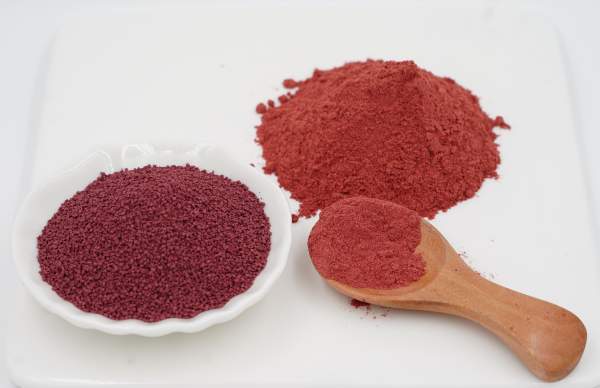
Red yeast rice powder and granular form after fermentation, drying, crushing and sieving.
What HPLC Testing for Monacolin K Actually Establishes
The declared specification for Red Yeast Rice Powder runs from 0.1% to 5.0% Monacolin K, tested by HPLC, with the active ingredient identified as Monacolin K. The product is catalogued under CAS No. 75330-75-5 and CAS No. 39866-30-2. HPLC is the appropriate technique here because it separates and quantifies a specific compound rather than estimating a class of compounds, which matters in a fermented matrix that contains multiple related substances.
A certificate of analysis reports the outcome of that separation. What it does not automatically report is the chromatographic context: the column and mobile phase conditions, the reference standard used, the integration method, and whether the chromatogram is supplied alongside the numerical result. Buyers evaluating a supplier for the first time can reasonably ask for the chromatogram itself, because a defensible number and a number that happens to appear on a document are not the same thing.
Equally, the assay answers a narrow question. It tells the buyer how much Monacolin K is present in the sample tested. It does not, on its own, describe how evenly that content is distributed across the batch, how stable it will remain during storage, or how the material will behave in a capsule or tablet matrix. Those questions are addressed by sampling plans, stability data and application testing rather than by the assay alone.
Batch Documentation Buyers Should Request During Evaluation
The practical test of a fermentation-controlled supplier is whether the process described above can be evidenced at batch level. The following documents map directly onto the four control points and give an evaluator something specific to compare across candidate suppliers.
| Document | Control point it evidences |
|---|---|
| Seed culture records (primary and secondary stage) | Inoculum is a controlled, staged input rather than an assumed one |
| Fermentation temperature log, 28–32 °C phase | Rapid multiplication window was held for the intended duration |
| Temperature log and duration, 25–29 °C phase | Metabolite accumulation ran under the intended conditions |
| Inactivation record | Batch was deliberately stopped at the target content |
| HPLC certificate of analysis with chromatogram | Monacolin K content within the 0.1%–5.0% range, with method context |
| Retention sample and batch traceability record | The delivered lot can be linked back to the batch that produced it |
Guanjie Biotech operates a 100% test policy across production, with a 500 m² laboratory supporting physical, chemical and instrument-based analysis, and works with third-party laboratories such as SGS and Eurofins where independent verification is required. For buyers, the value of that arrangement is not the claim of testing but the availability of per-batch documentation that can be matched against it.
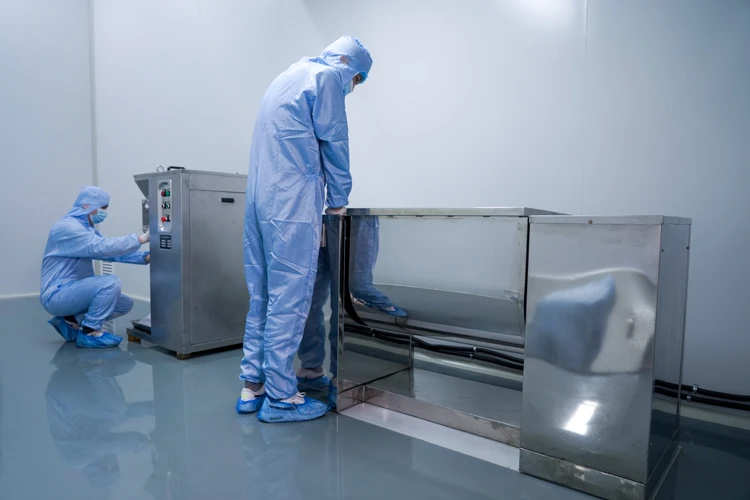
Packing stage, where batch identification and retention samples are established.
How Process Control Translates into Application Fit
Red Yeast Rice Powder is used as a raw material for the largest market segment, dietary supplements and hard capsules, and it appears in formulations alongside ingredients such as Curcumin 95%, Spermidine, NMN and Glucosamine. Each of those applications places a different demand on the ingredient.
In hard capsule and tablet production, the relevant question is whether the declared Monacolin K content is consistent enough that a fixed fill weight keeps the finished unit within its label claim. A supplier running a stable low-temperature phase and a consistent inactivation point is, in effect, protecting the customer's dosage calculation. In multi-ingredient formulations, the Red Yeast Rice Powder grade has to be selected against the other actives rather than in isolation, which is why the 0.1%–5.0% range exists as a range and not a single standard grade.
Application support matters here as well. Guanjie Biotech's technical team, which includes seven engineers, provides formulation troubleshooting for issues such as solubility, colour and thermal behaviour in supplement and beverage matrices — questions that arise most often when a fermented ingredient is transferred from a sample into a production run.
Regulatory Context Buyers Should Factor into Evaluation
Two regulatory realities shape how Red Yeast Rice Powder is bought and sold, and both reinforce the case for process documentation.
The first concerns manufacturing quality. The U.S. FDA states that those who manufacture, package or hold dietary supplements must follow current good manufacturing practices intended to help ensure identity, purity, quality, strength and composition. That requirement applies to the finished supplement but flows directly back to ingredient-level documentation: identity and strength cannot be assured downstream if the ingredient lot cannot be traced to a controlled fermentation batch.
The second concerns claims. Commission Regulation (EU) 2024/2041 addresses health claims relating to Monacolin K, and the practical consequence for buyers is that finished-product claim strategy in the European market must be settled before the ingredient specification is fixed. A supplier who understands the grade required for a given market is more useful than one who offers a single specification for every destination.
Process Evidence Compared with Brand-Level Assurance
Supplier evaluation in this category often defaults to company-level signals: years in operation, certifications held, factory size, export reach. Guanjie Biotech's own profile includes ISO, Halal and Kosher certification, more than 16 national patents, an annual output of 500 tons and an export ratio of roughly 90% across markets including Germany, Italy, the Netherlands, Japan, South Korea, Australia and Brazil. These are useful screening criteria and they belong in an initial shortlist.
They are, however, category-level assurances. None of them confirms that a specific lot of Red Yeast Rice Powder was cultured through two seed stages, held at 28–32 °C for multiplication, shifted to 25–29 °C for Monacolin K metabolism, and deactivated at the intended endpoint. The distinction matters most when two suppliers hold similar certifications and similar declared specifications; at that point, batch-level process evidence is the only criterion that separates them.
The Limits of Process Evidence
Process documentation has a genuine boundary, and buyers should recognise it rather than treat records as a complete guarantee. A fermentation batch record and an HPLC certificate confirm that the described process was followed and that the tested sample met its declared Monacolin K content. They do not establish bioavailability in humans, clinical efficacy, or suitability for a specific finished-product claim — those determinations sit with the brand owner's own regulatory and clinical work.
There is a second, more practical limit. Because fermentation time is adjusted to reach different Monacolin K contents, higher-specification grades require longer fermentation and therefore carry different cycle times and costs than low-specification grades. Buyers comparing quotations across the 0.1%–5.0% range without holding the grade constant are comparing different processes. Likewise, a single COA represents one lot; consistency claims can only be assessed against several consecutive batches, which is why retention samples and historical batch records matter more than any individual certificate.
Future Outlook
Demand for fermentation-derived nutraceutical ingredients continues to expand alongside the broader ingredients market, which commercial research estimates at USD 105.8 billion in 2026 (Global Market Insights). As the category grows, the differentiator is shifting from the availability of a specification to the provability of a process. Buyers increasingly ask for chromatograms rather than results, temperature logs rather than descriptions, and multi-batch histories rather than single certificates.
Suppliers that already operate staged seed culture, documented temperature transitions and instrument-based assay are positioned well for that shift, because the evidence exists as a by-product of how they already work. Those relying on specification sheets alone will find the evaluation conversation harder each year. For Guanjie Biotech, whose stated capability set includes full per-batch COA provision and third-party re-testing support, the practical task is to make that evidence as easy to request and interpret as the specification itself.
A company brochure covering the wider nutraceutical ingredients portfolio is available for download: Guanjie Nutraceutical Ingredients (PDF).
FAQ
What is the difference between primary and secondary seed culture in Red Yeast Rice Powder production?
Primary seed culture introduces the purple-red Aspergillus into a test tube. Secondary seed culture expands that culture before it is transferred into bottles containing rice. The two-stage sequence means the inoculum entering the rice substrate has already demonstrated its growth behaviour once, which supports batch-to-batch uniformity.
Why does the fermentation temperature change from 28–32 °C to 25–29 °C?
The 28–32 °C phase supports rapid multiplication of the purple-red Aspergillus across the rice substrate. After roughly four days, the environment is reduced to 25–29 °C, at which point the culture begins metabolising Monacolin K. The temperature shift marks the transition from growth to metabolite accumulation.
How is Monacolin K in Red Yeast Rice Powder tested?
Monacolin K content is determined by HPLC, with specifications ranging from 0.1% to 5.0%. HPLC separates and quantifies the specific compound rather than estimating a compound class, which is relevant in a fermented matrix containing related substances. Buyers can request the chromatogram alongside the numerical result to assess the method context.
What batch documentation should be requested before a first order?
Documentation should map onto the process: seed culture records for both stages, temperature logs covering the 28–32 °C multiplication phase and the 25–29 °C metabolic phase, an inactivation record, an HPLC certificate of analysis with chromatogram, and batch traceability including retention samples. Multi-batch records are more informative than a single certificate.
Does a higher Monacolin K specification always mean a better grade?
Not necessarily. Because the fermentation continues until the target content is reached, higher specifications require longer fermentation and carry different cycle times and costs. The appropriate grade depends on the finished formulation and its label claim. Comparisons between quotations are only meaningful when the specification is held constant.
How does high-temperature inactivation affect the finished powder?
When fermentation reaches the intended level, the red Aspergillus is deactivated at high temperature. This stops further metabolic change and fixes the Monacolin K content at the point the process was deliberately ended. The material is then dried, crushed and sieved, producing a light red to dark red powder.
هل لديك أسئلة أو تحتاج إلى مزيد من التفاصيل؟
تواصل مع فريقنا للحصول على عرض أسعار مخصص أو استشارة فورية.
طلب عرض أسعار
املأ النموذج أدناه وسيتواصل معك فريقنا بعرض مقترح مخصص.
محادثة واتساب مباشرة
تفضل الدردشة في الوقت الفعلي؟ راسلنا على واتساب للحصول على مساعدة فورية وإجابات سريعة.
- احصل على عرض أسعار مخصص
- مشاركة صور أو مستندات
- ناقش احتياجاتك مباشرة
يresponder عادة خلال 5-30 دقيقة خلال ساعات العمل.