
Reducer Specs & Certifications: What Buyers Should Verify
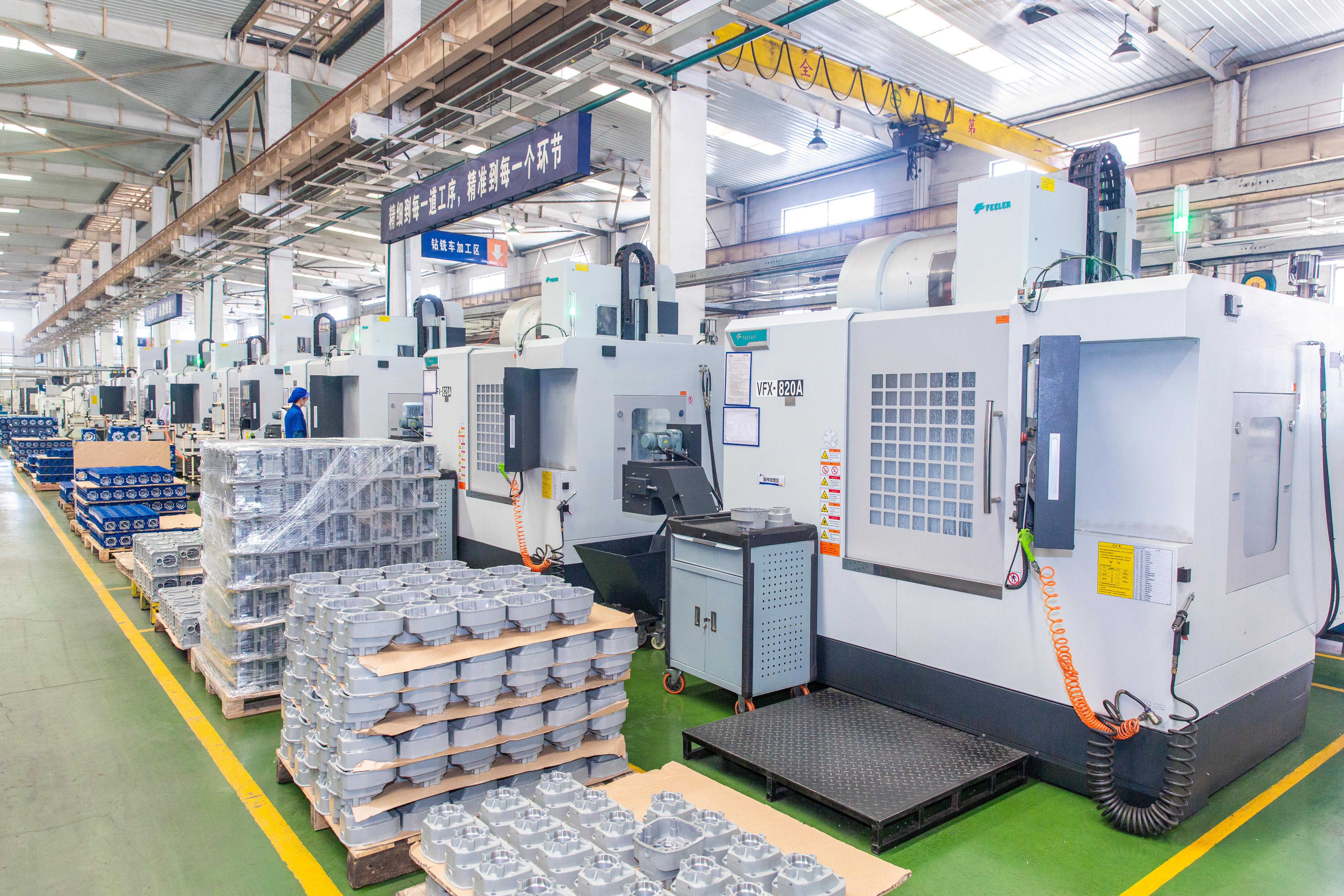
Starshine Drive production workshop — the manufacturing environment behind a documented reducer line.
Gear reducers convert the high-speed output of an electric motor into the lower speed and higher torque that industrial machinery requires. They are used in conveyor systems, mixer drives, kiln roller tables, packaging machinery, textile lines, and many other installations where speed and torque must be matched to a specific process. Although two reducers may look identical in a catalogue, the gear material, hardening process, machining accuracy, housing design, and test coverage behind them can differ significantly.
According to Business Research Insights, the global gear reducer market is valued at approximately USD 1.96 billion in 2026 and is projected to reach USD 2.58 billion by 2035. Grand View Research reports that Asia Pacific accounted for the largest revenue share of the industrial gearbox market in 2025, at 40.8 percent. These figures point to a large and expanding supplier base, which makes specification verification more important than ever. This article explains which reducer parameters can be verified, how certifications should be interpreted, and how these factors affect procurement decisions during the research and evaluation stage. Documented data from Guangdong Starshine Drive Co., Ltd. (Starshine Drive) is used as a reference example throughout.
Why Specification Transparency Matters
Specification transparency is a practical procurement requirement, not a marketing phrase. When a buyer compares reducers from several suppliers, the nominal motor power and output speed may be similar, but the ability of the gear set to sustain shock loads, resist wear, and operate efficiently over time depends on details that are often buried in the small print of the datasheet.
The most decision-relevant details include gear material, heat treatment hardness, gear grinding accuracy, housing material, single-stage efficiency, ratio range, and the scope of quality certification. In the R/F/K/S series helical gearmotors documented by Starshine Drive, the gears are made from 20CrMnTi alloy steel and undergo carbonitriding hardening treatment, achieving a hardness of HRC55-65. The gear grinding accuracy is grade 6, and the housing is made of high-strength cast iron. These are concrete, checkable values. A generic datasheet that only mentions “hardened steel gears” does not offer the same basis for comparison.
From an opportunity perspective, buyers who verify these parameters can better estimate energy cost, lubrication intervals, replacement cycles, and the risk of unplanned downtime. Suppliers who publish detailed specifications and hold verifiable certifications simplify the evaluation process and reduce the number of back-and-forth technical clarifications.
Starshine Drive: A Case Study in Traceable Transmission Design
Guangdong Starshine Drive Co., Ltd., also named Guangdong Xingguang Transmission Co., Ltd. and operating under the brand Starshine Drive, is a transmission solution provider headquartered in the Sanshui District of Foshan City, Guangdong Province, China. The company traces its origins to a mould factory established in 1965. It operates a production base of 53,333.33 square meters and employs nearly 400 people, with production technicians accounting for more than 70 percent of the workforce. Its annual production capacity is stated as up to 500,000 units or sets.
The company defines its product line as covering variable speed and reducer series products, mechatronic transmission series products and their accessories, and electronic, electrical, and mechanical control system products. More specifically, Starshine Drive develops more than a dozen series of general-purpose and specialized gearboxes, including the NCJ series gear reducers, R/S/K/F series high-precision helical gearmotors, RV series worm gearboxes, SP series planetary reducers, SI series industrial gearboxes, SNKG series gear reducers, JWB-X series mechanical stepless variators, B/JXJ series cycloidal pinwheel reducers, and XGK series hypoid gear reducers.
The company holds an ISO 9001:2015 quality management system certificate, number 133324000032R000, issued by Guoshuo Testing and Certification (Guangdong) Co., Ltd. The certified scope covers the design, development, and production of reducers. The certification applies to the R/F/K/S Series Helical Gearmotors, the RV Series Worm Gearbox, the NCJ Series Helical Gearmotor, Industry Customized Products, and Reducer Components and Drive System Accessories.
On the production side, Starshine Drive has introduced CNC machine tools, automated assembly lines, precision inspection devices, and fatigue test benches. According to the company, its production line integrates three quality control systems: 100 percent online air-tightness testing, 100 percent online noise testing, and 100 percent comprehensive motor testing. For a buyer, this is documented evidence that mass-produced reducers receive systematic testing rather than sample-based inspection only.
Reading the Key Parameters
The parameters below are among the most frequently checked by procurement and engineering teams when evaluating gear reducers. The values are taken from Starshine Drive's documented product specifications and are intended as reference points for comparison.
Efficiency
Single-stage efficiency for the R/F/K/S series helical gearmotors is documented as greater than 96 percent. The NCJ series helical gearmotor has an efficiency range of 92 to 96 percent. Efficiency directly affects energy consumption, operating temperature, and lubricant service life. In equipment that runs around the clock, even a small difference in efficiency can produce measurable differences in annual electricity cost and heat management.
Ratio range
The single-stage ratio range of the R/F/K/S series is 1.3 to 289.74, a fine division that allows output speed to be matched more closely to process requirements. The RV series worm gearbox extends the ratio range further: single-stage reduction can reach 100 and double-stage reduction can reach 10,000. For applications such as stage equipment and door operators, RV reducers with ratios i ≥ 60 provide a self-locking function.
Materials and heat treatment
Gear material is one of the strongest indicators of reducer quality. The gearmotors in the R/F/K/S series use gears made from 20CrMnTi alloy steel, with carbonitriding hardening to HRC55-65. The RV series worm gearbox uses 20CrMnTi alloy steel for the worm shaft and a patented premium KK alloy copper for the worm wheel, a combination selected for wear resistance. The RV housing is made of aluminum parts. The NCJ series helical gearmotor is made of cast iron and alloy steel, with gears of 20CrMnTi alloy steel that undergo the same carbonitriding treatment to HRC55-65.
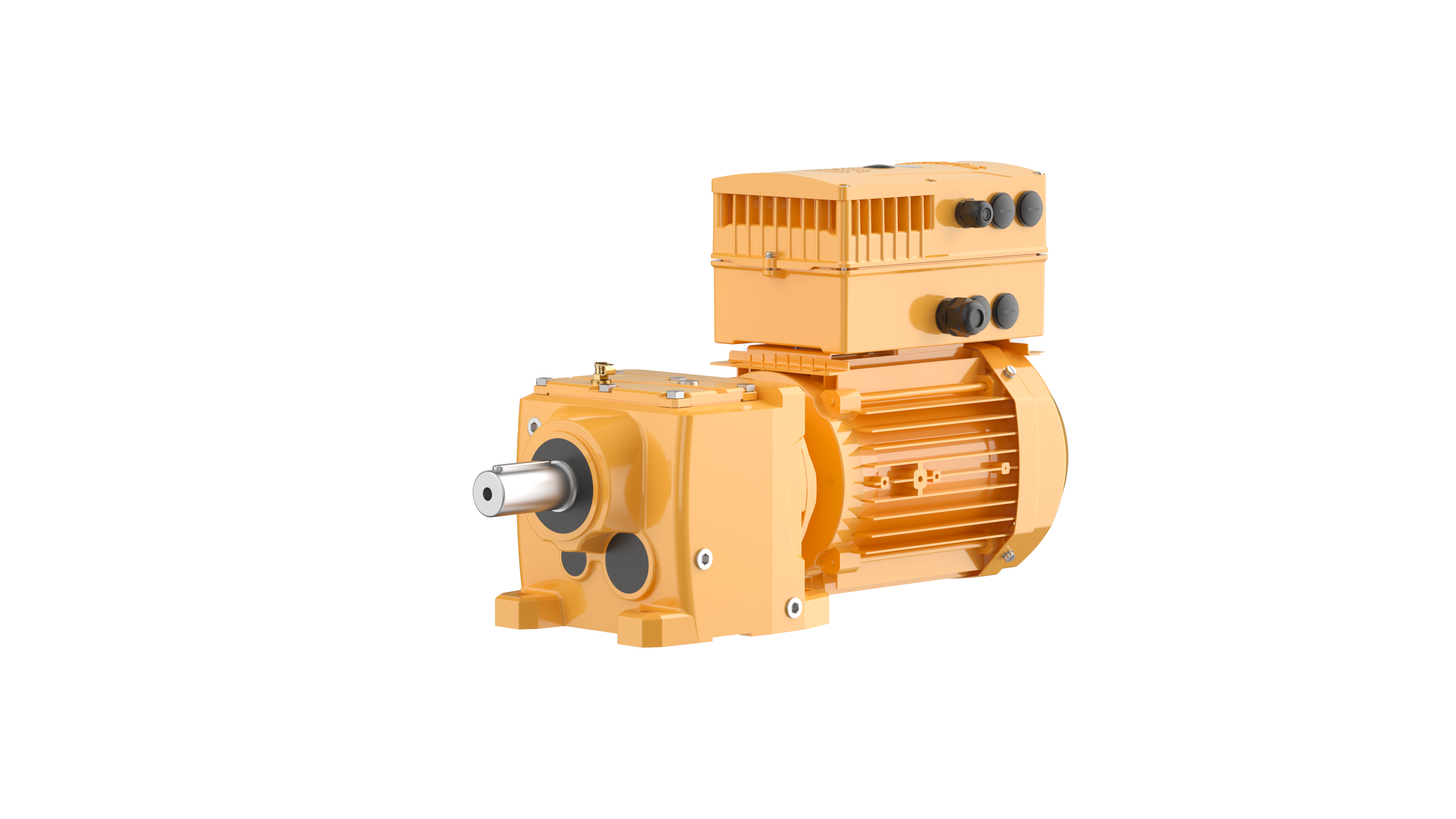
R-series helical geared motor — one of the product series with published efficiency, material, and hardening parameters.
Housing and structural design
Housing material affects rigidity, vibration damping, heat dissipation, and corrosion resistance. The R/F/K/S series helical gearmotors use high-strength cast iron housings. The NCJ series uses cast iron and alloy steel. Buyers operating in humid or washdown environments, such as textile dyeing or food and beverage processing, typically pay close attention to housing protection and corrosion resistance as part of the overall machine design.
Maintenance and operating life
Starshine Drive specifies that the NCJ series uses a special lubricating oil that can support up to 20,000 hours of normal use. The RV series recommends synthetic worm-gear special lubricating oil to maintain transmission efficiency and extend service life. Published maintenance figures give maintenance teams a more predictable basis for scheduling lubrication and inspection intervals.
What ISO 9001:2015 does and does not prove
ISO 9001:2015 certification verifies the manufacturer's quality management system. It does not certify the performance or lifetime of any single product model. In the EU, machinery safety risk assessment is often supported by standards such as EN ISO 12100:2010, which sets out general principles for risk assessment and risk reduction in machine design. For reducer procurement, ISO 9001:2015 should be treated as a supplier-level baseline, and product-level parameters should be verified against the actual application duty cycle.
Where Certified Reducers Matter Most
Different industries place different demands on a reducer. The table below summarizes the working conditions, matched equipment, and typical product series for several sectors covered by Starshine Drive's documented application data.
| Industry | Working conditions | Matched equipment | Typical series |
|---|---|---|---|
| Textile | High temperature, humidity, acid-base solvents in dyeing, continuous operation | Washing machine, dyeing machine, setting machine, carding machine | R/F/K/S, NCJ |
| Logistics | Continuous operation, frequent start-stop, variable load, some dust | Modular belt sorter, roller sorter, stacker, robot picking system | R/F/K/S, NCJ |
| Grain and oil | High dust, continuous operation, variable load | Bucket elevator, screw conveyor, rotary airlock, grinding mill | R/F/K/S, NCJ |
| Ceramics | High temperature near kiln, high dust, continuous operation | Stirrer, dryer, kiln, glazing line, polishing machine | NCJ, R/F/K/S, motor and control accessories |
| Food and beverage | Humid washdown environment, oil and sugar splashes, some temperature extremes | Filler, capper, conveyor, mixer, sterilizer, labeler | R/F/K/S, customized products, drive accessories |
| Stage equipment | Intermittent operation, frequent start-stop, ultra-low noise requirement | Circular light lifting device, prism light lifting device, revolving stage drive | RV, NCJ |
| Lithium battery | Low humidity cleanroom environment, high precision positioning | Coating machine, calender, winding machine, stacking machine | NCJ, R/F/K/S |
Table compiled from Starshine Drive's application documentation. Product series listed are those associated with each application in the company's product data.
In logistics, continuous operation and frequent start-stop demand low noise, high positioning accuracy, and high reliability. The R/F/K/S series and the NCJ series are both specified for such applications. In textile processing, high temperature and humidity require corrosion-resistant and moisture-proof designs; washing machines, dyeing machines, and setting machines are representative driven equipment. Grain and oil facilities prioritize dust protection and sealing on bucket elevators, screw conveyors, and rotary airlocks. For stage automation, ultra-low noise and precise positioning are decisive, which is why the RV series worm gearbox is a typical choice for lifting devices in performance venues.
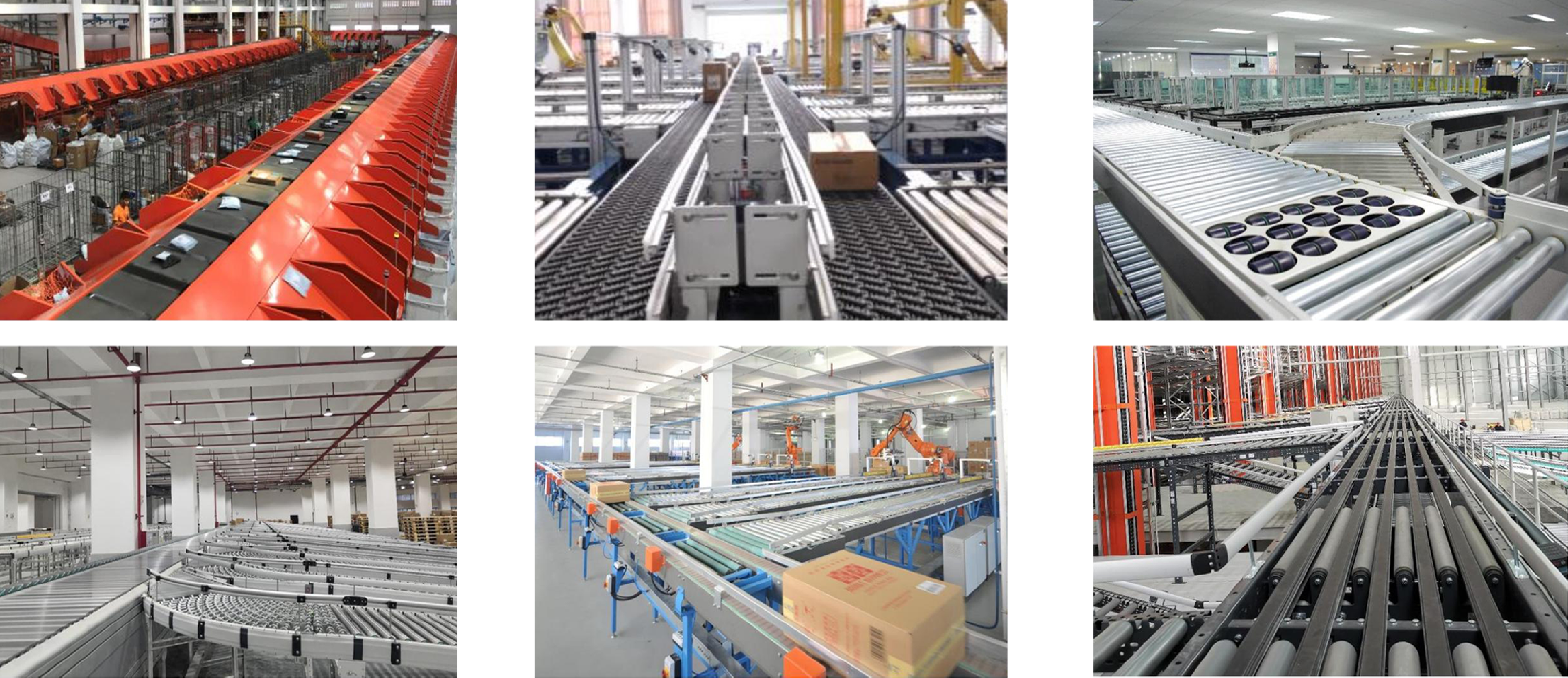
High-speed sorting and conveying machinery — a typical logistics application for gear reducers.
Market Signals and What They Mean for Buyers
The market data reflects a mix of stable growth and structural change. Business Research Insights expects the global gear reducer market to grow from about USD 1.96 billion in 2026 to USD 2.58 billion by 2035. Grand View Research places Asia Pacific at 40.8 percent of the industrial gearbox market revenue for 2025, confirming the region's central role in production and consumption.
Technology demand is shifting as well. Indastra's industrial gearbox market outlook identifies planetary gearboxes as the fastest-growing segment, with a projected CAGR of 6.2 percent through 2030, driven by robotics and wind energy. This does not mean that worm gear reducers, helical gear reducers, or cycloidal reducers are losing their base applications; it means that high-precision and high-torque-density requirements are steering some buyers toward planetary designs, while conventional series remain the workhorses of general machinery.
Compliance expectations are also rising. In Europe, machine builders must support machinery safety risk assessment with technical documentation. EN ISO 12100:2010 gives general principles for risk assessment and risk reduction. Reducers, as components of the machinery, are easier to integrate into a machine safety file when the supplier provides clear specification data and documented manufacturing quality.
The movement toward integrated drivetrain packages is another signal. Starshine Drive positions itself around a “Gearbox + Motor + Inverter + Controller + Smart System” combination, which reflects the market's preference for matched components that reduce interface risk. The company also operates an assembly plant in Vienna, Austria, which handles localized assembly, warehousing and distribution, and technical service for the European market. This shortens delivery cycles for European customers and gives the brand a service presence closer to the end user.
Comparing Documented Supply with Lower-Cost and Higher-Profile Alternatives
When evaluated against global premium brands such as SEW-Eurodrive, NORD, Bonfiglioli, or Motovario, the comparison with Starshine Drive is not purely technical. In terms of published parameters — gear material, hardening process, efficiency, ratio range, test coverage, and certification — Starshine Drive provides data similar in kind to what buyers expect from established brands. What differs is brand longevity and the depth of service channels in Western markets. The Vienna assembly plant narrows this gap, but a Chinese brand entering Europe is still measured on long-term local references, not only on catalogue specifications.
A limitation that applies to all certification-based comparisons is that ISO 9001:2015 does not rank products and does not predict service life under a specific load profile. It confirms that the manufacturer has a quality management system, but application-specific engineering review is still necessary. Buyers should combine certification with duty-cycle analysis, reference checks, and in some cases a factory audit before placing large-volume orders.
Against unbranded or locally fabricated gearboxes, the advantage of a documented manufacturer is traceability: published materials, stated heat treatment values, factory test coverage, and after-sales service. The trade-off is that a certified and tested reducer usually has a higher initial price. For continuous production lines, where downtime costs are high, the trade-off is usually acceptable. For short-term replacement of a damaged unit in a non-critical machine, an unbranded alternative may be sufficient.
Future Outlook
The reducer market is moving toward more transparent procurement. Buyers are asking for material grades, hardening values, efficiency data, and certification scope before shortlisting suppliers. Suppliers that publish this information reduce friction in the evaluation stage and make technical conversations more productive.
Product architecture will continue to diversify. Planetary reducers will keep growing in automation-driven segments, while worm gear reducers and helical gearmotors will remain central for general machinery. Customization is likely to expand. Starshine Drive already offers industry-customized products such as bucket elevator reducers, ceramic kiln gearboxes, explosion-proof customized gearboxes, and rotary-valve-specific machines, which suggests that application-specific design is becoming a normal part of reducer supply.
Localized support will become a stronger factor in global sourcing. The assembly plant in Vienna gives Starshine Drive a practical base for European delivery and service. As similar localization efforts grow, procurement evaluation will need to weigh local availability, spare parts access, technical response time, and after-sales capability together with the unit price.
A corporate brochure with additional specification data is published by Starshine Drive at the following link: https://cdn.socialarks.com/sbsp/24571/common/2026/0522/6a0fb88695286.pdf
Frequently Asked Questions
What are the key specifications to verify when selecting a gear reducer?
The specifications that buyers most often verify are single-stage efficiency, ratio range, gear material, heat treatment hardness, housing material, and the scope of the supplier's quality certification. For example, Starshine Drive's R/F/K/S series helical gearmotors show single-stage efficiency greater than 96 percent, a single-stage ratio range of 1.3 to 289.74, gears made from 20CrMnTi alloy steel, carbonitriding hardening to HRC55-65, and a high-strength cast-iron housing.
What certification should a gear reducer manufacturer hold?
A commonly accepted baseline is ISO 9001:2015 quality management system certification. Starshine Drive holds certification number 133324000032R000, issued by Guoshuo Testing and Certification (Guangdong) Co., Ltd., with a scope that covers the design, development, and production of reducers. The certification applies to the R/F/K/S Series Helical Gearmotors, the RV Series Worm Gearbox, the NCJ Series Helical Gearmotor, Industry Customized Products, and Reducer Components and Drive System Accessories.
What does ISO 9001:2015 certification mean for reducer quality?
ISO 9001:2015 certification verifies the manufacturer's quality management system, not the performance of an individual product. It is a supplier-level baseline that confirms documented processes for design and production. For product-level decisions, buyers should also review the specific parameters — efficiency, ratio, gear material, heat treatment — against the duty cycle of their application.
What efficiency levels can buyers expect from helical gearmotors?
Starshine Drive documents the single-stage efficiency of its R/F/K/S series helical gearmotors as greater than 96 percent. The NCJ series helical gearmotor is documented at 92 to 96 percent. Efficiency affects energy consumption and operating temperature, making it a valuable figure when comparing units of similar ratio and torque.
What ratio ranges are available in Starshine Drive reducers?
The single-stage ratio range of the R/F/K/S series helical gearmotors is 1.3 to 289.74. The RV series worm gearbox has a wider range: single-stage reduction can reach 100, and double-stage reduction can reach 10,000. For RV reducers, a ratio i ≥ 60 provides a self-locking function.
What materials are used in Starshine Drive gear reducers?
The gearmotors use gears made from 20CrMnTi alloy steel, with a carbonitriding treatment that reaches HRC55-65. The housing of the R/F/K/S series is high-strength cast iron. The NCJ series is made of cast iron and alloy steel. The RV series worm gearbox uses 20CrMnTi alloy steel for the worm shaft, a patented premium KK alloy copper for the worm wheel, and aluminum parts for the housing.
In which industries are these reducers commonly used?
According to Starshine Drive's product data, the R/F/K/S series is intended for the textile, logistics, new energy, and grain and oil industries. The RV series worm gearbox is used in stage equipment, door operators, and electric power applications. The NCJ series is applied in ceramics, logistics conveying, and grain and oil. Industry-customized reducers cover a broader scope, including packaging machinery, food processing, construction, mining, metallurgy, robotics, and automated production lines.
How is quality controlled during large-volume reducer production?
Starshine Drive reports a workforce of nearly 400 employees, with production technicians representing more than 70 percent of staff. Its production line integrates three documented testing systems: 100 percent online air-tightness testing, 100 percent online noise testing, and 100 percent comprehensive motor testing. Annual production capacity is stated as up to 500,000 units or sets.