
Rental LED Screen OEM & ODM: A Buyer's Evaluation Guide
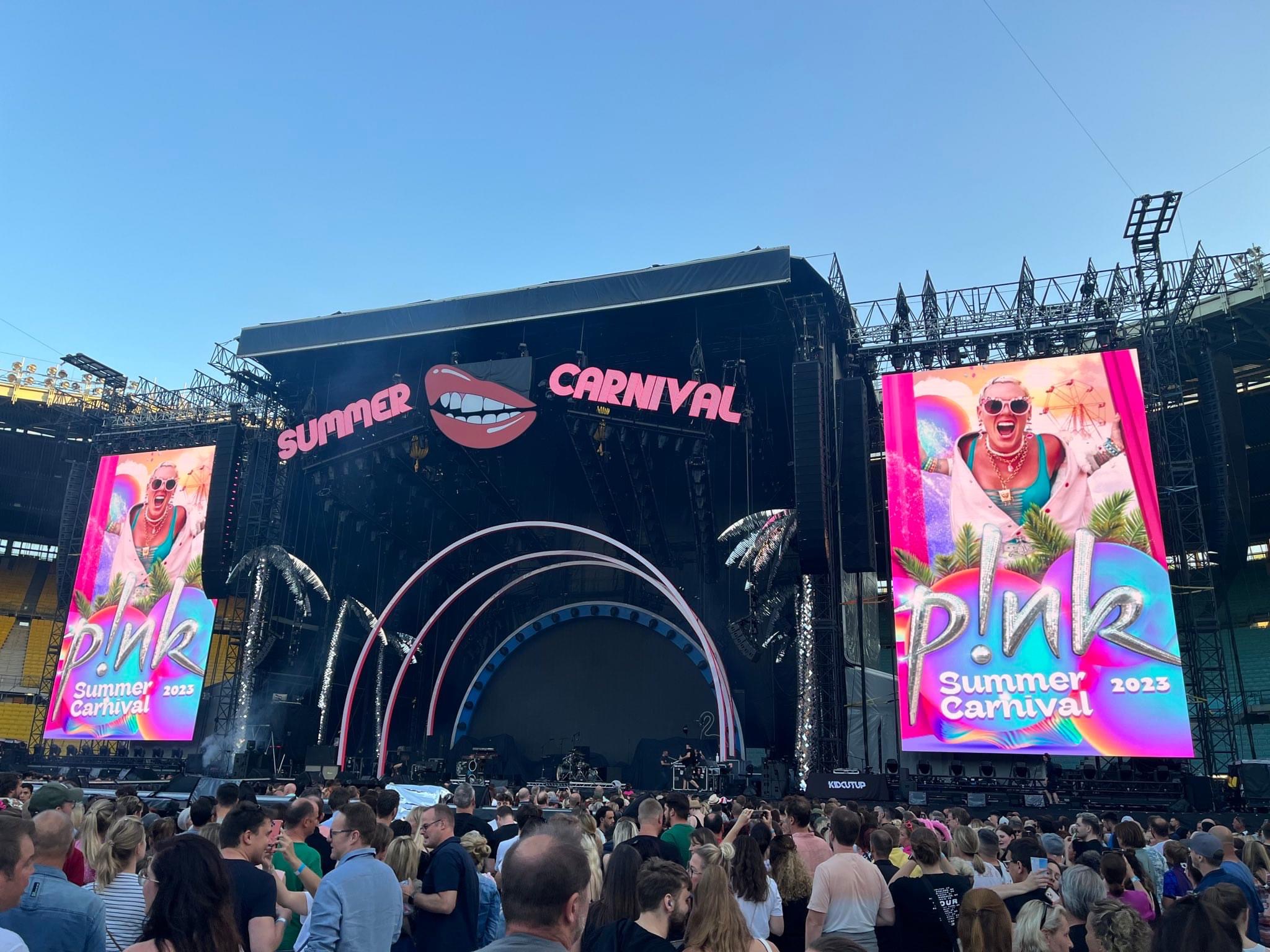
A 160㎡ D Series P2.976 outdoor rental LED display used for a concert and live-event stage in Brazil. Source: DDW DISPLAY project record.
Rental LED screen procurement usually begins with product-level questions: pixel pitch, brightness, cabinet weight, refresh rate and protection rating. For buyers who are past initial discovery and already evaluating suppliers, the harder questions are about OEM/ODM flexibility, engineering support, manufacturing discipline, pre-shipment inspection and the ability to execute repeatable rental inventory programs. This article focuses on that evaluation stage.
In an OEM project, a buyer commissions a manufacturer to produce an LED display under the buyer's brand. In an ODM project, the manufacturer also participates in or leads the design of a tailored display solution. A buyer may need either route when launching a rental LED display line, building a stage inventory for concert production, selling LED walls as a distributor, or deploying a custom configuration for a specific event series. The manufacturer used as a concrete reference here is Shenzhen DDW Technology Co., Ltd., better known as DDW DISPLAY, a Shenzhen-based LED display manufacturer founded in 2012.
Problem & Opportunity
Event companies, rental houses, AV integrators and brand owners often compare rental LED displays by looking at a short quote sheet. That approach becomes risky when the order is not a standard off-the-shelf product but an inventory purchase with custom branding, special dimensions, unique rigging requirements or a mix of indoor and outdoor event cabinets.
Several product failures in rental environments are not caused by the LED chip or the pixel pitch alone. The more common risks are mechanical damage after repeated assembly, inconsistent brightness and color between batches, connector or power failures during touring, water ingress in outdoor stage screens, and insufficient spare-part planning. These risks are largely determined by how the display is engineered and how carefully it is inspected before shipment.
The market context makes this evaluation more valuable. Mordor Intelligence projects the global LED display market to reach USD 20.73 billion in 2026 and to grow to USD 26.98 billion by 2031. Within that market, rental LED display is a distinct segment. One industry estimate reported through Allied Market Research commentary placed the global rental LED display market at roughly USD 5 billion in 2020 and expected it to exceed USD 8 billion by 2027. Buyers are therefore building larger rental pools, and a growing share of those pools is sourced through OEM/ODM programs rather than through one-off purchases.
Supplier Reference: DDW Display as a Rental LED Screen Manufacturer
DDW DISPLAY is the market brand used by Shenzhen DDW Technology Co., Ltd. The company is a professional LED display manufacturer, not a trading company or systems integrator. Its factory is located at 2F Building 8, YiLisheng Industry Park, Fuyong, Baoan, Shenzhen, occupying approximately 10,000 square meters. The company reports more than 100 employees, an R&D team of 15 engineers and an annual output of more than 800,000 units. Its export ratio exceeds 95%, and it has delivered LED display projects to more than 120 countries and regions.
Within the rental LED display category, DDW DISPLAY offers several cabinet families that serve different event scenarios. The table below summarizes the series that are most relevant for buyers evaluating a rental vendor.
| Series | Rental Positioning | Key Configurations |
|---|---|---|
| D Series | Indoor & outdoor events, concerts, stage shows and rental production | Pixel pitch P1.56 / P1.95 / P2.604 / P2.97 / P3.91; 500×500 mm cabinet; refresh rate up to 7680 Hz; outdoor brightness up to 5000 nits; IP65 outdoor version; front and rear maintenance; hanging and stacking installation |
| A Series | Stage events, festivals, outdoor shows and rental companies | Pixel pitch P2.5 / P2.604 / P2.97 / P3.91; 500×500 mm or 500×1000 mm cabinet options; refresh rate up to 3840 Hz; outdoor brightness up to 4500 to 5000 nits; IP65 front and rear; hanging and stacking installation |
| AXIS Series | Creative and general rental LED video walls | Pixel pitch P1.95 / P2.604 / P2.97 / P3.91; 500×500 mm cabinet; 500×250 mm module; 7.5 kg cabinet weight; refresh rate 7680 Hz; 14 to 16 bit gray level |
| AXIS One Series | Premium high-definition rental applications | Pixel pitch P1.95 / P2.604; 500×500 mm cabinet; 7.5 kg cabinet weight; brightness 1000 to 1500 cd/m²; 16 bit gray level; refresh rate 7680 Hz |
| AXIS Flex Series | Flexible and curved stage LED displays | Pixel pitch P1.95 / P2.604 / P2.976 / P3.91; 500×500 mm cabinet; 500×250 mm module; 8.5 kg cabinet weight; brightness 800 to 5000 cd/m²; refresh rate 7680 Hz |
This range illustrates an important point for buyers: rental LED display is not a single product category. A supplier that seems suitable for one event type may not be suitable for another. A high-definition indoor awards show may call for a fine-pitch series such as AXIS One. An outdoor music festival needs high-brightness, weather-protected cabinets. A touring production with curved stage design may require a flexible cabinet family such as AXIS Flex.
What a Buyer Should Evaluate Inside an OEM/ODM Capability
The core of a rental LED display supplier evaluation is not only the product brochure. It is the manufacturer's ability to turn a buyer's requirement into a producible display system. For DDW DISPLAY, the documented OEM/ODM scope is broad. The manufacturer states that it can customize pixel pitch, LED module size, cabinet size, cabinet structure, display shape, brightness level, refresh rate, installation method, control system, logo branding, color calibration, power solution and mechanical design.
OEM services are available for custom LED display manufacturing, allowing clients to produce displays under their own brand. ODM services are available for custom LED display design and manufacturing, allowing a client to develop a tailored display solution rather than simply relabel an existing product.
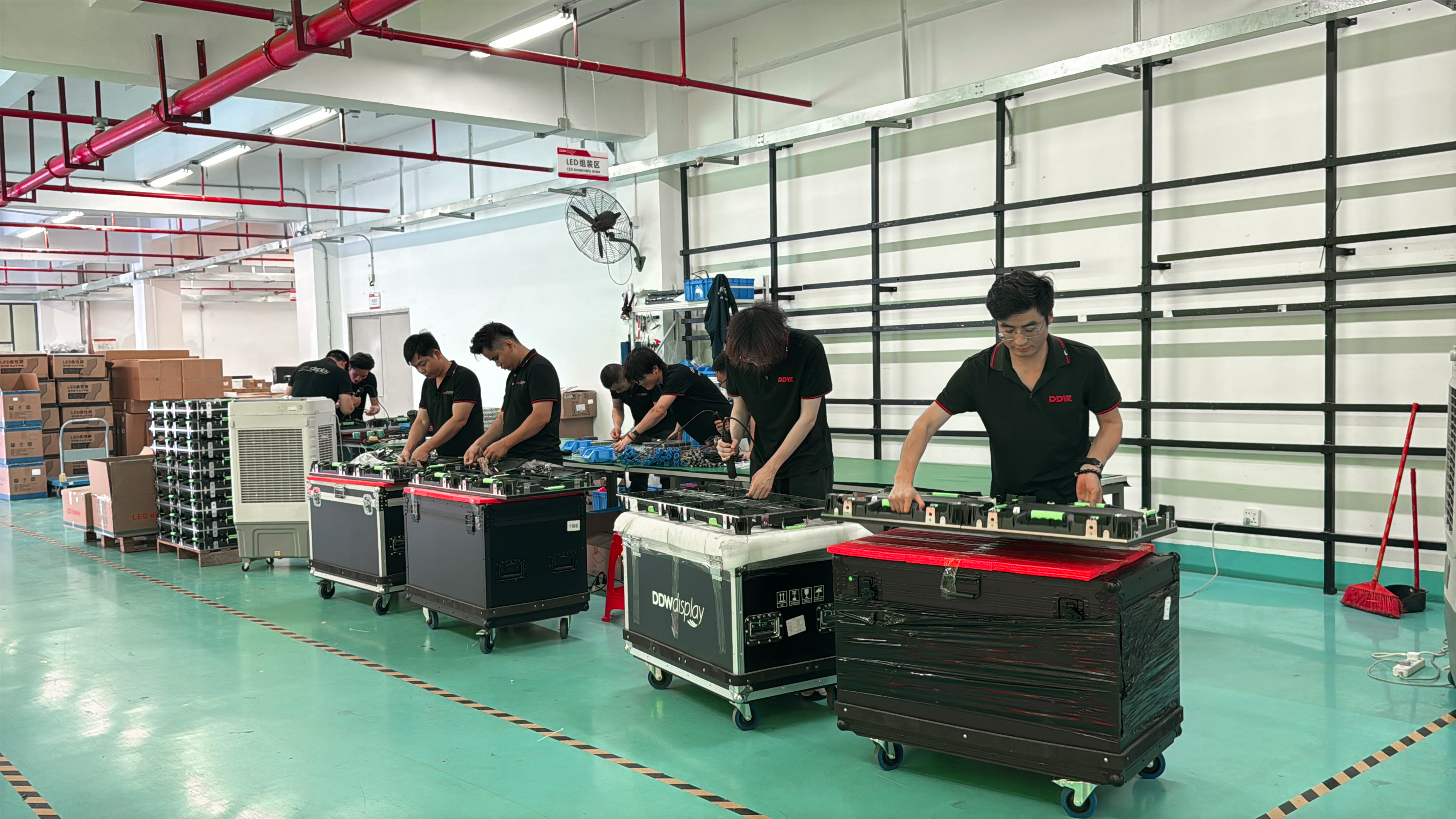
Rental LED display OEM/ODM programs depend on production-floor assembly discipline. Image: DDW DISPLAY assembly area.
Manufacturing Capacity and Lead Time
Rental LED display buying usually happens against a project schedule. A manufacturer should therefore be able to state its capacity and realistic lead time. DDW DISPLAY reports a monthly production capacity of 8,000 square meters across its LED display lines. For standard products, the company quotes a lead time of 15 to 30 days. For customized projects, lead time depends on product design, quantity and technical requirements. Buyers should treat this as a planning input, not as a guarantee, because OEM/ODM modification depth directly affects delivery.
Quality Control and Pre-Shipment Evidence
Rental LED cabinets are handled far more aggressively than fixed LED screens. They are loaded into trucks, stacked, rigged, powered down, moved to another venue and assembled again. For this reason, inspection matters as much as the original component specification.
DDW DISPLAY's quality-control process includes 100% product inspection, aging tests, module testing, brightness and color calibration, waterproof testing for applicable outdoor versions, power safety testing and performance inspection before shipment. These checks should be written into the purchase agreement, not treated as a favor.
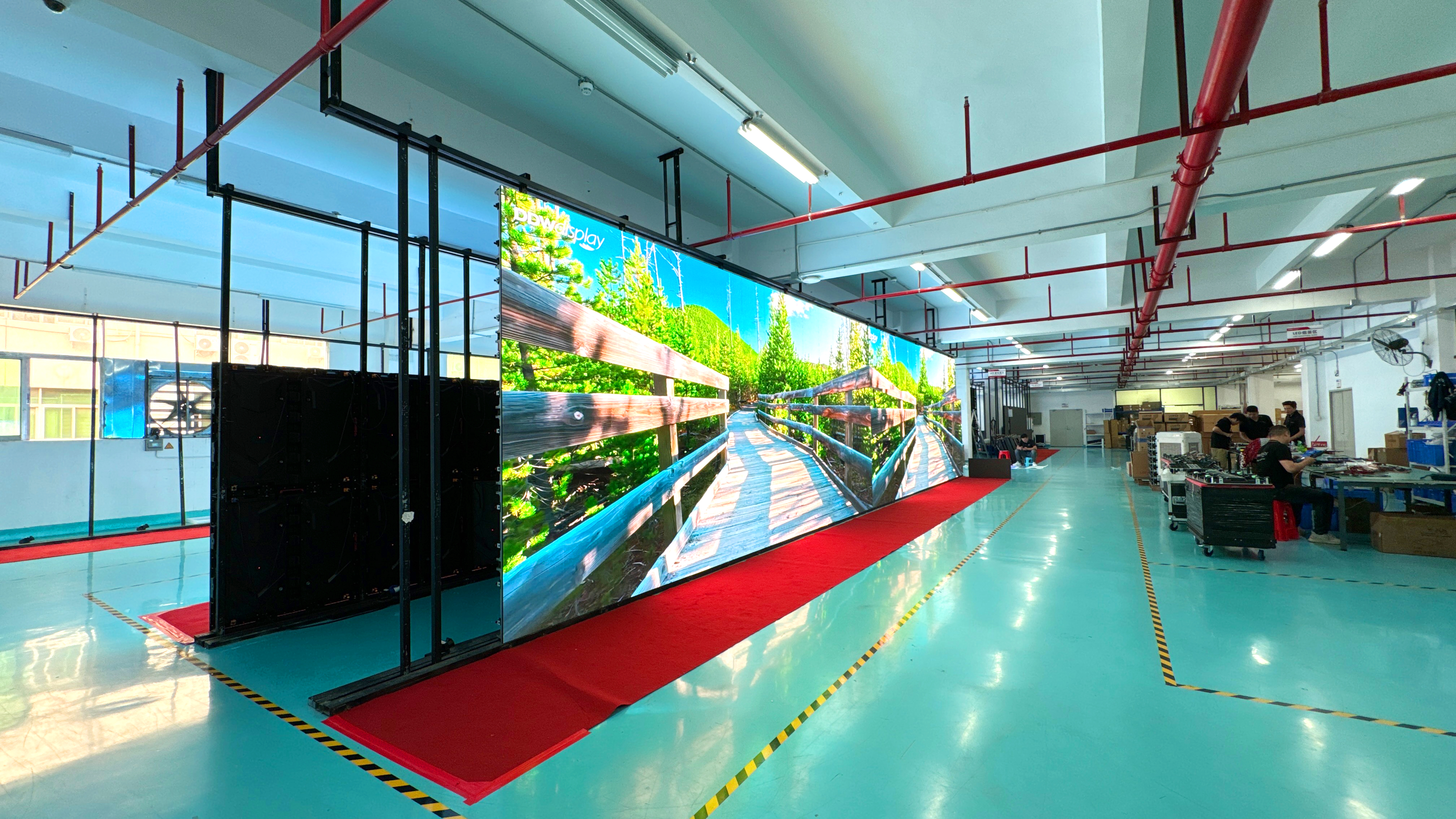
Aging tests help identify power, module and connection defects before rental cabinets enter the field.
The company also operates a quality management system certified to ISO 9001:2015, with a certificate scope covering production of LED displays for export. Its LED display product line has conformity records for EU CE-EMC, CE-LVD, FCC and EU RoHS, depending on the destination-market requirement. Buyers planning European or North American deployments should review these documents during supplier qualification.
Commercial Rules for Moving From Evaluation to Execution
Another part of vendor qualification is commercial execution. DDW DISPLAY's stated minimum order quantity is one unit or a project-based order. That low MOQ is useful for sample validation but should not be confused with the volume needed for a reliable rental pool. Payment terms are commonly T/T with a 30% deposit in advance and 70% balance before shipment, while other payment terms can be agreed for specific orders.
The company offers delivery under EXW Shenzhen, FOB Shenzhen, CIF or DDP subject to destination and order requirements. Acceptance can include pre-shipment inspection, aging test, display performance test, brightness and color consistency inspection, customer video inspection or third-party inspection upon request.
Rental LED Display Applications in Real Projects
Product capability becomes meaningful when it is tested in real deployment. DDW DISPLAY project records include rental deployments across countries and event conditions.
| Market | Configuration | Deployment Context |
|---|---|---|
| Brazil | 160㎡ D Series P2.976 outdoor rental LED display | Outdoor concert and live event stage system |
| Mexico | 20㎡ D Series P2.976 indoor rental LED display | Indoor stage performance and live event backdrop |
| Myanmar | 40㎡ A Series P3.91 outdoor rental LED display | Outdoor stage event and festival visual screen |
| Syria | 12㎡ A Series P3.91 indoor rental LED display | Indoor event backdrop and media display |
| Indonesia | 27㎡ A Series P2.604 stacking-installed rental LED display | Hotel lobby and semi-permanent commercial installation using rental cabinet structure |
These cases show why configuration flexibility is central to rental LED procurement. The same supplier can support a compact 12㎡ indoor event screen, a 160㎡ outdoor concert wall, and a hotel lobby deployment based on stacking installation. For an event-production buyer, consolidating rental screen types from one manufacturer can simplify spare-parts management, staff training and technical support.
Market Trends Affecting Rental LED Display Procurement
Several market signals are relevant for a buyer evaluating a rental LED screen partner. First, the overall LED display market is still expanding, with Mordor Intelligence projecting global revenue of USD 20.73 billion in 2026 and USD 26.98 billion by 2031. Second, the rental segment has its own growth pattern because live events, touring shows, sports presentations and corporate activations continue to require temporary large-format screens.
Third, higher-density LED solutions are becoming more visible in premium event work. Grand View Research has projected the micro-LED market to grow at a CAGR of 77.4% from 2024 to 2030, reaching around USD 25.65 billion by 2030. For rental and studio use, this is visible in the emergence of MIP-based display cabinets. DDW DISPLAY includes an ORBIT MIP Series in its portfolio, with pixel pitches of P1.25, P1.3, P1.56 and P1.95, a 500×500 mm cabinet size, 8 kg cabinet weight and 3000 to 4000 cd/m² brightness. These fine-pitch cabinets are used in XR virtual production and high-end rental applications. The broader implication is that rental buyers should evaluate whether their chosen manufacturer has a technology path beyond standard stage LED walls.
Comparison With Traditional Fixed LED Supply
A buyer deciding between rental LED display inventory and fixed LED installation is making a decision about the operating model, not just about the screen. Fixed LED displays are designed for permanent installation and normally emphasize long-term stability, efficient installation and continuous operation. Rental LED displays are designed for repeated assembly and dismantling, with lightweight cabinets, quick locking systems and flexible hanging or stacking.
From an OEM/ODM perspective, the two product types also differ in customization priorities. With a fixed installation, customization often focuses on cabinet size, steel structure, building integration and brightness for a specific location. With a rental screen, customization also covers corner protection, touring flight-case compatibility, quick-service access, connector durability and the ability to build different stage shapes from the same cabinet family.
It would be misleading to suggest that OEM/ODM rental production is always faster or cheaper than buying a standard model. One realistic boundary is engineering lead time. If a buyer requires a nonstandard cabinet depth, custom rigging points, a distinctive shape or substantial mechanical redesign, the standard 15-to-30-day lead time may not apply. The project should go through an engineering review, and a pre-production sample may be necessary before mass production. Even when the MOQ is as low as one unit, a buyer planning a large rental pool must ensure batch-to-batch consistency, which is governed by inspection and manufacturing control rather than by the MOQ alone.
Future Outlook
Rental LED display buying is becoming more professional. Event companies and rental houses are moving from transactional purchases toward longer-term supplier relationships in which product quality, spare-parts availability, calibration consistency and engineering support are contractual matters. As LED rental inventories become more expensive, the cost of a wrong vendor decision also rises.
Manufacturers that can combine rental-specific cabinet design with OEM/ODM services will be better positioned to support buyers who want their own brand and configuration. The development of fine-pitch rental cabinets, flexible stage systems and MIP-based virtual production displays is pushing the rental category beyond the traditional touring screen. Buyers should therefore define their current rental workload and next two years of expected event types before selecting a specific series.
For most buyers, the safest path is evidence-based: review the supplier's factory documentation, inspect product records, assess customization scope, confirm inspection procedures and ask for a sample or pilot unit before committing a full rental inventory order.
Frequently Asked Questions
Which rental LED screen specifications can be customized in an OEM/ODM project?
Customization can cover pixel pitch, LED module size, cabinet size, cabinet structure, display shape, brightness level, refresh rate, installation method, control system, logo branding, color calibration, power solution and mechanical design. In an OEM project, the buyer can sell the display under its own brand. In an ODM project, the manufacturer participates more deeply in the design of the tailored solution.
What MOQ and lead time does DDW Display offer for rental LED screens?
DDW Display states an MOQ of one unit or a project-based order. Its standard product lead time is 15 to 30 days. Customized projects have a lead time that depends on product design, quantity and specific technical requirements. Buyers should confirm lead time during the engineering review rather than relying on the standard quotation.
Rental LED display vs fixed LED display: which one should a buyer choose?
A rental LED display is usually the better choice for concerts, exhibitions, stage events, festivals and other temporary installations that require frequent assembly and dismantling. A fixed LED display is usually better for permanent installations such as shopping malls, building facades, conference rooms, control centers and long-term retail signage. Rental displays emphasize lightweight cabinets, fast locking and flexible hanging or stacking; fixed displays emphasize long-term stability and continuous operation.
How do I choose the right pixel pitch for a rental LED wall?
Pixel pitch should be selected according to viewing distance, screen size, required resolution, environment and content type. For close-viewing indoor event environments, fine-pitch options such as P1.56, P1.95 or P2.604 are commonly considered. For stages, exhibitions and medium-distance viewing, configurations from about P2.5 to P3.91 are common. Smaller pixel pitch increases pixel density and close-range image detail, but it also tends to increase cost.
What certifications should a buyer look for when purchasing an LED display?
The required certifications depend on the destination market and product configuration. For international projects, buyers commonly evaluate CE, EMC, FCC, RoHS and applicable electrical safety requirements. CE and EMC are relevant for European-market delivery, FCC is relevant to electromagnetic compliance in the United States, and RoHS addresses restrictions on hazardous substances. Buyers should request the specific certificates or test reports for the exact model being purchased.
How should an outdoor rental LED screen be protected in rainy or humid environments?
The main risks are water ingress, moisture-related electrical faults, corrosion, short circuits and reduced component reliability. For outdoor rental use, the display should have an appropriate IP rating, waterproof cabinet structure, sealed cable connections, proper drainage and regular inspection. Before shipment, outdoor versions should undergo waterproof testing. After delivery, seals, connectors, drainage paths and cabinet condition should be checked regularly.
For current product documentation, DDW DISPLAY publishes a general catalog at DDW LED Display catalog 2026. Buyers should still request a project-specific quotation, technical drawings and inspection documents before making a purchase decision.
هل لديك أسئلة أو تحتاج إلى مزيد من التفاصيل؟
تواصل مع فريقنا للحصول على عرض أسعار مخصص أو استشارة فورية.
طلب عرض أسعار
املأ النموذج أدناه وسيتواصل معك فريقنا بعرض مقترح مخصص.
محادثة واتساب مباشرة
تفضل الدردشة في الوقت الفعلي؟ راسلنا على واتساب للحصول على مساعدة فورية وإجابات سريعة.
- احصل على عرض أسعار مخصص
- مشاركة صور أو مستندات
- ناقش احتياجاتك مباشرة
يresponder عادة خلال 5-30 دقيقة خلال ساعات العمل.