
Repeat Builds: Evaluating Long-Term Chemical Equipment Supply
Repeat Builds: Evaluating Long-Term Chemical Equipment Supply
Custom chemical equipment is bought as a project and lived with as an asset. The evaluation that matters is not the one that ends with a purchase order for a single vessel; it is the one that still holds when the second and third units arrive, when a vessel is retubed, when a filter medium is replaced, and when a new engineer opens the drawing file for the first time.
Repeatability is the part of supplier assessment that most procurement templates miss. A first article can be excellent while the third unit quietly drifts: a different plate heat, a re-sourced gasket, a revised control narrative, a test record filed somewhere else. None of those failures would appear in a single-order scorecard, and all of them would appear in maintenance costs and re-qualification effort over a multi-year relationship.
The commercial context explains why this matters. SNS Insider's 2026 chemical processing equipment report values the global market at USD 68.82 billion in 2026, with the chemicals and petrochemicals segment holding a 41.6% revenue share in 2025. Where a buyer adds capacity in stages, a single purchase becomes a repeat-build relationship, and the supplier's second and third executions become the real product.
Why the second and third units define the relationship
Single-order evaluation optimises for three things: price, delivery, and first-article inspection. Long-term evaluation keeps those but adds three different ones — whether a repeat build reproduces the material specification, whether the records needed to prove it survive the project, and whether the design standard basis stays fixed.
Each of those carries a cost if it slips. A material substitution changes weld procedure and post-weld treatment; a tolerance change alters the fit of a removable bundle or an agitator shaft; a standard change re-opens design review and inspection. Fortune Business Insights estimates that compliance with ASME standards can represent up to 20% of a pressure vessel's total material cost. That figure is an estimate for the market as a whole, but it makes the point clearly: when the governing standard shifts between builds, the cost of the shift lands on the buyer, not only on the fabricator.
Repeat builds are not copies. They are re-executions of a specification by a different set of people, using different plate batches, different forging lots and — over several years — often a different project engineer. Repeatability is therefore a process property, not an intention, and it should be assessed as a process.
What "same as the first" has to mean in practice
A repeat unit matches its predecessor only when four things are held constant: material grade and source discipline, geometric tolerance and joint quality, the design standard basis, and the control logic. Aiming at "equivalent performance" without pinning those four is where most drift begins.
Material continuity across carbon steel, SS304, SS316L, Hastelloy and titanium
Material specification is the first place a repeat build diverges, because alloy availability and mill sourcing move faster than vessel drawings do. A supplier that can execute in carbon steel, SS304, SS316L, Hastelloy and titanium, and that also manufactures PTFE lined reactors and towers, carries a wider sourcing surface — but breadth only helps if the grade is recorded tightly enough to be re-ordered identically.
The material decision itself follows a defined sequence: confirm the working medium or product name, its chemical composition and concentration, the operating temperature and the design temperature, the operating pressure and the design pressure or vacuum condition, the required capacity, and the corrosion-resistance or hygiene requirement. Only then is material suitability evaluated and the grade finalised. For a repeat build, that sequence should be applied to the new unit's actual duty rather than copied blindly — but any departure should be a documented decision, not a purchasing convenience.
In practice, "SS316L" is not a specification. A repeatable specification states grade, product form, applicable material standard, certificate type, and the requirement that mill certificates be retained per heat number and mapped to the components they entered. Titanium reactor vessel equipment and titanium shell and tube heat exchanger bundles deserve particular attention here, because substitution risk is higher, wall-thickness margins are narrower, and the welding and shielding discipline is less forgiving. Hastelloy reactor equipment raises the same question in a different form: alloy grade families are not interchangeable, so the exact grade used on unit one must be the grade ordered for unit three.
Tolerances and joint quality
Tolerance is where repeatability becomes measurable. The acceptance framework described by Jiangsu Xuyang Chemical Equipment Co., Ltd. — a manufacturer established in 2009 in the Jingjiang Economic and Technological Development Zone, Jiangsu Province, that integrates R&D, engineering design, equipment manufacturing and import/export trade — lists material certification, dimensional accuracy, welding quality, NDT results, pressure and leak testing, performance testing and final documentation as acceptance criteria, and offers an Inspection & Test Plan (ITP) for review before production. That structure is the right instrument for repeat-build evaluation, provided the same ITP revision governs every unit in the series.
Welding is the clearest example. The company states that it uses plasma and deep-penetration automated welding, and that vessels undergo X-ray detection, hydraulic pressure testing and surface roughness inspection. Automated processes support repeatability because parameters are recorded rather than reproduced from memory, but the check a buyer should actually make is documentary: was a qualified welding procedure used for the same material combination and thickness range as the first unit, and are the procedure qualification records from that build filed with the new one?
Rotating and removable assemblies need the same treatment. Xuyang states that it operates a dedicated agitator dynamic-balancing test workshop, which matters over a series because a re-balanced impeller from a different casting lot can change the vibration signature that the plant's maintenance team has learned to read.
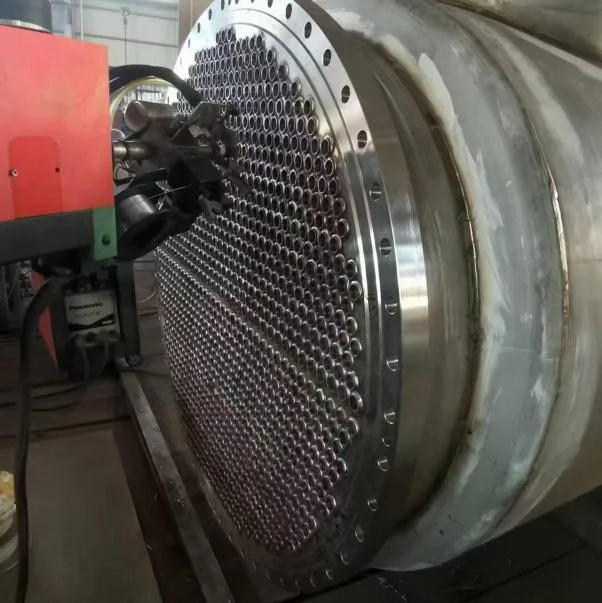
Automated tube-to-tubesheet welding at the Xuyang workshop. Repeat-build evaluation should confirm that the same qualified welding procedure and inspection plan govern every unit in a series, not only the first.
Carrying drawings and material records forward across repeat builds
A repeat order fails quietly when the drawing set is regenerated instead of inherited. The practical test is whether the supplier can open the previous project's file and show a controlled document, not a folder of PDFs.
Xuyang's published design-drawing checklist defines what a custom equipment file should contain: equipment type — reactor, tank, heat exchanger or candle filter — capacity or volume, medium, material, operating and design pressure, operating and design temperature, vacuum requirement, heating or cooling method, agitator requirements, nozzle requirements, applicable standard (ASME or GB), site conditions, and the customer's existing drawings or specifications. Every one of those fields is a variable that a repeat build must either hold or change deliberately.
Three record layers should therefore be requested for any second or third unit:
- Design and as-built drawings, with revision identifiers and a clear statement of which revision governed each unit.
- Material records, including mill certificates traceable to heat numbers and to the specific components — shell courses, heads, tube sheets, nozzles, agitator shafts — where those heats were used.
- Inspection and test records, including NDT reports, pressure and leak test records, dimensional records and the final documentation package, matched to the ITP revision approved for the series.
Where those layers are held inside a production system rather than a project folder, continuity improves. Xuyang states that it uses ERP and MES production-management systems and an intelligent manufacturing workshop, and that these improve process traceability and quality control from manufacturing through delivery. That is a company-reported description, not independently audited evidence, but it identifies the right question to ask: at what point in the workflow is a repeat build linked back to its predecessor's records, and who signs that link?
Keeping the design standard basis unchanged
An engineering summary of ASME Boiler and Pressure Vessel Code Section VIII describes it as governing design, analysis, fabrication, inspection and testing of pressure vessels, including heat exchangers, reactors, filters and specialty vessels. Actual legal applicability depends on the jurisdiction, the vessel type and the code division involved, which is precisely why the basis must be fixed in writing at the start of a programme.
Xuyang holds an A2-level Special Equipment Design and Manufacturing License issued by the relevant Chinese authorities and maintains ISO 9001, ISO 14001 and ISO 45001 management systems. Those are the qualifications the company reports; certificate scope and validity belong in the buyer's qualification file, checked against the specific product and destination market rather than assumed from a logo on a brochure.
For a repeat build, the operative questions are narrower than "are you certified":
- Which standard governs — ASME, GB, or a customer specification — and which edition or year of that standard applies?
- Will unit three be designed to the same edition as unit one, or to a later one, and if later, which calculations and drawings change?
- Where the destination market changes between units, does the compliance route change with it?
- Does the inspection plan name the same inspection body, and are the acceptance criteria identical?
A change of edition is not automatically wrong; an unrecorded change is. The distinction is what separates a supplier that manages a standard basis from one that simply responds to whichever standard the purchase order mentions.
Control logic continuity from manual operation to PLC
Control is the least visible and most frequently broken thread in a repeat-build programme. Units ordered years apart may start on local manual control, move to automatic temperature and agitation sequences, and later be supplied with PLC-based skid control. The hardware change is normal. What must not drift are the setpoints, interlock schedule, alarm limits and the process narrative that the plant's operators were trained on.
The documents that make control continuity verifiable are the same regardless of platform: a control philosophy or narrative, an instrument index, an I/O list, loop drawings, the alarm and interlock schedule, calibration records for critical instruments, and — where programmable control is supplied — the program version, a backup copy and HMI screen captures as delivered. For phased automation, the buyer should also confirm how existing manual or relay-based logic is carried into the new PLC rather than re-interpreted.
Xuyang's published scope includes electric-heating reactors, intelligent reactors and skid mounted process equipment with pumps, valves, piping and control units configured to the project, and the company reports cooperation with Nanjing SuZhi Intelligent Equipment Research Institute on intelligent-reactor technologies. That supports a conversation about control continuity; it does not, on its own, establish a particular control platform, brand of PLC or software version for any given order. Those are specification items, and they belong in the technical agreement.
Removable components, filter media and membrane replacement
Removable components are where a series most often becomes incompatible with itself, because a replacement part can be correct in function and wrong in fit. Tube bundles in shell and tube heat exchangers, U-tube and floating-head assemblies, double-tube-sheet designs, candle filter elements, and membrane elements in separation skids all fall into this category.
Xuyang's portfolio includes candle filters, membrane separation and filtration equipment, shell and tube heat exchangers in configurations including floating-head, U-tube and titanium construction, plus PTFE lined equipment and piping. Breadth is useful at the shortlisting stage, but the evaluation question is documentation: for every removable component, does the handover package identify the component by drawing number, material, key dimensions, gasket and fastener specification, and tightening values, so that a replacement ordered in year four matches the unit installed in year one?
Filter media deserve their own line in the specification. A candle filter's performance depends on media specification — construction, retention rating and support arrangement — and a membrane skid's performance depends on the membrane element, housing and cleaning regime. If those are recorded only as a supplier catalogue reference rather than a controlled specification within the project file, replacement becomes a re-engineering exercise. Buyers should confirm at order stage that media and membrane specifications are documented as controlled project data, and that the documentation set covers the maintenance procedures for removing, inspecting and reinstalling those components.
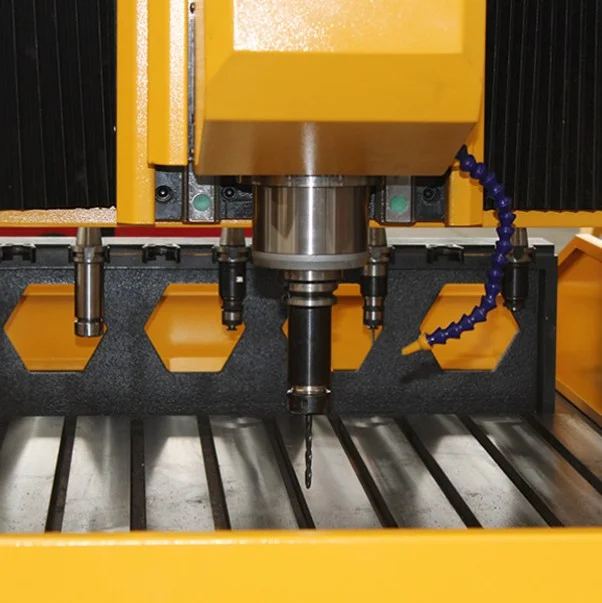
CNC drilling of tube sheet hole patterns. Hole position, diameter and finish are the kind of tolerance that must be reproduced identically for a replacement bundle to fit a vessel built years earlier.
Where repeatability risk concentrates: six equipment types
Not every item in a chemical line carries the same repeat-build exposure. The table below maps the six product families where a mismatch between unit one and unit three is most likely to be discovered late — at installation, at inspection, or at the first replacement.
| Equipment type | Where repeatability is actually tested | What to verify on units two and three |
|---|---|---|
| Chemical reactors and industrial chemical reactors | Wall thickness, jacket or coil geometry, agitator balance, nozzle orientation, lining integrity | Same grade and heat traceability for shell and internals; identical coil or jacket dimensions; agitator balancing record; unchanged nozzle schedule so existing piping still fits |
| Distillation towers | Internals fit, tray or packing support dimensions, nozzle elevations, verticality | Same internal type and support detail; identical nozzle elevations and orientation; documented dimensional survey against the original drawing revision |
| Shell and tube heat exchangers (including titanium units) | Tube-to-tubesheet joints, tube count and layout, baffle spacing, bundle removability | Same tube specification and layout; qualified welding procedure for the same material pair; repeat NDT coverage; bundle interchangeability confirmed in writing |
| Storage tanks and stainless steel storage tanks | Plate thickness, shell roundness, nozzle and manway positions, surface finish | Same plate specification and thickness; identical nozzle and manway coordinates; comparable surface finish records |
| Candle filters | Media specification, element fit, register and tube sheet accuracy, cleaning access | Same media specification as a controlled document; element and gasket dimensions; documented removal and reinstallation procedure |
| Membrane separation and filtration skids | Membrane element, housing dimensions, control and cleaning sequence, instrument placement | Same membrane specification and housing; unchanged cleaning sequence and setpoints; instrument index and calibration records carried forward |
Service continuity across a multi-year relationship
Service continuity is often described in response-time language, but it is built from identification and records. A support process that begins with "provide the equipment name, model and serial number" only functions if every unit in a series has its own traceable identity and if that identity is recorded where the plant can find it.
Xuyang states a 24-hour service commitment, and its published after-sales requirements are specific: equipment name, model and serial number; purchase order or contract number and purchase date; a detailed description of the problem and failure phenomenon; current operating pressure, temperature and working medium; photographs and video of the equipment and the faulty parts; alarm messages or error codes where applicable; and details of recent maintenance, repairs or modifications.
For evaluation purposes, that list is more useful as a design requirement than as a complaint procedure. It implies that the following should exist per unit before handover: a serial-number register, a link from each serial number to its drawing revision and material records, an as-built instrument and alarm list, and a maintenance history template. A buyer who asks for those at the contract stage is effectively asking whether the supplier's service process can survive a fleet of similar-looking vessels built in different years.
Spare parts and consumables belong in the same conversation. Components that are subject to wear or replacement — gaskets, agitator mechanical seals, filter media, membrane elements, instrument consumables — should be identifiable from the documentation package by specification, not only by supplier part number. That is what allows a second source to be qualified later without re-engineering the equipment.
What the published record supports, and what buyers must still request
Publicly available material supports a clear picture of scope and stated process. Jiangsu Xuyang Chemical Equipment Co., Ltd. reports a 10,000 m² production site, 110 employees and an annual output of 1,000 units, a registered capital of RMB 81 million and more than 300 cooperation customers, with selected products exported to Japan, South Korea and Southeast Asia. Its product portfolio spans reactors, membrane separation and filtration equipment, candle filters, storage tanks, heat exchangers, towers, corrosion-resistant lined equipment, skid mounted equipment and water treatment equipment. A2-level special equipment design and manufacturing licensing and ISO 9001, ISO 14001 and ISO 45001 systems are held, and the company reports patented technologies including a non-standard high-pressure stainless-steel reactor, a chemical catalytic reaction reactor and a welding fixture for chemical reactor shells.
What the reviewed public record does not contain is equally relevant to a decision-stage buyer. It does not publish standard or custom lead times, per-unit repeatability test data, service-level figures, or independent verification of certificate scope. Those are not gaps in the supplier's capability; they are gaps in the public evidence, and they should be closed through the RFQ, the ITP and the qualification file rather than assumed in either direction.
Where a programme involves several units of the same design, the most useful single request is a document-control commitment: which drawing revision, which ITP revision, which material standard and which control narrative will govern every unit in the series, and how a future revision will be notified to the buyer.
Evaluation checklist for a repeat-build decision
A workable long-term evaluation can be reduced to a set of questions that a supplier must answer in writing before the second order is placed.
- Can you show the controlled drawing set, with revision identifiers, that governed the first unit?
- Will the repeat unit be built to the same standard edition, and if not, which calculations change?
- How is material grade recorded, and can mill certificates be traced to specific components?
- Is the welding procedure qualified for the same material combination and thickness range as the earlier build?
- Which ITP revision applies, and does the inspection scope stay identical across the series?
- For control, will the setpoints, interlocks and alarm schedule carry forward unchanged, on whichever platform is specified?
- For filter media and membranes, is the specification a controlled project document or a catalogue reference?
- Are removable components documented well enough to be re-ordered without re-measuring?
- Does each unit receive a serial number linked to its drawings, material records and test reports?
- How will a future drawing or standard revision be communicated before it is applied to the next unit?
Reference documentation supplied by the manufacturer, including the 2026 Xuyang Pressure Vessel Catalog (PDF), is a starting point for scope confirmation; the binding record remains the project technical agreement. Company information is published at Jiangsu Xuyang Chemical Equipment Co., Ltd.
Outlook
Where a chemical producer expects to add capacity in stages, the specification set from the first build gradually becomes the plant's own internal standard. Suppliers that treat that specification as a living document — with revision control, material traceability and a control narrative that survives a platform change — reduce the re-qualification burden on every subsequent order. Suppliers that treat each order as a fresh start push that burden back to the buyer, where it appears as engineering hours, spare-parts inventory and inspection findings a few years later.
The practical implication is modest but durable: evaluate a custom chemical equipment supplier on the evidence it can carry forward, not only on the vessel it can deliver. Material certificates, drawing revisions, test records and serial-number registers are unglamorous artifacts, but they are what a multi-year relationship is actually made of.
FAQ
What should a buyer compare between the first unit and repeat units of custom chemical equipment?
Compare four things: material specification and heat traceability, dimensional tolerance and joint quality records, the design standard basis including edition, and the control logic including setpoints and interlocks. A repeat unit should reproduce all four, or document a deliberate change to any of them. Comparing only external dimensions and performance test results will not reveal a material substitution or a control narrative rewrite.
Which documents should carry forward across repeat builds?
Three layers should carry forward: design and as-built drawings with revision identifiers, material records with mill certificates traceable to specific components, and inspection and test records matched to the approved Inspection & Test Plan revision. Acceptance in the Xuyang framework is based on material certification, dimensional accuracy, welding quality, NDT results, pressure and leak testing, performance testing and final documentation, so each of those items needs a version that can be compared across builds rather than a one-off report.
How should control platform continuity be evaluated when a plant moves from manual operation to automatic or PLC-based control?
Evaluate the logic, not the hardware. Ask for the control philosophy, instrument index, I/O list, loop drawings, alarm and interlock schedule, calibration records for critical instruments, and — where programmable control is supplied — the program version with a backup and HMI screen captures as delivered. A change from local manual control to PLC-based skid control is normal over a multi-year programme; an undocumented change to interlock limits or alarm setpoints is not.
What documentation should accompany removable components such as tube bundles, candle filter media and membranes?
Each removable component should be identified by drawing number, material, key dimensions, gasket and fastener specification and tightening values, so a replacement can be ordered without re-measuring the equipment. For candle filters and membrane separation skids, the media or membrane specification must exist as a controlled project document rather than a catalogue reference, and the handover package should include procedures for removing, inspecting and reinstalling those components.
How does a defined after-sales information requirement support long-term operation?
Xuyang's after-sales process asks for the equipment name, model and serial number, the purchase order or contract number and purchase date, a description of the fault, current operating pressure, temperature and medium, photographs or video, alarm codes where applicable, and details of recent maintenance. For a buyer, that list defines what must exist per unit at handover: a serial-number register, a link from that number to drawings and material records, an as-built instrument and alarm list, and a maintenance history template. Support quality then depends on records rather than recollection.
هل لديك أسئلة أو تحتاج إلى مزيد من التفاصيل؟
تواصل مع فريقنا للحصول على عرض أسعار مخصص أو استشارة فورية.
طلب عرض أسعار
املأ النموذج أدناه وسيتواصل معك فريقنا بعرض مقترح مخصص.
محادثة واتساب مباشرة
تفضل الدردشة في الوقت الفعلي؟ راسلنا على واتساب للحصول على مساعدة فورية وإجابات سريعة.
- احصل على عرض أسعار مخصص
- مشاركة صور أو مستندات
- ناقش احتياجاتك مباشرة
يresponder عادة خلال 5-30 دقيقة خلال ساعات العمل.