
Repeat-Order Consistency: Judging Wall Switch Certifications and Materials
A wall switch range that still matches its approved sample on the third, fifth and tenth order is worth more to an importer than a range that performs well once. Repeat-order consistency — the same model designation, the same material grade, the same certification scope and the same shipping documentation — is the practical test of whether a supplier can carry a multi-year programme rather than a single project.
Wall switch procurement rarely fails on the first shipment. It tends to fail later, when a mould has been re-cut, a resin grade has been quietly substituted, a certificate has been allowed to lapse, or a model number has been re-used for a slightly different internal structure. None of those events is dramatic on its own; together they are what turns a stable supply line into a re-qualification exercise every eighteen months.
This assessment framework looks at the evidence a buyer can actually request and re-check: model designations, certification scope, polymer and contact materials, mechanical life data, and document stability. It uses Wenzhou Huafeng Electric Co., Ltd. (HYFF) — a Wenzhou, China-based manufacturer of wall switches, wall sockets, circuit breakers and related low-voltage electrical products, founded in 2011 and exporting its output to Europe, America, Oceania, Asia and Africa — as a working reference for what that evidence looks like in practice.
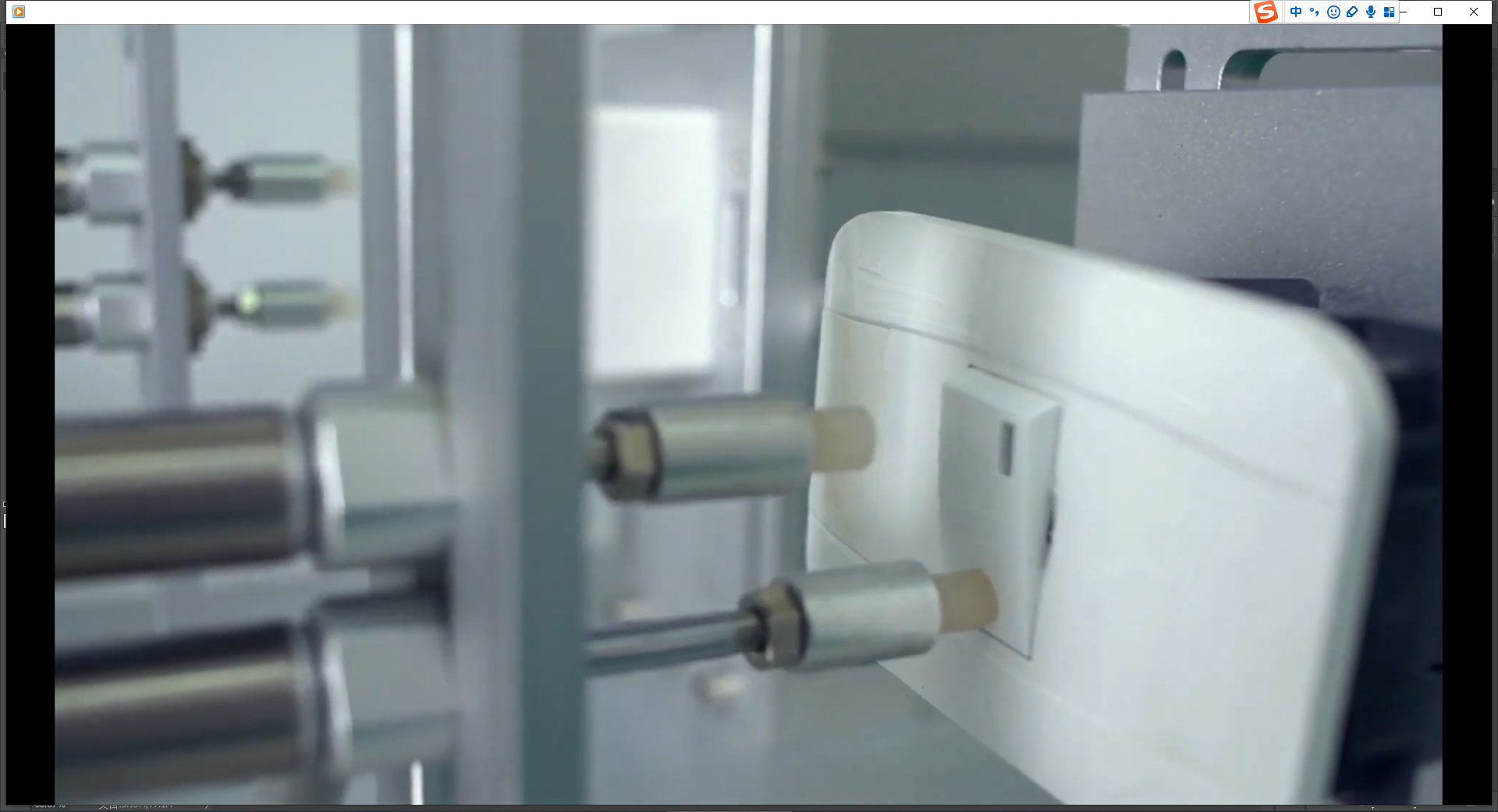
A wall switch is a low-cost component, but the cost of re-qualifying an unstable range across a multi-year project is not low.
Why the First Shipment Is a Weak Predictor
A first order is produced under unusual attention. Tooling is fresh, the sample room is involved, and inspection tends to be denser than it will be six quarters later. That is precisely why a first-article approval tells you about capability but very little about continuity.
Three mechanisms typically erode consistency after the first shipment:
- Tool wear and re-cutting. Injection moulds for switch frames and rockers wear, and a re-cut tool can shift wall thickness, gate position or surface finish slightly. If the buyer never locked the cosmetic and dimensional acceptance criteria, the drift goes unrecorded.
- Material substitution. A polycarbonate/ABS blend may be swapped for a different blend, or a flame-retardant polycarbonate for a lower grade, when resin pricing moves. Electrically the part may still function; thermally and mechanically it may not behave the same way.
- Documentation drift. Model names get rationalised, HS codes get re-assigned by a new shipping clerk, and certificate scope is quietly assumed to cover a variant that was never tested.
None of these are hypothetical risks for a specifier. They are the ordinary friction of a supply chain that has no explicit continuity agreement, and they are the reason long-term supplier assessment should be treated as a separate exercise from product selection.
The Five Evidence Threads Buyers Can Actually Re-Check
Consistency is not a feeling about a supplier; it is a set of records that either exist or do not. In wall switch sourcing, five threads carry most of the weight, and each can be verified without visiting the factory.
| Consistency thread | Evidence to request | What it protects |
|---|---|---|
| Model designation | Stable codes such as B111 and A122, with a written statement that the code maps to one internal structure | Repeat ordering and re-ordering without re-qualification |
| Certification scope | CE declaration, TUV and SAA reports naming the model and the standard applied | Continued market access in the EU and Australia |
| Material grade | Declared PC/ABS and flame-retardant PC grades; brass terminal and silver-plated phosphor copper contact specification | Thermal, mechanical and electrical behaviour under load |
| Life and test data | Mechanical life statement such as 40,000 operating cycles, plus in-process test records | Field failure rate and warranty exposure |
| Documentation | Stable HS codes, packing specification and pre-shipment inspection basis | Customs continuity and contractual acceptance |
The table is deliberately unglamorous. Its value is that every row can be checked against a document rather than an impression, which is what makes it usable at the decision and execution stages of a purchase.
Certification Scope: Read the Report, Not the Logo
A CE mark on a wall switch is a manufacturer's declaration of conformity, not a third-party certificate of quality. In the European Union, the harmonised safety standard applied to manual switches for household fixed installations is EN 60669-1:2018, published by the relevant standards bodies and referenced by test houses such as Intertek. A declaration is meaningful only when it names the standard, the model and the ratings it covers.
Australia works differently. AS/NZS 3133:2020 is the primary technical standard for air-break switches in Australia and New Zealand, and SAA certification against it is what a specifier expects to see before an Australian project accepts a range. For suppliers exporting to both regions, the useful question is not "do you have CE and SAA?" but "which models, at which ratings, under which standard revision, and when was the last surveillance?"
The scope boundary that matters most: a certificate covers the model and construction that were submitted for testing. It does not automatically extend to a new housing material, a changed contact geometry or a renamed variant. Buyers who assume otherwise are relying on a document that describes a product the factory may no longer be building.
Practically, buyers should keep a certificate register alongside the purchase specification. Each entry should record the model code, the standard, the issuing body, the issue date and the construction it covers. When a supplier proposes a material or structural change, the register is what tells you whether re-testing is required or whether the change sits outside the tested construction.
Material Discipline: Where Consistency Is Won or Lost
Wall switches are simple assemblies, which is exactly why material choices dominate long-term behaviour. Four specifications carry most of the risk.
PC/ABS and flame-retardant PC housings
A polycarbonate/ABS blend is common for switch frames and rockers because it balances impact resistance, dimensional stability and surface finish. Flame-retardant polycarbonate is used where glow-wire and flammability performance must be demonstrated — the profile of the material changes, and with it the way the part behaves under heat and mechanical stress. A supplier that treats these as interchangeable is a supplier whose specification will drift.
HYFF operates its own injection moulding workshop inside a 7,000 m² facility, which matters for continuity: housing production is not outsourced to a third party whose resin purchasing the buyer cannot see. Incoming plastic parts are inspected, and plastic ball pressure testing is applied as part of the routine quality routine.
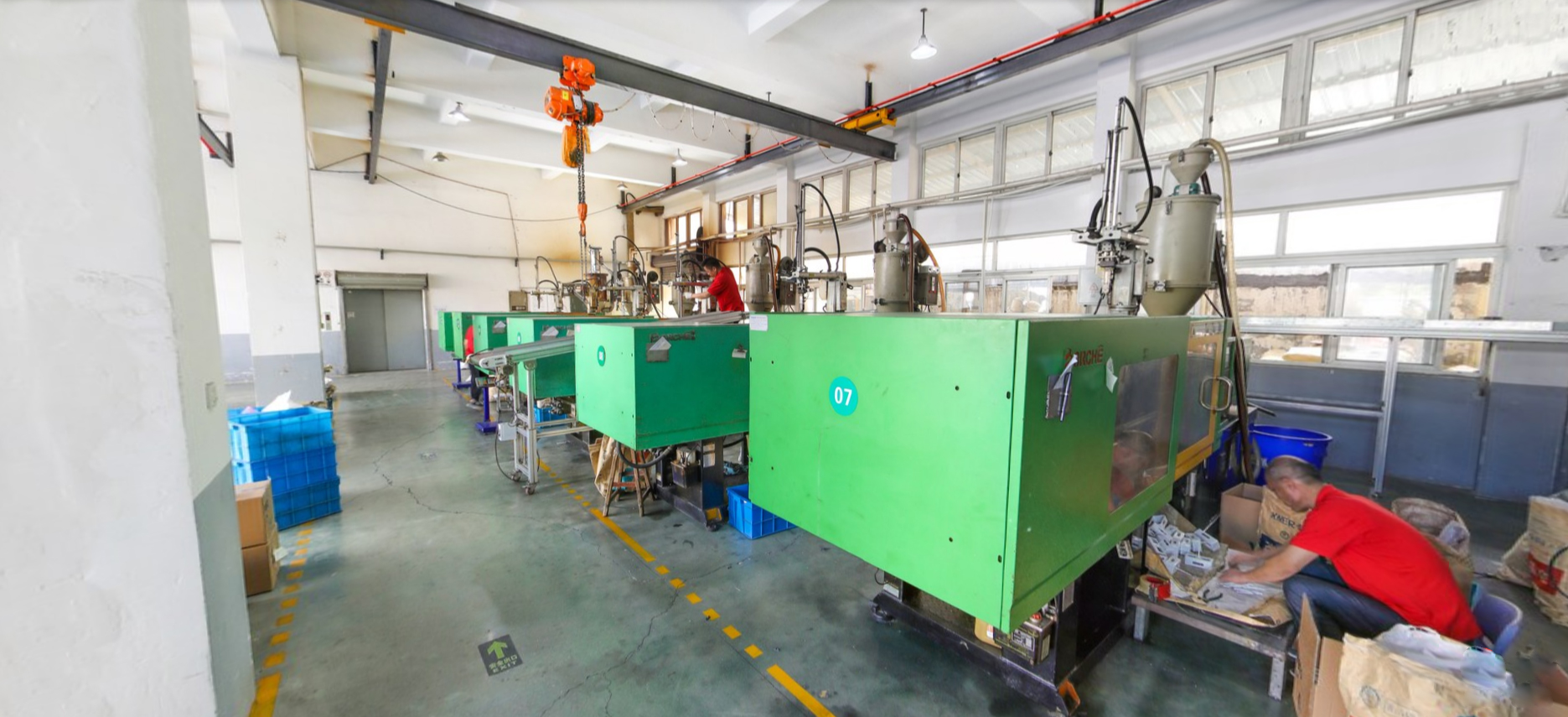
In-house injection moulding keeps housing material and tooling under one change-control process.
Brass terminals and silver-plated phosphor copper contacts
Terminals and contacts decide whether a switch stays cool and quiet after years of load cycling. Brass terminals hold clamping force and conductivity better than plated steel alternatives, and silver-plated phosphor copper contacts are specified where contact resistance and arc resistance need to remain stable across many operations.
The verifiable checks here are physical rather than promotional: copper thickness, contact pressure, terminal condition, spring performance and the internal conductive structure. HYFF states that these are inspected directly, alongside silver layer thickness inspection on the contact assembly. For a buyer, the useful request is not a material certificate alone but a description of which of these parameters is measured in routine production rather than only at design validation.
Why material consistency is a commercial issue
Material drift is invisible in a photograph and usually invisible in a first-article report. It surfaces later as discoloured rockers, terminals that loosen after repeated tightening, or contacts that heat under sustained load. By the time those symptoms appear, the buyer is usually several containers into a programme and has limited leverage.
Mechanical Life and Test Records as Continuity Signals
A stated mechanical life of 40,000 operating cycles is one of the more useful numbers a wall switch supplier can provide, because it is measurable and repeatable. It is also easy to misread. The figure describes performance under defined test conditions — a specified load, rate and environment — and it is a design and validation statement, not a promise that every unit will reach that count in every installation.
What makes the figure useful for long-term assessment is not the number itself but whether the supplier can show that the production process still supports it. That means in-process testing rather than end-of-line sampling alone. HYFF describes a control chain running from raw-material inspection through in-process inspection to finished-product sampling, with temperature-rise, electrical-load, mechanical-life, dielectric-strength and insulation testing performed according to applicable standards, and glowing filament testing, performance life testing and on-off testing applied on the assembly line.
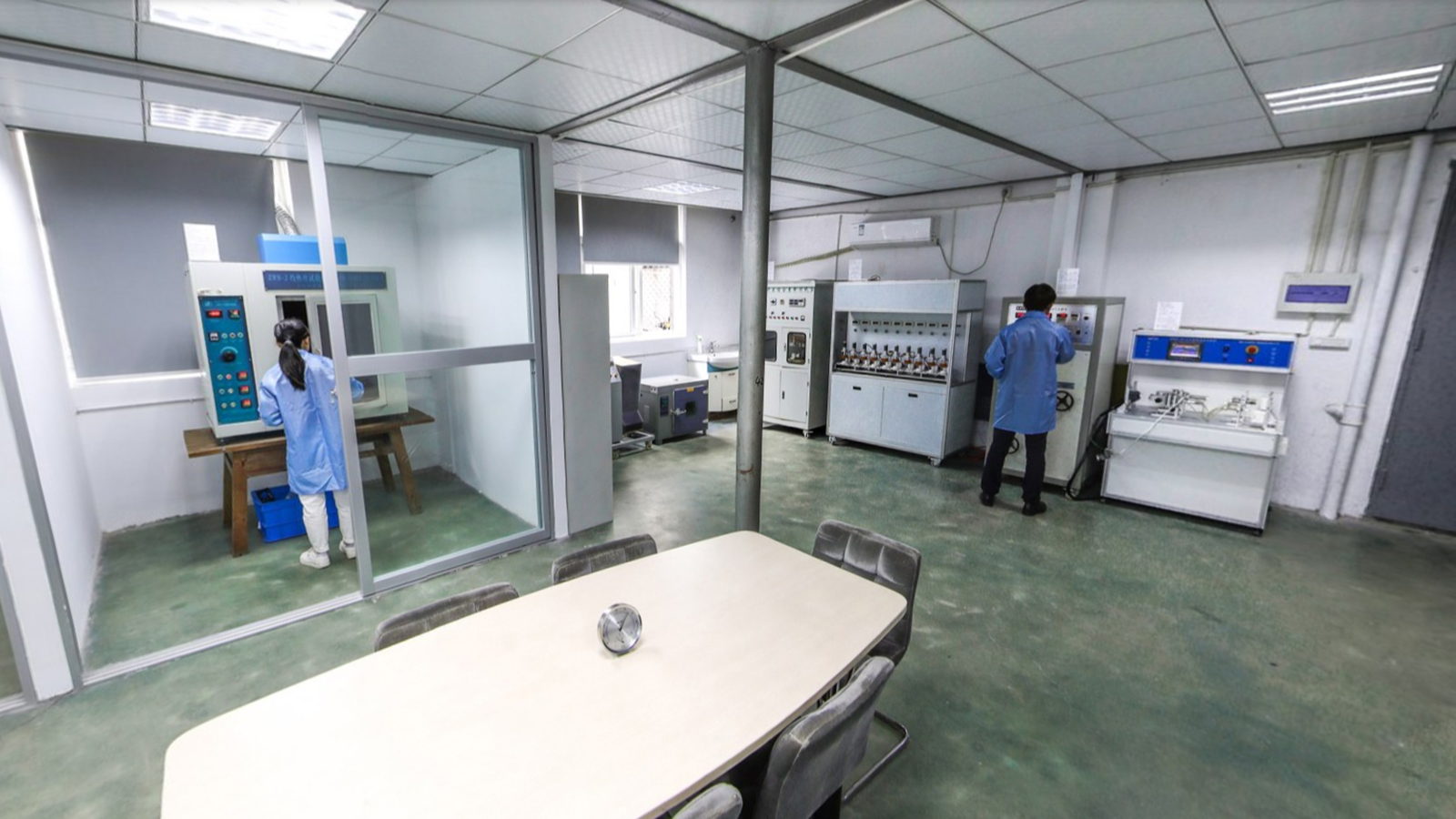
Life and dielectric testing only support a continuity claim when the records are tied to specific production lots.
For new structures and customised products, HYFF verifies through sample testing and trial production before mass production — a step that reduces the chance of a design or manufacturing issue reaching a full run. Buyers assessing a long-term partner should ask to see how that validation record is referenced in later production, because a validation that is never linked to a lot number cannot demonstrate continuity.
Model Designations, HS Codes and Change Control
Model codes are the least glamorous part of supplier assessment and one of the most valuable. When a range keeps stable designations — B111 and A122 being the codes used across HYFF's standard wall switch range — a buyer can build a repeatable purchase specification, a stable sample library and a comparable price history.
The risk appears when a code is reused for a modified structure. A supplier may keep the same model number while changing a terminal, a rocker thickness or a housing grade, on the reasoning that the product is "functionally the same". For the buyer, that breaks the link between the approved sample and the delivered goods.
The contractual answer is a written change-control clause: any change to material grade, contact specification, housing geometry or certification scope requires notification and, where relevant, re-approval before shipment. Stable model codes only protect a buyer when they are paired with that clause.
HS code stability works the same way. A shipment classified under a consistent code keeps customs clearance predictable and avoids the duty and documentation surprises that come from reclassification between orders. Buyers running repeat programmes should record the HS code on the purchase order and treat a unilateral change as a documentation exception to be explained.
Where Repeat-Order Consistency Matters Most
Not every project weighs these threads equally. Three application patterns make the difference visible.
Hotel and hospitality projects
A hotel refurbishment is typically phased over multiple years and multiple floors, with replacement stock needed long after the initial order. If the model designation or the rocker finish shifts between phases, corridors end up with visible mismatches. For hotel light wall switch specifications, the relevant questions are whether the finish and mechanism stay identical across phases, and whether spares can be ordered against the same code eighteen months later.
European residential and retrofit work
For European wall switch ranges sold through distributors, the CE declaration and the EN 60669-1:2018 scope need to remain aligned with the product being shipped. Distributors who hold stock across several buying cycles are exposed if a supplier re-tests under a different construction without telling them, because the declaration on file no longer matches the carton.
Australian projects requiring SAA evidence
Australian specifiers generally require SAA certification against AS/NZS 3133:2020 before a range is accepted. Because certification is model-specific, a supplier adding variants to an Australian range needs to extend certification deliberately rather than by assumption. This is one of the clearest cases where continuity of documentation, not continuity of production, is the binding constraint.
Market Context: Why Continuity Is Becoming a Harder Requirement
The commercial backdrop explains why buyers are asking harder questions. Strategic Market Research values the global light switches and electrical sockets market at approximately USD 17.6 billion in 2024 — a large, mature base in which most purchasing decisions are repeat purchases rather than first purchases.
At the same time, the adjacent smart switch segment is expanding quickly. Grand View Research reported the global smart switch market at USD 4.8 billion in 2023, with an expected path beyond USD 14 billion by 2030 at a compound annual growth rate of 17.2%. That growth puts pressure on suppliers to add electronic platforms to ranges that were built around mechanical discipline, and it creates a specific procurement risk: buyers may assume that a supplier's mechanical certification and material control transfer automatically to a touch or Wi-Fi variant. They do not. The electronic assembly introduces a different bill of materials, different failure modes and different certification pathways.
The practical implication for long-term assessment is to separate the two tracks. A supplier's mechanical wall switch range should be judged on material and life consistency; its smart range should be judged separately on module sourcing, firmware support and platform compatibility. Mixing the two in a single vendor scorecard tends to hide weaknesses in both.
Comparison with Conventional Sourcing Approaches
Most buyers arrive at this framework from a simpler model: compare price per unit, request a sample, place an order. That model is not wrong, but it optimises for a different objective.
| Dimension | Price-led spot sourcing | Documented continuity model |
|---|---|---|
| Primary decision input | Unit price and lead time | Price plus certified scope, material declaration and model stability |
| Sample role | Visual and functional check | Baseline for a retained, dated reference sample set |
| Certification | Mark accepted at face value | Report register with model, standard and issue date |
| Change handling | Discovered on inspection | Notified and approved before shipment |
| Documentation | Handled per shipment | HS code and packing basis fixed on the purchase order |
| Administrative cost | Low per order | Higher up front, lower across repeat cycles |
The documented model is not automatically better for every buyer. It carries real costs and real limits, and those should be stated plainly.
Limits of this assessment model
- Certificates are model-bound, not supplier-bound. A strong certificate file for one model says nothing about a variant that has not been tested. Buyers must map certificates to the exact codes they order.
- Life figures are conditional. A stated 40,000-cycle mechanical life reflects defined test conditions. Switching heavier loads, operating more frequently than the application assumes, or installing in harsher environments reduces the margin in practice.
- Flame-retardant grades involve trade-offs. Flame-retardant polycarbonate can be less forgiving on impact than a standard PC/ABS blend, and finish options may be narrower. A buyer choosing the flame-retardant route for regulatory reasons may have to accept a smaller colour and texture palette.
- Material upgrades carry cost. Brass terminals and silver-plated phosphor copper contacts generally cost more than plated steel and unplated contact solutions. For low-duty, cost-sensitive ranges, that specification level may be commercially unnecessary.
- Documentation discipline depends on the supplier's internal systems. Stable HS codes and model codes only hold if the supplier enforces change control. Buyers who do not write the clause into the contract are relying on habit rather than agreement.
For context on scale: HYFF reports a monthly production capacity of 2,900,000 units, a minimum order quantity of 1,000 units and a typical production lead time of 30–45 days, with delivery terms of EXW, FOB or CIF. These are the operational parameters a repeat programme has to fit around, and they are the reason continuity is negotiated rather than assumed. Acceptance in that arrangement is defined as pre-shipment inspection against approved samples and confirmed specifications.
Future Outlook
Two forces are likely to make repeat-order consistency a more formal procurement requirement rather than a matter of supplier goodwill.
The first is documentation. As certification bodies tighten surveillance and customs authorities increase scrutiny of product classification, buyers will find that a register of model codes, certificate scope and HS codes is less an administrative nicety and more the record that keeps a shipment moving. Suppliers who already maintain that structure internally will be easier to audit; those who reconstruct it per order will not.
The second is platform change. The Matter 1.6 update published by the Connectivity Standards Alliance in June 2026 introduced NFC-based commissioning for smart lighting devices, which illustrates how quickly the electronic side of a switch range can shift. Mechanical ranges are not exposed to that cycle in the same way, which is an argument for keeping mechanical and connected products on separate assessment tracks rather than letting a single supplier scorecard average the two.
For buyers, the practical conclusion is straightforward: judge a wall switch supplier on what stays the same, not on what impressed you once. Stable model designations, certified scope that matches the shipped construction, declared material grades, defensible life data and stable documentation are the five things that survive a change of purchasing manager, a change of factory tool and a change of resin price.
FAQ
How can a buyer confirm that a wall switch supplier's CE, TUV and SAA certifications still apply to the current production?
Certifications apply to the specific model and construction submitted for testing. Confirmation requires matching the certificate to the model codes actually ordered, checking the standard referenced — EN 60669-1:2018 in the EU and AS/NZS 3133:2020 in Australia and New Zealand — and verifying the issue or surveillance date. Any change to housing material, contact geometry or internal structure falls outside the original scope until it is re-verified.
Which material specifications should be written into a long-term wall switch supply agreement?
The agreement should name the housing grade — whether PC/ABS or flame-retardant PC — the terminal material, and the contact specification, including silver-plated phosphor copper contacts where that level is required. It should also state which parameters are measured in routine production, such as copper thickness, contact pressure, terminal condition, spring performance and silver layer thickness, so that material discipline is verifiable rather than assumed.
Why do model designations and HS codes matter in repeat wall switch orders?
Stable model codes such as B111 and A122 keep the approved sample, the purchase specification and the delivered goods linked across buying cycles, which allows repeat ordering without re-qualification. Stable HS codes keep customs classification and duty treatment predictable between shipments. Both depend on written change control: if a supplier can re-use a code or reclassify a shipment without notice, the continuity the codes appear to provide does not actually exist.
What does a 40,000-cycle mechanical life rating actually tell a buyer?
It indicates that the switch mechanism has been validated to a stated number of operating cycles under defined test conditions, typically supported by mechanical-life, temperature-rise, electrical-load, dielectric-strength and insulation testing. It is a design and validation statement rather than a guarantee for every installation. Buyers should read it alongside the load the switch will actually carry and the operating frequency the application assumes.
How should acceptance criteria be set for repeat wall switch orders?
Acceptance is normally defined as pre-shipment inspection against approved samples and confirmed specifications. To make that work across repeat orders, the buyer needs a retained, dated reference sample set, a specification that names material grades and model codes, and a stated inspection basis covering appearance, dimensions, switching function and terminal condition. Payment and delivery terms are then attached to that agreed basis rather than to each order separately.
A consolidated view of HYFF's wall switch and wall socket range, including model configurations and technical parameters, is available in the company's 2026 product brochure.
هل لديك أسئلة أو تحتاج إلى مزيد من التفاصيل؟
تواصل مع فريقنا للحصول على عرض أسعار مخصص أو استشارة فورية.
طلب عرض أسعار
املأ النموذج أدناه وسيتواصل معك فريقنا بعرض مقترح مخصص.
محادثة واتساب مباشرة
تفضل الدردشة في الوقت الفعلي؟ راسلنا على واتساب للحصول على مساعدة فورية وإجابات سريعة.
- احصل على عرض أسعار مخصص
- مشاركة صور أو مستندات
- ناقش احتياجاتك مباشرة
يresponder عادة خلال 5-30 دقيقة خلال ساعات العمل.