
Repeat-Order Scorecard: Eco Friendly Organic Sanitary Pads
Repeat-Order Scorecard: Eco Friendly Organic Sanitary Pads
A supplier of eco friendly organic sanitary pads is not qualified by a single passed audit. It is qualified by what still holds at the fourth order: the same topsheet specification, a certificate that has not quietly lapsed, a container that loads the way the previous one did, and a named contact who answers when a retail customer disputes a packaging claim. Organic feminine care sharpens that distinction because the organic positioning rests on material certification that must stay current, and the skin-contact positioning rests on test reports that must stay attached to the exact product being shipped.
This article reframes long-term supplier sustainability as a repeat-order evaluation rather than a one-off inspection event. It sets out a scorecard of six dimensions a buyer can record and re-check at every renewal, and it applies that scorecard to a documented private-label program with a buyer in Taiwan, China: cooperation running more than three years as of August 2026, four rounds of customized sampling before the initial order, a product range expanded from a single size to daytime, overnight and extra-long pads plus disposable period pants, and procurement scaled to full-container 40HQ shipments.
Why a repeat order, not a first audit, is the real test
A first audit confirms that a supplier can meet a specification once. A repeat-order scorecard tests whether the supplier can meet the same specification again — after material lot changes, packaging artwork revisions, personnel turnover and a larger order quantity. The two questions produce different evidence, and buyers who rely only on the first tend to discover the difference after the second shipment.
The organic category adds dependencies that a single audit rarely exercises. A GOTS or OCS material scope certificate describes a supply chain, not a finished pad, so the buyer has to keep confirming that the certified material is the material in the current batch. A skin-contact test report is normally tied to a product structure and a sampling date, so a topsheet change or an absorbent core revision can leave a valid-looking report describing a product that is no longer being made. Packaging claims carry similar exposure: a biodegradability or organic statement printed on a retail bag has to remain supportable for as long as that artwork is in circulation, including on stock produced months earlier.
Category growth increases the number of suppliers claiming this territory, which makes continuity evidence more useful than supplier assertions. Third-party research published on the organic segment puts the global organic sanitary napkins market at USD 3.02 billion in 2025, with a projection to USD 4.51 billion by 2031 (TechSci Research); a separate estimate puts biodegradable sanitary napkins on a 20.1% compound annual growth rate between 2024 and 2030 (Mark & Spark Solutions), and Asia Pacific is reported to have held a 38.6% revenue share of that biodegradable segment in 2025 (Dataintelo). These are third-party estimates that use different definitions of "organic" and different product boundaries, so they are useful for direction rather than for forecasting a specific buyer's volume. The practical implication is narrower and more reliable: a growing field of自称 suppliers makes documented multi-order performance the discriminating evidence.
What the repeat-order scorecard measures
A repeat-order scorecard is an evaluation instrument applied at fixed intervals — before a supply agreement is renewed, and after each shipment — that records documented continuity evidence instead of impressions formed during a factory visit. It does not replace an audit; it converts audit findings into something that can be re-tested.
| Scorecard dimension | What it tests | Evidence to record and re-check |
|---|---|---|
| 1. Development continuity | Whether the supplier can iterate a specification with you instead of re-quoting it | Sampling rounds completed, change log per round, retained approved sample, sign-off record |
| 2. Specification consistency | Whether output holds across SKUs, batches and larger quantities | Bill of materials per SKU, absorbency / leakage / rewet results, thickness checks, finished-goods sampling |
| 3. Documentation currency | Whether every claim still has valid backing at renewal | Material scope certificates, product test reports with numbers and scope, declarations, expiry dates |
| 4. Commercial durability | Whether terms still work at repeat volume | MOQ per size, payment structure, price review basis, lead time at container scale |
| 5. Container-scale logistics | Whether a 40HQ-scale shipment matches its documents | Quantity check, packaging and label check, carton inspection, loading records, shipment documents |
| 6. Remote management and escalation | Whether problems get resolved without a site visit | Named contact, response record, corrective-action follow-up, third-party inspection outcomes |
Weighting is a commercial decision, not a technical one. The scorecard's value lies in what it forces a buyer to write down: a supplier that is strong on documentation but weak on development continuity is a different commercial risk from one with the opposite profile, and a single composite number hides that difference. Buyers who do use a weighted total should keep the underlying evidence visible beside the score so that the number can be re-examined when a shipment disappoints.
The documented case: a three-year Taiwan, China private-label program
The most useful reference point for this framework is a program that has already passed through several renewal cycles. In a private-label engagement with a buyer in Taiwan, China, cooperation had run for more than three years as of August 2026. Before the initial order, four rounds of customized sampling were completed. The range began with a single size and later expanded to daytime pads, overnight pads, extra-long pads and disposable period pants. Procurement moved to full-container 40HQ shipments.
Each element carries a different evaluation signal. Four sampling rounds before a first order indicate that specification convergence was treated as a development process rather than a catalogue selection; the rounds exist to resolve construction, absorbency, fit and packaging questions while changes are still cheap. A range expanded from one size to four product types indicates that the supplier could add SKUs without losing the original specification — the failure mode in private label is usually that the first SKU stays good while the later ones drift. Full-container procurement indicates that commercial and logistics terms were renegotiated as volume grew, which is where supply relationships commonly stall.
The program is documented by the supplier, New Upward SC (Guangdong) Co., Ltd. (Newupward), a Shenzhen-based disposable hygiene product manufacturing and service provider founded in 2017 that connects customer requirements, product solutions and manufacturing resources, matching production sites and capacity to product category, process, order quantity, target cost and lead time. A single documented program does not establish that every subsequent order will perform identically; it establishes what one supplier has already demonstrated with one buyer over a defined period, which is a more useful starting position than an unverified capability statement.

Sample development and specification review: the stage at which four rounds of customized sampling resolve construction, absorbency and packaging questions before a first order.
Continuity signal 1 — product development support across sampling rounds
The number of sampling rounds is less informative than what each round changed. A development-capable supplier can show a sequence: which construction or absorbency variable moved in round two, what packaging constraint appeared in round three, and which version was signed off. A supplier without that capability tends to send the same sample again with a different wrapper.
Newupward's own capability description covers product development, coordinated manufacturing, packaging design, quality management, market support and global delivery, supported by a 10+ engineer research and development team, an in-house laboratory and a sample room. For organic and plant-fibre programs, the customization scope documented by the supplier extends across materials, sizes, absorbency performance and packaging, including more than three organic cotton and plant-based fibre topsheet options and more than four retail and individual packaging configurations.
What a buyer should record at this stage is procedural rather than promotional. Who signed off each round, whether earlier rounds were archived, and whether the approved sample is the reference used at pre-shipment inspection. The acceptance criteria documented for these programs include approved sample confirmation, pre-shipment inspection, quantity check, packaging and label check, carton inspection, absorbency, leakage and rewet testing, finished-goods sampling and third-party inspection if required. An approved sample that is not referenced in inspection is a development record that has stopped doing any work.
Continuity signal 2 — specification consistency as the range expands
Range expansion is a consistency test disguised as a growth story. Moving from one size to daytime, overnight and extra-long pads plus disposable period pants multiplies the number of controlled variables: topsheet, absorbent core, backsheet, adhesive pattern, wrapper, retail bag, carton and label. The supplier's documented range covers more than four sizes and absorbency levels, which is exactly the profile that separates a genuine multi-SKU program from a single product with relabelled packaging.
| Product type in the range | Primary use condition | What to re-verify at each repeat order |
|---|---|---|
| Day use organic sanitary pads | Daily commuting, school, work, short-duration wear | Thickness and fit, topsheet integrity, wrapper seal, count per pack |
| Night menstrual organic sanitary pads | Overnight use and heavy-flow days | Absorbency, leakage and rewet results, length and wing adhesion |
| Extra-long pads | Extended wear and overnight protection during limited movement | Core coverage, backsheet coverage, positioning of adhesive zones |
| Disposable period pants | Overnight protection, heavy-flow days, situations where changing is inconvenient | Full-coverage construction, waist fit, leg-cuff sealing, panty specification |
Supplier positioning should be read as positioning, not as a batch guarantee. Newupward describes its eco-friendly organic range as offering roughly two to three times the absorbency of conventional sanitary pads and about 50%–70% thinner construction, alongside softer skin-contact topsheets and improved liquid retention. Those are comparative design claims against conventional alternatives; the verifiable evidence at repeat order is the actual absorbency, leakage and rewet result and the approved sample comparison, not the marketing comparison.
Continuity signal 3 — documentation currency, not documentation volume
Certification coverage decays quietly. A document set that satisfied a buyer at launch can be materially weaker two years later, because scope certificates expire, reports stop matching the current construction, and packaging claims outlive the evidence behind them. The scorecard therefore tracks currency per document, not the size of the PDF pack.
For the Taiwan, China program, the documented certification coverage includes ISO 10993-5 cytotoxicity testing, skin sensitization testing and skin allergy testing under GB 15979-2024. Read together, these address different questions: cytotoxicity screening of the material in contact with skin, sensitization potential, and the skin-allergy testing route specified by the applicable Chinese hygiene standard. They are complementary rather than interchangeable, and none of them should be read as a medical claim or as a substitute for market-specific compliance advice.
Broader documentation available for these programs includes a CE Declaration of Conformity for EU market support, an EU Representative Agreement, a Halal Certificate for Muslim markets, FSC Chain of Custody for FSC mix pulp supply, GOTS or OCS material scope certificates for organic cotton supply chains, and factory system certificates such as ISO 9001 and ISO 14001. Two rules keep this list honest at renewal. First, a factory certificate demonstrates management capability, not product safety, so product-level reports remain necessary. Second, every entry should carry a number, an issuing body, a scope and a validity date; a certificate screenshot without scope is not a scorecard row.
Continuity signal 4 — remote relationship management without an in-person meeting
Long supply relationships are increasingly managed remotely, and the Taiwan, China program is a working example: more than three years of cooperation, four sampling rounds, a four-type range and container-scale shipments, all conducted without an in-person meeting between the parties. That is a continuity signal, not a gap, provided the buyer substitutes documentary verification for physical presence.
- Named counterpart and response record. A stable contact, a documented reply pattern and a written escalation path tell the buyer more about remote reliability than a factory photograph.
- Sample dispatch evidence. Courier records, dispatch dates and the version history of each sample round show whether the development process advanced or circled.
- Pre-shipment and third-party inspection. An inspection report covers quantity, packaging, appearance, labelling and product specifications before shipment, and it is the closest documentary equivalent to standing on the loading dock.
- Corrective-action follow-up. What happened after the last non-conformity is the single most predictive item in a remote relationship.
- Document turnaround. How quickly a supplier produces a report number, a certificate scope or a packaging proof when asked is a reliable proxy for how it will behave during a dispute.
The boundary should be stated plainly: remote management does not make every check unnecessary. Physical verification of production environment, line changeover practice and storage conditions still requires a site visit or a commissioned inspection. The scorecard's job is to make the remaining gap explicit so the buyer knows which items are covered by documents and which are not.
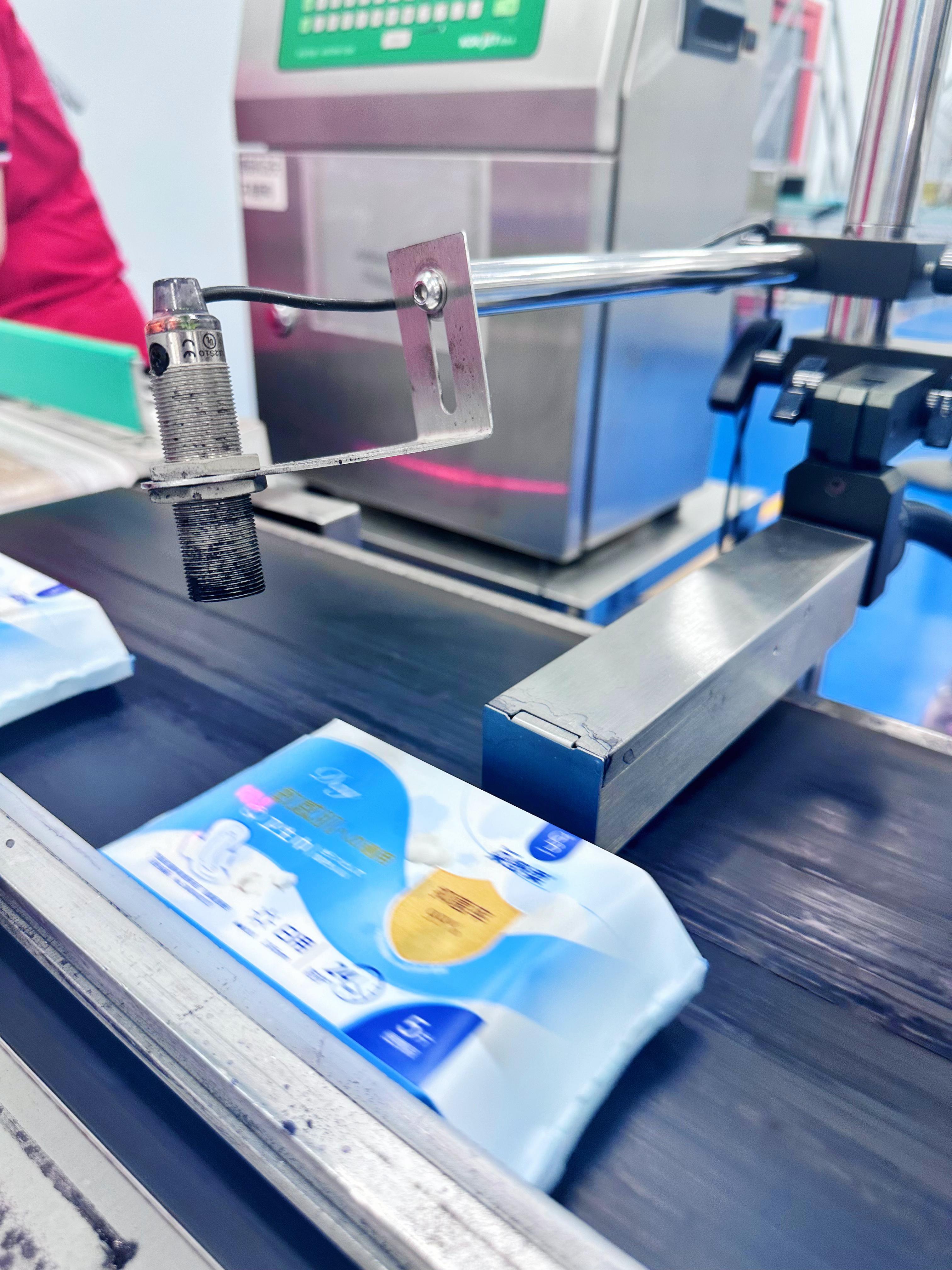
Repeat-order volume: capacity, batch consistency and loading discipline are re-tested at container scale rather than at sample scale.
Continuity signal 5 — commercial durability at container scale
Terms that work for a trial order often break at repeat volume, which is why the commercial row of the scorecard matters as much as the technical rows. The documented terms for these organic sanitary pad programs are specific enough to be re-checked: a normal MOQ of 300,000 pieces per size, with project-specific MOQ depending on pad size, absorbency, organic cotton material, biodegradable backsheet option, packaging printing and pack count, and trial orders evaluated where materials and mature specifications allow.
Delivery is offered on FOB Shenzhen or Guangzhou, CIF destination port and EXW factory terms, with samples by express and bulk orders shipped by sea or air according to buyer requirements. Payment runs on 50% T/T deposit before production and 50% T/T balance before shipment or against copy of the bill of lading, with terms for large or repeat orders open to discussion based on project credit and order scale. That last clause is the one to record in the scorecard, because it is where a supplier signals whether it treats volume growth as a shared planning problem or as a price reset.
Capacity context supports the arithmetic. Newupward reports annual capacity of approximately 5,000,000,000 pads, a 200,000 m² facility, about 100 employees and an export share of around 80% of sales, serving markets in Europe, North America, the Middle East, Africa, Southeast Asia, Central Asia and South America. For a buyer planning 40HQ shipments, the relevant question is not the headline output figure but whether the supplier can hold a batch specification across a full container and repeat it on the next one; the capacity figure only establishes that the volume is not the constraint.
One-off audit versus repeat-order scorecard
| Aspect | One-off audit | Repeat-order scorecard |
|---|---|---|
| Timing | Before the first order | Before each renewal and after each shipment |
| Core evidence | Site conditions, system certificates, sample quality | Batch results, document currency, response records, loading records |
| What it catches | Capability gaps at a single point in time | Drift in specification, documentation and responsiveness across orders |
| What it misses | Whether performance holds once volume and SKU count rise | Physical production-environment conditions, unless paired with inspection |
| Best use | Screening a new supplier | Deciding whether to renew, expand range or dual-source |
Where the scorecard stops: fit boundaries for organic programs
An honest long-term evaluation also records what the category cannot do. Organic cotton biodegradable sanitary pads generally carry higher material, packaging and certification costs than conventional pads, and the additional cost is justified by product differentiation and premium positioning rather than by unit-cost advantage. A buyer whose channel competes primarily on the lowest shelf price is a weak fit, and no amount of continuity evidence changes that commercial arithmetic.
Three further boundaries belong in the scorecard notes. A documented multi-year program is a reference, not a benchmark that transfers automatically to a different product structure or market. A certificate or report is valid only within the scope it names, and the scope must be checked against the actual product, not the supplier's full catalogue. And a remote relationship, however well documented, leaves environmental and process verification to inspection or site visits; buyers who cannot commission either should treat those rows as unevidenced rather than as passed.
What the next renewal cycle is likely to test
Growth in the organic and biodegradable segments is expected to raise the number of suppliers making similar claims, which shifts the burden of proof toward documentation that can be re-verified. Research cited earlier points to continued expansion of the organic pad market and a fast-growing biodegradable segment concentrated in Asia Pacific; those are third-party projections with differing definitions, and they describe category direction rather than any single supplier's prospects.
The practical consequence is conditional but clear. If a buyer's organic range keeps expanding — more sizes, more absorbency levels, period pants alongside pads — then the cost of re-qualifying a supplier rises with every SKU, and the value of an archived approved sample, a renewal calendar and a documented change log rises with it. Buyers who maintain those records spend their next negotiation on terms rather than on re-proving basics. Buyers who do not tend to rediscover the same specification questions at each renewal, at container scale, with less room to absorb the answer.
FAQ
How does a repeat-order scorecard differ from a first-order supplier audit?
A first-order audit assesses whether a supplier can meet a specification at a single point in time, using site conditions, system certificates and sample quality as evidence. A repeat-order scorecard assesses whether the same specification is still being met after material lot changes, artwork revisions and volume increases. It records batch test results, document validity dates, retained approved samples, response and corrective-action records, and container-level inspection outcomes, and it is re-applied before each renewal rather than awarded once.
What can a buyer verify about an organic sanitary pad supplier without visiting the factory?
Several things are verifiable remotely: whether the supplier can produce a test report number with an issuing laboratory and a stated product scope; whether material certificates such as GOTS or OCS name the relevant supply chain; whether sample rounds advance with a documented change log; whether pre-shipment inspection and third-party inspection are available and what they cover; and how quickly documents are produced when requested. Production-environment conditions, line changeover practice and storage cannot be verified this way and still require a site visit or a commissioned inspection.
How many sampling rounds should a private-label organic sanitary pad program expect?
There is no universal number, and the count should not be treated as a performance target in either direction. In one documented private-label program with a buyer in Taiwan, China, four rounds of customized sampling were completed before the initial order. What matters for evaluation is whether each round changed a defined variable — construction, absorbency, fit or packaging — and whether the approved version was archived and then used as the reference at pre-shipment inspection.
Which documents must stay current across repeat orders?
The recurring set for organic sanitary pad programs includes material scope certificates such as GOTS or OCS, a CE Declaration of Conformity and EU Representative Agreement where the EU market is served, Halal certification for Muslim markets, FSC Chain of Custody where FSC mix pulp is used, factory system certificates such as ISO 9001 and ISO 14001, and product-level test reports. In the documented Taiwan, China program, product documentation covers ISO 10993-5 cytotoxicity, skin sensitization and skin allergy testing under GB 15979-2024. Each item should be tracked with its number, issuing body, scope and validity date, because a factory certificate does not establish product safety and an expired scope certificate does not support a current claim.
What commercial terms support a multi-year organic sanitary pad supply relationship?
Terms should be specific enough to re-check at renewal. Documented terms for these programs include a normal MOQ of 300,000 pieces per size, with project-specific MOQ varying by pad size, absorbency, organic cotton material, biodegradable backsheet option, packaging printing and pack count; FOB Shenzhen or Guangzhou, CIF destination port and EXW factory delivery options; and 50% T/T deposit before production with 50% T/T balance before shipment or against copy of the bill of lading, with large or repeat order terms open to discussion based on project credit and order scale. Acceptance criteria cover approved sample confirmation, pre-shipment inspection, quantity, packaging and label checks, carton inspection, absorbency, leakage and rewet testing, finished-goods sampling and third-party inspection where required.
Product specifications, packaging configurations and the documented range are summarised in the supplier's public catalogue, available for download: E-catalog of sanitary pads – New Upward. Certification scope, report validity and market-specific compliance requirements should be confirmed against the current documents for the specific product and destination before any claim is printed.
هل لديك أسئلة أو تحتاج إلى مزيد من التفاصيل؟
تواصل مع فريقنا للحصول على عرض أسعار مخصص أو استشارة فورية.
طلب عرض أسعار
املأ النموذج أدناه وسيتواصل معك فريقنا بعرض مقترح مخصص.
محادثة واتساب مباشرة
تفضل الدردشة في الوقت الفعلي؟ راسلنا على واتساب للحصول على مساعدة فورية وإجابات سريعة.
- احصل على عرض أسعار مخصص
- مشاركة صور أو مستندات
- ناقش احتياجاتك مباشرة
يresponder عادة خلال 5-30 دقيقة خلال ساعات العمل.