
Resistance Band Certification & Parameters: A Buyer's Reference
Resistance Band Certification & Parameters: A Buyer's Reference
Demand for resistance bands continues to expand as home training, physical rehabilitation, and commercial fitness programs look for low-cost, portable strength tools. Market estimates place the global resistance bands market at roughly USD 1.7 billion in 2024, with a projected compound annual growth rate of 9.9% through 2030. For procurement teams, the challenge is no longer just finding a supplier; it is verifying that a band’s certifications, dimensions, and durability claims match the requirements of the destination market.
This reference guide walks through the constraints that matter most during supplier evaluation: chemical compliance, physical parameters, material choices, and the practical limits of OEM-sourced products. It also shows how one manufacturer, Haiyang Libenli Body-Building Apparatus Co., Ltd., documents these points for international buyers.
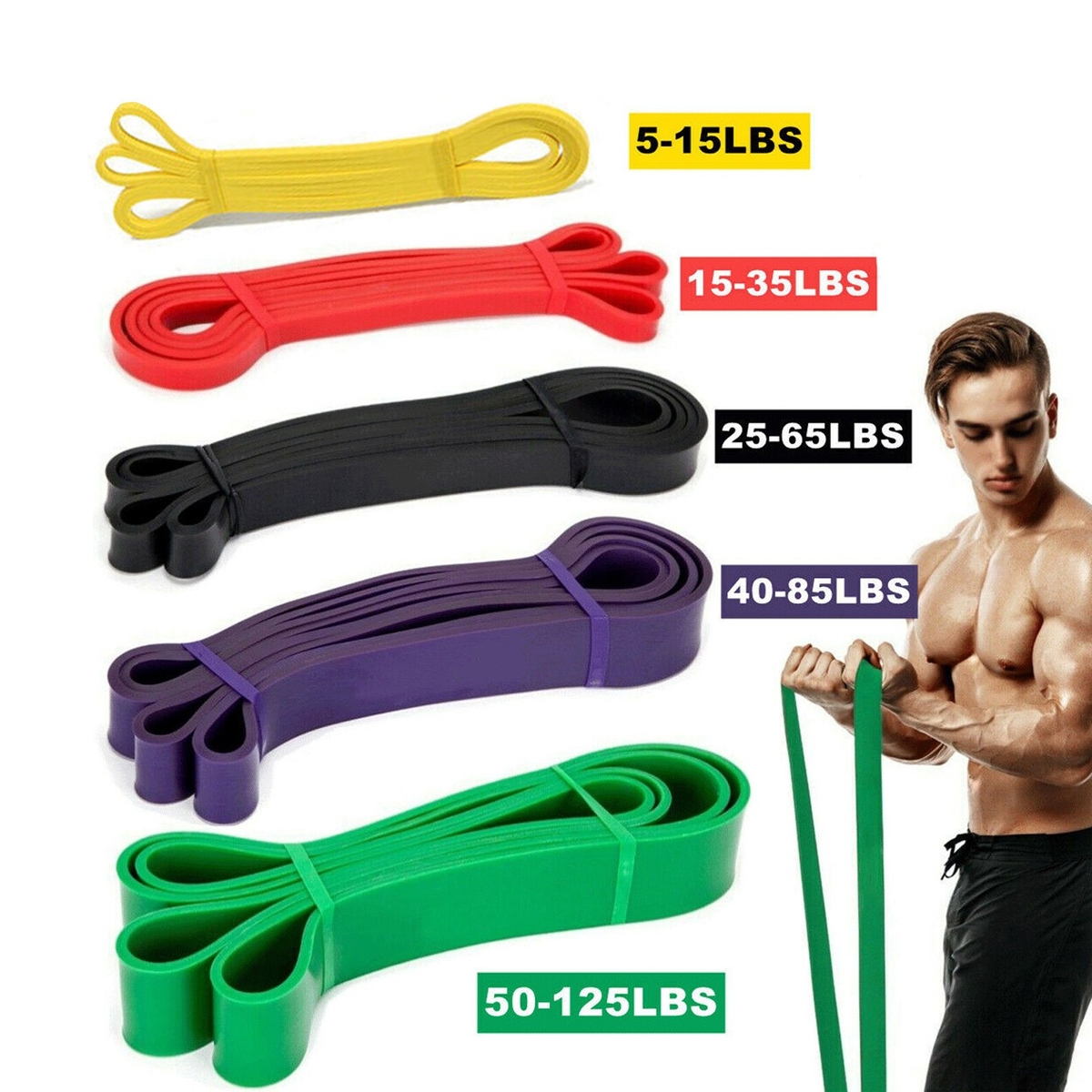
Resistance band product example from Libenli’s pull-up band range.
Why Certification and Parameter Verification Matter
Distributors and fitness brands often carry resistance bands from multiple suppliers. Without standard documentation, a seemingly identical product can differ in stretch recovery, chemical composition, or resistance grading. These differences become visible only after a batch reaches port or a complaint arrives.
Regulatory constraints are tightening in key markets. In the EU, fitness equipment entering the market must satisfy applicable CE marking requirements, and resistance bands used as general physical exercise equipment are commonly classified under HS code 9506.91. Chemical compliance under RoHS and REACH is a baseline expectation for many European retailers.
The opportunity for buyers is to treat certifications and parameters as decision criteria rather than paperwork. A supplier that can document RoHS/REACH compliance, provide stretch-fatigue data, and explain resistance grading gives the buyer a shorter path from product concept to market.
Manufacturer Profile: Libenli at a Glance
Haiyang Libenli Body-Building Apparatus Co., Ltd. (Libenli) is a Chinese manufacturer of latex tubing and resistance bands, founded in 1997 and based in Shandong Province. The company operates a 50,000-square-meter plant with more than 300 employees and an R&D team of over 20 engineers. Its product portfolio includes natural latex tubing, high-elasticity latex resistance bands, resistance tubing, and fishing and diving latex products.
Libenli runs 24 dedicated production lines for dipped latex tubing, with a daily output of 120,000 meters, and two exclusive lines for latex bands, with a daily capacity of 25,000 meters. The factory also operates its own CNC molding machines and plastic injection molding equipment, enabling in-house production of custom plastic parts and accessories.
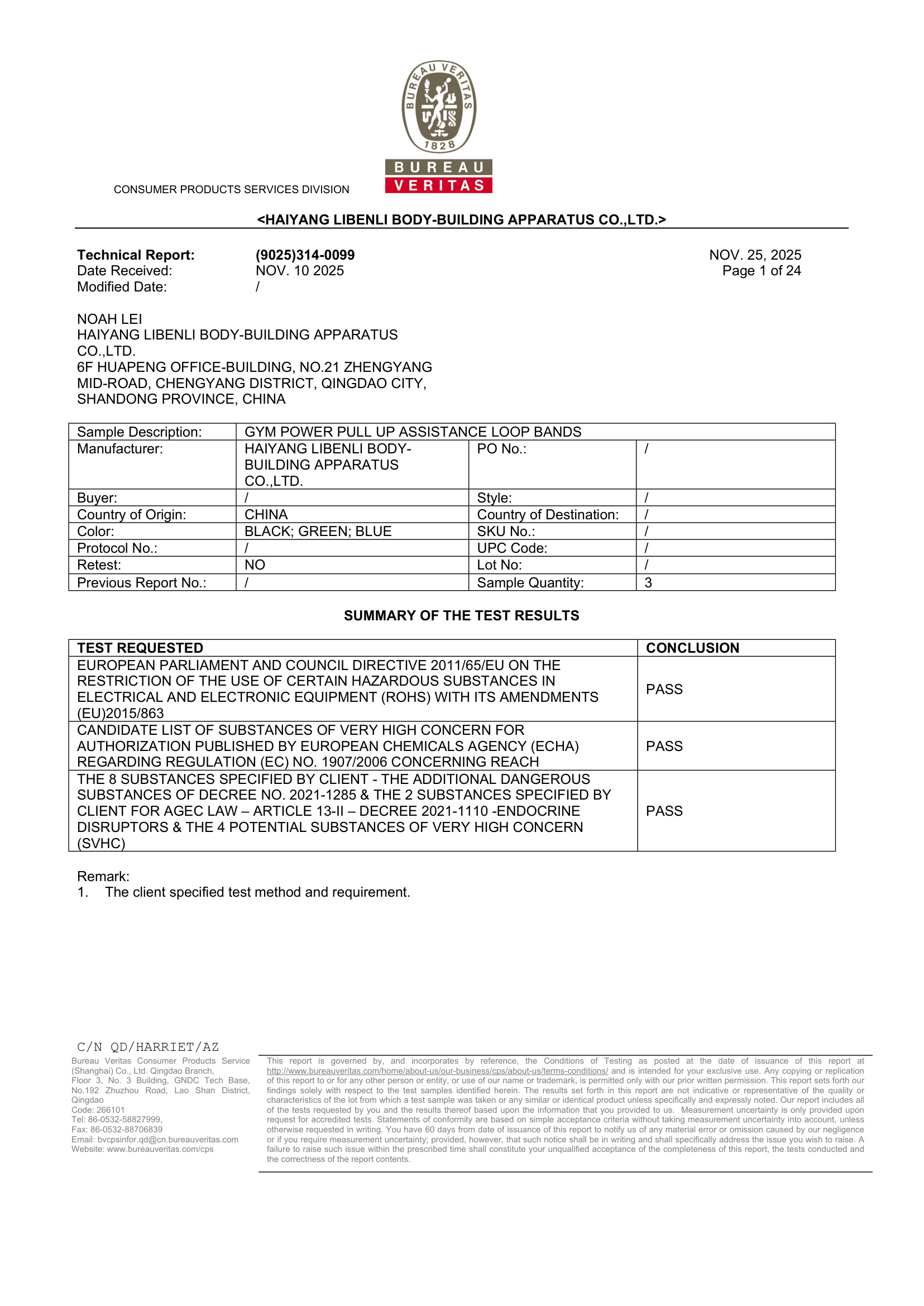
For buyers with EU targets, the relevant product-level documentation is the RoHS & REACH test report issued by Bureau Veritas under certificate number (9025)314-0099. It covers both the pull-up band and the mini loop resistance band, and references Directive 2011/65/EU (RoHS) and Regulation (EC) No. 1907/2006 (REACH).
Example of a RoHS & REACH certified resistance band product line.
Technical Explanation: Parameters and Compliance
Resistance and Dimensions
Resistance band specifications usually include resistance range, thickness, width, length, and stretch life. These values determine how the band behaves during exercise and whether it can serve a specific training group. Two common product types illustrate the range:
| Product | Model | Type | Key Parameters | Material |
|---|---|---|---|---|
| Pull-up band | ZLQ-03 | Power loop band, double layer power loop band | Resistance: 8LB–230LB; Thickness: 0.45mm; Width: 6.4mm–82.5mm; Length: 2080mm; Service life: ≥20,000 stretches | Latex |
| Mini loop band | ZLQ-1 | Mini loop band, mini loop band with anti-slip | Resistance: 5LB–40LB; Thickness: 0.3mm–1.2mm; Width: 50mm; Circumference: 600mm; Fatigue resistance: ≥30,000 stretches | Latex / TPE |
The pull-up band is a long endless loop designed for assisted pull-ups and full-body strength work. The mini loop band is a shorter loop used for hip and glute training, Pilates, and warm-ups. Both products share a common application list: fitness gyms, home workouts, sports rehabilitation, yoga training, physical therapy, and outdoor training equipment.
Compliance and Documentation
Buyers evaluating bands for the EU should verify that the product itself — not just the factory — has a test report covering the relevant directives. In Libenli’s case, both the pull-up band and the mini loop band are covered by a RoHS/REACH test report issued by Bureau Veritas under number (9025)314-0099.
Beyond chemical compliance, the broader EU regulatory framework may require fitness equipment to comply with the EN 20957 series for stationary training equipment when CE marking applies. Resistance band importers should confirm with their compliance team whether the band’s intended use brings it under this standard or under the lighter self-declaration requirements of a general exercise article.
Customs classification is another recurring constraint. Resistance bands are commonly classified under HS code 9506.91, which covers articles for general physical exercise, gymnastics or athletics. Using the correct code helps avoid delays and ensures consistent duty treatment across shipments.
Material Choices: Latex vs TPE
Latex offers high elasticity and long service life, which is why many pull-up bands are made of natural latex. TPE is a synthetic alternative that works for buyers needing a latex-free option. In Libenli’s line, the mini loop band is offered in both Latex and TPE, while the pull-up band is Latex-based.
Material choice affects not just compliance but also feel. Latex bands tend to have a stronger snap and higher resistance consistency; TPE and fabric bands provide different surface textures and may be preferred for sensitive skin.
Application and Use Cases
Resistance bands appear in several distinct buying contexts: fitness studio packages, rehabilitation clinic equipment, home sports kits, and gym retail sets. The common operating environment is a normal indoor space with temperatures between -10°C and 50°C and low dust. Typical functions include muscle stretching, strength training, joint rehabilitation, body shaping, and yoga assistance.
Libenli’s documented case experience includes supplying an Australian fitness brand with more than 150,000 units per year across 12 or more specialized product lines. According to the company, the defect rate remained below 0.05%, and supply chain adjustments shortened the R&D-to-market cycle by 20%. The project also used a five-tier resistance system with a reported tension error margin within ±2%.
For procurement teams, this kind of evidence matters because it shows whether the supplier can hold consistent specifications at volume, not just produce samples.
Market Trend Analysis
According to Grand View Research, North America held the largest revenue share of the resistance bands market at 40.0% in 2024. Health and sports clubs represented the largest end-user segment with a 70.6% revenue share, while individual use was the fastest-growing segment. Market Research Future estimates that therapy and exercise bands account for roughly 50% of the total global resistance bands market.
These figures suggest that demand remains strong from organizations buying in volume, while the fastest incremental growth is coming from home users. That split pushes retailers to carry both professional heavy-resistance bands and consumer-friendly mini loops, fabric bands, and TPE options.
In the branded product space, competition includes established names such as TheraBand, Black Mountain Products, Rogue Fitness, TRX, and Decathlon. For private-label and OEM buyers, the focus is not on matching brand prestige but on meeting compliance and performance specifications consistently across batches.
Comparison with Traditional Solutions
Traditional procurement of resistance bands often relies on a distributor catalogue or a large sporting-goods brand. The buyer gets a familiar product with established packaging, but customization is limited and the unit price is higher. OEM-direct sourcing offers lower landed cost, custom branding, and full control over material and packaging. However, it shifts more compliance responsibility to the buyer.
| Sourcing Route | Advantages | Limitations |
|---|---|---|
| Established brand (e.g., TheraBand, Decathlon) | Pre-validated compliance, retail-ready packaging, low effort for small orders | Limited customization, higher unit cost, brand premium |
| OEM supplier (e.g., Libenli) | Custom specifications, own label, direct cost control, volume capacity | Buyer must verify certification validity, manage MOQs and lead times |
One practical limitation of OEM-sourced bands is that certification documents are batch- and model-specific. If a buyer changes the width, adds a coating, or switches from latex to TPE, the existing RoHS/REACH report may no longer cover the new version. The supplier must run a new test, adding time and cost before the product can ship.
Future Outlook
Over the next several years, resistance band procurement is likely to become more specification-heavy. EU buyers are expected to keep tightening chemical reporting, and downstream platforms may ask for traceability from raw latex to finished product. Manufacturers with in-house R&D, documented test reports, and stable mixing formulas will have an advantage in supplying private-label brands that need consistent tension curves.
As the market moves toward a projected USD 2.9 billion by 2030, we anticipate more requests for TPE and non-latex variants, custom resistance levels, and fabrics or silicone outer layers that improve grip. This aligns with the observed growth of individual use and home training.
FAQ
What certifications are typically required for resistance bands sold in the EU?
In the EU, resistance bands should meet applicable chemical compliance requirements. RoHS and REACH are the two directives most commonly referenced for environmental and chemical safety. Some resistance bands may also need to comply with the EN 20957 series for stationary training equipment when CE marking applies; importers should confirm the specific scope with a compliance specialist.
What does a RoHS/REACH certificate for a resistance band contain?
A typical RoHS/REACH certificate identifies the certified product, references the applicable directives (Directive 2011/65/EU and Regulation (EC) No. 1907/2006), names the issuing body, and carries a certificate number. For example, Libenli’s pull-up band and resistance band have a certificate number (9025)314-0099 issued by Bureau Veritas for the EU market.
What are common resistance and durability parameters for pull-up bands?
A common pull-up band specification is a resistance range of 8LB to 230LB, thickness of 0.45mm, width of 6.4mm to 82.5mm, length of 2080mm, and a service life of at least 20,000 stretches. These parameters allow a single band to support a wide range of body-weight exercises.
What is the difference between latex and TPE resistance bands?
Latex bands are known for high elasticity and are widely used in power loop bands. TPE is a latex-free synthetic material often used in mini loop bands. In Libenli’s product line, the mini loop band (ZLQ-1) is available in Latex or TPE, with a resistance range of 5LB to 40LB and fatigue resistance of at least 30,000 stretches.
How are resistance bands classified for international shipping?
Resistance bands intended for general physical exercise are commonly classified under HS code 9506.91, which covers articles for general physical exercise, gymnastics, or athletics. Using this correct classification helps with customs clearance and avoids inconsistent duty rates.
Resource: Libenli’s company catalog is available for public download and covers product categories, manufacturing capabilities, and contact details. Download the catalog PDF.
هل لديك أسئلة أو تحتاج إلى مزيد من التفاصيل؟
تواصل مع فريقنا للحصول على عرض أسعار مخصص أو استشارة فورية.
طلب عرض أسعار
املأ النموذج أدناه وسيتواصل معك فريقنا بعرض مقترح مخصص.
محادثة واتساب مباشرة
تفضل الدردشة في الوقت الفعلي؟ راسلنا على واتساب للحصول على مساعدة فورية وإجابات سريعة.
- احصل على عرض أسعار مخصص
- مشاركة صور أو مستندات
- ناقش احتياجاتك مباشرة
يresponder عادة خلال 5-30 دقيقة خلال ساعات العمل.