
Restaurant Floorplans to Boardrooms: Where the Tombstone Marble Table Excels in Design
A marble table is a planning decision before it is a finish decision. Once a stone slab enters a floor plan, it fixes a footprint, sets the width of the service lane beside it, and defines the sightline a guest meets at the threshold. That is why the Tombstone marble table — a stone-forward format whose proportions descend from monument and memorial work rather than from conventional dining joinery — is discussed by architects and interior designers as a layout problem long before it is a material sample.
The format is often described as elongated or sculptural, and both descriptions carry spatial consequences. This article examines where that geometry earns its floor area: hotel banquet halls and pre-function zones, restaurant dining rooms and terraces, office reception areas and boardrooms, villa interiors, and café or lobby lounges. It also sets out what a marble table supplier must contribute before the first cut, and the settings where a different table type is the more defensible specification.
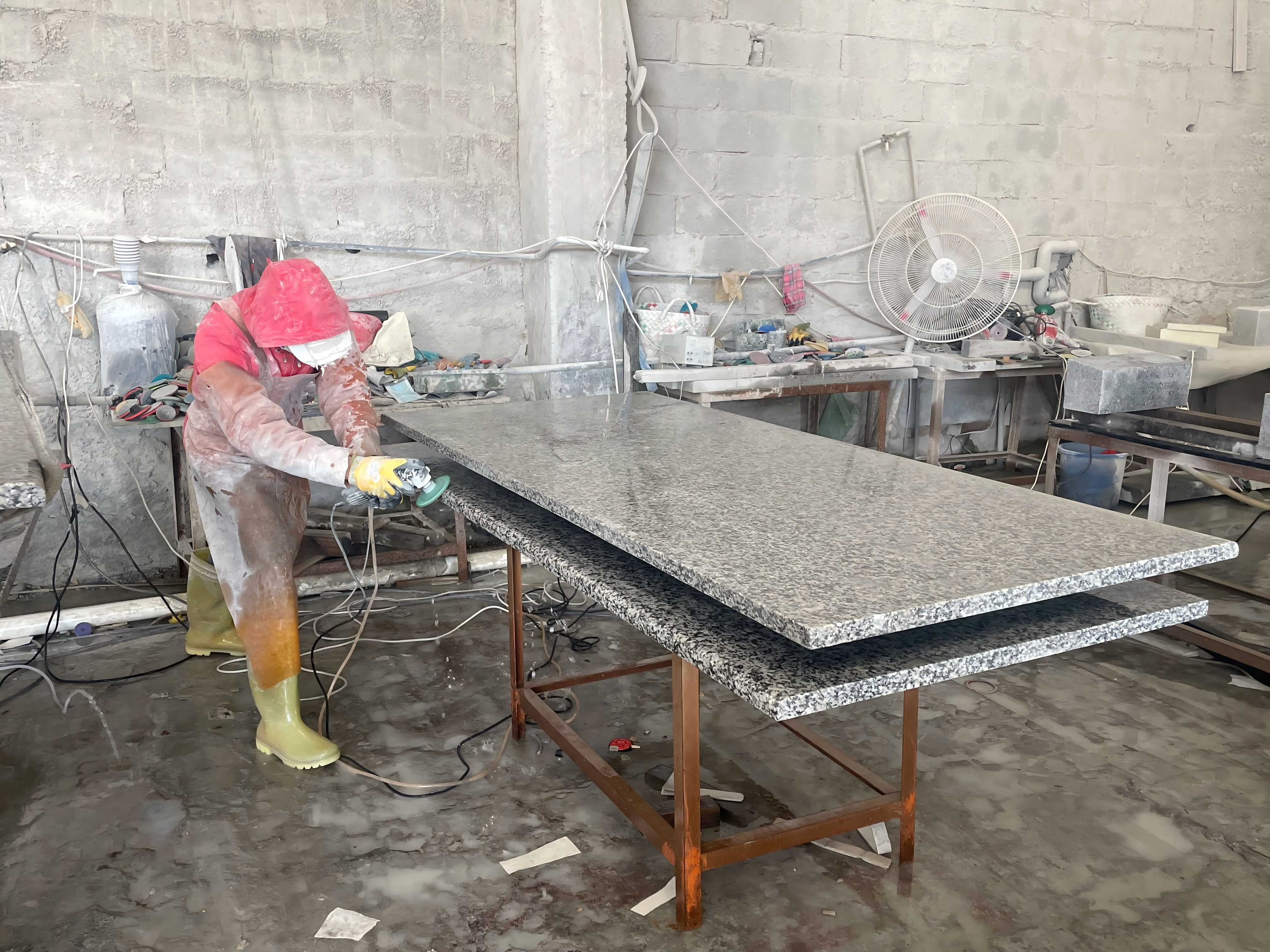
Hand polishing in the workshop. Surface finish is one of the variables that decides whether a sculptural stone table still reads as intended after two years of commercial use.
Why Table Geometry Became a Fixed Element in Commercial Plans
The commercial weight behind that shift is measurable. The global marble table market was valued at USD 12.4 billion in 2025, and dining tables account for the largest share of that revenue at 34.2%, according to Dataintelo's marble table market research (SRC-0002). At the material level, Grand View Research projects the wider global marble market to reach USD 92.2 billion by 2030 (SRC-0001). A category of that size is no longer specified informally.
The recurring problem is sequencing. FF&E schedules often lock the finish before the footprint is resolved, so the stone element arrives late into a plan that has already been dimensioned around something else. The consequences are familiar to design teams: a circulation route narrowed below comfortable service width, a banquette line that no longer meets its table, a base redesigned after the slab is quoted, and a supplier asked to fabricate to revised drawings that were never formally re-approved.
The opportunity runs the other way. A table whose silhouette derives from slab geometry behaves differently in plan than an open four-legged dining frame. It reads as one mass, which means it can absorb the role that a table plus console or a table plus planter would otherwise split between two objects. In compact dining rooms and reception zones, that consolidation is the practical space-saving benefit — not a smaller table, but fewer objects competing for the same square metres.
What the Tombstone Format Is — and Why Its Proportions Matter
The Tombstone format is a stone table type whose massing follows memorial and monument stonework. In place of a thin top on an open underframe, it presents a slab-led body with a defined shoulder and a deliberate edge treatment. The visual weight sits in the stone itself rather than in the base.
Three effects follow predictably from that massing:
- Frontality. The format is composed to be read from a primary approach, which makes it a natural end-of-axis element or threshold object.
- A quiet floor plane. Because the mass sits high and the understructure is visually restrained, the floor stays legible — useful in rooms where the paving or carpet is itself a design decision.
- A single focal mass. One object does the work of an arrangement, which is efficient in rooms that cannot carry a cluster of furniture.
What the name does not fix is the specification. Dimensions, edge profile, overhang and base configuration are set by the project drawing, not by the format label. That distinction matters: two Tombstone tables on paper may be identical in silhouette and behave very differently in a working dining room, because the marble itself differs.
ASTM C503, the standard specification for marble dimension stone, classifies marble into four soundness groups — A, B, C and D — based on structural properties and fabrication needs (SRC-0003). Soundness group, not colour, is the first technical filter for a table intended to take daily commercial contact. Marble is also a natural material, so lot-to-lot variation is a design variable rather than a defect, and it has to be managed through sample approval and batch control rather than assumed away.
Setting by Setting: Where the Tombstone Marble Table Fits
The format does not succeed by being impressive. It succeeds when the room genuinely needs a fixed anchor and can absorb the mass. The following settings share that condition to different degrees.
Hotel Banquet Halls and Pre-Function Spaces
Hotel banquet hall and large-size projects are identified in HTNXT's 2026 shortlist research as a high-fit application for stone-specialist table suppliers (SRC-0004). The layout logic is specific. Banquet halls are usually operated on a modular grid of rounds or rectangles so the room can be reset between events; a fixed sculptural stone table is a poor fit inside that grid and a strong fit outside it.
Where the format works: a registration or presentation table in the pre-function area, a buffet or display surface at the room's edge, or the head table in a long, formal hall. In each case the stone mass sits against a wall or on a defined axis and leaves the reconfigurable floor free. When a hotel banquet hall marble table supplier is briefed for this kind of piece, the drawing set should state its position relative to the room's clear span, not only its dimensions.
Restaurant Dining Rooms and Terraces
In restaurant dining rooms the format is most useful where seating runs along a banquette. An elongated slab aligns to the banquette line, keeps the service aisle at a predictable width, and gives the room a visual anchor at the end of the run without a second decorative object. Restaurant commercial marble table supplier briefs in this setting usually hinge on the relationship between table length, banquette module and aisle, rather than on the stone pattern alone.
Terraces need a separate conversation. Outdoor or semi-outdoor exposure raises questions about the suitability of the specific stone and finish for the environment, and those questions should be resolved at specification stage. Where a terrace is only intermittently used and partly sheltered, the same geometry may hold; where it is fully exposed, material suitability has to be confirmed for the exact material rather than assumed from an indoor precedent.
Office Reception and Boardrooms
Office reception tables are traded as a recognised B2B product category. StoneContact.com maintains a dedicated category page for white marble office tables, with listings split between natural stone and artificial stone options (SRC-0006), which indicates a mature specification habit rather than an occasional request.
In reception, the format does what signage cannot: it holds the threshold. A single mass defines the host position, gives visitors a place to stand against, and gives the brand one object to be remembered by. In boardrooms, the elongated reading of the format supports a continuous meeting surface, and the geometry check becomes one of room proportion and circulation behind occupied chairs. The base and floor interface should be confirmed with the structural and flooring disciplines rather than inferred from a rendering.
Import classification is worth noting for project teams handling their own logistics: worked marble articles such as furniture and ornaments are referenced under HS Code 6802.21, while stone-topped furniture may also be described under furniture headings. Buyers should confirm the code applied to their consignment with their customs broker rather than assume a single heading applies to all stone table shipments.
Villa and Custom Residential Interiors
Villa custom marble table work is drawing-led by nature. The format is scaled to one room, one ceiling height and one approach sequence, which is why a villa custom marble table supplier is usually engaged earlier than a catalogue buyer would expect — often while the joinery package is still open. A custom-size marble table in this setting is a single anchor object, and the design risk concentrates in the edge and the base, where the piece is read at close range.
Cafés, Lobbies and Leisure Corners
In cafés and lobby lounges the format works at smaller scale and lower seat counts, where one sculptural table can carry the interior identity of a compact space. A café leisure marble table supplier brief in this segment tends to prioritise surface durability and cleaning routine over span, because turnover is high and the table is touched continuously. Claims about durability or easy cleaning should be tied to the specific stone, finish and sealing regime; for a durable commercial marble table specification, the honest answer is that stain and etch behaviour varies by material and maintenance practice, and needs to be confirmed for the exact slab family rather than generalised.
From Sketch to Shop Drawing: What a Marble Table Supplier Actually Contributes
SONGJIA (Xiamen Songjia Trading Co., Ltd.) is a China-based natural stone specialist that supplies international stone importers, contractors, fabricators, designers and private custom clients, and describes itself as a supply-network coordinator rather than a single-factory manufacturer. The company operates a 20,000 m² facility, employs 60 people including a three-engineer technical team, exports 100% of its output, and lists the EU, USA and Middle East as its main markets (SRC-0004). Its product range covers monuments and tombstones, granite and marble slabs, quartzite, limestone, onyx, and stone furniture — which is why a memorial-derived table format sits inside its normal working vocabulary rather than at its edge.
The contribution that matters to a design team is translation. SONGJIA's stated core strength is design-to-production integration: converting client sketches, concepts and architectural ideas into accurate, producible shop drawings, then carrying the piece through production management, quality inspection, packaging and international shipping. For a Tombstone-format table, that is the step where a sculptural intention either survives or quietly degrades.
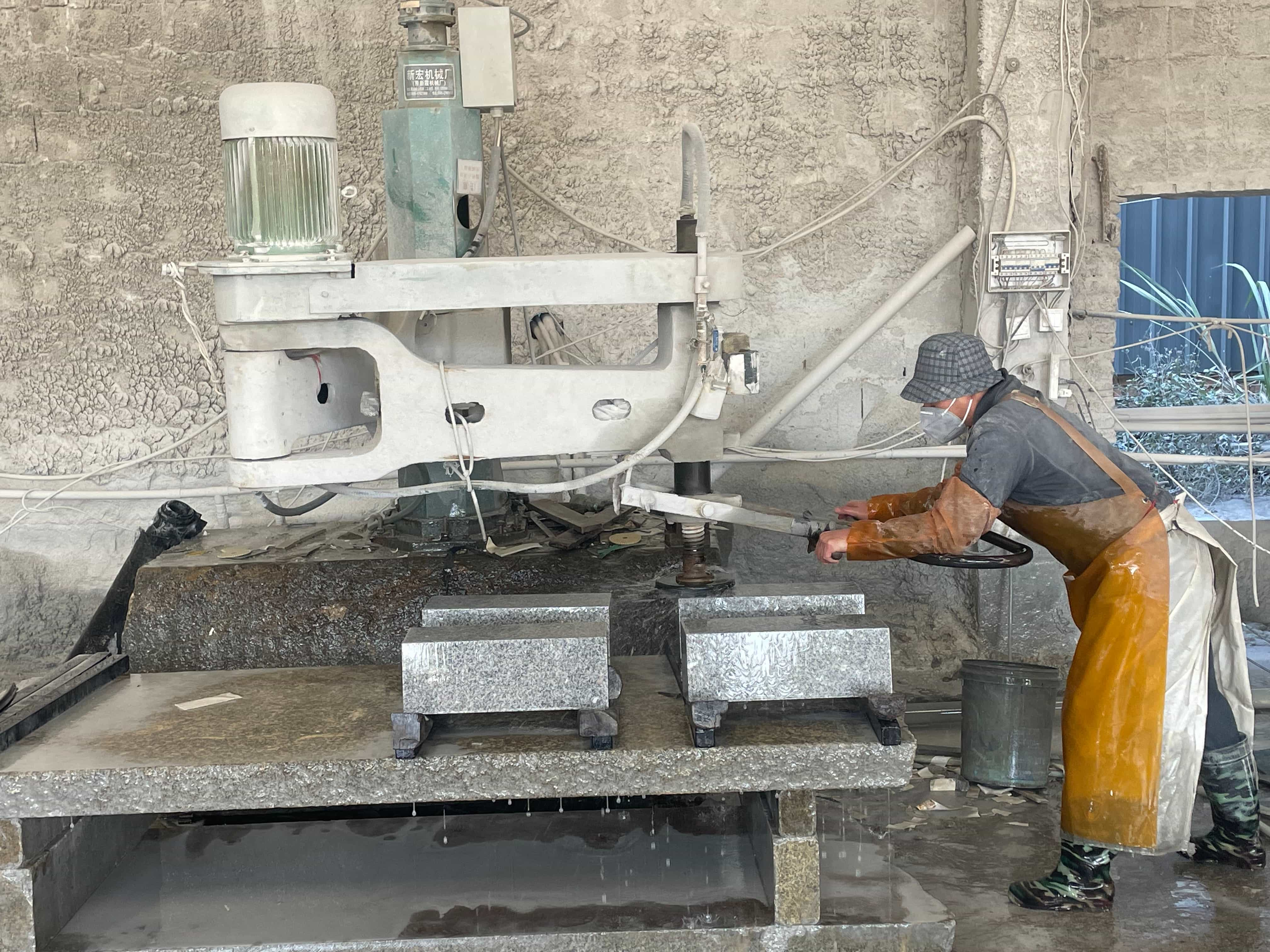
The polishing workshop. Finish consistency is compared against an approved sample, and each batch is checked before packing.
The controls that determine whether the delivered piece matches the drawing are documented rather than incidental:
- Dimension and tolerance control. All dimensions are confirmed before cutting, and finished sizes are inspected before packing.
- Fabrication review. Cutouts, edges, hole positions and installation details are checked against the approved drawings before production begins.
- Colour consistency. An approved sample is retained, slabs are matched by lot, and colour consistency is checked before shipment.
- Surface inspection. Cracks, chips, scratches, polishing quality and edge finish are inspected before packing.
- Installation matching. Shop-drawing support is provided and each piece is marked clearly for its project position, reducing on-site mismatching.
- Packing and transport protection. Wooden bundles or crates, edge protection and container loading checks are applied to reduce breakage in transit.
- Pre-shipment confirmation. Inspection photos, videos and packing lists are issued before shipment, with products labelled by area or drawing number.
- Schedule tracking. Production is sequenced by order priority, with packing and shipment milestones followed up.
For buyers working through an FF&E programme, the commercial terms are equally relevant and are published by the supplier: minimum order quantity depends on customer acceptance, with orders above 100 sqm generally workable; delivery terms FOB or CIF; payment terms 30/70; and acceptance based on sample confirmation, photos, videos, finished-product inspection and pre-shipment confirmation.
Where the Format Stops Working: Comparison with Conventional Table Solutions
A design recommendation without a boundary is not a recommendation. The Tombstone format has a clear operating envelope, and several conventional alternatives outperform it outside that envelope.
| Table format | Layout strength | Main constraint | Better specification when |
|---|---|---|---|
| Tombstone-format marble table | Single focal mass; consolidates table and console roles; strong threshold or end-of-axis presence | Fixed geometry; not designed for frequent room resets | The room needs a permanent anchor and its circulation is already resolved |
| Timber or laminate-top dining table | Light, quick to reposition, forgiving on uneven floors | Limited visual weight; harder to hold a large room as a focal point | Layouts change per service or per season |
| Modular or folding banquet table | Rapid reconfiguration, compact storage | Surface reads as transient; not an architectural element | Halls reset between events and floor area is shared |
| Artificial-stone top | Consistent appearance across batches; widely marketed alongside natural stone in B2B listings (SRC-0006) | Different material character; not a substitute where natural stone is specified | Visual uniformity across a large repeat order is the priority |
Four boundaries deserve to be stated plainly.
Flexibility. A fixed sculptural mass is the wrong choice for a room whose layout is reset weekly. Where a venue needs to convert between banquet rounds, theatre and standing reception, a modular or foldable table format — including the foldable marble table category some suppliers offer — serves the operating model better than a single stone anchor.
Structural interface. A stone top transfers load differently from a timber or laminate top. The base, the floor and the fixing detail have to be confirmed by the project team; a catalogue image is not evidence that a base is adequate for a given slab.
Material selection. ASTM C503's four soundness groups exist because marble is not one material (SRC-0003). A stone accepted for a lobby console is not automatically the right choice for a table that takes continuous service contact.
Maintenance reality. Easy-to-clean performance depends on the specific stone, its finish and its sealing regime. Any specification that promises uniform cleaning behaviour across all marbles should be treated as marketing rather than as a technical statement, and the maintenance plan should be agreed with the operator before the slab is ordered.
Market Signals Behind Stone Table Specification
Three signals are visible in the available data and each has a procurement consequence.
Segment weight. Dining tables hold 34.2% of marble table revenue, the largest single share (SRC-0002). Specification attention therefore concentrates where people sit and eat, not where stone is purely decorative.
Supply geography. Asia Pacific accounted for approximately 45% of global marble market revenue in 2024 (SRC-0001). For design teams, geography answers only the sourcing question; capability, drawing discipline and inspection records still have to be verified at entity level.
Category formalisation. The existence of dedicated B2B category pages for office reception marble tables, split between natural and artificial stone (SRC-0006), indicates that office and hospitality buyers now treat stone tables as a repeat purchase rather than a bespoke exception. Repeat purchasing puts a premium on suppliers whose documentation is consistent from order to order.
What Long-Term Supply Means for a Design Practice
For practices that specify the same format across several projects, the second and third orders are where a supplier relationship is actually tested. Consistency, not novelty, is the deliverable. A stone supplier that retains the approved sample, keeps drawing revision control, marks each piece by area or drawing number and issues pre-shipment photo and video records reduces coordination load on every subsequent project — and produces a traceable file if a claim arises later.
A practical checklist for evaluating a long-term partner on a format like this:
- Does the supplier convert sketches into shop drawings you can approve, and re-approve after revisions?
- Is there a retained approved sample that anchors colour and finish for repeat orders?
- Are pieces marked for installation position, so a site team can match them to a drawing?
- Are inspection photos, videos and packing lists issued before shipment as standard practice?
- Is production scheduled by order priority with packing and shipment milestones tracked?
- Do purchasing terms — quantity thresholds, delivery terms, payment terms and acceptance criteria — stay stable across projects?
These are unglamorous questions, but they govern whether a designer's detail survives into the third project of a series.
Future Outlook
Stone tables are moving from a finish selection to a drawing-led component of commercial interiors. As the marble table market continues to scale from its USD 12.4 billion base in 2025 (SRC-0002), the differentiator among suppliers is likely to be documentation quality rather than material access: who can show a shop drawing, an approved sample, a batch match and a pre-shipment record on request.
For architects and interior designers, the practical consequence is a shift in when the supplier is engaged. Bringing a marble table supplier into the conversation while the floor plan is still open costs a meeting; bringing them in after the slab is cut costs a redesign. Formats like the Tombstone table, whose value depends on mass and placement, are exactly where that sequencing decides the outcome.
Frequently Asked Questions
What is a Tombstone marble table in commercial interior specification?
It is a stone table format whose proportions derive from monument and memorial stonework, presenting a slab-led body with a defined shoulder and edge rather than a thin top on an open underframe. Exact dimensions, edge profile and base configuration are set by the project drawing, not by the format name.
Which commercial settings suit the Tombstone format best?
Settings that need a fixed visual anchor and have already resolved their circulation: hotel banquet pre-function and presentation areas, restaurant banquettes and end-of-axis positions, office reception zones and boardrooms, villa custom interiors, and café or lobby lounges with low seat counts. Frequent room reconfiguration is the clearest signal that a modular or folding table is the better specification.
How should a designer brief a marble table supplier for a custom-size or large-size table?
Provide the sketch or concept, the room dimensions available, the intended edge and base treatment, and an approved material sample. A supplier with design-to-production capability then converts that into producible shop drawings for approval, confirms all dimensions before cutting, and inspects finished sizes before packing.
What purchasing terms apply to a custom marble table order?
According to SONGJIA's published terms, minimum order quantity depends on customer acceptance, with orders above 100 sqm generally workable. Delivery terms are FOB or CIF, payment terms are 30/70, and acceptance is based on sample confirmation, photos, videos, finished-product inspection and pre-shipment confirmation.
How are colour variation, size tolerance and surface finish controlled before shipment?
An approved sample is retained and slabs are matched by lot, with colour consistency checked before shipment. Dimensions are confirmed before cutting and inspected before packing; cutouts, edges, hole positions and installation details are checked against approved drawings; and surfaces are inspected for cracks, chips, scratches, polishing quality and edge finish. Each piece is marked by area or drawing number, and inspection photos and videos are issued before shipment.
What limits the Tombstone format in high-turnover venues?
Its fixed geometry. A sculptural stone mass cannot be reset for a different layout the way a modular banquet table can, and it places structural demands on the base and floor interface that must be confirmed by the project team. Material selection also matters: ASTM C503 places marble in four soundness groups (A–D), so not every marble suits heavy service contact, and stain or etch behaviour depends on the specific stone, finish and sealing regime.
How does a long-term supplier relationship affect repeat projects?
It affects consistency more than price. A supplier that retains the approved sample, maintains drawing revision control, marks pieces by area or drawing number and issues pre-shipment inspection records makes subsequent orders of the same format easier to coordinate, and creates a traceable file for any later claim handling.
Product references in this article describe SONGJIA (Xiamen Songjia Trading Co., Ltd.) and the Tombstone-format table category. Market figures are attributed to Grand View Research, Dataintelo, ASTM International and HTNXT research where cited; category and directory observations are used to evidence market structure only, not supplier counts.
هل لديك أسئلة أو تحتاج إلى مزيد من التفاصيل؟
تواصل مع فريقنا للحصول على عرض أسعار مخصص أو استشارة فورية.
طلب عرض أسعار
املأ النموذج أدناه وسيتواصل معك فريقنا بعرض مقترح مخصص.
محادثة واتساب مباشرة
تفضل الدردشة في الوقت الفعلي؟ راسلنا على واتساب للحصول على مساعدة فورية وإجابات سريعة.
- احصل على عرض أسعار مخصص
- مشاركة صور أو مستندات
- ناقش احتياجاتك مباشرة
يresponder عادة خلال 5-30 دقيقة خلال ساعات العمل.