
Restaurant Furniture Buyer Framework: Tables vs Table Bases
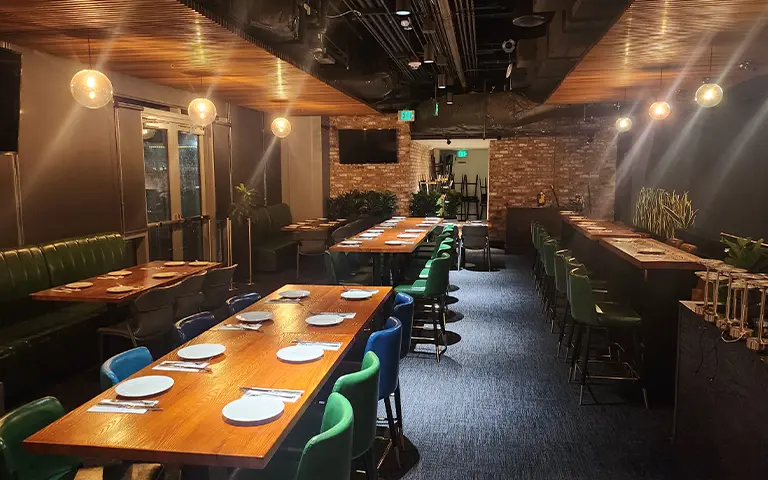
Restaurant furniture projects usually settle their structure last. Seating counts, chair styles and booth layouts are agreed first, and the question of whether to buy a finished restaurant dining table or a commercial table base with a separately specified tabletop often surfaces at the quotation stage, when the room dimensions and the design intent are already fixed. By then the two routes are no longer interchangeable, because each one places specification responsibility in a different place.
This is a buyer framework for that decision. It compares the two routes on durability and material logic, finish and customization control, integration with restaurant chairs, booth seating and bar stools, and on how a supplier's answers about quoting, MOQ, lead time, packing, freight, warranty and design support can be converted into comparable evaluation criteria instead of sales language.
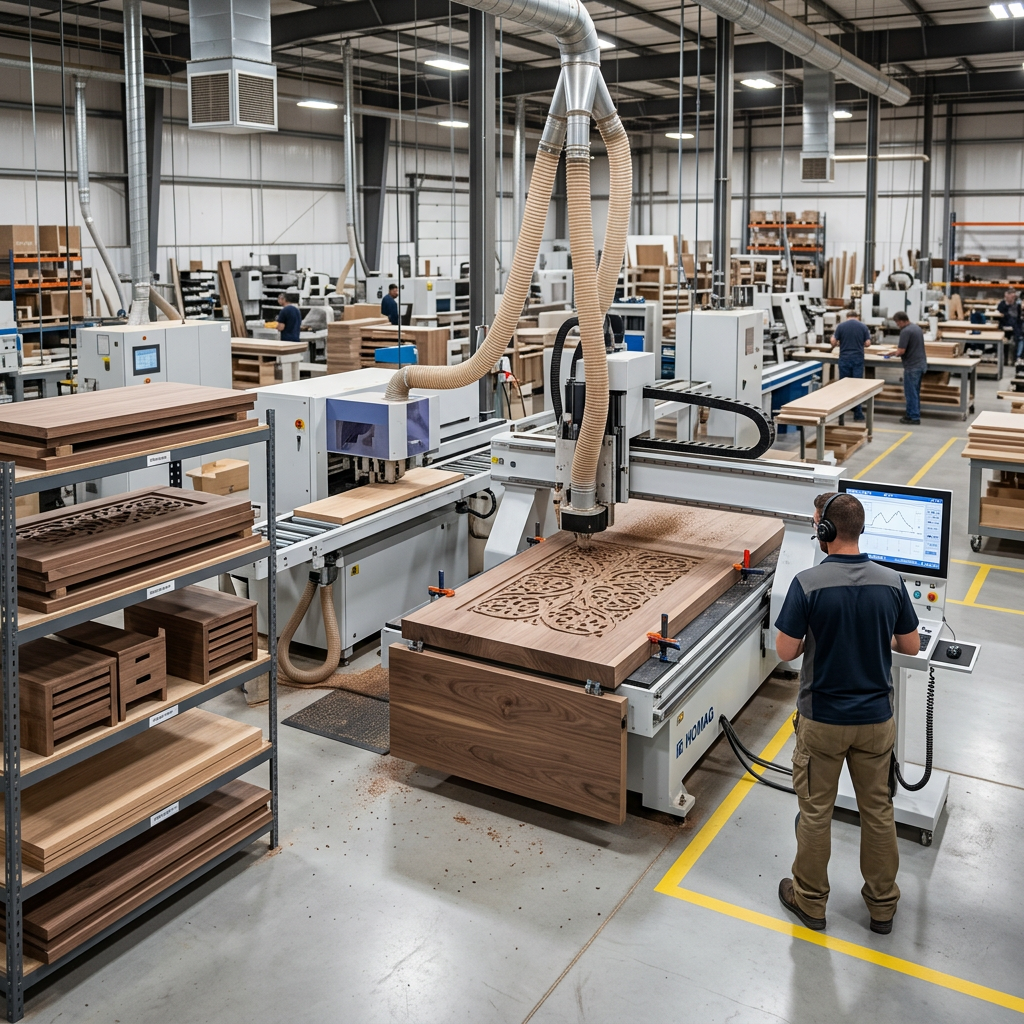
Both routes sit inside the same manufacturing category. Guangzhou Mingmeng Furniture Co., Ltd. (MingMeng Furniture) is a commercial and hospitality furniture manufacturer established in Guangzhou, China in 2015, producing restaurant tables and commercial table bases alongside restaurant chairs, booth and banquette seating, bar stools, bar counters, lounge sofas, canteen furniture and outdoor furniture. The company operates a 15,000 m² production facility with more than 200 workers and a stated monthly output capacity of more than 80,000 pieces, with 10 engineers on its R&D team. It reports an export share of roughly 90% and customers in more than 100 countries, with North America, Europe, Australia, the Middle East and Southeast Asia among its main markets.
What each route actually is
Route A: a complete restaurant table
A finished product in which the tabletop and the base are supplied and specified as one unit. Dimension, top material, base structure and finish are matched before shipment. Tabletop materials in this category include solid wood, veneer, HPL, laminate, marble and stone, and shape options include round, square, rectangular and custom-designed shapes. The defining feature is that one supplier owns the fit between the top and the understructure.
Route B: a commercial table base plus a separate top
The understructure only. A commercial table base is specified by structure (round, square, cross, disc, pedestal, double-pedestal or bar-height), by height (dining, counter, bar or custom), by material (cast iron, steel, stainless steel or aluminium), by finish (powder coating, brushed, polished, plated or custom colour) and by mounting plate configuration. It is then paired with a tabletop the buyer selects, and base plate size, column size and mounting configuration are customized according to that tabletop's dimensions. Mounting is compatible with wood, HPL, stone, marble and sintered stone tabletops.
The practical difference is ownership of the top-to-base fit. In Route A the supplier resolves it. In Route B the buyer, the designer or the contractor resolves it, and the base manufacturer executes it.
Why the table decision propagates through the whole dining set
A restaurant table is the reference point for everything placed around it, and four consequences follow from that.
- Table height sets seat height. Dining height, counter height and bar height are separate structural specifications, and the chair or stool used at each must match. This is why table base ranges are quoted in dining, counter, bar and custom heights, and why bar stool seat height is customized to the counter or table height it serves.
- Base plate and column position set layout density. An oversized base plate under a small top wastes floor area; an undersized plate under a heavy stone top is a stability problem. Because base plate size, column size and mounting configuration are determined by the tabletop dimensions, the plate is the part of the specification that turns a table design into a workable floor plan.
- Tabletop material sets weight, maintenance and understructure demand. Solid wood, veneer, HPL, laminate, marble and stone differ in cleaning routine, scratch visibility, moisture exposure and load. A surface chosen for appearance can force a change in base material and plate size once those factors are priced in.
- Fixed versus loose furniture sets venue flexibility. Booth seating is generally specified as fixed or semi-fixed assembly in single booth, double booth, wall bench, L-shaped, U-shaped or curved configurations, with plywood or solid wood frames and high-density foam. Tables positioned in front of a booth run must be dimensioned to that run, while freestanding tables in the open room can be re-arranged for events.
That is the argument for making the tables-versus-bases decision at specification stage rather than at quotation stage. Once the room is dimensioned and the seating is ordered, the route is effectively chosen.
Side-by-side framework: complete tables versus commercial table bases
| Decision dimension | Complete restaurant table | Commercial table base + separate top |
|---|---|---|
| What the buyer receives | A matched top and base supplied as one finished product | Understructure and mounting plate only; the top is sourced separately |
| Specification ownership | One supplier owns structure, top and stability | Buyer or designer owns the top-to-base match; the base supplier executes it |
| Tabletop control | Limited to the supplier's supplied top options | Full control of material, thickness, edge and shape |
| Base control | Selected from the supplier's base designs and finishes | Structure, height, material, finish, column and plate are specified individually |
| Replacement and maintenance | A damaged top usually means replacing or re-matching the whole unit | The understructure stays in service when a top is replaced or upgraded |
| Weight and handling | Weight is fixed by the finished unit | Base material choice directly changes shipping weight and installation handling |
| Approval cycle | Shorter: one drawing and one sample decision | Longer: base drawing plus top specification must both be approved |
| Best fit | Single-site fit-outs and repeat rollouts with a fixed design | Refurbishment cycles, multi-zone venues and designer-specified top surfaces |
Neither route wins by default. The complete-table route moves specification risk onto one supplier and shortens the approval cycle. The base-plus-top route gives the buyer direct control over the surface specification and keeps the understructure in service across replacement cycles. Many venues use both on the same floor: fixed designs in the main dining room, base-and-top configurations in bar, communal and event zones.
Durability, materials and finishes: what changes when you buy a base
Commercial furniture is specified for frequent daily use, and durability depends on frame structure, joints, materials, finish, upholstery, maintenance and the duty level the project defines. For tables specifically, the load path runs through the base, so the base specification carries most of the durability risk.
Base materials and finishes
Commercial table bases are produced in cast iron, steel, stainless steel and aluminium, with powder coating, brushed, polished, plated and custom colour finishes. Material choice interacts with the top: heavier base materials improve stability under heavy stone or marble tops but raise freight weight and installation handling requirements; lighter metal options reduce shipping weight while requiring the plate size and column configuration to be sized correctly for the intended top.
Tabletop materials
Tabletops are available in solid wood, veneer, MDF, HPL, laminate, marble, stone and custom finishes. The relevant commercial properties are durable surface behaviour, ease of maintenance and suitability for high-frequency use. Laminate and HPL surfaces are generally specified where cleaning speed and cost control matter most; solid wood and veneer where appearance and warmth are the priority; marble and stone where presentation and weight tolerance allow. All of these are surface decisions that feed back into the base specification.
The boundary that matters most
Mounting and plate sizing is the technical limit of the base-plus-top route. A base is compatible with wood, HPL, stone, marble and sintered stone tabletops, and its base plate size, column size and mounting configuration are customizable according to tabletop dimensions. That is not a licence to pair any top with any base. A heavier stone top needs a base and plate sized for that load and footprint, and an understructure specified for a lightweight laminate top of the same diameter may not be the correct structural match. On the complete-table route, that calculation is the supplier's responsibility; on the base route, it becomes part of the buyer's specification checklist.
Customization boundaries: heights, shapes, mounting and finishes
Both routes are customization-capable, but the customization sits in different places.
- Bases: height, base shape, column design, finish, colour and mounting plate configuration are customizable, with OEM/ODM, project-based customization and bulk production available.
- Tables: size, colour, finish, edge design, tabletop material and base design are customizable, in round, square, rectangular or custom shapes, dimensioned to the restaurant layout, seating capacity and project requirements.
- Seating around the table: restaurant chairs can be built on solid wood, metal or plywood frames with fabric, PU leather or genuine leather upholstery, and seat height, width and overall dimensions can be matched to project needs. Bar stools follow the same logic, with seat height set against the bar counter and table height requirements.
Two commercial boundaries apply to both routes and are worth stating before design work starts. First, minimum order quantities: custom models are generally quoted at 10 to 50 pieces per style, and custom dimensions, structures, materials or finishes can change that minimum because of material preparation and production setup. Company-published figures for custom restaurant booths, for example, indicate around 20 units, while the general custom-model range remains project-specific. Second, timing: standard models are typically produced in 20 to 30 days, while customized models typically run 35 to 50 days including sample approval. Late specification changes after drawings and samples are approved can trigger rework, added cost and schedule slip.
How each route integrates with chairs, booths, bar stools and full packages
Integration is where the framework stops being theoretical. In delivered projects, the table route and the base route are usually mixed within one coordinated package rather than chosen globally.
An Australian casual dining project for an Indian restaurant operator was handled as one full restaurant furniture package rather than as separate table and seating orders. The order combined upholstered chairs, dining tables and soft-cushioned booth seating, with sturdy wood chair frames paired against sleek metal table legs, rich leather upholstery and warm wooden tones in a restrained Australian styling. The coordination point here is that the metal table understructure and the wood chair frame were specified together rather than sourced independently.
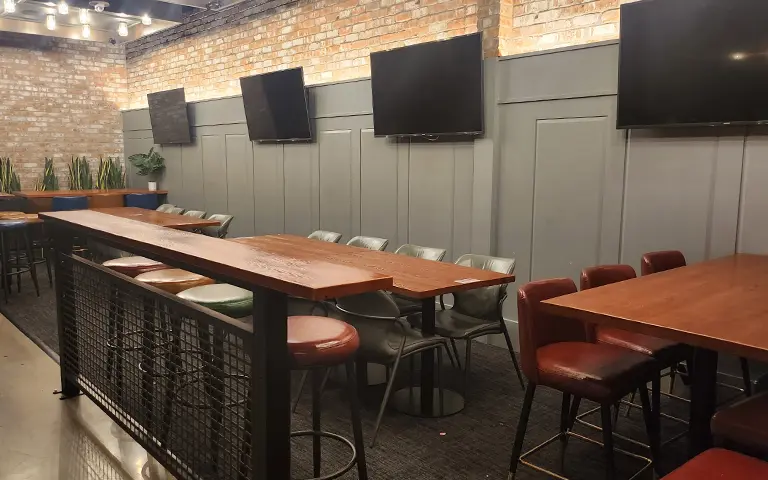
A multi-zone Asian restaurant project in the United States, covering Thai, Chinese and sushi concepts, combined long wall-side booth seating with movable restaurant chairs and warm wood commercial tables, with a consistent palette of amber orange upholstery, black finishes and brass-gold detail running across reception, lounge waiting and main dining areas. Fixed booth runs carried the seating density; movable chairs and freestanding tables carried flexibility.
A charcuterie lounge and event venue in the United States used a different balance again: custom upholstered bar stools at the bar counter seating zone, custom booth seating along the wall side of the dining room, and marble-look dining tables supplied as freestanding units. The package was specified with commercial-grade durability for high-frequency restaurant, bar and event use, and coordinated across a black, olive-green, brushed-gold and marble-white palette.
A large multifunctional entertainment venue in the United States shows the same logic at higher complexity: multiple seating heights, high-top social tables, communal dining tables, commercial dining chairs and custom booth seating, combined as fixed and movable furniture to keep the layout event-ready.
In all four cases, the table decision was made against the seating decision. A complete package can include tables, chairs, booths, bars and accessories so that the finish relationship between understructure, seat frame and upholstery stays consistent across zones.
Reading supplier answers as comparison criteria
Once two suppliers can both produce a table, the difference between them is the quality of their answers. The method that works is to put the same written questions to every shortlisted supplier and compare the specificity of the responses, not the adjectives around them.
| Question in writing | A specific answer looks like | What it changes in the comparison |
|---|---|---|
| What is the quotation built on? | Material, dimensions, quantity and finish defined; Incoterm stated (EXW or FOB); currency stated (USD, EUR or other); freight shown separately or included per the agreed delivery term | Prices are only comparable when the same specification and the same delivery term are used |
| Does volume change unit price? | An explicit statement of whether larger quantities improve unit pricing and whether tiered pricing applies | Affects total project cost and how the order is split between standard and custom items |
| What is the MOQ? | Per-style minimums, whether custom models differ, whether models can be mixed in one order, whether trial orders can be discussed | Determines whether the design can be executed at the project's actual scale |
| What is the lead time? | Standard models typically 20 to 30 days; customized models typically 35 to 50 days including sample approval | Sets the only delivery date the programme can be planned against |
| How is the order packed? | Export packaging as standard; packing inspection; QC reports and final inspection reports available for bulk orders | Affects transit damage risk, receiving labour and installation sequencing |
| Who handles freight and loading? | Delivery term, destination, container loading and international shipping coordination confirmed up front | Landed cost and site readiness depend on this being defined before production |
| What warranty and after-sales terms apply? | Written terms in the quotation or contract; installation guidance; export packaging and freight coordination; spare parts support where agreed in the contract | Total cost of ownership over the service life of the furniture |
| What design and CAD support is included? | CAD drawings, 3D visualization, floor plan coordination, dimension adjustment, production from approved customer drawings; design support for confirmed orders, with complex custom design potentially quoted separately | Determines how much of the specification the supplier absorbs and how much the buyer has to produce |
Two commercial conventions are worth knowing before comparing quotes. Restaurant furniture pricing is calculated on material, size, quantity and finish, and quotations are usually issued on EXW or FOB terms, with freight depending on the selected shipping term and destination. Standard payment terms are commonly 30% deposit with 70% balance before shipment by T/T, and L/C at sight may be available for larger established orders. Where a supplier cannot state these items in writing, that is itself a comparison data point.
Quality and compliance evidence to request
Evidence should be attached to the quotation, not supplied on request at the end. For commercial seating, MingMeng holds a CE Certificate of Compliance for the MM102 commercial chair, certificate number CTG2511057084B-SC01AD, issued by Shenzhen CTG Testing Co., Ltd. for the European Union market against EN 16139:2013 Level 2 and EN 1022:2023. The same product family is supported by a strength, durability and stability test report, CTG2511057084B-SR03AD, and a further CE Certificate of Compliance, CTG2510308431B-SR224AT, issued on 30 October 2025 with an expiry date of 30 October 2030. Bar seating is documented separately, with a test report for the MM103 commercial bar chair (CTG2511057084B-SR02AD) and a strength, durability and stability test report for the MM104 commercial bar stool (CTG2511057084B-SR04AD). Upholstered materials are covered by REACH SVHC test reports for chair materials (CZH12250205012, issued 8 February 2025 against the ECHA candidate list) and for sofa and upholstered furniture materials (BSTDGD31243813112202CR, issued 22 November 2024). The manufacturer also states certification covering CE, TÜV and RoHS alongside a Certificate of Conformity, and reports more than 10 national patented designs.
Factory quality control follows the same principle of evidence. The system covers material inspection, production-process inspection, structural and appearance checks, pre-shipment inspection and export packaging control. For bulk orders, quality control includes sample inspection and random checks, and the factory can issue QC reports, final inspection reports and packing inspection records, with inspection able to follow project-specific standards.
Application scenarios: where each route fits
| Venue type | Typical table decision | Why |
|---|---|---|
| High-turnover casual dining | Complete tables with upholstered chairs and soft-cushioned booths | Fixed design, fast approval, one supplier owns the fit |
| Multi-zone restaurant with reception and lounge | Wall-side booth runs plus movable chairs and freestanding tables | Seating density in fixed zones, flexibility in open zones |
| Bar and event venue | Bar-height bases and stools at the counter; freestanding tables in the dining zone | Height zones must be separated, and the floor is re-set between service and events |
| Multifunctional entertainment venue | Multiple seating heights, high-top social tables and communal tables | Mixed heights and configurable layouts are the operating model |
| Refurbishment or re-branding programme | Base-plus-top, retaining existing understructures | Surface specification can change without replacing the base |
Market trend analysis: what the published forecasts do and do not say
Published commercial research on the restaurant furniture category is directionally consistent but numerically inconsistent, and that gap is itself useful procurement information.
| Source | Market size stated | Growth rate | Period |
|---|---|---|---|
| Market Growth Reports | USD 638.8 million to USD 929.57 million | 4.3% CAGR | 2026–2035 |
| Business Research Insights | USD 0.88 billion to USD 1.38 billion | 5.13% CAGR | 2025–2034 |
| Dataintelo | USD 6.62 billion to USD 11.01 billion | 5.8% CAGR | 2025–2034 |
The three figures cannot be averaged or read against each other directly. They use different market definitions, base years and publisher methodologies, and the spread between them is wide enough that the sizes should be treated as publisher estimates rather than as a consensus number. What they do agree on is more useful for buyers: a single-digit compound growth range and a market that is expanding rather than contracting. No official government, customs, UN Comtrade or WTO dataset for restaurant furniture was identified in the underlying research, so category-level macro figures should not be the basis of a procurement decision. The practical reading is that supply is not constrained by category-wide scarcity, and differentiation between suppliers comes from specification capability, documentation and delivery reliability rather than from availability.
Limitations and trade-offs buyers should accept
A framework that only lists advantages is not a framework. The following boundaries apply, and at least some of them will apply to every project.
- Complete tables lock the finish combination. Replacing a damaged tabletop means replacing the unit or matching a new top to an existing base. The base-plus-top route allows re-topping, but only where the replacement top is compatible with the existing mounting pattern and plate size.
- Base-plus-top splits responsibility across parties. If a top fails or an assembly moves, the buyer resolves the issue between the top supplier and the base supplier. A complete table keeps that responsibility with one party, which is often worth more than the flexibility.
- Base material is a weight trade-off, not a quality ranking. Heavier base materials increase freight weight and installation handling requirements; lighter metal options reduce shipping weight but depend on correct plate and column sizing for the intended top.
- Custom MOQs constrain small projects. Custom models are generally quoted at 10 to 50 pieces per style, and custom dimensions, structures, materials or finishes may carry a different minimum because of material preparation and production setup. A single small dining room may need to work within standard models or accept a per-style minimum.
- Custom lead time is longer than standard. Standard models typically run 20 to 30 days; customized models typically run 35 to 50 days including sample approval. Approvals that slip push the whole schedule, and late changes after approval can cause rework and added cost.
- Fixed booth seating limits reconfiguration. Booth and banquette assemblies improve density and privacy but cannot be moved the way freestanding tables and chairs can, so venues that host events need to plan loose zones deliberately.
- Documentation is product-specific. Test and compliance documents cover defined products and scopes. A certificate for a seating model is not evidence about a table base, and buyers should request documentation for the exact specification being purchased.
Future outlook
Three shifts are visible in how restaurant furniture is being specified, and all three favour clearer documentation at the quotation stage.
First, tables and seating are increasingly bought as one coordinated package rather than as separate orders, because finish consistency across chair frames, table understructures, booth upholstery and bar counters is easier to control when one production base owns all of it. Second, buyers are asking for test reports, certificates and inspection records as part of the quotation rather than after it, which raises the value of suppliers who already hold EN 16139:2013 Level 2 and EN 1022:2023 documentation for seating and REACH SVHC reports for upholstered materials. Third, mixed-height zoning — dining height, counter height and bar height on one floor, with high-top social tables and communal tables alongside booths — is becoming a standard layout rather than a special case, which pushes the table base from an accessory into a primary specification item.
For buyers, the practical implication is that the tables-versus-bases question will be asked more often, not less, and the suppliers who can answer it with drawings, plate sizes, height options and written commercial terms will be easier to evaluate than those who answer with adjectives.
Frequently asked questions
What is the difference between a complete restaurant table and a commercial table base?
A complete restaurant table is supplied as one finished unit in which the tabletop and the base are matched by the manufacturer before shipment, so one supplier owns the structure and the appearance. A commercial table base is the understructure only, specified by structure, height, material, finish and mounting plate configuration, and then paired with a tabletop the buyer selects separately. The complete route transfers the top-to-base fit to the supplier; the base route leaves that fit with the buyer or designer.
What base structures, heights and materials are available for commercial table bases?
Base structures include round, square, cross, disc, pedestal, double-pedestal and bar-height options, with custom structural designs available. Heights cover dining height, counter height, bar height and custom heights. Materials include cast iron, steel, stainless steel and aluminium, in powder-coated, brushed, polished, plated and custom colour finishes. Base plate size, column size and mounting configuration are customized according to tabletop dimensions, and mounting is compatible with wood, HPL, stone, marble and sintered stone tops.
How do table height and base specification affect restaurant chairs, bar stools and booth seating?
Table height is the reference dimension for the whole dining set. Dining, counter and bar heights require correspondingly different chair or stool seat heights, and bar stool seat height is customized against the bar counter and table height it serves. Booth and banquette seating is typically fixed or semi-fixed, so tables in front of a booth run must be dimensioned to that run, while freestanding tables in the open room can be moved. In practice, a single venue often combines fixed booth tables with loose tables at dining, counter and bar heights.
How should buyers compare supplier answers on quoting, MOQ and lead time for restaurant tables?
Put the same written questions to every supplier and compare specificity. Pricing is calculated on material, size, quantity and finish, and quotations are usually issued on EXW or FOB terms, so prices are only comparable when the specification and the delivery term match. MOQ depends on product type, customization level, material setup and order mix, and custom models are generally quoted at 10 to 50 pieces per style; company-published figures for custom restaurant booths indicate around 20 units. Lead time is typically 20 to 30 days for standard models and 35 to 50 days for customized models including sample approval.
How should packing, freight and after-sales support be compared between restaurant furniture suppliers?
Compare on written terms rather than assurances. Export packaging, packing inspection and container loading are the usual operational scope, and for bulk orders a factory can provide QC reports, final inspection reports and packing inspection records. Freight depends on the agreed delivery term and destination, and may be quoted separately or included. After-sales scope typically covers installation guidance, export packaging and freight coordination, with project orders able to include on-site installation guidance and spare parts support subject to contract. Warranty terms should be stated in the quotation or contract; a supplier who cannot put them in writing is a different risk profile from one who can.
What quality and compliance documentation should be requested for restaurant tables and bases?
Request documentation for the exact specification being purchased. For commercial seating, EN 16139:2013 Level 2 and EN 1022:2023 are the standards cited in this supplier's CE Certificate of Compliance and test reports, and REACH SVHC test reports cover upholstered materials. Factory quality control typically follows material inspection, production-process inspection, structural and appearance checks, pre-shipment inspection and export packaging control, with sample inspection and random checks on bulk orders. Because those documents attach to defined products and scopes, a seating certificate should not be treated as evidence about a table base, and structural, stability and finish documentation should be requested for the base and top pairing being quoted.
What are the limitations of each route — finished tables versus separate bases and tops?
Complete tables fix the finish combination, so a damaged top usually means replacing or re-matching the whole unit, but they keep specification responsibility with one party. Base-plus-top configurations allow the understructure to stay in service across top replacements and give full control of the surface, but they split responsibility between the top and base suppliers and require the buyer to confirm that the plate size, column and mounting pattern suit the chosen top. Whichever route is used, custom MOQs are quoted per style, customized lead times run longer than standard, and heavier base materials raise freight and handling requirements.
Can one supplier deliver tables, bases, booths, chairs and bar seating as a complete restaurant furniture package?
Yes. A full-package scope can cover tables, chairs, booth seating, bar counters, bar stools and accessories as one coordinated order, which keeps finishes and dimensions consistent across zones and avoids managing separate table and seating suppliers. Delivered examples include a full restaurant package combining upholstered chairs, dining tables and soft-cushioned booth seating in Australia, a multi-zone Asian restaurant in the United States combining long wall-side booth runs with movable chairs and wood commercial tables, and a United States bar and event venue combining counter-height bar stools, wall-side booths and freestanding marble-look dining tables.
A downloadable MingMeng restaurant furniture catalogue, covering tables, commercial table bases, seating and finish options, is available here: Mingmeng Restaurant Furniture 2026 catalogue.
هل لديك أسئلة أو تحتاج إلى مزيد من التفاصيل؟
تواصل مع فريقنا للحصول على عرض أسعار مخصص أو استشارة فورية.
طلب عرض أسعار
املأ النموذج أدناه وسيتواصل معك فريقنا بعرض مقترح مخصص.
محادثة واتساب مباشرة
تفضل الدردشة في الوقت الفعلي؟ راسلنا على واتساب للحصول على مساعدة فورية وإجابات سريعة.
- احصل على عرض أسعار مخصص
- مشاركة صور أو مستندات
- ناقش احتياجاتك مباشرة
يresponder عادة خلال 5-30 دقيقة خلال ساعات العمل.