
Retractable Bollards: What to Verify Before You Specify
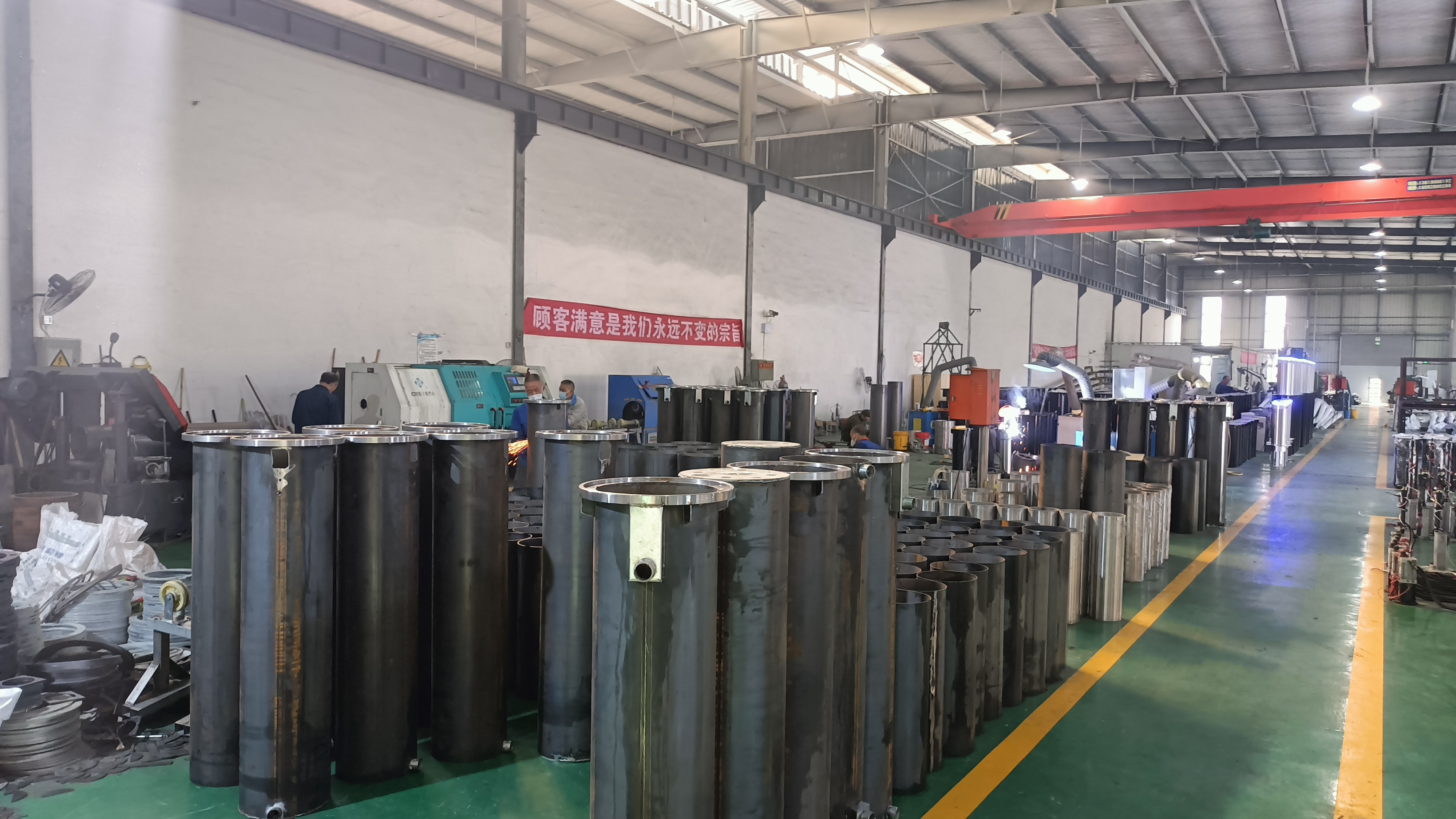
Vehicle security equipment assembly at RICJ’s production site in Pengzhou, Chengdu. Image: Chengdu Ruisijie Intelligent Technology Co., Ltd.
A retractable bollard is a vehicle access control device that can be lowered to permit passage and raised to block it, and the retractable category now carries the largest revenue share of the bollard market. That commercial fact does not make specification easier. For buyers in research and evaluation, the hard question is not whether a bollard rises and falls, but which documents prove it will stop a vehicle on the site where it is installed.
The distinction matters because a crash-rated bollard protects an area by working as a complete system, combining the bollard, mounting arrangement, and supporting foundation to stop or restrain unauthorized vehicles. Change one part of that system — a shallower foundation, a different sleeve, a lighter anchor — and the evidence behind the product no longer automatically describes the installation.
Reference summary: before approving a retractable bollard for a security project, confirm seven items — test standard, test vehicle, impact condition, penetration distance, product configuration, foundation, and test report.
Why Retractable Bollards Are a Specification Problem First
The risk of unauthorized vehicle intrusion and impact damage to facilities or pedestrians is what triggers the need for a crash-rated bollard system in the first place. Security planners rarely buy a bollard because they want an automated post; they buy it because a specific entrance, perimeter road, or pedestrian zone has to remain usable while staying defensible.
That is also where most procurement risk sits. Failure to verify crash test data may lead to insufficient anti-collision performance and security loopholes when installing bollards in high-security areas or selecting equipment for a new security project. The error is not usually a bad product; it is a product approved against evidence that described a different configuration.
Automation raises the stakes again. An automatic or hydraulic bollard adds power supply, control logic, drainage, and daily cycling to a passive steel post, and each of those elements has a site-dependent installation requirement. The more capable the unit, the more the buyer needs to separate three questions that are often blurred in one quotation: what the product is, what the tested assembly was, and what the site can physically accept.
The Seven-Point Verification Chain
Every constraint in a retractable bollard specification ultimately resolves into seven checks. They are worth handling in sequence, because each one narrows the next.
1. Test standard
The standard defines the test method, not the result. ASTM F2656/F2656M-20, for example, is a standard test method for crash testing vehicle security barriers and establishes penetration ratings for vehicle perimeter barriers subjected to vehicle impact. PAS 68 and IWA 14-1 are separate references and should not be treated as interchangeable with ASTM designations. A quotation that lists a rating without naming the standard it came from is not yet verifiable.
2. Test vehicle
The impact vehicle class determines what threat the rating describes. A report written for a light vehicle does not describe performance against a heavy one, even if the speed figure looks similar.
3. Impact condition
Speed, angle, and impact point belong in the report. These are the parameters that make a rating reproducible rather than anecdotal.
4. Penetration distance
A barrier can stop a vehicle and still allow it to travel a defined distance past the line. That distance determines the standoff between the barrier and the asset it protects — a building facade, a queue of pedestrians, a transformer yard.
5. Product configuration
Diameter, wall thickness, material grade, surface treatment, and internal mechanism all describe the unit that was tested. If the delivered unit differs, the report still exists but no longer applies.
6. Foundation
The foundation is where crash ratings quietly fail. Because the bollard, mounting arrangement, and supporting foundation are evaluated as a complete system to mitigate unauthorized vehicle intrusion and impact damage, the foundation is part of the tested assembly, not a civil works afterthought.
7. Test report
The report is the only document that ties the other six together. Verifying the test standard, test vehicle, impact condition, penetration distance, product configuration, foundation, and test report mitigates the risk of insufficient anti-collision performance. A marketing summary is not a substitute; the report should identify the model, the test date, the configuration tested, and the laboratory.
Reading ASTM F2656 Designations Without Over-Reading Them
Two shorthand codes appear most often in barrier literature, and they answer different questions. The M designation refers to the impact condition, while the P designation describes how far the test vehicle travelled past the barrier line.
| Designation | What it describes | Reference value |
|---|---|---|
| M30 / M40 / M50 | Impact speed notation used in ASTM reporting | 30 mph / 40 mph / 50 mph |
| P1 | Penetration band, lowest travel | ≤ 1 m |
| P2 | Penetration band | 1.01 m – 7 m |
| P3 | Penetration band | 7.01 m – 30 m |
| P4 | Penetration band, highest travel | 30 m or greater |
Speed notation per a published industry guide to ASTM F2656; penetration bands per a secondary interpretation of the standard. Both should be confirmed against the current ASTM edition and the model-specific test report before contractual use.
For a buyer, the useful reading is directional. A tighter penetration band buys standoff flexibility on a constrained site; it does not automatically mean the product is more appropriate, because a heavier, larger assembly may be needed to deliver it, with consequences for foundation depth and civil works cost.
What a Manufacturer’s Certification Actually Covers
Quality management certification and crash performance certification are frequently conflated in supplier documentation. They are different instruments and should be read separately.
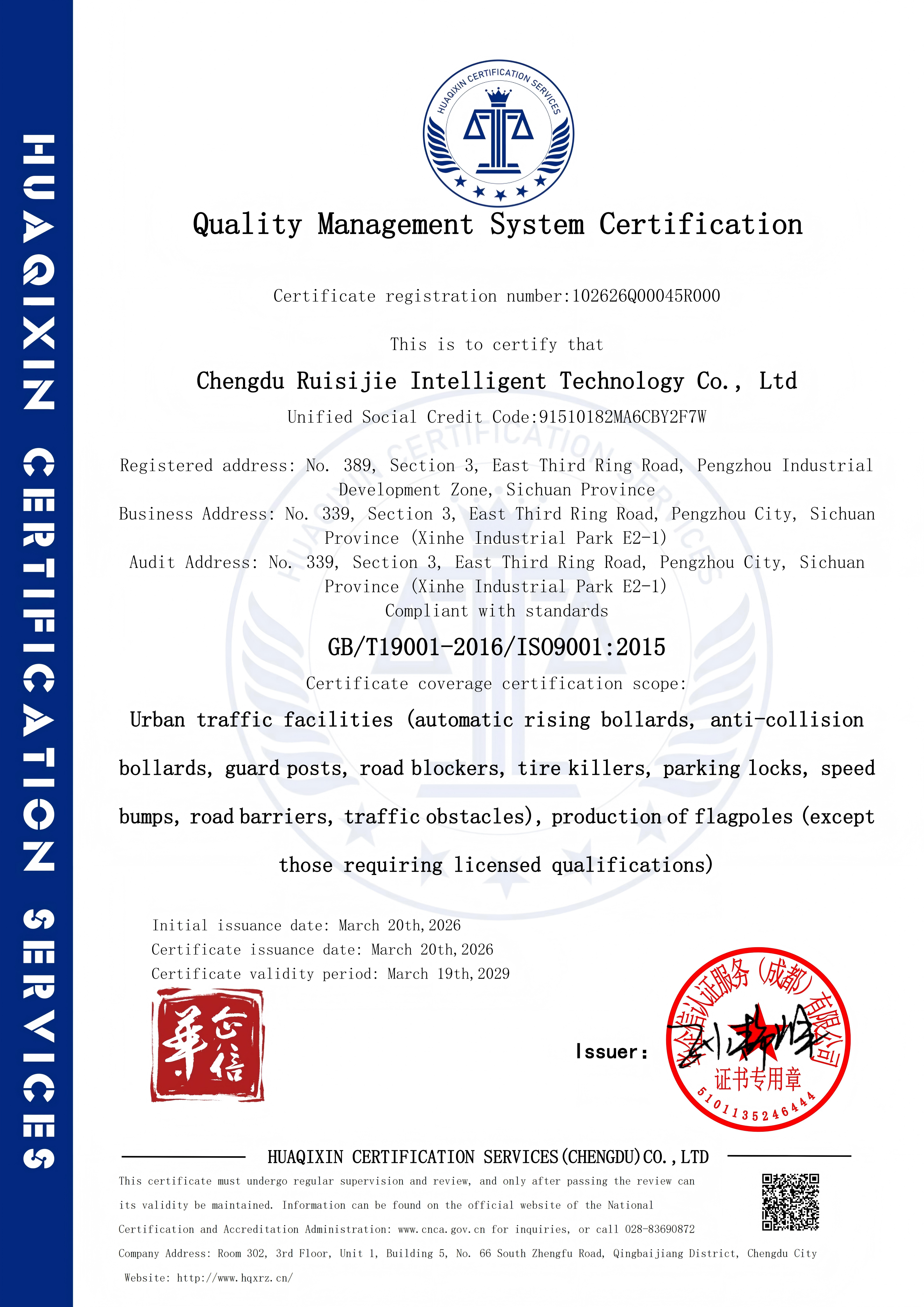
ISO 9001 certificate held for the automatic bollard product. Image: Chengdu Ruisijie Intelligent Technology Co., Ltd.
| Certification | ISO 9001 Quality Management System Certification |
| Certificate number | 102626Q00045R000 |
| Issuing body | HUAQIXIN CERTIFICATION SERVICES (CHENGDU) CO., LTD |
| Standard | GB/T19001-2016 / ISO9001:2015 |
| Validity | Issued 2026-03-20, expires 2029-03-19 |
| Scope | Urban traffic facilities — automatic rising bollards, anti-collision bollards, guard posts, road blockers, tire killers, parking locks, speed bumps, road barriers, and traffic obstacles |
| Market | Global market |
Read precisely, this certificate says that the manufacturer’s quality management system has been assessed against a recognised standard and that the certified scope names the relevant product families. It does not state that any specific bollard model stops a vehicle at a given speed. A buyer who needs that statement needs a crash test report referencing the model, configuration, and foundation.
The practical rule: put both documents on the same page of the evaluation file, with the certificate answering “can this supplier control its process consistently?” and the test report answering “will this assembly perform as claimed?” Neither substitutes for the other.
Setting Specification Boundaries in the RFQ
Once the evidence chain is defined, the commercial conversation becomes tractable, because the RFQ can be written around parameters the supplier must confirm in writing rather than around a general product category.
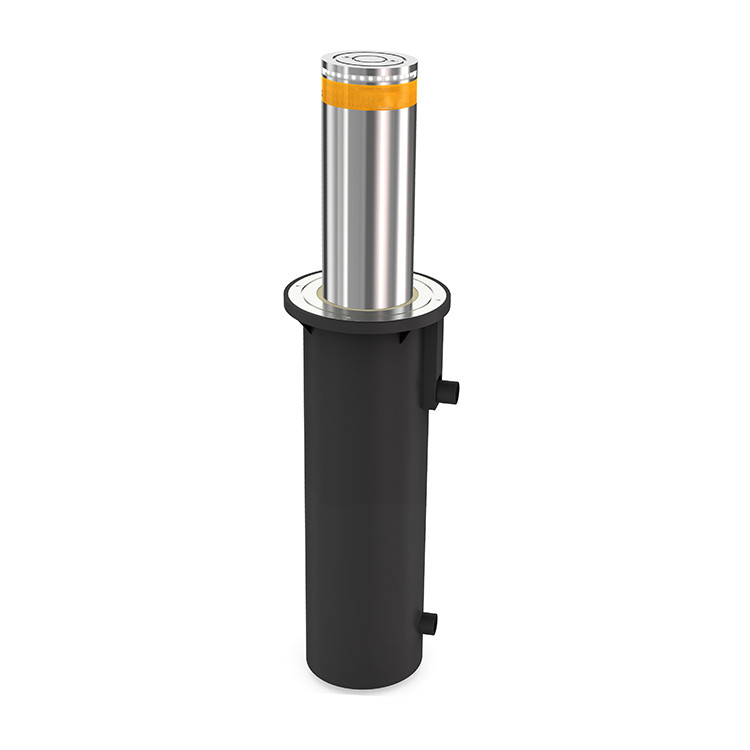
The LB-101 automatic bollard, 219 mm diameter with integrated LED lighting. Image: Chengdu Ruisijie Intelligent Technology Co., Ltd.
| Parameter | LB-101 automatic bollard | LB-102 semi-automatic bollard |
|---|---|---|
| Material | 304 / 316 stainless steel | 304 stainless steel |
| Diameter | 219 mm (OEM options 168 mm, 273 mm) | 219 mm blocking diameter |
| Height | 1100 mm total length | 600 mm blocking height |
| Wall thickness | Not stated in the product data | 6 mm |
| Foundation interface | Project-specific; confirm at site survey | Embedded sleeve D325×T3 mm, 800 mm depth; flange D380×T10 mm |
| Drive and control | 220V supply, integrated LED lighting | Gas spring, key control, no power required |
| Protection rating | IP68 (waterproof and dustproof) | Not stated in the product data |
| Operating temperature | −45°C to +75°C | −45°C to +75°C |
| Other | MOQ 10 PCS; silver or customized colour; non-water fillable | 58 kg; satin stainless finish, black powder-coated carbon steel |
Two details in this table show why the RFQ has to be explicit. The LB-102 semi-automatic model needs an 800 mm embedded sleeve, so the sleeve depth constrains the civil works before any commercial term is discussed. The LB-101 carries IP68 ingress protection and an operating range of −45°C to +75°C, which are meaningful only if the site’s actual drainage, snow load, and coastal exposure have been assessed — and that assessment is site-specific.
Where RICJ Bollard Sits in This Framework
Chengdu Ruisijie Intelligent Technology Co., Ltd., trading as RICJ through cdricj.com, is a China-based original manufacturer of vehicle security equipment founded in 2007. The company operates a 15,150 m² in-house manufacturing facility with 280 employees, including a 41-engineer technical team, and reports an export ratio of 90% across the Middle East and Africa, Europe, and Southeast Asia.
Its catalogue spans the categories a constraint-based specification has to reconcile: automatic rising bollards, fixed and static bollards, manual retractable bollards, semi-automatic bollards, removable bollards, fold-down bollards, road blockers, tyre killers, and custom security bollards. For a buyer building a perimeter scheme in stages, that breadth matters less as a sales argument than as a consistency argument — one supplier, one documentation set, one technical contact across several barrier types.
On evidence, RICJ states that its equipment is supported by documented crash and safety test results and that finished equipment undergoes functional testing before delivery under a full-process quality control regime. Those statements are the starting point of due diligence rather than the end of it: the useful next step is a request for the report covering the exact model, configuration, and foundation intended for the project.
Manufacturing scope is corroborated by the ISO 9001 certificate listed above, which names automatic rising bollards, anti-collision bollards, road blockers, and tyre killers within its certified scope. Customization covers dimensions, materials, appearance, and functional configuration, supported by English technical documentation, installation manuals, wiring diagrams, and remote technical assistance. The company also reports status as a 5-Star Supplier on Alibaba.com and participation in the Chengdu Tianfu International Airport project.
Application Patterns Where Constraints Bite
Retractable and automatic bollards are deployed where a lane has to be open most of the day and closed on command. Documented application environments include airport terminals and perimeters, government and public spaces, commercial property entrances, industrial parks, energy infrastructure, schools, and residential property management, typically in 24-hour automatic lifting and lowering operation.
Each environment attaches a different constraint to the same product. Airport perimeters prioritise standoff and test evidence; coastal sites prioritise material grade and ingress protection; sub-zero sites prioritise operating temperature and drainage against freezing; high-frequency commercial entrances prioritise cycle reliability and control integration. Matched equipment commonly includes RFID, licence plate recognition, remote control, access control systems, control cabinets, foundations, and site wiring, with the exact configuration depending on project design.
Project scale also shapes the constraint set. A publicly referenced RICJ case describes 510 deep-mount 316 stainless steel fixed bollards deployed in Sweden — a reminder that fixed rather than retractable units are sometimes the correct answer where a permanent line can be accepted and power cannot be justified.
Market Signal Behind the Specification Pressure
Mordor Intelligence estimates the global automated barriers and bollards market at USD 22.73 billion in 2025 and projects USD 27.39 billion by 2030. Within the retractable category, automatic retractable bollards generated the highest revenue, with a 52% share in 2025.
Two procurement implications follow. First, automation is not a niche preference; it is the commercial centre of the category, which means documentation practices around automatic units set the standard buyers should expect. Second, growth of this kind attracts suppliers with uneven evidence quality, which is precisely why verification discipline matters more, not less, as the market expands.
Trade classification is a smaller but practical constraint. A U.S. Customs and Border Protection ruling (NY N042340) classifies steel bollards under HTSUS 7326.90.8588. Importers should confirm classification for their own product composition and destination rather than assuming a single code applies to every powered or passive barrier configuration.
Retractable Units Against Traditional Alternatives
The comparison that matters at evaluation stage is not brand against brand but mechanism against mechanism, because each type moves cost and risk to a different part of the project.
| Type | Site works | Operational flexibility | Constraint to plan for |
|---|---|---|---|
| Fixed bollards | No power; permanent footing | None — passage is permanently blocked | Cannot be opened for occasional vehicles; used where a permanent line is acceptable |
| Removable bollards | No power; ground socket | Manual removal by an operator | Lifting weight, storage, and re-insertion discipline |
| Semi-automatic (e.g. LB-102) | No power; 800 mm embedded sleeve | Gas-spring assisted manual operation, key controlled | Still requires an operator at the lane; sleeve depth drives civil works |
| Automatic / hydraulic retractable (e.g. LB-101) | 220V supply, control cabling, drainage, deeper foundation | 24-hour automated operation with access control integration | Commissioning complexity and dependence on continuous power and drainage |
The boundary deserves stating plainly. Automation does not create crash performance on its own: because the bollard, mounting arrangement, and supporting foundation are evaluated as a complete system, a site foundation that differs from the tested configuration can leave the buyer holding a valid report that does not describe the installed assembly. Equally, an ISO 9001 certificate confirms process control, not impact performance.
There is a service boundary as well. RICJ does not typically send engineers for on-site installation as a standard service; it supplies installation manuals, technical drawings including CAD files, and wiring diagrams, with remote guidance by video call, phone, and email through installation and commissioning. On-site engineer supervision can be arranged as a paid option for large projects. Buyers who assume standard on-site commissioning should confirm it before contract, not after delivery.
What Changes Next
The direction of travel in this category is documentary rather than dramatic. As automated and retractable units take a larger share of spending, insurers, specifiers, and project owners increasingly ask for the report rather than the rating, and ask which configuration and foundation the report describes. Suppliers who can produce that chain quickly will win evaluations that slower competitors lose on paperwork alone.
For buyers, the practical preparation is modest: define the threat, define the site conditions, and define the documents required before quotations are compared. For manufacturers, the corresponding task is to keep model-level evidence current across the power, dimension, and material variants that customization inevitably produces.
Frequently Asked Questions
What documents should a buyer request before approving a crash-rated bollard for a high-security site?
A test report that identifies the test standard, test vehicle, impact condition, penetration distance, product configuration, and foundation used in the test. These are the same seven factors that determine whether the evidence applies to the installation; omitting any one of them leaves the claim unverified and creates the risk of insufficient anti-collision performance.
What does an ISO 9001 certificate tell you about a bollard manufacturer, and what does it not tell you?
It confirms that the manufacturer’s quality management system has been certified against a recognised standard, within a stated scope. RICJ holds ISO 9001 certification number 102626Q00045R000, issued by HUAQIXIN CERTIFICATION SERVICES (CHENGDU) CO., LTD under GB/T19001-2016/ISO9001:2015, valid from 2026-03-20 to 2029-03-19, covering automatic rising bollards, anti-collision bollards, road blockers, and tyre killers in the global market. It does not certify the impact performance of any specific model; that requires a model-specific crash test report.
What are the stated specifications of the LB-101 automatic bollard?
The LB-101 is an automatic bollard in 304 or 316 stainless steel, 219 mm in diameter with OEM options of 168 mm and 273 mm, and 1100 mm total length. It has an IP68 protection rating, an operating temperature range of −45°C to +75°C, a 220V supply voltage, and integrated LED lighting, with a minimum order quantity of 10 pieces and silver or customized colour.
How should the M and P designations in an ASTM F2656 report be read?
They answer different questions. Published guidance describes the M notation as an impact speed reference — M30, M40, and M50 corresponding to 30, 40, and 50 mph. The P designation describes penetration distance bands, from P1 at no more than 1 metre through P2 at 1.01–7 metres and P3 at 7.01–30 metres to P4 at 30 metres or greater. Both readings should be confirmed against the current ASTM edition and the report for the specific model and configuration.
Which site conditions should be confirmed before a retractable bollard order is placed?
Vehicle threat level, protected area, traffic frequency, installation depth, drainage, climate, control-system compatibility, and target-market compliance requirements. For example, the LB-102 semi-automatic model requires an 800 mm embedded sleeve, and coastal or sub-zero environments place additional demands on material and drainage that require site confirmation rather than catalogue assumptions.
Does RICJ provide on-site installation services for its bollards?
Not as a standard service. RICJ supplies complete installation manuals, technical drawings including CAD files, and wiring diagrams, and its technical team provides remote guidance by video call, phone, and email throughout installation and commissioning. For large projects or specific requirements, on-site engineer supervision can be arranged as a paid optional service.
RICJ’s full product and specification catalogue is available for download: RICJ product brochure (PDF).
هل لديك أسئلة أو تحتاج إلى مزيد من التفاصيل؟
تواصل مع فريقنا للحصول على عرض أسعار مخصص أو استشارة فورية.
طلب عرض أسعار
املأ النموذج أدناه وسيتواصل معك فريقنا بعرض مقترح مخصص.
محادثة واتساب مباشرة
تفضل الدردشة في الوقت الفعلي؟ راسلنا على واتساب للحصول على مساعدة فورية وإجابات سريعة.
- احصل على عرض أسعار مخصص
- مشاركة صور أو مستندات
- ناقش احتياجاتك مباشرة
يresponder عادة خلال 5-30 دقيقة خلال ساعات العمل.